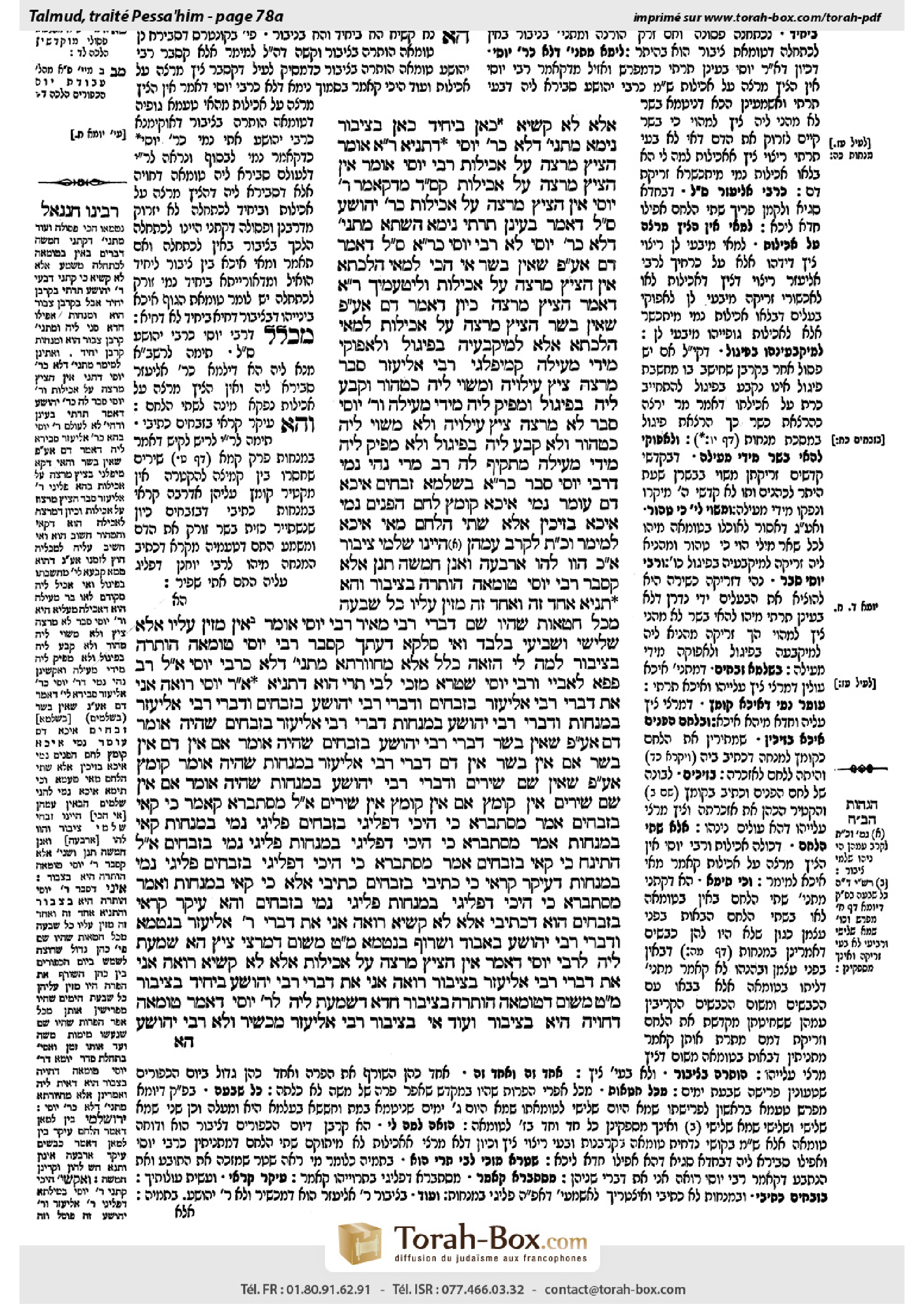
Pesachim 78a: Talmud study for Daf Yomi
Daf Yomi is the daily study of one Talmud folio. Explore 37 tractates with scans, Hebrew text, Sefaria English and AI-generated French translations where annotated.
Passage selection and English or AI-generated French translation are available where the scan has annotations. Daf Study is independent of Torah-Box and Sefaria.
Browse Pesachim · פסחים · All tractatesPesachim 78a text and translations
This page of Pesachim includes the Aramaic text, an English translation and an AI-generated French translation, alongside the scan above.
פסחים ע״ח א · Aramaic and Hebrew text
אֶלָּא, לָא קַשְׁיָא: כָּאן — בְּיָחִיד, כָּאן — בְּצִיבּוּר.
נֵימָא מַתְנִיתִין דְּלָא כְּרַבִּי יוֹסֵי. דְּתַנְיָא, רַבִּי אֱלִיעֶזֶר אוֹמֵר: הַצִּיץ מְרַצֶּה עַל אֲכִילוֹת. רַבִּי יוֹסֵי אוֹמֵר: אֵין הַצִּיץ מְרַצֶּה עַל אֲכִילוֹת.
קָא סָלְקָא דַּעְתָּךְ מִדְּקָאָמַר רַבִּי יוֹסֵי: אֵין הַצִּיץ מְרַצֶּה עַל אֲכִילוֹת — כְּרַבִּי יְהוֹשֻׁעַ סְבִירָא לֵיהּ, דְּאָמַר בָּעֵינַן תַּרְתֵּי. נֵימָא הַשְׁתָּא מַתְנִיתִין דְּלָא כְּרַבִּי יוֹסֵי?
לָא, רַבִּי יוֹסֵי כְּרַבִּי אֱלִיעֶזֶר סְבִירָא לֵיהּ, דְּאָמַר: דָּם — אַף עַל פִּי שֶׁאֵין בָּשָׂר.
אִי הָכִי, לְמַאי הִלְכְתָא אֵין הַצִּיץ מְרַצֶּה עַל אֲכִילוֹת? וְלִיטַעְמָיךְ, רַבִּי אֱלִיעֶזֶר דְּאָמַר: הַצִּיץ מְרַצֶּה, כֵּיוָן דְּאָמַר: דָּם — אַף עַל פִּי שֶׁאֵין בָּשָׂר, הַצִּיץ מְרַצֶּה עַל אֲכִילוֹת לְמַאי הִלְכְתָא?
אֶלָּא, לְמִיקְבְּעֵיהּ בְּפִיגּוּל וּלְאַפּוֹקֵי מִידֵי מְעִילָה קָמִיפַּלְגִי. רַבִּי אֱלִיעֶזֶר סָבַר: מְרַצֵּה צִיץ עִילָּוֵיהּ וּמְשַׁוֵּי לֵיהּ כְּטָהוֹר, וְקָבַע לֵיהּ בְּפִיגּוּל, וּמַפֵּיק לֵיהּ מִידֵּי מְעִילָה.
וְרַבִּי יוֹסֵי סָבַר: לָא מְרַצֵּה צִיץ עִילָּוֵיהּ, וְלָא מְשַׁוֵּי לֵיהּ כְּטָהוֹר, וְלָא קָבַע לֵיהּ בְּפִיגּוּל, וְלָא מַפֵּיק לֵיהּ מִידֵּי מְעִילָה.
מַתְקֵיף לַהּ רַב מָרִי: נְהִי נָמֵי דְּרַבִּי יוֹסֵי סָבַר כְּרַבִּי אֱלִיעֶזֶר, בִּשְׁלָמָא זְבָחִים — אִיכָּא דָּם, עוֹמֶר נָמֵי — אִיכָּא קוֹמֶץ, לֶחֶם הַפָּנִים נָמֵי — אִיכָּא בָּזִיכִין.
אֶלָּא שְׁתֵּי הַלֶּחֶם, מַאי אִיכָּא לְמֵימַר?
וְכִי תֵּימָא לִקְרַב עִמָּהֶן — הַיְינוּ שַׁלְמֵי צִיבּוּר. אִם כֵּן, הָווּ לְהוּ אַרְבָּעָה, וַאֲנַן — חֲמִשָּׁה תְּנַן!
אֶלָּא, קָסָבַר רַבִּי יוֹסֵי: טוּמְאָה הוּתְּרָה בְּצִיבּוּר.
וְהָא תַּנְיָא: אֶחָד זֶה וְאֶחָד זֶה — מַזִּין עָלָיו כׇּל שִׁבְעָה מִכׇּל חַטָּאוֹת שֶׁהָיוּ שָׁם, דִּבְרֵי רַבִּי מֵאִיר. רַבִּי יוֹסֵי אוֹמֵר: אֵין מַזִּין עָלָיו אֶלָּא שְׁלִישִׁי וּשְׁבִיעִי בִּלְבַד.
וְאִי סָלְקָא דַעְתָּךְ קָסָבַר רַבִּי יוֹסֵי טוּמְאָה הוּתְּרָה בְּצִיבּוּר, לְמָה לִי הַזָּאָה כְּלָל? אֶלָּא מְחַוַּורְתָּא מַתְנִיתִין דְּלָא כְּרַבִּי יוֹסֵי.
אֲמַר לֵיהּ רַב פָּפָּא לְאַבָּיֵי: וְרַבִּי יוֹסֵי שְׁטָרָא מְזַכֵּי לְבֵי תְרֵי הוּא?! דְּתַנְיָא, אָמַר רַבִּי יוֹסֵי: רוֹאֶה אֲנִי אֶת דִּבְרֵי רַבִּי אֱלִיעֶזֶר בִּזְבָחִים, וְדִבְרֵי רַבִּי יְהוֹשֻׁעַ בִּזְבָחִים, וְדִבְרֵי רַבִּי אֱלִיעֶזֶר בִּמְנָחוֹת, וְדִבְרֵי רַבִּי יְהוֹשֻׁעַ בִּמְנָחוֹת.
דִּבְרֵי רַבִּי אֱלִיעֶזֶר בִּזְבָחִים, שֶׁהָיָה אוֹמֵר: דָּם אַף עַל פִּי שֶׁאֵין בָּשָׂר. דִּבְרֵי רַבִּי יְהוֹשֻׁעַ בִּזְבָחִים, שֶׁהָיָה אוֹמֵר: אִם אֵין דָּם אֵין בָּשָׂר, אִם אֵין בָּשָׂר אֵין דָּם. דִּבְרֵי רַבִּי אֱלִיעֶזֶר בִּמְנָחוֹת, שֶׁהָיָה אוֹמֵר: קוֹמֶץ — אַף עַל פִּי שֶׁאֵין שָׁם שִׁירַיִם. וְדִבְרֵי רַבִּי יְהוֹשֻׁעַ בִּמְנָחוֹת, שֶׁהָיָה אוֹמֵר: אִם אֵין שָׁם שִׁירַיִם אֵין קוֹמֶץ, אִם אֵין קוֹמֶץ אֵין שִׁירַיִם!
אֲמַר לֵיהּ: מִסְתַּבְּרָא קָאָמַר. כִּי קָאֵי בִּזְבָחִים, אָמַר: מִסְתַּבְּרָא כִּי הֵיכִי דִּפְלִיגִי בִּזְבָחִים — פְּלִיגִי נָמֵי בִּמְנָחוֹת. קָאֵי בִּמְנָחוֹת, אָמַר: מִסְתַּבְּרָא כִּי הֵיכִי דִּפְלִיגִי בִּמְנָחוֹת — פְּלִיגִי נָמֵי בִּזְבָחִים.
אֲמַר לֵיהּ, הָתִינַח: כִּי קָאֵי בִּזְבָחִים אָמַר, מִסְתַּבְּרָא כִּי הֵיכִי דִּפְלִיגִי בִּזְבָחִים פְּלִיגִי נָמֵי בִּמְנָחוֹת, דְּעִיקָּר קְרָאֵי כִּי כְּתִיבִי — בִּזְבָחִים כְּתִיבִי. אֶלָּא, כִּי קָאֵי בִּמְנָחוֹת וְאָמַר, מִסְתַּבְּרָא כִּי הֵיכִי דִּפְלִיגִי בִּמְנָחוֹת פְּלִיגִי נָמֵי בִּזְבָחִים — וְהָא עִיקָּר קְרָאֵי בִּזְבָחִים הוּא דִּכְתִיבִי!
אֶלָּא, לָא קַשְׁיָא: רוֹאֶה אֲנִי אֶת דִּבְרֵי רַבִּי אֱלִיעֶזֶר בְּנִטְמָא, וְדִבְרֵי רַבִּי יְהוֹשֻׁעַ בְּאָבוּד וְשָׂרוּף.
בְּנִטְמָא מַאי טַעְמָא — מִשּׁוּם דִּמְרַצֵּי צִיץ. הָא שָׁמְעַתְּ לֵיהּ לְרַבִּי יוֹסֵי דְּאָמַר: אֵין הַצִּיץ מְרַצֶּה עַל אֲכִילוֹת!
אֶלָּא, לָא קַשְׁיָא: רוֹאֶה אֲנִי אֶת דִּבְרֵי רַבִּי אֱלִיעֶזֶר בְּצִיבּוּר, רוֹאֶה אֲנִי אֶת דִּבְרֵי רַבִּי יְהוֹשֻׁעַ בְּיָחִיד.
בְּצִיבּוּר מַאי טַעְמָא — מִשּׁוּם דְּטוּמְאָה הוּתְּרָה בְּצִיבּוּר? חֲדָא: דְּשָׁמְעַתְּ לֵיהּ לְרַבִּי יוֹסֵי דְּאָמַר טוּמְאָה דְּחוּיָה הִיא בְּצִיבּוּר, וְעוֹד: אִי בְּצִיבּוּר, רַבִּי אֱלִיעֶזֶר מַכְשִׁיר וְלָא רַבִּי יְהוֹשֻׁעַ?
Pesachim 78a · English translation
Rather, it is not difficult: There, where Rabbi Yehoshua said that it is invalid ab initio, he was referring to the offering of an individual. Here, in the mishna, which states that it may be sacrificed even ab initio, it is referring to an offering involving the public.
The Gemara asks: Shall we say that the mishna is not in accordance with the opinion of Rabbi Yosei? As it was taught in a baraita: Rabbi Eliezer says that the frontplate appeases God for the impurity of portions of offerings that are supposed to be eaten. Rabbi Yosei says that the frontplate does not appease God for the impurity of portions of offerings that are supposed to be eaten; it appeases God only for the impurity of the parts of offerings that are burned on the altar.
The Gemara explains the question: It could enter your mind to say: From the fact that Rabbi Yosei said that the frontplate does not appease God for the impurity of portions of offerings that are supposed to be eaten, it can be inferred that he holds in accordance with the opinion of Rabbi Yehoshua, who said that we require the two parts of the offering, the blood and the meat, to be valid. If this were not the case, it would be sufficient for the frontplate to appease God for the impurity of the blood, and it would not be necessary for the frontplate to appease God for the impurity of the portions of offerings that are supposed to be eaten. Let us now say that the mishna is not in accordance with the opinion of Rabbi Yosei.
The Gemara rejects this assertion: No, Rabbi Yosei holds in accordance with the opinion of Rabbi Eliezer, who said that the blood of an offering is accepted although there is no meat.
The Gemara asks: If so, with regard to what halakha did Rabbi Yosei say that the frontplate does not appease God for the impurity of the portions of offerings that are supposed to be eaten? Even if it does not appease God for the impurity of these portions, the offering remains valid. The Gemara rejects the question: And according to your reasoning, with regard to Rabbi Eliezer himself, who said that the frontplate appeases God for the impurity of the portions that are supposed to be eaten, since he said that the blood may be sprinkled although there is no meat, with regard to what halakha did he make his other statement that the frontplate appeases God for the impurity of the portions of offerings that are supposed to be eaten? Clearly, whether the frontplate appeases God is significant for reasons other than ensuring that an offering is accepted.
Rather, the fact that they disagree about whether the frontplate appeases God for the impurity of the portions of offerings that are supposed to be eaten determines whether it is possible to establish the offering as one disqualified due to improper intent [piggul] and whether it is possible to exclude the offering from the prohibition of misuse of consecrated property. The dispute is to be understood in this light: Rabbi Eliezer holds that the frontplate appeases God for the impurity of the meat that is supposed to be eaten, and it renders it like pure meat that is not disqualified. Therefore, although the meat may not be eaten, it may be established as piggul. Similarly, because it is treated as though it were pure, the sprinkling of the blood of the offering excludes the meat from the prohibition of misuse of consecrated property.
And Rabbi Yosei holds that the frontplate does not appease God for the impurity of sacrificial meat that has become impure, and it does not render it like pure meat. Therefore, sprinkling the blood of the offering does not establish it as piggul and does not exclude it from the prohibition of misusing consecrated property.
Rav Mari strongly objects to this conclusion: Even granting that Rabbi Yosei holds in accordance with the opinion of Rabbi Eliezer that an offering is accepted through the blood alone, even if the meat has become ritually impure, there is still a difficulty. Granted, in the case of animal offerings, which have two permitting factors, the blood and the meat, there is at least one of them, the blood, for which the frontplate appeases God and causes the offering to be accepted. With regard to the omer, too, there is the handful, for which the frontplate appeases God and is thereby validated. With regard to the shewbread, too, there are the bowls of frankincense, which permit the bread in the same manner that the handful permits a meal-offering.
But with regard to the two loaves, what is there to say? They are completely eaten, and nothing is brought on the altar. How can they be brought in a state of ritual impurity, as the mishna has stated, according to the opinion of Rabbi Yosei?
And if you say that the two loaves are valid because the frontplate appeases God for the impurity of the two lambs that are sacrificed with them, this is the same as the communal peace-offerings that are mentioned separately in the mishna. If so, there are only four offerings listed in the mishna. But we learned in the mishna that there are five, because the two loaves and the communal peace-offerings are listed separately.
Rather, the previous suggestion is rejected. Instead, it is suggested that Rabbi Yosei holds that ritual impurity is permitted in cases involving the public, even without the frontplate. Therefore, the two loaves remain valid.
The Gemara asks: But wasn’t the following baraita taught concerning the purity of both the High Priest on Yom Kippur and the priest who burns the red heifer, each of whom is separated from his house for seven days to ensure his purity? The baraita states: In the case of both this priest and that priest, one sprinkles on him all seven days of his separation from all the purification offerings, i.e., the ashes of the red heifers, that are there in the Temple. If he had become impure through contact with a corpse, he will be purified through the sprinkling of the purification offering. This is the statement of Rabbi Meir. Rabbi Yosei says: One does not sprinkle upon him on any day except for the third and seventh days of his separation. This ensures his purification.
And if it enters your mind that Rabbi Yosei holds that ritual impurity is permitted in cases involving the public, why do I need sprinkling at all? The offerings of Yom Kippur are communal offerings and may be sacrificed even in a state of ritual impurity. Rather, it is clear that the mishna is not in accordance with the opinion of Rabbi Yosei.
With regard to Rabbi Yosei’s statement quoted earlier, Rav Pappa said to Abaye: Rabbi Yosei is like a document that awards something to two conflicting parties, as it was taught in a baraita that Rabbi Yosei said: I see as correct the statement of Rabbi Eliezer with regard to animal offerings, and the statement of Rabbi Yehoshua with regard to animal offerings, and the statement of Rabbi Eliezer with regard to meal-offerings, and the statement of Rabbi Yehoshua with regard to meal-offerings.
The statement of Rabbi Eliezer is correct with regard to animal offerings, as he would say that the blood brings atonement although there is no meat. The statement of Rabbi Yehoshua is correct with regard to animal offerings, as he would say that if there is no blood there is no meat, and if there is no meat there is no blood. The statement of Rabbi Eliezer is correct with regard to meal-offerings, as he would say that the handful is fit although there is no remainder. The statement of Rabbi Yehoshua is correct with regard to meal-offerings, as he would say that if there is no valid handful there is no remainder, and if there is no remainder there is no handful. Rabbi Yosei accepted several contradictory statements.
Abaye said to him: Rabbi Yosei did not intend to issue a halakhic ruling in favor of both opinions. Rather, he said what was reasonable. How so? When involved in studying the halakhot of animal offerings, he said: It is reasonable that just as they disagree with regard to animal offerings, they also disagree with regard to meal-offerings. When involved in studying the halakhot of meal-offerings, he said: It is reasonable that just as they disagree with regard to meal-offerings, they also disagree with regard to animal offerings.
Rav Pappa said to him: It works out well to say that when he was involved in animal offerings, he said: It is reasonable that just as they disagree with regard to animal offerings, they also disagree with regard to meal-offerings, as the essential verses written about this topic are written with regard to animal offerings. But it does not seem realistic to say that when he was involved in meal-offerings, he said: It is reasonable that just as they disagree with regard to meal-offerings, they disagree with regard to animal offerings. Aren’t the essential verses about this topic written with regard to animal offerings? Clearly, meal-offerings would not serve as a model for animal-offerings.
Rather, this answer has been refuted, and Rabbi Yosei’s statement is not difficult for a different reason. When he said: I see as correct the statement of Rabbi Eliezer, he was referring to cases in which part of the offering became impure. When he said that he agreed with the opinion of Rabbi Yehoshua, he was referring to cases in which part of the offering was lost or burned. In other words, Rabbi Yosei partially accepts the opinions of both Rabbi Eliezer and Rabbi Yehoshua.
The Gemara asks: In a case in which the offering became impure, what is the reason that Rabbi Yosei accepts the opinion of Rabbi Eliezer? It is because the frontplate appeases God for the impurity. But this is impossible, as you have heard that Rabbi Yosei said that the frontplate does not appease God for the impurity of the portions of offerings that are supposed to be eaten.
Rather, this answer should be rejected, and Rabbi Yosei’s opinion is not difficult for the following reason. When he said: I see as correct the opinion of Rabbi Eliezer, he was referring to a case in which an offering involves the public. When he said: I see as correct the opinion of Rabbi Yehoshua, he was referring to the offering of an individual.
The Gemara asks: With regard to an offering involving the public, what is the reason that Rabbi Yosei accepts the opinion of Rabbi Eliezer? It is because ritual impurity is permitted in cases involving the public. This explanation can be rejected for two reasons. One reason is that you have heard that Rabbi Yosei said that ritual impurity is merely overridden in cases involving the public; it is not wholly permitted. And furthermore, if Rabbi Yosei was referring to the offering of the public, is it only Rabbi Eliezer who validates the offering, and not Rabbi Yehoshua?
Pesachim 78a · Traduction française (IA)
Il n’y a donc pas de difficulté : là, lorsque Rabbi Yehoshoua a dit que l’offrande est invalide a priori, il parlait d’une offrande individuelle. Ici, dans la Michna, qui affirme qu’elle peut être offerte même a priori, il s’agit d’une offrande collective.
La Guemara demande : Faut-il en conclure que la Michna ne suit pas l’opinion de Rabbi Yossi ? En effet, il a été enseigné dans une baraïta : Rabbi Éliézer dit que le fronton expie devant Dieu l’impureté des parts des offrandes destinées à être consommées. Rabbi Yossi dit que le fronton n’expie pas devant Dieu l’impureté des parts des offrandes destinées à être consommées ; il n’expie que l’impureté des parties des offrandes brûlées sur l’autel.
La Guemara explique la question : On pourrait penser que, puisque Rabbi Yossi a dit que le fronton n’expie pas devant Dieu l’impureté des parts des offrandes destinées à être consommées, on peut en déduire qu’il est d’accord avec Rabbi Yehoshoua, qui a dit que les deux éléments de l’offrande, le sang et la viande, doivent être valides. S’il n’en était pas ainsi, il suffirait que le fronton expie devant Dieu l’impureté du sang, et il ne serait pas nécessaire qu’il expie l’impureté des parts des offrandes destinées à être consommées. Disons donc que la Michna ne suit pas l’opinion de Rabbi Yossi.
La Guemara rejette cette affirmation : Non, Rabbi Yossi est d’accord avec Rabbi Éliézer, qui a dit que le sang d’une offrande est agréé même en l’absence de viande.
La Guemara demande : Si tel est le cas, quelle halakha Rabbi Yossi entend-il établir en disant que le fronton n’expie pas devant Dieu l’impureté des parts des offrandes destinées à être consommées ? Même s’il n’expie pas l’impureté de ces parts, l’offrande reste valide. La Guemara rejette la question : Et selon ton raisonnement, concernant Rabbi Éliézer lui-même, qui a dit que le fronton expie devant Dieu l’impureté des parts destinées à être consommées, puisqu’il a dit que le sang peut être aspergé même en l’absence de viande, quelle halakha entendait-il établir par son autre déclaration, selon laquelle le fronton expie devant Dieu l’impureté des parts des offrandes destinées à être consommées ? Il est clair que la question de savoir si le fronton expie devant Dieu a une portée pour des raisons autres que l’agrément de l’offrande.
En réalité, leur désaccord sur le fait que le fronton expie ou non devant Dieu l’impureté des parts des offrandes destinées à être consommées détermine s’il est possible de considérer l’offrande comme disqualifiée par une intention impropre [piggul] et s’il est possible de l’exclure de l’interdiction de tirer profit des biens consacrés. Il faut comprendre leur désaccord ainsi : Rabbi Éliézer estime que le fronton expie devant Dieu l’impureté de la viande destinée à être consommée et la rend semblable à de la viande pure, qui n’est pas disqualifiée. Par conséquent, bien que la viande ne puisse pas être consommée, l’offrande peut être considérée comme piggul. De même, puisqu’elle est traitée comme si elle était pure, l’aspersion du sang de l’offrande exclut la viande de l’interdiction de tirer profit des biens consacrés.
Rabbi Yossi estime, quant à lui, que le fronton n’expie pas devant Dieu l’impureté de la viande sacrificielle devenue impure et ne la rend pas semblable à de la viande pure. Par conséquent, l’aspersion du sang de l’offrande ne la rend pas piggul et ne l’exclut pas de l’interdiction de tirer profit des biens consacrés.
Rav Mari s’oppose vivement à cette conclusion : Même si l’on admet que Rabbi Yossi est d’accord avec Rabbi Éliézer, selon lequel une offrande est agréée par le sang seul, même si la viande est devenue rituellement impure, une difficulté subsiste. Certes, dans le cas des offrandes animales, qui comportent deux facteurs d’agrément, le sang et la viande, il y en a au moins un, le sang, pour lequel le fronton expie devant Dieu et qui permet ainsi à l’offrande d’être agréée. Pour l’omer aussi, il y a la poignée, pour laquelle le fronton expie devant Dieu et qui est ainsi validée. De même, pour le pain de proposition, il y a les coupes d’encens, qui rendent le pain permis, tout comme la poignée rend permise une offrande végétale.
Mais que dire des deux pains ? Ils sont entièrement consommés et rien n’est apporté sur l’autel. Comment peuvent-ils être apportés en état d’impureté rituelle, comme l’affirme la Michna, selon l’opinion de Rabbi Yossi ?
Et si tu dis que les deux pains sont valides parce que le fronton expie devant Dieu l’impureté des deux agneaux sacrifiés avec eux, cela revient au même que les offrandes de paix collectives, mentionnées séparément dans la Michna. Il n’y aurait alors que quatre offrandes énumérées dans la Michna. Or, nous avons appris dans la Michna qu’il y en a cinq, puisque les deux pains et les offrandes de paix collectives y sont énumérés séparément.
Il faut donc rejeter la suggestion précédente. On propose plutôt que Rabbi Yossi estime que l’impureté rituelle est permise dans les cas concernant la collectivité, même sans le fronton. Les deux pains restent donc valides.
La Guemara demande : Mais n’a-t-on pas enseigné la baraïta suivante au sujet de la purification du grand prêtre pour Yom Kippour et du prêtre qui brûle la vache rousse, chacun étant séparé de sa maison pendant sept jours afin d’assurer sa pureté ? La baraïta énonce : Pour ce prêtre comme pour celui-là, on l’asperge, pendant les sept jours de sa séparation, avec toutes les eaux de purification qui se trouvent au Temple, c’est-à-dire les cendres des vaches rousses. S’il était devenu impur par contact avec un cadavre, il sera purifié par l’aspersion de l’offrande de purification. Telle est l’opinion de Rabbi Méïr. Rabbi Yossi dit : On ne l’asperge aucun jour, sauf les troisième et septième jours de sa séparation. Cela assure sa purification.
Et si l’on pouvait penser que Rabbi Yossi estime que l’impureté rituelle est permise dans les cas concernant la collectivité, pourquoi faudrait-il procéder à une aspersion ? Les offrandes de Yom Kippour sont des offrandes collectives et peuvent être sacrifiées même en état d’impureté rituelle. Il est donc clair que la Michna ne suit pas l’opinion de Rabbi Yossi.
À propos de la déclaration de Rabbi Yossi citée précédemment, Rav Pappa dit à Abayé : Rabbi Yossi est comme un acte qui attribuerait un bien à deux parties adverses. En effet, il a été enseigné dans une baraïta que Rabbi Yossi a dit : Je trouve juste l’opinion de Rabbi Éliézer concernant les offrandes animales, l’opinion de Rabbi Yehoshoua concernant les offrandes animales, l’opinion de Rabbi Éliézer concernant les offrandes végétales et l’opinion de Rabbi Yehoshoua concernant les offrandes végétales.
L’opinion de Rabbi Éliézer est juste concernant les offrandes animales, car il disait que le sang expie même en l’absence de viande. L’opinion de Rabbi Yehoshoua est juste concernant les offrandes animales, car il disait que s’il n’y a pas de sang, il n’y a pas de viande, et que s’il n’y a pas de viande, il n’y a pas de sang. L’opinion de Rabbi Éliézer est juste concernant les offrandes végétales, car il disait que la poignée est valide même en l’absence du reste. L’opinion de Rabbi Yehoshoua est juste concernant les offrandes végétales, car il disait que s’il n’y a pas de poignée valide, il n’y a pas de reste, et que s’il n’y a pas de reste, il n’y a pas de poignée. Rabbi Yossi a ainsi retenu plusieurs opinions contradictoires.
Abayé lui dit : Rabbi Yossi n’entendait pas statuer en faveur des deux opinions. Il a plutôt énoncé ce qui lui semblait raisonnable. Comment cela ? Lorsqu’il étudiait les halakhot des offrandes animales, il disait : Il est raisonnable que, de même qu’ils sont en désaccord au sujet des offrandes animales, ils le soient aussi au sujet des offrandes végétales. Lorsqu’il étudiait les halakhot des offrandes végétales, il disait : Il est raisonnable que, de même qu’ils sont en désaccord au sujet des offrandes végétales, ils le soient aussi au sujet des offrandes animales.
Rav Pappa lui dit : Il est logique de dire que, lorsqu’il étudiait les offrandes animales, il disait : Il est raisonnable que, de même qu’ils sont en désaccord au sujet des offrandes animales, ils le soient aussi au sujet des offrandes végétales, puisque les versets essentiels sur ce sujet concernent les offrandes animales. Mais il ne semble pas plausible de dire que, lorsqu’il étudiait les offrandes végétales, il disait : Il est raisonnable que, de même qu’ils sont en désaccord au sujet des offrandes végétales, ils le soient aussi au sujet des offrandes animales. Les versets essentiels sur ce sujet ne concernent-ils pas les offrandes animales ? Il est clair que les offrandes végétales ne sauraient servir de modèle aux offrandes animales.
Cette réponse est donc réfutée, et la déclaration de Rabbi Yossi ne présente pas de difficulté pour une autre raison. Lorsqu’il a dit : « Je trouve juste l’opinion de Rabbi Éliézer », il parlait des cas où une partie de l’offrande était devenue impure. Lorsqu’il a dit qu’il était d’accord avec l’opinion de Rabbi Yehoshoua, il parlait des cas où une partie de l’offrande avait été perdue ou brûlée. Autrement dit, Rabbi Yossi accepte en partie les opinions de Rabbi Éliézer et de Rabbi Yehoshoua.
La Guemara demande : Dans le cas où l’offrande est devenue impure, pourquoi Rabbi Yossi accepte-t-il l’opinion de Rabbi Éliézer ? C’est parce que le fronton expie devant Dieu l’impureté. Mais cela est impossible, puisque tu as entendu Rabbi Yossi dire que le fronton n’expie pas devant Dieu l’impureté des parts des offrandes destinées à être consommées.
Cette réponse doit donc être rejetée, et l’opinion de Rabbi Yossi ne présente pas de difficulté pour la raison suivante. Lorsqu’il a dit : « Je trouve juste l’opinion de Rabbi Éliézer », il parlait d’un cas où l’offrande concerne la collectivité. Lorsqu’il a dit : « Je trouve juste l’opinion de Rabbi Yehoshoua », il parlait d’une offrande individuelle.
La Guemara demande : Pour une offrande concernant la collectivité, pourquoi Rabbi Yossi accepte-t-il l’opinion de Rabbi Éliézer ? C’est parce que l’impureté rituelle est permise dans les cas concernant la collectivité. Cette explication peut être rejetée pour deux raisons. D’abord, tu as entendu Rabbi Yossi dire que l’impureté rituelle est simplement écartée dans les cas concernant la collectivité ; elle n’y est pas entièrement permise. De plus, si Rabbi Yossi parlait d’une offrande collective, seul Rabbi Éliézer validerait-il l’offrande, et non Rabbi Yehoshoua ?
Traduction française générée par IA à partir de l’édition anglaise de Sefaria. Vérifie toujours un passage avec le texte source.
Text from Sefaria: William Davidson Edition - Vocalized Aramaic (CC BY NC); William Davidson Edition - English (CC BY NC).