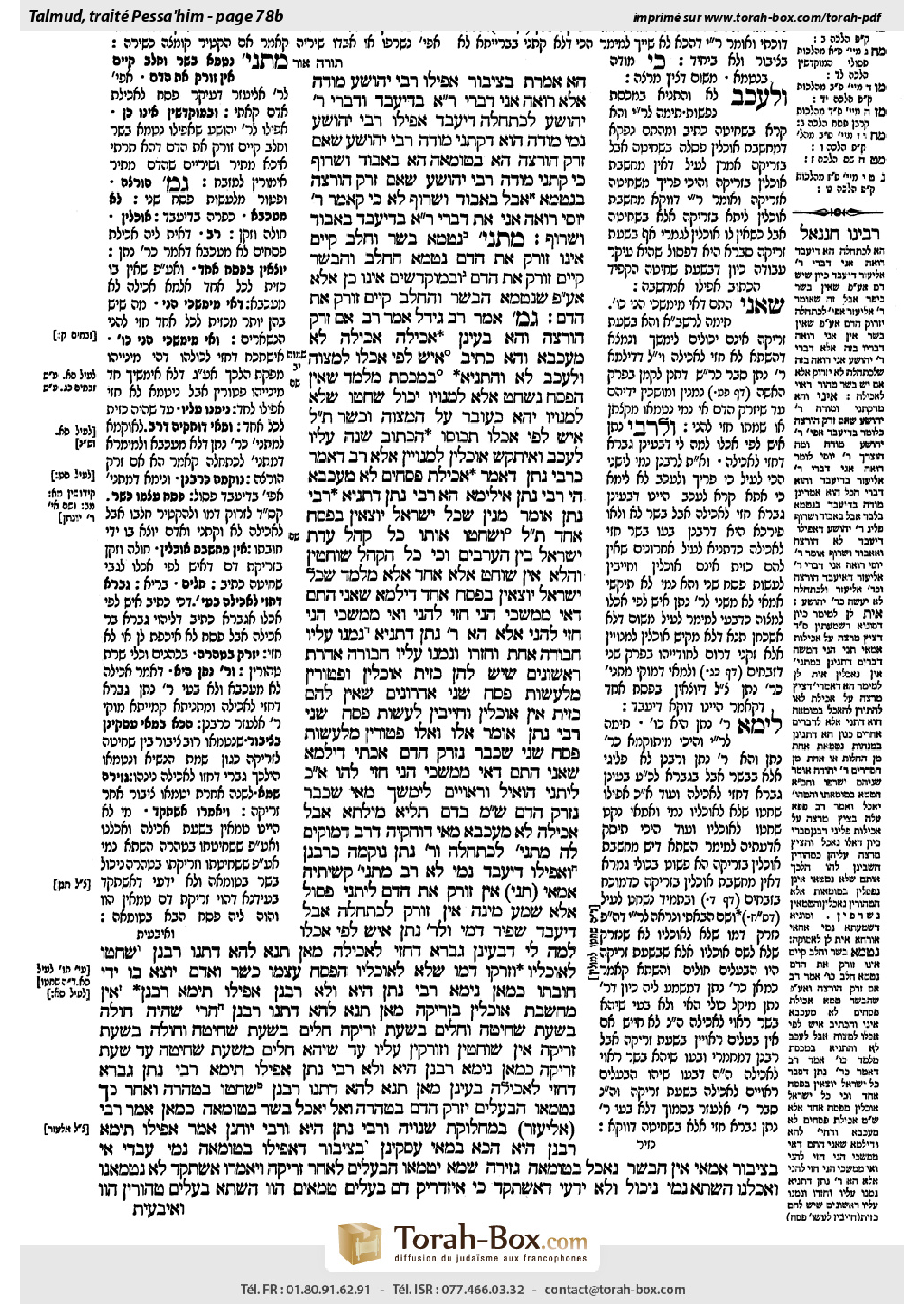
Pesachim 78b: Talmud study for Daf Yomi
Daf Yomi is the daily study of one Talmud folio. Explore 37 tractates with scans, Hebrew text, Sefaria English and AI-generated French translations where annotated.
Passage selection and English or AI-generated French translation are available where the scan has annotations. Daf Study is independent of Torah-Box and Sefaria.
Browse Pesachim · פסחים · All tractatesPesachim 78b text and translations
This page of Pesachim includes the Aramaic text, an English translation and an AI-generated French translation, alongside the scan above.
פסחים ע״ח ב · Aramaic and Hebrew text
הָא אָמְרַתְּ, בְּצִיבּוּר אֲפִילּוּ רַבִּי יְהוֹשֻׁעַ מוֹדֶה.
אֶלָּא: רוֹאֶה אֲנִי דִּבְרֵי רַבִּי אֱלִיעֶזֶר בְּדִיעֲבַד, וְדִבְרֵי רַבִּי יְהוֹשֻׁעַ לְכַתְּחִלָּה. דִּיעֲבַד — אֲפִילּוּ רַבִּי יְהוֹשֻׁעַ נָמֵי מוֹדֶה הוּא, דְּקָתָנֵי: מוֹדֶה רַבִּי יְהוֹשֻׁעַ שֶׁאִם זָרַק — הוּרְצָה!
הָא בְּטוּמְאָה, הָא בְּאָבוּד וְשָׂרוּף. כִּי קָתָנֵי: מוֹדֶה רַבִּי יְהוֹשֻׁעַ שֶׁאִם זָרַק הוּרְצָה — בְּנִטְמָא, אֲבָל בְּאָבוּד וְשָׂרוּף לָא. כִּי קָאָמַר רַבִּי יוֹסֵי: רוֹאֶה אֲנִי אֶת דִּבְרֵי רַבִּי אֱלִיעֶזֶר בְּדִיעֲבַד — בְּאָבוּד וְשָׂרוּף.
מַתְנִי׳ נִטְמָא בָּשָׂר וְחֵלֶב קַיָּים — אֵינוֹ זוֹרֵק אֶת הַדָּם. נִטְמָא הַחֵלֶב וְהַבָּשָׂר קַיָּים — זוֹרֵק אֶת הַדָּם. וּבַמּוּקְדָּשִׁים אֵינוֹ כֵּן, אֶלָּא אַף עַל פִּי שֶׁנִּטְמָא הַבָּשָׂר וְהַחֵלֶב קַיָּים — זוֹרֵק אֶת הַדָּם.
גְּמָ׳ אָמַר רַב גִּידֵּל אָמַר רַב: אִם זָרַק — הוּרְצָה. וְהָא בָּעֵינַן אֲכִילָה! אֲכִילָה לָא מְעַכְּבָא.
וְהָא כְּתִיב: ״אִישׁ לְפִי אׇכְלוֹ״?! לְמִצְוָה.
וּלְעַכֵּב לָא? וְהָתַנְיָא: ״בְּמִכְסַת״, מְלַמֵּד שֶׁאֵין הַפֶּסַח נִשְׁחָט אֶלָּא לִמְנוּיָו. יָכוֹל שְׁחָטוֹ שֶׁלֹּא לִמְנוּיָו יְהֵא כְּעוֹבֵר עַל הַמִּצְוָה וְכָשֵׁר — תַּלְמוּד לוֹמַר: ״אִישׁ לְפִי אׇכְלוֹ תָּכֹסּוּ״, הַכָּתוּב שָׁנָה עָלָיו לְעַכֵּב.
וְאִיתַּקַּשׁ אוֹכְלִין לִמְנוּיִין.
אֶלָּא רַב דְּאָמַר כְּרַבִּי נָתָן, דְּאָמַר: אֲכִילַת פְּסָחִים לָא מְעַכְּבָא.
הֵי רַבִּי נָתָן? אִילֵּימָא הָא רַבִּי נָתָן דְּתַנְיָא, רַבִּי נָתָן אוֹמֵר: מִנַּיִן שֶׁכׇּל יִשְׂרָאֵל יוֹצְאִין בְּפֶסַח אֶחָד — תַּלְמוּד לוֹמַר: ״וְשָׁחֲטוּ אֹתוֹ כֹּל קְהַל עֲדַת יִשְׂרָאֵל בֵּין הָעַרְבָּיִם״, וְכִי כָּל הַקָּהָל שׁוֹחֲטִין? וַהֲלֹא אֵין שׁוֹחֵט אֶלָּא אֶחָד! אֶלָּא מְלַמֵּד שֶׁכׇּל יִשְׂרָאֵל יוֹצְאִין בְּפֶסַח אֶחָד.
דִּילְמָא שָׁאנֵי הָתָם, דְּאִי מִמַּשְׁכִי הָנֵי חֲזֵי לְהָנֵי, וְאִי מִמַּשְׁכִי הָנֵי חֲזֵי לְהָנֵי!
אֶלָּא, הָא רַבִּי נָתָן דְּתַנְיָא: נִמְנוּ עָלָיו חֲבוּרָה אַחַת, וְחָזְרוּ וְנִמְנוּ עָלָיו חֲבוּרָה אַחֶרֶת, רִאשׁוֹנִים שֶׁיֵּשׁ לָהֶן כְּזַיִת, אוֹכְלִין — וּפְטוּרִין מִלַּעֲשׂוֹת פֶּסַח שֵׁנִי, אַחֲרוֹנִים שֶׁאֵין לָהֶם כַּזַּיִת, אֵין אוֹכְלִין — וְחַיָּיבִין לַעֲשׂוֹת פֶּסַח שֵׁנִי.
רַבִּי נָתָן אוֹמֵר: אֵלּוּ וְאֵלּוּ פְּטוּרִין מִלַּעֲשׂוֹת פֶּסַח שֵׁנִי, שֶׁכְּבָר נִזְרַק הַדָּם.
אַכַּתִּי: דִּילְמָא שָׁאנֵי הָתָם, דְּאִי מִמַּשְׁכִי הָנֵי חֲזֵי לְהוּ. אִם כֵּן, לִיתְנֵי: הוֹאִיל וּרְאוּיִים לִימָּשֵׁךְ, מַאי ״שֶׁכְּבָר נִזְרַק הַדָּם״? שְׁמַע מִינַּהּ בְּדָם תַּלְיָא מִילְּתָא, אֲבָל אֲכִילָה לָא מְעַכְּבָא.
מַאי דּוּחְקֵיהּ דְּרַב דְּמוֹקֵים לַהּ מַתְנִיתִין לְכַתְּחִלָּה, וְרַבִּי נָתָן? נוֹקְמַהּ כְּרַבָּנַן, וַאֲפִילּוּ דִּיעֲבַד נָמֵי לָא! רַב מַתְנִיתִין קְשִׁיתֵיהּ: אַמַּאי (תָּנֵי) ״אֵין זוֹרֵק אֶת הַדָּם״? לִיתְנֵי ״פָּסוּל״. אֶלָּא שְׁמַע מִינַּהּ: ״אֵין זוֹרֵק״ — לְכַתְּחִלָּה, אֲבָל דִּיעֲבַד שַׁפִּיר דָּמֵי.
וּלְרַבִּי נָתָן, ״אִישׁ לְפִי אׇכְלוֹ״ לְמָה לִי? דְּבָעֵינַן גַּבְרָא דַּחֲזֵי לַאֲכִילָה.
מַאן תְּנָא לְהָא דְּתָנוּ רַבָּנַן: שָׁחֲטוּ לְאוֹכְלָיו וְזָרְקוּ דָּמוֹ שֶׁלֹּא לְאוֹכְלָיו — הַפֶּסַח עַצְמוֹ כָּשֵׁר, וְאָדָם יוֹצֵא בּוֹ יְדֵי חוֹבָתוֹ. כְּמַאן? נֵימָא רַבִּי נָתָן הִיא, וְלָא רַבָּנַן?
אֲפִילּוּ תֵּימָא רַבָּנַן, אֵין מַחְשְׁבֶת אוֹכְלִין בִּזְרִיקָה.
מַאן תְּנָא לְהָא דְּתָנוּ רַבָּנַן: הֲרֵי שֶׁהָיָה חוֹלֶה בִּשְׁעַת שְׁחִיטָה וְחָלִים בִּשְׁעַת זְרִיקָה, חָלִים בִּשְׁעַת שְׁחִיטָה וְחוֹלֶה בִּשְׁעַת זְרִיקָה. אֵין שׁוֹחֲטִין וְזוֹרְקִין עָלָיו, עַד שֶׁיְּהֵא חָלִים מִשְּׁעַת שְׁחִיטָה עַד שְׁעַת זְרִיקָה. כְּמַאן? נֵימָא רַבָּנַן הִיא, וְלָא רַבִּי נָתָן? אֲפִילּוּ תֵּימָא רַבִּי נָתָן, גַּבְרָא דַּחֲזֵי לַאֲכִילָה בָּעֵינַן.
מַאן תְּנָא לְהָא דְּתָנוּ רַבָּנַן: שְׁחָטוֹ בְּטׇהֳרָה, וְאַחַר כָּךְ נִטְמְאוּ הַבְּעָלִים — יִזָּרֵק הַדָּם בְּטׇהֳרָה, וְאַל יֵאָכֵל בָּשָׂר בְּטוּמְאָה. כְּמַאן?
אָמַר רַבִּי (אֱלִיעֶזֶר): בְּמַחְלוֹקֶת שְׁנוּיָה, וְרַבִּי נָתָן הִיא. וְרַבִּי יוֹחָנָן אָמַר: אֲפִילּוּ תֵּימָא רַבָּנַן הִיא. הָכָא בְּמַאי עָסְקִינַן — בְּצִיבּוּר, דַּאֲפִילּוּ בְּטוּמְאָה נָמֵי עָבְדִי.
אִי בְּצִיבּוּר, אַמַּאי אֵין הַבָּשָׂר נֶאֱכָל בְּטוּמְאָה? גְּזֵירָה שֶׁמָּא יִטָּמְאוּ הַבְּעָלִים לְאַחַר זְרִיקָה, וְיֹאמְרוּ: אֶשְׁתָּקַד לֹא נִטְמֵאנוּ וְאָכַלְנוּ? הַשְׁתָּא נָמֵי נֵיכוֹל. וְלָא יָדְעִי דְּאֶשְׁתָּקַד כִּי אִיזְדְּרִיק דָּם, בְּעָלִים טְמֵאִים הֲווֹ, הַשְׁתָּא בְּעָלִים טְהוֹרִין הָווּ.
Pesachim 78b · English translation
Didn’t you say that with regard to an offering involving the public, even Rabbi Yehoshua concedes that ritual impurity is permitted?
Rather, Rabbi Yosei’s statement should be understood differently. When he said: I see as correct the statement of Rabbi Eliezer, he was referring to after the fact. When he said: I see as correct the statement of Rabbi Yehoshua, he meant ab initio. The Gemara asks: After the fact Rabbi Yehoshua also concedes, as it teaches: Rabbi Yehoshua concedes that if one sprinkled the blood, it was accepted and the offering is valid.
The Gemara responds: This case is with regard to ritual impurity, and that case is with regard to an offering that was lost or burned. The Gemara explains: When it teaches that Rabbi Yehoshua concedes that if one sprinkled the blood it is accepted, that is with regard to a case in which the meat of the offering became impure; but with regard to a case where the meat of the offering was lost or burned, he does not agree, even after the fact. When Rabbi Yosei said: I see as correct the opinion of Rabbi Eliezer after the fact, that was with regard to cases in which the meat was lost or burned, with regard to which Rabbi Yehoshua did not concede to Rabbi Eliezer.
MISHNA: If the meat of the Paschal lamb became ritually impure, and the fat remains pure and may be burned on the altar, one may not sprinkle the blood. On the other hand, if the fat became impure and the meat remains pure, one may sprinkle the blood because the meat remains fit to be eaten. This is the halakha with regard to a Paschal lamb, whose primary purpose is to be eaten by those who have registered for it. However, with regard to other offerings it is not so. Rather, although the meat has become impure and the fat remains pure, one may sprinkle the blood, because part of the offering still remains valid.
GEMARA: Rav Giddel said that Rav said: If one sprinkled the blood despite the fact that the meat was ritually impure, it was nonetheless accepted; one is not obligated to observe the second Pesaḥ. The Gemara asks: Don’t we require that the Paschal lamb be eaten, which could not occur in this case? The Gemara answers: Failure to engage in eating the offering does not preclude it from being accepted.
The Gemara asks: Isn’t it written: “And if the household be too little for a lamb, then he and his neighbor who is close to his house shall take one according to the number of the souls; according to every man’s eating you shall make your count for the lamb” (Exodus 12:4)? This indicates that the Torah requires one to eat the Paschal lamb. The Gemara responds: This verse is stated as a mitzva only. It should be fulfilled, but it does not preclude acceptance of the offering.
The Gemara asks: And was it not stated to preclude acceptance of the offering if it cannot be eaten? Wasn’t it taught in a baraita: “According to the number of the souls”; this teaches that the Paschal lamb is slaughtered only for those who have registered for it and have thereby included themselves in advance in the number of the souls? I might have thought that if one slaughtered it for those who have not registered for it, he is merely like one who violates a mitzva, but the offering is still valid after the fact. Therefore, the verse states: “According to every man’s eating you shall make your count”; the verse repeated that the Paschal lamb is eaten only by those registered in order to underscore that failure to register precludes the offering from being valid.
And those who are able to eat the offering, as opposed to the sick or elderly who are unable to eat it, are juxtaposed in the verse to those who registered. Therefore, just as a Paschal lamb is disqualified if it is slaughtered for those who did not register for it, it is disqualified if it cannot be eaten. This poses a difficulty for the opinion of Rav.
The Gemara answers: Rather, Rav said his statement in accordance with the opinion of Rabbi Natan, who said that failure to engage in eating the Paschal lamb does not preclude one from fulfilling one’s obligation to bring the offering, as the eating is a separate mitzva.
The Gemara asks: Which statement of Rabbi Natan is this referring to? If we say it is this statement of Rabbi Natan, as it was taught in a baraita that Rabbi Natan says: From where is it derived that all Jews may fulfill their obligation after the fact with one Paschal lamb? The verse states: “And the whole assembly of the congregation of Israel shall slaughter it in the afternoon” (Exodus 12:6). He asked: And does the entire assembly slaughter it? Is it a mitzva for each individual to slaughter his own Paschal lamb? Is it not true that only one person slaughters for the entire group? Rather, this formulation of the verse teaches that all Jews may fulfill their obligation with one Paschal lamb. It is considered as though they all slaughtered it and fulfilled their obligation, although they cannot all eat an olive-bulk of the offering.
The Gemara responds that this is not comparable to the case at hand: Perhaps it is different there, as, if these withdraw from the offering, it is fit for those, and if those withdraw it is fit for these. Although it is impossible for all Jews to partake of the same offering, the offering is fit for each individual, who could eat an olive-bulk of it if enough other people would withdraw.
Rather, it is this statement of Rabbi Natan, as it was taught in a baraita: If one group registered for a Paschal lamb and then another group registered for it, and there was not enough meat to allow each person to eat an olive-bulk, the first ones, who have an olive-bulk of the Paschal lamb for each person, eat and are exempt from performing the ritual of the Paschal lamb on the second Pesaḥ; the latter ones, who do not have an olive-bulk available from the Paschal lamb for each person, do not eat and are obligated to perform the ritual of the Paschal lamb on the second Pesaḥ.
Rabbi Natan says: Both these and those are exempt from performing the ritual of the Paschal lamb on the second Pesaḥ, as the blood has already been sprinkled. Therefore, they have all fulfilled their obligation. This indicates that, according to the opinion of Rabbi Natan, eating is not essential.
The Gemara responds that one can still ask: Perhaps it is different there, as, if these members of the first group withdraw, it is fit for the members of the second group. The Gemara rejects the question: If so, let it teach that the second group is exempt from the second Pesaḥ since the members of the first group are fit to withdraw. What is the reason for the statement of the baraita that the blood has already been sprinkled? Learn from this that the matter depends on the blood, but failure to engage in eating the Paschal lamb does not preclude one from fulfilling his obligation.
The Gemara asks: What compelled Rav to establish the mishna as teaching that the blood may not be sprinkled on the altar ab initio, in accordance with the opinion of Rabbi Natan? Let us establish the mishna in accordance with the view of the Rabbis and say that even after the fact, no, one does not fulfill his obligation. The Gemara answers: Rav had difficulty with the mishna: Why does it teach that one may not sprinkle the blood? It should teach that the offering is disqualified. Rather, learn from this use of language that one may not sprinkle the blood on the altar ab initio, but after the fact it seems well.
The Gemara asks: And according to the opinion of Rabbi Natan, why do I need the phrase “according to every man’s eating,” if it does not teach that the eating is essential? The Gemara answers: It is necessary, even according to the opinion of Rabbi Natan, to teach that we require a person who is fit for eating. Although it is possible to fulfill one’s obligation without actually eating the Paschal lamb, if one is physically unable to eat some of it, e.g., one who is sick or elderly, he does not fulfill his obligation.
The Gemara raises a discussion based on the views cited above. Who is the tanna that taught this baraita? As the Sages taught: If one slaughtered it for individuals who are able to eat it and sprinkled its blood for individuals who cannot eat it, the Paschal lamb itself is valid, and one fulfills his obligation with it. In accordance with whose opinion is this baraita? Let us say it is in accordance with the opinion of Rabbi Natan, who holds that eating is not essential, and not in accordance with the opinion of the Rabbis?
The Gemara rejects this suggestion: The baraita can be understood even if you say it is in accordance with the opinion of the Rabbis. Everyone agrees that improper intent pertaining to those who will eat the offering disqualifies the offering only if it occurs during the slaughter; it does not disqualify the offering if it occurs during the sprinkling of the blood.
The Gemara asks: Who is the tanna that taught this baraita? As the Sages taught: With regard to one who was sick and not able to eat meat at the time of the slaughter and was healthy at the time of the sprinkling of the blood, or one who was healthy at the time of the slaughter and sick at the time of the sprinkling of the blood, one may not slaughter or sprinkle blood for him until he is healthy from the time of slaughter until the time of the sprinkling of the blood. In accordance with whose opinion is this? Let us say it is in accordance with the opinion of the Rabbis, who hold that eating the Paschal lamb is essential, and not in accordance with the opinion of Rabbi Natan. The Gemara rejects this suggestion: The baraita can be understood even if you say it is in accordance with the opinion of Rabbi Natan, because even Rabbi Natan holds that we require a person who is fit for eating.
The Gemara records a further discussion: Who is the tanna that taught this baraita? As the Sages taught: If one slaughtered the Paschal lamb in ritual purity, and after that the owners became ritually impure, the blood should be sprinkled in purity and the meat should not be eaten in impurity. In accordance with whose opinion is this baraita?
Rabbi Eliezer said: This halakha is subject to dispute, and it is taught in this baraita in accordance with the opinion of Rabbi Natan, who holds that eating is not essential, and not in accordance with the opinion of the Rabbis. And Rabbi Yoḥanan said: The baraita can be understood even if you say that it is in accordance with the opinion of the Rabbis. With what are we dealing here? With a situation in which the majority of the public is ritually impure, in which case everyone agrees that they perform the ritual of the Paschal lamb even in a state of impurity.
The Gemara asks: If it is in a case involving the public, why is the meat not eaten in a state of impurity? When the majority of the public is impure, they may sacrifice and even consume the Paschal lamb. The Gemara answers that this prohibition is due to a rabbinic decree lest the owners become impure after the sprinkling of the blood, and they will say: Last year, didn’t we become impure, and nevertheless we ate the Paschal lamb? Now too, we will eat. And they will not know that last year, when the blood was sprinkled the owners were already impure, and therefore the offering could be consumed in a state of impurity. Now, the owners were pure when the blood was sprinkled and became impure only afterward, and a Paschal lamb sacrificed in a state of purity cannot be eaten in a state of impurity, even if everyone is impure.
Pesachim 78b · Traduction française (IA)
N’as-tu pas dit qu’en ce qui concerne une offrande impliquant le public, même Rabbi Yehoshua reconnaît que l’impureté rituelle est permise ?
Il faut plutôt comprendre autrement la déclaration de Rabbi Yosei. Lorsqu’il a dit : « Je trouve juste la déclaration de Rabbi Eliezer », il faisait référence à ce qui se passe a posteriori. Lorsqu’il a dit : « Je trouve juste la déclaration de Rabbi Yehoshua », il parlait de ce qu’il convient de faire a priori. La Guemara demande : a posteriori, Rabbi Yehoshua reconnaît également cela, comme il est enseigné : Rabbi Yehoshua reconnaît que si l’on a aspergé le sang, l’aspersion est acceptée et l’offrande est valide.
La Guemara répond : dans un cas, il s’agit d’impureté rituelle, et dans l’autre, d’une offrande qui a été perdue ou brûlée. La Guemara explique : lorsqu’il est enseigné que Rabbi Yehoshua reconnaît que si l’on a aspergé le sang, cela est accepté, il s’agit d’un cas où la viande de l’offrande est devenue impure. En revanche, si la viande de l’offrande a été perdue ou brûlée, il n’est pas d’accord, même a posteriori. Lorsque Rabbi Yosei a dit : « Je trouve juste l’opinion de Rabbi Eliezer a posteriori », il faisait référence aux cas où la viande avait été perdue ou brûlée, cas dans lesquels Rabbi Yehoshua ne reconnaissait pas le bien-fondé de l’opinion de Rabbi Eliezer.
MICHNA : Si la viande de l’agneau pascal est devenue rituellement impure, tandis que la graisse est restée pure et peut être brûlée sur l’autel, on ne doit pas asperger le sang. En revanche, si la graisse est devenue impure et que la viande est restée pure, on peut asperger le sang, puisque la viande reste propre à la consommation. Telle est la halakha concernant l’agneau pascal, dont le but principal est d’être mangé par ceux qui s’y sont inscrits. Toutefois, il n’en va pas ainsi pour les autres offrandes. Au contraire, même si la viande est devenue impure et que la graisse est restée pure, on peut asperger le sang, car une partie de l’offrande reste valide.
GUEMARA : Rav Giddel a dit au nom de Rav : si l’on a aspergé le sang malgré l’impureté rituelle de la viande, l’aspersion a néanmoins été acceptée ; on n’est pas tenu d’accomplir le rituel de Pessaḥ chéni. La Guemara demande : N’exige-t-on pas que l’agneau pascal soit mangé, ce qui était impossible dans ce cas ? La Guemara répond : le fait de ne pas manger l’offrande n’empêche pas qu’elle soit acceptée.
La Guemara demande : N’est-il pas écrit : « Si la maison est trop peu nombreuse pour un agneau, qu’il le prenne avec son voisin le plus proche de sa maison, selon le nombre des personnes ; selon ce que chacun peut manger, vous compterez les personnes pour l’agneau » (Exode 12:4) ? Cela indique que la Torah exige que l’on mange l’agneau pascal. La Guemara répond : ce verset n’énonce qu’une mitsva. Il faut l’accomplir, mais son non-accomplissement n’empêche pas que l’offrande soit acceptée.
Mais n’a-t-il pas été dit que cela empêche l’offrande d’être acceptée si elle ne peut pas être mangée ? N’a-t-on pas enseigné dans une baraïta : « Selon le nombre des personnes » — cela enseigne que l’agneau pascal n’est abattu que pour ceux qui s’y sont inscrits et se sont ainsi inclus à l’avance dans le nombre des personnes ? J’aurais pu penser que, si on l’abattait pour des personnes qui ne s’y étaient pas inscrites, on ne ferait que transgresser une mitsva, mais que l’offrande resterait valide a posteriori. C’est pourquoi le verset dit : « Selon ce que chacun peut manger, vous compterez les personnes » ; le verset répète que l’agneau pascal n’est mangé que par ceux qui s’y sont inscrits, afin de souligner que l’absence d’inscription empêche l’offrande d’être valide.
Ceux qui sont capables de manger l’offrande, contrairement aux malades ou aux personnes âgées qui en sont incapables, sont mis en parallèle dans le verset avec ceux qui s’y sont inscrits. Par conséquent, de même que l’agneau pascal est invalidé s’il est abattu pour des personnes qui ne s’y sont pas inscrites, il est invalidé s’il ne peut pas être mangé. Cela pose une difficulté à l’opinion de Rav.
La Guemara répond : Rav a plutôt énoncé sa déclaration conformément à l’opinion de Rabbi Natan, selon laquelle le fait de ne pas manger l’agneau pascal n’empêche pas de s’acquitter de l’obligation d’apporter l’offrande, car le fait de la manger constitue une mitsva distincte.
La Guemara demande : À quelle déclaration de Rabbi Natan cela fait-il référence ? Si l’on dit qu’il s’agit de cette déclaration de Rabbi Natan, comme il a été enseigné dans une baraïta que Rabbi Natan dit : d’où apprend-on que tous les Juifs peuvent, a posteriori, s’acquitter de leur obligation avec un seul agneau pascal ? Le verset dit : « Toute l’assemblée de la communauté d’Israël l’égorgera au crépuscule » (Exode 12:6). Rabbi Natan demande : Est-ce que toute l’assemblée l’égorge ? Est-ce une mitsva pour chaque individu d’égorger son propre agneau pascal ? N’est-il pas vrai qu’une seule personne égorge l’agneau pour tout le groupe ? Cette formulation du verset enseigne plutôt que tous les Juifs peuvent s’acquitter de leur obligation avec un seul agneau pascal. C’est comme si tous l’avaient égorgé et s’étaient acquittés de leur obligation, bien qu’ils ne puissent pas tous manger le volume d’une olive de cette offrande.
La Guemara répond que cela n’est pas comparable au cas présent : peut-être le cas précédent est-il différent, car si ceux-ci se retirent de l’offrande, elle convient à ceux-là, et si ceux-là se retirent, elle convient à ceux-ci. Bien qu’il soit impossible que tous les Juifs prennent part à la même offrande, celle-ci convient à chaque individu, qui pourrait en manger le volume d’une olive si suffisamment d’autres personnes se retiraient.
Il s’agit plutôt de cette déclaration de Rabbi Natan, comme il a été enseigné dans une baraïta : si un groupe s’inscrit pour un agneau pascal, puis qu’un autre groupe s’y inscrit, et que la viande est insuffisante pour que chaque personne en mange le volume d’une olive, les premiers, pour lesquels il y a le volume d’une olive d’agneau pascal par personne, en mangent et sont dispensés d’accomplir le rituel de Pessaḥ chéni ; les derniers, pour lesquels il n’y a pas le volume d’une olive disponible par personne dans l’agneau pascal, n’en mangent pas et sont tenus d’accomplir le rituel de Pessaḥ chéni.
Rabbi Natan dit : les uns comme les autres sont dispensés d’accomplir le rituel de Pessaḥ chéni, puisque le sang a déjà été aspergé. Par conséquent, ils se sont tous acquittés de leur obligation. Cela indique que, selon l’opinion de Rabbi Natan, le fait de manger n’est pas essentiel.
La Guemara répond qu’on peut encore demander : peut-être le cas précédent est-il différent, car si les membres du premier groupe se retirent, l’offrande convient aux membres du second groupe. La Guemara écarte cette question : dans ce cas, qu’elle enseigne que le second groupe est dispensé de Pessaḥ chéni parce que les membres du premier groupe peuvent se retirer. Pourquoi la baraïta dit-elle que le sang a déjà été aspergé ? Apprends-en que la question dépend du sang, mais que le fait de ne pas manger l’agneau pascal n’empêche pas de s’acquitter de son obligation.
La Guemara demande : Qu’est-ce qui a poussé Rav à établir que la Michna enseigne qu’on ne doit pas asperger le sang sur l’autel a priori, conformément à l’opinion de Rabbi Natan ? Établissons plutôt la Michna conformément à l’opinion des Rabbins et disons que même a posteriori, on ne s’acquitte pas de son obligation. La Guemara répond : Rav était gêné par la formulation de la Michna : pourquoi enseigne-t-elle qu’on ne doit pas asperger le sang ? Elle aurait dû enseigner que l’offrande est invalidée. Apprends plutôt de cette formulation qu’on ne doit pas asperger le sang sur l’autel a priori, mais qu’a posteriori, cela est acceptable.
La Guemara demande : Et selon l’opinion de Rabbi Natan, pourquoi faut-il l’expression « selon ce que chacun peut manger », si elle n’enseigne pas que le fait de manger est essentiel ? La Guemara répond : elle est nécessaire, même selon l’opinion de Rabbi Natan, pour enseigner qu’il faut une personne apte à manger. Bien qu’il soit possible de s’acquitter de son obligation sans manger effectivement l’agneau pascal, celui qui est physiquement incapable d’en manger une partie, par exemple un malade ou une personne âgée, ne s’acquitte pas de son obligation.
La Guemara soulève une discussion à partir des opinions citées ci-dessus. Quel est le tanna qui a enseigné cette baraïta ? Les Sages ont enseigné : si l’on a égorgé l’agneau pour des personnes capables de le manger et aspergé son sang pour des personnes incapables de le manger, l’agneau pascal lui-même est valide et l’on s’acquitte de son obligation par son intermédiaire. Selon l’opinion de qui cette baraïta a-t-elle été enseignée ? Disons qu’elle suit l’opinion de Rabbi Natan, qui estime que le fait de manger n’est pas essentiel, et non celle des Rabbins.
La Guemara rejette cette suggestion : on peut comprendre la baraïta même si l’on dit qu’elle suit l’opinion des Rabbins. Tous reconnaissent qu’une intention inadéquate concernant ceux qui mangeront l’offrande ne l’invalide que si elle intervient au moment de l’abattage ; elle ne l’invalide pas si elle intervient au moment de l’aspersion du sang.
La Guemara demande : Quel est le tanna qui a enseigné cette baraïta ? Les Sages ont enseigné : pour un malade incapable de manger de la viande au moment de l’abattage, mais qui est en bonne santé au moment de l’aspersion du sang, ou pour une personne en bonne santé au moment de l’abattage, mais malade au moment de l’aspersion du sang, on ne doit ni égorger ni asperger le sang pour lui tant qu’il n’est pas en bonne santé durant toute la période allant de l’abattage à l’aspersion du sang. Selon l’opinion de qui cela a-t-il été enseigné ? Disons que cela suit l’opinion des Rabbins, qui estiment que manger l’agneau pascal est essentiel, et non celle de Rabbi Natan. La Guemara rejette cette suggestion : on peut comprendre la baraïta même si l’on dit qu’elle suit l’opinion de Rabbi Natan, car Rabbi Natan lui-même estime qu’il faut une personne apte à manger.
La Guemara rapporte une discussion supplémentaire : Quel est le tanna qui a enseigné cette baraïta ? Les Sages ont enseigné : si l’on a égorgé l’agneau pascal en état de pureté rituelle, puis que les propriétaires sont devenus rituellement impurs, le sang doit être aspergé en état de pureté et la viande ne doit pas être mangée en état d’impureté. Selon l’opinion de qui cette baraïta a-t-elle été enseignée ?
Rabbi Eliezer a dit : cette halakha fait l’objet d’une controverse, et cette baraïta suit l’opinion de Rabbi Natan, qui estime que le fait de manger n’est pas essentiel, et non celle des Rabbins. Rabbi Yoḥanan a dit : on peut comprendre la baraïta même si l’on dit qu’elle suit l’opinion des Rabbins. De quelle situation s’agit-il ici ? D’un cas où la majorité du public est rituellement impure ; dans ce cas, tous reconnaissent qu’ils accomplissent le rituel de l’agneau pascal même en état d’impureté.
La Guemara demande : S’il s’agit d’un cas impliquant le public, pourquoi la viande n’est-elle pas mangée en état d’impureté ? Lorsque la majorité du public est impure, ils peuvent sacrifier et même consommer l’agneau pascal. La Guemara répond que cette interdiction découle d’un décret rabbinique, de crainte que les propriétaires ne deviennent impurs après l’aspersion du sang et ne disent : « L’année dernière, ne sommes-nous pas devenus impurs et n’avons-nous pas malgré tout mangé l’agneau pascal ? Cette année aussi, nous le mangerons. » Ils ne sauront pas que l’année dernière, au moment de l’aspersion du sang, les propriétaires étaient déjà impurs et que l’offrande pouvait donc être consommée en état d’impureté. Cette fois-ci, les propriétaires étaient purs au moment de l’aspersion du sang et ne sont devenus impurs qu’ensuite ; or un agneau pascal sacrifié en état de pureté ne peut pas être mangé en état d’impureté, même si tout le monde est impur.
Traduction française générée par IA à partir de l’édition anglaise de Sefaria. Vérifie toujours un passage avec le texte source.
Text from Sefaria: William Davidson Edition - Vocalized Aramaic (CC BY NC); William Davidson Edition - English (CC BY NC).