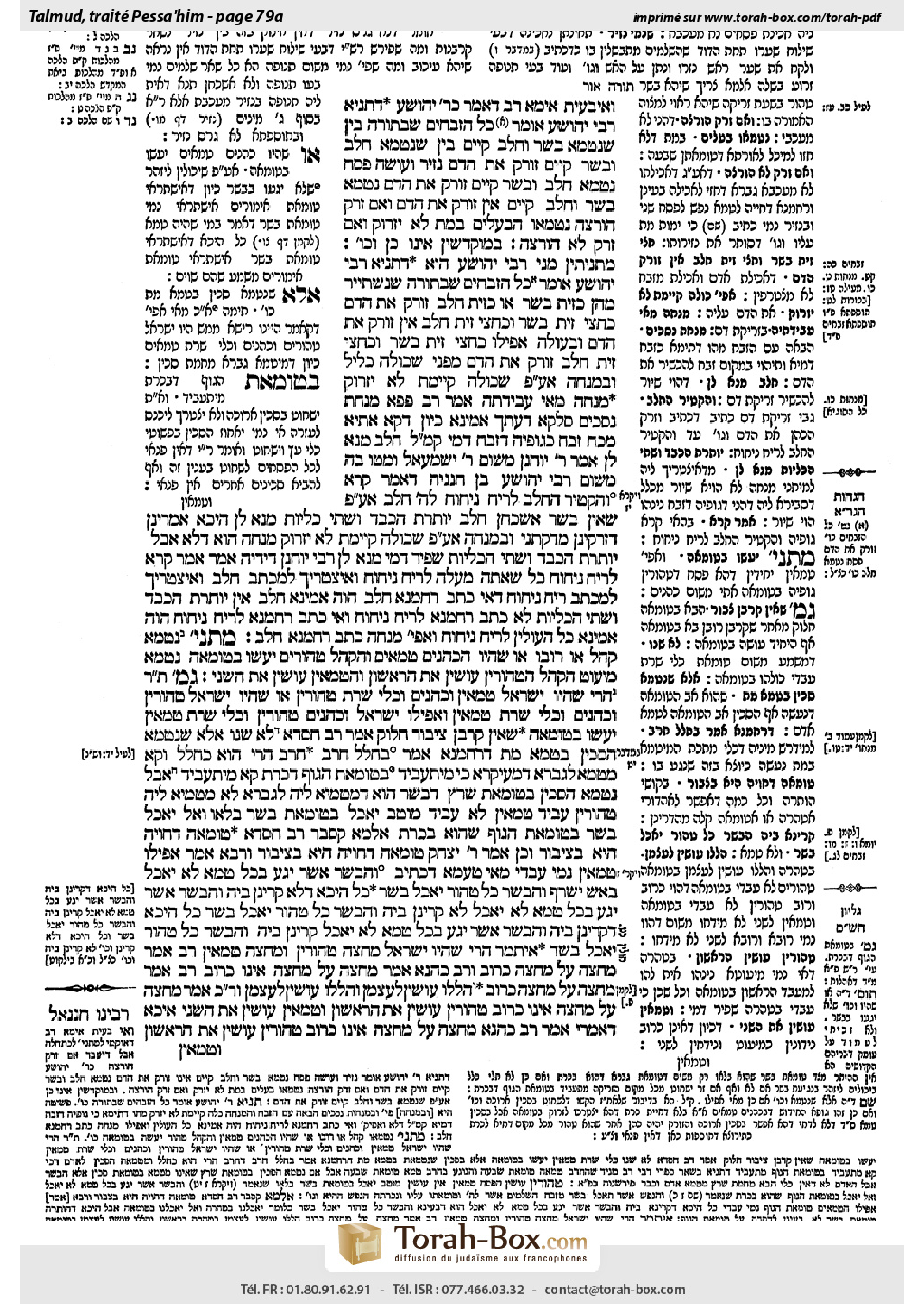
Pesachim 79a: Talmud study for Daf Yomi
Daf Yomi is the daily study of one Talmud folio. Explore 37 tractates with scans, Hebrew text, Sefaria English and AI-generated French translations where annotated.
Passage selection and English or AI-generated French translation are available where the scan has annotations. Daf Study is independent of Torah-Box and Sefaria.
Browse Pesachim · פסחים · All tractatesPesachim 79a text and translations
This page of Pesachim includes the Aramaic text, an English translation and an AI-generated French translation, alongside the scan above.
פסחים ע״ט א · Aramaic and Hebrew text
וְאִיבָּעֵית אֵימָא, רַב דְּאָמַר כְּרַבִּי יְהוֹשֻׁעַ. דְּתַנְיָא, רַבִּי יְהוֹשֻׁעַ אוֹמֵר: כׇּל הַזְּבָחִים שֶׁבַּתּוֹרָה בֵּין שֶׁנִּטְמָא בָּשָׂר וְחֵלֶב קַיָּים, בֵּין שֶׁנִּטְמָא חֵלֶב וּבָשָׂר קַיָּים — זוֹרֵק אֶת הַדָּם.
נָזִיר וְעוֹשֵׂה פֶסַח, נִטְמָא חֵלֶב וּבָשָׂר קַיָּים — זוֹרֵק אֶת הַדָּם. נִטְמָא בָּשָׂר וְחֵלֶב קַיָּים — אֵין זוֹרֵק אֶת הַדָּם, וְאִם זָרַק — הוּרְצָה.
נִטְמְאוּ הַבְּעָלִים בְּמֵת — לֹא יִזְרוֹק, וְאִם זָרַק — לֹא הוּרְצָה.
בַּמּוּקְדָּשִׁין אֵינוֹ כֵּן וְכוּ׳. מַתְנִיתִין מַנִּי?
רַבִּי יְהוֹשֻׁעַ הִיא. דְּתַנְיָא, רַבִּי יְהוֹשֻׁעַ אוֹמֵר: כׇּל הַזְּבָחִים שֶׁבַּתּוֹרָה שֶׁנִּשְׁתַּיֵּיר מֵהֶן כְּזַיִת בָּשָׂר אוֹ כְּזַיִת חֵלֶב — זוֹרֵק אֶת הַדָּם. כַּחֲצִי זַיִת בָּשָׂר וְכַחֲצִי זַיִת חֵלֶב — אֵין זוֹרֵק אֶת הַדָּם.
וּבָעוֹלָה, אֲפִילּוּ כַּחֲצִי זַיִת בָּשָׂר וְכַחֲצִי זַיִת חֵלֶב — זוֹרֵק אֶת הַדָּם, מִפְּנֵי שֶׁכּוּלָּהּ כָּלִיל. וּבַמִּנְחָה, אַף עַל פִּי שֶׁכּוּלָּהּ קַיֶּימֶת — לֹא יִזְרוֹק.
מִנְחָה מַאי עֲבִידְתֵּהּ? אָמַר רַב פָּפָּא: מִנְחַת נְסָכִים. סָלְקָא דַּעְתָּךְ אָמֵינָא, כֵּיוָן דְּקָא אָתְיָא מִכֹּחַ זֶבַח — כְּגוּפֵיהּ דְּזֶבַח דָּמֵי. קָא מַשְׁמַע לַן.
חֵלֶב מְנָא לַן? אָמַר רַבִּי יוֹחָנָן מִשּׁוּם רַבִּי יִשְׁמָעֵאל, וּמָטוּ בַּהּ מִשּׁוּם רַבִּי יְהוֹשֻׁעַ בֶּן חֲנַנְיָה, דְּאָמַר קְרָא: ״וְהִקְטִיר הַחֵלֶב לְרֵיחַ נִיחֹחַ לַה׳״, חֵלֶב — אַף עַל פִּי שֶׁאֵין בָּשָׂר.
אַשְׁכְּחַן חֵלֶב. יוֹתֶרֶת הַכָּבֵד וּשְׁתֵּי כְלָיוֹת, מְנָא לַן?
הֵיכָא אָמְרִינַן דְּזָרְקִינַן? מִדְּקָתָנֵי: וּבַמִּנְחָה אַף עַל פִּי שֶׁכּוּלָּהּ קַיֶּימֶת — לֹא יִזְרוֹק. מִנְחָה הוּא דְּלָא, אֲבָל יוֹתֶרֶת הַכָּבֵד וּשְׁתֵּי הַכְּלָיוֹת — שַׁפִּיר דָּמֵי, מְנָא לַן?
רַבִּי יוֹחָנָן דִּידֵיהּ אָמַר, אָמַר קְרָא: ״לְרֵיחַ נִיחֹחַ״ — כֹּל שֶׁאַתָּה מַעֲלֶה לְרֵיחַ נִיחוֹחַ.
וְאִיצְטְרִיךְ לְמִכְתַּב חֵלֶב וְאִיצְטְרִיךְ לְמִכְתַּב ״רֵיחַ נִיחוֹחַ״, דְּאִי כְּתַב רַחֲמָנָא חֵלֶב, הֲוָה אָמֵינָא: חֵלֶב — אִין, יוֹתֶרֶת הַכָּבֵד וּשְׁתֵּי הַכְּלָיוֹת — לָא, כְּתַב רַחֲמָנָא: ״לְרֵיחַ נִיחוֹחַ״. וְאִי כְּתַב רַחֲמָנָא: ״לְרֵיחַ נִיחוֹחַ״, הָוֵה אָמֵינָא: כׇּל הָעוֹלִין לְרֵיחַ נִיחוֹחַ, וַאֲפִילּוּ מִנְחָה, כְּתַב רַחֲמָנָא חֵלֶב.
מַתְנִי׳ נִטְמָא קָהָל אוֹ רוּבּוֹ, אוֹ שֶׁהָיוּ הַכֹּהֲנִים טְמֵאִים וְהַקָּהָל טְהוֹרִים — יַעֲשׂוּ בְּטוּמְאָה. נִטְמָא מִיעוּט הַקָּהָל — הַטְּהוֹרִין עוֹשִׂין אֶת הָרִאשׁוֹן, וְהַטְּמֵאִין עוֹשִׂין אֶת הַשֵּׁנִי.
גְּמָ׳ תָּנוּ רַבָּנַן: הֲרֵי שֶׁהָיוּ יִשְׂרָאֵל טְמֵאִין וְכֹהֲנִים וּכְלֵי שָׁרֵת טְהוֹרִין, אוֹ שֶׁהָיוּ יִשְׂרָאֵל טְהוֹרִין וְכֹהֲנִים וּכְלֵי שָׁרֵת טְמֵאִין, וַאֲפִילּוּ יִשְׂרָאֵל וְכֹהֲנִים טְהוֹרִין וּכְלֵי שָׁרֵת טְמֵאִין — יַעֲשׂוּ בְּטוּמְאָה, שֶׁאֵין קׇרְבַּן צִיבּוּר חָלוּק.
אָמַר רַב חִסְדָּא: לֹא שָׁנוּ אֶלָּא שֶׁנִּטְמָא הַסַּכִּין בִּטְמֵא מֵת, דְּרַחֲמָנָא אָמַר: ״בַּחֲלַל חֶרֶב״, חֶרֶב הֲרֵי הוּא כֶּחָלָל,
וְקָא מְטַמֵּא לְגַבְרָא, דְּמֵעִיקָּרָא כִּי מִיתְעֲבִיד — בְּטוּמְאַת הַגּוּף דְּכָרֵת קָא מִיתְעֲבִיד.
אֲבָל נִטְמָא הַסַּכִּין בְּטוּמְאַת שֶׁרֶץ, דְּבָשָׂר הוּא דִּמְטַמְּיָא לֵיהּ, לְגַבְרָא לָא מְטַמְּיָא לֵיהּ. טְהוֹרִין — עָבֵיד, טְמֵאִין — לָא עָבֵיד, מוּטָב יֵאָכֵל בְּטוּמְאַת בָּשָׂר בְּלָאו, וְאַל יֵאָכֵל בָּשָׂר בְּטוּמְאַת הַגּוּף שֶׁהוּא בְּכָרֵת.
אַלְמָא קָסָבַר רַב חִסְדָּא: טוּמְאָה דְּחוּיָה הִיא בְּצִיבּוּר. וְכֵן אָמַר רַבִּי יִצְחָק: טוּמְאָה דְּחוּיָה הִיא בְּצִיבּוּר.
וְרָבָא אָמַר: אֲפִילּוּ טְמֵאִין נָמֵי עָבְדִי. מַאי טַעְמָא, דִּכְתִיב: ״וְהַבָּשָׂר אֲשֶׁר יִגַּע בְּכׇל טָמֵא לֹא יֵאָכֵל בָּאֵשׁ יִשָּׂרֵף וְהַבָּשָׂר כׇּל טָהוֹר יֹאכַל בָּשָׂר״.
כׇּל הֵיכָא דְּלָא קָרֵינַן בֵּיהּ ״וְהַבָּשָׂר אֲשֶׁר יִגַּע בְּכׇל טָמֵא לֹא יֵאָכֵל״, לָא קָרֵינַן בֵּיהּ ״וְהַבָּשָׂר כׇּל טָהוֹר יֹאכַל בָּשָׂר״. כׇּל הֵיכָא דְּקָרֵינַן בֵּיהּ ״וְהַבָּשָׂר אֲשֶׁר יִגַּע בְּכׇל טָמֵא לֹא יֵאָכֵל״, קָרֵינַן בֵּיהּ ״וְהַבָּשָׂר כׇּל טָהוֹר יֹאכַל בָּשָׂר״.
אִיתְּמַר. הֲרֵי שֶׁהָיוּ יִשְׂרָאֵל מֶחֱצָה טְהוֹרִין וּמֶחֱצָה טְמֵאִין. רַב אָמַר: מֶחֱצָה עַל מֶחֱצָה כְּרוֹב. וְרַב כָּהֲנָא אָמַר: מֶחֱצָה עַל מֶחֱצָה אֵינוֹ כְּרוֹב.
רַב אָמַר מֶחֱצָה עַל מֶחֱצָה כְּרוֹב: הַלָּלוּ עוֹשִׂין לְעַצְמָן, וְהַלָּלוּ עוֹשִׂין לְעַצְמָן. וְרַב כָּהֲנָא אָמַר מֶחֱצָה עַל מֶחֱצָה אֵינוֹ כְּרוֹב: טְהוֹרִין עוֹשִׂין אֶת הָרִאשׁוֹן, וּטְמֵאִין עוֹשִׂין אֶת הַשֵּׁנִי.
אִיכָּא דְּאָמְרִי, אָמַר רַב כָּהֲנָא: מֶחֱצָה עַל מֶחֱצָה אֵינוֹ כְּרוֹב — טְהוֹרִין עוֹשִׂין אֶת הָרִאשׁוֹן,
Pesachim 79a · English translation
And if you wish, say that Rav, who said that, according to the mishna, if one did sprinkle the blood it is accepted, holds in accordance with the opinion of Rabbi Yehoshua, that eating the Paschal lamb is not essential. As it was taught in a baraita that Rabbi Yehoshua says: With regard to all offerings in the Torah, whether the meat became ritually impure and the fat remains pure, or the fat became ritually impure and the meat remains pure, one may sprinkle the blood.
With regard to the offerings of a nazirite and one who performs the ritual of a Paschal lamb, if the fat became impure and the meat remains pure, one may sprinkle the blood. If the meat became impure and the fat remains pure, one may not sprinkle the blood because eating the offering is a part of the mitzva itself and the impure meat may not be eaten. However, if he sprinkled the blood, it was accepted.
If the owners became ritually impure from a corpse and therefore cannot eat the offering, one may not sprinkle the blood; and if one sprinkled it, it was not accepted. Although failure to eat the offering does not preclude it from being accepted, that rule applies only when the owner of the offering is personally fit to eat it.
It was taught in the mishna: With regard to other offerings it is not so; even if the meat has become ritually impure, if the fat remains pure, the blood is sprinkled on the altar. The Gemara asks: Who is the tanna of the mishna?
The Gemara answers: It is Rabbi Yehoshua. As it was taught in a baraita that Rabbi Yehoshua says: With regard to all the offerings in the Torah from which there remains an olive-bulk of meat that is fit to be eaten or an olive-bulk of fat that is fit to be sacrificed on the altar, one may sprinkle the blood. If all that remains is half an olive-bulk of meat and half an olive-bulk of fat, one may not sprinkle the blood. The fat is burned on the altar and the meat is eaten by the priests. Since the meat and fat serve different functions, they do not combine to equal the minimum amount that must remain in order to sprinkle the blood.
And with regard to a burnt-offering, even if all that was left was half an olive-bulk of meat and half an olive-bulk of fat, one may sprinkle the blood because it is all consumed on the altar. Since both the meat and the fat are sacrificed on the altar, they can be combined. And with regard to a meal-offering, although all of it remains pure, one may not sprinkle the blood of the animal offering that is brought together with it.
The Gemara expresses surprise: What is the mention of a meal-offering doing here? The discussion is about sprinkling blood, which is not relevant in the case of a meal-offering. Rav Pappa said: The meal-offering under discussion is the meal-offering brought with the libations that accompany animal offerings. It could enter your mind to say: Since it comes due to the offering, it is comparable to the offering itself. One might think that even if the offering became impure but the meal-offering remained pure, one would be permitted to sprinkle the blood of the animal due to the remaining meal-offering. Consequently, it teaches us that this is not the case.
From where do we derive that if only the fat remains, one may sprinkle the blood of the offering? Rabbi Yoḥanan said in the name of Rabbi Yishmael, and there are those who determined that this halakha was stated in the name of Rabbi Yehoshua ben Ḥananya: As the verse states: “And the priest shall sprinkle the blood upon the altar of the Lord at the entrance to the Tent of Meeting; and he shall make the fat smoke for a satisfying aroma to the Lord” (Leviticus 17:6). This verse indicates that one may sprinkle the blood if the fat remains pure although there is no pure meat.
The Gemara asks: We have found a source for the halakha that one may sprinkle the blood if only fat remains; but if all that is left is the diaphragm and the two kidneys, which are also sacrificed on the altar, from where do we derive that one may sprinkle the blood?
The Gemara responds: Where did we say that one may sprinkle the blood in such a case? The Gemara answers: The fact that one may sprinkle the blood in that case is clear from the fact that it is taught at the end of the baraita: And with regard to a meal-offering, although all of it remains pure, one may not sprinkle the blood. It can be deduced from this statement that it is a meal-offering for which one may not sprinkle the blood, as the meal-offering is not part of the animal; but with regard to the diaphragm and the two kidneys, it seems well to sprinkle the blood if they remain. That being the case, from where do we derive this halakha?
The Gemara answers: Rabbi Yoḥanan himself said, this time without quoting tanna’im: The verse we quoted above states: For a satisfying aroma, which indicates that anything you raise as a satisfying aroma, i.e., anything burned on the altar, is enough to sprinkle the blood.
The Gemara notes: And it is necessary to write fat in that verse and it is necessary to write: For a satisfying aroma. As, if the Merciful One had written only fat, I would have said that if fat remains, yes, the blood may be sprinkled, but if only the diaphragm and two kidneys remain, which are not as significant as the fat, no, the blood may not be sprinkled. Therefore, the Merciful One writes: For a satisfying aroma. And if the Merciful One had written only: For a satisfying aroma, I would have said that it includes anything that rises as a satisfying aroma, and even a meal-offering is included. Therefore, the Merciful One writes fat, to teach that this halakha applies only to sacrificial parts of the animal and not to accompanying libations and meal-offerings.
MISHNA: If the entire community or most of it became ritually impure, or the priests were all impure and the community was pure, they should perform the ritual of the Paschal lamb in ritual impurity. If a minority of the community became impure, even if they are many people, those who are pure perform the ritual of the Paschal lamb on the first Pesaḥ, and those who are impure perform the ritual on the second Pesaḥ.
GEMARA: The Sages taught: If most or all of the Jewish people were impure and the priests and sacred vessels used in the Temple service were pure; or, conversely, if the Jewish people were pure and the priests and sacred vessels were impure; and even in a situation in which the Jewish people and the priests were pure and the sacred vessels were impure, they may perform any part of the ritual of the Paschal lamb in ritual impurity. The reason for this is that a communal offering, which is sacrificed even in a state of ritual impurity, is not divided. Therefore, since some of the service must be performed in a state of ritual impurity, it may all be performed in a state of ritual impurity.
Rav Ḥisda said: They taught that the service may be done in a state of ritual impurity if the sacred vessels are impure only in a case where the knife to be used for slaughtering became impure through contact with one who was ritually impure due to contact with a corpse, as the Merciful One states: “And whoever shall touch on the open field one slain with a sword, or one that died, or the bone of a man, or a grave, shall be impure for seven days” (Numbers 19:16). The Sages expounded: A sword is like a corpse. Therefore, a sword or another metal implement that touches a corpse attains the same level of impurity as the corpse itself, which is the ultimate primary source of ritual impurity. Similarly, a knife that touches a person who is a primary source of ritual impurity due to contact with a corpse attains that same status.
Therefore, it renders impure the person who uses it for slaughtering. In this case, when the ritual of the Paschal lamb is initially performed, it is performed in a state of ritual impurity of the body. Generally, one who is impure in this way is liable to receive karet if he eats sacrificial meat or enters the Temple.
However, if the knife became ritually impure with the impurity of a creeping animal, which renders the meat impure but does not render the person impure, because something rendered impure by a primary source of ritual impurity becomes a secondary source of ritual impurity, which can render food impure but not people, those who are pure may perform the ritual of the Paschal lamb, but those who are impure may not perform the ritual. This is because it is preferable that one eat the Paschal lamb with impurity of the meat, as the nature of its prohibition is that of a regular negative commandment, and one should not eat the meat with impurity of the body, which renders one liable to receive karet.
The Gemara comments on Rav Ḥisda’s attempt to distinguish between different types of impurity and to claim that the entire community sacrifices the Paschal lamb in a state of ritual impurity only when the people have become impure with a severe form of impurity. Apparently, Rav Ḥisda holds that impurity is overridden in cases involving the public. The prohibition of sacrificing offerings in a state of impurity is not wholly permitted for a community; rather, it is overridden in cases of great need. Therefore, whenever it is possible to minimize the severity of the impurity, it is necessary to do so. And, so too, Rabbi Yitzḥak said explicitly: Impurity is overridden in cases involving the public.
And Rava said that whenever there is any form of ritual impurity involved in the service, even those who are ritually impure may also perform the ritual of the Paschal lamb. What is the reason for this? As it is written: “And the flesh that touches any impure thing shall not be eaten, it shall be burned in fire; and the flesh, every one that is pure may eat the flesh” (Leviticus 7:19).
Rava derives from this verse that anywhere that we do not apply the halakha that “the flesh that touches any impure thing shall not be eaten” and the meat may be eaten despite being impure, we also do not apply “and the flesh, every one that is pure may eat the flesh.” In that case, the meat may be eaten even by one who is impure. Just as the first half of the verse is not applicable, the second half is also not applicable. It is only anywhere that we apply the halakha that “the flesh that touches any impure thing shall not be eaten” that we also apply the second half of the verse: “And the flesh, every one that is pure may eat the flesh.” Therefore, when the offering is sacrificed in a state of ritual impurity, there is no prohibition for impure people to eat it.
It was stated that the amora’im disagreed with regard to the mishna’s statement that the Paschal lamb may be sacrificed in a state of impurity if the majority of the public is impure. In a case where the Jewish people were divided, and exactly half were pure and half were impure, Rav said half and half is like the majority, and Rav Kahana said half and half is not like the majority.
The Gemara explains the dispute between Rav and Rav Kahana. Rav said: Half and half is like the majority, meaning that each of the two groups has the status of the majority of the public. Therefore, those who are pure perform the ritual of the Paschal lamb for themselves in a state of ritual purity. And those who are impure perform the ritual of the Paschal lamb for themselves in a state of ritual impurity. They are also considered like the majority of the public, and the sacrifice of the majority of the public is not deferred to the second Pesaḥ. And Rav Kahana said: Half and half is not like the majority. Therefore, those who are pure perform the ritual of the Paschal lamb on the first Pesaḥ, and those who are impure perform the ritual of the Paschal lamb on the second Pesaḥ.
Some say that what was stated above is not the correct conclusion based on Rav Kahana’s statement. Rather, Rav Kahana said: Half and half is not like the majority. Therefore, those who are pure perform the ritual of the Paschal lamb on the first Pesaḥ,
Pesachim 79a · Traduction française (IA)
Et si tu veux, dis que Rav, qui a affirmé que, selon la Michna, si l’on a aspergé le sang, le sacrifice est agréé, suit l’opinion de Rabbi Yehoshua, selon laquelle le fait de manger l’agneau pascal n’est pas indispensable. En effet, il a été enseigné dans une baraïta que Rabbi Yehoshua dit : Pour tous les sacrifices de la Torah, que la viande soit devenue rituellement impure tandis que la graisse est restée pure, ou que la graisse soit devenue rituellement impure tandis que la viande est restée pure, on peut asperger le sang.
Pour les sacrifices d’un nazir et de celui qui accomplit le rite de l’agneau pascal, si la graisse est devenue rituellement impure et que la viande est restée pure, on peut asperger le sang. Si la viande est devenue rituellement impure et que la graisse est restée pure, on ne peut pas asperger le sang, car le fait de manger le sacrifice fait partie intégrante de la mitsva et la viande impure ne peut pas être consommée. Toutefois, si l’on a aspergé le sang, le sacrifice a été agréé.
Si les propriétaires du sacrifice sont devenus rituellement impurs au contact d’un cadavre et ne peuvent donc pas manger le sacrifice, on ne peut pas asperger le sang ; et si on l’a aspergé, le sacrifice n’a pas été agréé. Bien que le fait de ne pas manger le sacrifice n’empêche pas son agrément, cette règle ne s’applique que lorsque le propriétaire du sacrifice est personnellement apte à le manger.
Il a été enseigné dans la Michna : Pour les autres sacrifices, il n’en va pas ainsi ; même si la viande est devenue rituellement impure, si la graisse est restée pure, le sang est aspergé sur l’autel. La Guemara demande : Quel est le tanna de la Michna ?
La Guemara répond : Il s’agit de Rabbi Yehoshua. En effet, il a été enseigné dans une baraïta que Rabbi Yehoshua dit : Pour tous les sacrifices de la Torah dont il reste un volume équivalent à une olive de viande propre à être consommée ou un volume équivalent à une olive de graisse propre à être brûlée sur l’autel, on peut asperger le sang. S’il ne reste qu’un demi-volume équivalent à une olive de viande et un demi-volume équivalent à une olive de graisse, on ne peut pas asperger le sang. La graisse est brûlée sur l’autel et la viande est mangée par les prêtres. Puisque la viande et la graisse remplissent des fonctions différentes, elles ne s’additionnent pas pour atteindre la quantité minimale qui doit subsister afin que l’on puisse asperger le sang.
Et dans le cas d’un holocauste, même s’il ne reste qu’un demi-volume équivalent à une olive de viande et un demi-volume équivalent à une olive de graisse, on peut asperger le sang, car tout est consumé sur l’autel. Puisque la viande comme la graisse sont offertes sur l’autel, elles peuvent être additionnées. Et dans le cas d’une offrande végétale, bien qu’elle soit restée entièrement pure, on ne peut pas asperger le sang du sacrifice animal qui est offert avec elle.
La Guemara s’étonne : Que vient faire ici la mention d’une offrande végétale ? La discussion porte sur l’aspersion du sang, qui ne concerne pas une offrande végétale. Rav Pappa dit : L’offrande végétale dont il est question est celle qui accompagne les libations apportées avec les sacrifices animaux. On pourrait penser que, puisqu’elle est apportée en raison du sacrifice, elle est comparable au sacrifice lui-même. On pourrait donc croire que, même si le sacrifice est devenu impur tandis que l’offrande végétale est restée pure, il serait permis d’asperger le sang de l’animal en raison de l’offrande végétale qui subsiste. La baraïta nous enseigne donc que ce n’est pas le cas.
D’où déduisons-nous que, s’il ne reste que la graisse, on peut asperger le sang du sacrifice ? Rabbi Yoḥanan a dit au nom de Rabbi Yishmael — et certains ont rapporté que cette halakha avait été énoncée au nom de Rabbi Yehoshua ben Ḥananya — : le verset dit : « Le prêtre aspergera le sang sur l’autel du Seigneur, à l’entrée de la Tente d’assignation, et il fera fumer la graisse, en odeur agréable au Seigneur » (Lévitique 17,6). Ce verset indique que l’on peut asperger le sang si la graisse est restée pure, même s’il ne reste pas de viande pure.
La Guemara demande : Nous avons trouvé une source pour la halakha selon laquelle on peut asperger le sang s’il ne reste que de la graisse ; mais si seuls subsistent le diaphragme et les deux reins, qui sont eux aussi offerts sur l’autel, d’où déduisons-nous que l’on peut asperger le sang ?
La Guemara répond : Où avons-nous dit que l’on peut asperger le sang dans un tel cas ? La Guemara répond : Le fait que l’on puisse asperger le sang dans ce cas ressort de ce qui est enseigné à la fin de la baraïta : « Et dans le cas d’une offrande végétale, bien qu’elle soit restée entièrement pure, on ne peut pas asperger le sang. » On peut déduire de cette déclaration que c’est pour une offrande végétale que l’on ne peut pas asperger le sang, car l’offrande végétale ne fait pas partie de l’animal ; mais, s’agissant du diaphragme et des deux reins, il semble tout à fait approprié d’asperger le sang s’ils subsistent. Dans ce cas, d’où déduisons-nous cette halakha ?
La Guemara répond : Rabbi Yoḥanan lui-même a dit, cette fois sans citer de tannaïm : le verset cité plus haut dit « en odeur agréable », ce qui indique que tout ce que l’on fait monter en odeur agréable, c’est-à-dire tout ce qui est brûlé sur l’autel, suffit pour asperger le sang.
La Guemara fait remarquer qu’il est nécessaire que le verset mentionne la graisse et qu’il mentionne aussi « en odeur agréable ». En effet, si le Miséricordieux n’avait écrit que « graisse », j’aurais dit que si la graisse subsiste, oui, on peut asperger le sang, mais que si seuls subsistent le diaphragme et les deux reins, qui sont moins importants que la graisse, non, on ne peut pas asperger le sang. Le Miséricordieux a donc écrit « en odeur agréable ». Et si le Miséricordieux n’avait écrit que « en odeur agréable », j’aurais dit que cela inclut tout ce qui s’élève en odeur agréable, y compris une offrande végétale. Le Miséricordieux a donc écrit « graisse », pour enseigner que cette halakha ne s’applique qu’aux parties sacrificielles de l’animal, et non aux libations et aux offrandes végétales qui les accompagnent.
MICHNA : Si toute la communauté ou sa majorité est devenue rituellement impure, ou si tous les prêtres sont impurs tandis que la communauté est pure, on accomplit le rite de l’agneau pascal en état d’impureté rituelle. Si une minorité de la communauté est devenue impure, même si elle compte beaucoup de personnes, ceux qui sont purs accomplissent le rite de l’agneau pascal au premier Pessaḥ, et ceux qui sont impurs l’accomplissent au second Pessaḥ.
GUEMARA : Les Sages ont enseigné : Si la majorité ou la totalité du peuple juif est impure tandis que les prêtres et les ustensiles sacrés utilisés dans le service du Temple sont purs ; ou, inversement, si le peuple juif est pur tandis que les prêtres et les ustensiles sacrés sont impurs ; et même si le peuple juif et les prêtres sont purs tandis que les ustensiles sacrés sont impurs, ils peuvent accomplir n’importe quelle partie du rite de l’agneau pascal en état d’impureté rituelle. En effet, un sacrifice communautaire, qui est offert même en état d’impureté rituelle, n’est pas fractionné. Par conséquent, puisque certaines parties du service doivent être accomplies en état d’impureté rituelle, tout le service peut l’être.
Rav Ḥisda a dit : Ils ont enseigné que le service peut être accompli en état d’impureté rituelle lorsque les ustensiles sacrés sont impurs uniquement dans le cas où le couteau destiné à l’abattage est devenu impur au contact d’une personne rituellement impure parce qu’elle a été en contact avec un cadavre. En effet, le Miséricordieux dit : « Celui qui, dans la campagne, touche un homme tué par l’épée, un mort, un ossement humain ou un sépulcre sera impur pendant sept jours » (Nombres 19,16). Les Sages ont interprété : une épée est comme un cadavre. Par conséquent, une épée ou un autre objet en métal qui touche un cadavre acquiert le même degré d’impureté que le cadavre lui-même, qui est la source première suprême d’impureté rituelle. De même, un couteau qui touche une personne constituant une source première d’impureté rituelle en raison de son contact avec un cadavre acquiert ce même statut.
Il rend donc impur celui qui s’en sert pour l’abattage. Dans ce cas, lorsque le rite de l’agneau pascal est accompli à l’origine, il l’est en état d’impureté rituelle du corps. En général, celui qui est impur de cette manière encourt le karet s’il mange de la viande sacrificielle ou entre dans le Temple.
Cependant, si le couteau est devenu rituellement impur par l’impureté d’un animal rampant, qui rend la viande impure mais ne rend pas la personne impure — car ce qui est rendu impur par une source première d’impureté rituelle devient une source secondaire d’impureté rituelle, laquelle peut rendre la nourriture impure, mais pas les personnes —, ceux qui sont purs peuvent accomplir le rite de l’agneau pascal, mais ceux qui sont impurs ne le peuvent pas. En effet, il est préférable de manger l’agneau pascal avec une viande impure, puisque l’interdiction correspondante relève d’un commandement négatif ordinaire, plutôt que de manger la viande avec l’impureté du corps, qui rend passible du karet.
La Guemara commente la tentative de Rav Ḥisda de distinguer différentes sortes d’impureté et d’affirmer que toute la communauté offre l’agneau pascal en état d’impureté rituelle uniquement lorsque le peuple a été atteint par une forme grave d’impureté. Il semble que Rav Ḥisda considère que, dans les cas concernant le public, l’impureté est écartée. L’interdiction d’offrir des sacrifices en état d’impureté n’est pas entièrement levée pour la communauté ; elle est écartée en cas de grande nécessité. Par conséquent, chaque fois qu’il est possible de réduire la gravité de l’impureté, il faut le faire. De même, Rabbi Yitzḥak a dit explicitement : Dans les cas concernant le public, l’impureté est écartée.
Et Rava a dit que, dès lors qu’une forme quelconque d’impureté rituelle intervient dans le service, même ceux qui sont rituellement impurs peuvent eux aussi accomplir le rite de l’agneau pascal. Pour quelle raison ? Car il est écrit : « La chair qui touche une chose impure ne sera pas mangée ; elle sera brûlée au feu ; quant à la chair, toute personne pure peut manger de la chair » (Lévitique 7,19).
Rava déduit de ce verset que partout où l’on n’applique pas la halakha selon laquelle « la chair qui touche une chose impure ne sera pas mangée » et où la viande peut être consommée malgré son impureté, on n’applique pas non plus la seconde partie : « quant à la chair, toute personne pure peut manger de la chair ». Dans ce cas, même une personne impure peut manger la viande. De même que la première partie du verset ne s’applique pas, sa seconde partie ne s’applique pas non plus. C’est uniquement là où l’on applique la halakha selon laquelle « la chair qui touche une chose impure ne sera pas mangée » que l’on applique également la seconde partie du verset : « quant à la chair, toute personne pure peut manger de la chair ». Par conséquent, lorsque le sacrifice est offert en état d’impureté rituelle, il n’est pas interdit aux personnes impures de le manger.
Il a été rapporté que les amoraïm étaient en désaccord sur la déclaration de la Michna selon laquelle l’agneau pascal peut être offert en état d’impureté si la majorité du public est impure. Dans le cas où le peuple juif était divisé, avec exactement la moitié pure et l’autre moitié impure, Rav a dit que moitié-moitié équivaut à la majorité, tandis que Rav Kahana a dit que moitié-moitié n’équivaut pas à la majorité.
La Guemara explique le désaccord entre Rav et Rav Kahana. Rav a dit : Moitié-moitié équivaut à la majorité, c’est-à-dire que chacun des deux groupes a le statut de majorité du public. Par conséquent, ceux qui sont purs accomplissent pour eux-mêmes le rite de l’agneau pascal en état de pureté rituelle. Et ceux qui sont impurs accomplissent pour eux-mêmes le rite de l’agneau pascal en état d’impureté rituelle. Eux aussi sont considérés comme constituant la majorité du public, et le sacrifice de la majorité du public n’est pas reporté au second Pessaḥ. Rav Kahana a dit : Moitié-moitié n’équivaut pas à la majorité. Par conséquent, ceux qui sont purs accomplissent le rite de l’agneau pascal au premier Pessaḥ, et ceux qui sont impurs l’accomplissent au second Pessaḥ.
Certains disent que ce qui a été dit plus haut n’est pas la conclusion correcte à tirer de la déclaration de Rav Kahana. Rav Kahana a plutôt dit : Moitié-moitié n’équivaut pas à la majorité. Par conséquent, ceux qui sont purs accomplissent le rite de l’agneau pascal au premier Pessaḥ,
Traduction française générée par IA à partir de l’édition anglaise de Sefaria. Vérifie toujours un passage avec le texte source.
Text from Sefaria: William Davidson Edition - Vocalized Aramaic (CC BY NC); William Davidson Edition - English (CC BY NC).