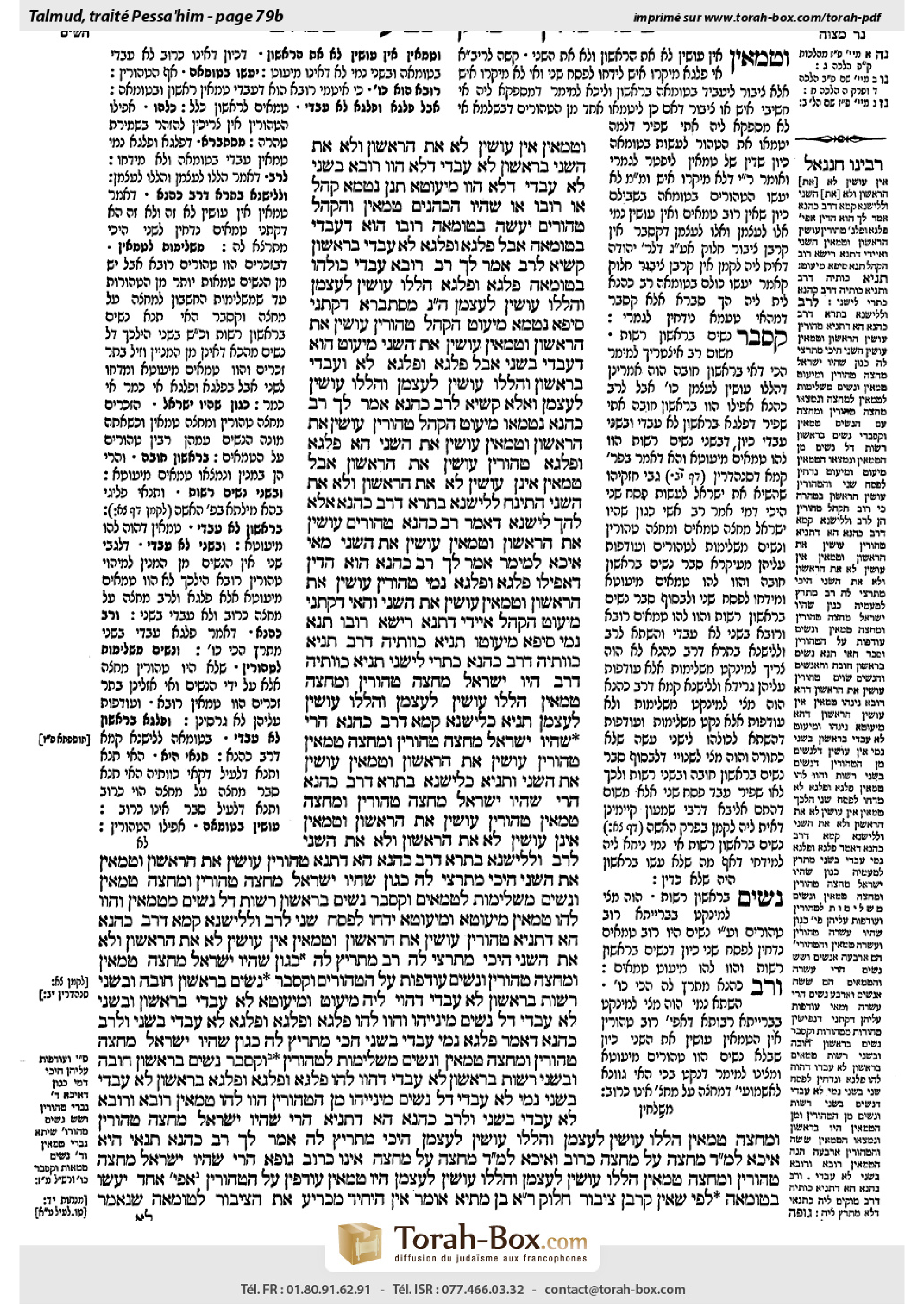
Pesachim 79b: Talmud study for Daf Yomi
Daf Yomi is the daily study of one Talmud folio. Explore 37 tractates with scans, Hebrew text, Sefaria English and AI-generated French translations where annotated.
Passage selection and English or AI-generated French translation are available where the scan has annotations. Daf Study is independent of Torah-Box and Sefaria.
Browse Pesachim · פסחים · All tractatesPesachim 79b text and translations
This page of Pesachim includes the Aramaic text, an English translation and an AI-generated French translation, alongside the scan above.
פסחים ע״ט ב · Aramaic and Hebrew text
וּטְמֵאִין אֵין עוֹשִׂין לֹא אֶת הָרִאשׁוֹן וְלֹא אֶת הַשֵּׁנִי. בָּרִאשׁוֹן לָא עָבְדִי — דְּלָא הָווּ רוּבָּא. בַּשֵּׁנִי לָא עָבְדִי — דְּלָא הָווּ מִיעוּטָא.
תְּנַן: נִטְמָא קָהָל אוֹ רוּבּוֹ, אוֹ שֶׁהָיוּ הַכֹּהֲנִים טְמֵאִין וְהַקָּהָל טְהוֹרִים — יֵעָשֶׂה בְּטוּמְאָה. רוּבּוֹ הוּא דְּעָבְדִי בְּטוּמְאָה, אֲבָל פַּלְגָא וּפַלְגָא לָא עָבְדִי בָּרִאשׁוֹן. קַשְׁיָא לְרַב!
אָמַר לָךְ רַב: רוּבָּא עָבְדִי כּוּלְּהוּ בְּטוּמְאָה, פַּלְגָא וּפַלְגָא — הַלָּלוּ עוֹשִׂין לְעַצְמָן וְהַלָּלוּ עוֹשִׂין לְעַצְמָן.
הָכִי נָמֵי מִסְתַּבְּרָא, דְּקָתָנֵי סֵיפָא: נִטְמָא מִיעוּט הַקָּהָל, טְהוֹרִין עוֹשִׂין אֶת הָרִאשׁוֹן וּטְמֵאִין עוֹשִׂין אֶת הַשֵּׁנִי. מִיעוּט הוּא דְּעָבְדִי בַּשֵּׁנִי, אֲבָל פַּלְגָא וּפַלְגָא — לָא. וְעָבְדִי בָּרִאשׁוֹן, וְהַלָּלוּ עוֹשִׂין לְעַצְמָן וְהַלָּלוּ עוֹשִׂין לְעַצְמָן.
וְאֶלָּא קַשְׁיָא לְרַב כָּהֲנָא! אָמַר לָךְ רַב כָּהֲנָא: נִטְמְאוּ מִיעוּט הַקָּהָל — טְהוֹרִין עוֹשִׂין אֶת הָרִאשׁוֹן וּטְמֵאִין עוֹשִׂין אֶת הַשֵּׁנִי. הָא פַּלְגָא וּפַלְגָא — טְהוֹרִין עוֹשִׂין אֶת הָרִאשׁוֹן, אֲבָל טְמֵאִין אֵינָן עוֹשִׂין לֹא אֶת הָרִאשׁוֹן וְלֹא אֶת הַשֵּׁנִי.
הָתִינַח לְלִישָּׁנָא בָּתְרָא דְּרַב כָּהֲנָא. אֶלָּא לְהָךְ לִישָּׁנָא דְּאָמַר רַב כָּהֲנָא: טְהוֹרִים עוֹשִׂין אֶת הָרִאשׁוֹן, וּטְמֵאִין עוֹשִׂין אֶת הַשֵּׁנִי, מַאי אִיכָּא לְמֵימַר?
אָמַר לְךָ רַב כָּהֲנָא: הוּא הַדִּין דַּאֲפִילּוּ פַּלְגָא וּפַלְגָא נָמֵי — טְהוֹרִין עוֹשִׂין אֶת הָרִאשׁוֹן, וּטְמֵאִין עוֹשִׂין אֶת הַשֵּׁנִי. וְהַאי דְּקָתָנֵי מִיעוּט הַקָּהָל, אַיְּידֵי דִּתְנָא רֵישָׁא ״רוּבּוֹ״ — תְּנָא נָמֵי סֵיפָא ״מִיעוּטוֹ״.
תַּנְיָא כְּווֹתֵיהּ דְּרַב, תַּנְיָא כְּווֹתֵיהּ דְּרַב כָּהֲנָא כִּתְרֵי לִישָּׁנֵי. תַּנְיָא כְּווֹתֵיהּ דְּרַב: הָיוּ יִשְׂרָאֵל מֶחֱצָה טְהוֹרִין וּמֶחֱצָה טְמֵאִין, הַלָּלוּ עוֹשִׂין לְעַצְמָן וְהַלָּלוּ עוֹשִׂין לְעַצְמָן.
תַּנְיָא כְּלִישְׁנָא קַמָּא דְּרַב כָּהֲנָא: הֲרֵי שֶׁהָיוּ יִשְׂרָאֵל מֶחֱצָה טְהוֹרִין וּמֶחֱצָה טְמֵאִין, טְהוֹרִין עוֹשִׂין אֶת הָרִאשׁוֹן וּטְמֵאִין עוֹשִׂין אֶת הַשֵּׁנִי.
וְתַנְיָא כְּלִישָּׁנָא בָּתְרָא דְּרַב כָּהֲנָא: הֲרֵי שֶׁהָיוּ יִשְׂרָאֵל מֶחֱצָה טְהוֹרִין וּמֶחֱצָה טְמֵאִין, טְהוֹרִין עוֹשִׂין אֶת הָרִאשׁוֹן, וּטְמֵאִין אֵינָן עוֹשִׂין לֹא אֶת הָרִאשׁוֹן וְלֹא אֶת הַשֵּׁנִי.
לְרַב וּלְלִישָּׁנָא בָּתְרָא דְּרַב כָּהֲנָא, הָא דְּתָנָא ״טְהוֹרִין עוֹשִׂין אֶת הָרִאשׁוֹן וּטְמֵאִין אֶת הַשֵּׁנִי״, הֵיכִי מְתָרְצִי לַהּ? כְּגוֹן שֶׁהָיוּ יִשְׂרָאֵל מֶחֱצָה טְהוֹרִין וּמֶחֱצָה טְמֵאִין, וְנָשִׁים מַשְׁלִימוֹת לַטְּמֵאִים.
וְקָסָבַר: נָשִׁים בָּרִאשׁוֹן רְשׁוּת. דַּל נָשִׁים מִטְּמֵאִין, וְהָווּ לְהוּ טְמֵאִין מִיעוּטָא, וּמִיעוּטָא יִדְחוּ לְפֶסַח שֵׁנִי.
לְרַב וּלְלִישָּׁנָא קַמָּא דְּרַב כָּהֲנָא, הָא דְּתַנְיָא ״טְהוֹרִין עוֹשִׂין אֶת הָרִאשׁוֹן וּטְמֵאִין אֵין עוֹשִׂין לֹא אֶת הָרִאשׁוֹן וְלֹא אֶת הַשֵּׁנִי״, הֵיכִי מְתָרְצִי לַהּ?
רַב מְתָרֵיץ לַהּ, כְּגוֹן שֶׁהָיוּ יִשְׂרָאֵל מֶחֱצָה טְמֵאִין וּמֶחֱצָה טְהוֹרִין, וְנָשִׁים עוֹדְפוֹת עַל הַטְּהוֹרִים, וְקָסָבַר: נָשִׁים בָּרִאשׁוֹן חוֹבָה, וּבַשֵּׁנִי רְשׁוּת.
בָּרִאשׁוֹן לָא עָבְדִי — דְּהָוֵי לֵיהּ מִיעוּט, וּמִיעוּטָא לָא עָבְדִי בָּרִאשׁוֹן. וּבַשֵּׁנִי לָא עָבְדִי — דַּל נָשִׁים מִינַּיְיהוּ וְהָווּ לְהוּ פַּלְגָא וּפַלְגָא, וּפַלְגָא לָא עָבְדִי בַּשֵּׁנִי.
וּלְרַב כָּהֲנָא דַּאֲמַר: פַּלְגָא נָמֵי עָבְדִי בַּשֵּׁנִי, הָכִי מְתָרֵיץ לַהּ: כְּגוֹן שֶׁהָיוּ יִשְׂרָאֵל מֶחֱצָה טְהוֹרִין וּמֶחֱצָה טְמֵאִין, וְנָשִׁים מַשְׁלִימוֹת לַטְּהוֹרִין. וְקָסָבַר: נָשִׁים בָּרִאשׁוֹן חוֹבָה וּבַשֵּׁנִי רְשׁוּת.
בָּרִאשׁוֹן לָא עָבְדִי — דְּהָווּ לְהוּ פַּלְגָא וּפַלְגָא, וּפַלְגָא בָּרִאשׁוֹן לָא עָבְדִי, בַּשֵּׁנִי נָמֵי לָא עָבְדִי — דַּל נָשִׁים מִינַּיְיהוּ מִן הַטְּהוֹרִין הָווּ לְהוּ טְמֵאִין רוּבָּא, וְרוּבָּא לָא עָבְדִי בַּשֵּׁנִי.
וּלְרַב כָּהֲנָא, הָא דְּתַנְיָא: הֲרֵי שֶׁהָיוּ יִשְׂרָאֵל מֶחֱצָה טְהוֹרִין וּמֶחֱצָה טְמֵאִין, הַלָּלוּ עוֹשִׂין לְעַצְמָן וְהַלָּלוּ עוֹשִׂין לְעַצְמָן, הֵיכִי מְתָרֵיץ לַהּ? אָמַר לָךְ רַב כָּהֲנָא: תַּנָּאֵי הִיא. אִיכָּא לְמַאן דְּאָמַר: מֶחֱצָה עַל מֶחֱצָה כְּרוֹב, וְאִיכָּא לְמַאן דְּאָמַר: מֶחֱצָה עַל מֶחֱצָה אֵינוֹ כְּרוֹב.
גּוּפָא. הֲרֵי שֶׁהָיוּ יִשְׂרָאֵל מֶחֱצָה טְהוֹרִין וּמֶחֱצָה טְמֵאִין, הַלָּלוּ עוֹשִׂין לְעַצְמָן וְהַלָּלוּ עוֹשִׂין לְעַצְמָן. הָיוּ טְמֵאִין עוֹדְפִין עַל הַטְּהוֹרִין, אֲפִילּוּ אֶחָד — יַעֲשׂוּ בְּטוּמְאָה, לְפִי שֶׁאֵין קׇרְבַּן צִיבּוּר חָלוּק.
רַבִּי אֶלְעָזָר בֶּן מַתְיָא אוֹמֵר: אֵין הַיָּחִיד מַכְרִיעַ אֶת הַצִּיבּוּר לְטוּמְאָה, שֶׁנֶּאֱמַר:
Pesachim 79b · English translation
and those who are impure do not perform the ritual of the Paschal lamb on the first Pesaḥ or the second. They do not perform the ritual of the Paschal lamb on the first Pesaḥ because they are not the majority, and the Paschal lamb may be sacrificed in a state of impurity only when the majority of the community is impure. Additionally, they may not perform the ritual of the Paschal lamb on the second Pesaḥ because they are not the minority, and only the sacrifice of a minority of the community is deferred to the second Pesaḥ.
The Gemara raises an objection from that which we learned in the mishna: If the entire community became ritually impure, or if most of it became impure, or if the priests were impure and the community was pure, they should perform the ritual of the Paschal lamb in impurity. This indicates that it is only when most of the community is impure that they perform the ritual of the Paschal lamb in impurity, but if it is half and half, they do not perform the ritual of the Paschal lamb on the first Pesaḥ. This poses a difficulty to the opinion of Rav.
Rav could have said to you: When a majority of the community is impure, they may all perform the ritual of the Paschal lamb in impurity. Even those who are still pure are not required to ensure that they remain pure in order to sacrifice the Paschal lamb. When it is half and half, these who are pure perform the ritual of the Paschal lamb for themselves in a state of purity and these who are impure perform the ritual of the Paschal lamb for themselves in a state of impurity.
The Gemara adds: So too, it is reasonable to understand the mishna in this way, as the latter clause teaches: If a minority of the community became impure, those who are pure perform the ritual of the Paschal lamb on the first Pesaḥ and those who are impure perform the ritual of the Paschal lamb on the second Pesaḥ. This indicates that it is only when the minority has become impure that they perform the ritual of the Paschal lamb on the second Pesaḥ. But when it is half and half this is not the case; rather, these perform the ritual of the Paschal lamb for themselves in a state of purity and those perform the ritual of the Paschal lamb for themselves in a state of impurity on the first Pesaḥ.
However, if so, it then poses a difficulty to the opinion of Rav Kahana. The Gemara responds: Rav Kahana could have said to you that the latter clause of the mishna should be understood as follows: If a minority of the community became ritually impure, those who are pure perform the ritual of the Paschal lamb on the first Pesaḥ and those who are impure perform the ritual of the Paschal lamb on the second Pesaḥ. This indicates that if it is half and half, those who are pure perform the ritual of the Paschal lamb on the first Pesaḥ and those who are impure do not perform the ritual of the Paschal lamb on the first or the second Pesaḥ.
The Gemara asks: This works out well according to the latter version of Rav Kahana’s statement, according to which this is the halakha when exactly half of the community is pure and half is impure. But according to that first version, in which Rav Kahana said that when half the community is pure and half is impure, those who are pure perform the ritual of the Paschal lamb on the first Pesaḥ and those who are impure perform the ritual of the Paschal lamb on the second Pesaḥ, what is there to say?
Rav Kahana could have said to you that the mishna should be understood as follows: The same is true even in a case of half and half as well; those who are pure perform the ritual of the Paschal lamb on the first Pesaḥ, and those who are impure perform the ritual of the Paschal lamb on the second Pesaḥ. And that which was taught in the mishna that the sacrifice of a minority of the community is deferred to the second Pesaḥ is not meant to indicate that half the community cannot observe the second Pesaḥ. Rather, since it taught in the first clause of the mishna the case in which the majority of the community became ritually impure, it also taught in the latter clause the case in which the minority of the community became impure, so as to employ a parallel formulation.
The Gemara points out that it was taught in a baraita in accordance with the opinion of Rav, and it was taught in a baraita in accordance with the opinion of Rav Kahana, in accordance with each of the two versions of his opinion. It was taught in the following baraita in accordance with the opinion of Rav: If the Jewish people were divided, and half were pure and half were impure, those who are pure perform the ritual of the Paschal lamb for themselves in a state of purity, and those who are impure perform the ritual of the Paschal lamb for themselves in a state of impurity on the first Pesaḥ.
It was taught in the following baraita in accordance with the first version of the opinion of Rav Kahana: If the Jewish people were divided, and half were pure and half were impure, those who are pure perform the ritual of the Paschal lamb on the first Pesaḥ, and those who are impure perform the ritual of the Paschal lamb on the second Pesaḥ.
And it was taught in the following baraita in accordance with the latter version of the opinion of Rav Kahana: If the Jewish people were divided, and half were pure and half were impure, those who are pure perform the ritual of the Paschal lamb on the first Pesaḥ, and those who are impure do not perform the ritual of the Paschal lamb on the first Pesaḥ or the second Pesaḥ.
The Gemara asks: According to Rav and according to the latter version of the opinion of Rav Kahana, with regard to that which was taught in the second baraita quoted above, that those who are pure perform the ritual of the Paschal lamb on the first Pesaḥ and those who are impure perform the ritual of the Paschal lamb on the second Pesaḥ, how do they reconcile it? The Gemara answers: According to them, the case under discussion is one where the Jewish people are divided, and half are pure and half are impure. However, the majority of the men are pure, and the majority of the women are impure and the women complete the number of impure people necessary to reach half of the community.
And this tanna holds that the participation of women in the first Pesaḥ is optional. Therefore, remove the women from those who are impure, and the impure become the minority. And the sacrifice of the minority is deferred to the second Pesaḥ according to all opinions.
The Gemara asks: According to the opinion of Rav and according to the first version of the opinion of Rav Kahana, with regard to that which was taught in the third baraita cited above: Those who are pure perform the ritual of the Paschal lamb on the first Pesaḥ and those who are impure do not perform the ritual of the Paschal lamb on the first Pesaḥ or on the second Pesaḥ, how do they reconcile it according to their opinions?
Rav reconciles the baraita by explaining that it is referring to a case where the men of the Jewish people were divided, and half were impure and half were pure, and the women, a majority of whom were pure, added on to the number of those who were pure so that the majority of the community was pure. And this tanna holds that the participation of women in the first Pesaḥ is obligatory, and their participation in the second Pesaḥ is optional.
Therefore, on the first Pesaḥ, those who are impure do not perform the ritual of the Paschal lamb because they are a minority, and a minority of the community that is ritually impure may not perform the ritual of the Paschal lamb on the first Pesaḥ. And on the second Pesaḥ they do not perform the ritual of the Paschal lamb because when one removes the women from them, those who were impure are half of the community, and half the community does not perform the ritual of the Paschal lamb on the second Pesaḥ.
And according to the first version of the opinion of Rav Kahana, in which he said that half the community also performs the ritual of the Paschal lamb on the second Pesaḥ, this is how he would reconcile the baraita with his opinion: It is addressing a case where the Jewish people were divided, and half were pure and half were impure. However, the majority of the men were impure, and it is the women who completed the necessary number of the pure so that the division was half and half. And this tanna holds that the participation of women on the first Pesaḥ is obligatory, and their participation on the second Pesaḥ is optional.
Therefore, on the first Pesaḥ they may not perform the ritual of the Paschal lamb because they are half and half, and according to his opinion, half of the community may not perform the ritual of the Paschal lamb on the first Pesaḥ in a state of impurity. On the second Pesaḥ as well, they may not perform the ritual of the Paschal lamb because one must remove the women from the number of those who are pure, and the impure become the majority, and the majority does not perform the ritual of the Paschal lamb on the second Pesaḥ.
The Gemara asks further: And according to Rav Kahana, with regard to that which was taught in the first of the three baraitot above: If the Jewish people were divided, half were pure and half were impure, those who were pure perform the ritual of the Paschal lamb for themselves on the first Pesaḥ, and those who were impure perform the ritual of the Paschal lamb for themselves on the second Pesaḥ, how does he reconcile it? Rav Kahana could have said to you: This matter is subject to a dispute between the tanna’im. There is one who said that in a case of half and half, each half by itself is considered like the majority, and there is one who said that half and half is not like the majority.
The Gemara addresses the matter itself discussed in the baraita cited previously. If the Jewish people were divided, half were pure and half were impure, those who were pure perform the ritual of the Paschal lamb for themselves on the first Pesaḥ and those who were impure perform the ritual of the Paschal lamb for themselves on the second Pesaḥ. If those who were impure outnumbered those who were pure even by one person, they should perform the ritual of the Paschal lamb in ritual impurity on the first Pesaḥ because a communal offering is not divided. Therefore, the entire community may sacrifice the Paschal lamb in a state of impurity. This includes those who were pure; they do not need to take care to remain pure in order to sacrifice the Paschal lamb.
Rabbi Elazar ben Matya says: The individual cannot tip the balance of the entire public toward ritual impurity, as it is stated:
Pesachim 79b · Traduction française (IA)
Et ceux qui sont impurs n’accomplissent pas le rituel du sacrifice pascal, ni à Pessaḥ rishon ni à Pessaḥ chéni. Ils ne l’accomplissent pas à Pessaḥ rishon, car ils ne constituent pas la majorité, et le sacrifice pascal ne peut être offert en état d’impureté que lorsque la majorité de la communauté est impure. De plus, ils ne peuvent pas l’accomplir à Pessaḥ chéni, car ils ne constituent pas la minorité ; seule une minorité de la communauté voit son sacrifice reporté à Pessaḥ chéni.
La Guemara soulève une objection à partir de ce que nous avons appris dans la Michna : si toute la communauté est devenue rituellement impure, si sa majorité est devenue impure, ou si les prêtres sont impurs tandis que la communauté est pure, ils accomplissent le rituel du sacrifice pascal en état d’impureté. Cela indique qu’ils ne l’accomplissent en état d’impureté que lorsque la majorité de la communauté est impure ; mais si les deux groupes sont à égalité, ils n’accomplissent pas le rituel du sacrifice pascal à Pessaḥ rishon. Cela constitue une difficulté pour l’opinion de Rav.
Rav aurait pu te répondre : lorsque la majorité de la communauté est impure, tous peuvent accomplir le rituel du sacrifice pascal en état d’impureté. Même ceux qui sont encore purs ne sont pas tenus de veiller à le rester afin d’offrir le sacrifice pascal. Lorsque les deux groupes sont à égalité, ceux qui sont purs accomplissent le rituel du sacrifice pascal pour eux-mêmes en état de pureté, et ceux qui sont impurs l’accomplissent pour eux-mêmes en état d’impureté.
La Guemara ajoute : il est également raisonnable de comprendre ainsi la Michna, car sa dernière partie enseigne : si une minorité de la communauté est devenue impure, ceux qui sont purs accomplissent le rituel du sacrifice pascal à Pessaḥ rishon et ceux qui sont impurs l’accomplissent à Pessaḥ chéni. Cela indique que c’est seulement lorsque la minorité est devenue impure qu’ils accomplissent le rituel du sacrifice pascal à Pessaḥ chéni. Mais lorsque les deux groupes sont à égalité, il n’en va pas ainsi ; au contraire, les uns accomplissent le rituel du sacrifice pascal pour eux-mêmes en état de pureté, et les autres l’accomplissent pour eux-mêmes en état d’impureté à Pessaḥ rishon.
Cependant, dans ce cas, cela soulève une difficulté pour l’opinion de Rav Kahana. La Guemara répond : Rav Kahana aurait pu te dire que la dernière partie de la Michna doit être comprise ainsi : si une minorité de la communauté est devenue rituellement impure, ceux qui sont purs accomplissent le rituel du sacrifice pascal à Pessaḥ rishon et ceux qui sont impurs l’accomplissent à Pessaḥ chéni. Cela indique que lorsque les deux groupes sont à égalité, ceux qui sont purs accomplissent le rituel du sacrifice pascal à Pessaḥ rishon, tandis que ceux qui sont impurs ne l’accomplissent ni à Pessaḥ rishon ni à Pessaḥ chéni.
La Guemara demande : cela s’accorde bien avec la seconde version de la déclaration de Rav Kahana, selon laquelle telle est la halakha lorsque la moitié de la communauté est pure et l’autre moitié impure. Mais que peut-on dire selon la première version, où Rav Kahana a dit que, lorsque la moitié de la communauté est pure et l’autre moitié impure, ceux qui sont purs accomplissent le rituel du sacrifice pascal à Pessaḥ rishon et ceux qui sont impurs l’accomplissent à Pessaḥ chéni ?
Rav Kahana aurait pu te répondre que la Michna doit être comprise ainsi : il en va de même lorsque les deux groupes sont à égalité ; ceux qui sont purs accomplissent le rituel du sacrifice pascal à Pessaḥ rishon, et ceux qui sont impurs l’accomplissent à Pessaḥ chéni. Ce qui est enseigné dans la Michna, à savoir que le sacrifice d’une minorité de la communauté est reporté à Pessaḥ chéni, ne signifie pas que la moitié de la communauté ne peut pas observer Pessaḥ chéni. Mais puisque la première partie de la Michna enseigne le cas où la majorité de la communauté est devenue rituellement impure, sa dernière partie enseigne également le cas où la minorité de la communauté est devenue impure, afin de conserver une formulation parallèle.
La Guemara relève qu’une baraïta a été enseignée conformément à l’opinion de Rav, et qu’une baraïta a été enseignée conformément à l’opinion de Rav Kahana, selon chacune des deux versions de son opinion. La baraïta suivante est conforme à l’opinion de Rav : si le peuple juif était partagé, la moitié étant pure et l’autre moitié impure, ceux qui sont purs accomplissent le rituel du sacrifice pascal pour eux-mêmes en état de pureté, et ceux qui sont impurs l’accomplissent pour eux-mêmes en état d’impureté à Pessaḥ rishon.
La baraïta suivante est conforme à la première version de l’opinion de Rav Kahana : si le peuple juif était partagé, la moitié étant pure et l’autre moitié impure, ceux qui sont purs accomplissent le rituel du sacrifice pascal à Pessaḥ rishon, et ceux qui sont impurs l’accomplissent à Pessaḥ chéni.
La baraïta suivante est conforme à la seconde version de l’opinion de Rav Kahana : si le peuple juif était partagé, la moitié étant pure et l’autre moitié impure, ceux qui sont purs accomplissent le rituel du sacrifice pascal à Pessaḥ rishon, et ceux qui sont impurs ne l’accomplissent ni à Pessaḥ rishon ni à Pessaḥ chéni.
La Guemara demande : selon Rav et selon la seconde version de l’opinion de Rav Kahana, comment concilient-ils avec leur opinion ce qui a été enseigné dans la deuxième baraïta citée ci-dessus, à savoir que ceux qui sont purs accomplissent le rituel du sacrifice pascal à Pessaḥ rishon et ceux qui sont impurs l’accomplissent à Pessaḥ chéni ? La Guemara répond : selon eux, le cas discuté est celui où le peuple juif est partagé, la moitié étant pure et l’autre moitié impure. Cependant, la majorité des hommes est pure, et la majorité des femmes est impure ; les femmes complètent le nombre de personnes impures nécessaire pour atteindre la moitié de la communauté.
Et ce tanna considère que la participation des femmes à Pessaḥ rishon est facultative. Par conséquent, si l’on retranche les femmes du groupe des personnes impures, les impurs deviennent minoritaires. Or, selon toutes les opinions, le sacrifice de la minorité est reporté à Pessaḥ chéni.
La Guemara demande : selon Rav et selon la première version de l’opinion de Rav Kahana, comment concilient-ils avec leur opinion ce qui a été enseigné dans la troisième baraïta citée ci-dessus : ceux qui sont purs accomplissent le rituel du sacrifice pascal à Pessaḥ rishon, tandis que ceux qui sont impurs ne l’accomplissent ni à Pessaḥ rishon ni à Pessaḥ chéni ?
Rav concilie la baraïta en expliquant qu’elle se rapporte à un cas où les hommes du peuple juif étaient partagés, la moitié étant impure et l’autre moitié pure, et où les femmes, dont la majorité était pure, s’ajoutaient au nombre des personnes pures, de sorte que la majorité de la communauté était pure. Et ce tanna considère que la participation des femmes à Pessaḥ rishon est obligatoire, tandis que leur participation à Pessaḥ chéni est facultative.
Par conséquent, à Pessaḥ rishon, ceux qui sont impurs n’accomplissent pas le rituel du sacrifice pascal, car ils sont minoritaires, et une minorité de la communauté rituellement impure ne peut pas accomplir ce rituel à Pessaḥ rishon. À Pessaḥ chéni, ils ne l’accomplissent pas non plus, car si l’on retranche les femmes de leur groupe, ceux qui étaient impurs représentent la moitié de la communauté, et la moitié de la communauté n’accomplit pas le rituel du sacrifice pascal à Pessaḥ chéni.
Et selon la première version de l’opinion de Rav Kahana, qui a dit que la moitié de la communauté accomplit elle aussi le rituel du sacrifice pascal à Pessaḥ chéni, voici comment il concilierait la baraïta avec son opinion : elle porte sur un cas où le peuple juif était partagé, la moitié étant pure et l’autre moitié impure. Cependant, la majorité des hommes était impure, et ce sont les femmes qui complétaient le nombre nécessaire de personnes pures, de sorte que les deux groupes étaient à égalité. Et ce tanna considère que la participation des femmes à Pessaḥ rishon est obligatoire, tandis que leur participation à Pessaḥ chéni est facultative.
Par conséquent, à Pessaḥ rishon, ils ne peuvent pas accomplir le rituel du sacrifice pascal, car les deux groupes sont à égalité et, selon son opinion, la moitié de la communauté ne peut pas accomplir le rituel du sacrifice pascal en état d’impureté à Pessaḥ rishon. De même, à Pessaḥ chéni, ils ne peuvent pas accomplir le rituel du sacrifice pascal, car il faut retrancher les femmes du nombre des personnes pures ; les impurs deviennent alors majoritaires, et la majorité n’accomplit pas le rituel du sacrifice pascal à Pessaḥ chéni.
La Guemara demande encore : et selon Rav Kahana, comment concilie-t-il ce qui a été enseigné dans la première des trois baraïtot ci-dessus : si le peuple juif était partagé, la moitié étant pure et l’autre moitié impure, ceux qui étaient purs accomplissent le rituel du sacrifice pascal pour eux-mêmes à Pessaḥ rishon, et ceux qui étaient impurs l’accomplissent pour eux-mêmes à Pessaḥ chéni ? Rav Kahana aurait pu te répondre : cette question fait l’objet d’une controverse entre les tannaïm. L’un dit que, lorsque les deux groupes sont à égalité, chacun d’eux est considéré à lui seul comme une majorité ; l’autre dit que l’égalité des deux groupes ne vaut pas majorité.
La Guemara revient à la question elle-même, discutée dans la baraïta citée précédemment. Si le peuple juif était partagé, la moitié étant pure et l’autre moitié impure, ceux qui étaient purs accomplissent le rituel du sacrifice pascal pour eux-mêmes à Pessaḥ rishon et ceux qui étaient impurs l’accomplissent pour eux-mêmes à Pessaḥ chéni. Si ceux qui étaient impurs étaient plus nombreux que ceux qui étaient purs, ne serait-ce que d’une personne, ils devraient accomplir le rituel du sacrifice pascal en état d’impureté rituelle à Pessaḥ rishon, car une offrande communautaire ne se divise pas. Par conséquent, toute la communauté peut offrir le sacrifice pascal en état d’impureté. Cela inclut ceux qui étaient purs ; ils n’ont pas besoin de veiller à rester purs pour offrir le sacrifice pascal.
Rabbi Elazar ben Matya dit : un individu ne peut pas faire basculer tout le public du côté de l’impureté rituelle, ainsi qu’il est dit :
Traduction française générée par IA à partir de l’édition anglaise de Sefaria. Vérifie toujours un passage avec le texte source.
Text from Sefaria: William Davidson Edition - Vocalized Aramaic (CC BY NC); William Davidson Edition - English (CC BY NC).