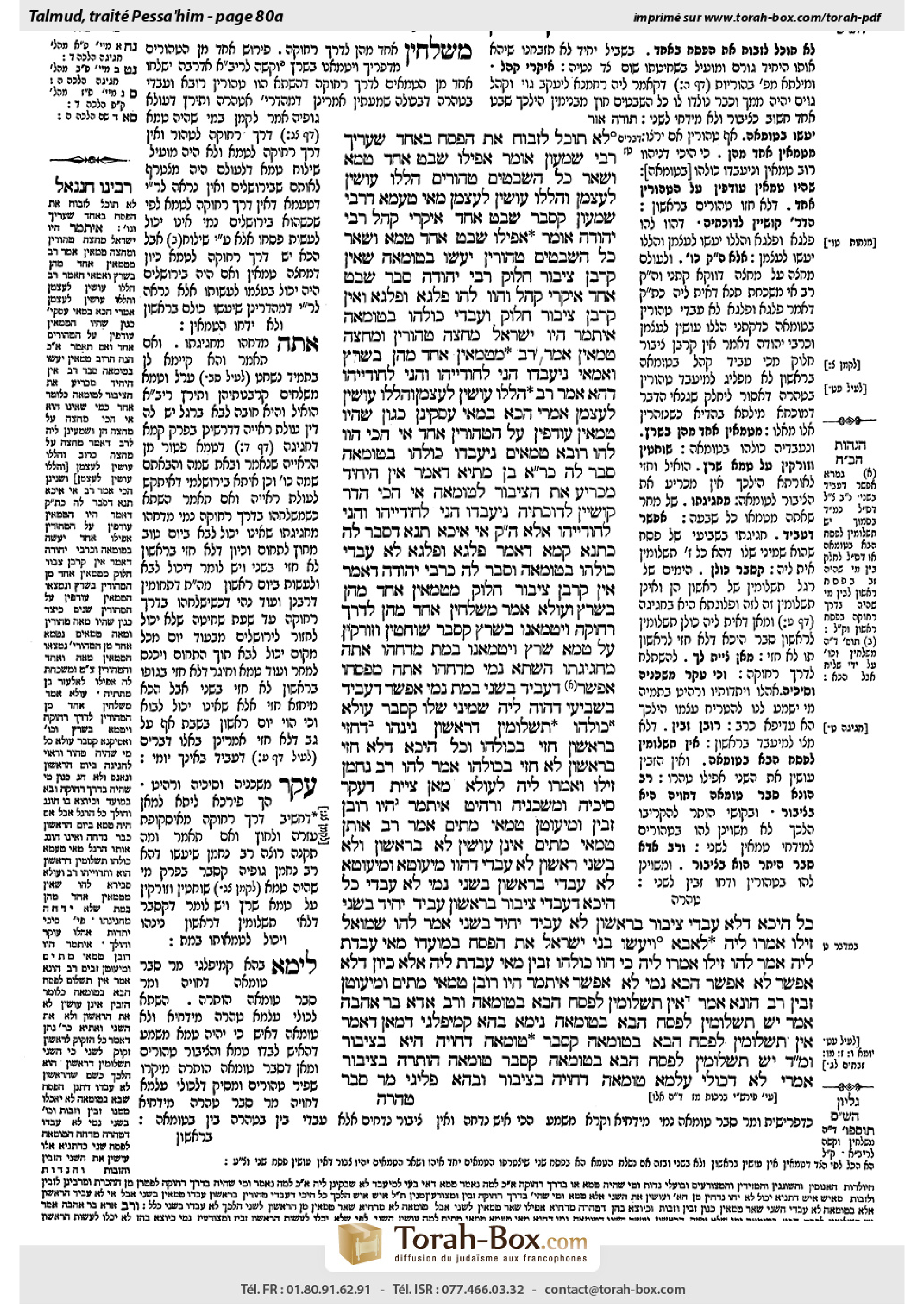
Pesachim 80a: Talmud study for Daf Yomi
Daf Yomi is the daily study of one Talmud folio. Explore 37 tractates with scans, Hebrew text, Sefaria English and AI-generated French translations where annotated.
Passage selection and English or AI-generated French translation are available where the scan has annotations. Daf Study is independent of Torah-Box and Sefaria.
Browse Pesachim · פסחים · All tractatesPesachim 80a text and translations
This page of Pesachim includes the Aramaic text, an English translation and an AI-generated French translation, alongside the scan above.
פסחים פ׳ א · Aramaic and Hebrew text
״לֹא תוּכַל לִזְבֹּחַ אֶת הַפָּסַח בְּאַחַד שְׁעָרֶיךָ״.
רַבִּי שִׁמְעוֹן אוֹמֵר: אֲפִילּוּ שֵׁבֶט אֶחָד טָמֵא וּשְׁאָר כׇּל הַשְּׁבָטִים טְהוֹרִים — הַלָּלוּ עוֹשִׂין לְעַצְמָן וְהַלָּלוּ עוֹשִׂין לְעַצְמָן. מַאי טַעְמָא דְּרַבִּי שִׁמְעוֹן, קָסָבַר: שֵׁבֶט אֶחָד אִיקְּרִי קָהָל.
רַבִּי יְהוּדָה אוֹמֵר: אֲפִילּוּ שֵׁבֶט אֶחָד טָמֵא וּשְׁאָר כׇּל הַשְּׁבָטִים טְהוֹרִין — יַעֲשׂוּ בְּטוּמְאָה, שֶׁאֵין קׇרְבַּן צִיבּוּר חָלוּק. רַבִּי יְהוּדָה סָבַר: שֵׁבֶט אֶחָד אִיקְּרִי קָהָל. וְהָווּ לְהוּ פַּלְגָא וּפַלְגָא, וְאֵין קׇרְבַּן צִיבּוּר חָלוּק — וְעָבְדִי כּוּלְּהוּ בְּטוּמְאָה.
אִיתְּמַר: הָיוּ יִשְׂרָאֵל מֶחֱצָה טְהוֹרִין וּמֶחֱצָה טְמֵאִין, אָמַר רַב: מְטַמְּאִין אֶחָד מֵהֶן בְּשֶׁרֶץ.
וְאַמַּאי? נִיעְבְּדוּ הָנֵי לְחוֹדַיְיהוּ וְהָנֵי לְחוֹדַיְיהוּ, דְּהָא אָמַר רַב: הַלָּלוּ עוֹשִׂין לְעַצְמָן, וְהַלָּלוּ עוֹשִׂין לְעַצְמָן! אָמְרִי: הָכָא בְּמַאי עָסְקִינַן, כְּגוֹן שֶׁהָיוּ טְמֵאִין עוֹדְפִין עַל הַטְּהוֹרִין אֶחָד.
אִי הָכִי, הָווּ לְהוּ רוּבָּא טְמֵאִים? נִיעְבְּדוּ כּוּלְּהוּ בְּטוּמְאָה! סָבַר לַהּ כְּרַבִּי אֶלְעָזָר בֶּן מַתְיָא, דְּאָמַר: אֵין הַיָּחִיד מַכְרִיעַ אֶת הַצִּיבּוּר לְטוּמְאָה. אִי הָכִי, הֲדַר קוּשְׁיַין לְדוּכְתֵּיהּ: נִיעְבְּדוּ הָנֵי לְחוֹדַיְיהוּ וְהָנֵי לְחוֹדַיְיהוּ!
אֶלָּא הָכִי קָאָמַר: אִי אִיכָּא תַּנָּא דְּסָבַר לַהּ כְּתַנָּא קַמָּא, דְּאָמַר: פַּלְגָא וּפַלְגָא לָא עָבְדִי כּוּלְּהוּ בְּטוּמְאָה, וְסָבַר לַהּ כְּרַבִּי יְהוּדָה, דְּאָמַר: אֵין קׇרְבַּן צִיבּוּר חָלוּק — מְטַמְּאִין אֶחָד מֵהֶן בְּשֶׁרֶץ.
וְעוּלָּא אָמַר: מְשַׁלְּחִין אֶחָד מֵהֶן לְדֶרֶךְ רְחוֹקָה. וִיטַמְּאֶנּוּ בְּשֶׁרֶץ!
קָסָבַר: שׁוֹחֲטִין וְזוֹרְקִין עַל טְמֵא שֶׁרֶץ.
וִיטַמְּאֶנּוּ בְּמֵת! מַדְחֵהוּ אַתָּה מֵחֲגִיגָתוֹ.
הַשְׁתָּא נָמֵי מַדְחֵהוּ אַתָּה מִפִּסְחוֹ! אֶפְשָׁר דְּעָבֵיד בַּשֵּׁנִי.
בְּמֵת נָמֵי, אֶפְשָׁר דְּעָבֵיד בַּשְּׁבִיעִי דַּהֲוָה לֵיהּ שְׁמִינִי שֶׁלּוֹ!
קָסָבַר עוּלָּא: כּוּלְּהוּ — תַּשְׁלוּמִין דְּרִאשׁוֹן נִינְהוּ. דַּחֲזֵי בָּרִאשׁוֹן — חֲזֵי בְּכוּלְּהוּ, וְכֹל הֵיכָא דְּלָא חֲזֵי בָּרִאשׁוֹן — לָא חֲזֵי בְּכוּלְּהוּ.
אֲמַר לְהוּ רַב נַחְמָן: זִילוּ וֶאֱמַרוּ לֵיהּ לְעוּלָּא, מַאן צָיֵית דְּעָקַר סִיכֵּיהּ וּמַשְׁכְּנֵיהּ וְרָהֵיט.
אִיתְּמַר: הָיוּ רוּבָּן זָבִין, וּמִיעוּטָן טְמֵאֵי מֵתִים, אָמַר רַב: אוֹתָן טְמֵאֵי מֵתִים אֵינָן עוֹשִׂין לֹא בָּרִאשׁוֹן וְלֹא בַּשֵּׁנִי.
רִאשׁוֹן לָא עָבְדִי, דְּהָווּ מִיעוּטָא, וּמִיעוּטָא לָא עָבְדִי בָּרִאשׁוֹן. בַּשֵּׁנִי נָמֵי לָא עָבְדִי, כׇּל הֵיכָא דְּעָבְדִי צִיבּוּר בָּרִאשׁוֹן — עָבֵיד יָחִיד בַּשֵּׁנִי. כׇּל הֵיכָא דְּלָא עָבְדִי צִיבּוּר בָּרִאשׁוֹן — לָא עָבֵיד יָחִיד בַּשֵּׁנִי.
אֲמַר לְהוּ שְׁמוּאֵל, זִילוּ אֱמַרוּ לֵיהּ לְאַבָּא: ״וְיַעֲשׂוּ בְנֵי יִשְׂרָאֵל אֶת הַפָּסַח בְּמוֹעֲדוֹ״ מַאי עָבְדַתְּ לֵיהּ? אֲמַר לְהוּ, זִילוּ אֱמַרוּ לֵיהּ: כִּי הֲווֹ כּוּלְּהוּ זָבִין מַאי עָבְדַתְּ לֵיהּ? אֶלָּא כֵּיוָן דְּלָא אֶפְשָׁר — לָא אֶפְשָׁר. הָכָא נָמֵי, לָא אֶפְשָׁר.
אִיתְּמַר: הָיוּ רוּבָּן טְמֵאֵי מֵתִים וּמִיעוּטָן זָבִין,
רַב הוּנָא אָמַר: אֵין תַּשְׁלוּמִין לְפֶסַח הַבָּא בְּטוּמְאָה, וְרַב אַדָּא בַּר אַהֲבָה אָמַר: יֵשׁ תַּשְׁלוּמִין לְפֶסַח הַבָּא בְּטוּמְאָה.
נֵימָא בְּהָא קָמִיפַּלְגִי, דְּמַאן דְּאָמַר: אֵין תַּשְׁלוּמִין לְפֶסַח הַבָּא בְּטוּמְאָה, קָסָבַר: טוּמְאָה דְּחוּיָה הִיא בְּצִיבּוּר.
וּמַאן דְּאָמַר: יֵשׁ תַּשְׁלוּמִין לְפֶסַח הַבָּא בְּטוּמְאָה, קָסָבַר: טוּמְאָה הוּתְּרָה בְּצִיבּוּר.
אָמְרִי: לָא. דְּכוּלֵּי עָלְמָא טוּמְאָה דְּחוּיָה בְּצִיבּוּר, וּבְהָא פְּלִיגִי: מָר סָבַר —
Pesachim 80a · English translation
“You may not sacrifice the Paschal lamb in any one of your cities” (Deuteronomy 16:5). Rabbi Elazar ben Matya derived from the expression “in any one” that one person cannot be the determining factor in whether the community sacrifices the Paschal lamb in a state of ritual purity or impurity.
Rabbi Shimon says: Even if one tribe is ritually impure and all the rest of the tribes are pure, those tribes who are ritually pure perform the ritual of the Paschal lamb for themselves in a state of purity, and those members of the tribe that is impure perform the ritual of the Paschal lamb for themselves in a state of ritual impurity. The Gemara asks: What is the reason for the opinion of Rabbi Shimon? The Gemara answers: He holds that one tribe is called a community, and a community may sacrifice the Paschal lamb in a state of impurity.
Rabbi Yehuda says: Even if one tribe is impure and all the rest of the tribes are pure, all the tribes may perform the ritual of the Paschal lamb in a state of ritual impurity, as a communal offering is not divided. The Gemara explains that Rabbi Yehuda holds that one tribe is called a community, and since an entire community is impure, it is considered as though half the Jewish people were pure and half were impure. And a communal offering is not divided. Therefore, all of them may perform the ritual of the Paschal lamb in a state of ritual impurity.
It was stated that the amora’im disputed the following issue: If the Jewish people were divided, and exactly half were pure and half were impure, Rav said: They render impure one of those who was pure with a creeping animal. The majority of the people will then be ritually impure and they may all sacrifice the Paschal lamb in a state of ritual impurity.
The Gemara asks: Why do so? Let those who are pure perform the ritual of the Paschal lamb on their own in a state of purity and those who are impure perform the ritual of the Paschal lamb on their own in a state of impurity. Didn’t Rav himself say: If half the community is ritually pure and half is ritually impure, those who are pure perform the ritual of the Paschal lamb for themselves and those who are impure perform the ritual of the Paschal lamb for themselves? Say in answer to this question: With what are we dealing here? We are dealing with a unique circumstance where the ritually impure outnumbered the ritually pure by one person.
The Gemara challenges this answer: If so, the majority of the community is impure. Therefore, let them all perform the ritual of the Paschal lamb in a state of impurity. The Gemara answers: Rav holds in accordance with the opinion of Rabbi Elazar ben Matya, who said: An individual cannot tip the balance of the community toward ritual impurity. The Gemara asks: If so, our question has returned to its place. If this situation is considered half and half, let those who are pure perform the ritual of the Paschal lamb on their own in a state of purity and those who are impure perform the ritual of the Paschal lamb on their own in a state of impurity.
Rather, this is what Rav said: If there is a tanna who holds in accordance with the opinion of the first tanna, who said that in a case where half the community is pure and half is impure, they do not all perform the ritual of the Paschal lamb in a state of impurity, and also holds in accordance with the opinion of Rabbi Yehuda, who said that a communal offering is not divided, there is no way to solve the problem other than to render impure one of those who were pure with a creeping animal.
And Ulla said: They do not render one of them impure with a creeping animal. Rather, they send one of them who is pure to a distant place, so that the majority of the community that is present at the Temple will be ritually impure, and they will all sacrifice the Paschal lamb in a state of ritual impurity. The Gemara suggests: Let them render him impure with a creeping animal as Rav said, which is easier to implement.
The Gemara responds: Ulla holds that one may slaughter the Paschal lamb and sprinkle its blood even for someone who is ritually impure from a creeping animal because he can become ritually pure by the evening and eat from the Paschal lamb. Therefore, rendering someone impure with a creeping animal does not disqualify him from participating in the Paschal lamb in a state of purity.
The Gemara suggests: Let them render him impure with a corpse, which causes ritual impurity for seven days. The Gemara responds that this solution is not implemented because you would defer him from his Festival peace-offering. Since he would be impure for the entire Festival, he would be unable to sacrifice a Festival peace-offering, which is the peace-offering brought by each person who visits the Temple on the Festival. He would needlessly be prevented from performing a mitzva.
The Gemara challenges this response: Now, too, by sending one pure person to a distant place, you disqualify him from sacrificing his Paschal lamb and prevent him from performing a mitzva. The Gemara answers: His sacrifice of the Paschal lamb will not necessarily be totally disqualified. It is possible that he will perform the ritual of the Paschal lamb on the second Pesaḥ.
The Gemara challenges this response: With regard to ritual impurity from a corpse also, it is possible that he will perform the ritual of the Festival peace-offering on the seventh day of Passover, which is his eighth day of ritual impurity, since he became impure on the eve of Passover. He can become ritually pure by the seventh day and still sacrifice a Festival peace-offering.
The Gemara answers: Ulla holds that all the days of the Festival on which one may sacrifice a Festival peace-offering are redress for what one was obligated but unable to bring on the first day. Therefore, one who is fit to bring the offering on the first day is fit on all of them, and whenever one is not fit on the first day, he is not fit on all of them. Consequently, one who is impure on the first day of the Festival is unable to sacrifice a Festival peace-offering the rest of the Festival.
Rav Naḥman said to the students: Go and say to Ulla that his solution is not practical. Who will listen to uproot his pegs and tent and run to a distant place?
It was stated that the amora’im discussed the following matter: If the majority of the public were zavim and a minority of them were ritually impure from impurity imparted by a corpse, what should they do? The halakha is that even if the majority of the public has the status of zavim, they may not sacrifice the Paschal lamb in a state of impurity. Rav said: Those who are impure from impurity imparted by a corpse do not perform the ritual of the Paschal lamb on the first Pesaḥ or on the second Pesaḥ.
Rav explains: On the first Pesaḥ they do not perform the ritual of the Paschal lamb because they are the minority, and the minority may not perform the ritual of the Paschal lamb on the first Pesaḥ in a state of impurity. On the second Pesaḥ, they also do not perform the ritual of the Paschal lamb because whenever the community performs the ritual of the Paschal lamb on the first Pesaḥ, the individual performs the ritual of the Paschal lamb on the second. Conversely, whenever the community does not perform the ritual of the Paschal lamb on the first Pesaḥ, the individual does not perform the ritual of the Paschal lamb on the second Pesaḥ.
Shmuel said to those who informed him of Rav’s ruling: Go and say to Rav, whose first name was Abba: What do you do with the following verse: “Let the children of Israel offer the Paschal lamb in its appointed time” (Numbers 9:2)? Rav said to those who transmitted Shmuel’s objection: Go and say to him: When they are all zavim, what do you do? Rather, you are forced to say that since it is impossible to fulfill the mitzva, it is impossible. Here, too, it is impossible.
It was stated that the amora’im discussed the following matter: The majority of the public were ritually impure from impurity imparted by a corpse on the first Pesaḥ, so that the Paschal lamb is sacrificed in a state of impurity, and a minority of them were zavim, whose impurity does not permit them to sacrifice the Paschal lamb on the first Pesaḥ.
In a case where the zavim became pure in time for the second Pesaḥ, Rav Huna said: There is no redress for a Paschal lamb that is brought in ritual impurity. Since the Paschal lamb was sacrificed in a state of impurity on the first Pesaḥ, it cannot be sacrificed on the second Pesaḥ that year. And Rav Adda bar Ahava said: There is redress for a Paschal lamb that is brought in a state of impurity. Therefore, one who was unable to participate when the public sacrificed the Paschal lamb in a state of impurity may still bring the Paschal lamb on the second Pesaḥ.
The Gemara suggests: Let us say that they disagree about the following: Rav Huna, the one who said there is no redress for a Paschal lamb that is brought in a state of impurity, holds that ritual impurity is merely overridden in cases involving the public. It is not fully permitted. Therefore, although those who are impure are deferred to the second Pesaḥ when the Paschal lamb is brought in a state of purity, there is no indication that the same is true when it is brought on the first Pesaḥ in a state of impurity.
Conversely, Rav Adda bar Ahava, the one who said there is redress for a Paschal lamb that is brought in ritual impurity, holds that ritual impurity is wholly permitted in cases involving the public. Therefore, it is considered as though the Paschal lamb were sacrificed on the first Pesaḥ in a state of purity, and those who were unable to sacrifice the Paschal lamb on the first Pesaḥ sacrifice it on the second Pesaḥ.
Say: No, it is unnecessary to accept this assumption. It is possible that everyone agrees that ritual impurity is overridden in cases involving the public, and they disagree about this other issue: This Master, Rav Huna, who said there is no redress, holds:
Pesachim 80a · Traduction française (IA)
« Vous ne sacrifierez pas le Pessa’h dans l’une quelconque de vos villes » (Deutéronome 16,5). Rabbi Elazar ben Matya déduit de l’expression « dans l’une quelconque » qu’un seul individu ne peut pas faire pencher la balance et déterminer si la communauté sacrifie le Pessa’h en état de pureté ou d’impureté rituelle.
Rabbi Shimon dit : même si une tribu est rituellement impure et que toutes les autres tribus sont pures, les tribus pures accomplissent pour elles-mêmes le rituel du Pessa’h en état de pureté, tandis que les membres de la tribu impure l’accomplissent pour eux-mêmes en état d’impureté rituelle. La Guemara demande : quelle est la raison de l’opinion de Rabbi Shimon ? La Guemara répond : il estime qu’une tribu est considérée comme une communauté, et qu’une communauté peut sacrifier le Pessa’h en état d’impureté.
Rabbi Yehuda dit : même si une tribu est impure et que toutes les autres tribus sont pures, toutes les tribus peuvent accomplir le rituel du Pessa’h en état d’impureté rituelle, car une offrande communautaire ne se divise pas. La Guemara explique que Rabbi Yehuda estime qu’une tribu est considérée comme une communauté et que, puisqu’une communauté entière est impure, c’est comme si la moitié du peuple juif était pure et l’autre moitié impure. Or, une offrande communautaire ne se divise pas. Par conséquent, tous peuvent accomplir le rituel du Pessa’h en état d’impureté rituelle.
Il a été dit que les amoraïm ont débattu de la question suivante : si le peuple juif était divisé exactement en deux, une moitié pure et l’autre impure, Rav dit : ils rendent impur l’un de ceux qui étaient purs au moyen d’un animal rampant. La majorité du peuple sera alors rituellement impure, et tous pourront sacrifier le Pessa’h en état d’impureté rituelle.
La Guemara demande : pourquoi agir ainsi ? Que ceux qui sont purs accomplissent de leur côté le rituel du Pessa’h en état de pureté, et que ceux qui sont impurs l’accomplissent de leur côté en état d’impureté. Rav lui-même n’a-t-il pas dit que, si la moitié de la communauté est rituellement pure et l’autre moitié rituellement impure, ceux qui sont purs accomplissent pour eux-mêmes le rituel du Pessa’h et ceux qui sont impurs l’accomplissent pour eux-mêmes ? Réponds à cette question : de quelle situation s’agit-il ici ? D’une situation particulière où les personnes rituellement impures sont plus nombreuses d’une personne que celles qui sont rituellement pures.
La Guemara conteste cette réponse : dans ce cas, la majorité de la communauté est impure. Qu’ils accomplissent donc tous le rituel du Pessa’h en état d’impureté. La Guemara répond : Rav suit l’opinion de Rabbi Elazar ben Matya, qui a dit qu’un individu ne peut pas faire pencher la communauté vers l’impureté rituelle. La Guemara demande : dans ce cas, nous voici revenus à notre question initiale. Si cette situation est considérée comme une égalité entre les deux moitiés, que ceux qui sont purs accomplissent de leur côté le rituel du Pessa’h en état de pureté, et que ceux qui sont impurs l’accomplissent de leur côté en état d’impureté.
En réalité, voici ce que Rav a dit : s’il existe un tanna qui suit l’opinion du premier tanna, selon lequel, lorsque la moitié de la communauté est pure et l’autre moitié impure, tous n’accomplissent pas le rituel du Pessa’h en état d’impureté, et qui suit également l’opinion de Rabbi Yehuda, selon lequel une offrande communautaire ne se divise pas, la seule solution est de rendre impur au moyen d’un animal rampant l’un de ceux qui étaient purs.
Et Ulla a dit : ils ne rendent pas l’un d’eux impur au moyen d’un animal rampant. Ils envoient plutôt l’un de ceux qui sont purs dans un lieu éloigné, de sorte que la majorité de la communauté présente au Temple soit rituellement impure et que tous sacrifient le Pessa’h en état d’impureté rituelle. La Guemara suggère : qu’ils le rendent impur au moyen d’un animal rampant, comme le dit Rav ; ce serait plus facile à mettre en œuvre.
La Guemara répond : Ulla estime qu’on peut égorger le Pessa’h et en asperger le sang même pour quelqu’un qui est rituellement impur à cause d’un animal rampant, car il peut redevenir rituellement pur le soir et manger du Pessa’h. Par conséquent, rendre quelqu’un impur au moyen d’un animal rampant ne l’empêche pas de participer au Pessa’h en état de pureté.
La Guemara suggère : qu’ils le rendent impur au contact d’un cadavre, ce qui entraîne une impureté rituelle de sept jours. La Guemara répond que cette solution n’est pas mise en œuvre, car on le priverait ainsi de son offrande de paix de pèlerinage. Puisqu’il serait impur pendant toute la fête, il ne pourrait pas offrir l’offrande de paix que présente chaque personne qui se rend au Temple pour la fête. On l’empêcherait ainsi inutilement d’accomplir une mitsva.
La Guemara conteste cette réponse : même à présent, en envoyant une personne pure dans un lieu éloigné, vous l’empêchez d’offrir son Pessa’h et de réaliser une mitsva. La Guemara répond : son sacrifice du Pessa’h ne sera pas nécessairement entièrement empêché. Il est possible qu’il accomplisse le rituel du second Pessa’h.
La Guemara conteste cette réponse : même en cas d’impureté due à un cadavre, il est possible qu’il accomplisse le rituel de l’offrande de paix de pèlerinage le septième jour de Pessa’h, qui est son huitième jour d’impureté rituelle, puisqu’il est devenu impur la veille de Pessa’h. Il peut redevenir rituellement pur avant le septième jour et offrir malgré tout une offrande de paix de pèlerinage.
La Guemara répond : Ulla estime que tous les jours de la fête où l’on peut offrir une offrande de paix de pèlerinage permettent de compenser ce qu’on était tenu d’offrir, mais qu’on n’a pas pu apporter, le premier jour. Par conséquent, celui qui est apte à apporter l’offrande le premier jour l’est aussi tous les autres jours, et celui qui n’est pas apte le premier jour ne l’est aucun des autres jours. Ainsi, celui qui est impur le premier jour de la fête ne peut pas offrir d’offrande de paix de pèlerinage pendant le reste de la fête.
Rav Naḥman dit aux étudiants : allez dire à Ulla que sa solution n’est pas praticable. Qui acceptera de démonter ses piquets et sa tente pour partir en courant vers un lieu éloigné ?
Il a été dit que les amoraïm ont débattu de la question suivante : si la majorité du public était composée de zavim et qu’une minorité était rituellement impure à cause d’un cadavre, que doivent-ils faire ? Selon la halakha, même si la majorité du public a le statut de zavim, ils ne peuvent pas sacrifier le Pessa’h en état d’impureté. Rav dit : ceux qui sont impurs à cause d’un cadavre n’accomplissent le rituel du Pessa’h ni lors du premier Pessa’h ni lors du second.
Rav explique : ils n’accomplissent pas le rituel du premier Pessa’h parce qu’ils sont minoritaires et qu’une minorité ne peut pas accomplir le rituel du premier Pessa’h en état d’impureté. Ils n’accomplissent pas non plus le rituel du second Pessa’h, car, chaque fois que la communauté accomplit le rituel du premier Pessa’h, l’individu accomplit celui du second. Inversement, chaque fois que la communauté n’accomplit pas le rituel du premier Pessa’h, l’individu n’accomplit pas celui du second.
Shmuel dit à ceux qui lui rapportèrent la décision de Rav : allez dire à Rav, dont le prénom était Abba : que faites-vous du verset suivant : « Que les enfants d’Israël offrent le Pessa’h au temps fixé » (Nombres 9,2) ? Rav dit à ceux qui lui transmirent l’objection de Shmuel : allez lui dire : que faites-vous lorsque tous sont zavim ? Vous êtes bien obligés de conclure que, puisqu’il est impossible d’accomplir la mitsva, on ne peut pas l’accomplir. Ici aussi, c’est impossible.
Il a été dit que les amoraïm ont débattu de la question suivante : la majorité du public était rituellement impure à cause d’un cadavre lors du premier Pessa’h, si bien que le Pessa’h est sacrifié en état d’impureté, tandis qu’une minorité était composée de zavim, dont l’impureté ne leur permet pas de sacrifier le Pessa’h lors du premier Pessa’h.
Dans le cas où les zavim sont redevenus purs à temps pour le second Pessa’h, Rav Huna dit : il n’y a pas de rattrapage pour un Pessa’h apporté en état d’impureté rituelle. Puisque le Pessa’h a été sacrifié en état d’impureté lors du premier Pessa’h, il ne peut pas être sacrifié lors du second Pessa’h cette année-là. Rav Adda bar Ahava dit : il y a un rattrapage pour un Pessa’h apporté en état d’impureté. Par conséquent, celui qui n’a pas pu participer lorsque le public a sacrifié le Pessa’h en état d’impureté peut encore apporter le Pessa’h lors du second Pessa’h.
La Guemara suggère : peut-on dire qu’ils sont en désaccord sur la question suivante ? Rav Huna, qui dit qu’il n’y a pas de rattrapage pour un Pessa’h apporté en état d’impureté, estime que l’impureté rituelle n’est que repoussée, à titre dérogatoire, dans les cas concernant le public ; elle n’est pas pleinement autorisée. Par conséquent, bien que les personnes impures soient renvoyées au second Pessa’h lorsque le Pessa’h est apporté en état de pureté, rien ne permet de conclure qu’il en va de même lorsqu’il est apporté lors du premier Pessa’h en état d’impureté.
Inversement, Rav Adda bar Ahava, qui dit qu’il y a un rattrapage pour un Pessa’h apporté en état d’impureté rituelle, estime que l’impureté rituelle est pleinement permise dans les cas concernant le public. On considère donc que le Pessa’h a été sacrifié lors du premier Pessa’h en état de pureté, et ceux qui n’ont pas pu le sacrifier lors du premier Pessa’h le sacrifient lors du second.
Réponds : non, il n’est pas nécessaire d’accepter cette hypothèse. Il est possible que tous soient d’accord pour dire que l’impureté rituelle n’est que repoussée, à titre dérogatoire, dans les cas concernant le public, et qu’ils soient en désaccord sur cette autre question : ce maître, Rav Huna, qui a dit qu’il n’y a pas de rattrapage, estime que…
Traduction française générée par IA à partir de l’édition anglaise de Sefaria. Vérifie toujours un passage avec le texte source.
Text from Sefaria: William Davidson Edition - Vocalized Aramaic (CC BY NC); William Davidson Edition - English (CC BY NC).