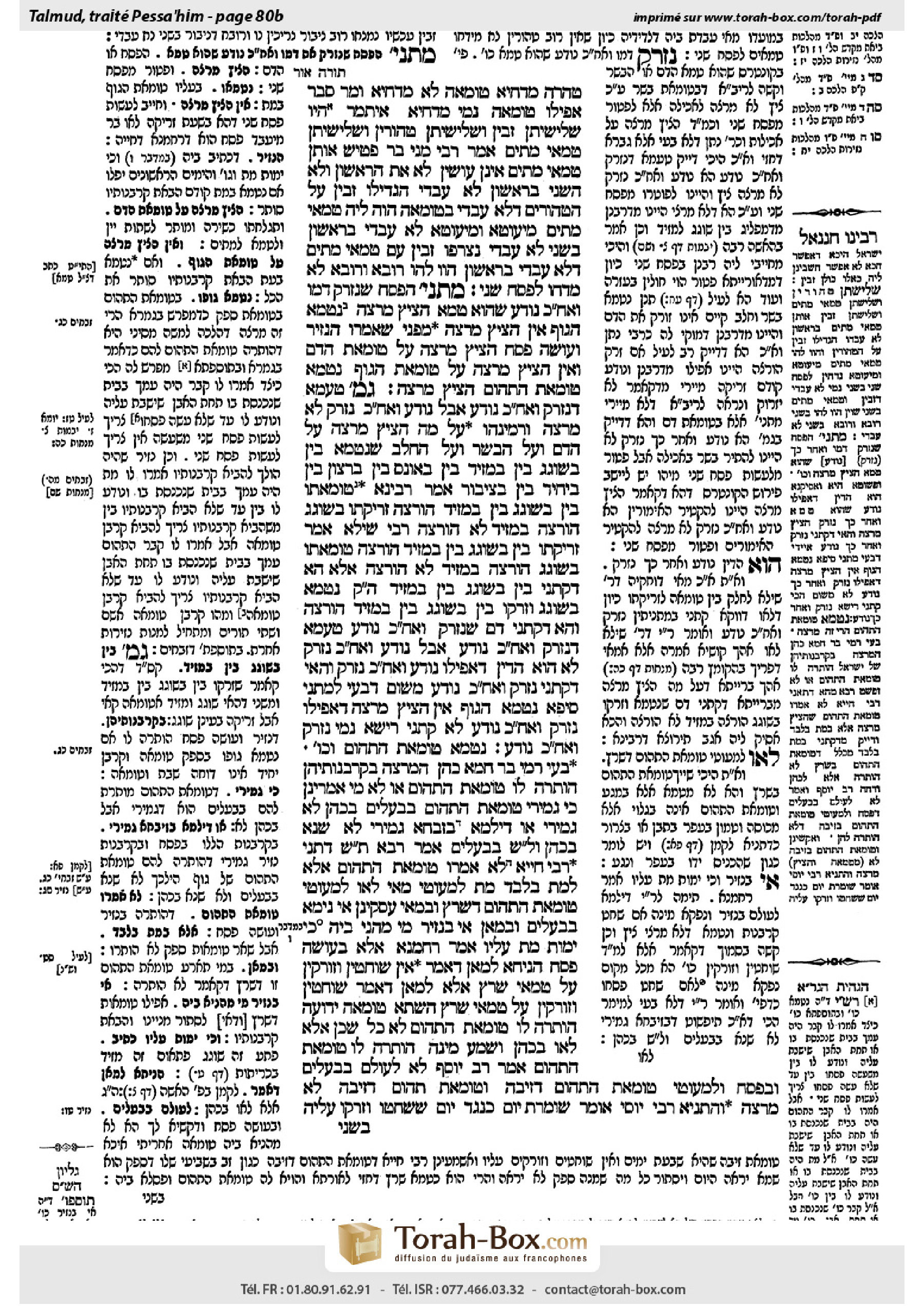
Pesachim 80b: Talmud study for Daf Yomi
Daf Yomi is the daily study of one Talmud folio. Explore 37 tractates with scans, Hebrew text, Sefaria English and AI-generated French translations where annotated.
Passage selection and English or AI-generated French translation are available where the scan has annotations. Daf Study is independent of Torah-Box and Sefaria.
Browse Pesachim · פסחים · All tractatesPesachim 80b text and translations
This page of Pesachim includes the Aramaic text, an English translation and an AI-generated French translation, alongside the scan above.
פסחים פ׳ ב · Aramaic and Hebrew text
טׇהֳרָה מְדַחֲיָא, טוּמְאָה לָא מְדַחֲיָא. וּמָר סָבַר — אֲפִילּוּ טוּמְאָה נָמֵי מְדַחֲיָא.
אִיתְּמַר: הָיוּ שְׁלִישִׁיתָן זָבִין, וּשְׁלִישִׁיתָן טְהוֹרִין, וּשְׁלִישִׁיתָן טְמֵאֵי מֵתִים — אָמַר רַבִּי מָנִי בַּר פַּטִּישׁ: אוֹתָן טְמֵאֵי מֵתִים אֵינָן עוֹשִׂין לֹא אֶת הָרִאשׁוֹן וְלֹא הַשֵּׁנִי.
בָּרִאשׁוֹן לָא עָבְדִי: הִגְדִּילוּ זָבִין עַל הַטְּהוֹרִים, דְּלָא עָבְדִי בְּטוּמְאָה, הָוֵה לֵיהּ טְמֵאֵי מֵתִים מִיעוּטָא — וּמִיעוּטָא לָא עָבְדִי בָּרִאשׁוֹן. בַּשֵּׁנִי לָא עָבְדִי: נִצָּרְפוּ זָבִין עִם טְמֵאֵי מֵתִים, דְּלָא עָבְדִי בָּרִאשׁוֹן, הָווּ לְהוּ רוּבָּא — וְרוּבָּא לָא מִדְּחוּ לְפֶסַח שֵׁנִי.
מַתְנִי׳ הַפֶּסַח שֶׁנִּזְרַק דָּמוֹ וְאַחַר כָּךְ נוֹדַע שֶׁהוּא טָמֵא — הַצִּיץ מְרַצֶּה. נִטְמָא הַגּוּף — אֵין הַצִּיץ מְרַצֶּה, מִפְּנֵי שֶׁאָמְרוּ: הַנָּזִיר וְעוֹשֵׂה פֶסַח, הַצִּיץ מְרַצֶּה עַל טוּמְאַת הַדָּם, וְאֵין הַצִּיץ מְרַצֶּה עַל טוּמְאַת הַגּוּף.
נִטְמָא טוּמְאַת הַתְּהוֹם — הַצִּיץ מְרַצֶּה.
גְּמָ׳ טַעְמָא דְּנִזְרַק וְאַחַר כָּךְ נוֹדַע, אֲבָל נוֹדַע וְאַחַר כָּךְ נִזְרַק — לֹא מְרַצֶּה.
וּרְמִינְהוּ: עַל מָה הַצִּיץ מְרַצֶּה? עַל הַדָּם וְעַל הַבָּשָׂר וְעַל הַחֵלֶב שֶׁנִּטְמָא, בֵּין בְּשׁוֹגֵג בֵּין בְּמֵזִיד, בֵּין בְּאוֹנֶס בֵּין בְּרָצוֹן, בֵּין בְּיָחִיד בֵּין בְּצִיבּוּר!
אָמַר רָבִינָא: טוּמְאָתוֹ, בֵּין בְּשׁוֹגֵג בֵּין בְּמֵזִיד — הוּרְצָה. זְרִיקָתוֹ, בְּשׁוֹגֵג — הוּרְצָה, בְּמֵזִיד — לֹא הוּרְצָה.
רַבִּי שֵׁילָא אָמַר: זְרִיקָתוֹ, בֵּין בְּשׁוֹגֵג בֵּין בְּמֵזִיד — הוּרְצָה. טוּמְאָתוֹ, בְּשׁוֹגֵג — הוּרְצָה, בְּמֵזִיד — לֹא הוּרְצָה.
אֶלָּא הָא דְּקָתָנֵי: בֵּין בְּשׁוֹגֵג בֵּין בְּמֵזִיד, הָכִי קָאָמַר: נִטְמָא בְּשׁוֹגֵג, וּזְרָקוֹ בֵּין בְּשׁוֹגֵג בֵּין בְּמֵזִיד — הוּרְצָה.
וְהָא דְּקָתָנֵי: דָּם שֶׁנִּזְרַק וְאַחַר כָּךְ נוֹדַע, טַעְמָא דְּנִזְרַק וְאַחַר כָּךְ נוֹדַע, אֲבָל נוֹדַע וְאַחַר כָּךְ נִזְרָק — לָא, הוּא הַדִּין דַּאֲפִילּוּ נוֹדַע וְאַחַר כָּךְ נִזְרַק.
וְהַאי דְּקָתָנֵי נִזְרַק וְאַחַר כָּךְ נוֹדַע, מִשּׁוּם דְּבָעֵי לְמִתְנֵי סֵיפָא: נִטְמָא הַגּוּף אֵין הַצִּיץ מְרַצֶּה, דַּאֲפִילּוּ נִזְרַק וְאַחַר כָּךְ נוֹדַע — לָא, קָתָנֵי רֵישָׁא נָמֵי: נִזְרַק וְאַחַר כָּךְ נוֹדַע.
נִטְמָא טוּמְאַת הַתְּהוֹם וְכוּ׳. בָּעֵי רָמֵי בַּר חָמָא: כֹּהֵן הַמְרַצֶּה בְּקׇרְבְּנוֹתֵיהֶן, הוּתְּרָה לוֹ טוּמְאַת הַתְּהוֹם, אוֹ לָא? מִי אָמְרִינַן כִּי גְּמִירִי טוּמְאַת הַתְּהוֹם — בִּבְעָלִים, בְּכֹהֵן — לָא גְּמִירִי, אוֹ דִילְמָא: בְּזִבְחָא גְּמִירִי, לָא שְׁנָא בְּכֹהֵן וְלָא שְׁנָא בִּבְעָלִים.
אָמַר רָבָא: תָּא שְׁמַע, דְּתָנֵי רַבִּי חִיָּיא: לֹא אָמְרוּ טוּמְאַת הַתְּהוֹם אֶלָּא לְמֵת בִּלְבַד. מֵת לְמַעוֹטֵי מַאי? לָאו לְמַעוֹטֵי טוּמְאַת הַתְּהוֹם דְּשֶׁרֶץ?
וּבְמַאי עָסְקִינַן? אִי נֵימָא בִּבְעָלִים, וּבְמַאן — אִי בְּנָזִיר, מִי מַהֲנֵי בֵּיהּ? ״כִּי יָמוּת מֵת עָלָיו״ אָמַר רַחֲמָנָא.
אֶלָּא בְּעוֹשֵׂה פֶסַח. הָנִיחָא לְמַאן דְּאָמַר אֵין שׁוֹחֲטִין וְזוֹרְקִין עַל טְמֵאֵי שֶׁרֶץ. אֶלָּא לְמַאן דְּאָמַר שׁוֹחֲטִין וְזוֹרְקִין עַל טְמֵאֵי שֶׁרֶץ, הַשְׁתָּא טוּמְאָה יְדוּעָה הוּתְּרָה לוֹ, טוּמְאַת הַתְּהוֹם לֹא כׇּל שֶׁכֵּן?!
אֶלָּא לָאו — בְּכֹהֵן, וּשְׁמַע מִינַּהּ הוּתְּרָה לוֹ טוּמְאַת הַתְּהוֹם!
אָמַר רַב יוֹסֵף: לֹא, לְעוֹלָם בִּבְעָלִים, וּבְפֶסַח. וּלְמַעוֹטֵי טוּמְאַת הַתְּהוֹם דְּזִיבָה.
וְטוּמְאַת תְּהוֹם דְּזִיבָה לֹא מְרַצֶּה? וְהָתַנְיָא, רַבִּי יוֹסֵי אוֹמֵר: שׁוֹמֶרֶת יוֹם כְּנֶגֶד יוֹם שֶׁשָּׁחֲטוּ וְזָרְקוּ עָלֶיהָ
Pesachim 80b · English translation
A Paschal lamb offered in a state of purity defers those who are unable to bring the offering to the second Pesaḥ, but a Paschal lamb brought in a state of impurity does not defer those who are unable to bring the offering to the second Pesaḥ. And this Master, Rav Adda bar Ahava, who said there is redress, holds that even a Paschal lamb offered in a state of ritual impurity defers those who are unable to bring the offering to the second Pesaḥ.
It was stated that the Sages discussed the following matter: If one-third of the members of the community were zavim, and one-third of them were ritually pure, and one-third of them were ritually impure with impurity imparted by a corpse, what is the halakha? Rabbi Manni bar Pattish said: Those who were ritually impure with impurity imparted by a corpse do not perform the ritual of the Paschal lamb on the first Pesaḥ or the second Pesaḥ.
On the first Pesaḥ, they do not perform the ritual of the Paschal lamb because the zavim increased the number of the ritually pure, as zavim may not perform the ritual of the Paschal lamb in a state of impurity. Therefore, the ritually impure with impurity imparted by a corpse are the minority, and a minority may not perform the ritual of the Paschal lamb in a state of ritual impurity on the first Pesaḥ. On the second Pesaḥ, they may not perform the ritual of the Paschal lamb for a different reason: The zavim are joined with those who were ritually impure with impurity imparted by a corpse, who did not perform the ritual of the Paschal lamb on the first Pesaḥ. Consequently, they are the majority, and the offering of the majority is not deferred to the second Pesaḥ.
MISHNA: In a case of a Paschal lamb whose blood was sprinkled and subsequently it became known that the meat or blood was ritually impure, the frontplate of the High Priest appeases God for the ritual impurity after the fact, and the owners are exempt from observing the second Pesaḥ. If it became known later that the body of the individual who brought the Paschal lamb had become ritually impure, the frontplate does not appease God. The individual has not fulfilled his obligation to bring the Paschal lamb, and therefore he must observe the second Pesaḥ. This is because the Sages said that with regard to the nazirite and one who performs the ritual of the Paschal lamb, the frontplate appeases God for both impurity of the blood and meat of the offering, but the frontplate does not appease God for impurity of the body of the individual bringing the offering.
The mishna introduces a halakha with regard to ritual impurity of the deep, a term that refers to a source of impurity that is unknown to anyone and is discovered only after it has rendered someone impure. If it became known after the offering was brought that the person had become impure due to ritual impurity of the deep, e.g., if he was informed that there was a concealed grave under the place he had sat in a house where he had previously stayed, the frontplate appeases God and the offering is valid.
GEMARA: The Gemara begins with an inference with regard to a Paschal lamb that is found to be ritually impure after its blood was sprinkled. The reason the frontplate appeases God is that the blood was sprinkled and it subsequently became known that it was ritually impure. However, if it became known that it was ritually impure and its blood was subsequently sprinkled, the frontplate does not appease God and the offering is disqualified.
The Gemara raises a contradiction from what was taught in a baraita: For what does the frontplate appease God? It appeases God for the blood and the meat and the fat that became impure, whether unwittingly or intentionally, whether by circumstances beyond his control or willfully, and whether the offering belonged to an individual or the public. This indicates that the frontplate appeases God even when the blood was sprinkled, despite the fact that it was already known that the meat or blood was ritually impure.
Ravina said that the baraita should be understood as follows: With regard to its ritual impurity, regardless of whether it became impure unwittingly or intentionally, the frontplate appeases God for the impurity and the offering is accepted. However, with regard to the sprinkling of its blood, if it was unwittingly sprinkled while the meat was ritually impure, then the offering is accepted, but if it was intentionally sprinkled while the meat was impure, it is not accepted.
Rabbi Sheila said that the baraita should be understood as follows: With regard to sprinkling the blood of the impure offering, whether it was done unwittingly or intentionally, it is accepted. However, with regard to the manner in which it contracted its ritual impurity, if it became impure unwittingly the offering is accepted, and if it became impure intentionally it is not accepted.
The Gemara explains: However, that which was taught in the baraita that the frontplate appeases God regardless of whether the impure offering was brought unwittingly or intentionally, this is what it is saying: If the offering became impure unwittingly and one sprinkled its blood, whether unwittingly or intentionally, it is accepted.
And from that which was taught in this mishna with regard to blood that was sprinkled and subsequently it became known that the offering was impure, one should not infer that the reason the frontplate appeases God is specifically that the blood was sprinkled and subsequently it became known that the offering was impure, but if it became known that the offering was impure and subsequently the blood was sprinkled, even unwittingly, the frontplate does not appease God. In fact, the same is true, i.e., the frontplate appeases God, even if the impure status of the offering became known and the blood was subsequently sprinkled.
And that which was taught in the mishna with regard to blood that was sprinkled and subsequently it became known that it was impure, was formulated in that particular way because the tanna wanted to teach the latter clause of the mishna, which states that if the body of the individual bringing the Paschal lamb became impure, the frontplate does not appease God for his impurity. In this case, even if the blood was sprinkled and subsequently it became known that the body of the individual had been impure, the frontplate does not appease God. Therefore, he also taught the first clause in a parallel way, as one in which the blood was sprinkled and subsequently it became known that the offering was impure. However, the halakha holds true even if the ritual impurity of the blood or meat of the offering was known before the sprinkling of the blood.
It was taught in the mishna that if one became ritually impure through impurity of the deep, the frontplate appeases God. Rami bar Ḥama raised a dilemma: With regard to the priest who facilitates acceptance of their offerings, i.e., who performs the service of the Paschal lamb or the offerings of the nazirite, is ritual impurity of the deep permitted for him too or not? Do we say that they learned the leniency of impurity of the deep through oral tradition only with regard to the owners of the offering, but they did not learn through oral tradition that it applies also to a priest? Or perhaps they learned through oral tradition that this leniency applies to the sacrifice of the Paschal lamb and the offering of a nazirite, and therefore it is no different whether the priest was impure or whether the owners were impure.
Rava said: Come and hear a resolution to this question, as Rabbi Ḥiyya taught that they stated the rule of impurity of the deep only with regard to ritual impurity imparted by a corpse. The Gemara infers: Ritual impurity imparted by a corpse was specified to exclude what? Is it not to exclude impurity of the deep of a creeping animal, so that in a case of impurity caused by a creeping animal that had not been known, the frontplate does not appease God?
And with what are we dealing? If we say that we are dealing with a case where the owners became impure, to whom does this apply? If it applies to a nazirite, is impurity imparted by a creeping animal effective in interrupting his term as a nazirite and requiring him to bring offerings? The Merciful One states: “And if any man shall die very suddenly beside him and contaminate his nazirite head, he shall shave his head on the day of his purification; on the seventh day shall he shave it” (Numbers 6:9). This indicates that one’s term as a nazirite is interrupted only due to ritual impurity imparted by a corpse and not due to the impurity imparted by a creeping animal.
Rather, say that we are dealing with one performing the ritual of the Paschal lamb. If so, it works out well according to the one who said one may not slaughter the Paschal lamb and sprinkle its blood for those who are impure from creeping animals, and therefore there is reason to discuss impurity of the deep. However, according to the one who said that one may slaughter and sprinkle the blood of the Paschal lamb for those who are impure from creeping animals so that they will be able to eat its meat at night, when they are pure, now you have said that known impurity is permitted for him, meaning that even when it is clear that one is ritually impure from a creeping animal, he is not prevented from participating in the Paschal lamb. In that case, with regard to impurity of the deep, is it not all the more so true that he is permitted to offer the Paschal lamb?
Rather, is Rabbi Ḥiyya not referring to a priest who has become ritually impure? Learn from here that impurity of the deep is permitted for a priest.
Rav Yosef said: No, this cannot be proven from Rabbi Ḥiyya’s statement. Actually, it is possible to say that Rabbi Ḥiyya was referring to a case where the owners became ritually impure with impurity of the deep, and they intended to offer the Paschal lamb. And the limitation of the leniency to a case of ritual impurity imparted by a corpse is meant to exclude impurity of the deep imparted by the discharge of a zava. The frontplate does not appease God with regard to ritual impurity from impure discharges that are unknown.
The Gemara asks: Does the frontplate not appease God with regard to ritual impurity of the deep imparted by the discharge of a zava? Wasn’t it taught in a baraita that Rabbi Yosei says: A woman who keeps watch a day for a day is a woman who discharges blood for one or two days at a time when she does not expect her menstrual period. The case under discussion is one where she experienced a discharge for one day and they slaughtered a Paschal lamb and sprinkled the blood for her
Pesachim 80b · Traduction française (IA)
Un agneau pascal offert en état de pureté repousse au second Pessa’h ceux qui ne peuvent pas présenter l’offrande, tandis qu’un agneau pascal offert en état d’impureté ne les repousse pas au second Pessa’h. Or, ce maître, Rav Adda bar Ahava, qui a dit qu’il existe une possibilité de rattrapage, considère que même un agneau pascal offert en état d’impureté rituelle repousse au second Pessa’h ceux qui ne peuvent pas présenter l’offrande.
Les Sages ont discuté de la question suivante : si un tiers des membres de la communauté étaient des zavim, un tiers étaient rituellement purs et un tiers étaient rituellement impurs du fait d’un cadavre, quelle est la halakha ? Rabbi Manni bar Pattish a dit : ceux qui étaient rituellement impurs du fait d’un cadavre n’accomplissent le rite de l’agneau pascal ni au premier Pessa’h ni au second Pessa’h.
Au premier Pessa’h, ils n’accomplissent pas le rite de l’agneau pascal, car les zavim augmentent le nombre de ceux qui sont rituellement purs, puisqu’ils ne peuvent pas accomplir ce rite en état d’impureté. Ceux qui sont rituellement impurs du fait d’un cadavre constituent donc une minorité, et une minorité ne peut pas accomplir le rite de l’agneau pascal en état d’impureté rituelle au premier Pessa’h. Au second Pessa’h, ils ne peuvent pas accomplir le rite de l’agneau pascal pour une autre raison : les zavim se joignent à ceux qui étaient rituellement impurs du fait d’un cadavre et qui n’ont pas accompli le rite de l’agneau pascal au premier Pessa’h. Ils constituent donc une majorité, et l’offrande de la majorité n’est pas repoussée au second Pessa’h.
MICHNA : Dans le cas d’un agneau pascal dont le sang a été aspergé, puis dont on a appris que la viande ou le sang étaient rituellement impurs, le pectoral du grand prêtre obtient après coup le pardon divin pour cette impureté, et les propriétaires sont dispensés d’observer le second Pessa’h. Si l’on apprend plus tard que le corps de celui qui avait présenté l’agneau pascal était devenu rituellement impur, le pectoral n’obtient pas le pardon divin. L’individu ne s’est pas acquitté de son obligation de présenter l’agneau pascal et doit donc observer le second Pessa’h. En effet, les Sages ont enseigné que, pour le nazir et celui qui accomplit le rite de l’agneau pascal, le pectoral obtient le pardon divin pour l’impureté du sang et de la viande de l’offrande, mais pas pour l’impureté du corps de celui qui présente l’offrande.
La Michna introduit une halakha concernant l’impureté rituelle profonde, terme qui désigne une source d’impureté inconnue de tous et découverte seulement après qu’elle a rendu quelqu’un impur. Si, après la présentation de l’offrande, on apprend que la personne était devenue impure du fait d’une impureté rituelle profonde — par exemple, si on l’informe qu’une tombe dissimulée se trouvait sous l’endroit où elle s’était assise dans une maison où elle avait séjourné auparavant —, le pectoral obtient le pardon divin et l’offrande est valide.
GUEMARA : La Guemara commence par déduire une règle concernant un agneau pascal qui s’avère rituellement impur après l’aspersion de son sang. Le pectoral obtient le pardon divin parce que le sang a été aspergé, puis l’on a appris que l’offrande était rituellement impure. En revanche, si l’on apprend qu’elle était rituellement impure avant que son sang soit aspergé, le pectoral n’obtient pas le pardon divin et l’offrande est invalidée.
La Guemara soulève une contradiction à partir de ce qui a été enseigné dans une baraïta : pour quoi le pectoral obtient-il le pardon divin ? Il l’obtient pour le sang, la viande et la graisse qui sont devenus impurs, que cela se soit produit par inadvertance ou intentionnellement, indépendamment de la volonté de la personne ou délibérément, et que l’offrande appartienne à un particulier ou à la collectivité. Cela indique que le pectoral obtient le pardon divin même lorsque le sang a été aspergé alors que l’on savait déjà que la viande ou le sang étaient rituellement impurs.
Ravina a dit qu’il faut comprendre la baraïta ainsi : s’agissant de l’impureté rituelle de l’offrande, qu’elle soit devenue impure par inadvertance ou intentionnellement, le pectoral obtient le pardon divin pour cette impureté et l’offrande est agréée. Toutefois, s’agissant de l’aspersion de son sang, si celui-ci a été aspergé par inadvertance alors que la viande était rituellement impure, l’offrande est agréée ; mais s’il a été aspergé intentionnellement alors que la viande était impure, elle n’est pas agréée.
Rabbi Sheila a dit qu’il faut comprendre la baraïta ainsi : s’agissant de l’aspersion du sang de l’offrande impure, que celle-ci ait été faite par inadvertance ou intentionnellement, l’offrande est agréée. En revanche, s’agissant de la manière dont elle a contracté son impureté rituelle, si elle est devenue impure par inadvertance, l’offrande est agréée ; si elle est devenue impure intentionnellement, elle n’est pas agréée.
La Guemara explique : voici ce qu’enseigne la baraïta lorsqu’elle dit que le pectoral obtient le pardon divin, que l’offrande impure ait été présentée par inadvertance ou intentionnellement : si l’offrande est devenue impure par inadvertance et que l’on a aspergé son sang, qu’on l’ait fait par inadvertance ou intentionnellement, elle est agréée.
De ce qui a été enseigné dans cette Michna au sujet du sang aspergé après quoi l’on a appris que l’offrande était impure, il ne faut pas déduire que le pectoral obtient le pardon divin uniquement lorsque le sang a été aspergé avant que l’on apprenne que l’offrande était impure, mais qu’il ne l’obtient pas si l’on apprend que l’offrande était impure avant que le sang soit aspergé, même par inadvertance. En réalité, il en va de même — le pectoral obtient le pardon divin — même si l’on apprend que l’offrande était impure avant que son sang soit aspergé.
La Michna mentionne que le sang a été aspergé avant que l’on apprenne qu’il était impur parce que le tanna voulait enseigner la partie finale de la Michna : si le corps de celui qui présente l’agneau pascal est devenu impur, le pectoral n’obtient pas le pardon divin pour cette impureté. Dans ce cas, même si le sang a été aspergé avant que l’on apprenne que le corps de l’individu était impur, le pectoral n’obtient pas le pardon divin. Le tanna a donc également formulé la partie initiale de manière parallèle, en présentant le cas où le sang a été aspergé avant que l’on apprenne que l’offrande était impure. Toutefois, la halakha s’applique même si l’impureté rituelle du sang ou de la viande de l’offrande était connue avant l’aspersion du sang.
La Michna a enseigné que, si quelqu’un est devenu rituellement impur du fait d’une impureté profonde, le pectoral obtient le pardon divin. Rami bar Ḥama soulève une question : qu’en est-il du prêtre qui permet à leurs offrandes d’être agréées, c’est-à-dire qui accomplit le service de l’agneau pascal ou les rites liés aux offrandes du nazir ? L’impureté rituelle profonde est-elle également permise dans son cas ? Ont-ils appris par tradition orale que l’impureté profonde est permise uniquement pour les propriétaires de l’offrande, sans apprendre qu’elle s’applique également au prêtre ? Ou bien ont-ils appris par tradition orale que cette permission s’applique au sacrifice de l’agneau pascal et à l’offrande du nazir, de sorte qu’il n’y a pas de différence entre le cas où le prêtre est impur et celui où les propriétaires sont impurs ?
Rava a dit : Viens et écoute la réponse à cette question, car Rabbi Ḥiyya a enseigné que la règle de l’impureté profonde a été énoncée uniquement au sujet de l’impureté rituelle transmise par un cadavre. La Guemara en déduit : pourquoi avoir précisé qu’il s’agit de l’impureté rituelle transmise par un cadavre ? N’est-ce pas pour exclure l’impureté profonde due à un reptile, de sorte que, dans un cas d’impureté causée par un reptile dont on ignorait la présence, le pectoral n’obtient pas le pardon divin ?
De quel cas s’agit-il ? Si nous disons qu’il s’agit d’un cas où les propriétaires sont devenus impurs, à qui cela s’applique-t-il ? S’il s’agit d’un nazir, l’impureté transmise par un reptile interrompt-elle son naziréat et l’oblige-t-elle à apporter des offrandes ? Le Miséricordieux dit : « Et si quelqu’un meurt subitement près de lui et souille sa tête de nazir, il se rasera la tête le jour de sa purification ; le septième jour, il la rasera » (Nombres 6, 9). Cela indique que le naziréat n’est interrompu qu’en raison d’une impureté rituelle transmise par un cadavre, et non d’une impureté transmise par un reptile.
Il faut plutôt dire qu’il s’agit de quelqu’un qui accomplit le rite de l’agneau pascal. Dans ce cas, cela s’accorde avec l’opinion selon laquelle on ne peut ni égorger l’agneau pascal ni en asperger le sang pour des personnes impures du fait de reptiles ; il y a donc lieu de discuter de l’impureté profonde. Mais selon l’opinion selon laquelle on peut égorger l’agneau pascal et en asperger le sang pour des personnes impures du fait de reptiles afin qu’elles puissent manger sa viande le soir, lorsqu’elles seront pures, tu as maintenant affirmé que l’impureté connue est permise dans son cas. Autrement dit, même lorsqu’il est certain qu’une personne est rituellement impure du fait d’un reptile, cela ne l’empêche pas de participer au sacrifice pascal. Dans ce cas, s’agissant de l’impureté profonde, n’est-il pas à plus forte raison permis pour lui de présenter l’agneau pascal ?
Rabbi Ḥiyya ne fait-il pas plutôt référence à un prêtre qui est devenu rituellement impur ? Il faut en déduire que l’impureté profonde est permise dans le cas d’un prêtre.
Rav Yosef a dit : Non, on ne peut pas le démontrer à partir de la déclaration de Rabbi Ḥiyya. En réalité, il est possible de dire que Rabbi Ḥiyya faisait référence à un cas où les propriétaires étaient devenus rituellement impurs du fait d’une impureté profonde et où ils avaient l’intention de présenter l’agneau pascal. La restriction de cette permission aux cas d’impureté rituelle transmise par un cadavre vise à exclure l’impureté profonde due à l’écoulement d’une zava. Le pectoral n’obtient pas le pardon divin pour une impureté rituelle due à des écoulements impurs dont la présence est inconnue.
La Guemara demande : Le pectoral n’obtient-il pas le pardon divin pour l’impureté rituelle profonde due à l’écoulement d’une zava ? N’a-t-on pas enseigné dans une baraïta que Rabbi Yosei dit : « Une femme qui observe un jour pour un jour » est une femme qui perd du sang pendant un ou deux jours à un moment où elle ne s’attend pas à avoir ses règles. Le cas dont il est question est celui où elle a eu un écoulement pendant un jour, et où l’on a égorgé un agneau pascal et aspergé son sang pour elle
Traduction française générée par IA à partir de l’édition anglaise de Sefaria. Vérifie toujours un passage avec le texte source.
Text from Sefaria: William Davidson Edition - Vocalized Aramaic (CC BY NC); William Davidson Edition - English (CC BY NC).