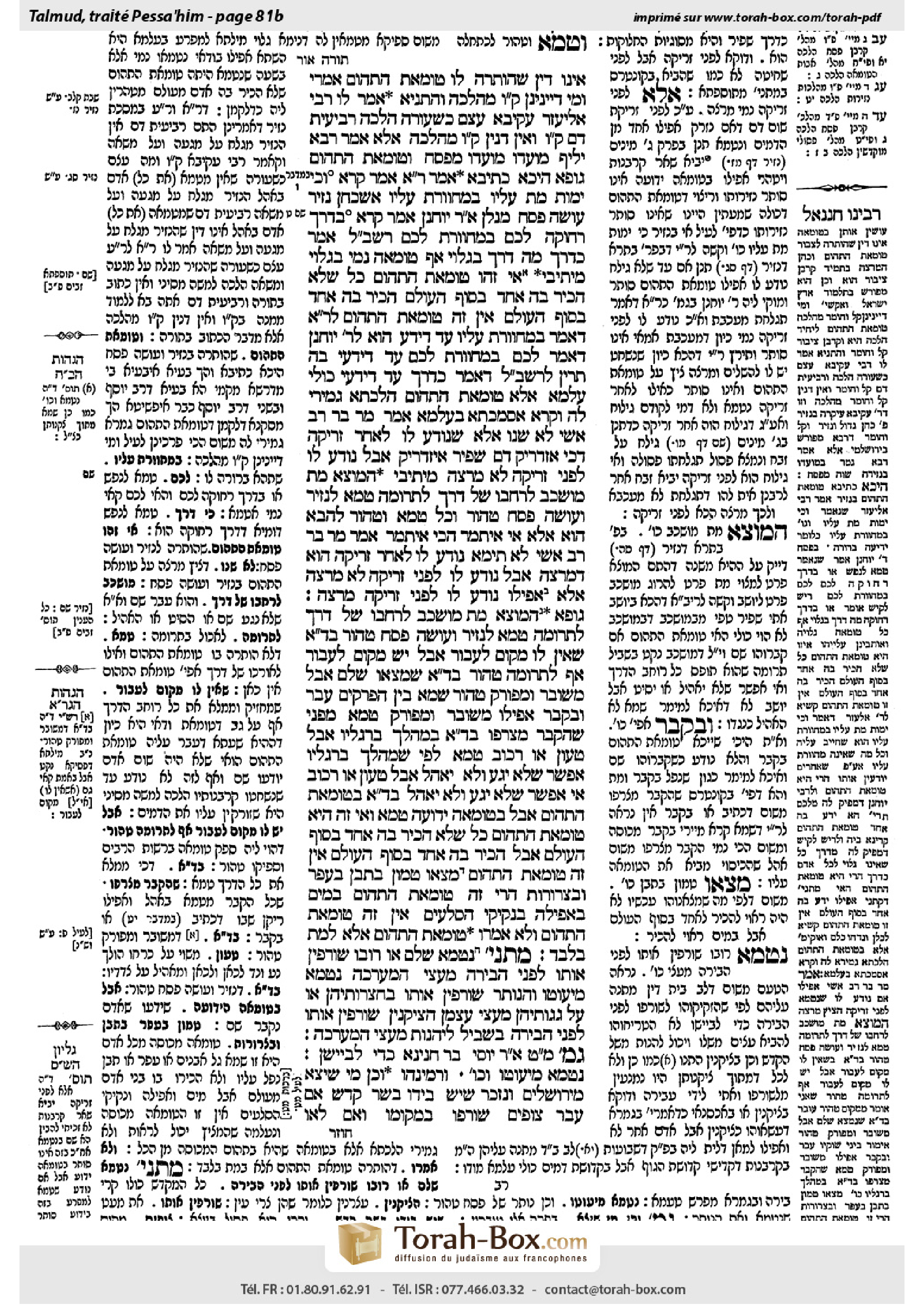
Pesachim 81b: Talmud study for Daf Yomi
Daf Yomi is the daily study of one Talmud folio. Explore 37 tractates with scans, Hebrew text, Sefaria English and AI-generated French translations where annotated.
Passage selection and English or AI-generated French translation are available where the scan has annotations. Daf Study is independent of Torah-Box and Sefaria.
Browse Pesachim · פסחים · All tractatesPesachim 81b text and translations
This page of Pesachim includes the Aramaic text, an English translation and an AI-generated French translation, alongside the scan above.
פסחים פ״א ב · Aramaic and Hebrew text
אֵינוֹ דִּין שֶׁהוּתְּרָה לוֹ טוּמְאַת הַתְּהוֹם!
אָמְרִי: וּמִי דָּיְינִינַן קַל וָחוֹמֶר מֵהֲלָכָה? וְהָתַנְיָא, אָמַר לוֹ רַבִּי אֱלִיעֶזֶר: עֲקִיבָא, עֶצֶם כִּשְׂעוֹרָה הֲלָכָה, רְבִיעִית דָּם קַל וְחוֹמֶר, וְאֵין דָּנִין קַל וָחוֹמֶר מֵהֲלָכָה!
אֶלָּא אָמַר רָבָא: יָלֵיף ״מוֹעֲדוֹ״ ״מוֹעֲדוֹ״ מִפֶּסַח.
וְטוּמְאַת הַתְּהוֹם גּוּפָא הֵיכָא כְּתִיבָא? אָמַר רַבִּי אֶלְעָזָר, אָמַר קְרָא: ״וְכִי יָמוּת מֵת עָלָיו״ — בִּמְחֻוֶּורֶת עָלָיו.
אַשְׁכְּחַן נָזִיר. עוֹשֵׂה פֶסַח מְנָלַן? אָמַר רַבִּי יוֹחָנָן, אָמַר קְרָא: ״בְּדֶרֶךְ רְחוֹקָה לָכֶם״ — בִּמְחֻוֶּורֶת לָכֶם.
רַבִּי שִׁמְעוֹן בֶּן לָקִישׁ אָמַר: כְּדֶרֶךְ. מָה דֶּרֶךְ — בְּגָלוּי, אַף טוּמְאָה נָמֵי — בְּגָלוּי.
מֵיתִיבִי: אֵי זֶהוּ טוּמְאַת הַתְּהוֹם? כׇּל שֶׁלֹּא הִכִּיר בָּהּ אֶחָד בְּסוֹף הָעוֹלָם. הִכִּיר בָּהּ אֶחָד בְּסוֹף הָעוֹלָם — אֵין זֶה טוּמְאַת הַתְּהוֹם. לְרַבִּי אֶלְעָזָר, דְּאָמַר: בִּמְחֻוֶּורֶת עָלָיו — עַד דְּיָדַע הוּא.
לְרַבִּי יוֹחָנָן, דְּאָמַר: ״לָכֶם״, בִּמְחֻוֶּורֶת לָכֶם — עַד דְּיָדְעִי בַּהּ תְּרֵין.
לְרַבִּי שִׁמְעוֹן בֶּן לָקִישׁ, דְּאָמַר: כְּדֶרֶךְ — עַד דְּיָדְעִי כּוּלֵּי עָלְמָא.
אֶלָּא, טוּמְאַת הַתְּהוֹם הִלְכְתָא גְּמִירִי לַהּ, וּקְרָא — אַסְמַכְתָּא בְּעָלְמָא.
אָמַר מָר בַּר רַב אָשֵׁי: לֹא שָׁנוּ אֶלָּא שֶׁנּוֹדַע לוֹ לְאַחַר זְרִיקָה, דְּכִי אִזְדְּרִיק דָּם — שַׁפִּיר אִיזְדְּרִיק, אֲבָל נוֹדַע לוֹ לִפְנֵי זְרִיקָה — לֹא מְרַצֶּה.
מֵיתִיבִי: הַמּוֹצֵא מֵת מוּשְׁכָּב לְרׇחְבּוֹ שֶׁל דֶּרֶךְ, לִתְרוּמָה — טָמֵא. לְנָזִיר וְעוֹשֵׂה פֶסַח — טָהוֹר. וְכׇל טָמֵא וְטָהוֹר — לְהַבָּא הוּא.
אֶלָּא אִי אִיתְּמַר, הָכִי אִיתְּמַר: אָמַר מָר בַּר רַב אָשֵׁי: לָא תֵּימָא נוֹדַע לוֹ לְאַחַר זְרִיקָה הוּא דִּמְרַצֶּה, אֲבָל נוֹדַע לוֹ לִפְנֵי זְרִיקָה — לֹא מְרַצֶּה, אֶלָּא אֲפִילּוּ נוֹדַע לוֹ לִפְנֵי זְרִיקָה — מְרַצֶּה.
גּוּפָא. הַמּוֹצֵא מֵת מוּשְׁכָּב לְרׇחְבּוֹ שֶׁל דֶּרֶךְ, לִתְרוּמָה — טָמֵא, לְנָזִיר וְעוֹשֵׂה פֶסַח — טָהוֹר.
בַּמֶּה דְּבָרִים אֲמוּרִים — שֶׁאֵין לוֹ מָקוֹם לַעֲבוֹר. אֲבָל יֵשׁ מָקוֹם לַעֲבוֹר — אַף לִתְרוּמָה טָהוֹר.
בַּמֶּה דְּבָרִים אֲמוּרִים — שֶׁמְּצָאוֹ שָׁלֵם. אֲבָל מְשׁוּבָּר וּמְפוֹרָק טָהוֹר, שֶׁמָּא בֵּין הַפְּרָקִים עָבַר. וּבַקֶּבֶר, אֲפִילּוּ מְשׁוּבָּר וּמְפוֹרָק טָמֵא, מִפְּנֵי שֶׁהַקֶּבֶר מְצָרְפוֹ.
בַּמֶּה דְּבָרִים אֲמוּרִים — בִּמְהַלֵּךְ בְּרַגְלָיו, אֲבָל טָעוּן אוֹ רָכוּב — טָמֵא, לְפִי שֶׁמְּהַלֵּךְ בְּרַגְלָיו אֶפְשָׁר שֶׁלֹּא יִגַּע וְלֹא יַאֲהִיל, אֲבָל טָעוּן אוֹ רָכוּב אִי אֶפְשָׁר שֶׁלֹּא יִגַּע וְלֹא יַאֲהִיל.
בַּמֶּה דְּבָרִים אֲמוּרִים — בְּטוּמְאַת הַתְּהוֹם, אֲבָל בְּטוּמְאָה יְדוּעָה — טָמֵא:
וְאֵי זֶה הִיא טוּמְאַת הַתְּהוֹם — כׇּל שֶׁלֹּא הִכִּיר בָּהּ אֶחָד בְּסוֹף הָעוֹלָם. אֲבָל הִכִּיר בָּהּ אֶחָד בְּסוֹף הָעוֹלָם — אֵין זֶה טוּמְאַת הַתְּהוֹם.
מְצָאוֹ טָמוּן בְּתֶבֶן, בְּעָפָר, וּבִצְרוֹרוֹת — הֲרֵי זֶה טוּמְאַת הַתְּהוֹם. בְּמַיִם, בַּאֲפֵילָה, בִּנְקִיקֵי הַסְּלָעִים — אֵין זֶה טוּמְאַת הַתְּהוֹם. וְלֹא אָמְרוּ טוּמְאַת הַתְּהוֹם אֶלָּא לְמֵת בִּלְבַד.
מַתְנִי׳ נִטְמָא שָׁלֵם אוֹ רוּבּוֹ — שׂוֹרְפִין אוֹתוֹ לִפְנֵי הַבִּירָה מֵעֲצֵי הַמַּעֲרָכָה. נִטְמָא מִיעוּטוֹ וְהַנּוֹתָר — שׂוֹרְפִין אוֹתוֹ בְּחַצְרוֹתֵיהֶן אוֹ עַל גַּגּוֹתֵיהֶן מֵעֲצֵי עַצְמָן. הַצִּיקָנִין שׂוֹרְפִין אוֹתוֹ לִפְנֵי הַבִּירָה בִּשְׁבִיל לֵיהָנוֹת מֵעֲצֵי הַמַּעֲרָכָה.
גְּמָ׳ מַאי טַעְמָא? אָמַר רַבִּי יוֹסֵי בַּר חֲנִינָא: כְּדֵי לְבַיְּישָׁן.
נִטְמָא מִיעוּטוֹ וְכוּ׳. וּרְמִינְהוּ: וְכֵן מִי שֶׁיָּצָא מִירוּשָׁלַיִם וְנִזְכַּר שֶׁיֵּשׁ בְּיָדוֹ בְּשַׂר קֹדֶשׁ, אִם עָבַר צוֹפִים — שׂוֹרְפוֹ בִּמְקוֹמוֹ, וְאִם לָאו —
Pesachim 81b · English translation
is it not right that impurity of the deep is permitted for him completely, even if there are other priests who are ritually pure?
Say in refutation of this proof: And do we derive an a fortiori inference from a halakha transmitted to Moses from Sinai, such as the halakha of ritual impurity of the deep? Wasn’t the following taught in a baraita? Rabbi Akiva employed an a fortiori inference to derive that a nazirite must shave if he touches or carries blood, just as he must shave if he touches or carries a bone from a corpse, and Rabbi Eliezer said to him: Akiva, a bone the size of a grain of barley is able to transmit ritual impurity due to a halakha transmitted to Moses from Sinai, and you want to derive that the same is true of a quarter-log of blood on the basis of an a fortiori inference, and one may not derive an a fortiori inference from a halakha transmitted to Moses from Sinai.
Rather, Rava said: It is derived on the basis of a verbal analogy of the expressions “its appointed time” (Numbers 9:13) stated with regard to the Paschal lamb, and “its appointed time” (Numbers 28:2) stated with regard to the daily offering. Since the Torah uses this expression in both cases, the halakha with regard to the daily offering can be derived from the halakha in the case of the Paschal lamb: Just as impurity of the deep is permitted with regard to the Paschal lamb, it is permitted with regard to the daily offering.
The Gemara asks: And with regard to impurity of the deep itself, which is permitted in the cases of a nazirite and one who sacrifices the Paschal lamb, due to the fact that the frontplate appeases God for the impurity, where is it written? Rabbi Elazar said that the verse states with regard to a nazirite: “And if any man shall die very suddenly beside him” (Numbers 6:9). The emphasis provided by the expression “beside him” indicates that it is clear to him that he has become impure. However, one is not impure if the presence of the corpse is unknown.
The Gemara asks: We found a source for impurity of the deep with regard to a nazirite; from where do we derive that impurity of the deep is also permitted with regard to one who performs the ritual of the Paschal lamb? Rabbi Yoḥanan said that the verse states: “Any man of you [lakhem] who shall be ritually impure due to a corpse or on a road far away” (Numbers 9:10). The term lakhem is interpreted as indicating that the impurity must be clear to you [lakhem]. However, any ritual impurity that is not clearly identified does not render one who wishes to sacrifice the Paschal lamb impure.
Rabbi Shimon ben Lakish said: This halakha may be derived in a different way, from the word “road,” which is juxtaposed in the verse to the phrase “ritually impure.” This indicates that the impurity is like a road. Just as a road is in the open, so too, the impurity is in the open.
The Gemara raises an objection to these derivations from that which was taught in the following baraita: Which is the impurity of the deep that was permitted for both a nazirite and one who sacrifices the Paschal lamb? It is impurity imparted by any corpse of which no one is aware, even at the end of the earth; but if even one person is aware of it, even at the end of the earth, this is not impurity of the deep. However, according to the opinion of Rabbi Elazar, who said that the expression “beside him” indicates that the impurity must be clear to him, it would be considered impurity of the deep until he knew about it; it would not be enough for some other person to be aware of the corpse.
According to Rabbi Yoḥanan, who said that the halakha is derived from the term lakhem, which teaches that it must be clear to you, it is considered impurity of the deep until two people know about it, as the word lakhem is plural.
According to Rabbi Shimon ben Lakish, who said that the impurity must be like a road, it is impurity of the deep until the entire world knows about it.
Rather, one must conclude that the previous sources cited are insufficient and say that they learned the principle of impurity of the deep as a halakha transmitted to Moses from Sinai, and the verse that the amora’im quoted is a mere support for the halakha and not its actual source.
Mar bar Rav Ashi said: They taught that the frontplate appeases God for impurity of the deep with regard to a nazirite and one bringing the Paschal lamb only when the fact that he is impure became known to him after the sprinkling of the blood of the offering, as when the blood was sprinkled, it was sprinkled well, because the impurity of the one bringing the offering was unknown. However, if his impurity was known to him before the sprinkling of the blood, the frontplate does not appease God.
The Gemara raises an objection based on the following baraita: In the case of one who finds a corpse lying across the width of a road, meaning that it had been buried there in such a way that it was impossible that the passerby could have avoided becoming impure by touching, moving, or passing over the corpse, then with regard to teruma, the passerby is impure. Therefore, if he is a priest, he may not eat teruma. However, with regard to both a nazirite and one performing the ritual of the Paschal lamb, the passerby is pure because the frontplate appeases God for impurity of the deep in these cases. And any time it says: Impure, and: Pure, it is for the future. These terms indicate a halakhic ruling that may be followed ab initio and not just as a leniency after the fact, if the blood of the offering was already sprinkled.
Rather, if it was stated, it was stated as follows: Mar bar Rav Ashi said: Do not say that it is only when it became known to him after the sprinkling of the blood that the frontplate appeases God, but if it became known to him before the sprinkling it does not appease God. Rather, even if it became known to him before the sprinkling, the frontplate appeases God because impurity of the deep is insignificant with regard to both the Paschal lamb and a nazirite.
Since the Gemara quoted a baraita with regard to impurity of the deep, it returns to discuss the matter itself. In the case of one who finds a corpse lying across the width of the road, with regard to teruma he is impure, and with regard to a nazirite and one who performs the ritual of the Paschal lamb he is pure.
In what case is this statement, that the person is considered impure with regard to teruma, said? It is said in a case where he does not have space to pass by on the road without passing over the corpse. However, if there is space to pass by, even for the purposes of teruma he is pure. There is a principle that if a doubt arises concerning the ritual purity of a person or object in the public domain, they are considered pure. In this case, there is doubt because it is possible that the passerby did not become ritually impure. Therefore, he is considered pure.
Similarly, in what case is this statement said? It is said in a case where one finds the body whole. However, if it is broken or dismembered, he is pure. One can say that perhaps he passed between the parts of the corpse and did not touch or pass over any of them. However, this applies only when he finds the corpse out in the open; but if he finds it in a grave, even if it is broken or dismembered, he is impure, because the grave joins it into one unit and renders one impure if one passed over any part of the grave, even if he did not pass over part of the corpse.
In what case is this statement, that if the corpse was dismembered the passerby is pure, said? It is said with regard to a passerby who travels by foot, but if he was loaded with a heavy burden or riding an animal, he is impure. The reason for this is because one who travels by foot, it is possible that he will not touch the corpse and will not pass over it; but one who is loaded with a heavy burden and therefore does not walk in a straight line or someone riding an animal, it is impossible that he will not touch and will not pass over the corpse.
In what case is this statement, that a nazirite and one bringing a Paschal lamb are considered pure, said? It is said with regard to impurity of the deep. However, if the source of impurity was known to some but not to the individual who became impure, he is nevertheless impure.
The baraita continues: And which corpse is considered impurity of the deep? Any corpse of which no one is aware, even at the end of the earth; but if even one individual is aware of it, even if that individual is at the end of the earth, this is not considered impurity of the deep.
In order to ascertain whether anyone ever knew about the corpse, its condition is taken into account. If one finds it hidden in hay or in dirt or in pebbles, and it is possible that the person died in an avalanche, in which case it is likely that the corpse had never been found, this is impurity of the deep. But if he finds it in water, or in a dark place, or in the clefts of the rocks, this is not impurity of the deep. Although these are places where people do not often go, with the passage of time the corpse is likely to be discovered, and it is quite possible that someone already passed by and saw it. And they said the leniency of impurity of the deep only with regard to a corpse, but not with regard to other sources of ritual impurity.
MISHNA: If the whole Paschal lamb or most of it became ritually impure, one burns it before the Temple [habira] with wood from the arrangement of wood on the altar that was given to the owners of the Paschal lamb for this purpose. If a minority of it became impure, and similarly, with regard to the parts of the Paschal lamb that are leftover, which must be burned, the owners of the Paschal lamb burn it in their courtyards or on their roofs, with their own wood. Only the miserly, who want to save the expenditure of wood, burn it before the Temple in order to benefit from the wood of the arrangement.
GEMARA: The Gemara asks: What is the reason that the Paschal lamb must be burned before the Temple and that those who prefer to burn it elsewhere are not permitted to do so? Rabbi Yosei bar Ḥanina said: In order to embarrass them. Presumably, the reason that most of the offering became impure is because the owners were not sufficiently careful with it. Therefore, the Sages decreed that it be burned in a public place.
It was stated in the mishna that if a minority of it became ritually impure, and similarly, if part of it was left over, it is burned in the owners’ courtyards with their own wood. The Gemara raises a contradiction based on what was taught in a different mishna: And similarly, with regard to one who left Jerusalem and remembers that there is consecrated meat in his hand, which is now disqualified because it has left Jerusalem and must therefore be burned, if he passed Mount Scopus, he burns the meat at the site where he is located, and he need not return to burn it in Jerusalem; and if he has not yet passed Mount Scopus,
Pesachim 81b · Traduction française (IA)
N’est-il pas juste que l’impureté du profond lui soit entièrement permise, même s’il y a d’autres prêtres rituellement purs ?
Réfutons cette preuve : peut-on tirer une inférence a fortiori d’une halakha transmise à Moïse au Sinaï, telle que celle de l’impureté du profond ? N’a-t-on pas enseigné dans une baraïta ce qui suit ? Rabbi Akiva a recouru à une inférence a fortiori pour déduire qu’un nazir doit se raser s’il touche ou transporte du sang, tout comme il doit se raser s’il touche ou transporte un os de cadavre. Rabbi Eliezer lui a dit : « Akiva, un os de la taille d’un grain d’orge peut transmettre l’impureté rituelle en vertu d’une halakha transmise à Moïse au Sinaï, et tu veux déduire par une inférence a fortiori qu’il en va de même pour un quart de log de sang ? Or, on ne peut pas tirer d’inférence a fortiori d’une halakha transmise à Moïse au Sinaï. »
Rava dit plutôt : cela se déduit d’une analogie verbale entre les expressions « son temps fixé » (Nombres 9:13), employée au sujet de l’agneau pascal, et « son temps fixé » (Nombres 28:2), employée au sujet de l’offrande quotidienne. Puisque la Torah emploie cette expression dans les deux cas, on peut déduire la halakha concernant l’offrande quotidienne de celle qui concerne l’agneau pascal : de même que l’impureté du profond est permise pour l’agneau pascal, elle l’est aussi pour l’offrande quotidienne.
La Guemara demande : Quant à l’impureté du profond elle-même, qui est permise dans les cas du nazir et de celui qui offre l’agneau pascal parce que le tsits apaise Dieu au sujet de cette impureté, où est-il écrit qu’il en est ainsi ? Rabbi Elazar dit que le verset concernant le nazir l’indique : « Si quelqu’un meurt très soudainement auprès de lui » (Nombres 6:9). L’expression « auprès de lui » indique qu’il lui est manifeste qu’il est devenu impur. En revanche, il n’est pas impur si la présence du cadavre lui est inconnue.
La Guemara demande : Nous avons trouvé une source pour l’impureté du profond dans le cas d’un nazir ; d’où déduisons-nous qu’elle est également permise pour celui qui accomplit le rituel de l’agneau pascal ? Rabbi Yoḥanan dit que le verset l’indique : « Tout homme parmi vous [lakhem] qui sera rituellement impur à cause d’un cadavre ou en chemin, au loin » (Nombres 9:10). Le terme lakhem est interprété comme indiquant que l’impureté doit vous être manifeste [lakhem]. Toutefois, une impureté rituelle qui n’est pas clairement identifiée ne rend pas impur celui qui souhaite offrir l’agneau pascal.
Rabbi Shimon ben Lakish dit : cette halakha peut se déduire autrement, du mot « chemin », qui est juxtaposé dans le verset à l’expression « rituellement impur ». Cela indique que l’impureté est comparable à un chemin : de même qu’un chemin est à découvert, l’impureté est elle aussi à découvert.
La Guemara soulève une objection à ces déductions à partir de ce qui a été enseigné dans la baraïta suivante : quelle est l’impureté du profond permise à la fois pour un nazir et pour celui qui offre l’agneau pascal ? C’est l’impureté causée par un cadavre dont personne n’a connaissance, même à l’autre bout du monde ; mais si une seule personne en a connaissance, même à l’autre bout du monde, il ne s’agit pas d’une impureté du profond. Toutefois, selon l’avis de Rabbi Elazar, qui a dit que l’expression « auprès de lui » indique que l’impureté doit lui être manifeste, il s’agirait d’une impureté du profond jusqu’à ce qu’il en prenne connaissance ; il ne suffirait pas qu’une autre personne ait connaissance du cadavre.
Selon Rabbi Yoḥanan, qui a dit que la halakha se déduit du terme lakhem, lequel enseigne que l’impureté doit vous être manifeste, il s’agit d’une impureté du profond jusqu’à ce que deux personnes en aient connaissance, puisque le mot lakhem est au pluriel.
Selon Rabbi Shimon ben Lakish, qui a dit que l’impureté doit être comparable à un chemin, il s’agit d’une impureté du profond jusqu’à ce que le monde entier en ait connaissance.
Il faut donc plutôt conclure que les sources précédemment citées ne suffisent pas et dire qu’ils ont appris le principe de l’impureté du profond comme une halakha transmise à Moïse au Sinaï, tandis que le verset cité par les amoraïm n’est qu’un appui à cette halakha, et non sa véritable source.
Mar bar Rav Ashi dit : ils ont enseigné que le tsits apaise Dieu au sujet de l’impureté du profond dans le cas d’un nazir et de celui qui apporte l’agneau pascal uniquement lorsque celui-ci apprend qu’il est impur après l’aspersion du sang de l’offrande. En effet, au moment où le sang a été aspergé, l’aspersion était valide, car l’impureté de celui qui apportait l’offrande était inconnue. En revanche, s’il a appris qu’il était impur avant l’aspersion du sang, le tsits n’apaise pas Dieu.
La Guemara soulève une objection à partir de la baraïta suivante : si quelqu’un trouve un cadavre étendu en travers d’un chemin, c’est-à-dire qu’il a été enterré de telle sorte qu’il était impossible au passant d’éviter de devenir impur en touchant ou en déplaçant le cadavre, ou en passant au-dessus de lui, alors, en ce qui concerne la terouma, le passant est impur. Par conséquent, s’il est prêtre, il ne peut pas manger de terouma. Toutefois, tant dans le cas d’un nazir que dans celui de quelqu’un qui accomplit le rituel de l’agneau pascal, le passant est pur, car le tsits apaise Dieu au sujet de l’impureté du profond dans ces cas. Chaque fois qu’il est dit « impur » ou « pur », cela concerne la conduite à tenir à l’avenir. Ces termes indiquent une décision halakhique que l’on peut appliquer d’emblée, et non simplement une indulgence après coup, lorsque le sang de l’offrande a déjà été aspergé.
Il faut plutôt comprendre que, si cette opinion a été formulée, Mar bar Rav Ashi l’a formulée ainsi : ne dis pas que le tsits apaise Dieu uniquement lorsque celui-ci apprend qu’il est impur après l’aspersion du sang, mais qu’il ne l’apaise pas s’il l’apprend avant l’aspersion. Au contraire, même s’il l’apprend avant l’aspersion, le tsits apaise Dieu, car l’impureté du profond est sans importance pour l’agneau pascal comme pour un nazir.
Puisque la Guemara a cité une baraïta concernant l’impureté du profond, elle revient à examiner le sujet lui-même. Si quelqu’un trouve un cadavre étendu en travers d’un chemin, il est impur en ce qui concerne la terouma, mais pur en ce qui concerne un nazir et celui qui accomplit le rituel de l’agneau pascal.
Dans quel cas a-t-on dit que la personne est considérée comme impure en ce qui concerne la terouma ? Lorsque le chemin ne lui offre pas assez d’espace pour passer sans enjamber le cadavre. En revanche, s’il y a assez d’espace pour le contourner, il est pur même en ce qui concerne la terouma. Selon un principe, lorsqu’un doute concernant la pureté rituelle d’une personne ou d’un objet survient dans le domaine public, cette personne ou cet objet est considéré comme pur. Dans ce cas, il y a un doute, car il est possible que le passant ne soit pas devenu rituellement impur. Il est donc considéré comme pur.
De même, dans quel cas cette déclaration s’applique-t-elle ? Lorsque l’on trouve le corps entier. En revanche, s’il est brisé ou démembré, le passant est pur. Il est possible qu’il soit passé entre les morceaux du cadavre, sans en toucher aucun ni passer au-dessus d’eux. Cela ne s’applique toutefois que lorsqu’on trouve le cadavre à découvert ; mais si on le trouve dans une tombe, le passant est impur, même si le corps est brisé ou démembré, car la tombe le réunit en une seule unité et rend impur celui qui est passé au-dessus de n’importe quelle partie de la tombe, même s’il n’est pas passé au-dessus d’une partie du cadavre.
Dans quel cas a-t-on dit que le passant est pur si le cadavre était démembré ? Lorsqu’il se déplaçait à pied ; mais s’il portait un lourd fardeau ou était à dos d’animal, il est impur. En effet, lorsqu’on se déplace à pied, il est possible de ne pas toucher le cadavre et de ne pas passer au-dessus de lui ; mais celui qui porte un lourd fardeau et, par conséquent, ne marche pas en ligne droite, ou celui qui est à dos d’animal, ne peut pas éviter de toucher le cadavre et de passer au-dessus de lui.
Dans quel cas a-t-on dit qu’un nazir et celui qui apporte l’agneau pascal sont considérés comme purs ? Lorsqu’il s’agit d’une impureté du profond. En revanche, si la source de l’impureté était connue de quelqu’un, mais pas de la personne qui est devenue impure, celle-ci est néanmoins impure.
La baraïta poursuit : quel cadavre est considéré comme relevant de l’impureté du profond ? Tout cadavre dont personne n’a connaissance, même à l’autre bout du monde ; mais si une seule personne en a connaissance, même si elle se trouve à l’autre bout du monde, il ne s’agit pas d’une impureté du profond.
Pour déterminer si quelqu’un a jamais eu connaissance du cadavre, on tient compte de son état. Si on le trouve caché dans du foin, de la terre ou des cailloux, et qu’il est possible que la personne soit morte dans une avalanche, auquel cas il est probable que le cadavre n’ait jamais été découvert, il s’agit d’une impureté du profond. En revanche, si on le trouve dans l’eau, dans un endroit sombre ou dans les fissures des rochers, il ne s’agit pas d’une impureté du profond. Bien que ce soient des endroits où les gens ne se rendent pas souvent, le cadavre est susceptible d’être découvert avec le temps, et il est tout à fait possible que quelqu’un soit déjà passé à proximité et l’ait vu. Ils ont enseigné l’assouplissement concernant l’impureté du profond uniquement pour un cadavre, mais pas pour les autres sources d’impureté rituelle.
MICHNA : Si la totalité de l’agneau pascal, ou la majeure partie de celui-ci, est devenue rituellement impure, on le brûle devant le Temple [habira], avec le bois de la pile destinée à cet usage, prélevé sur l’autel et fourni aux propriétaires de l’agneau pascal. Si une partie minoritaire de l’agneau est devenue impure, et de même pour les parties restantes de l’agneau pascal qui doivent être brûlées, les propriétaires les brûlent dans leurs cours ou sur leurs toits, avec leur propre bois. Seuls les avares, qui veulent économiser le coût du bois, le brûlent devant le Temple afin de profiter du bois de la pile.
GUEMARA : La Guemara demande : pourquoi l’agneau pascal doit-il être brûlé devant le Temple, et pourquoi ceux qui préfèrent le brûler ailleurs n’en ont-ils pas le droit ? Rabbi Yosei bar Ḥanina dit : pour leur faire honte. On suppose que si la majeure partie de l’offrande est devenue impure, c’est parce que ses propriétaires n’en ont pas pris suffisamment soin. Les Sages ont donc décrété qu’elle soit brûlée dans un lieu public.
La Michna a enseigné que si une partie minoritaire de l’agneau est devenue rituellement impure, et de même si une partie en est restée, on la brûle dans la cour des propriétaires, avec leur propre bois. La Guemara soulève une contradiction à partir de ce qui a été enseigné dans une autre Michna : de même, celui qui a quitté Jérusalem et se souvient qu’il a en sa possession de la viande consacrée, désormais disqualifiée parce qu’elle a quitté Jérusalem et doit donc être brûlée, s’il a dépassé le mont Scopus, brûle la viande là où il se trouve et n’a pas besoin de revenir la brûler à Jérusalem ; et s’il n’a pas encore dépassé le mont Scopus,
Traduction française générée par IA à partir de l’édition anglaise de Sefaria. Vérifie toujours un passage avec le texte source.
Text from Sefaria: William Davidson Edition - Vocalized Aramaic (CC BY NC); William Davidson Edition - English (CC BY NC).