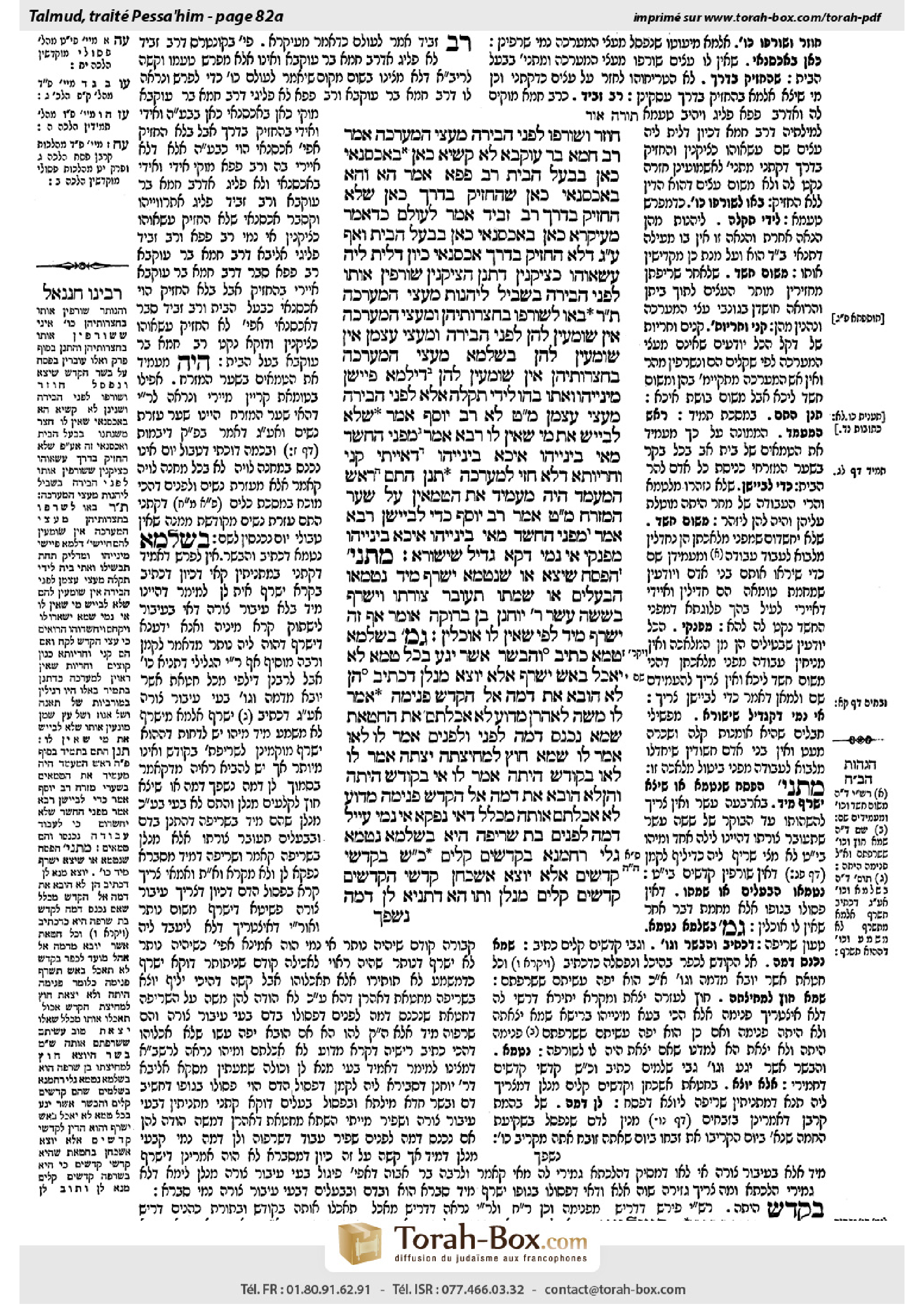
Pesachim 82a: Talmud study for Daf Yomi
Daf Yomi is the daily study of one Talmud folio. Explore 37 tractates with scans, Hebrew text, Sefaria English and AI-generated French translations where annotated.
Passage selection and English or AI-generated French translation are available where the scan has annotations. Daf Study is independent of Torah-Box and Sefaria.
Browse Pesachim · פסחים · All tractatesPesachim 82a text and translations
This page of Pesachim includes the Aramaic text, an English translation and an AI-generated French translation, alongside the scan above.
פסחים פ״ב א · Aramaic and Hebrew text
חוֹזֵר וְשׂוֹרְפוֹ לִפְנֵי הַבִּירָה מֵעֲצֵי הַמַּעֲרָכָה!
אָמַר רַב חָמָא בַּר עוּקְבָא: לָא קַשְׁיָא, כָּאן — בְּאַכְסְנַאי. כָּאן — בְּבַעַל הַבַּיִת.
רַב פָּפָּא אָמַר: הָא וְהָא בְּאַכְסְנַאי, כָּאן — שֶׁהֶחְזִיק בַּדֶּרֶךְ, כָּאן — שֶׁלֹּא הֶחְזִיק בַּדֶּרֶךְ.
רַב זְבִיד אָמַר: לְעוֹלָם כִּדְאָמַר מֵעִיקָּרָא — כָּאן בְּאַכְסְנַאי כָּאן בְּבַעַל הַבַּיִת, וְאַף עַל גַּב דְּלָא הֶחְזִיק בַּדֶּרֶךְ, אַכְסְנַאי כֵּיוָן דְּלֵית לֵיהּ עֲשָׂאוּהוּ כְּצִיקָנִין. דִּתְנַן: הַצִּיקָנִין שׂוֹרְפִין אוֹתוֹ לִפְנֵי הַבִּירָה בִּשְׁבִיל לֵיהָנוֹת מֵעֲצֵי הַמַּעֲרָכָה.
תָּנוּ רַבָּנַן: בָּאוּ לְשׂוֹרְפוֹ בְּחַצְרוֹתֵיהֶן וּמֵעֲצֵי הַמַּעֲרָכָה — אֵין שׁוֹמְעִין לָהֶן. לִפְנֵי הַבִּירָה וּמֵעֲצֵי עַצְמָן — אֵין שׁוֹמְעִין לָהֶן.
בִּשְׁלָמָא מֵעֲצֵי הַמַּעֲרָכָה בְּחַצְרוֹתֵיהֶן אֵין שׁוֹמְעִין לָהֶן — דִּילְמָא פָּיְישָׁן מִינַּיְיהוּ, וְאָתוּ בְּהוּ לִידֵי תַקָּלָה. אֶלָּא לִפְנֵי הַבִּירָה מֵעֲצֵי עַצְמָן, מַאי טַעְמָא לָא?
רַב יוֹסֵף אָמַר: שֶׁלֹּא לְבַיֵּישׁ אֶת מִי שֶׁאֵין לוֹ. רָבָא אָמַר: מִפְּנֵי הַחֲשָׁד.
מַאי בֵּינַיְיהוּ? אִיכָּא בֵּינַיְיהוּ דְּאַיְיתִי קְנֵי וְחַרְיָוָתָא, דְּלָא חֲזֵי לַמַּעֲרָכָה.
תְּנַן הָתָם: רֹאשׁ הַמַּעֲמָד הָיָה מַעֲמִיד אֶת הַטְּמֵאִין עַל שַׁעַר הַמִּזְרָח. מַאי טַעְמָא? אָמַר רַב יוֹסֵף: כְּדֵי לְבַיְּישָׁן. רָבָא אָמַר: מִפְּנֵי הַחֲשָׁד.
מַאי בֵּינַיְיהוּ? אִיכָּא בֵּינַיְיהוּ מְפַנְּקִי, אִי נָמֵי דְּקָא גָדֵיל שִׁישׁוּרָא.
מַתְנִי׳ הַפֶּסַח שֶׁיָּצָא אוֹ שֶׁנִּטְמָא — יִשָּׂרֵף מִיָּד. נִטְמְאוּ הַבְּעָלִים אוֹ שֶׁמֵּתוּ — תְּעוּבַּר צוּרָתוֹ, וְיִשָּׂרֵף בְּשִׁשָּׁה עָשָׂר. רַבִּי יוֹחָנָן בֶּן בְּרוֹקָה אוֹמֵר: אַף זֶה יִשָּׂרֵף מִיָּד לְפִי שֶׁאֵין לוֹ אוֹכְלִין.
גְּמָ׳ בִּשְׁלָמָא טָמֵא, כְּתִיב: ״וְהַבָּשָׂר אֲשֶׁר יִגַּע בְּכׇל טָמֵא לֹא יֵאָכֵל בָּאֵשׁ יִשָּׂרֵף״. אֶלָּא יוֹצֵא מְנָלַן?
דִּכְתִיב: ״הֵן לֹא הוּבָא אֶת דָּמָהּ אֶל הַקֹּדֶשׁ פְּנִימָה״. אָמַר לוֹ מֹשֶׁה לְאַהֲרֹן: מַדּוּעַ לֹא אֲכַלְתֶּם אֶת הַחַטָּאת? שֶׁמָּא נִכְנַס דָּמָהּ לִפְנַי וְלִפְנִים. אָמַר לוֹ: לָאו.
אָמַר לוֹ: שֶׁמָּא חוּץ לִמְחִיצָתָהּ יָצְתָה? אָמַר לוֹ: לָאו, בַּקּוֹדֶשׁ הָיְתָה. אָמַר לוֹ: אִי בַּקּוֹדֶשׁ הָיְתָה וְ״הֵן לֹא הוּבָא אֶת דָּמָהּ אֶל הַקֹּדֶשׁ פְּנִימָה״, מַדּוּעַ לֹא אֲכַלְתֶּם אוֹתָהּ? מִכְּלָל דְּאִי נָפְקָא, אִי נָמֵי עָיֵיל דָּמָהּ לִפְנִים — בַּת שְׂרֵיפָה הִיא.
בִּשְׁלָמָא נִטְמָא, גַּלִּי רַחֲמָנָא בְּקָדָשִׁים קַלִּים, כׇּל שֶׁכֵּן בְּקׇדְשֵׁי קָדָשִׁים. אֶלָּא יוֹצֵא, אַשְׁכְּחַן קׇדְשֵׁי הַקֳּדָשִׁים, קָדָשִׁים קַלִּים מְנָלַן? וְתוּ, הָא דְּתַנְיָא: לָן דָּמָהּ,
Pesachim 82a · English translation
he must return and burn it before the Temple with wood from the arrangement. The mishna’s formulation uses the word remembered, implying that not only a large piece of meat that became ritually impure or somehow disqualified, but even a piece that is so small that it could become forgotten, must be burnt with wood from the arrangement.
Rav Ḥama bar Ukva said: It is not difficult. Here, where it is stated that one burns it in the Temple with wood from the arrangement, it is referring to a visitor who does not live in Jerusalem or have wood there, and he may therefore use wood from the arrangement. While there, where it is stated that one burns it at home with one’s own wood, it is referring to a resident of Jerusalem.
Rav Pappa said: This case and that case both refer to a visitor. Here, where it is stated that one may use wood from the arrangement, it is referring to one who already set out on the road, and it is difficult for him to collect wood. There, where it is stated that one must use his own wood, it is referring to a case in which the visitor has not yet set out on the road, and he can gather his own wood.
Rav Zevid disagreed with Rav Pappa and clarified Rav Ḥama bar Ukva’s opinion. He said: Actually, it can be explained as Rav Ḥama initially said: Here, it is referring to a visitor; there, it is referring to a resident. And even though he did not yet set out on the road, a visitor may use wood from the arrangement for the following reason: Since he does not have his own wood, the Sages treated him like the misers, as we learned in a mishna: The misers burn it before the Temple in order to benefit from the wood of the arrangement. This indicates that anyone who is unconcerned about his reputation, like a miser, may use wood from the arrangement, and this is not considered to be a misuse of consecrated property. Similarly, the Sages also permitted a visitor to use wood from the arrangement.
The Sages taught in the Tosefta: If individuals came and wanted to burn the Paschal lamb that had become ritually impure in their courtyards and wanted to take wood from the arrangement to use for this purpose, one does not listen to them. Similarly, if they wanted to burn it before the Temple with their own wood, one does not listen to them.
The Gemara asks: Granted, if people want to burn it with wood from the arrangement in their own courtyards one does not listen to them. This is because the Sages were concerned lest they leave over some of the wood they took to burn the Paschal lamb and come to experience a mishap with it by using the wood for another purpose. But in the case in which they wanted to burn the offering before the Temple with their own wood, what is the reason one does not listen to them?
Rav Yosef said: It is in order not to embarrass one who does not have the means to bring his own wood. If it were permitted to bring one’s own wood to burn in the Temple, people would realize that only the poor people take wood from the Temple. This would be embarrassing to the poor. Rava said: It is due to suspicion. People would take back their own unused wood that they had brought, and others might suspect that they were stealing consecrated wood from the Temple.
The Gemara asks: What is the practical difference between these two answers? The Gemara answers: The practical difference between them is the case of one who brings reeds or palm branches that are not fit for the arrangement. Since these types of branches are not used for the arrangement of wood on the altar, there is no concern that people would be wrongly suspected of stealing them from the Temple; therefore, Rava would permit it. However, the concern that the poor will be embarrassed is still relevant, and so Rav Yosef would prohibit it.
Another mishna teaches a similar dispute between Rav Yosef and Rava on a different subject: We learned in a mishna there, in tractate Tamid: The head of the watch would stand the ritually impure priests at the entrance to the eastern gate each morning. The Gemara asks: What is the reason that they did not simply send them home without making them stand at the entrance to the eastern gate? Rav Yosef said: It was in order to embarrass them for not having been careful to avoid becoming impure. Rava said: They would stand them there to avoid suspicion, so that people would realize that they were not performing the Temple service because they were impure, rather than in order to work in their regular professions.
The Gemara asks: What is the practical difference between these two opinions? The Gemara answers: The practical difference between them is the case of pampered people who never work, whom others would not suspect of avoiding Temple service in order to work in their regular professions. Alternatively, it is the case of one who twists ropes for a living. No one would suspect someone of missing the Temple service in order to work in such a lowly and non-profitable occupation. These two categories of people would not have to stand at the gate according to Rava’s opinion, but would have to according to Rav Yosef’s opinion.
MISHNA: A Paschal lamb that was taken out of its permissible area or that became ritually impure should be burned immediately on the eve of Passover. If the owners became ritually impure or died, its form must be allowed to decay by leaving it for a period of time instead of burning it immediately, and it should be burned on the sixteenth of Nisan, immediately after the first day of the Festival. Rabbi Yoḥanan ben Beroka says: This, too, should be burned immediately, because it has no one to eat it, which is also so severe a disqualification that decay of form is not required.
GEMARA: The Gemara asks: Granted, the fact that ritually impure sacrificial meat must be burned is written in the Torah, as it says: “The flesh that touches any impure item shall not be eaten, it shall be burned in fire” (Leviticus 7:19). But sacrificial meat that is taken out of its permissible area, from where do we derive that it must be burned?
The Gemara responds: It is derived from the verses describing Moses admonishing Aaron and his sons about the fact that they did not eat the sin-offering on the eighth day of inauguration, as it is written: “Behold, its blood was not brought into the Sanctuary within; you should have eaten it in the Sanctuary, as I commanded” (Leviticus 10:18). This should be understood as follows: Moses said to Aaron: Why didn’t you eat the sin-offering? Perhaps its blood entered the innermost chamber, the Sanctuary, in which case it must be burned? Aaron said to him: No.
Moses said to him: Perhaps it was taken outside of its boundary, and that is the reason you did not eat it? He said to him: No, it was in the sacred area, i.e., the courtyard. Moses said to him: If it was in the sacred area the entire time, behold, its blood was not brought into the Sanctuary within, why didn’t you eat it? This proves by inference that if it leaves its boundary, or alternatively, if its blood enters within the Sanctuary of the Temple, it must be burned. This can serve as a model for all offerings.
The Gemara asks: Granted, with regard to sacrificial meat that became ritually impure, the Merciful One reveals that halakha in the Torah with regard to offerings of lesser sanctity, as the verse: “The flesh that touches any impure item shall not be eaten,” is referring to a peace-offering, and it applies all the more so with regard to offerings of the most sacred order. However, with regard to sacrificial meat that is taken out of its boundary, we have found a source that this applies to offerings of only the most sacred order. With regard to offerings of lesser sanctity, such as the Paschal lamb, from where do we derive that they too must be burned? And furthermore, with regard to that which is taught in a baraita: If the blood of an offering was left overnight instead of being sprinkled on the altar on the day it was slaughtered,
Pesachim 82a · Traduction française (IA)
il doit revenir et le brûler devant le Temple avec du bois provenant de l’ordonnance. La formulation de la Michna emploie le mot « oublié », ce qui implique que non seulement un gros morceau de viande devenu impur rituellement ou invalidé d’une manière ou d’une autre, mais même un morceau si petit qu’on pourrait l’oublier, doit être brûlé avec du bois provenant de l’ordonnance.
Rav Ḥama bar Ukva dit : Il n’y a pas de difficulté. Ici, lorsqu’il est dit qu’on le brûle dans le Temple avec du bois provenant de l’ordonnance, il s’agit d’un visiteur qui n’habite pas à Jérusalem et n’y possède pas de bois ; il peut donc utiliser du bois provenant de l’ordonnance. Là, lorsqu’il est dit qu’on le brûle chez soi avec son propre bois, il s’agit d’un habitant de Jérusalem.
Rav Pappa dit : Les deux cas, ici et là, concernent un visiteur. Ici, lorsqu’il est dit qu’on peut utiliser du bois provenant de l’ordonnance, il s’agit de quelqu’un qui a déjà pris la route et pour qui il est difficile de ramasser du bois. Là, lorsqu’il est dit qu’il doit utiliser son propre bois, il s’agit d’un visiteur qui n’a pas encore pris la route et peut ramasser son propre bois.
Rav Zevid conteste Rav Pappa et précise l’avis de Rav Ḥama bar Ukva. Il dit : En réalité, on peut l’expliquer comme Rav Ḥama l’a d’abord dit : ici, il s’agit d’un visiteur ; là, d’un habitant. Et même s’il n’a pas encore pris la route, un visiteur peut utiliser du bois provenant de l’ordonnance pour la raison suivante : puisqu’il ne possède pas son propre bois, les Sages l’ont traité comme les avares, ainsi que nous l’avons appris dans une Michna : les avares le brûlent devant le Temple afin de profiter du bois provenant de l’ordonnance. Cela indique que quiconque ne se soucie pas de sa réputation, comme un avare, peut utiliser du bois provenant de l’ordonnance, sans que cela soit considéré comme un détournement de biens consacrés. De même, les Sages ont également permis à un visiteur d’utiliser du bois provenant de l’ordonnance.
Les Sages enseignent dans la Tossefta : Si des particuliers viennent et veulent brûler dans leurs cours l’agneau pascal devenu impur rituellement, et prendre du bois provenant de l’ordonnance à cette fin, on ne les laisse pas faire. De même, s’ils veulent le brûler devant le Temple avec leur propre bois, on ne les laisse pas faire.
La Guemara demande : Il est compréhensible qu’on ne les laisse pas brûler l’agneau dans leurs propres cours avec du bois provenant de l’ordonnance. En effet, les Sages craignaient qu’ils ne gardent une partie du bois pris pour brûler l’agneau pascal et ne commettent une faute en l’utilisant à une autre fin. Mais, dans le cas où ils veulent brûler le sacrifice devant le Temple avec leur propre bois, pour quelle raison ne les laisse-t-on pas faire ?
Rav Yosef dit : C’est afin de ne pas faire honte à celui qui n’a pas les moyens d’apporter son propre bois. S’il était permis d’apporter son propre bois pour le brûler dans le Temple, les gens comprendraient que seuls les pauvres prennent du bois dans le Temple. Cela ferait honte aux pauvres. Rava dit : C’est par crainte des soupçons. Les gens reprendraient le bois leur appartenant qu’ils n’auraient pas utilisé, et d’autres pourraient les soupçonner de voler du bois consacré au Temple.
La Guemara demande : Quelle est la différence pratique entre ces deux réponses ? La Guemara répond : La différence pratique concerne le cas de celui qui apporte des roseaux ou des branches de palmier, qui ne conviennent pas à l’ordonnance. Comme ces types de branches ne sont pas utilisés pour l’ordonnance du bois sur l’autel, il n’y a pas lieu de craindre que les gens soient soupçonnés à tort de les avoir volés dans le Temple ; Rava le permettrait donc. Toutefois, la crainte que les pauvres aient honte reste pertinente, et Rav Yosef l’interdirait donc.
Une autre Michna enseigne une controverse similaire entre Rav Yosef et Rava sur un autre sujet. Nous avons appris dans une Michna, dans le traité Tamid : chaque matin, le chef de la garde faisait tenir les prêtres rituellement impurs à l’entrée de la porte orientale. La Guemara demande : Pourquoi ne les renvoyait-on pas simplement chez eux, sans leur faire tenir leur poste à l’entrée de la porte orientale ? Rav Yosef dit : C’était pour leur faire honte de ne pas avoir pris garde à éviter de devenir impurs. Rava dit : On les faisait tenir là pour prévenir les soupçons, afin que les gens comprennent qu’ils n’accomplissaient pas le service du Temple parce qu’ils étaient impurs, et non pour exercer leurs métiers habituels.
La Guemara demande : Quelle est la différence pratique entre ces deux avis ? La Guemara répond : La différence pratique concerne le cas des gens choyés qui ne travaillent jamais, que personne ne soupçonnerait d’éviter le service du Temple pour exercer leurs métiers habituels. Autre possibilité : il s’agit de celui qui gagne sa vie en tressant des cordes. Personne ne soupçonnerait quelqu’un de manquer le service du Temple pour exercer une activité aussi modeste et peu lucrative. Selon l’avis de Rava, ces deux catégories de personnes n’auraient pas à se tenir à la porte, mais selon l’avis de Rav Yosef, elles le devraient.
MICHNA : Un agneau pascal qui a été emporté hors de la zone où il est permis de le trouver, ou qui est devenu impur rituellement, doit être brûlé immédiatement, la veille de Pessaḥ. Si ses propriétaires sont devenus impurs rituellement ou sont morts, il faut le laisser se dégrader pendant un certain temps au lieu de le brûler immédiatement ; il doit être brûlé le seize Nissan, immédiatement après le premier jour de la fête. Rabbi Yoḥanan ben Beroka dit : Celui-ci aussi doit être brûlé immédiatement, car personne ne peut le manger ; cette invalidation est elle aussi si grave qu’il n’est pas nécessaire de le laisser se dégrader.
GUEMARA : La Guemara demande : Il est évident que la Torah prescrit de brûler la viande sacrificielle devenue impure rituellement, comme il est dit : « La chair qui touche quelque chose d’impur ne sera pas mangée ; elle sera brûlée au feu » (Lévitique 7, 19). Mais, pour la viande sacrificielle emportée hors de la zone où il est permis de la trouver, d’où déduit-on qu’elle doit être brûlée ?
La Guemara répond : On le déduit des versets rapportant que Moïse reprocha à Aaron et à ses fils de ne pas avoir mangé le sacrifice expiatoire le huitième jour de l’inauguration, comme il est écrit : « Voici, son sang n’a pas été porté à l’intérieur du sanctuaire ; vous auriez dû le manger dans le lieu saint, comme je l’ai ordonné » (Lévitique 10, 18). Il faut comprendre ainsi : Moïse dit à Aaron : Pourquoi n’avez-vous pas mangé le sacrifice expiatoire ? Peut-être son sang est-il entré dans la partie la plus intérieure, le Sanctuaire, auquel cas il doit être brûlé ? Aaron lui répondit : Non.
Moïse lui dit : Peut-être a-t-il été emporté au-delà de ses limites, et est-ce la raison pour laquelle vous ne l’avez pas mangé ? Il lui répondit : Non, il se trouvait dans la zone sacrée, c’est-à-dire dans la cour. Moïse lui dit : S’il est resté dans la zone sacrée tout le temps, voici que son sang n’a pas été porté à l’intérieur du sanctuaire : pourquoi ne l’avez-vous pas mangé ? Il ressort donc que s’il franchit ses limites, ou, autrement dit, si son sang pénètre à l’intérieur du Sanctuaire du Temple, il doit être brûlé. Cela peut servir de modèle pour tous les sacrifices.
La Guemara demande : Il est compréhensible que, pour la viande sacrificielle devenue impure rituellement, le Miséricordieux révèle cette halakha dans la Torah à propos des sacrifices de moindre sainteté, puisque le verset « La chair qui touche quelque chose d’impur ne sera pas mangée » parle d’un sacrifice de paix et qu’il s’applique a fortiori aux sacrifices de sainteté supérieure. Toutefois, concernant la viande sacrificielle emportée hors de ses limites, nous avons trouvé une source établissant que cela s’applique uniquement aux sacrifices de sainteté supérieure. D’où déduit-on que les sacrifices de moindre sainteté, tels que l’agneau pascal, doivent eux aussi être brûlés ? Et, de plus, concernant ce qui est enseigné dans une baraïta : si le sang d’un sacrifice a passé la nuit sans être aspergé sur l’autel le jour où l’animal a été égorgé,
Traduction française générée par IA à partir de l’édition anglaise de Sefaria. Vérifie toujours un passage avec le texte source.
Text from Sefaria: William Davidson Edition - Vocalized Aramaic (CC BY NC); William Davidson Edition - English (CC BY NC).