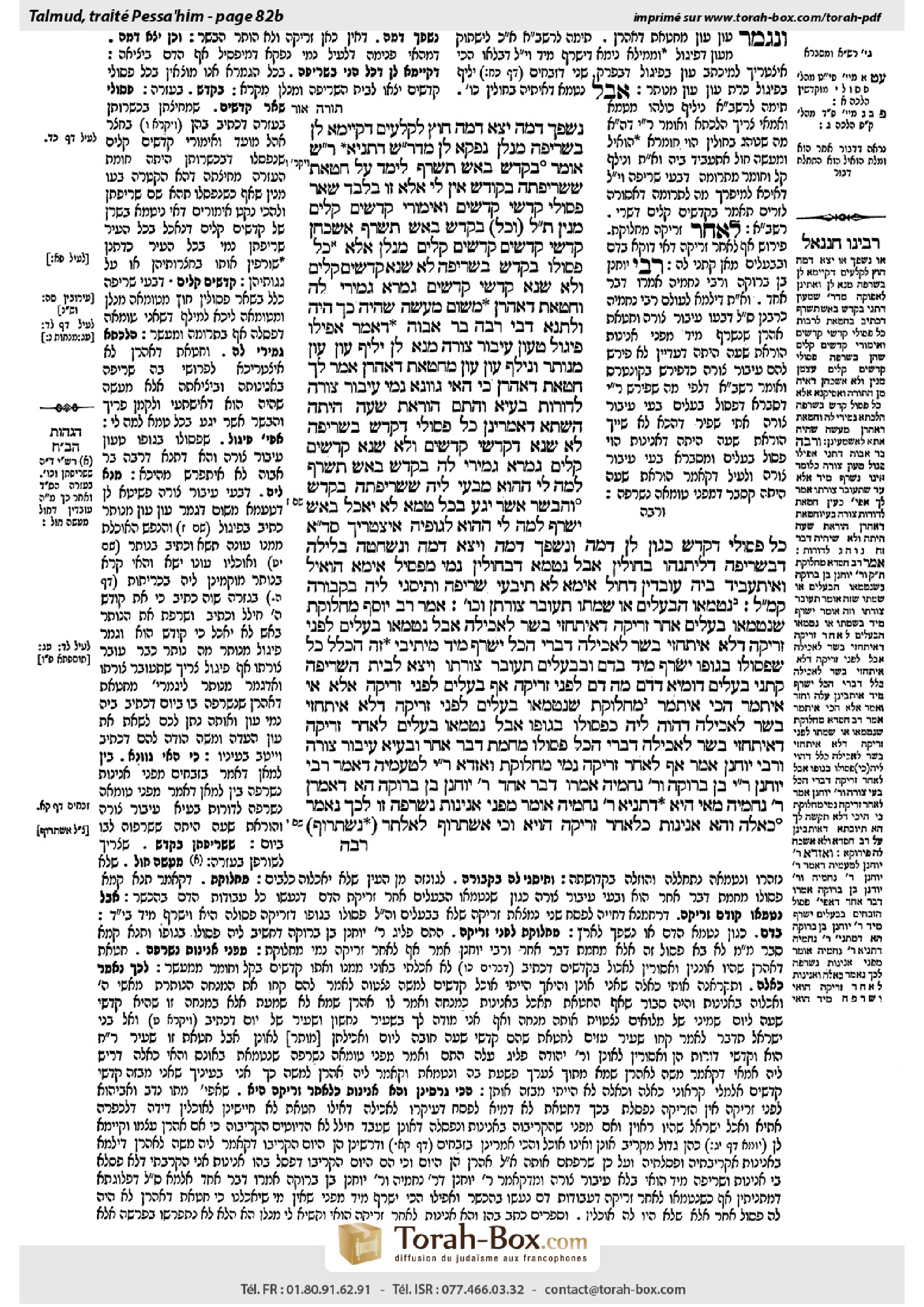
Pesachim 82b: Talmud study for Daf Yomi
Daf Yomi is the daily study of one Talmud folio. Explore 37 tractates with scans, Hebrew text, Sefaria English and AI-generated French translations where annotated.
Passage selection and English or AI-generated French translation are available where the scan has annotations. Daf Study is independent of Torah-Box and Sefaria.
Browse Pesachim · פסחים · All tractatesPesachim 82b text and translations
This page of Pesachim includes the Aramaic text, an English translation and an AI-generated French translation, alongside the scan above.
פסחים פ״ב ב · Aramaic and Hebrew text
נִשְׁפַּךְ דָּמָהּ, יָצָא דָּמָהּ חוּץ לַקְּלָעִים — דְּקַיְימָא לַן בִּשְׂרֵיפָה, מְנָלַן?
נָפְקָא לַן מִדְּרַבִּי שִׁמְעוֹן. דְּתַנְיָא, רַבִּי שִׁמְעוֹן אוֹמֵר: ״בַּקֹּדֶשׁ בָּאֵשׁ תִּשָּׂרֵף״ — לִימֵּד עַל חַטָּאת שֶׁשְּׂרֵיפָתָהּ בַּקּוֹדֶשׁ.
אֵין לִי אֶלָּא זוֹ בִּלְבַד, שְׁאָר פְּסוּלֵי קׇדְשֵׁי קָדָשִׁים וְאֵימוּרֵי קָדָשִׁים קַלִּים מִנַּיִן? תַּלְמוּד לוֹמַר: ״(וְכׇל) ... בַּקֹּדֶשׁ ... בָּאֵשׁ תִּשָּׂרֵף״.
אַשְׁכְּחַן קׇדְשֵׁי קָדָשִׁים, קָדָשִׁים קַלִּים מְנָלַן? אֶלָּא: כׇּל פְּסוּלוֹ בַּקֹּדֶשׁ בִּשְׂרֵיפָה, לָא שְׁנָא קָדָשִׁים קַלִּים וְלָא שְׁנָא קׇדְשֵׁי קָדָשִׁים — גְּמָרָא גְּמִירִי לַהּ, וְחַטָּאת דְּאַהֲרֹן מִשּׁוּם מַעֲשֶׂה שֶׁהָיָה כָּךְ הָיָה.
וּלְתַנָּא דְּבֵי רַבָּה בַּר אֲבוּהּ, דְּאָמַר: אֲפִילּוּ פִּיגּוּל טָעוּן עִיבּוּר צוּרָה. מְנָא לַן?
יָלֵיף ״עָוֹן״ ״עָוֹן״ מִנּוֹתָר.
וְנֵילַף ״עָוֹן״ ״עָוֹן״ מֵחַטָּאת דְּאַהֲרֹן! אָמַר לָךְ: חַטָּאת דְּאַהֲרֹן כִּי הַאי גַוְונָא נָמֵי עִיבּוּר צוּרָה לְדוֹרוֹת בָּעֲיָא, וְהָתָם — הוֹרָאַת שָׁעָה הָיְתָה.
הַשְׁתָּא דְּאָמְרִינַן כָּל פְּסוּלֵי דְקֹדֶשׁ בִּשְׂרֵיפָה, לָא שְׁנָא דְּקׇדְשֵׁי קָדָשִׁים וְלָא שְׁנָא קָדָשִׁים קַלִּים, גְּמָרָא גְּמִירִי לַהּ, ״בַּקֹּדֶשׁ ... בָּאֵשׁ תִּשָּׂרֵף״ לְמָה לִי? הָהוּא מִבְּעֵי לֵיהּ שֶׁשְּׂרֵיפָתָהּ בַּקֹּדֶשׁ.
״וְהַבָּשָׂר אֲשֶׁר יִגַּע בְּכׇל טָמֵא לֹא יֵאָכֵל בָּאֵשׁ יִשָּׂרֵף״, לְמָה לִי?
הַהוּא, לְגוּפֵיהּ אִיצְטְרִיךְ. סָלְקָא דַּעְתָּךְ אָמֵינָא כֹּל פְּסוּלֵי דְקֹדֶשׁ, כְּגוֹן: לָן דָּמָהּ, וְנִשְׁפַּךְ דָּמָהּ, וְיָצָא דָּמָהּ, וְנִשְׁחֲטָה בַּלַּיְלָה, דְּבִשְׂרֵיפָה דְּלֵיתַנְהוּ בְּחוּלִּין.
אֲבָל נִטְמָא, דִּבְחוּלִּין נָמֵי מִפְּסִיל, אֵימָא הוֹאִיל וְאִיתְעֲבִיד בֵּיהּ עוֹבָדִין דְּחוֹל — אֵימָא לָא תִּיבְּעֵי שְׂרֵיפָה, וְתִיסְגֵּי לֵיהּ בִּקְבוּרָה, קָא מַשְׁמַע לַן.
נִטְמְאוּ הַבְּעָלִים אוֹ שֶׁמֵּתוּ תְּעוּבַּר צוּרָתָן וְכוּ׳. אָמַר רַב יוֹסֵף: מַחְלוֹקֶת שֶׁנִּטְמְאוּ בְּעָלִים אַחַר זְרִיקָה, דְּאִיתְחֲזִי בָּשָׂר לַאֲכִילָה. אֲבָל נִטְמְאוּ בְּעָלִים לִפְנֵי זְרִיקָה, דְּלָא אִיתְחֲזִי בָּשָׂר לַאֲכִילָה — דִּבְרֵי הַכֹּל יִשָּׂרֵף מִיָּד.
מֵיתִיבִי, זֶה הַכְּלָל: כׇּל שֶׁפְּסוּלוֹ בְּגוּפוֹ — יִשָּׂרֵף מִיָּד. בַּדָּם וּבַבְּעָלִים — תְּעוּבַּר צוּרָתוֹ וְיֵצֵא לְבֵית הַשְּׂרֵיפָה.
קָתָנֵי בְּעָלִים דּוּמְיָא דְּדָם: מָה דָּם לִפְנֵי זְרִיקָה, אַף בְּעָלִים לִפְנֵי זְרִיקָה.
אֶלָּא אִי אִיתְּמַר, הָכִי אִיתְּמַר: מַחְלוֹקֶת שֶׁנִּטְמְאוּ בְּעָלִים לִפְנֵי זְרִיקָה, דְּלָא אִיתְחֲזִי בָּשָׂר לַאֲכִילָה, דְּהָוֵה לֵיהּ כִּפְסוּלוֹ בְּגוּפוֹ. אֲבָל נִטְמְאוּ בְּעָלִים לְאַחַר זְרִיקָה, דְּאִיתְחֲזִי בָּשָׂר לַאֲכִילָה — דִּבְרֵי הַכֹּל פְּסוּלוֹ מֵחֲמַת דָּבָר אַחֵר, וּבָעֲיָא עִיבּוּר צוּרָה.
וְרַבִּי יוֹחָנָן אָמַר: אַף לְאַחַר זְרִיקָה נָמֵי מַחְלוֹקֶת. וְאַזְדָּא רַבִּי יוֹחָנָן לְטַעְמֵיהּ, דְּאָמַר רַבִּי יוֹחָנָן: רַבִּי יוֹחָנָן בֶּן בְּרוֹקָה וְרַבִּי נְחֶמְיָה אָמְרוּ דָּבָר אֶחָד, רַבִּי יוֹחָנָן בֶּן בְּרוֹקָה הָא דַּאֲמַרַן.
רַבִּי נְחֶמְיָה מַאי הִיא? דְּתַנְיָא, רַבִּי נְחֶמְיָה אוֹמֵר: מִפְּנֵי אֲנִינוּת נִשְׂרְפָה זוֹ, לְכָךְ נֶאֱמַר ״כָּאֵלֶּה״.
וְהָא אֲנִינוּת כִּלְאַחַר זְרִיקָה הָוְיָא, וְכִי אִשְׂתְּרוּף — לְאַלְתַּר (נִשְׂתְּרוּף).
Pesachim 82b · English translation
or its blood was spilled, or its blood was taken outside the hangings that denoted the courtyard of the Tabernacle, we maintain that it must be burned; from where do we derive this halakha?
The Gemara answers: We derive it from the exposition of Rabbi Shimon, as it was taught in a baraita that Rabbi Shimon says: The verse that states: “Any sin-offering from which some blood has been brought to the Tent of Meeting, to make atonement in the sacred place, shall not be eaten; it shall be burned in fire” (Leviticus 6:23), has taught that the burning of a sin-offering is in the sacred area, the Temple courtyard.
I have derived only that the halakha applies to this alone, a sin-offering; with regard to the rest of the disqualified offerings of the most sacred order and the portions of offerings of lesser sanctity that are consumed on the altar, from where do we derive that they must be burned in the Temple courtyard, which is their boundary when they are valid? The verse states: “Any…in the sacred place…shall be burned in fire,” which teaches that any consecrated item must be burned in a sacred place.
The Gemara asks further: We found a source for offerings of the most sacred order; from where do we derive that it also applies to offerings of lesser sanctity? Rather, we must say as follows: Anything disqualified in the sacred area, the Temple courtyard, must be burned. It is no different whether it is offerings of lesser sanctity, and it is no different whether it is offerings of the most sacred order; they learned it as a tradition. And the sin-offering of Aaron that was burned on the eighth day of inauguration was mentioned only because the incident that took place, took place in this way. It was not mentioned in order to teach the halakhot of offerings.
The Gemara proceeds to ask an unrelated question with regard to piggul: And according to the opinion of the tanna from the school of Rabba bar Avuh, who said that even piggul, which is a disqualification of the animal itself, requires decay of form, meaning that it must be left over until the next day so that it will begin to decay and is only then burned, from where do we derive that it requires decay of form?
The Gemara answers: It is derived from a verbal analogy from the parallel words “iniquity” and “iniquity.” With regard to piggul, the verse states: “It remains rejected [piggul]; and the soul that eats it shall bear its iniquity” (Leviticus 7:18), and with regard to leftover sacrificial meat, the verse states: “And whatever is leftover…shall be burned in fire…and each of those who eat it shall bear his iniquity” (Leviticus 19:6–8). Just as leftover sacrificial meat is burned after it has been left over to the next day, so too, piggul is burned only after it has been left over to the next day and its form has decayed.
The Gemara asks: Let us instead learn the rules of piggul through a verbal analogy based on the parallel words “iniquity” and “iniquity” from the sin-offering of Aaron, with regard to which the verse states: “Why did you not eat the sin-offering in the place of sanctity…and He gave it to you to bear the iniquity of the congregation” (Leviticus 10:17). The sin-offering of Aaron was burned immediately, without decay of form, so why can it not be learned from there that piggul does not require decay of form either? That tanna could have said to you: The sin-offering of Aaron in a case like this would also require decay of form were it to occur in future generations; but there, when it was burned immediately, it was a provisional edict issued in exigent circumstances.
The Gemara asks: Now that we say that we have accepted the conclusion that all disqualified sacred offerings must be burned, and it is no different whether they are disqualified offerings of the most sacred order or offerings of lesser sanctity, because in both cases they learned it as a tradition, with regard to the verse that says: “In the sacred place…shall be burned in fire,” why do I need it? What does this verse teach that is not known from oral tradition? The Gemara answers: That verse is required to teach that the requirement of burning that is learned from the oral tradition cannot take place anywhere; its burning must take place only in the sacred place, the Temple courtyard.
The Gemara asks further: If the source of the halakha is an oral tradition, with regard to the verse that states: “The flesh that touches any impure item shall not be eaten, it shall be burned in fire” (Leviticus 7:19), why do I need it? This halakha is included in the oral tradition and should not require its own verse.
The Gemara answers: That verse is necessary for itself. It could enter your mind to say that disqualified sacred offerings include only a case where its blood was left overnight instead of being sprinkled on the altar on the day the offering was slaughtered; or its blood was spilled; or its blood was taken outside the hangings; and similarly, the case of an offering that was slaughtered at night. In all these cases, the offering must be burned because these are disqualifications unique to sanctified offerings that do not exist with regard to unconsecrated items.
But if the meat became ritually impure, which disqualifies unconsecrated meat also, say that since it was treated in the manner of unconsecrated items, as the disqualification is not unique to consecrated items, it should not require burning, and burial should be sufficient for it. Therefore, the verse teaches us that an offering that is disqualified through ritual impurity must also be burned.
It was taught in the mishna that if the owners of the offering became ritually impure or died before the offering was completed, its form must be left to decay, and it is burned after the first day of the Festival. Rabbi Yoḥanan ben Beroka disagrees and says that it is burned immediately. Rav Yosef said: This dispute is about a case in which the owners became ritually impure after the sprinkling of the blood, because the meat was fit for eating since all its services were completed in a valid way. But if the owners became ritually impure before the sprinkling of the blood, such that the meat was not fit for eating even for a moment, all agree that it should be burned immediately.
The Gemara raises an objection to this statement based on the Tosefta: This is the principle: In all cases in which its disqualification is in itself, it should be burned immediately. If the disqualification is in the blood of the offering or in the owners, its form should be left to decay, and then it should be taken out to the place designated for burning.
The following inference can be made based on the formulation of the Tosefta: It is teaching that the case of disqualified owners is similar to the case of disqualified blood: Just as in the case of blood the disqualification necessarily occurred before the sprinkling of the blood, as the offering is not disqualified if anything happens to the blood after sprinkling, so too, the case of owners is referring to one in which they became disqualified even before the sprinkling of the blood, which contradicts the statement of Rav Yosef.
Rather, if this was stated in the name of Rav Yosef, it was stated as follows: This dispute is specifically about a case in which the owners became ritually impure before the sprinkling of the blood, such that the meat was never fit for eating, which makes it as though its disqualification is in itself. But if the owners became ritually impure after sprinkling of the blood, such that the meat was fit for eating, all agree that its disqualification is due to a different matter, i.e., an external factor, and it requires decay of form.
And Rabbi Yoḥanan said: Even a case in which the owners became ritually impure after sprinkling the blood is included in the dispute about whether decay of form is necessary. And Rabbi Yoḥanan follows his line of reasoning, as Rabbi Yoḥanan said: Rabbi Yoḥanan ben Beroka and Rabbi Neḥemya said the same thing. The statement of Rabbi Yoḥanan ben Beroka is that which we said.
With regard to Rabbi Neḥemya, what is the ruling in which he expressed his opinion? It is as it was taught in a baraita: Rabbi Neḥemya says: Aaron’s sin-offering that was burned on the eighth day of inauguration was burned due to acute mourning, as that was the day his sons Nadav and Avihu died. For this reason, it is stated that Aaron explained to Moses: “Now that events such as these befell me, were I to eat this day’s sin-offering would the Lord approve?” (Leviticus 10:19). In other words, it was due to the deaths of his sons, which Aaron referred as “events such as these,” that Aaron burned the sin-offering instead of eating it.
Rabbi Yoḥanan analyzes Rabbi Neḥemya’s statement: Now, acute mourning is similar to a case of disqualification after sprinkling of the blood, because acute mourning merely disqualifies the owners from eating the offering. It does not disqualify the actual performance of the sacrificial service by a High Priest, such as Aaron. Therefore, it is like other disqualifications that take effect after the sprinkling, which simply prohibit the eating of the meat. And when it was burned, it was burned immediately, without waiting until the following day. This shows that Rabbi Neḥemya agrees that an offering that becomes disqualified after its blood has been sprinkled should be burned immediately.
Pesachim 82b · Traduction française (IA)
ou que son sang ait été répandu, ou que son sang ait été emporté au-delà des tentures qui délimitaient la cour du Tabernacle, nous considérons qu’il doit être brûlé. D’où déduisons-nous cette halakha ?
La Guemara répond : Nous la déduisons de l’interprétation de Rabbi Shimon, comme il a été enseigné dans une baraïta que Rabbi Shimon dit : Le verset qui dit : « Tout sacrifice expiatoire dont une partie du sang a été apportée à la Tente de réunion pour faire l’expiation dans le lieu saint ne sera pas mangé ; il sera brûlé au feu » (Lévitique 6,23) enseigne que le sacrifice expiatoire doit être brûlé dans le lieu saint, c’est-à-dire dans la cour du Temple.
J’ai déduit que cette halakha ne s’applique qu’à ce cas, celui d’un sacrifice expiatoire ; mais d’où déduisons-nous que les autres sacrifices disqualifiés de très haute sainteté et les portions des sacrifices de moindre sainteté qui sont consumées sur l’autel doivent être brûlés dans la cour du Temple, qui est leur limite lorsqu’ils sont valides ? Le verset dit : « Tout… dans le lieu saint… sera brûlé au feu », ce qui enseigne que tout objet consacré doit être brûlé dans un lieu saint.
La Guemara demande encore : Nous avons trouvé une source pour les sacrifices de très haute sainteté ; d’où déduisons-nous que cela s’applique aussi aux sacrifices de moindre sainteté ? Il faut plutôt dire ceci : Tout ce qui est disqualifié dans le lieu saint, c’est-à-dire la cour du Temple, doit être brûlé. Qu’il s’agisse de sacrifices de moindre sainteté ou de sacrifices de très haute sainteté, ils l’ont appris par tradition. Le sacrifice expiatoire d’Aaron, qui fut brûlé le huitième jour de l’inauguration, n’a été mentionné que parce que l’incident s’est déroulé de cette manière. Il n’a pas été mentionné pour enseigner les halakhot des sacrifices.
La Guemara pose ensuite une question sans rapport avec ce qui précède, au sujet du piggul : Et selon l’opinion du tanna de l’école de Rabba bar Avuh, qui disait que même le piggul, qui constitue une disqualification de l’animal lui-même, exige que sa forme se dégrade, c’est-à-dire qu’il faut le laisser jusqu’au lendemain pour qu’il commence à se décomposer et ne le brûler qu’ensuite, d’où déduisons-nous qu’il faut que sa forme se dégrade ?
La Guemara répond : On le déduit d’une analogie verbale fondée sur les mots parallèles « faute » et « faute ». Au sujet du piggul, le verset dit : « Il reste rejeté [piggul], et la personne qui en mangera portera sa faute » (Lévitique 7,18) ; et au sujet de la viande sacrificielle restante, le verset dit : « Ce qui restera… sera brûlé au feu… et chacun de ceux qui en mangeront portera sa faute » (Lévitique 19,6-8). De même que la viande sacrificielle restante est brûlée après avoir été laissée jusqu’au lendemain, de même le piggul n’est brûlé qu’après avoir été laissé jusqu’au lendemain et que sa forme s’est dégradée.
La Guemara demande : Pourquoi ne pas plutôt apprendre les règles du piggul au moyen d’une analogie verbale fondée sur les mots parallèles « faute » et « faute », à partir du sacrifice expiatoire d’Aaron, à propos duquel le verset dit : « Pourquoi n’avez-vous pas mangé le sacrifice expiatoire dans le lieu saint… Il vous l’a donné afin que vous portiez la faute de la communauté » (Lévitique 10,17) ? Le sacrifice expiatoire d’Aaron fut brûlé immédiatement, sans que sa forme se dégrade ; pourquoi ne pas en déduire que le piggul n’exige pas non plus que sa forme se dégrade ? Ce tanna aurait pu te répondre : Dans un cas comme celui-ci, le sacrifice expiatoire d’Aaron aurait lui aussi exigé que sa forme se dégrade si cela s’était produit dans les générations futures ; mais, à l’époque, le fait qu’il ait été brûlé immédiatement relevait d’un décret provisoire rendu dans des circonstances pressantes.
La Guemara demande : Maintenant que nous affirmons avoir accepté la conclusion selon laquelle tous les sacrifices sacrés disqualifiés doivent être brûlés, qu’il s’agisse de sacrifices disqualifiés de très haute sainteté ou de sacrifices de moindre sainteté, puisqu’ils l’ont appris par tradition dans les deux cas, à quoi sert le verset qui dit : « Dans le lieu saint… sera brûlé au feu » ? Qu’enseigne-t-il que la Torah orale ne nous apprenne pas déjà ? La Guemara répond : Ce verset est nécessaire pour enseigner que la combustion exigée par la tradition orale ne peut pas avoir lieu n’importe où ; elle doit avoir lieu uniquement dans le lieu saint, c’est-à-dire dans la cour du Temple.
La Guemara demande encore : Si la source de cette halakha est une tradition orale, à quoi sert le verset qui dit : « La chair qui touche une chose impure ne sera pas mangée ; elle sera brûlée au feu » (Lévitique 7,19) ? Cette halakha est incluse dans la tradition orale et ne devrait pas nécessiter son propre verset.
La Guemara répond : Ce verset est nécessaire pour lui-même. On pourrait penser que les sacrifices sacrés disqualifiés ne comprennent que les cas où leur sang a passé la nuit sans être aspergé sur l’autel le jour de l’abattage du sacrifice, où leur sang a été répandu, où leur sang a été emporté au-delà des tentures, ainsi que le cas d’un sacrifice abattu pendant la nuit. Dans tous ces cas, le sacrifice doit être brûlé, car il s’agit de disqualifications propres aux sacrifices consacrés, qui n’existent pas pour les objets non consacrés.
Mais si la viande est devenue rituellement impure — ce qui disqualifie aussi la viande non consacrée —, on pourrait dire que, puisqu’elle a été traitée comme un objet non consacré, cette disqualification n’étant pas propre aux objets consacrés, elle ne doit pas être brûlée et qu’il suffit de l’enterrer. Le verset nous enseigne donc qu’un sacrifice disqualifié par l’impureté rituelle doit lui aussi être brûlé.
Il a été enseigné dans la Michna que si les propriétaires du sacrifice sont devenus rituellement impurs ou sont morts avant que le sacrifice soit achevé, il faut laisser sa forme se dégrader et le brûler après le premier jour de la fête. Rabbi Yoḥanan ben Beroka est en désaccord et dit qu’il est brûlé immédiatement. Rav Yosef dit : Cette controverse porte sur un cas où les propriétaires sont devenus rituellement impurs après l’aspersion du sang, car la viande était propre à la consommation, toutes les opérations ayant été accomplies de manière valide. Mais si les propriétaires sont devenus rituellement impurs avant l’aspersion du sang, de sorte que la viande n’a pas été propre à la consommation, même un seul instant, tous conviennent qu’elle doit être brûlée immédiatement.
La Guemara objecte à cette affirmation à partir de la Tossefta : Voici le principe : dans tous les cas où la disqualification réside dans l’offrande elle-même, elle doit être brûlée immédiatement. Si la disqualification porte sur le sang du sacrifice ou sur les propriétaires, il faut laisser sa forme se dégrader, puis sortir l’offrande vers l’endroit désigné pour la combustion.
On peut tirer l’inférence suivante de la formulation de la Tossefta : elle enseigne que le cas des propriétaires disqualifiés est comparable à celui du sang disqualifié. De même que, dans le cas du sang, la disqualification est nécessairement survenue avant son aspersion — car le sacrifice n’est pas disqualifié si quelque chose arrive au sang après l’aspersion —, de même, le cas des propriétaires désigne celui où ils sont devenus disqualifiés avant l’aspersion du sang, ce qui contredit l’affirmation de Rav Yosef.
Il faut plutôt dire que, si cette affirmation a été rapportée au nom de Rav Yosef, elle l’a été ainsi : Cette controverse porte précisément sur un cas où les propriétaires sont devenus rituellement impurs avant l’aspersion du sang, de sorte que la viande n’a jamais été propre à la consommation, ce qui revient à dire que la disqualification réside dans l’offrande elle-même. Mais si les propriétaires sont devenus rituellement impurs après l’aspersion du sang, de sorte que la viande était propre à la consommation, tous conviennent que sa disqualification est due à un autre facteur, c’est-à-dire à un facteur extérieur, et qu’il faut laisser sa forme se dégrader.
Et Rabbi Yoḥanan dit : Même le cas où les propriétaires sont devenus rituellement impurs après l’aspersion du sang fait partie de la controverse sur la nécessité de laisser la forme se dégrader. Rabbi Yoḥanan suit ici son raisonnement, car il dit : Rabbi Yoḥanan ben Beroka et Rabbi Neḥemya ont exprimé la même opinion. Celle de Rabbi Yoḥanan ben Beroka est celle que nous avons rapportée.
Quant à Rabbi Neḥemya, quelle décision a-t-il énoncée ? C’est celle qui a été enseignée dans une baraïta : Rabbi Neḥemya dit : Le sacrifice expiatoire d’Aaron qui fut brûlé le huitième jour de l’inauguration le fut en raison du deuil aigu, car c’était le jour où ses fils Nadav et Avihou moururent. C’est pourquoi il est dit qu’Aaron expliqua à Moïse : « Maintenant que de tels événements m’ont frappé, si je mangeais le sacrifice expiatoire de ce jour, le Seigneur l’approuverait-il ? » (Lévitique 10,19). Autrement dit, c’est à cause de la mort de ses fils, à laquelle Aaron faisait référence par « de tels événements », qu’il brûla le sacrifice expiatoire au lieu de le manger.
Rabbi Yoḥanan analyse la déclaration de Rabbi Neḥemya : Or, le deuil aigu est comparable à une disqualification survenue après l’aspersion du sang, car il rend seulement les propriétaires inaptes à manger le sacrifice. Il ne disqualifie pas l’accomplissement même du service sacrificiel par un Grand Prêtre tel qu’Aaron. Il est donc comparable aux autres disqualifications qui prennent effet après l’aspersion et qui interdisent simplement de manger la viande. Or, le sacrifice fut brûlé immédiatement, sans attendre le lendemain. Cela montre que Rabbi Neḥemya convient qu’un sacrifice qui devient disqualifié après l’aspersion de son sang doit être brûlé immédiatement.
Traduction française générée par IA à partir de l’édition anglaise de Sefaria. Vérifie toujours un passage avec le texte source.
Text from Sefaria: William Davidson Edition - Vocalized Aramaic (CC BY NC); William Davidson Edition - English (CC BY NC).