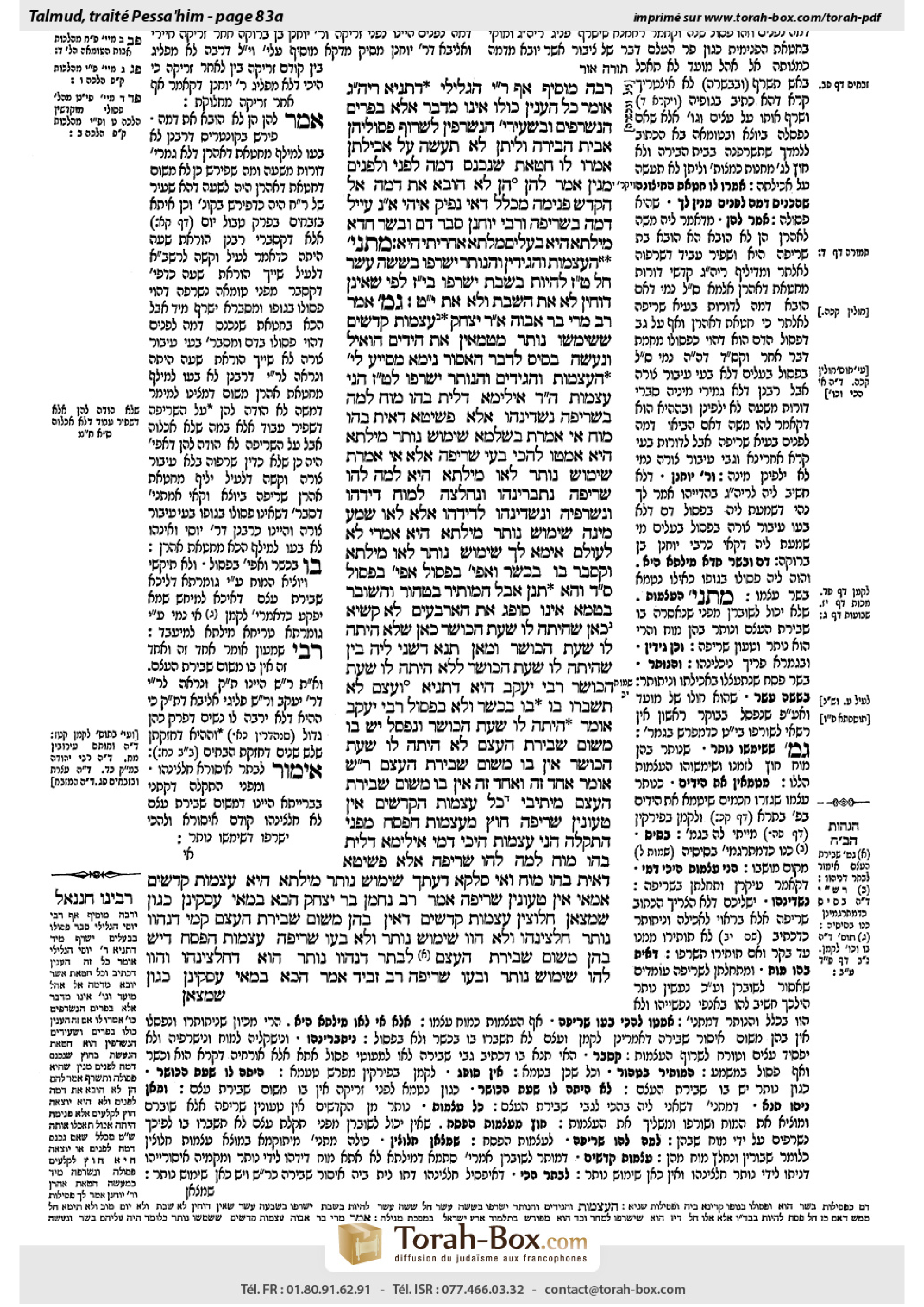
Pesachim 83a: Talmud study for Daf Yomi
Daf Yomi is the daily study of one Talmud folio. Explore 37 tractates with scans, Hebrew text, Sefaria English and AI-generated French translations where annotated.
Passage selection and English or AI-generated French translation are available where the scan has annotations. Daf Study is independent of Torah-Box and Sefaria.
Browse Pesachim · פסחים · All tractatesPesachim 83a text and translations
This page of Pesachim includes the Aramaic text, an English translation and an AI-generated French translation, alongside the scan above.
פסחים פ״ג א · Aramaic and Hebrew text
רַבָּה מוֹסִיף, אַף רַבִּי יוֹסֵי הַגְּלִילִי. דְּתַנְיָא, רַבִּי יוֹסֵי הַגְּלִילִי אוֹמֵר: כׇּל הָעִנְיָן כּוּלּוֹ אֵינוֹ מְדַבֵּר אֶלָּא בְּפָרִים הַנִּשְׂרָפִים וּבִשְׂעִירִין הַנִּשְׂרָפִין, לִשְׂרוֹף פְּסוּלֵיהֶן אַבֵּית הַבִּירָה, וְלִיתֵּן ״לֹא תַעֲשֶׂה״ עַל אֲכִילָתָן.
אָמְרוּ לוֹ: חַטָּאת שֶׁנִּכְנַס דָּמָהּ לִפְנַי וְלִפְנִים מִנַּיִן? אָמַר לָהֶן: ״הֵן לֹא הוּבָא אֶת דָּמָהּ אֶל הַקֹּדֶשׁ פְּנִימָה״, מִכְּלָל דְּאִי נָפֵיק אִיהִי, אִי נָמֵי עָיֵיל דָּמָהּ — בִּשְׂרֵיפָה.
וְרַבִּי יוֹחָנָן סָבַר: דָּם וּבָשָׂר חֲדָא מִילְּתָא הִיא. בְּעָלִים מִלְּתָא אַחֲרִיתִי הִיא.
מַתְנִי׳ הָעֲצָמוֹת וְהַגִּידִין וְהַנּוֹתָר — יִשָּׂרְפוּ בְּשִׁשָּׁה עָשָׂר. חָל שִׁשָּׁה עָשָׂר לִהְיוֹת בְּשַׁבָּת — יִשָּׂרְפוּ בְּשִׁבְעָה עָשָׂר. לְפִי שֶׁאֵינָן דּוֹחִין לֹא אֶת הַשַּׁבָּת וְלֹא אֶת יוֹם טוֹב.
גְּמָ׳ אָמַר רַב מָרִי בַּר אֲבוּהּ אָמַר רַבִּי יִצְחָק: עַצְמוֹת קָדָשִׁים שֶׁשִּׁימְּשׁוּ נוֹתָר — מְטַמְּאִין אֶת הַיָּדַיִם, הוֹאִיל וְנַעֲשָׂה בָּסִיס לְדָבָר הָאָסוּר. נֵימָא מְסַיַּיע לֵיהּ: הָעֲצָמוֹת וְהַגִּידִים וְהַנּוֹתָר — יִשָּׂרְפוּ לְשִׁשָּׁה עָשָׂר.
הָנֵי עֲצָמוֹת הֵיכִי דָמֵי? אִילֵּימָא דְּלֵית בְּהוּ מוֹחַ, לָמָּה בִּשְׂרֵיפָה? נִשְׁדִּינְהוּ! אֶלָּא פְּשִׁיטָא, דְּאִית בְּהוּ מוֹחַ.
אִי אָמְרַתְּ בִּשְׁלָמָא שִׁימּוּשׁ נוֹתָר מִילְּתָא הִיא, אַמְּטוּ לְהָכִי בָּעֵי שְׂרֵיפָה. אֶלָּא אִי אָמְרַתְּ שִׁימּוּשׁ נוֹתָר לָאו מִילְּתָא הִיא, לְמָה לְהוּ שְׂרֵיפָה? נִתְבְּרִינְהוּ וְנַחְלְצֵהּ לְמוֹחַ דִּידְהוּ וְנִשְׂרְפֵיהּ וְנִשְׁדִּינְהוּ לְדִידְהוּ. אֶלָּא לָאו שְׁמַע מִינַּהּ, שִׁימּוּשׁ נוֹתָר מִילְּתָא הִיא.
אָמְרִי: לָא, לְעוֹלָם אֵימָא לָךְ שִׁימּוּשׁ נוֹתָר — לָאו מִילְּתָא, וְקָסָבַר: ״בּוֹ״ בְּכָשֵׁר, וַאֲפִילּוּ בְּפָסוּל.
אֲפִילּוּ בְּפָסוּל סָלְקָא דַּעְתָּךְ? וְהָא תְּנַן: אֲבָל הַמּוֹתִיר בַּטָּהוֹר וְהַשּׁוֹבֵר בַּטָּמֵא אֵינוֹ סוֹפֵג אֶת הָאַרְבָּעִים! לָא קַשְׁיָא, כָּאן — שֶׁהָיְתָה לוֹ שְׁעַת הַכּוֹשֶׁר, כָּאן — שֶׁלֹּא הָיְתָה לוֹ שְׁעַת הַכּוֹשֶׁר.
וּמַאן תַּנָּא דְּשָׁנֵי לֵיהּ בֵּין שֶׁהָיְתָה לוֹ שְׁעַת הַכּוֹשֶׁר לְלֹא הָיְתָה לוֹ שְׁעַת הַכּוֹשֶׁר, רַבִּי יַעֲקֹב הִיא. דְּתַנְיָא: ״וְעֶצֶם לֹא תִשְׁבְּרוּ בוֹ״, ״בּוֹ״ בְּכָשֵׁר וְלֹא בְּפָסוּל. רַבִּי יַעֲקֹב אוֹמֵר: הָיְתָה לוֹ שְׁעַת הַכּוֹשֶׁר וְנִפְסַל — יֵשׁ בּוֹ מִשּׁוּם שְׁבִירַת הָעֶצֶם, לֹא הָיְתָה לוֹ שְׁעַת הַכּוֹשֶׁר — אֵין בּוֹ מִשּׁוּם שְׁבִירַת הָעֶצֶם. רַבִּי שִׁמְעוֹן אוֹמֵר: אֶחָד זֶה וְאֶחָד זֶה — אֵין בּוֹ מִשּׁוּם שְׁבִירַת הָעֶצֶם.
מֵיתִיבִי: כׇּל עַצְמוֹת הַקֳּדָשִׁים אֵין טְעוּנִין שְׂרֵיפָה, חוּץ מֵעַצְמוֹת הַפֶּסַח מִפְּנֵי הַתַּקָּלָה. הָנֵי עֲצָמוֹת הֵיכִי דָּמֵי? אִילֵּימָא דְּלֵית בְּהוּ מוֹחַ, לְמָה לְהוּ שְׂרֵיפָה? אֶלָּא פְּשִׁיטָא דְּאִית בְּהוּ מוֹחַ, וְאִי סָלְקָא דַעְתָּךְ שִׁימּוּשׁ נוֹתָר מִילְּתָא הִיא — עַצְמוֹת קָדָשִׁים אַמַּאי אֵין טְעוּנִין שְׂרֵיפָה?
אָמַר רַב נַחְמָן בַּר יִצְחָק: הָכָא בְּמַאי עָסְקִינַן? כְּגוֹן שֶׁמְּצָאָן חֲלוּצִין: עַצְמוֹת קָדָשִׁים, דְּאֵין בָּהֶן מִשּׁוּם שְׁבִירַת הָעֶצֶם — קַמֵּי דְּנֶהְווֹ נוֹתָר חַלְצִינְהוּ, וְלָא הָווּ שִׁימּוּשׁ נוֹתָר, וְלָא בָּעוּ שְׂרֵיפָה.
עַצְמוֹת הַפֶּסַח, דְּיֵשׁ בָּהֶן מִשּׁוּם שְׁבִירַת הָעֶצֶם — לְבָתַר דְּנֶהְווֹ נוֹתָר הוּא דְּחַלְצִינְהוּ, וְהָווּ לְהוּ שִׁימּוּשׁ נוֹתָר, וּבָעוּ שְׂרֵיפָה.
רַב זְבִיד אָמַר: הָכָא בְּמַאי עָסְקִינַן? כְּגוֹן
Pesachim 83a · English translation
Rabba adds that these tanna’im were not the only ones who maintain this opinion; even Rabbi Yosei HaGelili agreed with them, as it was taught in a baraita that Rabbi Yosei HaGelili says: The entire matter that is stated in the verse: “Any sin-offering from which some blood has been brought to the Tent of Meeting, to make atonement in the sacred place, shall not be eaten; it shall be burned in fire” (Leviticus 6:23) is not stated with regard to a regular sin-offering improperly brought inside the Sanctuary; rather, it speaks only about bulls that are burned and goats that are burned. These are unique sin-offerings, and the Torah states that their blood should be brought inside the Sanctuary. The verse is stated with regard to these sin-offerings both in order to command the Jewish people to burn the disqualified ones in the place of the bira on the Temple Mount and in order to establish a prohibition with regard to their consumption.
The Rabbis said to Rabbi Yosei HaGelili: If you expound the verse in this fashion, then with regard to a regular sin-offering whose blood entered inside the Sanctuary, from where is it derived that it must be burned? He said to them: It is derived from the verse: “Behold, its blood was not brought into the Sanctuary within” (Leviticus 10:18). This proves by inference that if the sin-offering is taken out of its permitted area, or alternatively, if its blood enters the Sanctuary, it must be burned immediately without waiting for decay of form.
The Gemara explains: And Rabbi Yoḥanan did not include Rabbi Yosei HaGelili because Rabbi Yoḥanan holds that there is a difference between the opinion of Rabbi Yosei HaGelili and those of Rabbi Yoḥanan ben Beroka and Rabbi Neḥemya. The reason for this difference is that impurity of blood and meat, about which Rabbi Yosei HaGelili was speaking, is one matter, and impurity of the blood can therefore be considered a disqualification in the animal itself, but disqualification of the owners is a different matter. Therefore, Rabbi Yosei HaGelili does not necessarily agree with the tanna’im who allow the offering to be burned immediately in the case of disqualification of the owners.
MISHNA: The bones of the Paschal lamb that contain edible marrow but cannot be eaten because it is prohibited to break the bones of the Paschal lamb; and the sinews; and the leftover meat should all be burned on the sixteenth of Nisan, immediately after the first day of the Festival. If the sixteenth occurs on Shabbat, they should be burned on the seventeenth, because the mitzva to burn them does not override Shabbat or the Festival. Therefore, they are burned on the first weekday.
GEMARA: Rav Mari bar Avuh said that Rabbi Yitzḥak said: Bones of offerings that served as a base for leftover, meaning that they have leftover meat on them or inside them after the time of eating, render hands impure, just as the leftover sacrificial parts themselves render hands impure. Since the bones have become a base for an intrinsically prohibited object, they are treated in the same manner as the prohibited object itself. The Gemara suggests: Let us say that the following expression in the mishna supports him: The bones, and the sinews, and the leftover should be burned on the sixteenth of Nisan.
The Gemara asks: What are the circumstances in which these bones must be burned? If we say that there is no marrow in them, why must they be burned? We should discard them, as the Torah requires that leftover parts of offerings be burned only when they are edible. Rather, it is obvious that we are dealing with bones that have marrow in them. The marrow is part of the meat of the offering, and in other offerings one would have broken the bones in order to eat the marrow.
Granted, if you say that an item that serves as a base or container for leftover is something significant and becomes disqualified in the same manner as the leftover themselves, because of this it needs burning like the leftover itself. But if you say that serving as a base for leftover is nothing significant, why do these bones need to be burned? Let us break them, and remove their marrow, and burn the marrow, and discard the bones. Rather, must one not conclude from it that serving as a base for leftover is something significant, and the bones themselves become prohibited and impart ritual impurity due to their consecrated contents?
Say in refutation of this proof: No. Actually, I could say to you that serving as a base for leftover is nothing significant, and the tanna of the mishna holds that the prohibition stated in the Torah: “And you shall not break a bone in it” (Exodus 12:46), applies even to a disqualified Paschal lamb. The prohibition to break the bones of the Paschal lamb applies even when the Paschal lamb itself may no longer be eaten. Thus, the bones must be burned because there is no way to extract the marrow. They are not burned because they themselves have served as a base for the leftover marrow.
The Gemara expresses surprise at the previous answer: Can it enter your mind to say that the prohibition applies even to a disqualified Paschal lamb? Didn’t we learn in a mishna: But one who leaves over part of a pure Paschal lamb or one who breaks the bone of a ritually impure Paschal lamb does not receive forty lashes, which indicates that the Torah prohibition to break a bone applies only to a Paschal lamb that is still valid? The Gemara responds: This is not difficult. Here, when the mishna indicates that it is prohibited to break even the bone of a disqualified Paschal lamb, it is referring to a case where it had a time when it was valid, such as leftover sacrificial meat, which was valid before it was left over, and the prohibition therefore became relevant when it was valid. There, when the other mishna stated that the prohibition does not apply, it is referring to sacrificial meat that did not have a time when it was valid.
The Gemara adds: And who is the tanna who differentiates between a Paschal lamb that had a time when it was valid and one that did not have a time when it was valid? It is Rabbi Ya’akov, as it was taught in a baraita: The verse states: “And you shall not break a bone in it,” and the emphasis of the expression “in it” teaches that the prohibition applies only to a valid Paschal lamb and not to a disqualified one. Rabbi Ya’akov says: If an offering had a time when it was valid and then became disqualified, it is subject to the prohibition of breaking a bone; if it did not have any time when it was valid, it is not subject to the prohibition of breaking a bone. Rabbi Shimon says: With regard to both this and that, whether the offering was valid at some point or not, once it becomes disqualified it is not subject to the prohibition of breaking a bone.
The Gemara raises an objection based on what was taught in the following baraita: No bones of offerings require burning except for the bones of the Paschal lamb, due to the possibility that leaving the bones around will lead to a mishap because one may eventually transgress the prohibition of breaking the bones. The Gemara asks: What are the circumstances in which these bones must be burned? If we say we are dealing with a case where there is no marrow in the bones, why must they be burned? They should simply be discarded. Rather, it is obvious that there is marrow in them. And if it should enter your mind that serving as a base for leftover meat of an offering is something significant, why do bones of other offerings not require burning? They are serving as a base for the leftover marrow in them.
Rav Naḥman bar Yitzḥak said: With what are we dealing here? We are dealing with a special case where one finds bones from which the marrow had already been removed. Therefore, there is room to differentiate between the different cases: With regard to bones of other offerings, to which the prohibition of breaking a bone does not apply, one may presume that before they became leftover one removed the marrow from them and ate it. Therefore, these bones were not serving as a base for leftover sacrificial meat, and they do not require burning and may be discarded.
On the other hand, bones of the Paschal lamb, to which the prohibition of breaking a bone does apply, were certainly not broken while the prohibition applied; rather, it was after they became leftover that one removed the marrow from them, when the prohibition of breaking a bone no longer applied, according to the opinion of Rabbi Shimon above. In that case, the bones temporarily served as a base for leftover sacrificial meat, and therefore they require burning.
Rav Zevid said that one can answer in a different way: With what are we dealing here? We are dealing with a case such as
Pesachim 83a · Traduction française (IA)
Rabba ajoute que ces tannaïm n’étaient pas les seuls à soutenir cette opinion : Rabbi Yosei HaGelili était lui aussi d’accord avec eux, comme l’enseigne une baraïta dans laquelle Rabbi Yosei HaGelili dit : « Tout ce qui est énoncé dans le verset : “Toute offrande expiatoire dont une partie du sang a été apportée à la Tente d’assignation pour faire l’expiation dans le lieu saint ne sera pas mangée ; elle sera brûlée au feu” (Lévitique 6,23) ne concerne pas une offrande expiatoire ordinaire dont le sang a été apporté par erreur à l’intérieur du Sanctuaire ; le verset parle uniquement des taureaux qui sont brûlés et des boucs qui sont brûlés. Ce sont des offrandes expiatoires particulières, et la Torah prescrit que leur sang soit apporté à l’intérieur du Sanctuaire. Le verset concerne ces offrandes expiatoires à la fois pour ordonner au peuple juif de brûler celles qui ont été invalidées à l’emplacement de la bira, sur le mont du Temple, et pour établir une interdiction de les consommer. »
Les Sages dirent à Rabbi Yosei HaGelili : « Si tu interprètes le verset de cette manière, d’où apprend-on qu’une offrande expiatoire ordinaire dont le sang est entré dans le Sanctuaire doit être brûlée ? » Il leur répondit : « On l’apprend du verset : “Voici, son sang n’a pas été apporté à l’intérieur du Sanctuaire” (Lévitique 10,18). » On en déduit que si l’offrande expiatoire est sortie de la zone où elle était autorisée, ou si, à l’inverse, son sang est entré dans le Sanctuaire, elle doit être brûlée immédiatement, sans attendre qu’elle perde sa forme.
La Guemara explique : Rabbi Yoḥanan n’a pas inclus Rabbi Yosei HaGelili, car il estime qu’il existe une différence entre l’opinion de Rabbi Yosei HaGelili et celles de Rabbi Yoḥanan ben Beroka et de Rabbi Neḥemya. Cette différence tient au fait que l’impureté du sang et de la viande, dont parlait Rabbi Yosei HaGelili, est une question distincte ; l’impureté du sang peut donc être considérée comme une invalidité inhérente à l’animal, tandis que l’invalidité des propriétaires relève d’une autre question. Par conséquent, Rabbi Yosei HaGelili n’est pas nécessairement d’accord avec les tannaïm qui autorisent à brûler immédiatement l’offrande lorsque les propriétaires sont invalides.
MICHNA : Les os de l’agneau pascal qui contiennent de la moelle comestible, mais qu’il est interdit de manger parce qu’il est défendu de briser les os de l’agneau pascal, ainsi que les tendons et les restes de viande, doivent tous être brûlés le seize Nisan, immédiatement après le premier jour de la fête. Si le seize tombe un Chabbat, ils doivent être brûlés le dix-sept, car la mitsva de les brûler ne repousse ni le Chabbat ni la fête. Ils sont donc brûlés le premier jour de semaine.
GUEMARA : Rav Mari bar Avuh dit que Rabbi Yitzḥak a enseigné : Les os des offrandes qui ont servi de support à des restes — c’est-à-dire qui portent ou contiennent de la viande restante après l’expiration du délai de consommation — rendent les mains impures, tout comme les restes des offrandes eux-mêmes rendent les mains impures. Puisque ces os sont devenus le support d’un objet interdit par nature, ils sont traités de la même manière que cet objet. La Guemara suggère : Disons que la formulation suivante de la Michna confirme son propos : « Les os, les tendons et les restes doivent être brûlés le seize Nisan. »
La Guemara demande : Dans quelles circonstances ces os doivent-ils être brûlés ? Si l’on dit qu’ils ne contiennent pas de moelle, pourquoi faudrait-il les brûler ? On devrait les jeter, car la Torah exige que les restes des offrandes ne soient brûlés que s’ils sont comestibles. Il est donc évident qu’il s’agit d’os qui contiennent de la moelle. La moelle fait partie de la viande de l’offrande et, dans le cas des autres offrandes, on aurait brisé les os pour la manger.
Certes, si tu dis qu’un objet servant de support ou de contenant à des restes a de l’importance et est invalidé de la même manière que les restes eux-mêmes, il faut donc le brûler comme les restes eux-mêmes. Mais si tu dis que servir de support à des restes n’a aucune importance, pourquoi faut-il brûler ces os ? Brisons-les, retirons-en la moelle, brûlons celle-ci et jetons les os. Ne faut-il pas plutôt en conclure que servir de support à des restes a de l’importance, et que les os eux-mêmes deviennent interdits et transmettent l’impureté rituelle en raison de leur contenu consacré ?
Réfute cette preuve : Non. En réalité, je pourrais te dire que servir de support à des restes n’a aucune importance, et que le tanna de la Michna estime que l’interdiction énoncée dans la Torah — « Vous ne briserez aucun de ses os » (Exode 12,46) — s’applique même à un agneau pascal invalidé. Il est interdit de briser les os de l’agneau pascal même lorsque celui-ci ne peut plus être mangé. Ainsi, les os doivent être brûlés parce qu’il est impossible d’en extraire la moelle. Ils ne sont pas brûlés parce qu’ils auraient servi de support aux restes de moelle.
La Guemara s’étonne de la réponse précédente : « Peut-on vraiment envisager que l’interdiction s’applique même à un agneau pascal invalidé ? N’avons-nous pas appris dans une Michna : “Celui qui laisse une partie d’un agneau pascal pur, ou qui brise l’os d’un agneau pascal rituellement impur, ne reçoit pas les quarante coups de fouet” ? Cela indique que l’interdiction de la Torah de briser un os ne s’applique qu’à un agneau pascal encore valide. » La Guemara répond : Il n’y a pas de difficulté. Ici, lorsque la Michna indique qu’il est interdit de briser même l’os d’un agneau pascal invalidé, elle parle d’un cas où celui-ci a été valide à un moment donné, comme les restes de viande consacrée, qui étaient valides avant de devenir des restes ; l’interdiction s’est donc appliquée lorsqu’il était valide. Là, lorsque l’autre Michna affirme que l’interdiction ne s’applique pas, il s’agit de viande consacrée qui n’a jamais été valide.
La Guemara ajoute : Qui est le tanna qui distingue entre un agneau pascal qui a été valide à un moment donné et un autre qui ne l’a jamais été ? C’est Rabbi Ya’akov, comme l’enseigne une baraïta : « Le verset dit : “Vous ne briserez aucun de ses os”, et l’expression “en lui” souligne que l’interdiction ne s’applique qu’à un agneau pascal valide, et non à un agneau invalidé. Rabbi Ya’akov dit : Si une offrande a été valide à un moment donné, puis a été invalidée, elle est soumise à l’interdiction de briser un os ; si elle n’a jamais été valide, elle n’est pas soumise à cette interdiction. Rabbi Shimon dit : Dans les deux cas, que l’offrande ait été valide à un moment donné ou non, dès qu’elle est invalidée, elle n’est pas soumise à l’interdiction de briser un os. »
La Guemara soulève une objection à partir de l’enseignement de la baraïta suivante : Aucun os d’offrande ne doit être brûlé, à l’exception des os de l’agneau pascal, car les laisser traîner risque d’entraîner une faute : on pourrait finir par transgresser l’interdiction de briser les os. La Guemara demande : Dans quelles circonstances ces os doivent-ils être brûlés ? Si l’on dit qu’ils ne contiennent pas de moelle, pourquoi faudrait-il les brûler ? Il suffirait de les jeter. Il est donc évident qu’ils contiennent de la moelle. Et s’il pouvait être envisagé que servir de support aux restes de viande d’une offrande ait de l’importance, pourquoi les os des autres offrandes n’auraient-ils pas à être brûlés ? Ils servent eux aussi de support à la moelle restante qu’ils contiennent.
Rav Naḥman bar Yitzḥak dit : De quel cas s’agit-il ici ? D’un cas particulier où l’on trouve des os dont la moelle a déjà été retirée. On peut donc distinguer les différentes situations : pour les os des autres offrandes, auxquels ne s’applique pas l’interdiction de briser un os, on peut présumer que leur moelle a été retirée et mangée avant qu’ils ne deviennent des restes. Ces os n’ont donc pas servi de support à des restes de viande consacrée ; ils n’ont pas à être brûlés et peuvent être jetés.
En revanche, les os de l’agneau pascal, auxquels s’applique l’interdiction de briser un os, n’ont certainement pas été brisés tant que cette interdiction s’appliquait. Leur moelle n’en a été retirée qu’après qu’ils sont devenus des restes, à un moment où l’interdiction de briser un os ne s’appliquait plus, selon l’opinion de Rabbi Shimon exposée plus haut. Dans ce cas, les os ont temporairement servi de support à des restes de viande consacrée et doivent donc être brûlés.
Rav Zevid dit qu’on peut répondre autrement : De quel cas s’agit-il ici ? D’un cas tel que
Traduction française générée par IA à partir de l’édition anglaise de Sefaria. Vérifie toujours un passage avec le texte source.
Text from Sefaria: William Davidson Edition - Vocalized Aramaic (CC BY NC); William Davidson Edition - English (CC BY NC).