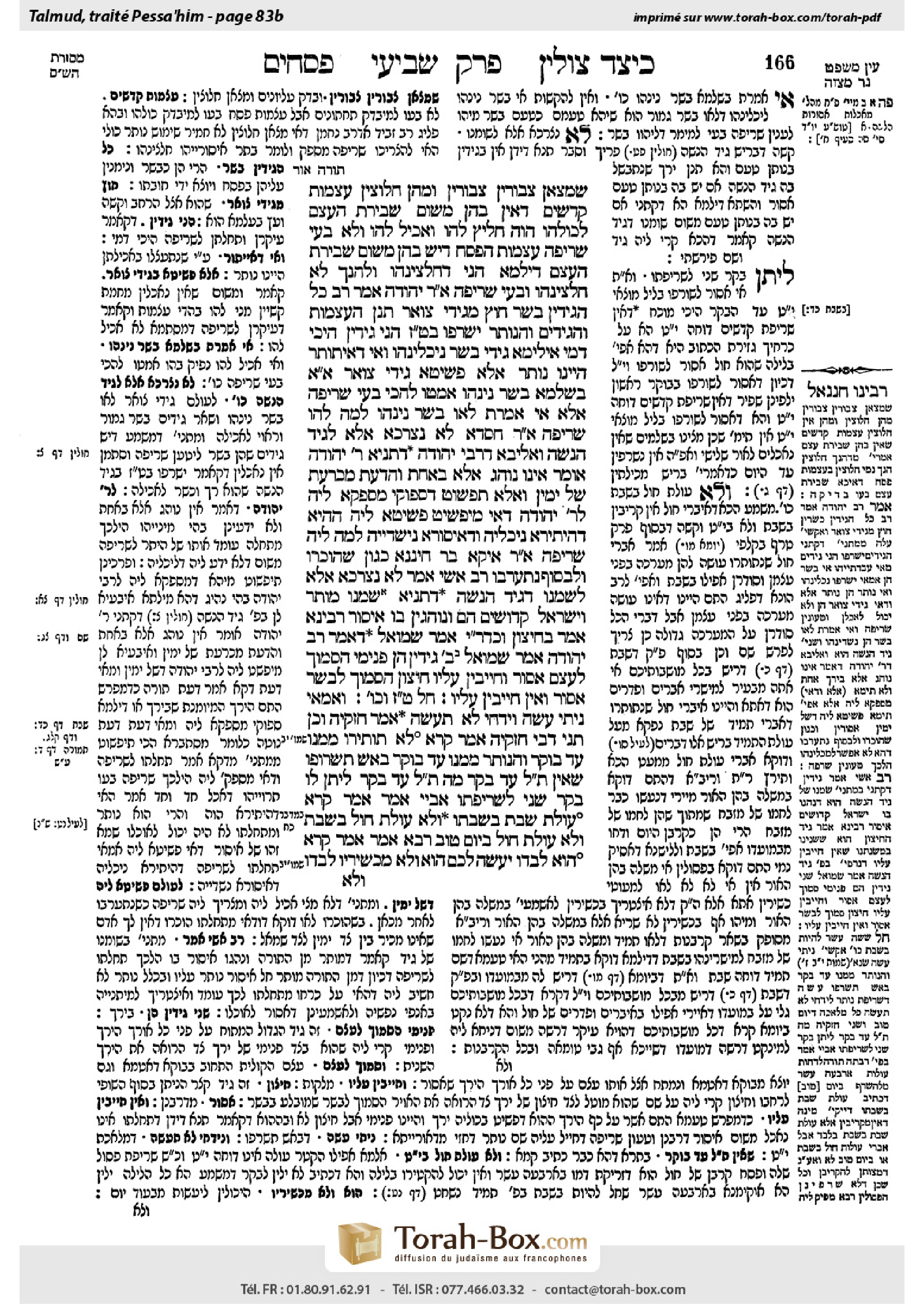
Pesachim 83b: Talmud study for Daf Yomi
Daf Yomi is the daily study of one Talmud folio. Explore 37 tractates with scans, Hebrew text, Sefaria English and AI-generated French translations where annotated.
Passage selection and English or AI-generated French translation are available where the scan has annotations. Daf Study is independent of Torah-Box and Sefaria.
Browse Pesachim · פסחים · All tractatesPesachim 83b text and translations
This page of Pesachim includes the Aramaic text, an English translation and an AI-generated French translation, alongside the scan above.
פסחים פ״ג ב · Aramaic and Hebrew text
שֶׁמְּצָאָן צִבּוּרִין צִבּוּרִין, וּמֵהֶן חֲלוּצִין. עַצְמוֹת קָדָשִׁים דְּאֵין בָּהֶן מִשּׁוּם שְׁבִירַת הָעֶצֶם — לְכוּלְּהוּ הֲוָה חָלֵיץ לְהוּ וְאָכֵיל לְהוּ, וְלָא בָּעֵי שְׂרֵיפָה.
עַצְמוֹת הַפֶּסַח דְּיֵשׁ בָּהֶן מִשּׁוּם שְׁבִירַת הָעֶצֶם — דִּילְמָא הָנֵי דְּחַלְצִינְהוּ, וּלְהָנָךְ לָא חַלְצִינְהוּ, וּבָעֵי שְׂרֵיפָה.
אָמַר רַב יְהוּדָה אָמַר רַב: כׇּל הַגִּידִין בָּשָׂר, חוּץ מִגִּידֵי צַוָּאר.
תְּנַן: הָעֲצָמוֹת וְהַגִּידִים וְהַנּוֹתָר יִשָּׂרְפוּ בְּשִׁשָּׁה עָשָׂר. הָנֵי גִּידִין הֵיכִי דָמֵי? אִילֵּימָא גִּידֵי בָשָׂר — נֵיכְלִינְהוּ? וְאִי דְּאִיתּוֹתַר — הַיְינוּ נוֹתָר? אֶלָּא פְּשִׁיטָא: גִּידֵי צַוָּאר.
אִי אָמְרַתְּ בִּשְׁלָמָא בָּשָׂר נִינְהוּ, אַמְּטוּ לְהָכִי בָּעֵי שְׂרֵיפָה. אֶלָּא אִי אָמְרַתְּ לָאו בָּשָׂר נִינְהוּ — לְמָה לְהוּ שְׂרֵיפָה? אָמַר רַב חִסְדָּא: לֹא נִצְרְכָא אֶלָּא לְגִיד הַנָּשֶׁה, וְאַלִּיבָּא דְּרַבִּי יְהוּדָה.
דְּתַנְיָא, רַבִּי יְהוּדָה אוֹמֵר: אֵינוֹ נוֹהֵג אֶלָּא בְּאַחַת, וְהַדַּעַת מַכְרַעַת שֶׁל יָמִין.
וְאֶלָּא תִּפְשׁוֹט דְּסַפּוֹקֵי מְסַפְּקָא לֵיהּ לְרַבִּי יְהוּדָה. דְּאִי מִיפְּשִׁיט פְּשִׁיטָא לֵיהּ, הָהִיא דְּהֶיתֵּירָא נֵיכְלֵיהּ, וּדְאִיסּוּרָא נִישְׁדְּיֵיהּ — לְמָה לֵיהּ שְׂרֵיפָה!
אָמַר רַב אִיקָא בַּר חִינָּנָא: כְּגוֹן שֶׁהוּכְּרוּ וּלְבַסּוֹף נִתְעָרְבוּ.
רַב אָשֵׁי אָמַר: לֹא נִצְרְכָא אֶלָּא לְשֻׁמָּנוֹ דְּגִיד הַנָּשֶׁה. דְּתַנְיָא: שֻׁמָּנוֹ מוּתָּר, וְיִשְׂרָאֵל קְדוֹשִׁים הֵם וְנוֹהֲגִין בּוֹ אִיסּוּר.
רָבִינָא אָמַר: בַּחִיצוֹן, וְכִדְרַב יְהוּדָה אָמַר שְׁמוּאֵל. דְּאָמַר רַב יְהוּדָה אָמַר שְׁמוּאֵל: שְׁנֵי גִידִין הֵן, פְּנִימִי הַסָּמוּךְ לָעֶצֶם — אָסוּר, וְחַיָּיבִין עָלָיו. חִיצוֹן הַסָּמוּךְ לַבָּשָׂר — אָסוּר, וְאֵין חַיָּיבִין עָלָיו.
חָל שִׁשָּׁה עָשָׂר וְכוּ׳. וְאַמַּאי? נֵיתֵי עֲשֵׂה וְיִדְחֵי לֹא תַּעֲשֶׂה!
אָמַר חִזְקִיָּה, וְכֵן תָּנֵי דְּבֵי חִזְקִיָּה, אָמַר קְרָא: ״לֹא תוֹתִירוּ מִמֶּנּוּ עַד בֹּקֶר וְהַנּוֹתָר מִמֶּנּוּ עַד בֹּקֶר בָּאֵשׁ תִּשְׂרֹפוּ״, שֶׁאֵין תַּלְמוּד לוֹמַר ״עַד בֹּקֶר״, מָה תַּלְמוּד לוֹמַר ״עַד בֹּקֶר״ — לִיתֵּן לוֹ בֹּקֶר שֵׁנִי לִשְׂרֵיפָתוֹ.
אַבָּיֵי אָמַר, אָמַר קְרָא: ״עֹלַת שַׁבָּת בְּשַׁבַּתּוֹ״, וְלֹא עוֹלַת חוֹל בְּשַׁבָּת, וְלֹא עוֹלַת חוֹל בְּיוֹם טוֹב.
רָבָא אָמַר, אָמַר קְרָא: ״הוּא לְבַדּוֹ יֵעָשֶׂה לָכֶם״ — ״הוּא״ וְלֹא מַכְשִׁירָיו, ״לְבַדּוֹ״,
Pesachim 83b · English translation
when one finds them in piles, and he sees that some of them have had their marrow removed. If these bones are bones of offerings to which the prohibition of breaking a bone does not apply, one can assume that the owner removed the marrow from all the bones before the marrow became leftover and ate it, and they do not require burning.
On the other hand, with regard to the bones of the Paschal lamb, to which the prohibition of breaking a bone does apply, perhaps the owner removed the marrow from these, and from those he did not remove the marrow, and they require burning. Therefore, although one needs to check all the bones of the Paschal lamb he finds to ensure that they do not have marrow left in them, he does not need to burn them due to the unconfirmed possibility that the marrow was removed after it became leftover. The bones would need to be burned only if there was still marrow in them or if one knew for certain that they had served as a base for leftover sacrificial meat.
Rav Yehuda said that Rav said: All the sinews in an animal are considered like meat. Therefore, one can fulfill his obligation to eat the Paschal lamb by eating them and one can register for them, except for the sinews of the neck, which are so hard that they are not considered meat.
We learned in the mishna: The bones, and the sinews, and the leftover shall be burned on the sixteenth. The Gemara asks: What are the circumstances in which these sinews must be burned? If we say they are sinews of meat, let us eat them. Why are they burned? And if they are sinews that were left over and not eaten for some other reason, they are leftover, so why does the mishna list sinews separately? Rather, it is obvious that the mishna is referring to sinews of the neck, which are different than other sinews and are therefore mentioned separately.
Granted, if you say they are meat, due to that they require burning; but if you say they are not meat, why do they require burning? One should simply discard them like other waste. Rav Ḥisda said: The mishna’s mention of sinews is necessary only for the sciatic nerve, in accordance with the opinion of Rabbi Yehuda.
As it was taught in a baraita that Rabbi Yehuda said: The prohibition to eat the sciatic nerve according to Torah law applies only to the sciatic nerve in one of the animal’s thighs, and not to both, and logic dictates that it is the right thigh. However, since there is no absolute proof that this is correct, the sciatic nerve must be removed from both sides. Although in theory the forbidden sciatic nerve may be discarded and the permitted one may be eaten, since there is uncertainty as to which one is permitted, neither of them may be eaten. Both must be burned.
The Gemara asks: Shall we then conclude that Rabbi Yehuda was uncertain about which sciatic nerve is forbidden? The Sages were unsure whether Rabbi Yehuda was absolutely convinced that it is the sciatic nerve from the right side that is forbidden, or if he was saying that this would seem likely to be the case, but he was not certain. As, if it were clear to him that it is the sciatic nerve from the right thigh that is forbidden, the proper procedure would be different: The one that is permitted we should eat, and the one that is forbidden we should discard. Why should he require burning?
Rav Ika bar Ḥinnana said, in response to this attempted proof: The mishna addresses a case where the two sciatic nerves were known, but in the end became mixed together. In other words, at first it was known which was the forbidden right nerve and which was the permitted left nerve. However, they were then mixed together and can no longer be identified. Therefore, due to the uncertainty, they must both be burned.
Rav Ashi said: The mishna’s ruling that the sinews must be burned is necessary only with regard to the fat of the sciatic nerve, as it was taught in a baraita: The fat around the sciatic nerve is permitted according to Torah law, but the Jewish people are holy and treat it as forbidden. Since it is permitted according to Torah law, it has the status of meat and may not be simply discarded. However, since the Jewish people treat it as forbidden, they do not eat it even from the Paschal lamb. Therefore, it is left until after the time when the meat may be eaten and burned in accordance with the general halakha of leftover.
Ravina said: This discussion pertains to the outer nerve, and it is in accordance with that which Rav Yehuda said that Shmuel said, as Rav Yehuda said that Shmuel said: There are two sinews in the sciatic nerve: The inner sinew that is next to the bone is forbidden according to Torah law, and one is liable to be flogged for eating it. The outer sinew that is next to the meat is forbidden by rabbinic law, and therefore one is not liable to be flogged for eating it. Since the outer sinew is permitted according to Torah law, it attains the status of leftover when it is not eaten.
It was taught in the mishna that if the sixteenth of Nisan occurs on Shabbat, the burning of the leftover does not override Shabbat, and they are burned on the seventeenth. The Gemara asks: And why isn’t the leftover of the Paschal lamb burned on the Festival day itself? The positive mitzva to burn the leftover should come and override the prohibition that prohibits the performance of labor on Festivals.
Ḥizkiya said, and similarly, one of the Sages in the school of Ḥizkiya taught: The verse states: “And you shall not leave any of it until morning; and that which remains of it until morning you shall burn with fire” (Exodus 12:10). As there is no need for the verse to state “until morning,” and repeating that phrase adds nothing to the verse, what is the meaning when the verse states “until morning”? It is to give it a second morning for its burning. In other words, it comes to teach that the mitzva to burn the leftover does not apply on the first morning, i.e., the morning of the Festival when they become prohibited to eat, but on the second morning, the sixteenth of Nisan. However, when the sixteenth falls on Shabbat, the burning is delayed until the seventeenth.
Abaye said: The reason is because the verse states: “The burnt-offering of each Shabbat on its Shabbat in addition to the continual burnt-offering and its libation” (Numbers 28:10). This indicates that the burnt-offering of Shabbat may be offered on the altar on Shabbat or burned if it is disqualified, but not the burnt-offering of a weekday on Shabbat, and not the burnt-offering of a weekday on a Festival. It is derived from here that one may not burn anything on Shabbat that is not an obligation of that day.
Rava said a different reason: The verse states concerning Festivals: “And on the first day there shall be a sacred convocation; no kind of labor shall be done on them, save that which every man must eat, only that may be done for you” (Exodus 12:16). From this verse one can infer the following: That, i.e., the food itself, you may prepare, but you may not perform acts that facilitate its preparation, which must be done beforehand. The word only is also exclusive; it indicates that only food preparation is permitted,
Pesachim 83b · Traduction française (IA)
lorsqu’on les trouve en tas et que l’on constate que certains ont été vidés de leur moelle. Si ces os sont ceux d’offrandes auxquelles ne s’applique pas l’interdiction de briser un os, on peut supposer que le propriétaire a retiré la moelle de tous les os avant qu’elle ne devienne un reste et l’a mangée ; ces os n’ont donc pas besoin d’être brûlés.
En revanche, pour les os de l’agneau pascal, auxquels s’applique l’interdiction de briser un os, le propriétaire a peut-être retiré la moelle de certains os, mais pas de ceux-ci ; ces os doivent alors être brûlés. Par conséquent, bien qu’il faille vérifier tous les os de l’agneau pascal que l’on trouve afin de s’assurer qu’il ne reste pas de moelle à l’intérieur, il n’est pas nécessaire de les brûler au seul motif que l’on peut supposer, sans certitude, que la moelle a été retirée après qu’elle est devenue un reste. Les os ne doivent être brûlés que s’il reste encore de la moelle à l’intérieur, ou si l’on sait avec certitude qu’ils ont servi de support à des restes de viande sacrificielle.
Rav Yehouda a dit au nom de Rav : Tous les tendons d’un animal sont considérés comme de la viande. On peut donc s’acquitter de son obligation de manger l’agneau pascal en les mangeant et s’y inscrire, à l’exception des tendons du cou, qui sont si durs qu’ils ne sont pas considérés comme de la viande.
Nous avons appris dans la Michna : « Les os, les tendons et les restes seront brûlés le 16. » La Guemara demande : Dans quelles circonstances ces tendons doivent-ils être brûlés ? Si l’on dit qu’il s’agit de tendons considérés comme de la viande, mangeons-les ! Pourquoi les brûler ? Et s’il s’agit de tendons qui n’ont pas été mangés pour une autre raison et sont donc des restes, pourquoi la Michna mentionne-t-elle les tendons séparément ? Il est donc évident que la Michna parle des tendons du cou, qui diffèrent des autres tendons et sont, par conséquent, mentionnés à part.
Certes, si l’on dit qu’il s’agit de viande, c’est pour cette raison qu’ils doivent être brûlés ; mais si l’on dit qu’ils ne sont pas de la viande, pourquoi doivent-ils être brûlés ? Il suffirait de les jeter, comme les autres déchets. Rav Ḥisda a dit : La Michna ne mentionne les tendons que pour le nerf sciatique, conformément à l’opinion de Rabbi Yehouda.
Comme il a été enseigné dans une baraïta, Rabbi Yehouda a dit : Selon la Torah, l’interdiction de manger le nerf sciatique ne s’applique qu’au nerf sciatique de l’une des cuisses de l’animal, et non des deux ; la logique indique qu’il s’agit de la cuisse droite. Toutefois, puisqu’aucune preuve absolue ne permet de l’établir, il faut retirer le nerf sciatique des deux côtés. Bien qu’en théorie on puisse jeter le nerf sciatique interdit et manger celui qui est permis, l’incertitude quant à celui qui est permis interdit de manger l’un comme l’autre. Tous deux doivent être brûlés.
La Guemara demande : Faut-il donc en conclure que Rabbi Yehouda doutait de savoir quel nerf sciatique était interdit ? Les Sages ne savaient pas si Rabbi Yehouda était absolument convaincu que le nerf sciatique de la cuisse droite était interdit, ou s’il disait que cela semblait vraisemblable sans en être certain. En effet, s’il avait été certain que le nerf sciatique de la cuisse droite était interdit, la procédure appropriée aurait été différente : celui qui est permis, mangeons-le ; celui qui est interdit, jetons-le. Pourquoi exiger qu’on le brûle ?
Rav Ika bar Ḥinnana a répondu à cette tentative de preuve : La Michna traite d’un cas où les deux nerfs sciatiques étaient identifiés, mais ont fini par être mélangés. Autrement dit, on savait d’abord lequel était le nerf droit interdit et lequel était le nerf gauche permis. Cependant, ils ont ensuite été mélangés et on ne peut plus les distinguer. Par conséquent, en raison de l’incertitude, tous deux doivent être brûlés.
Rav Ashi a dit : La décision de la Michna selon laquelle les tendons doivent être brûlés ne concerne que la graisse du nerf sciatique, comme il a été enseigné dans une baraïta : La graisse qui entoure le nerf sciatique est permise selon la Torah, mais le peuple juif est saint et la traite comme interdite. Puisqu’elle est permise selon la Torah, elle a le statut de viande et ne peut pas être simplement jetée. Cependant, puisque le peuple juif la traite comme interdite, on ne la mange pas non plus lorsqu’elle provient de l’agneau pascal. Elle est donc laissée jusqu’à l’expiration du délai pendant lequel on peut manger la viande, puis brûlée conformément à la halakha générale des restes.
Ravina a dit : Cette discussion porte sur le nerf externe, conformément à ce que Rav Yehouda a dit au nom de Shmuel : Il y a deux tendons dans le nerf sciatique : le tendon interne, proche de l’os, est interdit selon la Torah, et celui qui le mange est passible de flagellation ; le tendon externe, proche de la viande, est interdit par décret rabbinique, et celui qui le mange n’est donc pas passible de flagellation. Puisque le tendon externe est permis selon la Torah, il prend le statut de reste lorsqu’il n’est pas mangé.
La Michna enseigne que, si le 16 Nissan tombe un Chabbat, on ne brûle pas les restes, car cela ne repousse pas le Chabbat ; ils sont brûlés le 17. La Guemara demande : Pourquoi les restes de l’agneau pascal ne sont-ils pas brûlés le jour même de la fête ? La mitsva positive de brûler les restes devrait l’emporter sur l’interdiction d’effectuer un travail pendant les fêtes.
Ḥizkiya a dit, et de même, l’un des Sages de l’école de Ḥizkiya a enseigné : Le verset dit : « Vous n’en laisserez rien jusqu’au matin ; ce qui en restera jusqu’au matin, vous le brûlerez au feu » (Exode 12,10). Puisqu’il n’était pas nécessaire que le verset dise « jusqu’au matin », et que la répétition de cette expression n’ajoute rien au verset, que signifie la mention « jusqu’au matin » ? Elle lui donne un second matin pour être brûlé. Autrement dit, elle enseigne que la mitsva de brûler les restes ne s’applique pas le premier matin, c’est-à-dire le matin de la fête, lorsqu’ils deviennent interdits à la consommation, mais le deuxième matin, le 16 Nissan. Toutefois, lorsque le 16 tombe un Chabbat, la combustion est reportée au 17.
Abayé a dit : La raison en est que le verset dit : « L’holocauste de chaque Chabbat, le jour du Chabbat, en plus de l’holocauste perpétuel et de sa libation » (Nombres 28,10). Cela indique que l’holocauste du Chabbat peut être offert sur l’autel le Chabbat, ou brûlé s’il est disqualifié, mais pas l’holocauste d’un jour de semaine le Chabbat, ni l’holocauste d’un jour de semaine un jour de fête. On déduit de là qu’on ne peut rien brûler le Chabbat si cela ne constitue pas une obligation de ce jour.
Rava a donné une autre raison : Le verset dit au sujet des fêtes : « Le premier jour, il y aura une sainte convocation ; vous ne ferez aucun travail, sauf ce que chacun doit manger : cela seul pourra être fait pour vous » (Exode 12,16). On peut déduire de ce verset ce qui suit : cela, c’est-à-dire la nourriture elle-même, vous pouvez le préparer, mais vous ne pouvez pas accomplir les actes qui facilitent sa préparation et qui doivent être faits à l’avance. Le mot « seul » a également une valeur restrictive ; il indique que seule la préparation des aliments est permise,
Traduction française générée par IA à partir de l’édition anglaise de Sefaria. Vérifie toujours un passage avec le texte source.
Text from Sefaria: William Davidson Edition - Vocalized Aramaic (CC BY NC); William Davidson Edition - English (CC BY NC).