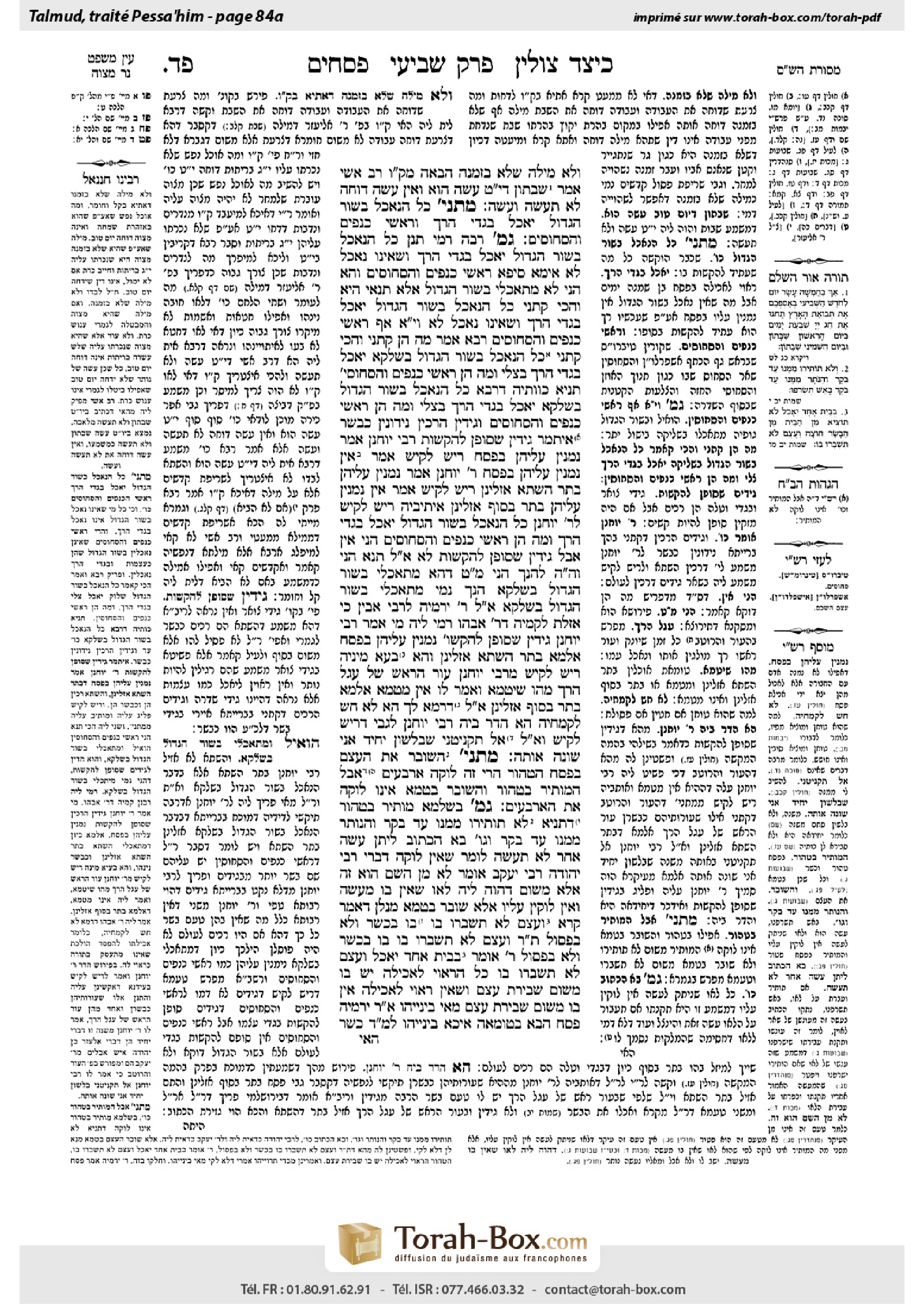
Pesachim 84a: Talmud study for Daf Yomi
Daf Yomi is the daily study of one Talmud folio. Explore 37 tractates with scans, Hebrew text, Sefaria English and AI-generated French translations where annotated.
Passage selection and English or AI-generated French translation are available where the scan has annotations. Daf Study is independent of Torah-Box and Sefaria.
Browse Pesachim · פסחים · All tractatesPesachim 84a text and translations
This page of Pesachim includes the Aramaic text, an English translation and an AI-generated French translation, alongside the scan above.
פסחים פ״ד א · Aramaic and Hebrew text
וְלֹא מִילָה שֶׁלֹּא בִּזְמַנָּהּ, הַבָּאָה מִקַּל וָחוֹמֶר.
רַב אָשֵׁי אָמַר: ״שַׁבָּתוֹן״ דְּיוֹם טוֹב — עֲשֵׂה הוּא, וְאֵין עֲשֵׂה דּוֹחֶה לֹא תַעֲשֶׂה וַעֲשֵׂה.
מַתְנִי׳ כׇּל הַנֶּאֱכָל בְּשׁוֹר הַגָּדוֹל — יֵאָכֵל בִּגְדִי הָרַךְ, וְרָאשֵׁי כְנָפַיִם וְהַסְּחוּסִים.
גְּמָ׳ רַבָּה רָמֵי, תְּנַן: כׇּל הַנֶּאֱכָל בְּשׁוֹר הַגָּדוֹל — יֵאָכֵל בִּגְדִי הָרַךְ, וְשֶׁאֵינוֹ נֶאֱכָל — לֹא. אֵימָא סֵיפָא: רָאשֵׁי כְנָפַיִם וְהַסְּחוּסִים. וְהָא הָנֵי לָא מִתְאַכְלִי בְּשׁוֹר הַגָּדוֹל!
אֶלָּא תַּנָּאֵי הִיא, וְהָכִי קָתָנֵי: כׇּל הַנֶּאֱכָל בְּשׁוֹר הַגָּדוֹל — יֵאָכֵל בִּגְדִי הָרַךְ, וְשֶׁאֵינוֹ נֶאֱכָל — לֹא. וְיֵשׁ אוֹמְרִים: אַף רָאשֵׁי כְנָפַיִם וְהַסְּחוּסִים.
רָבָא אָמַר: ״מָה הֵן״ קָתָנֵי, וְהָכִי קָתָנֵי: כׇּל הַנֶּאֱכָל בְּשׁוֹר הַגָּדוֹל בְּשִׁלְקָא — יֵאָכֵל בִּגְדִי הָרַךְ בְּצָלִי. וּמָה הֵן: רָאשֵׁי כְנָפַיִם וְהַסְּחוּסִים.
תַּנְיָא כְּווֹתֵיהּ דְּרָבָא: כׇּל הַנֶּאֱכָל בְּשׁוֹר הַגָּדוֹל בְּשִׁלְקָא — יֵאָכֵל בִּגְדִי הָרַךְ בְּצָלִי, וּמָה הֵן: רָאשֵׁי כְנָפַיִם וְהַסְּחוּסִים, וְגִידִין הָרַכִּין נִידּוֹנִין כְּבָשָׂר.
אִיתְּמַר: גִּידִין שֶׁסּוֹפָן לְהַקְשׁוֹת, רַבִּי יוֹחָנָן אָמַר: נִמְנִין עֲלֵיהֶן בַּפֶּסַח, רֵישׁ לָקִישׁ אָמַר: אֵין נִמְנִין עֲלֵיהֶן בַּפֶּסַח. רַבִּי יוֹחָנָן אָמַר נִמְנִין עֲלֵיהֶן — בָּתַר הַשְׁתָּא אָזְלִינַן. רֵישׁ לָקִישׁ אָמַר אֵין נִמְנִין עֲלֵיהֶן — בָּתַר בַּסּוֹף אָזְלִינַן.
אֵיתִיבֵיהּ רֵישׁ לָקִישׁ לְרַבִּי יוֹחָנָן: כׇּל הַנֶּאֱכָל בְּשׁוֹר הַגָּדוֹל — יֵאָכֵל בִּגְדִי הָרַךְ, וּמָה הֵן רָאשֵׁי כְנָפַיִם וְהַסְּחוּסִים. הָנֵי אִין, אֲבָל גִּידִין שֶׁסּוֹפָן לְהַקְשׁוֹת — לָא! אֲמַר לֵיהּ: תְּנָא הָנֵי וְהוּא הַדִּין לְהָנָךְ. הָנֵי מַאי טַעְמָא — דְּהָא מִתְאַכְלִי בְּשׁוֹר הַגָּדוֹל בְּשִׁלְקָא, הָנָךְ נָמֵי מִתְאַכְלִי בְּשׁוֹר הַגָּדוֹל בְּשִׁלְקָא.
אֲמַר לֵיהּ רַבִּי יִרְמְיָה לְרַבִּי אָבִין: כִּי אָזְלַתְּ לְקַמֵּיהּ דְּרַבִּי אֲבָהוּ, רְמִי לֵיהּ: מִי אָמַר רַבִּי יוֹחָנָן גִּידִין שֶׁסּוֹפָן לְהַקְשׁוֹת נִמְנִין עֲלֵיהֶן בַּפֶּסַח, אַלְמָא: בָּתַר הַשְׁתָּא אָזְלִינַן? וְהָא בְּעָא מִינֵּיהּ רֵישׁ לָקִישׁ מֵרַבִּי יוֹחָנָן: עוֹר הָרֹאשׁ שֶׁל עֵגֶל הָרַךְ, מַהוּ שֶׁיְּטַמֵּא? וְאָמַר לוֹ: אֵין מְטַמֵּא. אַלְמָא: בָּתַר בַּסּוֹף אָזְלִינַן!
אֲמַר לֵיהּ: דִּרְמָא לָךְ הָא — לָא חַשׁ לְקִמְחֵיהּ. הָא הֲדַר בֵּיהּ רַבִּי יוֹחָנָן לְגַבֵּי דְּרֵישׁ לָקִישׁ, וַאֲמַר לֵיהּ: אַל תַּקְנִיטֵנִי, שֶׁבִּלְשׁוֹן יָחִיד אֲנִי שׁוֹנֶה אוֹתָהּ.
מַתְנִי׳ הַשּׁוֹבֵר אֶת הָעֶצֶם בַּפֶּסַח הַטָּהוֹר — הֲרֵי זֶה לוֹקֶה אַרְבָּעִים. אֲבָל הַמּוֹתִיר בַּטָּהוֹר וְהַשּׁוֹבֵר בְּטָמֵא — אֵינוֹ לוֹקֶה אֶת הָאַרְבָּעִים.
גְּמָ׳ בִּשְׁלָמָא מוֹתִיר בַּטָּהוֹר — דְּתַנְיָא: ״לֹא תוֹתִירוּ מִמֶּנּוּ עַד בֹּקֶר וְהַנֹּתָר מִמֶּנּוּ עַד בֹּקֶר וְגוֹ׳״, בָּא הַכָּתוּב לִיתֵּן עֲשֵׂה אַחַר לֹא תַּעֲשֶׂה לוֹמַר שֶׁאֵין לוֹקֶה — דִּבְרֵי רַבִּי יְהוּדָה.
רַבִּי יַעֲקֹב אוֹמֵר: לֹא מִן הַשֵּׁם הוּא זֶה, אֶלָּא מִשּׁוּם דְּהָוֵה לֵיהּ לָאו שֶׁאֵין בּוֹ מַעֲשֶׂה, וְאֵין לוֹקִין עָלָיו. אֶלָּא שׁוֹבֵר בַּטָּמֵא מְנָלַן? דְּאָמַר קְרָא: ״וְעֶצֶם לֹא תִשְׁבְּרוּ בוֹ״, ״בּוֹ״ בְּכָשֵׁר וְלֹא בְּפָסוּל.
תָּנוּ רַבָּנַן: ״וְעֶצֶם לֹא תִשְׁבְּרוּ בוֹ״, ״בּוֹ״ — בְּכָשֵׁר וְלֹא בְּפָסוּל. רַבִּי אוֹמֵר: ״בְּבַיִת אֶחָד יֵאָכֵל ... וְעֶצֶם לֹא תִשְׁבְּרוּ בּוֹ״. כׇּל הָרָאוּי לַאֲכִילָה — יֵשׁ בּוֹ מִשּׁוּם שְׁבִירַת עֶצֶם, וְשֶׁאֵין רָאוּי לַאֲכִילָה — אֵין בּוֹ מִשּׁוּם שְׁבִירַת עֶצֶם.
מַאי בֵּינַיְיהוּ? אָמַר רַבִּי יִרְמְיָה: פֶּסַח הַבָּא בְּטוּמְאָה אִיכָּא בֵּינַיְיהוּ. לְמַאן דְּאָמַר כָּשֵׁר —
Pesachim 84a · English translation
but not a circumcision that is not at its ideal time. If, for some reason, circumcision was not performed on the eighth day after birth, its performance at a later date does not override a Festival, because the obligation to perform the circumcision is not particular to that specific day. This needed to be emphasized. Otherwise, it would have come to be derived through an a fortiori inference that circumcision does override Shabbat and Festivals, based on the fact that it overrides the laws of leprosy. Therefore, the Torah emphasized that circumcision performed later than the eighth day does not override Festivals.
Rav Ashi said a different reason that the leftover Paschal lamb is not burned on the Festival: The obligation of solemn rest stated with regard to Festivals is a positive mitzva. Therefore, the halakhot of Festivals include both a positive mitzva to rest from performing prohibited labor and a prohibition to avoid such labor, and a positive mitzva such as burning leftover sacrificial meat does not override both a prohibition and a positive mitzva.
MISHNA: Anything that is fit to be eaten in an adult ox, whose bones have fully hardened, may be eaten in a young kid. One may register for a Paschal offering in order to eat any of these parts, and eating any such part is considered a fulfillment of the mitzva to eat the Paschal lamb. However, any part of the animal that is inedible in an adult ox is not considered meat, even if it is soft enough to be eaten in a young kid. One may not register for a Paschal offering in order to eat one of these parts, and eating it is not a fulfillment of the mitzva to eat the Paschal lamb. And the soft ends of the ribs and the cartilage are soft enough to be considered edible and may therefore be eaten from the Paschal lamb.
GEMARA: Rabba raised a contradiction: We learned in the mishna that anything that is fit to be eaten in an adult ox may be eaten in a young kid, which indicates clearly that anything that is not eaten in an adult ox is not eaten even when it comes from a young kid. Say the latter clause of the mishna: The ends of the ribs and the cartilage of the young kid may be eaten. But these are not eaten in an adult ox, because they have already become as hard as bone and are no longer edible.
Rather, it is a dispute between tanna’im, and both opinions are mentioned in the mishna, and this is what it is teaching: Anything eaten in an adult ox may be eaten in a young kid, and anything that is not eaten in an adult ox is not eaten in a young kid. And some say that even the ends of the ribs and the cartilage are eaten from a young kid, because even these parts of an adult ox can be made edible through extensive cooking.
Rava said: The mishna teaches employing the style: What are they, in which the mishna establishes a principle and then provides detail, and this is what it is teaching: Anything that is fit to be eaten in an adult ox through cooking may be eaten in a young kid through roasting, even if this part of an adult ox cannot be made edible through roasting. And what are these parts? They are the ends of the ribs and the cartilage.
It was taught in a baraita in accordance with the opinion of Rava: Anything that is fit to be eaten in an adult ox through cooking may be eaten in a young kid through roasting; and what are these parts? They are the ends of the ribs and the cartilage; and the soft sinews are judged as meat.
It was stated that the Sages disputed the issue of sinews that will eventually harden but are currently soft. Rabbi Yoḥanan said: One may register for them in the Paschal lamb. Reish Lakish said: One may not register for them in the Paschal lamb. The Gemara explains: Rabbi Yoḥanan said that one may register for them in the Paschal lamb because we follow the current condition of the sinews; since they are edible in their current state, they are considered meat. Reish Lakish said that one may not register for them in the Paschal lamb because we follow the eventual condition of the sinews, and they eventually become inedible.
Reish Lakish raised an objection to Rabbi Yoḥanan: It was stated that anything eaten in an adult ox may be eaten in a young kid, and what are these parts? They are the ends of the ribs and the cartilage. This indicates that with regard to these items, yes, they may be eaten; but with regard to sinews that will eventually harden, no, they may not. This contradicts the opinion of Rabbi Yoḥanan. Rabbi Yoḥanan said to him: It taught these, the ends of the ribs and the cartilage, and the same is true for those, i.e., the same halakha applies to sinews that will eventually harden. What is the reason that people may register for these, the ends of the ribs and the cartilage? It is because they are eaten in an adult ox through cooking. These, too, the sinews that will eventually harden, are eaten in an adult ox through cooking.
Rabbi Yirmeya said to Rabbi Avin: When you go before Rabbi Abbahu, raise the following contradiction to him: Did Rabbi Yoḥanan actually say: With regard to sinews that will eventually harden, people may register for them in the Paschal lamb, which would apparently indicate that we go according to the current condition of the sinews? But Reish Lakish asked Rabbi Yoḥanan: With regard to the hide of the head of a young calf, which is still edible, what is the halakha with regard to the possibility of it becoming ritually impure as a food? Do we view it as a food and apply the rules of ritual impurity of foods, or do we view it as a hide? And he said to him: It does not become ritually impure. Apparently, we go according to the eventual condition of the hide, which contradicts Rabbi Yoḥanan’s own opinion with regard to sinews.
When Rabbi Avin came before Rabbi Abbahu and asked him this question, Rabbi Abbahu said to him: Whoever asked you this question was not concerned for his flour, meaning he did not carefully consider what he said. Rabbi Yoḥanan retracted his opinion in this regard in favor of the opinion of Reish Lakish, and Rabbi Yoḥanan said to him, at the end of their discussion on the topic: Do not trouble me by asking a question based on a mishna that seems to prove that we follow the current state of the hide, as I teach it in the singular. That mishna, on which I previously relied, is the opinion of one Sage and should not be relied upon. This proves that Rabbi Yoḥanan changed his mind and concluded that the status of parts of the animal is established based on their eventual condition. The opinion of Rabbi Yoḥanan with regard to the Paschal lamb was stated before he changed his mind.
MISHNA: One who breaks the bone of a Paschal lamb that is ritually pure receives forty lashes for having violated a prohibition stated in the Torah. But one who leaves over part of a ritually pure Paschal lamb and one who breaks the bone of a ritually impure Paschal lamb do not receive forty lashes.
GEMARA: The Gemara analyzes the mishna’s rulings: Granted, one who leaves over part of a ritually pure Paschal lamb is not flogged for having violated Torah law. There is good reason for this, as it was taught in a baraita: The verse states: “And you shall not leave any of it until morning; and that which remains of it until morning you shall burn with fire” (Exodus 12:10). The verse comes to provide a positive mitzva to burn the leftover after the prohibition against leaving it over, to say that one is not flogged because any prohibition that can be rectified by the performance of a positive mitzva does not carry a punishment of lashes. This is the statement of Rabbi Yehuda.
Rabbi Ya’akov says: This is not for that reason. Rather, it is because it is a prohibition that does not involve an action. The transgression is simply the failure to consume all the meat during the allotted time rather than the performance of an action. And one is not flogged for any prohibition that does not involve an action. But with regard to one who breaks the bone of a ritually impure Paschal lamb, from where do we derive that he, too, does not receive lashes? The Gemara answers that the source is as the verse states: “In one house shall it be eaten; you shall not remove any of the meat from the house to the outside, and you shall not break a bone in it” (Exodus 12:46). It may be inferred that the prohibition applies “in it,” in a valid Paschal lamb, and not in a disqualified one.
The Sages taught with regard to that same topic: “And you shall not break a bone in it”; the prohibition applies in it, i.e., in a valid Paschal lamb and not in a disqualified one. Rabbi Yehuda HaNasi says that this halakha should be learned in the following manner: It states: “In one house shall it be eaten,” and shortly thereafter the verse states: “And you shall not break a bone in it,” from which one can derive that any Paschal lamb fit for eating is subject to the prohibition of breaking a bone, and any Paschal lamb that is not fit for eating is not subject to the prohibition of breaking a bone.
The Gemara asks: What is the practical difference between them? Rabbi Yirmeya said: The practical difference between them is with regard to a Paschal lamb that is brought when the majority of the nation is in a state of ritual impurity. According to the one who says that the prohibition of breaking a bone applies only to a valid Paschal lamb,
Pesachim 84a · Traduction française (IA)
mais non une circoncision pratiquée hors de son temps prescrit. Si, pour une raison quelconque, la circoncision n’a pas été pratiquée le huitième jour après la naissance, son accomplissement à une date ultérieure ne repousse pas un jour de fête, car l’obligation de la pratiquer n’est pas liée à ce jour précis. Il fallait le souligner. Sinon, on aurait pu déduire, par raisonnement a fortiori, que la circoncision repousse Chabbat et les jours de fête, puisqu’elle l’emporte sur les lois relatives à la lèpre. C’est pourquoi la Torah a souligné qu’une circoncision pratiquée après le huitième jour ne repousse pas les jours de fête.
Rav Ashi a donné une autre raison pour laquelle le reste de l’agneau pascal n’est pas brûlé un jour de fête : le repos solennel prescrit à l’occasion des fêtes est une mitsva positive. Par conséquent, les halakhot des fêtes comprennent à la fois une mitsva positive de se reposer des travaux interdits et une interdiction de les accomplir ; or, une mitsva positive telle que brûler les restes de viande sacrificielle ne l’emporte pas à la fois sur une interdiction et sur une mitsva positive.
Michna : Tout ce qui est propre à être mangé sur un bœuf adulte, dont les os ont complètement durci, peut être mangé sur un chevreau. On peut s’inscrire pour un sacrifice pascal afin de manger l’une quelconque de ces parties, et manger une telle partie est considéré comme l’accomplissement de la mitsva de manger l’agneau pascal. En revanche, toute partie de l’animal qui n’est pas comestible chez un bœuf adulte n’est pas considérée comme de la viande, même si elle est assez tendre pour être mangée chez un chevreau. On ne peut pas s’inscrire pour un sacrifice pascal afin de manger l’une de ces parties, et la manger ne constitue pas l’accomplissement de la mitsva de manger l’agneau pascal. Les extrémités tendres des côtes et le cartilage sont suffisamment tendres pour être considérés comme comestibles ; ils peuvent donc être mangés sur l’agneau pascal.
Guemara : Rabba souleva une contradiction : nous avons appris dans la Michna que tout ce qui est propre à être mangé sur un bœuf adulte peut être mangé sur un chevreau, ce qui indique clairement que tout ce qui ne se mange pas chez un bœuf adulte ne se mange pas non plus lorsqu’il provient d’un chevreau. Considérons la dernière proposition de la Michna : les extrémités des côtes et le cartilage du chevreau peuvent être mangés. Or, on ne les mange pas chez un bœuf adulte, car ils sont devenus durs comme de l’os et ne sont plus comestibles.
Il s’agit plutôt d’une controverse entre des tannaïm, dont les deux opinions sont rapportées dans la Michna ; voici ce qu’elle enseigne : tout ce qui se mange chez un bœuf adulte se mange chez un chevreau, et tout ce qui ne se mange pas chez un bœuf adulte ne se mange pas chez un chevreau. Certains disent que même les extrémités des côtes et le cartilage se mangent chez un chevreau, car ces parties d’un bœuf adulte aussi peuvent devenir comestibles après une cuisson prolongée.
Rava dit : La Michna adopte la formulation « Quels sont-ils ? », dans laquelle elle pose d’abord un principe, puis en donne le détail. Voici ce qu’elle enseigne : tout ce qui peut être mangé chez un bœuf adulte après cuisson peut être mangé chez un chevreau après rôtissage, même si cette partie du bœuf adulte ne peut pas être rendue comestible par le rôtissage. Et quelles sont ces parties ? Les extrémités des côtes et le cartilage.
Une baraïta fut enseignée conformément à l’opinion de Rava : tout ce qui peut être mangé chez un bœuf adulte après cuisson peut être mangé chez un chevreau après rôtissage. Et quelles sont ces parties ? Les extrémités des côtes et le cartilage. Les tendons tendres sont considérés comme de la viande.
Il fut rapporté que les Sages étaient en désaccord au sujet des tendons qui finiront par durcir, mais qui sont encore tendres. Rabbi Yoḥanan dit : On peut s’inscrire pour l’agneau pascal afin de les manger. Reish Lakish dit : On ne peut pas s’inscrire pour l’agneau pascal afin de les manger. La Guemara explique : Rabbi Yoḥanan dit qu’on peut s’inscrire pour l’agneau pascal afin de les manger, car nous nous réglons sur l’état actuel des tendons ; puisqu’ils sont comestibles dans leur état présent, ils sont considérés comme de la viande. Reish Lakish dit qu’on ne peut pas s’inscrire pour l’agneau pascal afin de les manger, car nous nous réglons sur leur état futur, et ils deviendront alors non comestibles.
Reish Lakish souleva une objection à Rabbi Yoḥanan : il fut enseigné que tout ce qui se mange chez un bœuf adulte peut être mangé chez un chevreau, et que ces parties sont les extrémités des côtes et le cartilage. Cela indique que ces éléments, oui, peuvent être mangés, mais que les tendons qui finiront par durcir, non, ne peuvent pas l’être. Cela contredit l’opinion de Rabbi Yoḥanan. Rabbi Yoḥanan lui dit : La Michna a enseigné ces éléments, les extrémités des côtes et le cartilage, mais il en va de même pour ceux-là, c’est-à-dire que la même halakha s’applique aux tendons qui finiront par durcir. Pourquoi peut-on s’inscrire pour manger ces éléments, les extrémités des côtes et le cartilage ? Parce qu’ils se mangent chez un bœuf adulte après cuisson. Ces tendons aussi, ceux qui finiront par durcir, se mangent chez un bœuf adulte après cuisson.
Rabbi Yirmeya dit à Rabbi Avin : Lorsque tu te présenteras devant Rabbi Abbahu, soulève-lui la contradiction suivante : Rabbi Yoḥanan a-t-il réellement dit qu’on peut s’inscrire pour l’agneau pascal afin de manger des tendons qui finiront par durcir, ce qui semble indiquer que nous nous réglons sur leur état actuel ? Mais Reish Lakish demanda à Rabbi Yoḥanan : Concernant la peau de la tête d’un jeune veau, qui est encore comestible, quelle est la halakha quant à la possibilité qu’elle contracte l’impureté rituelle en tant qu’aliment ? La considérons-nous comme un aliment et lui appliquons-nous les règles de l’impureté rituelle des aliments, ou la considérons-nous comme une peau ? Il lui répondit : Elle ne contracte pas l’impureté rituelle. Apparemment, nous nous réglons sur l’état futur de la peau, ce qui contredit l’opinion même de Rabbi Yoḥanan concernant les tendons.
Lorsque Rabbi Avin se présenta devant Rabbi Abbahu et lui posa cette question, Rabbi Abbahu lui dit : Celui qui t’a posé cette question ne s’est pas soucié de sa farine, c’est-à-dire qu’il n’a pas réfléchi soigneusement à ce qu’il disait. Rabbi Yoḥanan avait rétracté son opinion sur ce point en faveur de celle de Reish Lakish, et, à la fin de leur discussion sur le sujet, Rabbi Yoḥanan lui dit : Ne me donne pas de tracas en posant une question fondée sur une Michna qui semble prouver que nous nous réglons sur l’état actuel de la peau, car je l’enseigne au singulier. Cette Michna, sur laquelle je m’étais auparavant appuyé, rapporte l’opinion d’un seul Sage et ne doit pas faire autorité. Cela prouve que Rabbi Yoḥanan changea d’avis et conclut que le statut des parties de l’animal est déterminé d’après leur état futur. L’opinion de Rabbi Yoḥanan concernant l’agneau pascal fut énoncée avant qu’il ne change d’avis.
Michna : Celui qui brise un os d’un agneau pascal rituellement pur reçoit quarante coups de fouet pour avoir transgressé une interdiction formulée dans la Torah. Mais celui qui laisse une partie de la viande d’un agneau pascal rituellement pur et celui qui brise un os d’un agneau pascal rituellement impur ne reçoivent pas quarante coups de fouet.
Guemara : La Guemara examine les décisions de la Michna : il est compréhensible que celui qui laisse une partie de la viande d’un agneau pascal rituellement pur ne soit pas fouetté pour avoir transgressé la loi de la Torah. Il y a à cela une bonne raison, comme l’enseigne une baraïta : le verset dit : « Vous n’en laisserez rien jusqu’au matin ; ce qui en restera jusqu’au matin, vous le brûlerez au feu » (Exode 12, 10). Le verset vient ajouter une mitsva positive de brûler les restes, après l’interdiction de les laisser, afin d’enseigner qu’on ne reçoit pas de coups de fouet pour une interdiction à laquelle on peut remédier par l’accomplissement d’une mitsva positive. Telle est la déclaration de Rabbi Yehuda.
Rabbi Ya’akov dit : Ce n’est pas pour cette raison. C’est plutôt parce qu’il s’agit d’une interdiction qui n’implique pas d’action. La transgression consiste simplement à ne pas consommer toute la viande dans le délai imparti, et non à accomplir un acte. Or, on ne reçoit pas de coups de fouet pour une interdiction qui n’implique pas d’action. Mais, concernant celui qui brise un os d’un agneau pascal rituellement impur, d’où déduisons-nous que lui non plus ne reçoit pas de coups de fouet ? La Guemara répond que la source est le verset qui dit : « On le mangera dans une seule maison ; tu ne feras sortir aucune partie de la viande de la maison vers l’extérieur, et tu n’en briseras aucun os » (Exode 12, 46). On peut en déduire que l’interdiction s’applique « en lui », c’est-à-dire dans un agneau pascal valide, et non dans un agneau pascal disqualifié.
Les Sages enseignèrent à propos de ce même sujet : « Tu n’en briseras aucun os » ; l’interdiction s’applique en lui, c’est-à-dire dans un agneau pascal valide, et non dans un agneau disqualifié. Rabbi Yehuda HaNasi dit qu’il faut apprendre cette halakha de la manière suivante : le verset dit « On le mangera dans une seule maison », puis, peu après, il dit « Tu n’en briseras aucun os », d’où l’on peut déduire que tout agneau pascal propre à être mangé est soumis à l’interdiction de briser un os, et que tout agneau pascal qui n’est pas propre à être mangé n’est pas soumis à cette interdiction.
La Guemara demande : Quelle est la différence pratique entre eux ? Rabbi Yirmeya dit : La différence pratique concerne un agneau pascal offert alors que la majorité du peuple se trouve en état d’impureté rituelle. Selon celui qui dit que l’interdiction de briser un os ne s’applique qu’à un agneau pascal valide,
Traduction française générée par IA à partir de l’édition anglaise de Sefaria. Vérifie toujours un passage avec le texte source.
Text from Sefaria: William Davidson Edition - Vocalized Aramaic (CC BY NC); William Davidson Edition - English (CC BY NC).