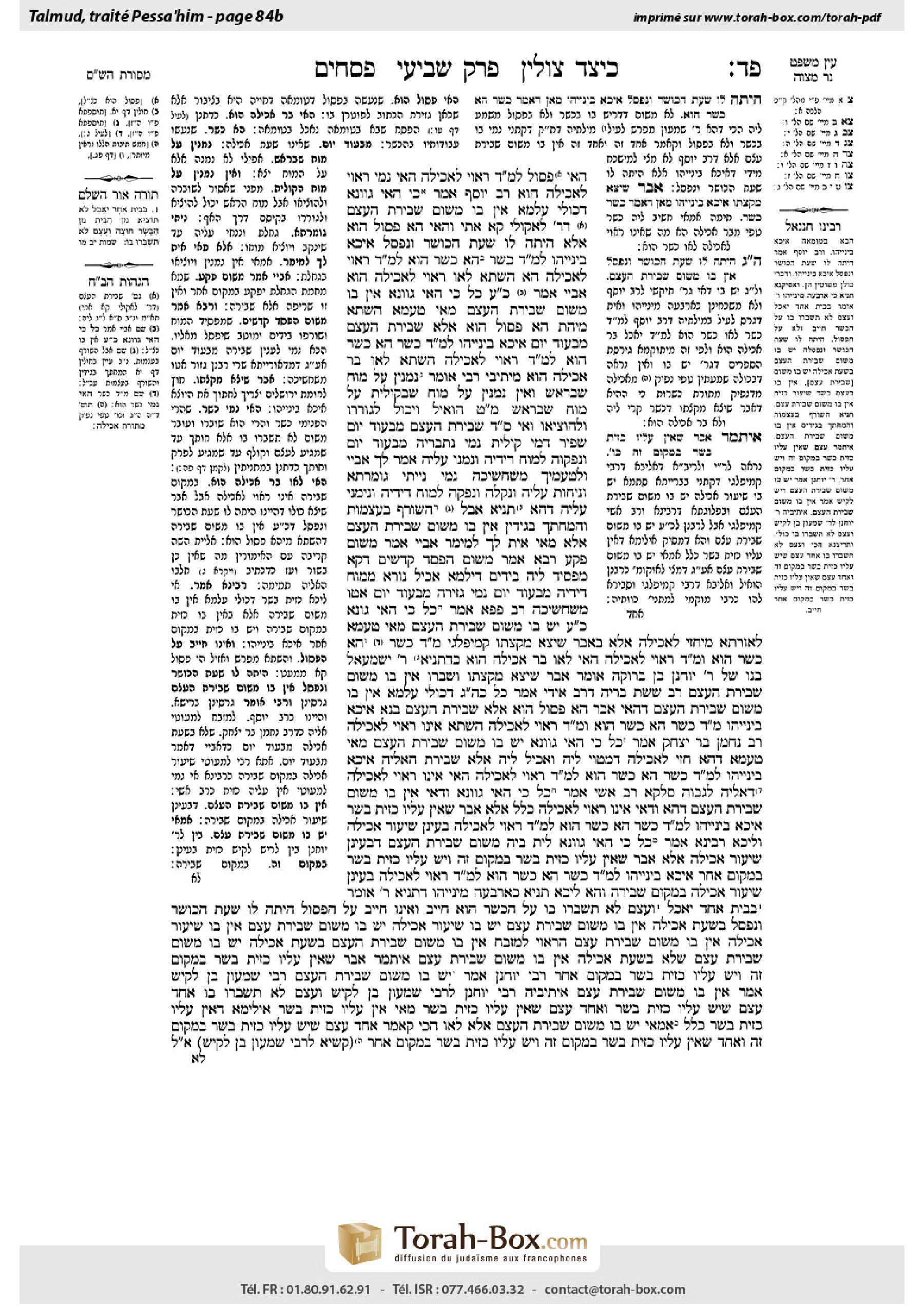
Pesachim 84b: Talmud study for Daf Yomi
Daf Yomi is the daily study of one Talmud folio. Explore 37 tractates with scans, Hebrew text, Sefaria English and AI-generated French translations where annotated.
Passage selection and English or AI-generated French translation are available where the scan has annotations. Daf Study is independent of Torah-Box and Sefaria.
Browse Pesachim · פסחים · All tractatesPesachim 84b text and translations
This page of Pesachim includes the Aramaic text, an English translation and an AI-generated French translation, alongside the scan above.
פסחים פ״ד ב · Aramaic and Hebrew text
הַאי פָּסוּל. לְמַאן דְּאָמַר רָאוּי לַאֲכִילָה — הַאי נָמֵי רָאוּי לַאֲכִילָה הוּא.
רַב יוֹסֵף אָמַר: כִּי הַאי גַוְונָא — דְּכוּלֵּי עָלְמָא אֵין בּוֹ מִשּׁוּם שְׁבִירַת הָעֶצֶם, דְּרַבִּי לְאַקּוֹלֵי קָא אָתֵי, וְהַאי הָא פָּסוּל הוּא.
אֶלָּא, הָיְתָה לוֹ שְׁעַת הַכּוֹשֶׁר וְנִפְסַל אִיכָּא בֵּינַיְיהוּ. לְמַאן דְּאָמַר כָּשֵׁר — הָא כָּשֵׁר הוּא. לְמַאן דְּאָמַר רָאוּי לַאֲכִילָה — הָא הַשְׁתָּא לָאו רָאוּי לַאֲכִילָה הוּא.
אַבָּיֵי אָמַר: כּוּלֵּי עָלְמָא כָּל כִּי הַאי גַוְונָא אֵין בּוֹ מִשּׁוּם שְׁבִירַת הָעֶצֶם, מַאי טַעְמָא? הַשְׁתָּא מִיהַת הָא פָּסוּל הוּא. אֶלָּא, שְׁבִירַת הָעֶצֶם מִבְּעוֹד יוֹם אִיכָּא בֵּינַיְיהוּ. לְמַאן דְּאָמַר כָּשֵׁר — הָא כָּשֵׁר הוּא, לְמַאן דְּאָמַר רָאוּי לַאֲכִילָה — הַשְׁתָּא לָאו בַּר אֲכִילָה הוּא,
מֵיתִיבִי, רַבִּי אוֹמֵר: נִמְנִין עַל מוֹחַ שֶׁבָּרֹאשׁ וְאֵין נִמְנִין עַל מוֹחַ שֶׁבַּקּוּלִית. עַל מוֹחַ שֶׁבָּרֹאשׁ מַאי טַעְמָא — הוֹאִיל וְיָכוֹל לְגוֹרְרוֹ וּלְהוֹצִיאוֹ. וְאִי סָלְקָא דַעְתָּךְ שְׁבִירַת הָעֶצֶם מִבְּעוֹד יוֹם שַׁפִּיר דָּמֵי — קוּלִית נָמֵי, נִתְבְּרֵיהּ מִבְּעוֹד יוֹם, וְנַפְּקוּהּ לְמוֹחַ דִּידֵיהּ, וְנִמְנוֹ עֲלֵיהּ!
אָמַר לָךְ אַבָּיֵי: וּלְטַעְמָיךְ, מִשֶּׁחָשֵׁיכָה נָמֵי: נַיְיתֵי גּוּמַרְתָּא וְנַיחֵות עֲלֵיהּ וְנִקְלֵהּ, וְנַפְּקֵהּ לְמוֹחַ דִּידֵיהּ, וְנִימְּנֵי עֲלֵיהּ. דְּהָא תַּנְיָא: אֲבָל הַשּׂוֹרֵף בַּעֲצָמוֹת וְהַמְחַתֵּךְ בְּגִידִין — אֵין בּוֹ מִשּׁוּם שְׁבִירַת הָעֶצֶם.
אֶלָּא מַאי אִית לָךְ לְמֵימַר — אַבָּיֵי אָמַר: מִשּׁוּם פֶּקַע, רָבָא אָמַר: מִשּׁוּם הֶפְסֵד קָדָשִׁים, דְּקָא מַפְסֵיד לֵיהּ בְּיָדַיִם — דִּילְמָא אָכֵיל נוּרָא מִמּוֹחַ דִּידֵיהּ. מִבְּעוֹד יוֹם נָמֵי, גְּזֵירָה מִבְּעוֹד יוֹם אַטּוּ מִשֶּׁחָשֵׁיכָה.
רַב פָּפָּא אָמַר: כָּל כִּי הַאי גַוְנָא — כּוּלֵּי עָלְמָא יֵשׁ בּוֹ מִשּׁוּם שְׁבִירַת הָעֶצֶם. מַאי טַעְמָא? לְאוּרְתָּא מִיחֲזֵי לַאֲכִילָה. אֶלָּא, בְּאֵבֶר שֶׁיָּצָא מִקְצָתוֹ קָמִיפַּלְגִי. מַאן דְּאָמַר כָּשֵׁר — הָא כָּשֵׁר הוּא, וּמַאן דְּאָמַר רָאוּי לַאֲכִילָה — הַאי לָאו בַּר אֲכִילָה הוּא.
כִּדְתַנְיָא, רַבִּי יִשְׁמָעֵאל בְּנוֹ שֶׁל רַבִּי יוֹחָנָן בֶּן בְּרוֹקָה אוֹמֵר: אֵבֶר שֶׁיָּצָא מִקְצָתוֹ וּשְׁבָרוֹ — אֵין בּוֹ מִשּׁוּם שְׁבִירַת הָעֶצֶם.
רַב שֵׁשֶׁת בְּרֵיהּ דְּרַב אִידִי אָמַר: כָּל כִּי הַאי גַוְונָא דְּכוּלֵּי עָלְמָא אֵין בּוֹ מִשּׁוּם שְׁבִירַת הָעֶצֶם, דְּהַאי אֵבֶר הָא פָּסוּל הוּא. אֶלָּא, שְׁבִירַת הָעֶצֶם בְּנָא אִיכָּא בֵּינַיְיהוּ. מַאן דְּאָמַר כָּשֵׁר — הָא כָּשֵׁר הוּא, וּמַאן דְּאָמַר רָאוּי לַאֲכִילָה — הַשְׁתָּא אֵינוֹ רָאוּי לַאֲכִילָה.
רַב נַחְמָן בַּר יִצְחָק אָמַר: כָּל כִּי הַאי גַוְונָא יֵשׁ בּוֹ מִשּׁוּם שְׁבִירַת הָעֶצֶם, מַאי טַעְמָא דְּהָא חֲזֵי לַאֲכִילָה, דְּמַטְוֵי לֵיהּ וְאָכֵיל לֵיהּ. אֶלָּא, שְׁבִירַת הָאַלְיָה אִיכָּא בֵּינַיְיהוּ. לְמַאן דְּאָמַר כָּשֵׁר — הָא כָּשֵׁר הוּא, לְמַאן דְּאָמַר רָאוּי לַאֲכִילָה — הַאי אֵינוֹ רָאוּי לַאֲכִילָה, דְּאַלְיָה לְגָבוֹהַּ סָלְקָא.
רַב אָשֵׁי אָמַר: כָּל כִּי הַאי גַוְונָא וַדַּאי אֵין בּוֹ מִשּׁוּם שְׁבִירַת הָעֶצֶם, דְּהָא וַדַּאי אֵינוֹ רָאוּי לַאֲכִילָה כְּלָל. אֶלָּא, אֵבֶר שֶׁאֵין עָלָיו כַּזַּיִת בָּשָׂר אִיכָּא בֵּינַיְיהוּ. לְמַאן דְּאָמַר כָּשֵׁר — הָא כָּשֵׁר הוּא, לְמַאן דְּאָמַר רָאוּי לַאֲכִילָה — בָּעֵינַן שִׁיעוּר אֲכִילָה, וְלֵיכָּא.
רָבִינָא אָמַר: כׇּל כִּי הַאי גַוְונָא לֵית בֵּיהּ מִשּׁוּם שְׁבִירַת הָעֶצֶם, דְּבָעֵינַן שִׁיעוּר אֲכִילָה. אֶלָּא, אֵבֶר שֶׁאֵין עָלָיו כְּזַיִת בָּשָׂר בְּמָקוֹם זֶה וְיֵשׁ עָלָיו כְּזַיִת בָּשָׂר בִּמְקוֹם אַחֵר אִיכָּא בֵּינַיְיהוּ. לְמַאן דְּאָמַר כָּשֵׁר — הָא כָּשֵׁר הוּא. לְמַאן דְּאָמַר רָאוּי לַאֲכִילָה — בָּעֵינַן שִׁיעוּר אֲכִילָה בִּמְקוֹם שְׁבִירָה, וְהָא לֵיכָּא.
תַּנְיָא כְּאַרְבְּעָה מִינַּיְיהוּ. דְּתַנְיָא, רַבִּי אוֹמֵר: ״בְּבַיִת אֶחָד יֵאָכֵל ... וְעֶצֶם לֹא תִשְׁבְּרוּ בּוֹ״, עַל הַכָּשֵׁר הוּא חַיָּיב, וְאֵינוֹ חַיָּיב עַל הַפָּסוּל.
הָיְתָה לוֹ שְׁעַת הַכּוֹשֶׁר וְנִפְסַל בִּשְׁעַת אֲכִילָה — אֵין בּוֹ מִשּׁוּם שְׁבִירַת עֶצֶם.
יֵשׁ בּוֹ שִׁיעוּר אֲכִילָה — יֵשׁ בּוֹ מִשּׁוּם שְׁבִירַת עֶצֶם, אֵין בּוֹ שִׁיעוּר אֲכִילָה — אֵין בּוֹ מִשּׁוּם שְׁבִירַת עֶצֶם.
הָרָאוּי לַמִּזְבֵּחַ — אֵין בּוֹ מִשּׁוּם שְׁבִירַת הָעֶצֶם.
בִּשְׁעַת אֲכִילָה — יֵשׁ בּוֹ מִשּׁוּם שְׁבִירַת עֶצֶם, שֶׁלֹּא בִּשְׁעַת אֲכִילָה — אֵין בּוֹ מִשּׁוּם שְׁבִירַת עֶצֶם.
אִיתְּמַר: אֵבֶר שֶׁאֵין עָלָיו כְּזַיִת בָּשָׂר בִּמְקוֹם זֶה וְיֵשׁ עָלָיו כְּזַיִת בָּשָׂר בִּמְקוֹם אַחֵר, רַבִּי יוֹחָנָן אָמַר: יֵשׁ בּוֹ מִשּׁוּם שְׁבִירַת הָעֶצֶם, רַבִּי שִׁמְעוֹן בֶּן לָקִישׁ אָמַר: אֵין בּוֹ מִשּׁוּם שְׁבִירַת עֶצֶם.
אֵיתִיבֵיהּ רַבִּי יוֹחָנָן לְרַבִּי שִׁמְעוֹן בֶּן לָקִישׁ: ״וְעֶצֶם לֹא תִשְׁבְּרוּ בּוֹ״ — אֶחָד עֶצֶם שֶׁיֵּשׁ עָלָיו כְּזַיִת בָּשָׂר, וְאֶחָד עֶצֶם שֶׁאֵין עָלָיו כְּזַיִת בָּשָׂר. מַאי אֵין עָלָיו כְּזַיִת בָּשָׂר? אִילֵּימָא דְּאֵין עָלָיו כְּזַיִת בָּשָׂר כְּלָל — אַמַּאי יֵשׁ בּוֹ מִשּׁוּם שְׁבִירַת הָעֶצֶם?! אֶלָּא לָאו, הָכִי קָאָמַר: אֶחָד עֶצֶם שֶׁיֵּשׁ עָלָיו כְּזַיִת בָּשָׂר בְּמָקוֹם זֶה, וְאֶחָד שֶׁאֵין עָלָיו כְּזַיִת בָּשָׂר בְּמָקוֹם זֶה וְיֵשׁ עָלָיו כְּזַיִת בָּשָׂר בְּמָקוֹם אַחֵר (— קַשְׁיָא לְרַבִּי שִׁמְעוֹן בֶּן לָקִישׁ)!
אֲמַר לֵיהּ:
Pesachim 84b · English translation
this one is disqualified, and the prohibition does not apply. However, according to the one who says that it depends on whether the offering is fit for eating, this offering that is brought in a state of ritual impurity is also fit for eating, and the prohibition of breaking a bone therefore applies.
Rav Yosef said: In a case like this, in which the Paschal lamb was brought in a state of ritual impurity, everyone agrees that it is not subject to the prohibition of breaking a bone. This is because Rabbi Yehuda HaNasi only came to be lenient, and this offering is disqualified due to the fact that it is ritually impure, despite the fact that such an offering is accepted and therefore obligatory.
Rather, the practical difference between them is with regard to a Paschal lamb that had a time when it was valid and then became disqualified. According to the one who says that the verse should be understood as indicating that the prohibition of breaking a bone applies only to a valid Paschal lamb, this one is valid and the prohibition applies. According to the one who says that the prohibition applies only to an offering that is fit for eating, it is not fit for eating now, and therefore the prohibition does not apply.
Abaye said: In any case like this, everyone agrees that it is not subject to the prohibition of breaking a bone. What is the reason? Now, at least, it is disqualified. Rather, the halakha with regard to breaking a bone while it is still day on Passover eve is the practical difference between them. According to the one who says the verse should be understood as applying the prohibition to any Paschal lamb that is valid, this one is valid and the prohibition applies. According to the one who says the prohibition applies to a Paschal lamb that is fit for eating, now it is not fit for eating and therefore the prohibition does not yet apply.
The Gemara raises an objection: Rabbi Yehuda HaNasi says: One may register for a Paschal lamb to eat the marrow of the head, and one may not register for the purpose of eating the marrow of the thigh bone. The Gemara clarifies: What is the reason one may register for the marrow of the head? It is since one can extract it from inside the head and remove it without breaking any of the bones, which is not the case with regard to marrow from the thigh bone. And if it should enter your mind to say that breaking a bone while it is still day seems well, Rabbi Yehuda HaNasi should hold that we may break the thigh bone as well and remove its marrow, and it should be permitted to register for it.
The Gemara responds: Abaye could have said to you: And according to your reasoning, after nightfall there is also a permissible way to consume the marrow of the thigh bone: We should bring a coal, and place it on the bone, and burn it, and remove its marrow, and therefore it should be permissible to register for it, for it was taught explicitly in a baraita: But one who burns bones of the Paschal lamb and one who cuts sinews do not transgress the prohibition of breaking a bone.
Rather, what have you to say in order to explain why one may not remove the marrow from the thigh bone by burning the bone? It must be due to a rabbinic prohibition. Why did the Sages enact this prohibition? Abaye said: It is because the heat might cause the bone to burst at a location other than where the coal is placed, which would be considered breaking rather than burning. Rava said: It is due to ruining sacrificial food, as one who burns a hole in the bone ruins it actively because it is possible that the fire will consume some of its marrow. Similarly, breaking a bone while it is still day is also prohibited due to rabbinic decree. The Sages prohibited the breaking a bone while it still day due to the concern lest one do so after dark.
Rav Pappa said: With regard to any case like this, everyone agrees it is subject to the prohibition of breaking a bone. What is the reason? It is because at night it will be fit for eating. Rather, it is with regard to a portion of a limb that has gone out of its permissible boundary and thereby become disqualified that they disagree. In such an instance, one removes the disqualified part in order to be able to eat the rest, and the Sages disagree about whether one may cut the bone. According to the one who said that the verse limits the prohibition of breaking a bone to a Paschal lamb that is valid, this one is valid, and it is therefore prohibited to break a bone. And according to the one who said the prohibition applies to any Paschal lamb that is fit for eating, this one is not fit for eating, and it should therefore be permitted to break its bones.
As it was taught in a baraita that Rabbi Yishmael, son of Rabbi Yoḥanan ben Beroka, says: If a portion of a limb has gone out of its permissible boundary and one broke it, one has not transgressed. It is not subject to the prohibition of breaking a bone. This is in accordance with the view that the prohibition of breaking bones applies only to a Paschal lamb that is fit for eating.
Rav Sheshet, son of Rav Idi, said: With regard to any case like this, everyone agrees that it is not subject to the prohibition of breaking a bone, as this limb is disqualified and not merely unfit for eating. Rather, breaking a bone of a Paschal lamb when it is not yet fully roasted and still raw is the practical difference between them. According to the one who said the prohibition applies only to a Paschal lamb that is valid, this one is valid, and it is therefore prohibited to break a bone. And according to the one who said the prohibition applies to any Paschal lamb that is fit for eating, the prohibition does not apply to this offering because now it is not fit for eating.
Rav Naḥman bar Yitzḥak said: Any case like this is subject to the prohibition of breaking a bone. What is the reason? It is because it is still considered fit for eating, since one can roast it and eat it. Rather, breaking a bone in the tail is the practical difference between them. According to the one who says the prohibition applies to any Paschal lamb that is valid, this one is valid and the prohibition applies. According to the one who says the prohibition applies to any Paschal lamb that is fit for eating, this is not fit for eating, as the tail is consecrated to God, meaning that it is burned on the altar.
Rav Ashi said: A case like this is certainly not subject to the prohibition of breaking a bone, as the tail is certainly not fit for eating at all. Rather, the case of a limb upon which there is not an olive-bulk of meat is the practical difference between them. According to the one who says the prohibition applies to any Paschal lamb that is valid, this is valid, and the prohibition applies. According to the one who says the prohibition applies to any Paschal lamb that is fit for eating, we require the minimal measure of meat that would constitute an act of eating, and there is not enough meat on this bone; therefore, the prohibition does not apply.
Ravina said: Any case like this is not subject to the prohibition of breaking a bone, as we require the minimal measure of meat that would constitute an act of eating. Rather, the case of a limb upon which there is not an olive-bulk of meat in this place and there is an olive-bulk of meat in another place is the practical difference between them. According to the one who says the prohibition applies to any Paschal lamb that is valid, this one is valid, and it is prohibited to break a bone. According to the one who says the prohibition applies to any Paschal lamb that is fit for eating, we require the minimal measure of meat that would constitute an act of eating in the place of the break, and there is not enough meat there. Therefore, the prohibition of breaking a bone does not apply.
The Gemara points out that it was taught in a baraita in accordance with four of the interpretations cited above. As it was taught in a baraita that Rabbi Yehuda HaNasi says: The verse “In one house shall it be eaten…and you shall not break a bone in it” (Exodus 12:46) teaches that one is liable for breaking the bone of a valid Paschal lamb, and one is not liable for breaking the bone of a disqualified Paschal lamb.
If it had a time in which it was valid and it became disqualified at the time of eating, it is not subject to the prohibition of breaking a bone. This supports the opinion of Rav Yosef.
If it has the minimal measure of meat that would constitute an act of eating, it is subject to the prohibition of breaking a bone; if it does not have the minimal measure of meat necessary to constitute an act of eating, it is not subject to the prohibition of breaking a bone. This supports the opinion of both Rav Ashi and Ravina.
That which is fit for the altar, such as the tail, is not subject to the prohibition of breaking a bone. This supports the opinion of Rav Naḥman bar Yitzḥak.
At the time of eating, it is subject to the prohibition of breaking a bone; when it is not the time for eating, it is not subject to the prohibition of breaking a bone. This supports the opinion of Abaye.
It was stated that the amora’im argued about the following matter: In the case of a limb upon which there is not an olive-bulk of meat in this place in which one breaks the bone, and there is an olive-bulk of meat in a different place, has one violated the prohibition of breaking a bone? Rabbi Yoḥanan said: It is subject to the prohibition of breaking a bone. Rabbi Shimon ben Lakish said: It is not subject to the prohibition of breaking a bone.
Rabbi Yoḥanan raised an objection to Reish Lakish from a baraita: The verse states: “And you shall not break a bone in it,” which indicates that the prohibition applies to both a bone upon which there is an olive-bulk of meat and a bone upon which there is not an olive-bulk of meat. What is the meaning of the phrase: Upon which there is not an olive-bulk of meat? If we say that it does not have an olive-bulk of meat on it at all, it is not fit for eating at all. Why, then, is it subject to the prohibition against breaking a bone? Rather, is it not true that this is what it is saying: The prohibition applies both to a bone upon which there is an olive-bulk of meat in this place, and to a bone upon which there is not an olive-bulk of meat in this place and there is an olive-bulk of meat in a different place? This poses a difficulty to the opinion of Rabbi Shimon ben Lakish.
He said to him:
Pesachim 84b · Traduction française (IA)
Celui-ci est disqualifié et l’interdiction ne s’applique pas. Toutefois, selon celui qui affirme que cela dépend de l’aptitude de l’offrande à être consommée, cette offrande apportée en état d’impureté rituelle est elle aussi apte à être consommée ; l’interdiction de briser un os s’applique donc.
Rav Yosef dit : Dans un cas comme celui-ci, où l’agneau pascal a été apporté en état d’impureté rituelle, tous sont d’accord pour dire qu’il n’est pas soumis à l’interdiction de briser un os. En effet, Rabbi Yehuda HaNasi n’a fait que se montrer indulgent, et cette offrande est disqualifiée en raison de son impureté rituelle, bien qu’une telle offrande soit acceptée et donc obligatoire.
La différence pratique entre eux concerne plutôt un agneau pascal qui a été valide à un moment donné, puis a été disqualifié. Selon celui qui affirme que le verset signifie que l’interdiction de briser un os ne s’applique qu’à un agneau pascal valide, celui-ci est valide et l’interdiction s’applique. Selon celui qui affirme que l’interdiction ne s’applique qu’à une offrande apte à être consommée, il n’est pas apte à être consommé à présent ; l’interdiction ne s’applique donc pas.
Abaye dit : Dans tous les cas de ce genre, tous sont d’accord pour dire qu’il n’est pas soumis à l’interdiction de briser un os. Pour quelle raison ? À tout le moins, il est maintenant disqualifié. La différence pratique entre eux concerne plutôt le fait de briser un os alors qu’il fait encore jour, la veille de Pessa’h. Selon celui qui affirme que le verset signifie que l’interdiction s’applique à tout agneau pascal valide, celui-ci est valide et l’interdiction s’applique. Selon celui qui affirme que l’interdiction s’applique à un agneau pascal apte à être consommé, il n’est pas apte à être consommé à présent ; l’interdiction ne s’applique donc pas encore.
La Guemara soulève une objection : Rabbi Yehuda HaNasi dit : On peut s’inscrire pour un agneau pascal afin d’en manger la moelle de la tête, mais on ne peut pas s’y inscrire afin de manger la moelle de l’os de la cuisse. La Guemara précise : Pourquoi peut-on s’inscrire pour la moelle de la tête ? Parce qu’on peut l’extraire de l’intérieur de la tête sans briser aucun os, contrairement à la moelle de l’os de la cuisse. Et s’il te venait à l’esprit qu’il est permis de briser un os alors qu’il fait encore jour, Rabbi Yehuda HaNasi devrait également considérer qu’on peut briser l’os de la cuisse et en retirer la moelle ; il devrait donc être permis de s’y inscrire.
La Guemara répond : Abaye aurait pu te dire : Selon ton raisonnement, après la tombée de la nuit aussi, il existe une manière permise de consommer la moelle de l’os de la cuisse : apportons un charbon, posons-le sur l’os, brûlons-le et retirons-en la moelle. Il devrait donc être permis de s’y inscrire, car il a été explicitement enseigné dans une baraïta : Celui qui brûle les os de l’agneau pascal et celui qui coupe les tendons ne transgressent pas l’interdiction de briser un os.
Que diras-tu donc pour expliquer pourquoi on ne peut pas retirer la moelle de l’os de la cuisse en brûlant l’os ? C’est nécessairement en raison d’une interdiction rabbinique. Pourquoi les Sages ont-ils institué cette interdiction ? Abaye dit : Parce que la chaleur pourrait faire éclater l’os à un endroit autre que celui où le charbon est posé ; cela serait considéré comme le briser, et non comme le brûler. Rava dit : C’est en raison de la détérioration d’un aliment consacré : celui qui brûle un trou dans l’os le détériore activement, car le feu pourrait consumer une partie de la moelle. De même, briser un os alors qu’il fait encore jour est interdit par décret rabbinique. Les Sages ont interdit de briser un os tant qu’il fait encore jour, par crainte qu’on ne le fasse après la tombée de la nuit.
Rav Pappa dit : Dans tous les cas de ce genre, tous sont d’accord pour dire qu’il est soumis à l’interdiction de briser un os. Pour quelle raison ? Parce que, la nuit, il sera apte à être consommé. La divergence concerne plutôt une partie d’un membre qui a dépassé la limite permise et a ainsi été disqualifiée. Dans ce cas, on retire la partie disqualifiée afin de pouvoir manger le reste, et les Sages sont en désaccord sur la question de savoir si l’on peut couper l’os. Selon celui qui affirme que le verset limite l’interdiction de briser un os à un agneau pascal valide, celui-ci est valide ; il est donc interdit de briser un os. Selon celui qui affirme que l’interdiction s’applique à tout agneau pascal apte à être consommé, celui-ci n’est pas apte à être consommé ; il devrait donc être permis d’en briser les os.
Comme il a été enseigné dans une baraïta : Rabbi Yishmael, fils de Rabbi Yoḥanan ben Beroka, dit : Si une partie d’un membre a dépassé la limite permise et qu’on l’a brisée, on n’a pas transgressé. Elle n’est pas soumise à l’interdiction de briser un os. Cela correspond à l’opinion selon laquelle l’interdiction de briser des os ne s’applique qu’à un agneau pascal apte à être consommé.
Rav Sheshet, fils de Rav Idi, dit : Dans tous les cas de ce genre, tous sont d’accord pour dire qu’il n’est pas soumis à l’interdiction de briser un os, puisque ce membre est disqualifié et qu’il ne s’agit pas seulement d’une partie inapte à être consommée. La différence pratique entre eux concerne plutôt le fait de briser un os de l’agneau pascal alors qu’il n’est pas encore entièrement rôti et qu’il est toujours cru. Selon celui qui affirme que l’interdiction ne s’applique qu’à un agneau pascal valide, celui-ci est valide ; il est donc interdit de briser un os. Selon celui qui affirme que l’interdiction s’applique à tout agneau pascal apte à être consommé, elle ne s’applique pas à cette offrande, car elle n’est pas apte à être consommée à présent.
Rav Naḥman bar Yitzḥak dit : Dans tous les cas de ce genre, l’interdiction de briser un os s’applique. Pour quelle raison ? Parce qu’il est toujours considéré comme apte à être consommé, puisqu’on peut le rôtir et le manger. La différence pratique entre eux concerne plutôt le fait de briser un os de la queue. Selon celui qui affirme que l’interdiction s’applique à tout agneau pascal valide, celui-ci est valide et l’interdiction s’applique. Selon celui qui affirme que l’interdiction s’applique à tout agneau pascal apte à être consommé, celui-ci n’est pas apte à être consommé, car la queue est consacrée à Dieu, c’est-à-dire qu’elle est brûlée sur l’autel.
Rav Ashi dit : Un cas comme celui-ci n’est certainement pas soumis à l’interdiction de briser un os, puisque la queue n’est absolument pas apte à être consommée. La différence pratique entre eux concerne plutôt un membre sur lequel il n’y a pas un volume d’olive de viande. Selon celui qui affirme que l’interdiction s’applique à tout agneau pascal valide, celui-ci est valide et l’interdiction s’applique. Selon celui qui affirme que l’interdiction s’applique à tout agneau pascal apte à être consommé, il faut la quantité minimale de viande permettant de constituer une prise alimentaire, or cet os ne porte pas assez de viande. L’interdiction ne s’applique donc pas.
Ravina dit : Dans tous les cas de ce genre, l’interdiction de briser un os ne s’applique pas, car il faut la quantité minimale de viande permettant de constituer une prise alimentaire. La différence pratique entre eux concerne plutôt un membre sur lequel il n’y a pas un volume d’olive de viande à cet endroit, mais où il y en a un à un autre endroit. Selon celui qui affirme que l’interdiction s’applique à tout agneau pascal valide, celui-ci est valide et il est interdit de briser un os. Selon celui qui affirme que l’interdiction s’applique à tout agneau pascal apte à être consommé, il faut la quantité minimale de viande permettant de constituer une prise alimentaire à l’endroit où l’on brise l’os, or il n’y a pas assez de viande à cet endroit. L’interdiction de briser un os ne s’applique donc pas.
La Guemara relève qu’une baraïta a été enseignée conformément à quatre des interprétations citées ci-dessus. En effet, il a été enseigné dans une baraïta : Rabbi Yehuda HaNasi dit : Le verset « On le mangera dans une seule maison… et vous n’en briserez aucun os » (Exode 12,46) enseigne qu’on est passible pour avoir brisé l’os d’un agneau pascal valide, mais qu’on n’est pas passible pour avoir brisé l’os d’un agneau pascal disqualifié.
S’il a été valide à un moment donné, puis a été disqualifié au moment de la consommation, il n’est pas soumis à l’interdiction de briser un os. Cela étaye l’opinion de Rav Yosef.
S’il comporte la quantité minimale de viande permettant de constituer une prise alimentaire, il est soumis à l’interdiction de briser un os ; s’il ne comporte pas la quantité minimale de viande nécessaire pour constituer une prise alimentaire, il n’est pas soumis à cette interdiction. Cela étaye les opinions de Rav Ashi et de Ravina.
Ce qui est destiné à l’autel, comme la queue, n’est pas soumis à l’interdiction de briser un os. Cela étaye l’opinion de Rav Naḥman bar Yitzḥak.
Au moment où l’on mange, l’interdiction de briser un os s’applique ; en dehors de ce moment, elle ne s’applique pas. Cela étaye l’opinion d’Abaye.
Il a été rapporté que les amoraïm ont débattu de la question suivante : dans le cas d’un membre sur lequel il n’y a pas un volume d’olive de viande à l’endroit où l’on brise l’os, mais où il y en a un à un autre endroit, a-t-on transgressé l’interdiction de briser un os ? Rabbi Yoḥanan dit : L’interdiction de briser un os s’applique. Rabbi Shimon ben Lakish dit : Elle ne s’applique pas.
Rabbi Yoḥanan souleva une objection à Reish Lakish à partir d’une baraïta : Le verset dit : « Vous n’en briserez aucun os », ce qui indique que l’interdiction s’applique aussi bien à un os portant un volume d’olive de viande qu’à un os qui n’en porte pas. Que signifie la formule « qui n’en porte pas » ? Si l’on dit qu’il n’y a absolument pas de volume d’olive de viande sur cet os, celui-ci n’est absolument pas apte à être consommé. Pourquoi serait-il alors soumis à l’interdiction de briser un os ? Ne faut-il pas plutôt comprendre que le verset dit ceci : l’interdiction s’applique aussi bien à un os portant un volume d’olive de viande à cet endroit qu’à un os qui n’en porte pas à cet endroit, mais qui en porte un à un autre endroit ? Cela pose une difficulté à l’opinion de Rabbi Shimon ben Lakish.
Il lui dit :
Traduction française générée par IA à partir de l’édition anglaise de Sefaria. Vérifie toujours un passage avec le texte source.
Text from Sefaria: William Davidson Edition - Vocalized Aramaic (CC BY NC); William Davidson Edition - English (CC BY NC).