Pesachim 85b: Talmud study for Daf Yomi
Daf Yomi is the daily study of one Talmud folio. Explore 37 tractates with scans, Hebrew text, Sefaria English and AI-generated French translations where annotated.
Passage selection and English or AI-generated French translation are available where the scan has annotations. Daf Study is independent of Torah-Box and Sefaria.
Browse Pesachim · פסחים · All tractatesPesachim 85b text and translations
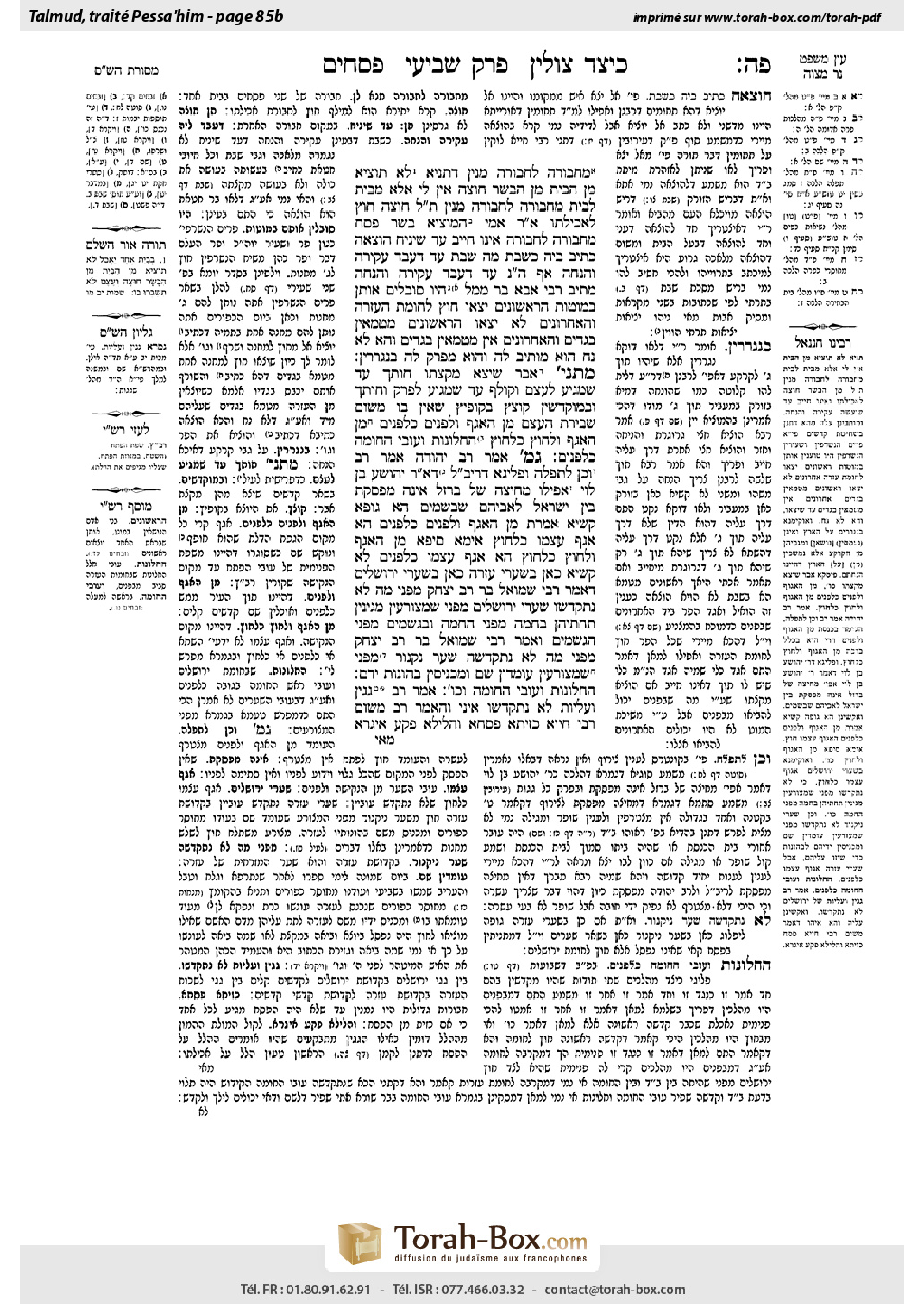
This page of Pesachim includes the Aramaic text, an English translation and an AI-generated French translation, alongside the scan above.
פסחים פ״ה ב · Aramaic and Hebrew text
מֵחֲבוּרָה לַחֲבוּרָה מִנַּיִן? דְּתַנְיָא: ״לֹא תוֹצִיא מִן הַבַּיִת מִן הַבָּשָׂר חוּצָה״, אֵין לִי אֶלָּא מִבַּיִת לְבַיִת, מֵחֲבוּרָה לַחֲבוּרָה מִנַּיִן? תַּלְמוּד לוֹמַר: ״חוּצָה״ — חוּץ לַאֲכִילָתוֹ.
אָמַר רַבִּי אַמֵּי: הַמּוֹצִיא בְּשַׂר פֶּסַח מֵחֲבוּרָה לַחֲבוּרָה, אֵינוֹ חַיָּיב עַד שֶׁיַּנִּיחַ. הוֹצָאָה כְּתִיב בֵּיהּ כְּשַׁבָּת: מָה שַׁבָּת — עַד דְּעָבֵד עֲקִירָה וְהַנָּחָה, אַף הָכָא נָמֵי — עַד דְּעָבֵד עֲקִירָה וְהַנָּחָה.
מֵתִיב רַבִּי אַבָּא בַּר מֶמֶל: הָיוּ סוֹבְלִים אוֹתָן בְּמוֹטוֹת, הָרִאשׁוֹנִים יָצְאוּ חוּץ לְחוֹמַת הָעֲזָרָה וְהָאַחֲרוֹנִים לֹא יָצְאוּ, הָרִאשׁוֹנִים מְטַמְּאִין בְּגָדִים וְהָאַחֲרוֹנִים אֵין מְטַמְּאִין בְּגָדִים. וְהָא לָא נָח?
הוּא מוֹתֵיב לַהּ וְהוּא מְפָרֵק לַהּ, בְּנִגְרָרִין.
מַתְנִי׳ אֵבֶר שֶׁיָּצָא מִקְצָתוֹ, חוֹתֵךְ עַד שֶׁמַּגִּיעַ לָעֶצֶם, וְקוֹלֵף עַד שֶׁמַּגִּיעַ לַפֶּרֶק, וְחוֹתֵךְ. וּבַמּוּקְדָּשִׁין — קוֹצֵץ בְּקוֹפִיץ, שֶׁאֵין בּוֹ מִשּׁוּם שְׁבִירַת הָעֶצֶם.
מִן הָאֲגַף וְלִפְנִים — כְּלִפְנִים, מִן הָאֲגַף וּלְחוּץ — כְּלַחוּץ. הַחַלּוֹנוֹת וְעוֹבִי הַחוֹמָה — כְּלִפְנִים.
גְּמָ׳ אָמַר רַב יְהוּדָה אָמַר רַב: וְכֵן לִתְפִלָּה. וּפְלִיגָא דְּרַבִּי יְהוֹשֻׁעַ בֶּן לֵוִי. דְּאָמַר רַבִּי יְהוֹשֻׁעַ בֶּן לֵוִי: אֲפִילּוּ מְחִיצָה שֶׁל בַּרְזֶל אֵינָהּ מַפְסֶקֶת בֵּין יִשְׂרָאֵל לַאֲבִיהֶם שֶׁבַּשָּׁמַיִם.
הָא גוּפָא קַשְׁיָא, אָמְרַתְּ: מִן הָאֲגַף וְלִפְנִים — כְּלִפְנִים, הָא אֲגַף עַצְמוֹ — כְּלַחוּץ. אֵימָא סֵיפָא: מִן הָאֲגַף וּלְחוּץ — כְּלַחוּץ. הָא אֲגַף עַצְמוֹ — כְּלִפְנִים!
לָא קַשְׁיָא: כָּאן — בְּשַׁעֲרֵי עֲזָרָה, כָּאן — בְּשַׁעֲרֵי יְרוּשָׁלַיִם.
דְּאָמַר רַבִּי שְׁמוּאֵל בַּר רַב יִצְחָק: מִפְּנֵי מָה לֹא נִתְקַדְּשׁוּ שַׁעֲרֵי יְרוּשָׁלַיִם? מִפְּנֵי שֶׁמְּצוֹרָעִין מְגִינִּין תַּחְתֵּיהֶן, בַּחַמָּה מִפְּנֵי הַחַמָּה, וּבַגְּשָׁמִים מִפְּנֵי הַגְּשָׁמִים.
וְאָמַר רַבִּי שְׁמוּאֵל בַּר רַב יִצְחָק: מִפְּנֵי מָה לֹא נִתְקַדְּשָׁה שַׁעַר נִקָּנוֹר? מִפְּנֵי שֶׁמְּצוֹרָעִין עוֹמְדִין שָׁם וּמַכְנִיסִין בְּהוֹנוֹת יָדָם.
הַחַלּוֹנוֹת וָעוֹבִי הַחוֹמָה וְכוּ׳. אָמַר רַב: גַּגִּין וַעֲלִיּוֹת לֹא נִתְקַדְּשׁוּ. אִינִי?! וְהָאָמַר רַב מִשּׁוּם רַבִּי חִיָּיא ״כְּזֵיתָא פִּסְחָא, וְהַלֵּילָא פָּקַע אִיגָּרָא״.
Pesachim 85b · English translation
from the location of its group to the location of another group, from where is it derived that he has violated a prohibition? As it was taught in a baraita with regard to the verse: “In one house shall it be eaten; you shall not carry out any of the meat from the house to the outside” (Exodus 12:46), I have derived only that it is prohibited to remove meat from house to house; from where do I derive that it is prohibited even to transfer the meat from group to group within one house? The verse states: To the outside, which includes any case in which one brings the meat outside of the place where it may be eaten.
Rabbi Ami said: One who carries out the meat of the Paschal lamb from the location of one group to another group is not liable until he places the meat in the location of the second group. The reason for this is that the term carrying out is written about it, as the Torah says: “You shall not carry out,” which is similar to the prohibited labor of the same name pertaining to Shabbat. Therefore, just as when it comes to Shabbat one is not liable for carrying from one domain to another until he performs an act of lifting from one domain and placing in the other domain, so too, here also one is not liable until he performs an act of lifting the meat from the location of one group and placing it in the location of another group.
Rabbi Abba bar Mammal raised an objection based upon the halakha that those who remove the inner sin-offerings from the Temple become ritually impure. A baraita with regard to that halakha teaches as follows: If those carrying the inner sin-offerings were carrying them on poles, and those in front already went outside the wall around the Temple courtyard, and those in the rear had not yet gone out, the ones in front nonetheless immediately cause their garments to become ritually impure, and the ones in the rear do not cause their garments to become ritually impure until they also leave. This proves that the people carrying these offerings become impure immediately. But the meat has not yet been placed outside the courtyard, so why should it already be considered to have been taken out?
He raised the objection and he resolved it: The baraita addresses a case in which the people are dragging the offerings, and therefore as soon as they leave the courtyard the offerings are considered to have been placed on the ground.
MISHNA: If a portion of a limb has gone out of its permissible boundary, one must cut the meat until one reaches the bone at the point that separates between the part of the limb that went out of its boundary and the part that did not, and then peel the meat away from the bone until one reaches the joint, and cut off the limb at the joint, as it is prohibited to break the bone itself. And with regard to other offerings, one may chop off the part that exited with a hatchet, as it is not subject to the prohibition of breaking a bone.
How does one determine the outer boundaries of a particular location? Anything that is located from the inside of the doorway inward is considered as though it is inside, and anything that is located from the doorway outward is considered as though it is outside. And the windows in the wall and the thickness of the wall are considered as though they are inside, such that an offering is considered to have exited the premises only if it is taken outside the wall.
GEMARA: Rav Yehuda said that Rav said: And the halakha is similar with regard to prayer, in that one who is standing outside the doorway cannot be included together with those praying inside. The Gemara notes that Rav disagrees with Rabbi Yehoshua ben Levi, as Rabbi Yehoshua ben Levi said: Even a barrier of iron does not separate between the Jewish people and their Father in Heaven. Barriers are irrelevant with regard to prayer.
The Gemara questions the mishna: This matter itself is difficult; the mishna itself contains an internal contradiction. At first you said that the space from the doorway inward is considered as though it is inside, which indicates that the space of the doorway itself is like the outside. Now you say the latter clause of the mishna’s ruling, which states that from the doorway outward is considered as though it is outside, which indicates that the doorway itself is considered as though it is inside.
The Gemara answers: It is not difficult, as one can explain that these two statements are referring to different situations: Here, in the latter clause of the mishna’s ruling, it is referring to the gates of the Temple courtyard, where the inside of the doorways were considered as though they were inside the courtyard and had the sanctity of the courtyard itself. There, in the first clause, it is discussing the gates of Jerusalem, where the insides of the gates were considered like the outside and did not have the sanctity of Jerusalem.
As Rabbi Shmuel bar Rav Yitzḥak said: For what reason were the insides of the gates of Jerusalem not sanctified? Because lepers protect themselves by sitting under them; in the sun they protect themselves from the sun and in the rain they sit in the gateway to protect themselves from the rain. Lepers are not permitted to enter Jerusalem. In order to allow them to use the gates of the city as shelter from the elements, the gateways were not sanctified.
Similarly, Rabbi Shmuel bar Rav Yitzḥak said: For what reason was the inside of the Gate of Nicanor not sanctified with the sanctity of the Temple courtyard? It is because lepers who had healed and needed to bring their purification offerings would stand there and insert their thumbs into the courtyard, so that the blood of the offerings could be sprinkled on them, which would allow them to be purified. These sources indicate that the insides of the other gates of the Temple courtyard were sanctified and that the insides of the gates of Jerusalem were not sanctified.
The mishna states that the windows and the thickness of the wall are considered to be on the inside. Rav said: Roofs and upper stories were not sanctified. Therefore, the roofs of the chambers in the Temple courtyard did not have the sanctity of the courtyard, and the roofs of buildings in Jerusalem did not have the sanctity of Jerusalem. The Gemara asks: Is that so? Didn’t Rav say the following aphorism in the name of Rabbi Ḥiyya: The Paschal lamb is the size of an olive-bulk, as it was common for so many people to register for a single Paschal lamb that each one would receive only an olive-bulk of its meat. And the hallel that is said during its consumption breaks the roof; there were so many people who said hallel together, it seemed as though the roofs were breaking due to all the commotion and noise.
Pesachim 85b · Traduction française (IA)
S’il transporte la viande du lieu où se trouve son groupe vers celui d’un autre groupe, d’où sait-on qu’il a transgressé une interdiction ? Car il a été enseigné dans une baraïta au sujet du verset : « Elle sera mangée dans une seule maison ; vous ne ferez sortir aucune viande de la maison vers l’extérieur » (Exode 12,46) : j’ai seulement appris qu’il est interdit de sortir la viande d’une maison à une autre. D’où apprend-on qu’il est également interdit de transporter la viande d’un groupe à un autre à l’intérieur d’une même maison ? Le verset dit : « vers l’extérieur », ce qui inclut tout cas où l’on fait sortir la viande du lieu où elle peut être mangée.
Rabbi Ami dit : Celui qui transporte la viande de l’agneau pascal du lieu d’un groupe vers celui d’un autre groupe n’est passible qu’après avoir déposé la viande dans le lieu du second groupe. En effet, le terme « faire sortir » est employé à ce sujet, comme le dit la Torah : « Vous ne ferez pas sortir », ce qui rappelle le travail interdit du même nom le Chabbat. Ainsi, de même que le Chabbat, on n’est passible d’avoir transporté un objet d’un domaine à un autre qu’après l’avoir soulevé dans un domaine et déposé dans l’autre, de même ici, on n’est passible qu’après avoir soulevé la viande du lieu d’un groupe et l’avoir déposée dans le lieu d’un autre groupe.
Rabbi Abba bar Mammal souleva une objection en s’appuyant sur la halakha selon laquelle ceux qui font sortir du Temple les sacrifices expiatoires intérieurs deviennent rituellement impurs. Une baraïta enseigne ce qui suit au sujet de cette halakha : si ceux qui portent les sacrifices expiatoires intérieurs les transportent sur des brancards, et que ceux qui se trouvent à l’avant ont déjà franchi le mur qui entoure la cour du Temple, tandis que ceux qui se trouvent à l’arrière ne l’ont pas encore franchi, les premiers rendent immédiatement leurs vêtements rituellement impurs, tandis que les seconds ne rendent leurs vêtements rituellement impurs qu’une fois sortis à leur tour. Cela prouve que ceux qui portent ces sacrifices deviennent immédiatement impurs. Or, la viande n’a pas encore été déposée à l’extérieur de la cour ; pourquoi devrait-on déjà considérer qu’elle a été sortie ?
Il souleva l’objection et y répondit : la baraïta traite d’un cas où les hommes traînent les sacrifices ; ceux-ci sont donc considérés comme déposés au sol dès que les hommes quittent la cour.
MICHNA : Si une partie d’un membre est sortie de la limite où elle est autorisée, il faut découper la viande jusqu’à atteindre l’os, à l’endroit qui sépare la partie du membre qui a franchi cette limite de celle qui ne l’a pas franchie. Puis on détache la viande de l’os jusqu’à atteindre l’articulation, et l’on coupe le membre au niveau de l’articulation, car il est interdit de briser l’os lui-même. Quant aux autres sacrifices, on peut couper à la hache la partie qui est sortie, car ils ne sont pas soumis à l’interdiction de briser un os.
Comment détermine-t-on les limites extérieures d’un lieu donné ? Tout ce qui se trouve à partir de l’intérieur de l’embrasure vers l’intérieur est considéré comme étant à l’intérieur, et tout ce qui se trouve à partir de l’embrasure vers l’extérieur est considéré comme étant à l’extérieur. Les fenêtres du mur et l’épaisseur du mur sont considérées comme étant à l’intérieur, de sorte qu’un sacrifice n’est considéré comme ayant quitté l’enceinte que s’il est transporté au-delà du mur.
GUEMARA : Rav Yehouda dit au nom de Rav : Il en va de même pour la prière : celui qui se tient à l’extérieur de l’embrasure ne peut pas être compté parmi ceux qui prient à l’intérieur. La Guemara relève que Rav est en désaccord avec Rabbi Yehoshoua ben Lévi, car Rabbi Yehoshoua ben Lévi a dit : « Même une barrière de fer ne sépare pas le peuple juif de son Père dans les Cieux. » Les barrières n’ont aucune pertinence en matière de prière.
La Guemara soulève une difficulté à propos de la Michna : la Michna elle-même présente une contradiction interne. D’abord, tu as dit que l’espace situé de l’embrasure vers l’intérieur est considéré comme étant à l’intérieur, ce qui indique que l’embrasure elle-même est considérée comme étant à l’extérieur. Puis, dans la dernière partie de la décision de la Michna, tu dis que l’espace situé de l’embrasure vers l’extérieur est considéré comme étant à l’extérieur, ce qui indique que l’embrasure elle-même est considérée comme étant à l’intérieur.
La Guemara répond : il n’y a pas de difficulté, car ces deux affirmations concernent des situations différentes. Ici, dans la dernière partie de la décision de la Michna, il s’agit des portes de la cour du Temple, dont les embrasures intérieures étaient considérées comme faisant partie de la cour et avaient la sainteté de la cour elle-même. Là, dans la première partie, il s’agit des portes de Jérusalem, dont les embrasures intérieures étaient considérées comme étant à l’extérieur et n’avaient pas la sainteté de Jérusalem.
Car Rabbi Shmuel bar Rav Yitzḥak a dit : Pour quelle raison les embrasures intérieures des portes de Jérusalem n’ont-elles pas été sanctifiées ? Parce que les lépreux s’abritent sous ces portes : lorsqu’il y a du soleil, ils s’y protègent du soleil, et lorsqu’il pleut, ils s’installent dans l’embrasure pour se protéger de la pluie. Les lépreux ne sont pas autorisés à entrer dans Jérusalem. Afin de leur permettre d’utiliser les portes de la ville pour s’abriter des intempéries, les embrasures n’ont pas été sanctifiées.
De même, Rabbi Shmuel bar Rav Yitzḥak a dit : Pour quelle raison l’intérieur de la porte de Nicanor n’a-t-il pas été sanctifié de la sainteté de la cour du Temple ? Parce que les lépreux guéris, qui devaient apporter leurs sacrifices de purification, se tenaient là et introduisaient leurs pouces dans la cour, afin que le sang des sacrifices puisse être aspergé sur eux, ce qui leur permettait d’être purifiés. Ces sources indiquent que l’intérieur des autres portes de la cour du Temple était sanctifié, tandis que l’intérieur des portes de Jérusalem ne l’était pas.
La Michna enseigne que les fenêtres et l’épaisseur du mur sont considérées comme étant à l’intérieur. Rav a dit : Les toits et les étages supérieurs n’ont pas été sanctifiés. Par conséquent, les toits des salles de la cour du Temple n’avaient pas la sainteté de la cour, et les toits des bâtiments de Jérusalem n’avaient pas la sainteté de Jérusalem. La Guemara demande : Est-ce bien le cas ? Rav n’a-t-il pas énoncé l’aphorisme suivant au nom de Rabbi Ḥiyya : L’agneau pascal a la taille d’une olive, car il était courant qu’un si grand nombre de personnes s’inscrivent pour un seul agneau pascal que chacune n’en recevait qu’un volume d’olive de viande. Et le Hallel récité pendant sa consommation fait trembler le toit : tant de personnes récitaient le Hallel ensemble qu’on avait l’impression que les toits tremblaient sous l’effet du tumulte et du bruit.
Traduction française générée par IA à partir de l’édition anglaise de Sefaria. Vérifie toujours un passage avec le texte source.
Text from Sefaria: William Davidson Edition - Vocalized Aramaic (CC BY NC); William Davidson Edition - English (CC BY NC).