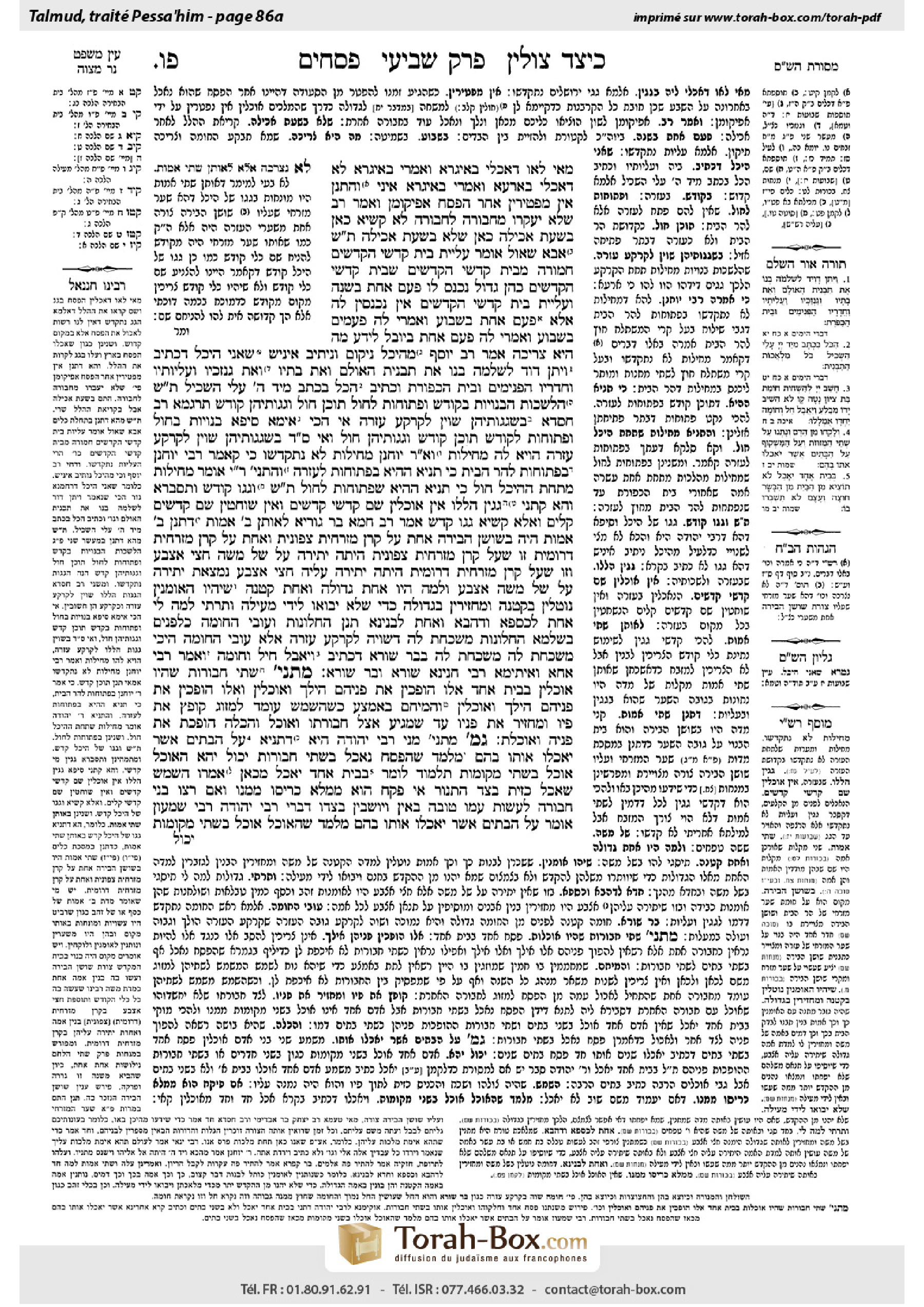
Pesachim 86a: Talmud study for Daf Yomi
Daf Yomi is the daily study of one Talmud folio. Explore 37 tractates with scans, Hebrew text, Sefaria English and AI-generated French translations where annotated.
Passage selection and English or AI-generated French translation are available where the scan has annotations. Daf Study is independent of Torah-Box and Sefaria.
Browse Pesachim · פסחים · All tractatesPesachim 86a text and translations
This page of Pesachim includes the Aramaic text, an English translation and an AI-generated French translation, alongside the scan above.
פסחים פ״ו א · Aramaic and Hebrew text
מַאי לָאו, דְּאָכְלִי בְּאִיגָּרָא וְאָמְרִי בְּאִיגָּרָא! לָא: דְּאָכְלִי בְּאַרְעָא וְאָמְרִי בְּאִיגָּרָא.
אִינִי? וְהָתְנַן: אֵין מַפְטִירִין אַחַר הַפֶּסַח אֲפִיקוֹמָן, וְאָמַר רַב: שֶׁלֹּא יֵעָקְרוּ מֵחֲבוּרָה לַחֲבוּרָה. לָא קַשְׁיָא: כָּאן — בִּשְׁעַת אֲכִילָה, כָּאן — שֶׁלֹּא בִּשְׁעַת אֲכִילָה.
תָּא שְׁמַע, אַבָּא שָׁאוּל אוֹמֵר: עֲלִיַּית בֵּית קׇדְשֵׁי הַקֳּדָשִׁים חֲמוּרָה מִבֵּית קׇדְשֵׁי הַקֳּדָשִׁים. שֶׁבֵּית קׇדְשֵׁי הַקֳּדָשִׁים — כֹּהֵן גָּדוֹל נִכְנָס לוֹ פַּעַם אַחַת בַּשָּׁנָה, וַעֲלִיַּית בֵּית קׇדְשֵׁי הַקֳּדָשִׁים — אֵין נִכְנָסִין לָהּ אֶלָּא פַּעַם אַחַת בְּשָׁבוּעַ, וְאָמְרִי לַהּ: פַּעֲמַיִם בְּשָׁבוּעַ, וְאָמְרִי לַהּ: פַּעַם אַחַת בְּיוֹבֵל, לֵידַע מָה הִיא צְרִיכָה.
אָמַר רַב יוֹסֵף: מֵהֵיכָל נֵיקוּם וְנִיתֵּיב אִינִישׁ? שָׁאנֵי הֵיכָל, דִּכְתִיב: ״וַיִּתֵּן דָּוִד לִשְׁלֹמֹה בְנוֹ אֶת תַּבְנִית הָאוּלָם וְאֶת בָּתָּיו וְאֶת גַּנְזַכָּיו וַעֲלִיֹּתָיו וַחֲדָרָיו הַפְּנִימִים וּבֵית הַכַּפּוֹרֶת״, וּכְתִיב: ״הַכֹּל בִּכְתָב מִיַּד ה׳ עָלַי הִשְׂכִּיל״.
תָּא שְׁמַע: הַלְּשָׁכוֹת הַבְּנוּיוֹת בַּקּוֹדֶשׁ וּפְתוּחוֹת לַחוֹל — תּוֹכָן חוֹל, וְגַגּוֹתֵיהֶן קוֹדֶשׁ! תַּרְגְּמָא רַב חִסְדָּא: בְּשֶׁגַּגּוֹתֵיהֶן שָׁוִין לְקַרְקַע עֲזָרָה.
אִי הָכִי, אֵימָא סֵיפָא: בְּנוּיוֹת בַּחוֹל וּפְתוּחוֹת לַקּוֹדֶשׁ — תּוֹכֶן קוֹדֶשׁ וְגַגּוֹתֵיהֶן חוֹל. וְאִי סָלְקָא דַעְתָּךְ בְּשֶׁגַּגּוֹתֵיהֶן שָׁוִין לְקַרְקַע עֲזָרָה, הָוְיָא לַהּ מְחִילּוֹת, וְאָמַר רַבִּי יוֹחָנָן: מְחִילּוֹת לֹא נִתְקַדְּשׁוּ! כִּי קָאָמַר רַבִּי יוֹחָנָן — בִּפְתוּחוֹת לְהַר הַבַּיִת. כִּי תַּנְיָא הָהִיא — בִּפְתוּחוֹת לָעֲזָרָה.
וְהָתַנְיָא, רַבִּי יְהוּדָה אוֹמֵר: מְחִילּוֹת מִתַּחַת הַהֵיכָל חוֹל! כִּי תַּנְיָא הָהִיא — שֶׁפְּתוּחוֹת לַחוֹל.
תָּא שְׁמַע: וְגַגּוֹ קוֹדֶשׁ!
וְתִסְבְּרָא?! וְהָא קָתָנֵי: גַּגִּין הַלָּלוּ אֵין אוֹכְלִין שָׁם קׇדְשֵׁי קָדָשִׁים, וְאֵין שׁוֹחֲטִין שָׁם קָדָשִׁים קַלִּים! וְאֶלָּא קַשְׁיָא גַּגּוֹ קֹדֶשׁ! אָמַר רַב חָמָא בַּר גּוּרְיָא: לְאוֹתָן שְׁתֵּי אַמּוֹת.
דִּתְנַן: שְׁתֵּי אַמּוֹת הָיָה בְּשׁוּשַׁן הַבִּירָה, אַחַת עַל קֶרֶן מִזְרָחִית צְפוֹנִית וְאַחַת עַל קֶרֶן מִזְרָחִית דְּרוֹמִית. זוֹ שֶׁעַל קֶרֶן מִזְרָחִית צְפוֹנִית הָיְתָה יְתֵירָה עַל שֶׁל מֹשֶׁה חֲצִי אֶצְבַּע, וְזוֹ שֶׁעַל קֶרֶן מִזְרָחִית דְּרוֹמִית הָיְתָה יְתֵירָה עָלֶיהָ חֲצִי אֶצְבַּע, נִמְצֵאת יְתֵירָה עַל שֶׁל מֹשֶׁה אֶצְבַּע.
וְלָמָה הָיוּ אַחַת גְּדוֹלָה וְאַחַת קְטַנָּה? שֶׁיִּהְיוּ הָאוּמָּנִין נוֹטְלִין בַּקְּטַנָּה וּמַחְזִירִין בַּגְּדוֹלָה, כְּדֵי שֶׁלֹּא יָבוֹאוּ לִידֵי מְעִילָה. וְתַרְתֵּי לְמָה לִי? אַחַת — לְכַסְפָּא וְדַהֲבָא, וְאַחַת — לְבִנְיָנָא.
תְּנַן: הַחַלּוֹנוֹת וְעוֹבִי הַחוֹמָה — כְּלִפְנִים. בִּשְׁלָמָא הַחַלּוֹנוֹת, מַשְׁכַּחַתְּ לַהּ דְּשָׁוְיָה לְקַרְקַע עֲזָרָה. אֶלָּא עוֹבִי הַחוֹמָה, הֵיכִי מַשְׁכַּחַתְּ לַהּ?
מַשְׁכַּחַתְּ לַהּ בְּבַר שׁוּרָא, דִּכְתִיב: ״וַיַּאֲבֶל חֵל וְחוֹמָה״, וְאָמַר רַבִּי אַחָא וְאִיתֵּימָא רַבִּי חֲנִינָא: שׁוּרָא וּבַר שׁוּרָא.
מַתְנִי׳ שְׁתֵּי חֲבוּרוֹת שֶׁהָיוּ אוֹכְלִין בְּבַיִת אֶחָד, אֵלּוּ הוֹפְכִין אֶת פְּנֵיהֶם הֵילָךְ וְאוֹכְלִין, וְאֵלּוּ הוֹפְכִין אֶת פְּנֵיהֶם הֵילָךְ וְאוֹכְלִין, וְהַמֵּיחַם בָּאֶמְצַע. כְּשֶׁהַשַּׁמָּשׁ עוֹמֵד לִמְזוֹג, קוֹפֵץ אֶת פִּיו וּמַחֲזִיר אֶת פָּנָיו, עַד שֶׁמַּגִּיעַ אֵצֶל חֲבוּרָתוֹ וְאוֹכֵל. וְהַכַּלָּה הוֹפֶכֶת אֶת פָּנֶיהָ וְאוֹכֶלֶת.
גְּמָ׳ מַתְנִיתִין מַנִּי? רַבִּי יְהוּדָה הִיא. דְּתַנְיָא: ״עַל הַבָּתִּים אֲשֶׁר יֹאכְלוּ אֹתוֹ בָּהֶם״, מְלַמֵּד שֶׁהַפֶּסַח נֶאֱכָל בִּשְׁתֵּי חֲבוּרוֹת. יָכוֹל יְהֵא הָאוֹכֵל אוֹכֵל בִּשְׁתֵּי מְקוֹמוֹת — תַּלְמוּד לוֹמַר: ״בְּבַיִת אֶחָד יֵאָכֵל״.
מִכָּאן אָמְרוּ: הַשַּׁמָּשׁ שֶׁאָכַל כְּזַיִת בְּצַד הַתַּנּוּר, אִי פִּקֵּחַ הוּא מְמַלֵּא כְּרֵיסוֹ מִמֶּנּוּ, וְאִם רָצוּ בְּנֵי חֲבוּרָה לַעֲשׂוֹת עִמּוֹ טוֹבָה — בָּאִין וְיוֹשְׁבִין בְּצִדּוֹ, דִּבְרֵי רַבִּי יְהוּדָה.
רַבִּי שִׁמְעוֹן אוֹמֵר: ״עַל הַבָּתִּים אֲשֶׁר יֹאכְלוּ אֹתוֹ בָּהֶם״, מְלַמֵּד שֶׁהָאוֹכֵל אוֹכֵל בִּשְׁתֵּי מְקוֹמוֹת.
Pesachim 86a · English translation
What, is it not the case that they eat the Paschal lamb on the roof and say hallel on the roof, which would mean that roofs have the sanctity of Jerusalem? The Gemara responds: No, there is no proof from here, as it is possible that they eat on the ground and say hallel on the roof.
The Gemara asks: Is that so? But didn’t we learn in a mishna: We do not conclude after eating the Paschal lamb with afikoman, and Rav said that this means that after eating the Paschal lamb one may not say: Afikoman, which refers to removing the utensils in order to go eat somewhere else, because they may not uproot themselves from one group to another group. This would indicate that one must complete the entire Passover seder in one place. The Gemara answers: It is not difficult. Here, where it says that one may not change places, it is during the time of eating. There, where it says they would say hallel on the roof, it is not during the time of eating.
The Gemara attempts to bring another proof with regard to this issue. Come and hear a resolution to this issue based upon the following baraita: Abba Shaul says: The upper story of the chamber of the Holy of Holies is more stringent with regard to the prohibition to enter it than the chamber of the Holy of Holies itself. How so? With regard to the chamber of the Holy of Holies, the High Priest would enter it once a year on Yom Kippur in order to offer the incense and sprinkle the blood between the staves of the ark, whereas the upper story of the chamber of the Holy of Holies is not entered except for once in seven years; and some say twice in seven years, and some say just one time in a Jubilee, i.e., once in fifty years, to see what it needs in case there are renovations that must be done. This indicates that the sanctity of the upper story was even greater than that of the Sanctuary itself.
Rav Yosef said: Can a person get up and ask based on the Sanctuary? The Sanctuary is different, as it is written: “Then David gave to Solomon his son the pattern of the Entrance Hall of the Temple, and of its houses, and of its treasuries, and of its upper rooms, and of its inner chambers, and of the place of the ark cover” (I Chronicles 28:11), and it is written with regard to the plans for the construction of the Temple: “All this is put in writing by the hand of the Lord, Who has instructed me” (I Chronicles 28:19). Therefore, the general rules of sanctity of roofs do not apply to the Sanctuary, as the details of its construction were determined through divine inspiration.
Come and hear another possible proof based on the following mishna: With regard to the chambers in the Temple that were built in the sanctified area and open to the unsanctified area of the Temple Mount, their interiors are unsanctified and their roofs are sanctified. This states explicitly that the roofs are sanctified. The Gemara answers: Rav Ḥisda interpreted it as referring to chambers that were built under the Temple courtyard, and their roofs were level with the ground of the courtyard. In this case, the reason their roofs were sanctified is because they were part of the courtyard itself.
The Gemara asks: If so, say the latter clause of the mishna as follows: If the chambers were built in the unsanctified area and open to the sanctified area, their interiors are sanctified and their roofs are unsanctified. And if it should enter your mind to say that this is referring to chambers whose roofs were level with the ground of the courtyard, such chambers would be tunnels, and Rabbi Yoḥanan said that the tunnels were not sanctified. The Gemara answers: When Rabbi Yoḥanan said that, he was referring to tunnels that were open to the Temple Mount; when that baraita, which says that the interiors were sanctified was taught, it was referring to rooms that open to the Temple courtyard itself.
The Gemara asks: But wasn’t it taught in a baraita that Rabbi Yehuda says: The tunnels under the Sanctuary are unsanctified? The Gemara answers: When that baraita was taught, it was pertaining to tunnels that open to the unsanctified area, which are considered unsanctified, as stated previously.
The Gemara attempts another proof: Come and hear another proof from the same source cited above: It says in the baraita that the roof of the Sanctuary was sanctified, and the roof of the Sanctuary is not mentioned in the plans for the Temple laid out in the book of Chronicles. Therefore, the answer mentioned earlier, that everything in those plans was based upon divine inspiration, is not relevant. In that case, one should be able to derive that all the roofs were sanctified.
The Gemara responds: And how can you understand it that way? Isn’t it teaching: In the case of these roofs of the courtyard and the chambers located there, one may not eat offerings of the most sacred order and one may not slaughter offerings of lesser sanctity there because they do not have the sanctity of the courtyard? However, that is difficult. It contradicts the previous statement that the roof is sanctified. Rav Ḥama bar Gurya said: The roof of the Sanctuary was considered sanctified only because those two measuring rods used to measure cubits were stored there.
As we learned in a mishna: There were two rods for measuring cubits in the chamber called Shushan the Capital, one in the northeast corner and one in the southeast corner. The one in the northeast corner was longer than the cubit mentioned in the Torah from the time of Moses, which was six handbreadths, by half a fingerbreadth, and the one in the southeast corner was longer than that by another half a fingerbreadth. Consequently, the second measuring rod was longer than Moses’ cubit by a full fingerbreadth.
And why did they construct two measures for cubits, one large and one small? It was so that the artisans who were working in the Temple would take payment according the amount of work they did, as measured by the small cubit, and return it to the Temple through their work, as measured by the large cubit, so they would not come to misuse consecrated property. If they would accept any payment that they did not deserve, they would be misusing consecrated property. Therefore, this system of measuring was instituted in order to slightly reduce their payment and prevent accidental misuse of Temple funds. The Gemara asks: And why do I need two large cubits? The Gemara answers: One, the shorter of the two, was for silver and gold, so that the artisans would not lose too much, and one was for construction.
We learned in the mishna: The space within the windows and the thickness of the wall were considered to be inside. The Gemara clarifies: Granted, with regard to the windows, you will find it to be sanctified with the sanctity of the Temple courtyard when it is level with the ground of the courtyard. But with regard to the thickness of the wall, which must have been significantly above the ground, under what circumstances can you find it to be level with the ground of the courtyard? Even the roofs of chambers in the courtyard were not sanctified; therefore, if the thickness of the wall was not level with the floor of the courtyard, it would certainly not have been sanctified.
The Gemara answers: You find it in the case of the low wall on the Temple Mount, which was the same height as the floor of the courtyard. This low wall is mentioned in the Bible, as it is written: “He has made the rampart and wall mourn” (Lamentations 2:8), and Rabbi Aḥa said, and some say it in the name of Rabbi Ḥanina, that this double language of both rampart and wall in the verse is referring to a wall and a low wall that were next to each other. This low wall was the same height as the floor of the courtyard.
MISHNA: Two groups that were eating one Paschal lamb in one house need not be concerned that they will appear to be one group. Rather, these turn their faces this way and eat, and these turn their faces that way and eat. And it is permissible for them to have the boiler from which they pour hot water in the middle, so that the waiter can easily serve both groups. When the attendant who is serving both groups gets up to pour for the group of which he is not a member, he must close his mouth and turn his face so that he does not accidentally eat with the other group, until he reaches his group again and eats with it. And the bride, who is embarrassed to eat in the presence of men she does not know, turns her face away from her group and eats, although this may make it seem as though she is part of a different group.
GEMARA: The Gemara asks: Who is the tanna of the mishna? The Gemara answers: It is Rabbi Yehuda. As it was taught in a baraita: The verse states: “Upon the houses wherein they shall eat it” (Exodus 12:7). This teaches that one Paschal lamb may be eaten in two separate groups, even if the groups eat it in separate houses. I might have thought that one person who eats from it may eat it in two separate places; therefore, the Torah states: “In one house shall it be eaten [ye’akhel]” (Exodus 12:46).
From here they stated that if an attendant who was registered for a Paschal lamb ate an olive-bulk of it next to the oven in which it is being roasted, and thereby made himself into an independent group at that location, if he is prudent he will fill his stomach with it because when the Paschal lamb is moved to a different location he will no longer be able to eat it. And if the members of the group wanted to do him a favor so that he may continue eating, they would come and sit at his side. This is the statement of Rabbi Yehuda.
Rabbi Shimon says that the verses should be understood in the opposite manner: “Upon the houses wherein they shall eat it” teaches that one person who eats the Paschal lamb may eat it in two places.
Pesachim 86a · Traduction française (IA)
N’est-ce pas qu’ils mangent l’agneau pascal sur le toit et récitent le Hallel sur le toit, ce qui signifierait que les toits ont la sainteté de Jérusalem ? La Guemara répond : Non, on ne peut rien prouver de là, car il est possible qu’ils mangent au sol et récitent le Hallel sur le toit.
La Guemara demande : En est-il ainsi ? N’avons-nous pas appris dans une Michna : « On ne termine pas le repas après avoir mangé l’agneau pascal par un afikoman » ? Rav a expliqué que cela signifie qu’après avoir mangé l’agneau pascal, on ne peut pas dire : « Afikoman », expression qui désigne le fait d’emporter les ustensiles pour aller manger ailleurs, car on ne peut pas passer d’un groupe à un autre. Cela indique qu’il faut achever tout le seder de Pessa’h au même endroit. La Guemara répond : Il n’y a pas de difficulté. Ici, lorsqu’il est dit qu’on ne peut pas changer de lieu, cela concerne le temps du repas. Là, lorsqu’il est dit qu’ils récitaient le Hallel sur le toit, cela ne concerne pas le temps du repas.
La Guemara tente d’apporter une autre preuve sur cette question. Viens et entends une réponse à cette question, fondée sur la baraïta suivante : Abba Shaul dit : L’étage supérieur de la chambre du Saint des Saints est soumis à une interdiction d’accès plus stricte que la chambre du Saint des Saints elle-même. Comment cela ? Le grand prêtre entrait dans la chambre du Saint des Saints une fois par an, à Yom Kippour, afin d’offrir l’encens et d’asperger le sang entre les barres de l’Arche, tandis qu’on ne pénétrait dans l’étage supérieur de la chambre du Saint des Saints qu’une fois tous les sept ans ; certains disent deux fois tous les sept ans, et d’autres disent une seule fois par jubilé, c’est-à-dire une fois tous les cinquante ans, pour voir quels travaux étaient nécessaires, au cas où des rénovations s’imposeraient. Cela indique que la sainteté de l’étage supérieur était encore plus grande que celle du Sanctuaire lui-même.
Rav Yossef dit : Peut-on se lever et poser une question en prenant le Sanctuaire comme exemple ? Le Sanctuaire est différent, car il est écrit : « David donna à son fils Salomon le plan du portique du Temple, de ses maisons, de ses trésors, de ses chambres hautes, de ses chambres intérieures et de la place du propitiatoire » (I Chroniques 28:11), et il est écrit au sujet des plans de construction du Temple : « Tout cela est consigné par écrit de la main de l’Éternel, qui m’a instruit » (I Chroniques 28:19). Par conséquent, les règles générales relatives à la sainteté des toits ne s’appliquent pas au Sanctuaire, puisque les détails de sa construction ont été déterminés par inspiration divine.
Viens et entends une autre preuve possible, tirée de la Michna suivante : En ce qui concerne les chambres du Temple construites dans la zone sanctifiée et donnant sur la zone non sanctifiée du mont du Temple, leur intérieur n’est pas sanctifié, tandis que leurs toits le sont. Il est donc dit explicitement que les toits sont sanctifiés. La Guemara répond : Rav Ḥisda l’a interprétée comme se rapportant à des chambres construites sous la cour du Temple, dont les toits étaient au même niveau que le sol de la cour. Dans ce cas, leurs toits étaient sanctifiés parce qu’ils faisaient eux-mêmes partie de la cour.
La Guemara demande : Si tel est le cas, énonce la dernière partie de la Michna ainsi : Si les chambres étaient construites dans la zone non sanctifiée et donnaient sur la zone sanctifiée, leur intérieur était sanctifié et leurs toits ne l’étaient pas. Et si l’on devait penser qu’il s’agit de chambres dont les toits étaient au même niveau que le sol de la cour, de telles chambres seraient des tunnels ; or Rabbi Yoḥanan a dit que les tunnels n’étaient pas sanctifiés. La Guemara répond : Lorsque Rabbi Yoḥanan a dit cela, il faisait référence aux tunnels qui s’ouvraient sur le mont du Temple ; quant à la baraïta qui dit que les intérieurs étaient sanctifiés, elle se rapportait à des pièces qui s’ouvraient sur la cour même du Temple.
La Guemara demande : Mais n’a-t-on pas enseigné dans une baraïta que Rabbi Yehouda dit : « Les tunnels situés sous le Sanctuaire ne sont pas sanctifiés » ? La Guemara répond : Cette baraïta se rapportait à des tunnels qui s’ouvraient sur la zone non sanctifiée et qui, comme cela a été dit précédemment, sont considérés comme non sanctifiés.
La Guemara tente d’apporter une autre preuve : Viens et entends une autre preuve tirée de la même source citée plus haut. La baraïta dit que le toit du Sanctuaire était sanctifié, alors que ce toit ne figure pas dans les plans du Temple présentés dans le livre des Chroniques. Par conséquent, la réponse mentionnée précédemment, selon laquelle tout ce qui figurait dans ces plans reposait sur une inspiration divine, n’est pas pertinente. Dans ce cas, on devrait pouvoir en déduire que tous les toits étaient sanctifiés.
La Guemara répond : Comment peux-tu comprendre les choses ainsi ? N’enseigne-t-on pas que, sur les toits de la cour et des chambres qui s’y trouvent, on ne peut pas manger les offrandes de sainteté suprême ni égorger les offrandes de moindre sainteté, car ces toits n’ont pas la sainteté de la cour ? Pourtant, cela pose une difficulté : cela contredit l’affirmation précédente selon laquelle le toit est sanctifié. Rav Ḥama bar Gourya dit : Le toit du Sanctuaire n’était considéré comme sanctifié que parce que les deux règles servant à mesurer les coudées y étaient conservées.
Comme nous l’avons appris dans une Michna : Il y avait deux règles pour mesurer les coudées dans la chambre appelée Chouchan la Capitale, l’une dans l’angle nord-est et l’autre dans l’angle sud-est. Celle de l’angle nord-est dépassait d’un demi-doigt la coudée mentionnée dans la Torah, celle de l’époque de Moïse, qui mesurait six largeurs de main ; celle de l’angle sud-est la dépassait d’un demi-doigt supplémentaire. Par conséquent, la seconde règle dépassait d’un doigt entier la coudée de Moïse.
Et pourquoi ont-ils fabriqué deux mesures de la coudée, l’une grande et l’autre petite ? C’était afin que les artisans travaillant dans le Temple soient rémunérés selon la quantité de travail accomplie, mesurée avec la petite coudée, et rendent au Temple, par leur travail, une quantité mesurée avec la grande coudée, afin de ne pas risquer de faire un usage abusif des biens consacrés. S’ils acceptaient une rémunération supérieure à celle qui leur était due, ils feraient un usage abusif des biens consacrés. Ce système de mesure fut donc institué afin de réduire légèrement leur rémunération et d’éviter qu’ils n’utilisent par inadvertance les fonds du Temple à mauvais escient. La Guemara demande : Et pourquoi faut-il deux grandes coudées ? La Guemara répond : L’une, la plus courte des deux, servait pour l’argent et l’or, afin que les artisans ne subissent pas une perte trop importante ; l’autre servait pour la construction.
Nous avons appris dans la Michna : L’espace à l’intérieur des fenêtres et l’épaisseur du mur étaient considérés comme faisant partie de l’intérieur. La Guemara précise : Pour les fenêtres, on peut comprendre qu’elles étaient sanctifiées de la sainteté de la cour du Temple lorsqu’elles se trouvaient au même niveau que le sol de la cour. Mais pour l’épaisseur du mur, qui devait se trouver nettement au-dessus du sol, dans quelles circonstances pouvait-elle se trouver au même niveau que le sol de la cour ? Même les toits des chambres de la cour n’étaient pas sanctifiés ; par conséquent, si l’épaisseur du mur n’était pas au niveau du sol de la cour, elle n’aurait certainement pas été sanctifiée.
La Guemara répond : Cela peut se comprendre dans le cas du muret du mont du Temple, qui était à la même hauteur que le sol de la cour. Ce muret est mentionné dans la Bible, comme il est écrit : « Il a fait gémir le rempart et le mur » (Lamentations 2:8). Rabbi Aḥa a dit — et certains rapportent cette déclaration au nom de Rabbi Ḥanina — que l’emploi conjoint, dans le verset, de « rempart » et de « mur » désigne un mur et un muret qui se trouvaient côte à côte. Ce muret était à la même hauteur que le sol de la cour.
MICHNA : Deux groupes qui mangent le même agneau pascal dans une même maison n’ont pas à craindre de donner l’impression de ne former qu’un seul groupe. Les uns tournent le visage d’un côté et mangent, et les autres tournent le visage de l’autre côté et mangent. Il leur est permis de placer au milieu le chaudron contenant l’eau chaude, afin que le serveur puisse facilement servir les deux groupes. Lorsque le préposé qui sert les deux groupes se lève pour verser de l’eau pour le groupe auquel il n’appartient pas, il doit garder la bouche fermée et tourner le visage, afin de ne pas manger par inadvertance avec l’autre groupe, jusqu’à ce qu’il rejoigne son propre groupe et mange avec lui. Quant à la mariée, qui est gênée de manger en présence d’hommes qu’elle ne connaît pas, elle détourne le visage de son groupe et mange, même si cela peut donner l’impression qu’elle fait partie d’un autre groupe.
GUEMARA : La Guemara demande : Quel tanna a enseigné la Michna ? La Guemara répond : C’est Rabbi Yehouda. Car il a été enseigné dans une baraïta : Le verset dit : « Dans les maisons où ils le mangeront » (Exode 12:7). Cela enseigne qu’un même agneau pascal peut être mangé par deux groupes distincts, même si ceux-ci le mangent dans des maisons séparées. J’aurais pu penser qu’une personne qui en mange peut le manger en deux endroits distincts ; c’est pourquoi la Torah dit : « Dans une seule maison, il sera mangé [ye’akhel] » (Exode 12:46).
C’est de là qu’ils ont conclu que si un préposé inscrit pour un agneau pascal en mangeait une olive-bulk près du four où celui-ci rôtissait, se constituant ainsi en groupe indépendant à cet endroit, il ferait bien, s’il était avisé, de s’en rassasier, car lorsque l’agneau pascal serait déplacé ailleurs, il ne pourrait plus en manger. Si les membres du groupe voulaient lui faire une faveur afin qu’il puisse continuer à manger, ils viendraient s’asseoir à côté de lui. Telle est la déclaration de Rabbi Yehouda.
Rabbi Chimon dit que les versets doivent être compris en sens inverse : « Dans les maisons où ils le mangeront » enseigne qu’une personne qui mange l’agneau pascal peut le manger en deux endroits.
Traduction française générée par IA à partir de l’édition anglaise de Sefaria. Vérifie toujours un passage avec le texte source.
Text from Sefaria: William Davidson Edition - Vocalized Aramaic (CC BY NC); William Davidson Edition - English (CC BY NC).