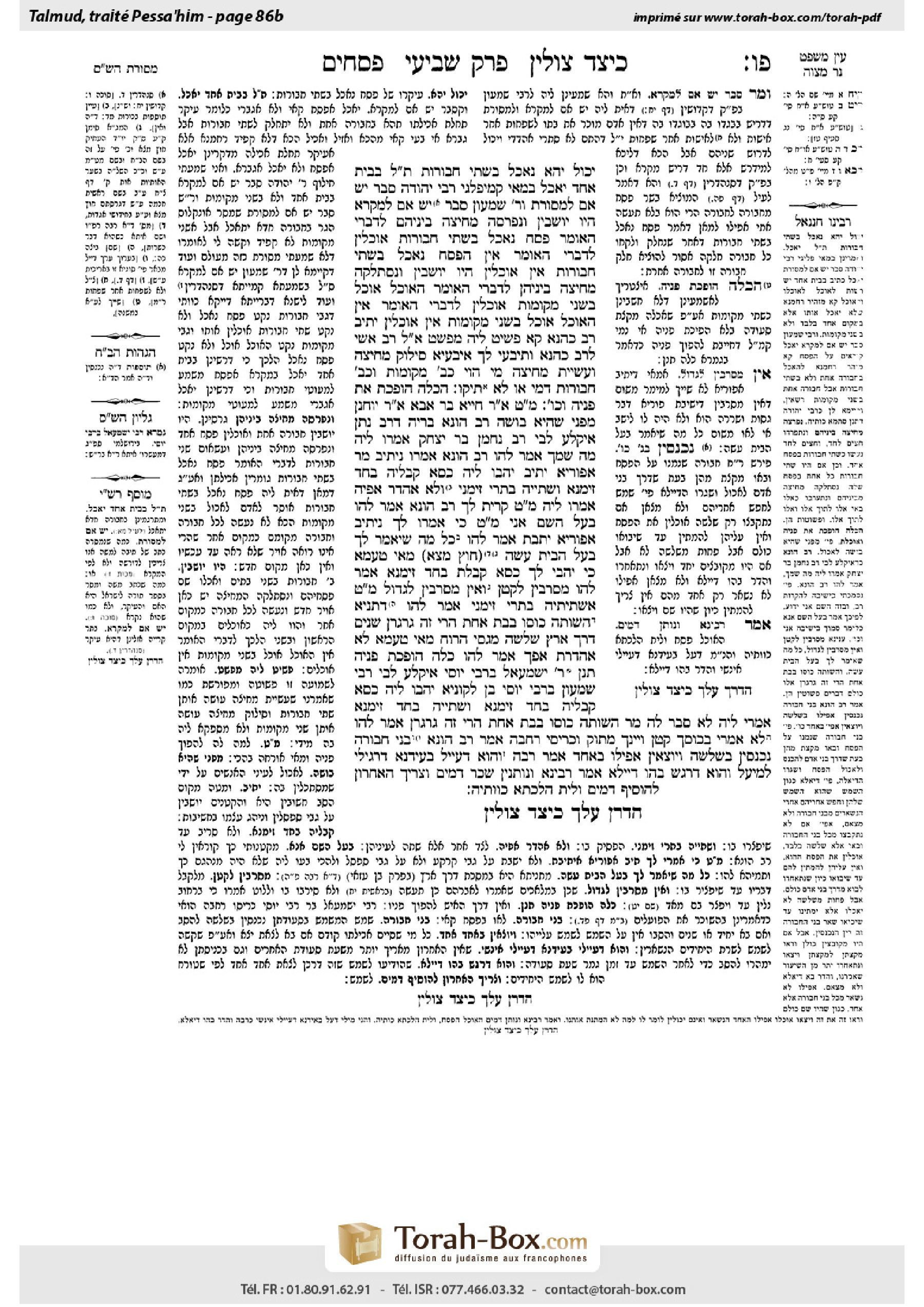
Pesachim 86b: Talmud study for Daf Yomi
Daf Yomi is the daily study of one Talmud folio. Explore 37 tractates with scans, Hebrew text, Sefaria English and AI-generated French translations where annotated.
Passage selection and English or AI-generated French translation are available where the scan has annotations. Daf Study is independent of Torah-Box and Sefaria.
Browse Pesachim · פסחים · All tractatesPesachim 86b text and translations
This page of Pesachim includes the Aramaic text, an English translation and an AI-generated French translation, alongside the scan above.
פסחים פ״ו ב · Aramaic and Hebrew text
יָכוֹל יְהֵא נֶאֱכָל בִּשְׁתֵּי חֲבוּרוֹת, תַּלְמוּד לוֹמַר: ״בְּבַיִת אֶחָד יֵאָכֵל״.
בְּמַאי קָמִיפַּלְגִי? רַבִּי יְהוּדָה סָבַר: יֵשׁ אֵם לַמָּסוֹרֶת. וְרַבִּי שִׁמְעוֹן סָבַר: יֵשׁ אֵם לַמִּקְרָא.
הָיוּ יוֹשְׁבִין וְנִפְרְסָה מְחִיצָה בֵּינֵיהֶם, לְדִבְרֵי הָאוֹמֵר פֶּסַח נֶאֱכָל בִּשְׁתֵּי חֲבוּרוֹת — אוֹכְלִין, לְדִבְרֵי הָאוֹמֵר אֵין הַפֶּסַח נֶאֱכָל בִּשְׁתֵּי חֲבוּרוֹת — אֵין אוֹכְלִין.
הָיוּ יוֹשְׁבִין וְנִסְתַּלְּקָה מְחִיצָה בֵּינֵיהֶן, לְדִבְרֵי הָאוֹמֵר הָאוֹכֵל אוֹכֵל בִּשְׁנֵי מְקוֹמוֹת — אוֹכְלִין, לְדִבְרֵי הָאוֹמֵר אֵין הָאוֹכֵל אוֹכֵל בִּשְׁנֵי מְקוֹמוֹת — אֵין אוֹכְלִין.
יָתֵיב רַב כָּהֲנָא קָא פָּשֵׁיט לֵיהּ מִפְשָׁט. אֲמַר לֵיהּ רַב אָשֵׁי לְרַב כָּהֲנָא: וְתִיבְּעֵי לָךְ אִיבַּעְיָא: סִילּוּק מְחִיצָה וַעֲשִׂיַּית מְחִיצָה מִי הָוֵי כִּשְׁנֵי מְקוֹמוֹת, וְכִשְׁתֵּי חֲבוּרוֹת דָּמֵי, אוֹ לָא? תֵּיקוּ.
הַכַּלָּה הוֹפֶכֶת אֶת פָּנֶיהָ וְכוּ׳. מַאי טַעְמָא? אָמַר רַבִּי חִיָּיא בַּר אַבָּא אָמַר רַבִּי יוֹחָנָן: מִפְּנֵי שֶׁהִיא בּוֹשָׁה.
רַב הוּנָא בְּרֵיהּ דְּרַב נָתָן אִיקְּלַע לְבֵי רַב נַחְמָן בַּר יִצְחָק. אֲמַרוּ לֵיהּ: מָה שְׁמָךְ? אֲמַר לְהוּ: רַב הוּנָא. אֲמַרוּ: נִיתֵּיב מָר אַפּוּרְיָא! יְתֵיב, יְהַבוּ לֵיהּ כָּסָא, קַבְּלֵיהּ בְּחַד זִימְנָא וְשַׁתְיֵיהּ בִּתְרֵי זִימְנֵי, וְלָא אַהְדַּר אַפֵּיהּ.
אֲמַרוּ לֵיהּ: מַאי טַעְמָא קָרֵית לְךָ רַב הוּנָא? אֲמַר לְהוּ בַּעַל הַשֵּׁם אֲנִי. מַאי טַעְמָא כִּי אֲמַרוּ לָךְ נִיתֵּיב אַפּוּרְיָא יְתֵבְתְּ? אֲמַר לְהוּ: כׇּל מַה שֶׁיֹּאמַר לְךָ בַּעַל הַבַּיִת עֲשֵׂה (חוּץ מִצֵּא).
מַאי טַעְמָא כִּי יָהֲבִי לָךְ כָּסָא קַבֵּלְתְּ בְּחַד זִימְנָא? אֲמַר לְהוּ: מְסָרְבִין לַקָּטָן, וְאֵין מְסָרְבִין לַגָּדוֹל. מַאי טַעְמָא אִשְׁתֵּיתֵיהּ בִּתְרֵי זִימְנֵי? אָמַר לְהוּ: דְּתַנְיָא, הַשּׁוֹתֶה כּוֹסוֹ בְּבַת אַחַת הֲרֵי זֶה גַּרְגְּרָן, שְׁנַיִם — דֶּרֶךְ אֶרֶץ, שְׁלֹשָׁה — מִגַּסֵּי הָרוּחַ. מַאי טַעְמָא לָא אַהְדַּרְתְּ אַפָּךְ? אֲמַר לְהוּ: ״כַּלָּה הוֹפֶכֶת פָּנֶיהָ״ תְּנַן.
רַבִּי יִשְׁמָעֵאל בְּרַבִּי יוֹסֵי אִיקְּלַע לְבֵי רַבִּי שִׁמְעוֹן בְּרַבִּי יוֹסֵי בֶּן לָקוֹנְיָא. יְהַבוּ לֵיהּ כָּסָא, קַבְּלֵיהּ בְּחַד זִימְנָא וְשַׁתְיֵיהּ בְּחַד זִימְנָא. אָמְרִי לֵיהּ: לָא סָבַר לַהּ מָר הַשּׁוֹתֶה כּוֹסוֹ בְּבַת אַחַת הֲרֵי זֶה גַּרְגְּרָן? אֲמַר לְהוּ: לָא אָמְרִי בְּכוֹסְךָ קָטָן וְיֵינְךָ מָתוֹק וּכְרֵיסִי רְחָבָה.
אָמַר רַב הוּנָא: בְּנֵי חֲבוּרָה נִכְנָסִין בִּשְׁלֹשָׁה, וְיוֹצְאִין אֲפִילּוּ בְּאֶחָד. אָמַר רַבָּה: וְהוּא דְּעָיֵיל בְּעִידָּנָא דִּרְגִילִי לְמֵיעַל, וְהוּא דִּרְגַשׁ בְּהוּ דַּיָּילָא.
אָמַר רָבִינָא: וְנוֹתְנִין שְׂכַר דָּמִים, וְצָרִיךְ הָאַחֲרוֹן לְהוֹסִיף דָּמִים. וְלֵית הִלְכְתָא כְּווֹתֵיהּ.
הַדְרָן עֲלָךְ כֵּיצַד צוֹלִין
Pesachim 86b · English translation
I might have thought that a single Paschal lamb may be eaten in two separate groups; therefore, the verse states: “In one house shall it be eaten.”
The Gemara asks: With regard to what principle do they disagree? The Gemara answers: Rabbi Yehuda holds that the consonantal text of the Torah is authoritative; meaning, the primary understanding of the verse is according to the way it is spelled. If this is the case, the verse may be rendered: In one house shall he eat it [yokhal], referring to the person eating the Paschal lamb. This would indicate that one eating from the Paschal lamb must eat in one location, but the verse does not prohibit dividing the offering between multiple groups. And Rabbi Shimon holds that the vocalized text of the Torah is authoritative. Since the word is pronounced ye’akhel, it is clear that it is referring to the Paschal lamb itself, and the verse requires that the offering be consumed by a single group of people (Rabbeinu Ḥananel).
The Gemara attempts to clarify this halakha: If members of a group were sitting and eating the Paschal lamb, and a partition was spread between them such that they now constitute two separate groups, according to Rabbi Yehuda, who says a Paschal lamb may be eaten in two groups, they may continue to eat; according to Rabbi Shimon, who says a Paschal lamb may not be eaten in two groups, they may not continue to eat because they now constitute two groups.
On the other hand, if they were sitting in two separate groups separated by a partition, and the partition between them was removed, according to Rabbi Shimon, who says that one who eats the Paschal lamb may eat it in two places, they may eat; according to Rabbi Yehuda, who says that one who eats the Paschal lamb may not eat it in two places, they may not eat. The removal of the partition defines a new place and it is as though they are eating in a new location.
The Gemara relates that Rav Kahana sat and taught this lesson simply, as though it were absolutely clear that erecting a partition divides a group into two distinct groups and removing a partition causes the area to be regarded as a new location. Rav Ashi said to Rav Kahana: You should raise this dilemma as a question: Does removal of a partition or the construction of a partition in one location during the eating of the Paschal lamb render the place comparable to two locations and cause the people to be considered two groups, or not? In fact, there is no clear answer to this dilemma, and the Gemara concludes: Let the question stand unresolved.
It was taught in the mishna that a bride turns her face. The Gemara asks: What is the reason she turns her face? Rabbi Ḥiyya bar Abba said that Rabbi Yoḥanan said: It is because she is embarrassed by other members of the group looking at her.
In this regard, the Gemara relates that Rav Huna, son of Rav Natan, happened to come to the house of Rav Naḥman bar Yitzḥak. They said to him: What is your name? He said to them: Rav Huna, even though using his title appeared to show conceit. They said: Our master may sit on the bed due to his great stature. He sat immediately, despite the fact that common etiquette dictated that he initially refuse. They gave him a cup of wine that he accepted the first time, without initially refusing it. And he drank it in two sips and did not turn his face from the rest of the people who were present.
These actions all appeared to be departures from the common etiquette and surprised his hosts, who said to him: What is the reason you call yourself Rav Huna? He said to them: I am known by that name since my youth, and therefore referring to myself with that title does not indicate conceit. They asked him: What is the reason that when they told you to sit on the bed, you sat immediately and did not initially refuse? He said to them: We have learned that anything the master of the house says to you, you should do, except for an inappropriate request, such as if he says to leave.
They continued to question his conduct: What is the reason that when they gave you the cup, you accepted it the first time and did not politely demur? He said to them: One may refuse a lesser person, but one may not refuse a great person; when an important person makes a request, it is respectful to comply immediately. They persisted in their questioning: What is the reason you drank it in two sips? He said to them: As it was taught in a baraita: One who drinks his cup at one time is a guzzler; drinking it in two sips is proper manners; one who drinks his cup in three sips is haughty, as he thereby demonstrates that he is pampered and indulgent. They continued to question his conduct: What is the reason you did not turn your face in accordance with the common etiquette? He said to them: We learned in the mishna that a bride turns her face; however, there is no reason for anyone else to turn his face.
The Gemara relates another incident that is somewhat similar to the one just quoted: Rabbi Yishmael, son of Rabbi Yosei, happened to come to the house of Rabbi Shimon, son of Rabbi Yosei ben Lakonya. They gave him a cup of wine to drink. He accepted it the first time it was offered and drank it at one time. They said to him: Does our master not hold of the halakha that one who drinks his cup at one time is a guzzler? He said to them: They did not say this rule with regard to your small cup, and your sweet wine, and my wide stomach.
Rav Huna said: Members of a group enter with three, meaning that when there are three members present the waiter must start serving them, and they may leave even with one, meaning that they may leave one at a time, and the waiter must continue serving those who remain until they are finished. Rabba said: And that is true only when the last member of the group entered at a time when it is common to enter the meal and not unusually early or late, and it is true only when the waiter [dayyala] knew about them, i.e., he knew that the members of this group leave one by one as they finish their meals and do not eat the entire meal together.
Ravina said: And the people who stayed late and extended their meal must give the waiter extra money for the wages he earned during the extra time that he served them, and the last one must add money for the time the waiter stayed to serve him individually. The Gemara notes: And the halakha is not in accordance with the opinion of Ravina. Rather, the waiter must serve until the last member of the group has completed his meal without additional compensation.
Pesachim 86b · Traduction française (IA)
J’aurais pu penser qu’un même agneau pascal peut être consommé par deux groupes distincts ; le verset enseigne donc : « Dans une seule maison, il sera mangé. »
La Guemara demande : Sur quel principe sont-ils en désaccord ? Elle répond : Rabbi Yehouda considère que le texte consonantique de la Torah fait autorité, c’est-à-dire que le sens premier du verset dépend de la manière dont il est écrit. Dans ce cas, on peut rendre le verset ainsi : « Dans une seule maison, il le mangera » [yokhal], en parlant de la personne qui mange l’agneau pascal. Cela indique que celui qui mange de l’agneau pascal doit le faire en un seul lieu, mais le verset n’interdit pas de répartir l’offrande entre plusieurs groupes. Rabbi Shimon, lui, considère que le texte vocalisé de la Torah fait autorité. Puisque le mot se prononce ye’akhel, il est clair qu’il se rapporte à l’agneau pascal lui-même, et le verset exige que l’offrande soit consommée par un seul groupe de personnes (Rabbeinu Ḥananel).
La Guemara cherche à préciser cette halakha : si les membres d’un groupe étaient assis et mangeaient l’agneau pascal, puis qu’une cloison était tendue entre eux, de sorte qu’ils constituaient désormais deux groupes distincts, ils peuvent continuer à manger selon Rabbi Yehouda, qui dit qu’un agneau pascal peut être consommé par deux groupes ; selon Rabbi Shimon, qui dit qu’un agneau pascal ne peut pas être consommé par deux groupes, ils ne peuvent pas continuer à manger, puisqu’ils constituent désormais deux groupes.
À l’inverse, s’ils étaient assis en deux groupes distincts séparés par une cloison, puis que la cloison entre eux était retirée, ils peuvent manger selon Rabbi Shimon, qui dit que celui qui mange l’agneau pascal peut le manger en deux endroits ; selon Rabbi Yehouda, qui dit que celui qui mange l’agneau pascal ne peut pas le manger en deux endroits, ils ne peuvent pas manger. Le retrait de la cloison définit un nouvel endroit, comme s’ils mangeaient dans un nouveau lieu.
La Guemara rapporte que Rav Kahana s’assit et enseigna cette règle sans réserve, comme s’il était absolument évident que l’installation d’une cloison divise un groupe en deux groupes distincts et que son retrait fait considérer l’espace comme un nouvel endroit. Rav Ashi dit à Rav Kahana : Tu devrais poser cette question : Le retrait d’une cloison ou l’installation d’une cloison en un même lieu, pendant que l’on mange l’agneau pascal, rend-il l’endroit comparable à deux lieux et fait-il considérer les personnes comme deux groupes, ou non ? En fait, cette question ne reçoit pas de réponse claire, et la Guemara conclut : Que la question reste sans réponse.
La Michna enseignait qu’une mariée tourne le visage. La Guemara demande : Pourquoi tourne-t-elle le visage ? Rabbi Ḥiyya bar Abba a dit au nom de Rabbi Yoḥanan : C’est parce qu’elle est gênée que les autres membres du groupe la regardent.
À ce sujet, la Guemara rapporte que Rav Huna, fils de Rav Natan, se rendit par hasard chez Rav Naḥman bar Yitzḥak. Ils lui demandèrent : Comment t’appelles-tu ? Il leur répondit : Rav Huna, bien que l’emploi de son titre pût sembler témoigner de présomption. Ils lui dirent : Notre maître peut s’asseoir sur le lit, en raison de son grand rang. Il s’assit aussitôt, alors que les convenances ordinaires voulaient qu’il refuse d’abord. Ils lui donnèrent une coupe de vin, qu’il accepta dès la première fois, sans commencer par la refuser. Il la but en deux gorgées et ne détourna pas le visage des autres personnes présentes.
Tous ces gestes semblaient s’écarter des convenances ordinaires et surprirent ses hôtes, qui lui demandèrent : Pourquoi t’appelles-tu Rav Huna ? Il leur répondit : On me connaît sous ce nom depuis ma jeunesse ; ainsi, me désigner par ce titre ne témoigne pas de présomption. Ils lui demandèrent : Pourquoi, lorsqu’on t’a dit de t’asseoir sur le lit, t’es-tu assis aussitôt, sans commencer par refuser ? Il leur répondit : Nous avons appris que tout ce que le maître de maison te dit, tu dois le faire, sauf s’il te demande quelque chose d’inconvenant, par exemple s’il te dit de partir.
Ils continuèrent à l’interroger sur sa conduite : Pourquoi, lorsqu’on t’a donné la coupe, l’as-tu acceptée dès la première fois, sans décliner poliment ? Il leur répondit : On peut refuser une personne de moindre importance, mais on ne peut pas refuser une personne importante ; lorsqu’une personne importante fait une demande, il est respectueux d’y accéder aussitôt. Ils insistèrent : Pourquoi l’as-tu bue en deux gorgées ? Il leur répondit : Comme il a été enseigné dans une baraïta : Celui qui boit sa coupe d’un seul trait est un glouton ; la boire en deux gorgées relève des bonnes manières ; celui qui la boit en trois gorgées est prétentieux, car il montre ainsi qu’il est choyé et qu’il se complaît dans son confort. Ils continuèrent à l’interroger sur sa conduite : Pourquoi n’as-tu pas détourné le visage, conformément aux convenances ordinaires ? Il leur répondit : Nous avons appris dans la Michna qu’une mariée tourne le visage ; mais personne d’autre n’a de raison de le faire.
La Guemara rapporte un autre incident quelque peu semblable à celui qui vient d’être cité : Rabbi Yishmael, fils de Rabbi Yosei, se rendit par hasard chez Rabbi Shimon, fils de Rabbi Yosei ben Lakonya. On lui donna une coupe de vin à boire. Il l’accepta dès la première fois qu’on la lui proposa et la but d’un seul trait. Ils lui dirent : Notre maître ne tient-il pas compte de la halakha selon laquelle celui qui boit sa coupe d’un seul trait est un glouton ? Il leur répondit : Cette règle n’a pas été énoncée à propos de votre petite coupe, de votre vin doux et de mon large estomac.
Rav Huna a dit : Les membres d’un groupe entrent à trois, c’est-à-dire que, dès qu’ils sont trois, le serveur doit commencer à les servir ; et ils peuvent partir même s’il n’en reste qu’un, c’est-à-dire qu’ils peuvent partir l’un après l’autre, tandis que le serveur doit continuer à servir ceux qui restent jusqu’à ce qu’ils aient fini. Rabba a dit : Cela n’est vrai que si le dernier membre du groupe est entré à une heure habituelle pour commencer le repas, et non anormalement tôt ou tard ; et cela n’est vrai que si le serveur [dayyala] était au courant, c’est-à-dire s’il savait que les membres de ce groupe partent l’un après l’autre à mesure qu’ils finissent leur repas, au lieu de prendre tout le repas ensemble.
Ravina a dit : Les personnes qui sont restées tard et ont prolongé leur repas doivent donner au serveur un supplément correspondant au salaire qu’il a gagné pendant le temps supplémentaire où il les a servis, et le dernier doit ajouter de l’argent pour le temps que le serveur est resté afin de le servir seul. La Guemara précise : La halakha ne suit pas l’avis de Ravina. Le serveur doit plutôt continuer à servir jusqu’à ce que le dernier membre du groupe ait terminé son repas, sans rémunération supplémentaire.
Traduction française générée par IA à partir de l’édition anglaise de Sefaria. Vérifie toujours un passage avec le texte source.
Text from Sefaria: William Davidson Edition - Vocalized Aramaic (CC BY NC); William Davidson Edition - English (CC BY NC).