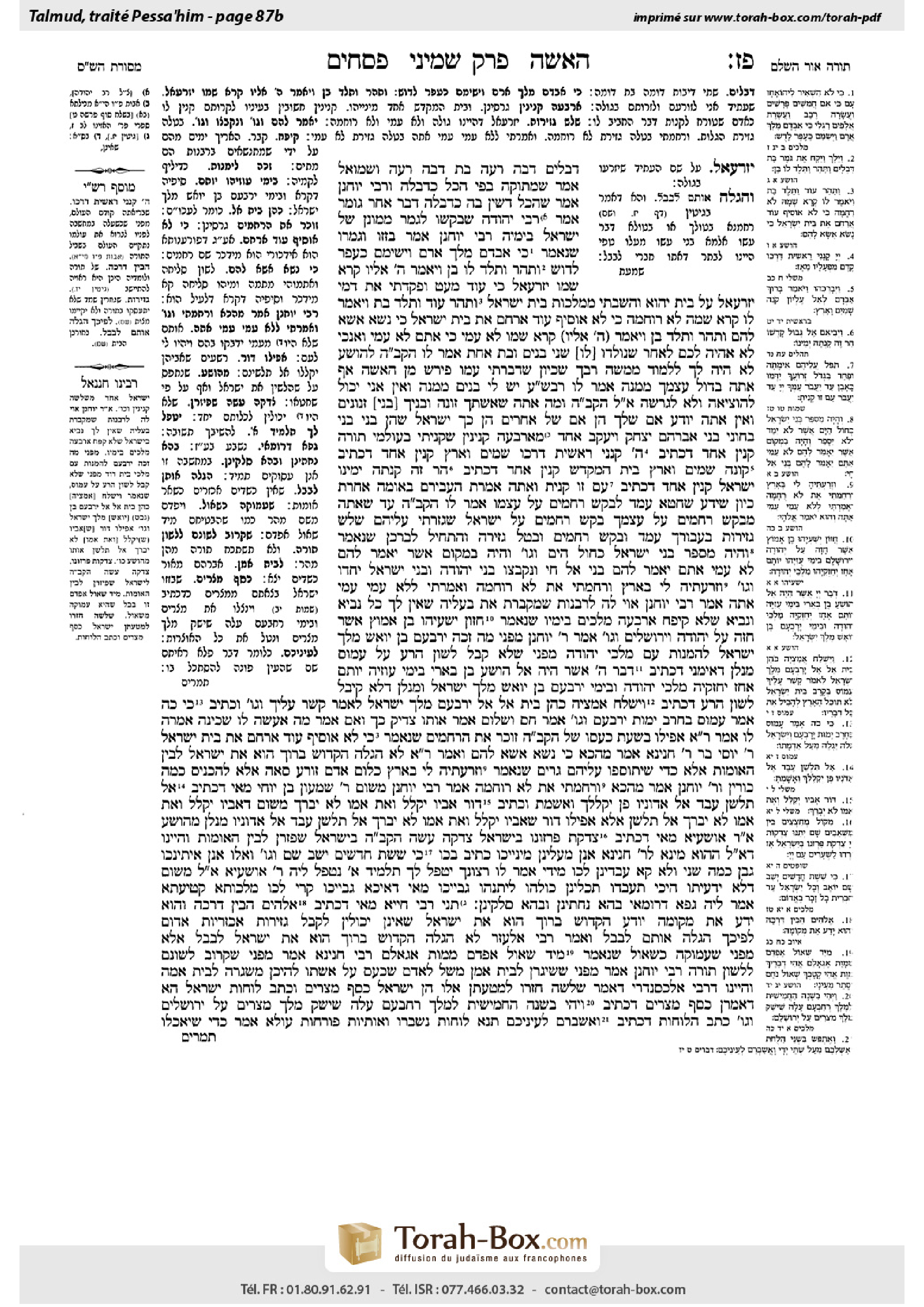
Pesachim 87b: Talmud study for Daf Yomi
Daf Yomi is the daily study of one Talmud folio. Explore 37 tractates with scans, Hebrew text, Sefaria English and AI-generated French translations where annotated.
Passage selection and English or AI-generated French translation are available where the scan has annotations. Daf Study is independent of Torah-Box and Sefaria.
Browse Pesachim · פסחים · All tractatesPesachim 87b text and translations
This page of Pesachim includes the Aramaic text, an English translation and an AI-generated French translation, alongside the scan above.
פסחים פ״ז ב · Aramaic and Hebrew text
דִּבְלָיִם״, דִּבָּה רָעָה בַּת דִּבָּה רָעָה. וּשְׁמוּאֵל אָמַר: שֶׁמְּתוּקָה בְּפִי הַכֹּל כִּדְבֵלָה. וְרַבִּי יוֹחָנָן אָמַר: שֶׁהַכֹּל דָּשִׁין בָּהּ כִּדְבֵלָה.
דָּבָר אַחֵר: ״גּוֹמֶר״, אָמַר רַבִּי יְהוּדָה: שֶׁבִּקְּשׁוּ לְגַמֵּר מָמוֹנָן שֶׁל יִשְׂרָאֵל בְּיָמֶיהָ, רַבִּי יוֹחָנָן אָמַר: בָּזְזוּ וְגָמְרוּ, שֶׁנֶּאֱמַר: ״כִּי אִבְּדָם מֶלֶךְ אֲרָם וַיְשִׂמֵם כֶּעָפָר לָדֻשׁ״.
״וַתַּהַר וַתֵּלֶד לוֹ בֵּן וַיֹּאמֶר ה׳ אֵלָיו קְרָא שְׁמוֹ יִזְרְעֶאל כִּי עוֹד מְעַט וּפָקַדְתִּי אֶת דְּמֵי יִזְרְעֶאל עַל בֵּית יֵהוּא וְהִשְׁבַּתִּי מַמְלְכוּת בֵּית יִשְׂרָאֵל וַתַּהַר עוֹד וַתֵּלֶד בַּת וַיֹּאמֶר לוֹ קְרָא שְׁמָהּ לֹא רֻחָמָה כִּי לֹא אוֹסִיף עוֹד אֲרַחֵם אֶת בֵּית יִשְׂרָאֵל כִּי נָשֹׂא אֶשָּׂא לָהֶם וַתַּהַר וַתֵּלֶד בֵּן וַיֹּאמֶר (ה׳ אֵלָיו) קְרָא שְׁמוֹ לֹא עַמִּי כִּי אַתֶּם לֹא עַמִּי וְאָנֹכִי לֹא אֶהְיֶה לָכֶם״,
לְאַחַר שֶׁנּוֹלְדוּ [לוֹ] שְׁנֵי בָנִים וּבַת אַחַת, אָמַר לוֹ הַקָּדוֹשׁ בָּרוּךְ הוּא לְהוֹשֵׁעַ: לֹא הָיָה לְךָ לִלְמוֹד מִמֹּשֶׁה רַבָּךְ? שֶׁכֵּיוָן שֶׁדִּבַּרְתִּי עִמּוֹ פֵּירַשׁ מִן הָאִשָּׁה, אַף אַתָּה בְּדוֹל עַצְמְךָ מִמֶּנָּה. אָמַר לוֹ: רִבּוֹנוֹ שֶׁל עוֹלָם יֵשׁ לִי בָּנִים מִמֶּנָּה וְאֵין אֲנִי יָכוֹל לְהוֹצִיאָהּ וְלֹא לְגָרְשָׁהּ.
אֲמַר לֵיהּ הַקָּדוֹשׁ בָּרוּךְ הוּא: וּמָה אַתָּה שֶׁאִשְׁתְּךָ זוֹנָה וּבָנֶיךָ [בְּנֵי] זְנוּנִים, וְאֵין אַתָּה יוֹדֵעַ אִם שֶׁלְּךָ הֵן אִם שֶׁל אֲחֵרִים הֵן — כָּךְ, יִשְׂרָאֵל שֶׁהֵן בָּנַי, בְּנֵי בְּחוּנַי בְּנֵי אַבְרָהָם יִצְחָק וְיַעֲקֹב, אֶחָד מֵאַרְבָּעָה קִנְיָנִין שֶׁקָּנִיתִי בְּעוֹלָמִי.
תּוֹרָה קִנְיָן אֶחָד, דִּכְתִיב: ״ה׳ קָנָנִי רֵאשִׁית דַּרְכּוֹ״. שָׁמַיִם וָאָרֶץ קִנְיָן אֶחָד, דִּכְתִיב: ״קֹנֵה שָׁמַיִם וָאָרֶץ״. בֵּית הַמִּקְדָּשׁ קִנְיָן אֶחָד, דִּכְתִיב: ״הַר זֶה קָנְתָה יְמִינוֹ״. יִשְׂרָאֵל קִנְיָן אֶחָד דִּכְתִיב: ״עַם זוּ קָנִיתָ״ — וְאַתָּה אָמַרְתָּ הַעֲבִירֵם בְּאוּמָּה אַחֶרֶת!
כֵּיוָן שֶׁיָּדַע שֶׁחָטָא, עָמַד לְבַקֵּשׁ רַחֲמִים עַל עַצְמוֹ. אָמַר לוֹ הַקָּדוֹשׁ בָּרוּךְ הוּא: עַד שֶׁאַתָּה מְבַקֵּשׁ רַחֲמִים עַל עַצְמְךָ — בַּקֵּשׁ רַחֲמִים עַל יִשְׂרָאֵל, שֶׁגָּזַרְתִּי עֲלֵיהֶם שָׁלֹשׁ גְּזֵירוֹת בַּעֲבוּרֶךָ.
עָמַד וּבִקֵּשׁ רַחֲמִים וּבִטֵּל גְּזֵירָה, וְהִתְחִיל לְבָרְכָן, שֶׁנֶּאֱמַר: ״וְהָיָה מִסְפַּר בְּנֵי יִשְׂרָאֵל כְּחוֹל הַיָּם וְגוֹ׳ וְהָיָה בִּמְקוֹם אֲשֶׁר יֵאָמֵר לָהֶם לֹא עַמִּי אַתֶּם יֵאָמֵר לָהֶם בְּנֵי אֵל חָי וְנִקְבְּצוּ בְּנֵי יְהוּדָה וּבְנֵי יִשְׂרָאֵל יַחְדָּו וְגוֹ׳ וּזְרַעְתִּיהָ לִּי בָּאָרֶץ וְרִחַמְתִּי אֶת לֹא רֻחָמָה וְאָמַרְתִּי לְלֹא עַמִּי עַמִּי אַתָּה״.
אָמַר רַבִּי יוֹחָנָן: אוֹי לָהּ לָרַבָּנוּת שֶׁמְּקַבֶּרֶת אֶת בְּעָלֶיהָ. שֶׁאֵין לָךְ כׇּל נָבִיא וְנָבִיא שֶׁלֹּא קִיפֵּחַ אַרְבָּעָה מְלָכִים בְּיָמָיו, שֶׁנֶּאֱמַר: ״חֲזוֹן יְשַׁעְיָהוּ בֶן אָמוֹץ אֲשֶׁר חָזָה עַל יְהוּדָה וִירוּשָׁלַיִם וְגוֹ׳״.
אָמַר רַבִּי יוֹחָנָן: מִפְּנֵי מָה זָכָה יָרׇבְעָם בֶּן יוֹאָשׁ מֶלֶךְ יִשְׂרָאֵל לְהִמָּנוֹת עִם מַלְכֵי יְהוּדָה? מִפְּנֵי שֶׁלֹּא קִבֵּל לָשׁוֹן הָרַע עַל עָמוֹס.
מְנָלַן דְּאִימְּנִי? דִּכְתִיב: ״דְּבַר ה׳ אֲשֶׁר הָיָה אֶל הוֹשֵׁעַ בֶּן בְּאֵרִי בִּימֵי עֻזִּיָּה יוֹתָם אָחָז יְחִזְקִיָּה מַלְכֵי יְהוּדָה וּבִימֵי יָרׇבְעָם בֶּן יוֹאָשׁ מֶלֶךְ יִשְׂרָאֵל״.
וּמְנָלַן דְּלֹא קִיבֵּל לָשׁוֹן הָרָע? דִּכְתִיב: ״וַיִּשְׁלַח אֲמַצְיָה כֹּהֵן בֵּית אֵל אֶל יָרׇבְעָם מֶלֶךְ יִשְׂרָאֵל לֵאמֹר קָשַׁר עָלֶיךָ וְגוֹ׳״, וּכְתִיב: ״כִּי כֹה אָמַר עָמוֹס בַּחֶרֶב יָמוּת יָרׇבְעָם וְגוֹ׳״. אָמַר: חַס וְשָׁלוֹם אָמַר אוֹתוֹ צַדִּיק כָּךְ, וְאִם אָמַר — מָה אֶעֱשֶׂה לוֹ? שְׁכִינָה אָמְרָה לוֹ.
אָמַר רַבִּי אֶלְעָזָר: אֲפִילּוּ בִּשְׁעַת כַּעְסוֹ שֶׁל הַקָּדוֹשׁ בָּרוּךְ הוּא זוֹכֵר אֶת הָרַחֲמִים. שֶׁנֶּאֱמַר: ״כִּי לֹא אוֹסִיף עוֹד אֲרַחֵם אֶת בֵּית יִשְׂרָאֵל״. רַבִּי יוֹסֵי בַּר רַבִּי חֲנִינָא אָמַר מֵהָכָא: ״כִּי נָשֹׂא אֶשָּׂא לָהֶם״.
וְאָמַר רַבִּי אֶלְעָזָר: לֹא הִגְלָה הַקָּדוֹשׁ בָּרוּךְ הוּא אֶת יִשְׂרָאֵל לְבֵין הָאוּמּוֹת אֶלָּא כְּדֵי שֶׁיִּתּוֹסְפוּ עֲלֵיהֶם גֵּרִים, שֶׁנֶּאֱמַר: ״וּזְרַעְתִּיהָ לִי בָּאָרֶץ״. כְּלוּם אָדָם זוֹרֵעַ סְאָה אֶלָּא לְהַכְנִיס כַּמָּה כּוֹרִין.
וְרַבִּי יוֹחָנָן אָמַר מֵהָכָא: ״וְרִחַמְתִּי אֶת לֹא רֻחָמָה״.
אָמַר רַבִּי יוֹחָנָן מִשּׁוּם רַבִּי שִׁמְעוֹן בֶּן יוֹחַי, מַאי דִּכְתִיב: ״אַל תַּלְשֵׁן עֶבֶד אֶל אֲדוֹנָיו פֶּן יְקַלֶּלְךָ וְאָשָׁמְתָּ״, וּכְתִיב: ״דּוֹר אָבִיו יְקַלֵּל וְאֶת אִמּוֹ לֹא יְבָרֵךְ״, מִשּׁוּם דְּאָבִיו יְקַלֵּל וְאֶת אִמּוֹ לֹא יְבָרֵךְ — אַל תַּלְשֵׁן?
אֶלָּא, אֲפִילּוּ דּוֹר שֶׁאָבִיו יְקַלֵּל וְאֶת אִמּוֹ לֹא יְבָרֵךְ — אַל תַּלְשֵׁן עֶבֶד אֶל אֲדוֹנָיו. מְנָלַן — מֵהוֹשֵׁעַ.
אָמַר רַבִּי אוֹשַׁעְיָא, מַאי דִּכְתִיב: ״צִדְקַת פִּרְזוֹנוֹ בְּיִשְׂרָאֵל״, צְדָקָה עָשָׂה הַקָּדוֹשׁ בָּרוּךְ הוּא בְּיִשְׂרָאֵל שֶׁפִּזְּרָן לְבֵין הָאוּמּוֹת. וְהַיְינוּ דַּאֲמַר לֵיהּ הָהוּא מִינָא לְרַבִּי חֲנִינָא: אֲנַן מְעַלִּינַן מִינַּיְיכוּ, כְּתִיב בְּכוּ: ״כִּי שֵׁשֶׁת חֳדָשִׁים יָשַׁב שָׁם וְגוֹ׳״, וְאִלּוּ אֲנַן אִיתִינְכוּ גַּבַּן כַּמָּה שְׁנֵי וְלָא קָא עָבְדִינַן לְכוּ מִידֵּי. אָמַר לוֹ: רְצוֹנְךָ יִטָּפֵל לָךְ תַּלְמִיד אֶחָד.
נִטְפַּל לֵיהּ רַבִּי אוֹשַׁעְיָא, אֲמַר לֵיהּ: מִשּׁוּם דְּלָא יָדְעִיתוּ הֵיכִי תַּעְבְּדוּ, תְּכַלִּינַן כּוּלְּהוּ — לֵיתַנְהוּ גַּבַּיְיכוּ. מַאי דְּאִיכָּא גַּבַּיְיכוּ, קָרֵי לְכוּ מַלְכוּתָא קְטִיעֲתָא. אֲמַר לֵיהּ: גַּפָּא דְרוֹמָאֵי! בְּהָא נָחֲתִינַן וּבְהָא סָלְקִינַן.
תָּנֵי רַבִּי חִיָּיא, מַאי דִּכְתִיב: ״אֱלֹהִים הֵבִין דַּרְכָּהּ וְהוּא יָדַע אֶת מְקוֹמָהּ״, יוֹדֵעַ הַקָּדוֹשׁ בָּרוּךְ הוּא אֶת יִשְׂרָאֵל שֶׁאֵינָן יְכוֹלִין לְקַבֵּל גְּזֵירוֹת שֶׁל רוֹמִיִּים, לְפִיכָךְ הִגְלָה אוֹתָם לְבָבֶל. וְאָמַר רַבִּי אֶלְעָזָר: לֹא הִגְלָה הַקָּדוֹשׁ בָּרוּךְ הוּא אֶת יִשְׂרָאֵל לְבָבֶל אֶלָּא מִפְּנֵי שֶׁעֲמוּקָּה כִּשְׁאוֹל, שֶׁנֶּאֱמַר: ״מִיַּד שְׁאוֹל אֶפְדֵּם מִמָּוֶת אֶגְאָלֵם״. רַבִּי חֲנִינָא אָמַר: מִפְּנֵי שֶׁקָּרוֹב לְשׁוֹנָם לִלְשׁוֹן תּוֹרָה.
רַבִּי יוֹחָנָן אָמַר: מִפְּנֵי שֶׁשִּׁיגְּרָן לְבֵית אִמָּן. מָשָׁל לְאָדָם שֶׁכָּעַס עַל אִשְׁתּוֹ, לְהֵיכָן מְשַׁגְּרָהּ — לְבֵית אִמָּהּ.
וְהַיְינוּ דְּרַבִּי אֲלֶכְּסַנְדְּרִי, דְּאָמַר: שְׁלֹשָׁה חָזְרוּ לְמַטָּעָתָן, אֵלּוּ הֵן: יִשְׂרָאֵל, כֶּסֶף מִצְרַיִם, וּכְתַב לוּחוֹת. יִשְׂרָאֵל — הָא דַּאֲמַרַן. כֶּסֶף מִצְרַיִם, דִּכְתִיב: ״וַיְהִי בַּשָּׁנָה הַחֲמִישִׁית לַמֶּלֶךְ רְחַבְעָם עָלָה שִׁישַׁק מֶלֶךְ מִצְרַיִם עַל יְרוּשָׁלַיִם וְגוֹ׳״. כְּתַב הַלּוּחוֹת, דִּכְתִיב: ״וָאֲשַׁבְּרֵם לְעֵינֵיכֶם״, תָּנָא: לוּחוֹת נִשְׁבְּרוּ וְאוֹתִיּוֹת פּוֹרְחוֹת.
עוּלָּא אָמַר: כְּדֵי שֶׁיֹּאכְלוּ
Pesachim 87b · English translation
Diblaim”; the name Diblaim can be taken as the dual form of the word dibba, ill repute. It suggests that she was a woman of ill repute, daughter of a woman of ill repute. And Shmuel said: The name Diblaim is the plural of the word deveila, a cake of pressed figs, indicating that she was as sweet as a cake of pressed figs, and therefore everyone used her services. Rabbi Yoḥanan, based on a similar derivation, said the name signifies that everyone would tread [dashin] upon her, a euphemism for sexual relations, like a cake of pressed figs.
Alternatively, with regard to the name Gomer, Rav Yehuda said: The name can be understood as deriving from the root gamar, to finish. It alludes to the fact that the gentiles sought to finish the money of the Jewish people in her days. Rabbi Yoḥanan said: They did not just seek to do so, but were successful. They plundered and finished it, as it is stated: “For the king of Aram destroyed them and made them like the dust in threshing” (II Kings 13:7).
The passage in Hosea continues: “And she conceived, and bore him a son. And the Lord said to him: Call his name Jezreel; for soon I will visit the blood of Jezreel upon the house of Jehu, and will obliterate the kingdom of the house of Israel…And she conceived again, and bore a daughter. And He said to him: Call her name Lo-ruhamah, for I will no more have compassion upon the house of Israel that I should bear them…And she conceived, and bore a son. And He said: Call his name Lo-ammi; for you are not My people, and I will not be yours” (Hosea 1:3–9).
After two sons and one daughter had been born to him, the Holy One, Blessed be He, said to Hosea: Shouldn’t you have learned from the example of your master Moses, who, once I spoke with him, separated from his wife? You too, separate yourself from your wife. He said to Him: Master of the Universe, I have sons from her and I am unable to dismiss her or to divorce her.
In response to Hosea’s show of loyalty to his family, the Holy One, Blessed be He, rebuked him and said to him: Just as you, whose wife is a prostitute and your children from her are children of prostitution, and you do not even know if they are yours or if they are children of other men, despite this, you are still attached to them and will not forsake them, so too, I am still attached to the Jewish people, who are My sons, the sons of My faithful who withstood ordeals, the sons of Abraham, Isaac, and Jacob. They are so special that they are one of the four acquisitions that I acquired in My world.
The Gemara proceeds to enumerate all four: Torah is one acquisition, as it is written: “The Lord acquired me as the beginning of His way” (Proverbs 8:22). Heaven and earth are one acquisition [kinyan], as it is written: “Blessed be Abram of God Most High, Creator [koneh] of heaven and earth” (Genesis 14:19). The Holy Temple is one acquisition, as it is written: “And He brought them to His sacred border, to this mountain, which His right hand had acquired” (Psalms 78:54). The Jewish people are one acquisition, as it is written: “The nation that You have acquired” (Exodus 15:16). And you, Hosea, said that I should replace them with another nation?
Once Hosea realized that he had sinned, he got up to request that God have compassion upon him for having spoken ill of the Jewish people. The Holy One, Blessed be He, said to him: Before you request compassion upon yourself, first request compassion upon the Jewish people, since I have already decreed upon them three harsh decrees on your account, in response to your condemnation of them. There is an allusion to these three decrees in the names of the children born of the prostitute. Jezreel is an allusion to a decree for Jehu’s actions in the Jezreel Valley (see II Kings 9–10). Lo-ruhamah, one that had not received compassion, suggests that God will no longer have compassion for the Jewish people. Lo-ammi, not My people, indicates that the Jewish people will no longer be considered God’s people.
Hosea stood and requested compassion upon the Jewish people and nullified the decree. God responded and began to bless them, as it is stated: “Yet the number of the children of Israel shall be as the sand of the sea, which cannot be measured nor numbered. And it will be that instead of that which was said to them: You are not My people, it shall be said to them: You are the children of the living God. And the children of Judea and the children of Israel shall be gathered together” (Hosea 2:1). And I will sow her to Me in the land; and I will have compassion upon her that had not received compassion; and I will say to them that were not My people: You are My people” (Hosea 2:25).
Rabbi Yoḥanan said: Woe to authority, which shortens the life and buries its holders. This is evident from the fact that you don’t have any prophet who did not outlast four kings in his lifetime, as the kings’ positions of authority caused them to die young. A prophet outliving four kings is demonstrated in the opening verses of Hosea, and similarly, as it is stated with regard to Isaiah: “The vision of Isaiah, the son of Amoz, which he saw concerning Judea and Jerusalem in the days of Uzziah, Jotham, Ahaz, and Hezekiah, kings of Judea” (Isaiah 1:1).
Rabbi Yoḥanan said: Due to what reason was the less than righteous Jeroboam, son of Joash, king of Israel, privileged to be counted in the verse together with the righteous kings of Judea? It is due to the fact that he did not accept slander about Amos.
The Gemara asks: From where do we derive that he was counted together with the righteous kings of Judea? As it is written: “The word of the Lord that came to Hosea, son of Beeri, in the days of Uzziah, Jotham, Ahaz, and Hezekiah, kings of Judea, and in the days of Jeroboam, the son of Joash, king of Israel” (Hosea 1:1).
And from where do we derive that he did not accept slander? As it is written: “Then Amaziah the priest of Beth-El sent to Jeroboam king of Israel, saying: Amos has conspired against you in the midst of the house of Israel” (Amos 7:10). And it is written: “For thus said Amos: Jeroboam shall die by the sword and Israel shall surely be led away captive out of his land” (Amos 7:11). Jeroboam said: Heaven forfend that that righteous person, Amos, said this, that I will die by the sword; and if he indeed said it, what shall I do to him and why should I punish him? The Divine Presence said it to him, and he is required to transmit his prophecy.
Rabbi Elazar said: Even at the time of the anger of the Holy One, Blessed be He, He remembers the attribute of compassion, as it is stated: “For I will no more have compassion upon the house of Israel” (Hosea 1:6). Even when implementing His attribute of justice, God still mentions His attribute of compassion. Rabbi Yosei bar Rabbi Ḥanina said that this is also indicated from here, from the continuation of the verse, which states: “That I should bear them,” indicating that God promised to eventually bear Israel’s sins and pardon them.
And Rabbi Elazar said: The Holy One, Blessed be He, exiled Israel among the nations only so that converts would join them, as it is stated: “And I will sow her to Me in the land” (Hosea 2:25). Does a person sow a se’a of grain for any reason other than to bring in several kor of grain during the harvest? So too, the exile is to enable converts from the nations to join the Jewish people.
And Rabbi Yoḥanan said that this idea may be derived from here: “And I will have compassion upon her that had not received compassion; and I will say to them that were not My people: You are My people” (Hosea 2:25). Even those who were initially “not My people,” i.e., gentiles, will convert and become part of the Jewish nation.
Rabbi Yoḥanan said in the name of Rabbi Shimon ben Yoḥai: What is the meaning of that which is written: “Slander not a servant to his master, lest he curse you, and you be found guilty” (Proverbs 30:10), and it is then written in the next verse: “There is a generation that curses its father, and does not bless its mother” (Proverbs 30:11). Is it because they curse their father and do not bless their mother that you should not slander them? Clearly that is absurd.
Rather, the juxtaposition serves to emphasize that even in a wicked generation that curses its father and does not bless its mother, one should not slander a servant to his master. From where do we derive this? From Hosea, whose criticism of the Jewish people, God’s servants, to God, their master, aroused His ire, despite the fact that it was a wicked generation.
Rabbi Oshaya said: What is the meaning of that which is written: “The righteous acts of His rulers [pirzono] in Israel” (Judges 5:11)? The Holy One, Blessed be He, performed a charitable deed toward Israel in that He scattered them [pizran] among the nations; had He exiled them to one place, they could have all been destroyed at once. And this concept is that which a certain apostate said to Rabbi Ḥanina: We gentiles are superior to you Jews in that we have patience. It is written of you: “For Joab and all Israel remained there six months until he had cut off every male in Edom” (I Kings 11:16), whereas we, although you have been with us for several years, are not doing anything to you. He said to him: With your consent, let one student deal with your assertion and answer you.
Rabbi Oshaya dealt with his assertion and said to him: This is not a sign of your righteousness but is simply because you do not know how to do it, to destroy us. If you seek to destroy all of the Jewish people, you cannot because they are not all with you in your kingdom. If you destroy only those Jews who are with you in your kingdom, you will be called a severed kingdom for murdering part of its own population. The apostate said to him: I swear by Gappa, god of the Romans, with this problem we lie down and with this problem we rise up, for we are constantly struggling with the dilemma of how to eliminate the Jewish people.
Rabbi Ḥiyya teaches: What is the meaning of that which is written: “God understands its ways and He knows its place” (Job 28:23)? The Holy One, Blessed be He, knows the Jewish people, who are unable to withstand the harsh decrees of the Romans. Therefore, He exiled them to Babylonia, whose people are less cruel. And Rabbi Elazar said: The Holy One, Blessed be He, exiled Israel to Babylonia only due to the fact it is a land as deep as the netherworld, i.e., it is a land of plains and valleys, which alludes to that which is stated: “I shall ransom them from the power of the netherworld, I shall redeem them from death” (Hosea 13:14). Rabbi Ḥanina said: It is due to the fact that their language, Aramaic, is similar to the language of the Torah, which enables the Jews who live there to study Torah.
Rabbi Yoḥanan said: It is due to the fact that He sent them to their mother’s house, i.e., the birthplace of the forefathers of the Jewish people, who lived in Aram-Nahara’im, which is in Babylonia. This is comparable to a man who is angry at his wife; to where does he send her? He sends her to her mother’s house.
And this is expressed in the statement of Rabbi Alexandri, who said: There are three that returned to their points of origin, and these are they: The Jewish people, the money of Egypt, and the writing on the Tablets of the Covenant. The Jewish people; that which we just said, they returned to Babylonia. The money of Egypt; as it is written: “And it came to pass in the fifth year of King Rehoboam, that Shishak, king of Egypt, came up against Jerusalem; and he took away the treasures of the house of the Lord and the treasures of the king’s house; he took everything” (I Kings 14:25–26). The writing on the Tablets of the Covenant; as it is written: “And I took hold of the two tablets, and cast them out of my two hands, and broke them before your eyes” (Deuteronomy 9:17). And it was taught in the Tosefta: The tablets were broken and the letters are flying and returning to their point of origin.
Ulla said that Israel was exiled to Babylonia in order to enable them to eat
Pesachim 87b · Traduction française (IA)
« Diblaïm » : le nom Diblaïm peut être compris comme la forme duelle du mot dibba, « mauvaise réputation ». Il suggère qu’elle était une femme de mauvaise réputation, fille d’une femme de mauvaise réputation. Et Chmouel dit : le nom Diblaïm est le pluriel du mot deveïla, un gâteau de figues pressées, ce qui indique qu’elle était aussi douce qu’un gâteau de figues pressées et que, par conséquent, tout le monde avait recours à ses services. Rabbi Yoḥanan, s’appuyant sur une dérivation semblable, dit que ce nom signifie que tout le monde la foulait [dashin], euphémisme désignant les relations sexuelles, comme un gâteau de figues pressées.
Autre explication du nom Gomer : Rav Yehouda dit que ce nom peut être compris comme dérivant de la racine gamar, « achever ». Il fait allusion au fait que les nations cherchaient à épuiser les ressources du peuple juif à son époque. Rabbi Yoḥanan dit qu’elles ne se sont pas contentées de le chercher, mais qu’elles y sont parvenues. Elles ont pillé ses biens et les ont épuisés, comme il est dit : « Car le roi d’Aram les avait détruits et les avait réduits à la poussière sous le fléau » (II Rois 13:7).
Le passage d’Osée poursuit : « Elle conçut et lui donna un fils. Le Seigneur lui dit : “Appelle-le du nom de Jizréel, car bientôt Je demanderai compte du sang de Jizréel à la maison de Jéhu et Je ferai disparaître le royaume de la maison d’Israël… Elle conçut de nouveau et donna une fille. Il lui dit : “Appelle-la du nom de Lo-Rouḥama, car Je n’aurai plus compassion de la maison d’Israël au point de la supporter… Elle conçut et donna un fils. Il dit : “Appelle-le du nom de Lo-Ammi, car vous n’êtes pas Mon peuple, et Moi, Je ne serai pas à vous” » (Osée 1:3–9).
Après la naissance de deux fils et d’une fille, le Saint, béni soit-Il, dit à Osée : « N’aurais-tu pas dû tirer une leçon de l’exemple de ton maître Moïse, qui, dès que J’ai parlé avec lui, s’est séparé de sa femme ? Toi aussi, sépare-toi de ta femme. » Il Lui répondit : « Maître de l’Univers, j’ai des enfants avec elle et je ne peux ni la renvoyer ni divorcer d’elle. »
En réponse à la fidélité d’Osée envers sa famille, le Saint, béni soit-Il, le réprimanda et lui dit : « De même que toi, dont la femme est une prostituée et dont les enfants sont issus de la prostitution, tu restes malgré tout attaché à eux et ne veux pas les abandonner, sans même savoir s’ils sont à toi ou s’ils sont les enfants d’autres hommes, de même, Moi aussi, Je reste attaché au peuple juif, qui est Mon fils, les fils de Mes fidèles qui ont résisté aux épreuves, les fils d’Abraham, d’Isaac et de Jacob. Ils sont si précieux qu’ils constituent l’une des quatre acquisitions que J’ai faites dans Mon monde. »
La Guemara énumère les quatre acquisitions : la Torah est l’une d’elles, comme il est écrit : « Le Seigneur m’a acquise comme prémices de Sa voie » (Proverbes 8:22). Le ciel et la terre constituent une acquisition [kinyan], comme il est écrit : « Béni soit Abram par le Dieu Très-Haut, créateur [koneh] du ciel et de la terre » (Genèse 14:19). Le Temple est une acquisition, comme il est écrit : « Il les conduisit à Sa frontière sainte, à cette montagne que Sa droite a acquise » (Psaumes 78:54). Le peuple juif est une acquisition, comme il est écrit : « La nation que Tu as acquise » (Exode 15:16). Et toi, Osée, tu as dit que Je devais les remplacer par une autre nation ?
Lorsqu’Osée comprit qu’il avait péché, il se leva pour demander à Dieu d’avoir compassion de lui, car il avait mal parlé du peuple juif. Le Saint, béni soit-Il, lui dit : « Avant de demander de la compassion pour toi-même, demande d’abord de la compassion pour le peuple juif, car, à cause de toi et de tes accusations contre lui, J’ai déjà prononcé contre lui trois décrets sévères. » Les noms des enfants nés de la prostituée font allusion à ces trois décrets. Jizréel fait allusion à un décret concernant les actes de Jéhu dans la vallée de Jizréel (voir II Rois 9–10). Lo-Rouḥama, « celle qui n’a pas reçu de compassion », suggère que Dieu n’aura plus compassion du peuple juif. Lo-Ammi, « pas Mon peuple », indique que le peuple juif ne sera plus considéré comme le peuple de Dieu.
Osée se leva et demanda à Dieu d’avoir compassion du peuple juif, et il annula le décret. Dieu répondit en commençant à le bénir, comme il est dit : « Pourtant, le nombre des enfants d’Israël sera comme le sable de la mer, qu’on ne peut mesurer ni compter. Et au lieu de leur dire : “Vous n’êtes pas Mon peuple”, on leur dira : “Vous êtes les enfants du Dieu vivant.” Les enfants de Juda et les enfants d’Israël se rassembleront » (Osée 2:1). « Je la sèmerai pour Moi dans le pays ; J’aurai compassion de celle qui n’a pas reçu de compassion, et Je dirai à ceux qui n’étaient pas Mon peuple : “Vous êtes Mon peuple” » (Osée 2:25).
Rabbi Yoḥanan dit : « Malheur au pouvoir, qui abrège la vie et conduit ceux qui l’exercent à la tombe ! » Cela se voit au fait qu’aucun prophète n’a survécu à moins de quatre rois de son vivant, car leur position de pouvoir les a fait mourir jeunes. Le fait qu’un prophète ait survécu à quatre rois apparaît dans les premiers versets d’Osée et, de même, il est dit au sujet d’Isaïe : « Vision d’Isaïe, fils d’Amots, qu’il a reçue au sujet de Juda et de Jérusalem, aux jours d’Ouzias, de Yotam, d’Achaz et d’Ézéchias, rois de Juda » (Isaïe 1:1).
Rabbi Yoḥanan dit : « Pour quelle raison Yarovam, fils de Yoash, roi d’Israël, qui n’était pas tout à fait juste, eut-il le mérite d’être mentionné dans le verset avec les rois justes de Juda ? » Parce qu’il n’a pas accepté de médisance au sujet d’Amos.
La Guemara demande : « D’où savons-nous qu’il a été mentionné avec les rois justes de Juda ? » Comme il est écrit : « Parole du Seigneur adressée à Osée, fils de Beéri, aux jours d’Ouzias, de Yotam, d’Achaz et d’Ézéchias, rois de Juda, et aux jours de Yarovam, fils de Yoash, roi d’Israël » (Osée 1:1).
Et d’où savons-nous qu’il n’a pas accepté de médisance ? Comme il est écrit : « Alors Amatsia, prêtre de Béthel, envoya dire à Yarovam, roi d’Israël : “Amos a conspiré contre toi au milieu de la maison d’Israël” » (Amos 7:10). Et il est écrit : « Car voici ce qu’a dit Amos : “Yarovam mourra par l’épée, et Israël sera certainement emmené captif hors de son pays” » (Amos 7:11). Yarovam dit : « À Dieu ne plaise qu’Amos, ce juste, ait dit que je mourrai par l’épée ; et s’il l’a effectivement dit, que puis-je faire contre lui, et pourquoi le punirais-je ? La Présence divine le lui a dit, et il est tenu de transmettre sa prophétie. »
Rabbi Elazar dit : « Même au moment de la colère du Saint, béni soit-Il, Il se souvient de l’attribut de compassion », comme il est dit : « Car Je n’aurai plus compassion de la maison d’Israël » (Osée 1:6). Même lorsqu’Il met en œuvre Son attribut de justice, Dieu mentionne encore Son attribut de compassion. Rabbi Yosse bar Rabbi Ḥanina dit que cela ressort également de la suite du verset, qui dit : « au point de les supporter », ce qui indique que Dieu a promis de porter finalement les péchés d’Israël et de lui pardonner.
Et Rabbi Elazar dit : « Le Saint, béni soit-Il, n’a exilé Israël parmi les nations que pour que des convertis se joignent à lui », comme il est dit : « Je la sèmerai pour Moi dans le pays » (Osée 2:25). Quelqu’un sème-t-il un séa de grain pour une autre raison que de récolter plusieurs kor de grain ? De même, l’exil vise à permettre aux convertis issus des nations de se joindre au peuple juif.
Et Rabbi Yoḥanan dit que cette idée peut être déduite d’ici : « J’aurai compassion de celle qui n’a pas reçu de compassion, et Je dirai à ceux qui n’étaient pas Mon peuple : “Vous êtes Mon peuple” » (Osée 2:25). Même ceux qui, au départ, n’étaient pas « Mon peuple », c’est-à-dire les non-Juifs, se convertiront et feront partie du peuple juif.
Rabbi Yoḥanan dit au nom de Rabbi Shimon ben Yoḥai : « Que signifie ce qui est écrit : “Ne dénonce pas un serviteur auprès de son maître, de peur qu’il ne te maudisse et que tu ne sois reconnu coupable” (Proverbes 30:10), puis, au verset suivant : “Il est une génération qui maudit son père et ne bénit pas sa mère” (Proverbes 30:11) ? Est-ce parce qu’ils maudissent leur père et ne bénissent pas leur mère qu’il ne faudrait pas les dénoncer ? C’est manifestement absurde. »
Mais ce rapprochement souligne que, même dans une génération méchante qui maudit son père et ne bénit pas sa mère, on ne doit pas dénoncer un serviteur auprès de son maître. D’où le déduisons-nous ? D’Osée, dont les critiques du peuple juif, les serviteurs de Dieu, adressées à Dieu, leur maître, éveillèrent Sa colère, alors même qu’il s’agissait d’une génération méchante.
Rabbi Ochaya dit : « Que signifie ce qui est écrit : “Les actes justes de Ses chefs [pirzono] en Israël” » (Juges 5:11) ? Le Saint, béni soit-Il, a accompli un acte de bonté envers Israël en le dispersant [pizran] parmi les nations ; s’Il l’avait exilé en un seul endroit, il aurait pu être entièrement détruit d’un seul coup. Cette idée apparaît aussi dans la remarque d’un certain apostat à Rabbi Ḥanina : « Nous, les non-Juifs, vous sommes supérieurs, à vous les Juifs, car nous savons patienter. Il est écrit à votre sujet : “Yoav et tout Israël demeurèrent là six mois, jusqu’à ce qu’il eût exterminé tous les mâles d’Édom” (I Rois 11:16), tandis que nous, bien que vous soyez parmi nous depuis plusieurs années, ne vous faisons rien. » Rabbi Ḥanina lui répondit : « Si tu le permets, qu’un élève réponde à ton affirmation. »
Rabbi Ochaya répondit à son affirmation et lui dit : « Ce n’est pas le signe de votre droiture ; c’est simplement que vous ne savez pas comment vous y prendre pour nous détruire. Si vous cherchez à détruire tout le peuple juif, vous ne le pouvez pas, car tous ses membres ne se trouvent pas dans votre royaume. Si vous ne détruisez que les Juifs qui se trouvent dans votre royaume, on vous appellera un royaume amputé, pour avoir assassiné une partie de votre propre population. » L’apostat lui dit : « Je le jure par Gappa, le dieu des Romains : c’est avec ce problème que nous nous couchons et que nous nous levons, car nous nous débattons constamment avec le dilemme de savoir comment éliminer le peuple juif. »
Rabbi Ḥiyya enseigne : « Que signifie ce qui est écrit : “Dieu en comprend les voies et Il en connaît le lieu” » (Job 28:23) ? Le Saint, béni soit-Il, connaît le peuple juif, incapable de supporter les décrets sévères des Romains. C’est pourquoi Il l’a exilé en Babylonie, dont les habitants sont moins cruels. Et Rabbi Elazar dit : « Le Saint, béni soit-Il, n’a exilé Israël en Babylonie que parce que c’est un pays aussi profond que les abîmes », c’est-à-dire un pays de plaines et de vallées, ce qui fait allusion à ce qui est dit : « Je les rachèterai du pouvoir des abîmes, Je les délivrerai de la mort » (Osée 13:14). Rabbi Ḥanina dit : « C’est parce que leur langue, l’araméen, ressemble à la langue de la Torah », ce qui permet aux Juifs qui y vivent d’étudier la Torah.
Rabbi Yoḥanan dit : « C’est parce qu’Il les a envoyés dans la maison de leur mère », c’est-à-dire au lieu d’origine des ancêtres du peuple juif, qui vivaient en Aram-Naharaïm, en Babylonie. Cela ressemble à l’histoire d’un homme en colère contre sa femme : où l’envoie-t-il ? Il l’envoie chez sa mère.
Cela s’exprime dans l’enseignement de Rabbi Alexandri, qui dit : « Trois choses sont retournées à leur lieu d’origine, les voici : le peuple juif, l’argent d’Égypte et l’écriture des Tables de l’Alliance. » Le peuple juif : comme nous venons de le dire, il est retourné en Babylonie. L’argent d’Égypte : comme il est écrit : « La cinquième année du roi Roboam, Shishak, roi d’Égypte, marcha contre Jérusalem ; il prit les trésors de la maison du Seigneur et les trésors de la maison du roi, il prit tout » (I Rois 14:25–26). L’écriture des Tables de l’Alliance : comme il est écrit : « Je saisis les deux tables, je les jetai de mes deux mains et les brisai sous vos yeux » (Deutéronome 9:17). Et il a été enseigné dans la Tosefta : les tables furent brisées, et les lettres s’envolèrent pour retourner à leur lieu d’origine.
Oula dit qu’Israël fut exilé en Babylonie afin de lui permettre de manger
Traduction française générée par IA à partir de l’édition anglaise de Sefaria. Vérifie toujours un passage avec le texte source.
Text from Sefaria: William Davidson Edition - Vocalized Aramaic (CC BY NC); William Davidson Edition - English (CC BY NC).