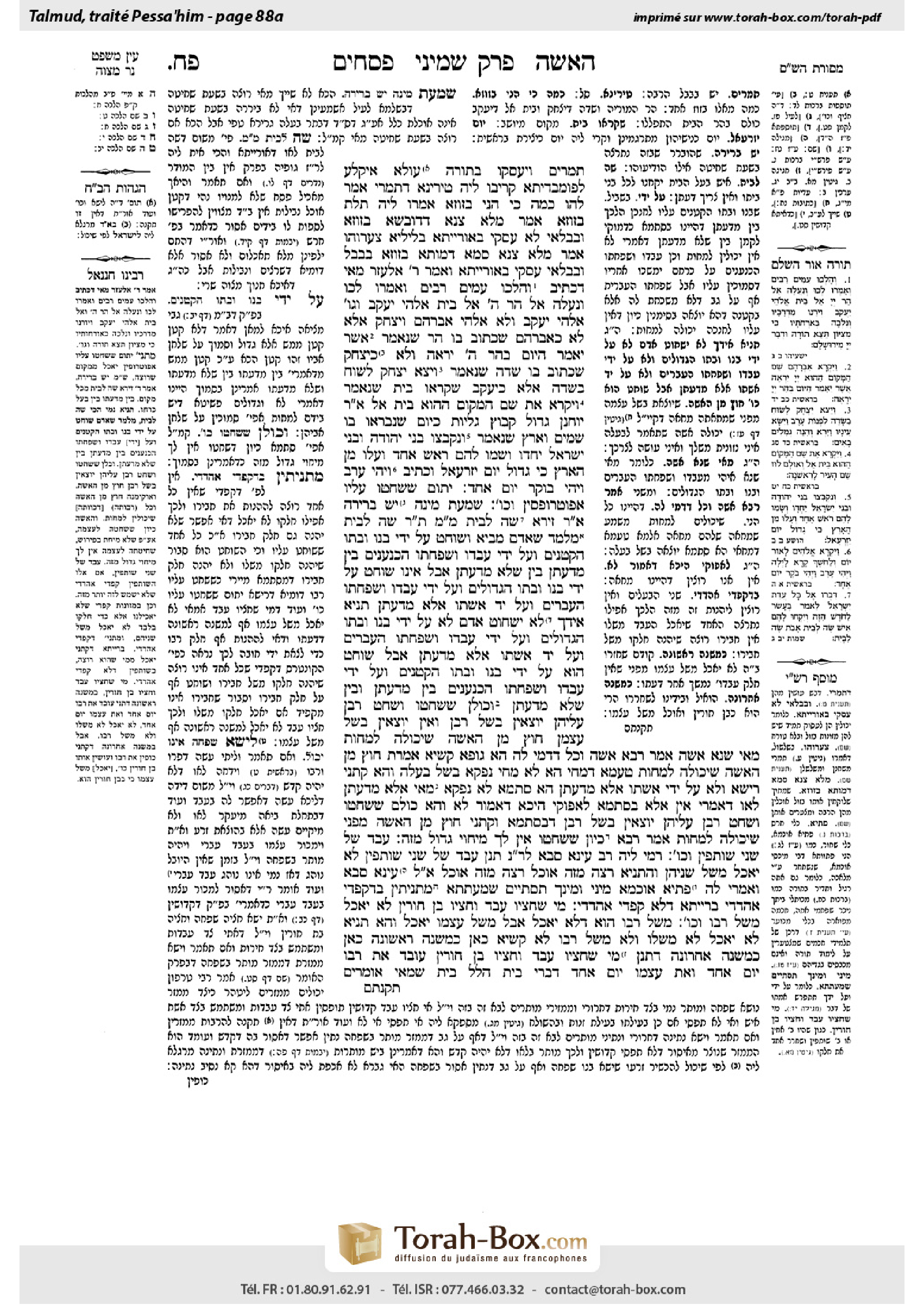
Pesachim 88a: Talmud study for Daf Yomi
Daf Yomi is the daily study of one Talmud folio. Explore 37 tractates with scans, Hebrew text, Sefaria English and AI-generated French translations where annotated.
Passage selection and English or AI-generated French translation are available where the scan has annotations. Daf Study is independent of Torah-Box and Sefaria.
Browse Pesachim · פסחים · All tractatesPesachim 88a text and translations
This page of Pesachim includes the Aramaic text, an English translation and an AI-generated French translation, alongside the scan above.
פסחים פ״ח א · Aramaic and Hebrew text
תְּמָרִים וְיַעַסְקוּ בַּתּוֹרָה. עוּלָּא אִיקְּלַע לְפוּמְבְּדִיתָא, קָרִיבוּ לֵיהּ טִירְיָנָא דְתַמְרֵי. אֲמַר לְהוּ: כַּמָּה כִּי הָנֵי בְּזוּזָא? אֲמַרוּ לֵיהּ: תְּלָת בְּזוּזָא. אֲמַר: מְלָא צַנָּא דְּדוּבְשָׁא בְּזוּזָא, וּבַבְלָאֵי לָא עָסְקִי בְּאוֹרָיְיתָא.
בְּלֵילְיָא צַעֲרוּהוּ. אָמַר: מְלָא צַנָּא סַמָּא דְמוֹתָא בְּזוּזָא בְּבָבֶל, וּבַבְלָאֵי עָסְקִי בְּאוֹרָיְיתָא.
וְאָמַר רַבִּי אֶלְעָזָר, מַאי דִּכְתִיב: ״וְהָלְכוּ עַמִּים רַבִּים וְאָמְרוּ לְכוּ וְנַעֲלֶה אֶל הַר ה׳ אֶל בֵּית אֱלֹהֵי יַעֲקֹב וְגוֹ׳״. אֱלֹהֵי יַעֲקֹב, וְלֹא אֱלֹהֵי אַבְרָהָם וְיִצְחָק?
אֶלָּא, לֹא כְּאַבְרָהָם שֶׁכָּתוּב בּוֹ ״הַר״, שֶׁנֶּאֱמַר: ״אֲשֶׁר יֵאָמֵר הַיּוֹם בְּהַר ה׳ יֵרָאֶה״, וְלֹא כְּיִצְחָק שֶׁכָּתוּב בּוֹ ״שָׂדֶה״, שֶׁנֶּאֱמַר: ״וַיֵּצֵא יִצְחָק לָשׂוּחַ בַּשָּׂדֶה״, אֶלָּא כְּיַעֲקֹב שֶׁקְּרָאוֹ ״בַּיִת״, שֶׁנֶּאֱמַר: ״וַיִּקְרָא אֶת שֵׁם הַמָּקוֹם הַהוּא בֵּית אֵל״.
אָמַר רַבִּי יוֹחָנָן: גָּדוֹל קִבּוּץ גָּלִיּוֹת כַּיּוֹם שֶׁנִּבְרְאוּ בּוֹ שָׁמַיִם וָאָרֶץ, שֶׁנֶּאֱמַר: ״וְנִקְבְּצוּ בְּנֵי יְהוּדָה וּבְנֵי יִשְׂרָאֵל יַחְדָּו וְשָׂמוּ לָהֶם רֹאשׁ אֶחָד וְעָלוּ מִן הָאָרֶץ כִּי גָדוֹל יוֹם יִזְרְעֶאל״, וּכְתִיב: ״וַיְהִי עֶרֶב וַיְהִי בֹקֶר יוֹם אֶחָד״.
יָתוֹם שֶׁשָּׁחֲטוּ עָלָיו אַפּוֹטְרוֹפְּסִין וְכוּ׳. שָׁמְעַתְּ מִינַּהּ יֵשׁ בְּרֵירָה. אָמַר רַבִּי זֵירָא: ״שֶׂה לַבָּיִת״ — מִכׇּל מָקוֹם.
תָּנוּ רַבָּנַן: ״שֶׂה לַבָּיִת״ — מְלַמֵּד שֶׁאָדָם מֵבִיא וְשׁוֹחֵט עַל יְדֵי בְּנוֹ וּבִתּוֹ הַקְּטַנִּים וְעַל יְדֵי עַבְדּוֹ וְשִׁפְחָתוֹ הַכְּנַעֲנִים, בֵּין מִדַּעְתָּן בֵּין שֶׁלֹּא מִדַּעְתָּן. אֲבָל אֵינוֹ שׁוֹחֵט עַל יְדֵי בְּנוֹ וּבִתּוֹ הַגְּדוֹלִים וְעַל יְדֵי עַבְדּוֹ וְשִׁפְחָתוֹ הָעִבְרִים וְעַל יַד אִשְׁתּוֹ, אֶלָּא מִדַּעְתָּן.
תַּנְיָא אִידַּךְ: לֹא יִשְׁחוֹט אָדָם לֹא עַל יְדֵי בְּנוֹ וּבִתּוֹ הַגְּדוֹלִים וְעַל יְדֵי עַבְדּוֹ וְשִׁפְחָתוֹ הָעִבְרִים וְעַל יַד אִשְׁתּוֹ, אֶלָּא מִדַּעְתָּן. אֲבָל שׁוֹחֵט הוּא עַל יְדֵי בְּנוֹ וּבִתּוֹ הַקְּטַנִּים וְעַל יְדֵי עַבְדּוֹ וְשִׁפְחָתוֹ הַכְּנַעֲנִים, בֵּין מִדַּעְתָּן וּבֵין שֶׁלֹּא מִדַּעְתָּן, וְכוּלָּן שֶׁשָּׁחֲטוּ וְשָׁחַט רַבָּן עֲלֵיהֶן — יוֹצְאִין בְּשֶׁל רַבָּן, וְאֵין יוֹצְאִין בְּשֶׁל עַצְמָן,
חוּץ מִן הָאִשָּׁה שֶׁיְּכוֹלָה לְמַחוֹת.
מַאי שְׁנָא אִשָּׁה? אָמַר רָבָא: אִשָּׁה וְכׇל דְּדָמֵי לַהּ.
הָא גּוּפָא קַשְׁיָא, אָמְרַתְּ: חוּץ מִן הָאִשָּׁה — שֶׁיְּכוֹלָה לְמַחוֹת. טַעְמָא דְּמַחַי, הָא לָא מַחַי — נָפְקָא בְּשֶׁל בַּעְלָהּ, וְהָא קָתָנֵי רֵישָׁא: ״וְלֹא עַל יְדֵי אִשְׁתּוֹ אֶלָּא מִדַּעְתָּן״, הָא סְתָמָא לָא נָפְקָא!
מַאי ״אֶלָּא מִדַּעְתָּן״ — לָאו דְּאָמְרִי אִין, אֶלָּא בִּסְתָמָא, לְאַפּוֹקֵי הֵיכָא דַּאֲמוּר לָא.
וְהָא ״כּוּלָּם שֶׁשָּׁחֲטוּ וְשָׁחַט רַבָּן עֲלֵיהֶן — יוֹצְאִין בְּשֶׁל רַבָּן״ דְּבִסְתָמָא, וְקָתָנֵי: חוּץ מִן הָאִשָּׁה — מִפְּנֵי שֶׁיְּכוֹלָה לְמַחוֹת!
אָמַר רָבָא: כֵּיוָן שֶׁשָּׁחֲטוּ אֵין לְךָ מִיחוּי גָּדוֹל מִזֶּה.
עֶבֶד שֶׁל שְׁנֵי שׁוּתָּפִין וְכוּ׳. רָמֵי לֵיהּ רַב עֵינָא סָבָא לְרַב נַחְמָן: תְּנַן, עֶבֶד שֶׁל שְׁנֵי שׁוּתָּפִין לֹא יֹאכַל מִשֶּׁל שְׁנֵיהֶן. וְהָתַנְיָא: רָצָה — מִזֶּה אוֹכֵל, רָצָה — מִזֶּה אוֹכֵל!
אֲמַר לֵיהּ: עֵינָא סָבָא, וְאָמְרִי לַהּ: פַּתְיָא אוּכָּמָא, מִינִּי וּמִינָּךְ תִּסְתַּיֵּים שְׁמַעְתְּתָא. מַתְנִיתִין — בִּדְקָפְדִי אַהֲדָדֵי, בָּרַיְיתָא — דְּלָא קָפְדִי אַהֲדָדֵי.
מִי שֶׁחֶצְיוֹ עֶבֶד וְחֶצְיוֹ בֶּן חוֹרִין לֹא יֹאכַל מִשֶּׁל רַבּוֹ וְכוּ׳. מִשֶּׁל רַבּוֹ הוּא דְּלֹא יֹאכַל, אֲבָל מִשֶּׁל עַצְמוֹ — יֹאכַל. וְהָא תַּנְיָא: לֹא יֹאכַל לֹא מִשֶּׁלּוֹ וְלֹא מִשֶּׁל רַבּוֹ.
לָא קַשְׁיָא: כָּאן — כְּמִשְׁנָה רִאשׁוֹנָה, כָּאן — כְּמִשְׁנָה אַחֲרוֹנָה. דִּתְנַן: מִי שֶׁחֶצְיוֹ עֶבֶד וְחֶצְיוֹ בֶּן חוֹרִין — עוֹבֵד אֶת רַבּוֹ יוֹם אֶחָד וְאֶת עַצְמוֹ יוֹם אֶחָד, דִּבְרֵי בֵּית הִלֵּל. בֵּית שַׁמַּאי אוֹמְרִים:
Pesachim 88a · English translation
the dates that grow there plentifully, which gave them strength and allowed them to engage in Torah study. The Gemara records a related incident: Ulla visited Pumbedita, and his hosts brought him a basket [tirina] of dates. He said to them: How many baskets of dates like these can one purchase for a zuz? They said to him: One can purchase three for a zuz. He said: How can it be that it is possible to purchase a basketful of date honey for just a single zuz, and yet the Babylonians do not engage in Torah study more extensively? Since the cost of food is so low and they do not need to work hard to support themselves, the Babylonians should be more extensively engaged in Torah study.
That night, the dates he ate afflicted him and he suffered from indigestion. In light of this, Ulla retracted his original assessment of the Babylonians and instead praised them and said: A basketful of lethal poison, i.e., the dates that cause indigestion, sells for a zuz in Babylonia, and despite the fact that they suffer its effects the Babylonians still engage in Torah study.
The Gemara returns to its discussion of prophecies of consolation that are related to those in the book of Hosea. And Rabbi Elazar said: What is the meaning of that which is written: “And many peoples shall go and say: Go and let us go up to the mountain of the Lord, to the house of the God of Jacob; and He will teach us of His ways, and we will walk in His paths” (Isaiah 2:3)? The Gemara notes that Jacob is the only Patriarch mentioned and asks: Is He the God of Jacob and not the God of Abraham and Isaac?
Rather, the verse specifically mentions Jacob to allude to the fact that the Temple will ultimately be described in the same way that Jacob referred to it. It will not be referred to as it was referred to by Abraham. It is written of him that when he prayed at the location of the Temple mountain, he called it mount, as it is stated: “As it is said on this day: On the mount where the Lord is seen” (Genesis 22:14). And it will not be referred to as it was referred to by Isaac. It is written of him that he called the location of the Temple field when he prayed there, as it is stated: “And Isaac went out to meditate in the field” (Genesis 24:63). Rather, it will be described as it was referred to by Jacob, who called it house, as it is stated: “And he called the name of that place Beth-El” (Genesis 28:19), which means house of God.
Rabbi Yoḥanan said: The day of the ingathering of exiles is as great as the day on which heaven and earth were created. This is derived by means of a verbal analogy between the word day in these two contexts, as it is stated concerning the ingathering of exiles: “And the children of Judea and the children of Israel shall be gathered together, and they shall appoint themselves one head, and shall go up out of the land; for great shall be the day of Jezreel” (Hosea 2:2), and it is written in the narrative of Creation: “And there was evening and there was morning, one day” (Genesis 1:5).
We learned in the mishna: In the case of an orphan with multiple guardians, if each of his guardians slaughtered a Paschal lamb on his behalf, he may eat in whichever place he wishes. The Gemara suggests: You can learn from it that there is retroactive clarification, and one’s ultimate decision as to which group he wishes to be part of retroactively indicates that from the outset he was registered in that group. This is problematic, as no halakhic conclusion has been reached in the matter of retroactive clarification. The Gemara therefore rejects this suggestion: Rabbi Zeira said: The halakha in the mishna is not based on retroactive clarification, but rather on the following principle: The verse states: “They shall take to them every man a lamb, according to their fathers’ houses, a lamb for a household” (Exodus 12:3), indicating that a minor’s membership in the household is sufficient for him to be registered in the household’s Paschal lamb in any case, even without his agreement.
The Sages taught in a baraita: A lamb for a household teaches that a person brings and slaughters a Paschal lamb on behalf of his minor son and daughter and on behalf of his Canaanite slave and maidservant, whether with their consent or without their consent. Since they do not have a legal identity independent of their household membership, their membership is sufficient to include them, even without their consent. However, one may not slaughter the Paschal lamb on behalf of his adult son or daughter, or on behalf of his Hebrew slave and maidservant, or on behalf of his wife unless he has their consent. Since they have legal identities independent of their household membership, their inclusion can be achieved only through their consent.
It was taught in another baraita: A person may not slaughter a Paschal lamb on behalf of his adult son or daughter, or on behalf of his Hebrew slave and maidservant, or on behalf of his wife unless he has their consent. However, he may slaughter on behalf of his son or daughter who are minors, or on behalf of his Canaanite slave or maidservant, both with their consent or without their consent. And if any of them who slaughtered a Paschal lamb for themselves, and their master, i.e., the father or owner, also slaughtered on their behalf, they can fulfill their obligation only with the Paschal lamb of their master, and they do not fulfill their obligation with their own.
The baraita concludes that this is the halakha except with regard to the wife, who is able to protest to her husband and say: I choose not to be supported by you and will therefore not grant you the proceeds of my labor. She therefore retains the ability to slaughter her own Paschal lamb, despite the fact that her husband slaughtered one on her behalf.
The fact that the conclusion of the baraita specifically mentions a wife implies she is the only exception, but adult children or Hebrew slaves would perforce be included in their father’s and master’s Paschal lamb, even if they slaughtered one for themselves. The Gemara challenges this: What is different about a wife; how is her status any different from that of adult children or Hebrew slaves? Rava said: The conclusion of the baraita is not limited to a wife, rather, it is referring to a wife and all who are similar to her, including adult children and Hebrew slaves. Since they all enjoy legal identities independent of their master, they may slaughter a Paschal lamb for themselves despite the master’s intention to include them in his. However, minor children and Canaanite slaves lack any legally independent identity, and so their master’s intention for them to be included in his Paschal lamb precludes their ability to offer their own.
The Gemara notes that this matter itself is difficult. You said in the conclusion of the baraita: Except for a wife, who is able to protest. She may therefore slaughter her own Paschal lamb, despite the fact that her husband slaughtered one on her behalf. The baraita states that the reason she can slaughter her own Paschal lamb is that she protests, which implies that if she does not protest, she must fulfill her obligation with her husband’s Paschal lamb. But doesn’t the first clause of that same baraita teach that a man slaughters a Paschal lamb on behalf of his adult children, Hebrew slaves, and his wife only with their consent, from which one can infer that in an indeterminate case, where the woman did not explicitly give her consent, she does not fulfill her obligation with her husband’s lamb?
The Gemara resolves this difficulty: What does the first clause mean when it teaches that one may slaughter the Paschal lamb only with their consent? It is not referring to a case where they explicitly said yes, thereby clarifying their intent; rather, it is referring to an indeterminate case where they did not explicitly agree, but their implicit consent is presumed. The ruling of the baraita comes to exclude only the case where they explicitly said no, clearly excluding themselves from their master’s Paschal lamb.
The Gemara challenges this reading of the first clause. But wasn’t it taught in the baraita: Any of them, i.e., minor children and Canaanite slaves, who slaughtered a Paschal lamb and their master also slaughtered a Paschal lamb on their behalf, fulfills his obligation only with the lamb of their master, which is an indeterminate case, and the baraita teaches: This is the halakha, except for the wife, because she is able to protest, and except for adult children and Hebrew slaves, who share her independent status, as explained previously in the Gemara? Apparently, a person is included in his master’s sacrifice, unless he explicitly indicates intent to the contrary.
Rava resolved this difficulty and said: Since they slaughtered their own Paschal lambs, you do not have a protest greater than this. The act of slaughtering their own Paschal lambs clearly demonstrates they intend to partake of their own lambs and do not intend to be included in the master’s group.
We learned in the mishna: A slave jointly owned by two partners may not eat from the lamb of either of them unless it was stipulated beforehand from whose lamb he will partake. Rav Eina the Elder raised a contradiction before Rav Naḥman. We learned in the mishna: A slave jointly owned by two partners may not eat from the lamb of either of them. But wasn’t it taught in a baraita: If he wanted to, he may eat from this one, and if he wanted to, he may eat from that one?
Rav Naḥman said to him: Eina the Elder, and some say that he called him black pot [patya], a term of endearment for a scholar who works hard studying Torah: From me and from you, clarification of this halakha will be concluded. The mishna is referring to a case where the partners are exacting with each other. Therefore, presumably, neither partner will allow his half of the slave to partake from his partner’s Paschal lamb. The baraita is referring to a case where they are not exacting with each other. In that case, the slave may eat from the Paschal lamb of whichever partner he chooses.
We learned in the mishna: One who is half slave and half free man may not eat from his master’s Paschal lamb. It is specifically from his master’s lamb that he may not eat; however, from his own lamb he may eat. But wasn’t it taught in a baraita: He may eat neither from his own nor from his master’s Paschal lamb?
The Gemara answers that this is not difficult: Here, the baraita that rules that the half slave may partake neither of his own nor of his master’s lamb, is in accordance with the original version of the mishna, which cites Beit Hillel’s opinion that the master retains his rights to the half slave. There, the mishna that allows the half slave to partake of his own lamb, is in accordance with the ultimate version of the mishna, which cites Beit Hillel’s revised opinion, according to which the status of the half slave is altered such that he is considered like a free man as pertains to his inclusion in a group for the Paschal lamb. As we learned in a mishna: One who is half slave and half free man serves his master one day and himself one day; this is the statement of Beit Hillel. Beit Shammai say:
Pesachim 88a · Traduction française (IA)
les dattes qui y poussent en abondance, lesquelles leur donnaient de la vigueur et leur permettaient de se consacrer à l’étude de la Torah. La Guemara rapporte un incident connexe : Oulla se rendit à Poumbedita, et ses hôtes lui apportèrent un panier [tirina] de dattes. Il leur demanda : Combien de paniers de dattes comme celui-ci peut-on acheter pour un zouz ? Ils lui répondirent : On peut en acheter trois pour un zouz. Il leur dit : Comment se fait-il qu’on puisse acheter un panier rempli de miel de dattes pour un seul zouz, et que pourtant les Babyloniens ne se consacrent pas davantage à l’étude de la Torah ? Puisque la nourriture coûte si peu et qu’ils n’ont pas besoin de travailler dur pour subvenir à leurs besoins, les Babyloniens devraient se consacrer davantage à l’étude de la Torah.
Cette nuit-là, les dattes qu’il avait mangées lui causèrent des troubles et il souffrit d’indigestion. À la lumière de cela, Oulla revint sur son jugement initial concernant les Babyloniens et les loua plutôt, en disant : En Babylonie, un panier rempli de poison mortel, c’est-à-dire de dattes qui provoquent l’indigestion, se vend pour un zouz ; et malgré les effets qu’ils en subissent, les Babyloniens continuent à étudier la Torah.
La Guemara revient aux prophéties de consolation apparentées à celles du livre d’Osée. Rabbi Elazar dit : Quel est le sens de ce qui est écrit : « De nombreux peuples iront et diront : Venez, montons à la montagne de l’Éternel, à la maison du Dieu de Jacob ; Il nous enseignera ses voies, et nous suivrons ses sentiers » (Isaïe 2,3) ? La Guemara remarque que seul Jacob, parmi les Patriarches, y est mentionné, et demande : Est-Il le Dieu de Jacob, et non le Dieu d’Abraham et d’Isaac ?
Mais le verset mentionne précisément Jacob pour faire allusion au fait que le Temple sera finalement désigné de la même manière que Jacob l’a désigné. Il ne sera pas désigné comme Abraham l’a désigné. Il est écrit à son sujet que, lorsqu’il pria à l’emplacement du mont du Temple, il l’appela « montagne », comme il est dit : « Comme on le dit aujourd’hui : Sur la montagne où l’Éternel apparaît » (Genèse 22,14). Il ne sera pas non plus désigné comme Isaac l’a désigné. Il est écrit à son sujet que, lorsqu’il pria à cet endroit, il l’appela « champ », comme il est dit : « Isaac sortit pour méditer dans le champ » (Genèse 24,63). Il sera plutôt désigné comme Jacob l’a désigné : il l’appela « maison », comme il est dit : « Il donna à cet endroit le nom de Beth-El » (Genèse 28,19), ce qui signifie « maison de Dieu ».
Rabbi Yoḥanan dit : Le jour du rassemblement des exilés est aussi grand que le jour où le ciel et la terre furent créés. On le déduit par une analogie verbale entre le mot « jour » dans ces deux contextes, car il est dit au sujet du rassemblement des exilés : « Les enfants de Juda et les enfants d’Israël se rassembleront, ils se donneront un seul chef et monteront du pays, car grand sera le jour de Jezréel » (Osée 2,2), et il est écrit dans le récit de la Création : « Il y eut un soir et il y eut un matin : un jour » (Genèse 1,5).
Nous avons appris dans la Michna : Dans le cas d’un orphelin ayant plusieurs tuteurs, si chacun de ses tuteurs a fait égorger un agneau pascal en son nom, il peut manger à l’endroit de son choix. La Guemara suggère : On peut en déduire qu’il existe une clarification rétroactive, et que le choix final de la personne quant au groupe auquel elle souhaite appartenir indique rétroactivement qu’elle était inscrite dans ce groupe dès le départ. Cela pose problème, car aucune conclusion halakhique n’a été établie concernant la clarification rétroactive. La Guemara rejette donc cette suggestion : Rabbi Zeira dit que la halakha de la Michna ne repose pas sur une clarification rétroactive, mais sur le principe suivant : le verset dit : « Qu’ils prennent pour eux, chaque homme, un agneau selon les maisons de leurs pères, un agneau par maison » (Exode 12,3). Cela indique qu’il suffit qu’un mineur appartienne au foyer pour qu’il soit inscrit sur l’agneau pascal de ce foyer, même sans son accord.
Les Sages ont enseigné dans une baraïta : « Un agneau par maison » enseigne qu’une personne fait égorger un agneau pascal au nom de son fils et de sa fille mineurs, ainsi qu’au nom de son esclave et de sa servante cananéens, qu’ils y consentent ou non. Puisqu’ils n’ont pas d’identité juridique indépendante de leur appartenance au foyer, cette appartenance suffit à les inclure, même sans leur consentement. Toutefois, on ne peut pas faire égorger l’agneau pascal au nom de son fils ou de sa fille majeurs, de son esclave ou de sa servante hébreux, ni de son épouse, à moins d’avoir leur consentement. Comme ils ont une identité juridique indépendante de leur appartenance au foyer, leur inclusion exige leur consentement.
Il a été enseigné dans une autre baraïta : Une personne ne peut pas faire égorger un agneau pascal au nom de son fils ou de sa fille majeurs, de son esclave ou de sa servante hébreux, ni de son épouse, à moins d’avoir leur consentement. En revanche, elle peut le faire égorger au nom de son fils ou de sa fille mineurs, ou de son esclave ou de sa servante cananéens, qu’ils y consentent ou non. Si l’un d’eux a fait égorger un agneau pascal pour lui-même, alors que son maître, c’est-à-dire son père ou son propriétaire, en a également fait égorger un en son nom, il ne peut s’acquitter de son obligation qu’avec l’agneau pascal de son maître et ne s’acquitte pas de son obligation avec le sien.
La baraïta conclut que telle est la halakha, à l’exception de l’épouse, qui peut protester auprès de son mari et lui dire : « Je choisis de ne pas être entretenue par toi et, par conséquent, je ne te céderai pas le produit de mon travail. » Elle conserve donc la possibilité de faire égorger son propre agneau pascal, bien que son mari en ait fait égorger un en son nom.
Le fait que la conclusion de la baraïta mentionne spécifiquement l’épouse implique qu’elle seule fait exception, mais que les enfants majeurs ou les esclaves hébreux seraient nécessairement inclus dans l’agneau pascal de leur père ou de leur maître, même s’ils en avaient fait égorger un pour eux-mêmes. La Guemara objecte : En quoi le statut d’une épouse est-il différent de celui des enfants majeurs ou des esclaves hébreux ? Rava dit : La conclusion de la baraïta ne se limite pas à l’épouse ; elle concerne l’épouse et tous ceux qui lui sont semblables, y compris les enfants majeurs et les esclaves hébreux. Puisqu’ils ont tous une identité juridique indépendante de celle de leur maître, ils peuvent faire égorger un agneau pascal pour eux-mêmes, malgré l’intention du maître de les inclure dans le sien. En revanche, les enfants mineurs et les esclaves cananéens n’ont aucune identité juridique indépendante ; l’intention de leur maître de les inclure dans son agneau pascal les empêche donc d’en faire égorger un pour eux-mêmes.
La Guemara remarque que cette question elle-même est difficile. Tu as dit dans la conclusion de la baraïta : « À l’exception de l’épouse, qui peut protester. » Elle peut donc faire égorger son propre agneau pascal, bien que son mari en ait fait égorger un en son nom. La baraïta affirme que la raison pour laquelle elle peut faire égorger son propre agneau pascal est qu’elle proteste, ce qui implique que si elle ne proteste pas, elle doit s’acquitter de son obligation avec l’agneau pascal de son mari. Mais la première partie de cette même baraïta n’enseigne-t-elle pas qu’un homme fait égorger un agneau pascal au nom de ses enfants majeurs, de ses esclaves hébreux et de son épouse uniquement avec leur consentement ? On peut en déduire que, dans un cas indéterminé où la femme n’a pas explicitement donné son accord, elle ne s’acquitte pas de son obligation avec l’agneau de son mari.
La Guemara résout cette difficulté : Que signifie, dans la première partie, l’enseignement selon lequel on ne peut faire égorger l’agneau pascal qu’avec leur consentement ? Il ne s’agit pas d’un cas où ils ont explicitement répondu oui, clarifiant ainsi leur intention ; il s’agit plutôt d’un cas indéterminé où ils n’ont pas explicitement donné leur accord, mais où leur consentement tacite est présumé. La décision de la baraïta vient seulement exclure le cas où ils ont explicitement répondu non, s’excluant ainsi clairement de l’agneau pascal de leur maître.
La Guemara conteste cette interprétation de la première partie. Mais n’a-t-il pas été enseigné dans la baraïta : Si l’un d’eux, c’est-à-dire un enfant mineur ou un esclave cananéen, a fait égorger un agneau pascal et que son maître en a également fait égorger un en son nom, il ne s’acquitte de son obligation qu’avec l’agneau de son maître ? Il s’agit là d’un cas indéterminé, et la baraïta enseigne que telle est la halakha, à l’exception de l’épouse, car elle peut protester, et à l’exception des enfants majeurs et des esclaves hébreux, qui partagent son statut indépendant, comme la Guemara l’a expliqué précédemment. Il semblerait donc qu’une personne soit incluse dans le sacrifice de son maître, à moins qu’elle n’indique explicitement une intention contraire.
Rava résolut cette difficulté et dit : Puisqu’ils ont fait égorger leurs propres agneaux pascals, il ne peut y avoir de protestation plus claire. Le fait de faire égorger leurs propres agneaux pascals démontre clairement qu’ils ont l’intention de prendre part à leurs propres agneaux et qu’ils ne souhaitent pas être inclus dans le groupe de leur maître.
Nous avons appris dans la Michna : Un esclave détenu en copropriété par deux associés ne peut manger de l’agneau de l’un ou de l’autre, à moins qu’il n’ait été stipulé à l’avance de quel agneau il prendra part. Rav Eina l’Ancien souleva une contradiction devant Rav Naḥman. Nous avons appris dans la Michna : Un esclave détenu en copropriété par deux associés ne peut manger de l’agneau de l’un ou de l’autre. Mais n’a-t-il pas été enseigné dans une baraïta : S’il le souhaite, il peut manger de celui-ci, et s’il le souhaite, de celui-là ?
Rav Naḥman lui dit : Eina l’Ancien — et certains disent qu’il l’appela « marmite noire » [patya], terme affectueux pour désigner un érudit qui travaille dur à l’étude de la Torah : la clarification de cette halakha sera achevée par moi et par toi. La Michna parle d’un cas où les associés sont pointilleux l’un envers l’autre. Par conséquent, aucun des deux ne laissera probablement la moitié de l’esclave qui lui appartient prendre part à l’agneau pascal de son associé. La baraïta parle d’un cas où ils ne sont pas pointilleux l’un envers l’autre. Dans ce cas, l’esclave peut manger de l’agneau pascal de l’associé de son choix.
Nous avons appris dans la Michna : Celui qui est à moitié esclave et à moitié homme libre ne peut pas manger de l’agneau pascal de son maître. Il ne peut précisément pas manger de l’agneau de son maître ; en revanche, il peut manger de son propre agneau. Mais n’a-t-il pas été enseigné dans une baraïta qu’il ne peut manger ni de son propre agneau pascal ni de celui de son maître ?
La Guemara répond que ce n’est pas difficile : ici, la baraïta qui statue que celui qui est à moitié esclave ne peut prendre part ni à son propre agneau ni à celui de son maître suit la version initiale de la Michna, qui cite l’opinion de Beit Hillel selon laquelle le maître conserve ses droits sur la moitié esclave. Là, la Michna qui permet à celui qui est à moitié esclave de prendre part à son propre agneau suit la version définitive de la Michna, qui cite l’opinion révisée de Beit Hillel : le statut de celui qui est à moitié esclave est alors modifié, de sorte qu’il est considéré comme un homme libre en ce qui concerne son inclusion dans un groupe pour l’agneau pascal. Car nous avons appris dans une Michna : Celui qui est à moitié esclave et à moitié homme libre sert son maître un jour et travaille pour lui-même un jour ; telle est la déclaration de Beit Hillel. Beit Shammaï disent :
Traduction française générée par IA à partir de l’édition anglaise de Sefaria. Vérifie toujours un passage avec le texte source.
Text from Sefaria: William Davidson Edition - Vocalized Aramaic (CC BY NC); William Davidson Edition - English (CC BY NC).