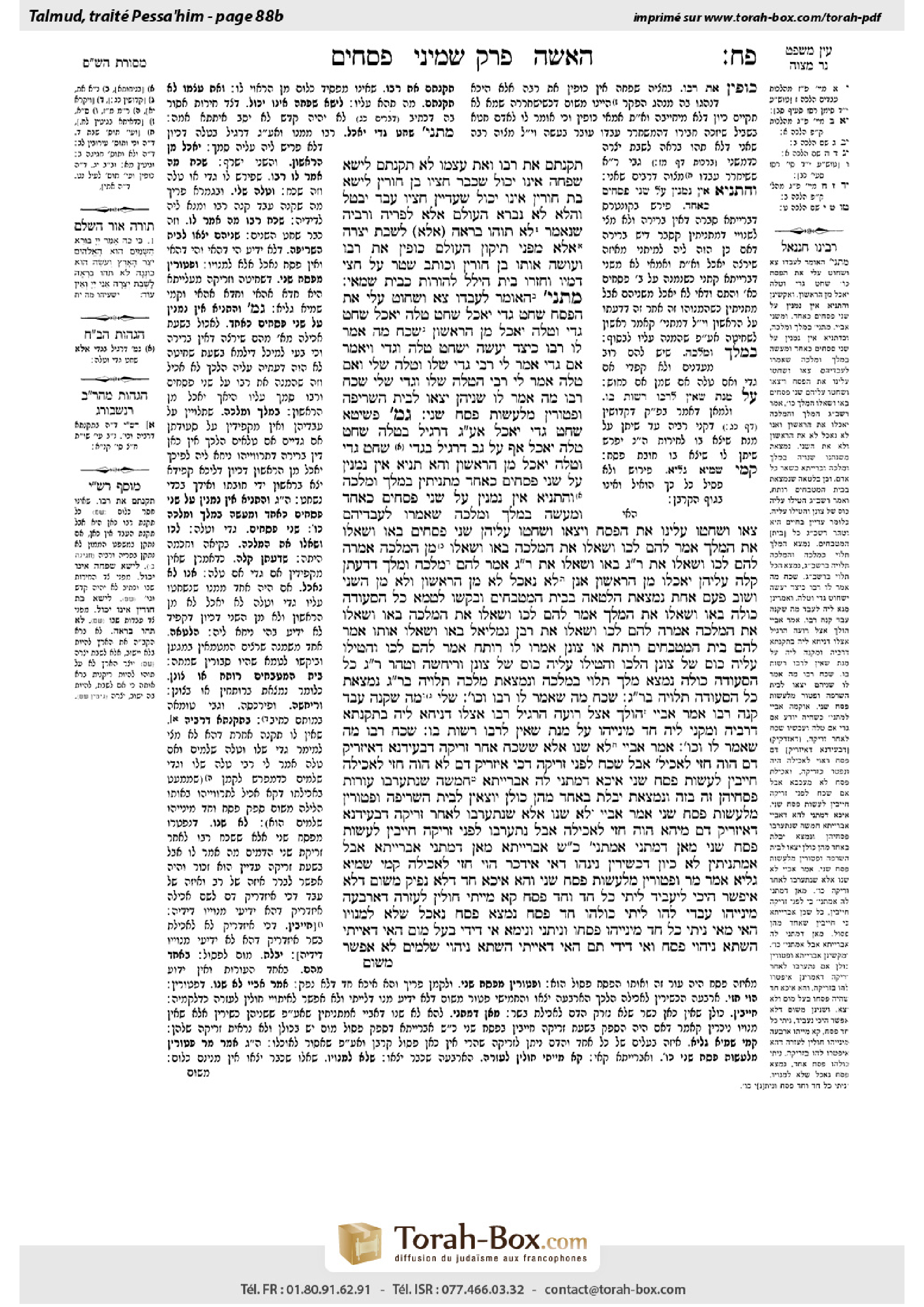
Pesachim 88b: Talmud study for Daf Yomi
Daf Yomi is the daily study of one Talmud folio. Explore 37 tractates with scans, Hebrew text, Sefaria English and AI-generated French translations where annotated.
Passage selection and English or AI-generated French translation are available where the scan has annotations. Daf Study is independent of Torah-Box and Sefaria.
Browse Pesachim · פסחים · All tractatesPesachim 88b text and translations
This page of Pesachim includes the Aramaic text, an English translation and an AI-generated French translation, alongside the scan above.
פסחים פ״ח ב · Aramaic and Hebrew text
תִּקַּנְתֶּם אֶת רַבּוֹ, וְאֶת עַצְמוֹ לֹא תִּקַּנְתֶּם. לִישָּׂא שִׁפְחָה אֵינוֹ יָכוֹל — שֶׁכְּבָר חֶצְיוֹ בֶּן חוֹרִין, לִישָּׂא בַּת חוֹרִין אֵינוֹ יָכוֹל — שֶׁעֲדַיִין חֶצְיוֹ עֶבֶד. יִבְטַל, וַהֲלֹא לֹא נִבְרָא הָעוֹלָם אֶלָּא לִפְרִיָּה וּרְבִיָּה, שֶׁנֶּאֱמַר: ״לֹא תֹהוּ בְרָאָהּ (אֶלָּא) לָשֶׁבֶת יְצָרָהּ״. אֶלָּא, מִפְּנֵי תִּיקּוּן הָעוֹלָם כּוֹפִין אֶת רַבּוֹ וְעוֹשֶׂה אוֹתוֹ בֶּן חוֹרִין, וְכוֹתֵב שְׁטָר עַל חֲצִי דָמָיו.
וְחָזְרוּ בֵּית הִילֵּל לְהוֹרוֹת כְּבֵית שַׁמַּאי.
מַתְנִי׳ הָאוֹמֵר לְעַבְדּוֹ צֵא וּשְׁחוֹט עָלַי אֶת הַפֶּסַח, שָׁחַט גְּדִי — יֹאכַל, שָׁחַט טָלֶה — יֹאכַל, שָׁחַט גְּדִי וְטָלֶה — יֹאכַל מִן הָרִאשׁוֹן.
שָׁכַח מָה אָמַר לוֹ רַבּוֹ, כֵּיצַד יַעֲשֶׂה? יִשְׁחַט טָלֶה וּגְדִי, וְיֹאמַר: אִם גְּדִי אֲמַר לִי רַבִּי — גְּדִי שֶׁלּוֹ וְטָלֶה שֶׁלִּי, וְאִם טָלֶה אֲמַר לִי רַבִּי — הַטָּלֶה שֶׁלּוֹ וּגְדִי שֶׁלִּי.
שָׁכַח רַבּוֹ מָה אָמַר לוֹ, שְׁנֵיהֶן יֵצְאוּ לְבֵית הַשְּׂרֵיפָה, וּפְטוּרִין מִלַּעֲשׂוֹת פֶּסַח שֵׁנִי.
גְּמָ׳ פְּשִׁיטָא! שָׁחַט גְּדִי — יֹאכַל, אַף עַל גַּב דִּרְגִיל בְּטָלֶה. שָׁחַט טָלֶה — יֹאכַל, אַף עַל גַּב דִּרְגִיל בִּגְדִי.
שָׁחַט גְּדִי וְטָלֶה — יֹאכַל מִן הָרִאשׁוֹן. וְהָא תַנְיָא: אֵין נִמְנִין עַל שְׁנֵי פְסָחִים כְּאֶחָד!
מַתְנִיתִין בְּמֶלֶךְ וּמַלְכָּה.
וְהָתַנְיָא: אֵין נִמְנִין עַל שְׁנֵי פְסָחִים כְּאֶחָד, וּמַעֲשֶׂה בְּמֶלֶךְ וּמַלְכָּה שֶׁאָמְרוּ לְעַבְדֵיהֶם: צְאוּ וְשַׁחֲטוּ עָלֵינוּ אֶת הַפֶּסַח, וְיָצְאוּ וְשָׁחֲטוּ עֲלֵיהֶן שְׁנֵי פְסָחִים. בָּאוּ וְשָׁאֲלוּ אֶת הַמֶּלֶךְ, אָמַר לָהֶם: לְכוּ וְשַׁאֲלוּ אֶת הַמַּלְכָּה. בָּאוּ וְשָׁאֲלוּ מִן הַמַּלְכָּה, אָמְרָה לָהֶם: לְכוּ וְשַׁאֲלוּ אֶת רַבָּן גַּמְלִיאֵל.
בָּאוּ וְשָׁאֲלוּ אֶת רַבָּן גַּמְלִיאֵל, אָמַר לָהֶם: מַלְכָּה וּמֶלֶךְ דְּדַעְתָּן קַלָּה עֲלֵיהֶן — יֹאכְלוּ מִן הָרִאשׁוֹן. אֲנַן לֹא נֹאכַל לֹא מִן הָרִאשׁוֹן וְלֹא מִן הַשֵּׁנִי.
וְשׁוּב פַּעַם אַחַת נִמְצֵאת הַלְטָאָה בְּבֵית הַמִּטְבָּחַיִם וּבִקְּשׁוּ לְטַמֵּא כָּל הַסְּעוּדָה כּוּלָּהּ. בָּאוּ וְשָׁאֲלוּ אֶת הַמֶּלֶךְ, אָמַר לָהֶם: לְכוּ וְשַׁאֲלוּ אֶת הַמַּלְכָּה. בָּאוּ וְשָׁאֲלוּ אֶת הַמַּלְכָּה, אָמְרָה לָהֶם: לְכוּ וְשַׁאֲלוּ אֶת רַבָּן גַּמְלִיאֵל.
בָּאוּ וְשָׁאֲלוּ אוֹתוֹ, אָמַר לָהֶם: בֵּית הַמִּטְבָּחַיִם רוֹתֵחַ אוֹ צוֹנֵן? אָמְרוּ לוֹ: רוֹתֵחַ. אָמַר לָהֶם: לְכוּ וְהָטִילוּ עָלֶיהָ כּוֹס שֶׁל צוֹנֵן. הָלְכוּ וְהֵטִילוּ עָלֶיהָ כּוֹס שֶׁל צוֹנֵן וְרִיחֲשָׁה, וְטִהֵר רַבָּן גַּמְלִיאֵל כׇּל הַסְּעוּדָה כּוּלָּהּ.
נִמְצָא מֶלֶךְ תָּלוּי בַּמַּלְכָּה, וְנִמְצֵאתָ מַלְכָּה תְּלוּיָה בְּרַבָּן גַּמְלִיאֵל, נִמְצֵאת כׇּל הַסְּעוּדָה תְּלוּיָה בְּרַבָּן גַּמְלִיאֵל.
שָׁכַח מַה שֶּׁאָמַר לוֹ רַבּוֹ וְכוּ׳. שֶׁלִּי?! מַה שֶּׁקָּנָה עֶבֶד קָנָה רַבּוֹ!
אָמַר אַבָּיֵי: הוֹלֵךְ אֵצֶל רוֹעֶה הָרָגִיל רַבּוֹ אֶצְלוֹ, דְּנִיחָא לֵיהּ בְּתַקַּנְתָּא דְרַבֵּיהּ, וּמַקְנֵי לֵיהּ חַד מִינַּיְיהוּ עַל מְנָת שֶׁאֵין לְרַבּוֹ רְשׁוּת בּוֹ.
שָׁכַח רַבּוֹ מַה שֶּׁאָמַר לוֹ וְכוּ׳. אָמַר אַבָּיֵי: לֹא שָׁנוּ אֶלָּא שֶׁשָּׁכַח אַחַר זְרִיקָה, דִּבְעִידָּנָא דְּאִיזְּרִיק דָּם — הֲוָה חֲזֵי לַאֲכִילָה. אֲבָל שָׁכַח לִפְנֵי זְרִיקָה, דְּכִי אִיזְּרִיק דָּם לָא הֲוָה חֲזֵי לַאֲכִילָה — חַיָּיבִין לַעֲשׂוֹת פֶּסַח שֵׁנִי.
אִיכָּא דְּמַתְנֵי לַהּ אַבָּרַיְיתָא: חֲמִשָּׁה שֶׁנִּתְעָרְבוּ עוֹרוֹת פִּסְחֵיהֶן זֶה בָּזֶה, וְנִמְצֵאת יַבֶּלֶת בְּאֶחָד מֵהֶן — כּוּלָּן יוֹצְאִין לְבֵית הַשְּׂרֵיפָה, וּפְטוּרִין מִלַּעֲשׂוֹת פֶּסַח שֵׁנִי.
אָמַר אַבָּיֵי: לֹא שָׁנוּ אֶלָּא שֶׁנִּתְעָרְבוּ לְאַחַר זְרִיקָה, דִּבְעִידָּנָא דְּאִיזְּרִיק דָּם מִיהָא הֲוָה חֲזֵי לַאֲכִילָה. אֲבָל נִתְעָרְבוּ לִפְנֵי זְרִיקָה — חַיָּיבִין לַעֲשׂוֹת פֶּסַח שֵׁנִי.
מַאן דְּמַתְנֵי אַמַּתְנִיתִין, כׇּל שֶׁכֵּן אַבָּרַיְיתָא. מַאן דְּמַתְנֵי אַבָּרַיְיתָא, אֲבָל אַמַּתְנִיתִין לָא. כֵּיוָן דִּכְשֵׁירִין נִינְהוּ, דְּאִי אִידְּכַר הֲוֵי חֲזֵי לַאֲכִילָה, קַמֵּי שְׁמַיָּא גַּלְיָא.
אָמַר מָר: וּפְטוּרִין מִלַּעֲשׂוֹת פֶּסַח שֵׁנִי. וְהָא אִיכָּא חַד דְּלָא נָפֵיק!
מִשּׁוּם דְּלָא אִיפְשָׁר. הֵיכִי לֶיעְבֵּיד? לַיְתֵי כׇּל חַד וְחַד פֶּסַח — קָא מַיְיתֵי חוּלִּין לָעֲזָרָה, דְּאַרְבְּעָה מִינַּיְיהוּ עָבְדִי לְהוּ.
לַיְתֵי כּוּלְּהוּ חַד פֶּסַח — נִמְצָא פֶּסַח נֶאֱכָל שֶׁלֹּא לִמְנוּיָו.
הַאי מַאי? נַיְתֵי כׇּל חַד מִינַּיְיהוּ פִּסְחוֹ, וְנַיתְנֵי וְנֵימָא: אִי דִּידִי בַּעַל מוּם — הַאי דְּאַיְיתַי הַשְׁתָּא נִיהְוֵי פֶּסַח, וְאִי דִּידִי תָּם — הַאי דְּאַיְיתַי הַשְׁתָּא נִיהְוֵי שְׁלָמִים!
לָא אֶפְשָׁר,
Pesachim 88b · English translation
You have remedied the situation of his master, who benefits fully from all his rights to the slave, but his own situation you have not remedied. How so? He is not able to marry a maidservant, since half of him is already free, and a free Jew may not marry a Canaanite maidservant. He is also not able to marry a free woman, since half of him is still a slave, and a Jewish woman may not marry a Canaanite slave. And if you say he should be idle and not marry, but is it not true that the world was created only for procreation, as it is stated: “He did not create it to be a waste; He formed it to be inhabited” (Isaiah 45:18)? Rather, for the improvement of the world we force his master to make him a free man, and the slave writes a bill accepting his responsibility to pay half his value to his master. This was the original version of the mishna.
The ultimate version of the mishna records the retraction of Beit Hillel: And Beit Hillel retracted its position and ruled like Beit Shammai.
MISHNA: In the case of one who says to his slave: Go and slaughter the Paschal offering on my behalf, but does not specify which type of animal to slaughter, the halakha is as follows: If the slave slaughtered a kid, his master may eat it; if he slaughtered a lamb, his master may eat it. If the slave slaughtered both a kid and a lamb, his master should eat from the first one that was slaughtered; the second is invalid and should be burned.
If the master had stated explicitly which type of animal to slaughter, but the slave forgot what his master said to him, what should he do? He should slaughter both a lamb and a kid and say the following stipulation: If my master said to me that I should slaughter a kid, the kid is for his Paschal offering and the lamb is for mine; and if my master said to me that I should slaughter a lamb, the lamb is for his Paschal offering and the kid is for mine. In this way, once the master ultimately clarifies what he had originally said, both animals may be used accordingly.
If his master also forgot what he said to him, neither animal may be used, since it has not been clarified which of the animals the slave and master are registered for. Therefore, both of them, the lamb and the kid, go out to the place designated for burning, in accordance with the halakha pertaining to offerings that may not be eaten. However, despite this, both the master and slave are exempt from observing the second Pesaḥ if the blood of the animals has already been applied to the altar before the master forgot.
GEMARA: The mishna teaches that if the master did not specify which type of animal he wishes to use, he eats from whichever type the slave slaughters. The Gemara exclaims: It is obvious. Since the master did not specify, he apparently does not have a preference. Therefore, whichever animal is used will be acceptable. The Gemara answers: The mishna’s ruling is necessary in the case where the slave slaughtered a kid. His master may eat it even though the master is accustomed to use a lamb. Even though he is accustomed to do so, it is not presumed that he is particular to use only a lamb, since he did not explicitly say so. Similarly, if the slave slaughtered a lamb, his master may eat it, although he is accustomed to use a kid for his Paschal offering.
We learned in the mishna: If the slave slaughtered a kid and a lamb, his master should eat from the first one the slave slaughtered. To allow for the possibility of eating from whichever one is slaughtered first, the master must have been registered to eat from either animal. The Gemara cites a baraita that appears to contradict this: Wasn’t it taught: One may not be registered for two Paschal offerings at once?
The Gemara answers: The mishna discusses a case of a king and queen and similar cases of those for whom food is supplied by slaves. They are content with whatever food is presented to them, since all their food is of good quality. Such people have the intent to be registered with whichever animal their slaves select to slaughter first, and only with that animal.
And similarly, it was taught in a baraita: One may not register for two Paschal offerings at once. And there was an incident involving a king and queen who said to their slaves: Go and slaughter the Paschal offering on our behalf. And they went out and slaughtered two Paschal offerings on their behalf. They came and asked the king which one he wished to eat. He said to them: Go and ask the queen. They came and asked the queen. She said to them: Go and ask Rabban Gamliel to rule which one should be used.
They came and asked Rabban Gamliel. He said to them: A king and queen, who are easily accepting of whichever foods their slaves choose to present to them, should eat from the first one that was slaughtered, since it is presumed they wished to be registered for any animal the slaves selected. But we, the general populace, who have limited supplies of food and so are particular about what food is served to us, would not eat from the first or from the second, since it is not permitted to be registered for two Paschal lambs at once.
And another time there was a similar incident involving the king, queen, and Rabban Gamliel. It happened that a dead lizard was found in the kitchen of the royal house. Since a lizard is one of the creeping animals whose carcasses impart ritual impurity upon contact, they wanted to pronounce the entire meal ritually impure. They came and asked the king. He said to them: Go and ask the queen. They came and asked the queen. She said to them: Go and ask Rabban Gamliel to rule on the matter.
They came and asked him, and he said to them: Is the kitchen boiling or cold? They said to him: It is boiling. He said to them: Go and pour a cup of cold liquid upon the lizard. They went and poured a cup of cold liquid on it and it quivered, demonstrating that it was still alive. That being the case, Rabban Gamliel pronounced the entire meal to be ritually pure, as a live creeping animal does not impart ritual impurity.
The Gemara comments: It turns out that the king is dependent on the queen, and it turns out that the queen is dependent on Rabban Gamliel. And so it turns out that the entire royal meal is dependent upon Rabban Gamliel.
We learned in the mishna: If the master had explicitly stated which type of animal to slaughter, but the slave forgot what his master said to him, the slave should slaughter both a lamb and a kid and stipulate: If my master said to slaughter a kid, the kid is for his Paschal offering and the lamb is for mine. The Gemara asks: How does it help if the slave stipulates that lamb will be for mine? Whatever a slave acquires, he does not gain ownership of it; rather, his master acquires it in his stead.
Abaye said the slave can retain ownership of the lamb in the following manner: The slave goes to a shepherd that his master regularly patronizes, since it can be assumed such a person is pleased to find a solution for his master. The shepherd grants the slave ownership of one of the animals on condition that his master has no rights to it. With this condition, the slave is able to retain ownership of the animal, thus allowing him to effectively make the stipulation described in the mishna.
We learned in the mishna: If a slave forgot which animal his master had specified and therefore offered a lamb and a kid with a stipulation, and his master also forgot what he said to him, neither animal may be used. Instead, both are burned. However, despite this, both the master and the slave are exempt from observing the second Pesaḥ. Abaye said: They taught that they are exempt from the second Pesaḥ in a case where the master forgot only after the sprinkling of the blood on the altar, for at the time the blood of each animal was sprinkled, it was still fit to be eaten, since the master still knew which animal he desired. Both animals are therefore considered to have been offered properly, and so both master and slave are exempt from the second Pesaḥ. But if the slave had already forgotten which animal he specified before the sprinkling, so that when the blood was sprinkled the offering was not fit to be eaten, the animals are not considered to have been properly offered. Consequently, the master and slave are both obligated to observe the second Pesaḥ.
Some teach this statement of Abaye as referring to the following baraita: Five people had the hides of their Paschal lambs mixed up together, and a wart was found on one of them. Since a wart is one of the blemishes that disqualify an animal from being used as an offering, the Paschal lamb from which the hide came is invalid. Since it is not possible to identify which lamb the hide came from, the meat of all of the lambs must go out to the place designated for burning. Nevertheless, all five people are exempt from observing the second Pesaḥ.
It is with regard to this baraita that Abaye said: They taught that they are all exempt from the second Pesaḥ in a case where the hides were mixed up together only after the sprinkling of the blood on the altar, for at the time the blood of each of the other four animals was sprinkled, each one of the four unblemished lambs was, at any rate, fit to be eaten, and therefore the owners are considered to have fulfilled their obligation to slaughter a fit Paschal lamb. As such, they are exempt from the second Pesaḥ. But if they were mixed up together before the sprinkling, each of the five lambs could possibly be the blemished one. Because of the doubt that exists with regard to all of them, they are all disqualified from being offered. Therefore, none of the five people fulfill their obligation, and they are all obligated to observe the second Pesaḥ.
The Gemara comments: The one who teaches this statement of Abaye as referring to the case in the mishna, where the disqualification is due only to a lack of awareness of which animals are registered for whom, but the animals themselves are inherently valid to be used, he would say that Abaye’s ruling applies all the more so to the baraita, where the disqualification is due to a blemish in the body of the animal itself. However, the one who teaches Abaye’s statement as referring to the case in the baraita would say that with regard to the mishna, no, it does not apply. Since both animals are inherently valid to be used, for if the slave remembers which animal the master requested, each one will be fit to be eaten, the following may be said: It is revealed before God in Heaven which offering belongs to which person; the lack of awareness of this information does not impinge on the offerings’ validity, and therefore both the master and slave are exempt from the second Pesaḥ.
The Gemara returns to discuss the previously mentioned baraita concerning five people who offered Paschal lambs, and it was made clear that one of the lambs was invalid: The Master said: All of them are exempt from observing the second Pesaḥ. The Gemara asks: But there is one, the owner of the lamb with the blemished hide, who did not fulfill his obligation to bring a valid Paschal lamb. How then can all five be exempt?
The Gemara answers: Because it is not possible to do otherwise; for what should he do? Let each one of the five bring a Paschal lamb. This would not be a solution. They would be bringing unconsecrated animals into the Temple courtyard, since four of them, i.e., the owners of the unblemished lambs, have already validly performed the ritual of the Paschal lamb. They are not obligated to bring another Paschal lamb; therefore, they are unable to consecrate another Paschal lamb. If they attempt to do so, the lamb remains unconsecrated and may not be brought into the Temple courtyard.
The Gemara suggests an alternative way for the five to ensure that they have all fulfilled their obligations: Let them all bring one Paschal lamb as a unified group. The Gemara rejects this as well: This would also not be a solution. It would turn out that the Paschal lamb was eaten by those who have not registered for it, since one who has already fulfilled his obligation to bring a Paschal lamb is unable to be registered in a group formed in order to offer another one.
What is this? Surely a solution can be found by using the following stipulation: Let each one bring his Paschal lamb and stipulate and say: If mine was the blemished lamb, this lamb that I am bringing now shall be a Paschal lamb, and if mine was unblemished, this lamb that I am bringing now shall be a peace-offering.
It is not possible to do this,
Pesachim 88b · Traduction française (IA)
Vous avez remédié à la situation de son maître, qui jouit pleinement de tous ses droits sur l’esclave, mais vous n’avez pas remédié à la sienne. Comment cela ? Il ne peut épouser une servante, puisque la moitié de lui-même est déjà libre, et qu’un Juif libre ne peut épouser une servante cananéenne. Il ne peut pas non plus épouser une femme libre, puisque la moitié de lui-même est encore esclave, et qu’une femme juive ne peut épouser un esclave cananéen. Et si vous dites qu’il devrait rester sans se marier, le monde n’a-t-il pas été créé uniquement pour la procréation, comme il est dit : « Il ne l’a pas créée pour être déserte ; Il l’a formée pour être habitée » (Isaïe 45,18) ? Mais, pour le bien du monde, nous contraignons son maître à l’affranchir, et l’esclave rédige un acte par lequel il s’engage à payer à son maître la moitié de sa valeur. Telle était la version initiale de la Michna.
La version définitive de la Michna rapporte que Beit Hillel revint sur sa position et trancha comme Beit Shammaï.
MICHNA : Dans le cas de quelqu’un qui dit à son esclave : « Va égorger l’offrande de Pessa’h pour moi », sans préciser quel type d’animal égorger, la halakha est la suivante : si l’esclave a égorgé un chevreau, son maître peut le manger ; s’il a égorgé un agneau, son maître peut le manger. Si l’esclave a égorgé à la fois un chevreau et un agneau, son maître mangera de celui qui a été égorgé en premier ; le second est invalide et doit être brûlé.
Si le maître avait précisé quel type d’animal égorger, mais que l’esclave a oublié ce que son maître lui avait dit, que doit-il faire ? Il égorgera à la fois un agneau et un chevreau, et formulera la condition suivante : « Si mon maître m’a dit d’égorger un chevreau, le chevreau est pour son offrande de Pessa’h et l’agneau est pour la mienne ; et si mon maître m’a dit d’égorger un agneau, l’agneau est pour son offrande de Pessa’h et le chevreau est pour la mienne. » Ainsi, une fois que le maître aura finalement précisé ce qu’il avait dit au départ, les deux animaux pourront être utilisés en conséquence.
Si son maître aussi a oublié ce qu’il lui avait dit, aucun des deux animaux ne peut être utilisé, puisqu’on ne sait pas pour quel animal le maître et l’esclave sont inscrits. Par conséquent, les deux animaux, l’agneau et le chevreau, sont conduits au lieu désigné pour être brûlés, conformément à la halakha concernant les offrandes qui ne peuvent pas être consommées. Toutefois, malgré cela, le maître et l’esclave sont tous deux dispensés d’accomplir le second Pessa’h si le sang des animaux a déjà été appliqué sur l’autel avant que le maître n’ait oublié.
GUEMARA : La Michna enseigne que si le maître n’a pas précisé quel type d’animal il souhaitait utiliser, il mange de celui que l’esclave a égorgé. La Guemara s’exclame : Cela va de soi. Puisque le maître n’a rien précisé, il semble ne pas avoir de préférence. Par conséquent, l’un ou l’autre animal conviendra. La Guemara répond : La décision de la Michna est nécessaire dans le cas où l’esclave a égorgé un chevreau. Son maître peut le manger, même s’il a l’habitude d’utiliser un agneau. Bien qu’il en ait l’habitude, on ne présume pas qu’il tient à n’utiliser qu’un agneau, puisqu’il ne l’a pas dit explicitement. De même, si l’esclave a égorgé un agneau, son maître peut le manger, bien qu’il ait l’habitude d’utiliser un chevreau pour son offrande de Pessa’h.
Nous avons appris dans la Michna : Si l’esclave a égorgé un chevreau et un agneau, son maître mangera de celui que l’esclave a égorgé en premier. Pour que le maître puisse manger celui des deux qui a été égorgé en premier, il faut qu’il ait été inscrit pour l’un ou l’autre animal. La Guemara cite une baraïta qui semble contredire cela : N’a-t-on pas enseigné qu’on ne peut pas être inscrit simultanément pour deux offrandes de Pessa’h ?
La Guemara répond : La Michna parle du cas d’un roi et d’une reine, et de cas semblables où des esclaves leur fournissent la nourriture. Ces personnes se satisfont de ce qu’on leur présente, car toute leur nourriture est de bonne qualité. Elles ont l’intention d’être inscrites pour l’animal que leurs esclaves choisiront d’égorger en premier, et pour celui-là seulement.
De même, il a été enseigné dans une baraïta : On ne peut pas être inscrit simultanément pour deux offrandes de Pessa’h. Or, un jour, un roi et une reine dirent à leurs esclaves : « Allez égorger l’offrande de Pessa’h pour nous. » Ils sortirent et égorgèrent deux offrandes de Pessa’h pour eux. Ils vinrent demander au roi laquelle il souhaitait manger. Il leur dit : « Allez demander à la reine. » Ils allèrent interroger la reine. Elle leur dit : « Allez demander à Rabban Gamliel de trancher laquelle doit être utilisée. »
Ils vinrent interroger Rabban Gamliel. Il leur dit : « Un roi et une reine, qui acceptent volontiers les aliments que leurs esclaves choisissent de leur présenter, doivent manger de celui qui a été égorgé en premier, car on présume qu’ils souhaitaient être inscrits pour l’animal choisi par les esclaves. Mais nous, le peuple en général, dont les provisions alimentaires sont limitées et qui sommes donc exigeants quant à la nourriture qui nous est servie, nous ne mangerions ni du premier ni du second, car il est interdit d’être inscrit simultanément pour deux agneaux de Pessa’h. »
Une autre fois, un incident semblable impliquant le roi, la reine et Rabban Gamliel se produisit. On découvrit un lézard mort dans la cuisine du palais royal. Comme le lézard fait partie des animaux rampants dont les cadavres transmettent l’impureté rituelle par contact, on voulut déclarer tout le repas rituellement impur. Ils vinrent interroger le roi. Il leur dit : « Allez demander à la reine. » Ils allèrent interroger la reine. Elle leur dit : « Allez demander à Rabban Gamliel de trancher la question. »
Ils vinrent l’interroger, et il leur demanda : « La cuisine est-elle chaude ou froide ? » Ils lui répondirent : « Elle est chaude. » Il leur dit : « Allez verser une coupe de liquide froid sur le lézard. » Ils allèrent en verser une coupe dessus, et le lézard tressaillit, ce qui montra qu’il était encore vivant. Dans ces conditions, Rabban Gamliel déclara tout le repas rituellement pur, car un animal rampant vivant ne transmet pas l’impureté rituelle.
La Guemara fait remarquer : Il s’avère que le roi dépend de la reine, et que la reine dépend de Rabban Gamliel. Ainsi, tout le repas royal dépend de Rabban Gamliel.
Nous avons appris dans la Michna : Si le maître avait explicitement précisé quel type d’animal égorger, mais que l’esclave a oublié ce que son maître lui avait dit, l’esclave doit égorger à la fois un agneau et un chevreau, et poser la condition suivante : « Si mon maître m’a dit d’égorger un chevreau, le chevreau est pour son offrande de Pessa’h et l’agneau est pour la mienne. » La Guemara demande : À quoi sert-il que l’esclave stipule que l’agneau sera pour lui ? Tout ce qu’un esclave acquiert ne devient pas sa propriété ; c’est son maître qui l’acquiert à sa place.
Abayé dit que l’esclave peut conserver la propriété de l’agneau de la manière suivante : il va trouver un berger auprès duquel son maître a l’habitude de se fournir, car on peut supposer que cette personne sera heureuse de trouver une solution pour son maître. Le berger cède à l’esclave la propriété de l’un des animaux, à condition que son maître n’ait aucun droit sur celui-ci. Grâce à cette condition, l’esclave peut conserver la propriété de l’animal, ce qui lui permet de poser effectivement la condition décrite dans la Michna.
Nous avons appris dans la Michna : Si l’esclave a oublié quel animal son maître avait désigné et a donc offert un agneau et un chevreau en posant une condition, et que son maître a lui aussi oublié ce qu’il lui avait dit, aucun des deux animaux ne peut être utilisé. Ils sont plutôt tous deux brûlés. Toutefois, malgré cela, le maître et l’esclave sont tous deux dispensés d’accomplir le second Pessa’h. Abayé dit : Ils ont enseigné qu’ils sont dispensés du second Pessa’h dans le cas où le maître n’a oublié qu’après l’aspersion du sang sur l’autel, car, au moment où le sang de chaque animal a été aspergé, celui-ci était encore propre à être consommé, puisque le maître savait encore quel animal il souhaitait. Les deux animaux sont donc considérés comme ayant été offerts correctement, et le maître comme l’esclave sont dispensés du second Pessa’h. Mais si l’esclave avait déjà oublié quel animal il avait désigné avant l’aspersion, de sorte qu’au moment où le sang a été aspergé l’offrande n’était pas propre à être consommée, les animaux ne sont pas considérés comme ayant été offerts correctement. Par conséquent, le maître et l’esclave sont tous deux tenus d’accomplir le second Pessa’h.
Certains rapportent cette déclaration d’Abayé à propos de la baraïta suivante : Les peaux des agneaux de Pessa’h de cinq personnes s’étaient mélangées, et l’on trouva une verrue sur l’une d’elles. Comme une verrue fait partie des défauts qui rendent un animal impropre à être offert, l’agneau dont provenait la peau est invalide. Puisqu’il est impossible de déterminer de quel agneau provenait cette peau, la viande de tous les agneaux doit être conduite au lieu désigné pour être brûlée. Néanmoins, les cinq personnes sont toutes dispensées d’accomplir le second Pessa’h.
C’est à propos de cette baraïta qu’Abayé a dit : Ils ont enseigné qu’ils sont tous dispensés du second Pessa’h dans le cas où les peaux ne se sont mélangées qu’après l’aspersion du sang sur l’autel, car, au moment où le sang de chacun des quatre autres animaux a été aspergé, chacun de ces quatre agneaux sans défaut était, en tout état de cause, propre à être consommé. Leurs propriétaires sont donc considérés comme ayant accompli leur obligation en égorgeant un agneau de Pessa’h valide. Ils sont par conséquent dispensés du second Pessa’h. Mais si les peaux se sont mélangées avant l’aspersion, chacun des cinq agneaux pouvait être celui qui avait un défaut. En raison du doute qui concerne tous les agneaux, ils sont tous impropres à être offerts. Par conséquent, aucun des cinq hommes n’accomplit son obligation, et tous sont tenus d’accomplir le second Pessa’h.
La Guemara fait remarquer : Celui qui rapporte cette déclaration d’Abayé à propos du cas de la Michna, où l’invalidité tient uniquement à l’ignorance de la répartition des animaux entre les personnes inscrites, alors que les animaux eux-mêmes sont aptes à être offerts, dira que la décision d’Abayé s’applique à plus forte raison à la baraïta, où l’invalidité tient à un défaut dans le corps même de l’animal. En revanche, celui qui rapporte la déclaration d’Abayé à propos du cas de la baraïta dira qu’elle ne s’applique pas à la Michna. Puisque les deux animaux sont aptes à être offerts — car si l’esclave se souvient de l’animal demandé par le maître, chacun des deux pourra être consommé —, on peut dire ce qui suit : il est révélé devant Dieu, dans les Cieux, quelle offrande appartient à quelle personne. Le fait que cette information soit ignorée ne porte pas atteinte à la validité des offrandes ; le maître et l’esclave sont donc tous deux dispensés du second Pessa’h.
La Guemara revient sur la baraïta précédemment mentionnée, au sujet de cinq personnes qui avaient offert des agneaux de Pessa’h, et où il a été établi que l’un des agneaux était invalide. Le Maître a dit qu’ils sont tous dispensés d’accomplir le second Pessa’h. La Guemara demande : Mais il y en a un — le propriétaire de l’agneau dont la peau portait un défaut — qui n’a pas accompli son obligation d’apporter un agneau de Pessa’h valide. Comment donc les cinq peuvent-ils tous être dispensés ?
La Guemara répond : Il est impossible de faire autrement. Que devrait-il faire ? Que chacun des cinq apporte un agneau de Pessa’h ? Ce ne serait pas une solution. Ils feraient entrer dans la cour du Temple des animaux non consacrés, car quatre d’entre eux, c’est-à-dire les propriétaires des agneaux sans défaut, ont déjà valablement accompli le rite de l’offrande de Pessa’h. Ils ne sont pas tenus d’apporter un autre agneau de Pessa’h ; ils ne peuvent donc pas en consacrer un autre. S’ils tentent de le faire, l’agneau reste non consacré et ne peut pas être introduit dans la cour du Temple.
La Guemara propose une autre manière pour que les cinq s’assurent d’avoir tous accompli leur obligation : qu’ils apportent tous ensemble un seul agneau de Pessa’h. La Guemara rejette également cette proposition : ce ne serait pas non plus une solution. Il s’ensuivrait que l’agneau de Pessa’h serait mangé par des personnes qui ne s’y sont pas inscrites, car celui qui a déjà accompli son obligation d’apporter un agneau de Pessa’h ne peut pas être inscrit dans un groupe constitué pour en offrir un autre.
Qu’est-ce que cela signifie ? On peut assurément trouver une solution en formulant la condition suivante : que chacun apporte son agneau de Pessa’h et stipule : « Si c’est le mien qui était l’agneau atteint d’un défaut, cet agneau que j’apporte maintenant sera une offrande de Pessa’h ; et si le mien était sans défaut, cet agneau que j’apporte maintenant sera un sacrifice de paix. »
Il n’est pas possible de procéder ainsi,
Traduction française générée par IA à partir de l’édition anglaise de Sefaria. Vérifie toujours un passage avec le texte source.
Text from Sefaria: William Davidson Edition - Vocalized Aramaic (CC BY NC); William Davidson Edition - English (CC BY NC).