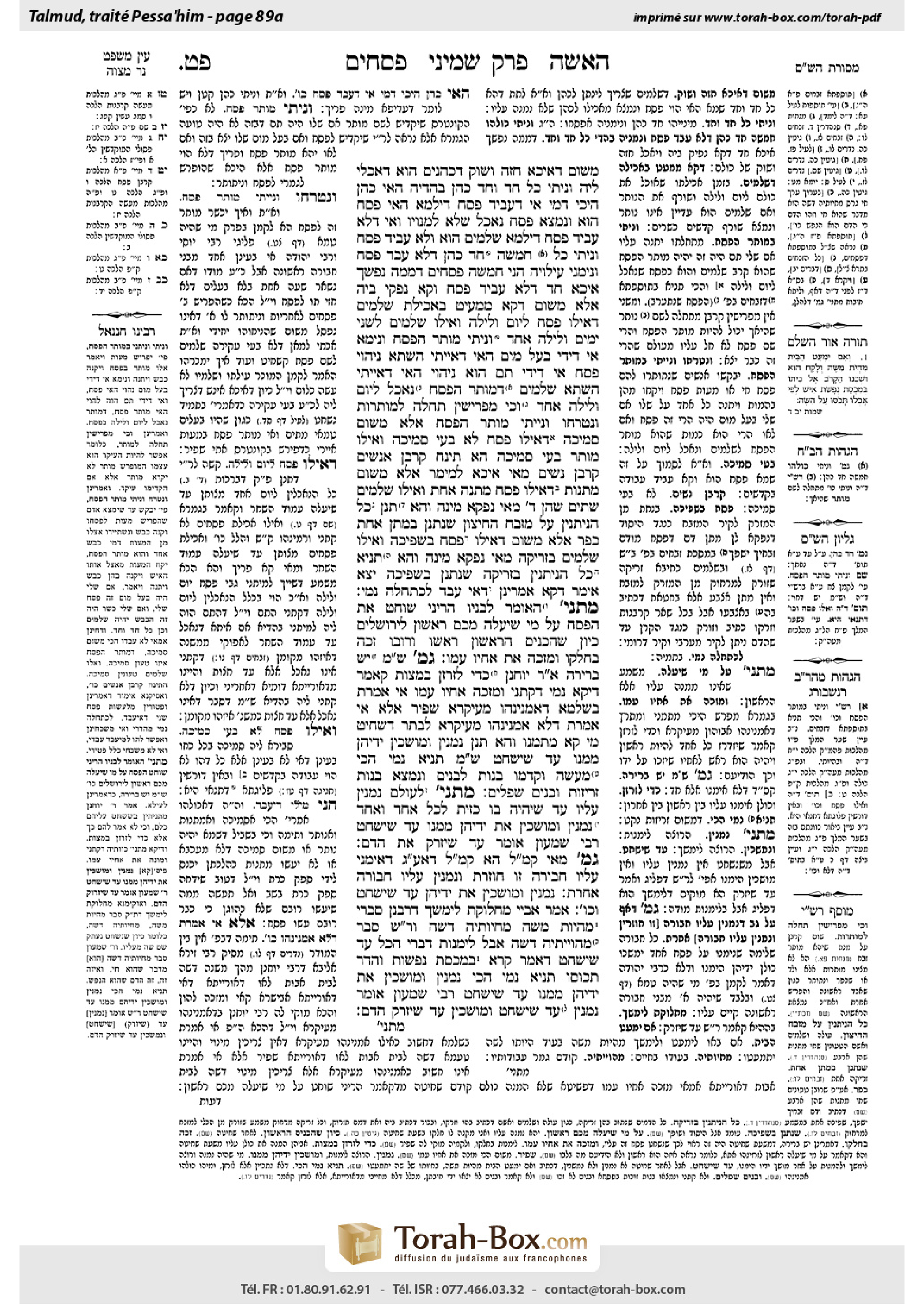
Pesachim 89a: Talmud study for Daf Yomi
Daf Yomi is the daily study of one Talmud folio. Explore 37 tractates with scans, Hebrew text, Sefaria English and AI-generated French translations where annotated.
Passage selection and English or AI-generated French translation are available where the scan has annotations. Daf Study is independent of Torah-Box and Sefaria.
Browse Pesachim · פסחים · All tractatesPesachim 89a text and translations
This page of Pesachim includes the Aramaic text, an English translation and an AI-generated French translation, alongside the scan above.
פסחים פ״ט א · Aramaic and Hebrew text
מִשּׁוּם דְּאִיכָּא חָזֶה וָשׁוֹק, דְּכֹהֲנִים הוּא דְּאָכְלִי לֵיהּ.
וְנַיְתֵי כׇּל חַד וְחַד כֹּהֵן בַּהֲדֵיהּ.
הַאי כֹּהֵן הֵיכִי דָּמֵי? אִי דְּעָבֵיד פֶּסַח — דִּילְמָא הַאי פֶּסַח הוּא, וְנִמְצָא פֶּסַח נֶאֱכָל שֶׁלֹּא לִמְנוּיָו. וְאִי דְּלָא עָבֵיד פֶּסַח — דִּילְמָא שְׁלָמִים הוּא, וְלָא עָבֵיד פֶּסַח!
וְנַיְתֵי כֹּל חַמְשָׁה חַד כֹּהֵן דְּלָא עֲבַד פֶּסַח, וְנִימְּנֵי עִילָּוֵיהּ הָנֵי חֲמִשָּׁה פְּסָחִים, דְּמִמָּה נַפְשָׁךְ אִיכָּא חַד דְּלָא עָבֵיד פֶּסַח, וְקָא נָפְקִי בֵּיהּ.
אֶלָּא מִשּׁוּם דְּקָא מְמַעֵיט בַּאֲכִילַת שְׁלָמִים, דְּאִילּוּ פֶּסַח לְיוֹם וְלַיְלָה, וְאִילּוּ שְׁלָמִים לִשְׁנֵי יָמִים וְלַיְלָה אֶחָד.
וְנַיְתֵי מוֹתַר הַפֶּסַח.
וְנֵימָא: אִי דִּידִי בַּעַל מוּם — הַאי דְּאַיְיתַי הַשְׁתָּא נִיהְוֵי פֶּסַח, אִי דִּידִי תָּם הוּא — נִיהְוֵי הַאי דְּאַיְיתַי הַשְׁתָּא שְׁלָמִים, דְּמוֹתַר הַפֶּסַח נֶאֱכָל לְיוֹם וְלַיְלָה אֶחָד.
וְכִי מַפְרִישִׁין תְּחִלָּה לַמּוֹתָרוֹת?! וְנִטְרְחוּ וְנַיְיתֵי מוֹתַר הַפֶּסַח!
אֶלָּא מִשּׁוּם סְמִיכָה. דְּאִילּוּ פֶּסַח לָא בָּעֵי סְמִיכָה, וְאִילּוּ מוֹתָר בָּעֵי סְמִיכָה.
הָא תִּינַח קׇרְבַּן אֲנָשִׁים. קׇרְבַּן נָשִׁים, מַאי אִיכָּא לְמֵימַר?
אֶלָּא מִשּׁוּם מַתָּנוֹת. דְּאִילּוּ פֶּסַח — מַתָּנָה אַחַת, וְאִילּוּ שְׁלָמִים — שְׁתַּיִם שֶׁהֵן אַרְבַּע.
מַאי נָפְקָא מִינַּהּ? וְהָא תְּנַן: כׇּל הַנִּיתָּנִין עַל מִזְבֵּחַ הַחִיצוֹן שֶׁנְּתָנָן בְּמַתַּן אַחַת — כִּפֵּר,
אֶלָּא מִשּׁוּם דְּאִילּוּ פֶּסַח בִּשְׁפִיכָה, וְאִילּוּ שְׁלָמִים בִּזְרִיקָה.
מַאי נָפְקָא מִינַּהּ? וְהָא תַּנְיָא: כׇּל הַנִּיתָּנִין בִּזְרִיקָה שֶׁנְּתָנָן בִּשְׁפִיכָה יָצָא. אֵימַר דְּקָא אָמְרִינַן דְּאִי עֲבַד, לְכַתְּחִלָּה נָמֵי?!
מַתְנִי׳ הָאוֹמֵר לְבָנָיו: הֲרֵינִי שׁוֹחֵט אֶת הַפֶּסַח עַל מִי שֶׁיַּעֲלֶה מִכֶּם רִאשׁוֹן לִירוּשָׁלַיִם, כֵּיוָן שֶׁהִכְנִיס הָרִאשׁוֹן רֹאשׁוֹ וְרוּבּוֹ — זָכָה בְּחֶלְקוֹ וּמְזַכֶּה אֶת אֶחָיו עִמּוֹ.
גְּמָ׳ שְׁמַע מִינַּהּ יֵשׁ בְּרֵירָה!
אָמַר רַבִּי יוֹחָנָן, כְּדֵי לְזָרְזָן בְּמִצְוֹת קָאָמַר.
דַּיְקָא נָמֵי דְּקָתָנֵי: וּמְזַכֶּה אֶחָיו עִמּוֹ, אִי אָמְרַתְּ בִּשְׁלָמָא דְּאַמְנִינְהוּ מֵעִיקָּרָא — שַׁפִּיר, אֶלָּא אִי אָמְרַתְּ דְּלָא אַמְנִינְהוּ מֵעִיקָּרָא, לְבָתַר דְּשָׁחֵיט מִי קָא מִתְמַנּוּ? וְהָא תְּנַן: נִמְנִין וּמוֹשְׁכִין יְדֵיהֶן מִמֶּנּוּ עַד שֶׁיִּשָּׁחֵט. שְׁמַע מִינַּהּ.
תַּנְיָא נָמֵי הָכִי: מַעֲשֶׂה וְקָדְמוּ בָּנוֹת לְבָנִים, וְנִמְצָא בָּנוֹת זְרִיזוֹת וּבָנִים שְׁפָלִים.
מַתְנִי׳ לְעוֹלָם נִמְנִין עָלָיו עַד שֶׁיִּהְיֶה בּוֹ כְּזַיִת לְכׇל אֶחָד וְאֶחָד. נִמְנִין וּמוֹשְׁכִין אֶת יְדֵיהֶן מִמֶּנּוּ עַד שֶׁיִּשָּׁחֵט. רַבִּי שִׁמְעוֹן אוֹמֵר: עַד שֶׁיִּזָּרֵק אֶת הַדָּם.
גְּמָ׳ מַאי קָא מַשְׁמַע לַן? הָא קָא מַשְׁמַע לַן דְּאַף עַל גַּב דְּאִימְּנִי עָלָיו חֲבוּרָה זוֹ, חוֹזֶרֶת וְנִמְנִין עָלָיו חֲבוּרָה אַחֶרֶת.
נִמְנִין וּמוֹשְׁכִין אֶת יְדֵיהֶן עַד שֶׁיִּשָּׁחֵט וְכוּ׳. אָמַר אַבָּיֵי: מַחֲלוֹקֶת לִימָּשֵׁךְ,
דְּרַבָּנַן סָבְרִי: ״מִהְיוֹת מִשֶּׂה״ — מֵחַיּוּתֵיהּ דְּשֶׂה. וְרַבִּי שִׁמְעוֹן סָבַר: מֵהֲוָיָיתֵיהּ דְּשֶׂה. אֲבָל לִימָּנוֹת — דִּבְרֵי הַכֹּל עַד שֶׁיִּשָּׁחֵט, דְּאָמַר קְרָא: ״בְּמִכְסַת נְפָשֹׁת״, וַהֲדַר: ״תָּכֹסּוּ״.
תַּנְיָא נָמֵי הָכִי: נִמְנִין וּמוֹשְׁכִין אֶת יְדֵיהֶן מִמֶּנּוּ עַד שֶׁיִּשָּׁחֵט, רַבִּי שִׁמְעוֹן אוֹמֵר: נִמְנִין עַד שֶׁיִּשָּׁחֵט, וּמוֹשְׁכִין עַד שֶׁיִּזָּרֵק הַדָּם.
Pesachim 89a · English translation
because there are the breast and the hind leg, which the priests eat only if the offering is a peace-offering, but not if it is a Paschal lamb. Due to the distinction between the two types of offerings, the proposed stipulation does not provide a solution. It would remain unclear who should eat these portions of the offering.
The Gemara suggests that it may still be possible to find a way to use the stipulation: Let each one of these five people bringing a new Paschal lamb bring a priest to be registered with him for their Paschal lamb. Then the priest will eat the breasts and hind legs. Since the priest eats these portions of the offering in any event, there is no longer any practical distinction between the two types of offerings. The stipulation should therefore provide a solution.
The Gemara rejects this suggestion: What are the circumstances of this priest? If he had already performed the ritual of the Paschal lamb during the first Pesaḥ, then, as the Gemara explained previously, he is unable to be registered to partake of a new Paschal lamb. If so, there is concern that perhaps this offering is a Paschal lamb and not a peace-offering, and it will turn out that a Paschal lamb is eaten by those who did not register for it. And if, on the other hand, the priest had not performed the ritual of the Paschal lamb on the first Pesaḥ, there is concern that perhaps this offering is a peace-offering, and it would turn out that this priest did not perform the ritual of the Paschal lamb at all.
The Gemara modifies its suggestion: Let all five together bring one priest, who has not yet performed the ritual of the Paschal lamb. And let the priest register for all these five Paschal lambs. This should provide a solution. Whichever way you look at it, there is one person who has not yet performed the ritual of the Paschal lamb, and the priest will now fulfill his obligation together with him. If the priest then eats the breasts and hind legs of all the offerings, the stipulation should provide a viable solution.
The Gemara identifies a further distinction between a peace-offering and the Paschal lamb that precludes the use of the stipulation: Rather, the reason it is not possible to use the stipulation is because it would reduce the amount of time available for eating the peace-offering, for a Paschal lamb may be eaten only for a day and a night, whereas a peace-offering may be eaten for two days and one night. Were the stipulation to be made, all the offerings would have an uncertain status of either being a peace-offering or a Paschal lamb. They would therefore all be treated with the strictures of a Paschal lamb, and any meat remaining on the morning after the first night would have to be burnt. However, in the event that the offering was actually a peace-offering, this would be premature, since it may still be eaten for another day.
The Gemara modifies the proposed stipulation: Instead of making a stipulation between a Paschal lamb and a regular peace-offering, let each one of them specify that if they have already fulfilled their obligations to bring a Paschal lamb, their intention is to consecrate and bring the current offering as a surplus Paschal lamb. The status of a surplus Paschal lamb is usually achieved when an animal is originally consecrated as a Paschal lamb but for some reason is not offered. Such an animal is offered as a type of peace-offering.
The Gemara assumes here that it is also possible to consecrate an animal directly with this status, and therefore the following stipulation could be used. And when bringing their lambs they should each say: If mine was the blemished lamb, this lamb that I am bringing now shall be a Paschal lamb; and if mine was unblemished, this lamb that I am bringing now shall be a surplus Paschal lamb, which is a type of peace-offering and may therefore be offered even if one has already fulfilled his obligation to bring a Paschal lamb. Although a surplus Paschal lamb has the sanctity of a peace-offering, it may be eaten for only one day and one night, similar to a Paschal lamb. Since there is no distinction between the time allotted to eat the two types of offerings, this stipulation should provide a solution.
The Gemara challenges this suggestion: But can we designate animals initially as surplus Paschal lambs? This cannot be done; the sanctity of a surplus Paschal lamb is achieved only with an animal that was initially designated for a Paschal lamb but remained unused. If so, how is the suggested stipulation tenable? The Gemara explains: Let them trouble themselves to find and bring an unused leftover animal already invested with the sanctity of a surplus Paschal lamb, and let them make the suggested stipulation upon it. In this way, the stipulation should work and provide a solution.
The Gemara identifies a distinction that exists even between a Paschal lamb and a surplus Paschal lamb that precludes the use of even this suggested stipulation. Rather, it is not possible to use the stipulation because of the requirement to perform the act of placing one’s hands on the head of the offering, for a Paschal lamb does not need the act of placing one’s hands, whereas a surplus Paschal lamb, since it is a type of peace-offering, does need the act of placing one’s hands. Due to this distinction, the proposed stipulation cannot provide a solution. It would remain unclear whether the offering requires one to perform the act of placing one’s hands on its head, an act that one is prohibited to do on an offering that does not require it.
This distinction works out well to explain why the stipulation can’t be used for an offering of men, since a man’s offering requires the act of placing one’s hands. However, if the case involved an offering of women, for which there is no such requirement, what is there to say? In such a case, there is no distinction between a Paschal lamb and a surplus Paschal lamb, and therefore the stipulation should provide a solution.
The Gemara identifies a further distinction between a Paschal lamb and a surplus Paschal lamb that precludes the use of the stipulation: Rather, it is not possible to use the stipulation because of the requirement to apply presentations of sacrificial blood upon the altar. For whereas the blood of a Paschal lamb is applied to the altar in one presentation, the blood of a peace-offering is applied to the altar with two that constitute four, i.e., the blood is applied on two opposite corners so that it runs down all four sides of the altar.
What difference does the distinction in the number of presentations make? Didn’t we learn in a mishna: With regard to all offerings whose blood must be presented upon the outer altar, once the blood has been presented with one presentation, the offering has atoned, even if more presentations are ideally required? If so, it should be possible to use the stipulation and then make a single presentation of blood upon the altar, which would be valid for whichever type of offering it turned out to be.
The Gemara identifies a further distinction: Rather, the proposal is not possible because of the following: Whereas the blood of the Paschal lamb must be applied to the altar by pouring it on the base of the altar, the blood of a peace-offering is applied by sprinkling it upon the altar.
What difference does the manner of applying the blood make? Wasn’t it taught in a baraita: In the case of all offerings whose blood must be applied to the altar by sprinkling, if one applied their blood by pouring, one has nonetheless fulfilled one’s obligation? If so, it should be possible to use the stipulation and then pour the blood upon the base of the altar. This pouring would be valid, whichever type of offering it turned out to be. The Gemara answers: Say in response that we say that one fulfilled his obligation only if he already did it this way; but would he be allowed to do so ab initio as well? Certainly not. Since the offering cannot be offered in a manner that is permissible ab initio, the distinction in the manner of applying the blood will preclude the use of the stipulation.
MISHNA: In the case of one who says to his children: I am slaughtering the Paschal lamb on behalf of whomever of you goes up first to Jerusalem, as soon as the first of the children has entered his head and the majority of his body into Jerusalem, he has acquired his portion and acquires on behalf of his brothers their portions together with him.
GEMARA: The Gemara suggests: You can learn from the case in the mishna that there is retroactive clarification. Although when the father slaughters the Paschal lamb it cannot be known which child will ultimately enter Jerusalem first, once one of the children does enter, the children are considered to have been registered for the father’s Paschal lamb from the outset. This is problematic, as no halakhic conclusion has been reached in the matter of retroactive clarification.
Rabbi Yoḥanan said: The mishna is not based on retroactive clarification. Rather, the father included all his children in his Paschal lamb from the outset. He created this competition only in order to enthuse them, so that they would be expeditious in their fulfillment of mitzvot; but in fact his statement had no halakhic implications.
According to the explanation of Rabbi Yoḥanan, the language of the mishna is also precise, as it teaches: And he acquires on behalf of his brothers their portions together with him. Granted, if you say that the father registered them from the beginning, before slaughtering the Paschal lamb, the case is well understood. But if you say that he did not register them from the beginning, but only after he slaughtered the Paschal lamb, can they then be registered? Didn’t we learn in a mishna: People can be registered and withdraw themselves from being registered for a Paschal lamb until it is slaughtered, but not after? Clearly, then, the children must have already been registered from the outset, and we may learn from this precise reading of the mishna that Rabbi Yoḥanan’s explanation is correct.
That the competition was meant only to enthuse his children to be expeditious in their fulfillment of mitzvot was also implied by that which was taught in the conclusion of a baraita that also records this competition: There was an incident such as this, and the daughters preceded the sons. And it turned out that the daughters demonstrated that they were enthusiastic, whereas the sons demonstrated that they were lazy.
MISHNA: Additional people can always be registered for a Paschal lamb, as long as there will be at least an olive-bulk of the lamb’s meat for each and every person registered. People can be registered and withdraw themselves from being registered for a Paschal lamb until it is slaughtered. Rabbi Shimon says: Even until the priest sprinkles the blood.
GEMARA: What is the first clause of the mishna teaching us? It is obvious that additional people can be registered. This comes to teach us that although this group was registered for it, the entire group can withdraw and a different group can register for it, despite the fact that no one from the original group remains.
We learned in the mishna: People can be registered and withdraw themselves from being registered for a Paschal lamb until it is slaughtered. Rabbi Shimon says: Even until the priest sprinkles the blood. The Gemara discusses the scope of the dispute between the first tanna and Rabbi Shimon: Abaye said: The dispute is only with regard to when one is able to withdraw from being registered. Both sides derive their opinions from the following verse: “And if the household be too little for a lamb [miheyot miseh], then shall he and his neighbor next to his house take one according to the number of the souls; according to every man’s eating you shall make your count for the lamb” (Exodus 12:4). The phrase miheyot miseh literally means: From being from a lamb. It is exegetically interpreted to refer to withdrawing from being registered for a lamb.
The Rabbis hold that “from being [miheyot] from a lamb” indicates that one can withdraw only during the life [meiḥayutei] of the lamb, i.e., while the lamb is still alive. And Rabbi Shimon holds that the phrase indicates that one can withdraw during the happenings [meihavayatei] of the lamb, i.e., as long as the sacrificial service is still being performed, which culminates with the application of the blood upon the altar. But with regard to being registered for the Paschal lamb, all agree that one can be registered for a lamb only until it is slaughtered, as the previously cited verse concerning registration states, in its conclusion: “According to the number [bemikhsat] of the people,” and then “you shall make your count [takhosu].” The word takhosu is taken to mean: You shall slaughter, in accordance with its meaning in Aramaic. The order of the verse therefore indicates that people can be registered only prior to the animal’s slaughter.
That was also taught in a baraita: People can be registered and withdraw themselves from being registered for a Paschal lamb until it is slaughtered. Rabbi Shimon says: They can be registered until it is slaughtered and withdraw themselves from being registered until the priest sprinkles the blood.
Pesachim 89a · Traduction française (IA)
car il y a la poitrine et la cuisse, que les prêtres ne mangent que si l’offrande est un sacrifice de paix, mais pas s’il s’agit d’un agneau pascal. En raison de la distinction entre ces deux types d’offrandes, la condition proposée ne résout pas le problème. On ne saurait toujours pas qui doit manger ces parts de l’offrande.
La Guemara suggère qu’il serait peut-être tout de même possible de trouver un moyen d’appliquer la condition : que chacun de ces cinq hommes qui apportent un nouvel agneau pascal fasse venir un prêtre, qui sera inscrit avec lui pour son agneau pascal. Le prêtre mangera alors les poitrines et les cuisses. Puisque le prêtre mange ces parts de l’offrande dans tous les cas, il n’y a plus de différence pratique entre les deux types d’offrandes. La condition devrait donc résoudre le problème.
La Guemara rejette cette suggestion : dans quelles circonstances se trouve ce prêtre ? S’il a déjà accompli le rituel de l’agneau pascal lors du premier Pessa’h, alors, comme la Guemara l’a expliqué précédemment, il ne peut pas être inscrit pour prendre part à un nouvel agneau pascal. On craint alors que cette offrande soit un agneau pascal et non un sacrifice de paix, et qu’il se révèle qu’un agneau pascal est mangé par des personnes qui ne s’y sont pas inscrites. Si, en revanche, le prêtre n’a pas accompli le rituel de l’agneau pascal lors du premier Pessa’h, on craint que cette offrande soit un sacrifice de paix, et qu’il se révèle que ce prêtre n’a pas du tout accompli le rituel de l’agneau pascal.
La Guemara modifie sa suggestion : que les cinq hommes amènent ensemble un seul prêtre, qui n’a pas encore accompli le rituel de l’agneau pascal, et que le prêtre s’inscrive pour ces cinq agneaux pascals. Cela devrait résoudre le problème. Quel que soit le cas, il y a une personne qui n’a pas encore accompli le rituel de l’agneau pascal, et le prêtre s’acquittera maintenant de son obligation avec elle. Si le prêtre mange ensuite les poitrines et les cuisses de toutes les offrandes, la condition devrait constituer une solution valable.
La Guemara relève une autre différence entre un sacrifice de paix et l’agneau pascal, qui empêche d’appliquer la condition : en réalité, celle-ci ne peut pas être utilisée parce qu’elle réduirait la durée pendant laquelle le sacrifice de paix peut être mangé. En effet, l’agneau pascal ne peut être mangé que pendant un jour et une nuit, tandis qu’un sacrifice de paix peut être mangé pendant deux jours et une nuit. Si la condition était formulée, toutes les offrandes auraient un statut incertain : elles pourraient être des sacrifices de paix ou des agneaux pascals. On leur appliquerait donc à toutes les restrictions propres à l’agneau pascal, et toute viande restante au matin suivant la première nuit devrait être brûlée. Toutefois, si l’offrande était en réalité un sacrifice de paix, ce serait prématuré, puisqu’elle pourrait encore être mangée pendant un jour supplémentaire.
La Guemara modifie la condition proposée : au lieu de formuler une condition entre un agneau pascal et un sacrifice de paix ordinaire, que chacun précise que, s’il s’est déjà acquitté de son obligation d’apporter un agneau pascal, il entend consacrer et apporter l’offrande actuelle comme agneau pascal surnuméraire. Le statut d’agneau pascal surnuméraire est généralement celui d’un animal consacré à l’origine comme agneau pascal, mais qui, pour une raison quelconque, n’a pas été offert. Un tel animal est offert comme une sorte de sacrifice de paix.
La Guemara suppose ici qu’il est également possible de consacrer directement un animal avec ce statut, et que l’on pourrait donc formuler la condition suivante. En apportant leurs agneaux, que chacun dise : « Si celui qui m’était destiné était l’agneau atteint d’un défaut, cet agneau que j’apporte maintenant sera un agneau pascal ; et si celui qui m’était destiné était sans défaut, cet agneau que j’apporte maintenant sera un agneau pascal surnuméraire », qui est une sorte de sacrifice de paix et peut donc être offert même si l’on s’est déjà acquitté de son obligation d’apporter un agneau pascal. Bien qu’un agneau pascal surnuméraire ait la sainteté d’un sacrifice de paix, il ne peut être mangé que pendant un jour et une nuit, comme l’agneau pascal. Puisque la durée autorisée pour manger ces deux types d’offrandes ne diffère pas, cette condition devrait résoudre le problème.
La Guemara conteste cette suggestion : mais peut-on désigner dès le départ des animaux comme agneaux pascals surnuméraires ? Cela ne se peut pas ; un animal n’acquiert le statut d’agneau pascal surnuméraire que s’il avait d’abord été désigné pour être un agneau pascal, puis n’a pas été utilisé. Dans ce cas, comment la condition proposée pourrait-elle tenir ? La Guemara explique : qu’ils se donnent la peine de trouver et d’apporter un animal resté inutilisé, déjà doté de la sainteté d’un agneau pascal surnuméraire, et qu’ils formulent à son sujet la condition proposée. Ainsi, la condition devrait fonctionner et résoudre le problème.
La Guemara relève une différence entre l’agneau pascal et l’agneau pascal surnuméraire qui empêche même l’application de cette condition : en réalité, elle ne peut pas être utilisée en raison de l’obligation d’imposer les mains sur la tête de l’offrande. L’agneau pascal ne requiert pas l’imposition des mains, tandis que l’agneau pascal surnuméraire, puisqu’il est une sorte de sacrifice de paix, la requiert. En raison de cette différence, la condition proposée ne peut pas résoudre le problème. On ne saurait toujours pas s’il faut imposer les mains sur la tête de l’offrande, alors qu’il est interdit de le faire pour une offrande qui ne le requiert pas.
Cette différence permet d’expliquer pourquoi la condition ne peut pas être utilisée dans le cas d’une offrande apportée par des hommes, puisqu’une offrande masculine requiert l’imposition des mains. Mais si le cas concernait une offrande apportée par des femmes, pour laquelle cette obligation n’existe pas, que peut-on répondre ? Dans ce cas, il n’y a aucune différence entre un agneau pascal et un agneau pascal surnuméraire ; la condition devrait donc résoudre le problème.
La Guemara relève une autre différence entre l’agneau pascal et l’agneau pascal surnuméraire, qui empêche d’appliquer la condition : en réalité, celle-ci ne peut pas être utilisée en raison de l’obligation d’appliquer le sang sacrificiel sur l’autel. En effet, le sang d’un agneau pascal est appliqué sur l’autel en une seule aspersion, tandis que le sang d’un sacrifice de paix est appliqué sur l’autel par deux aspersions qui en constituent quatre, c’est-à-dire que le sang est appliqué sur deux angles opposés, de sorte qu’il coule sur les quatre côtés de l’autel.
Quelle importance la différence du nombre d’aspersions a-t-elle ? N’avons-nous pas appris dans une Michna que, pour toutes les offrandes dont le sang doit être appliqué sur l’autel extérieur, dès lors que le sang a été appliqué en une seule aspersion, l’offrande a expié, même si, idéalement, d’autres aspersions sont requises ? Si tel est le cas, on devrait pouvoir appliquer la condition, puis faire une seule aspersion de sang sur l’autel, ce qui serait valable quel que soit le type d’offrande qui se révélerait être le bon.
La Guemara relève une autre différence : en réalité, la proposition n’est pas possible pour la raison suivante : le sang de l’agneau pascal doit être appliqué sur l’autel en le versant sur la base de l’autel, tandis que le sang d’un sacrifice de paix est appliqué sur l’autel par aspersion.
Quelle importance la manière d’appliquer le sang a-t-elle ? N’a-t-on pas enseigné dans une baraïta que, pour toutes les offrandes dont le sang doit être appliqué sur l’autel par aspersion, si l’on a appliqué leur sang en le versant, on s’est néanmoins acquitté de son obligation ? Si tel est le cas, on devrait pouvoir appliquer la condition, puis verser le sang sur la base de l’autel. Cette manière de faire serait valable quel que soit le type d’offrande qui se révélerait être le bon. La Guemara répond : réponds que l’on dit que l’on s’est acquitté de son obligation seulement si l’on a déjà procédé ainsi ; mais serait-il également permis de le faire a priori ? Certainement pas. Puisque l’offrande ne peut pas être offerte d’une manière qui soit permise a priori, la différence dans la manière d’appliquer le sang empêche d’utiliser la condition.
MICHNA : Dans le cas d’un homme qui dit à ses enfants : « J’abats l’agneau pascal pour celui d’entre vous qui montera le premier à Jérusalem », dès que le premier des enfants a fait entrer sa tête et la majeure partie de son corps dans Jérusalem, il acquiert sa part et acquiert également, pour ses frères et avec lui, leurs parts.
GUEMARA : La Guemara suggère : on peut déduire du cas de la Michna qu’il existe une clarification rétroactive. Bien qu’au moment où le père abat l’agneau pascal, on ne puisse pas savoir quel enfant entrera finalement le premier à Jérusalem, dès que l’un des enfants y entre, les enfants sont considérés comme ayant été inscrits dès le départ pour l’agneau pascal de leur père. Cela pose problème, car aucune conclusion halakhique n’a été établie sur la question de la clarification rétroactive.
Rabbi Yoḥanan a dit : la Michna ne repose pas sur une clarification rétroactive. Au contraire, le père avait inscrit tous ses enfants pour son agneau pascal dès le départ. Il n’a organisé cette compétition que pour les stimuler, afin qu’ils s’empressent d’accomplir les mitsvot ; en réalité, ses paroles n’avaient aucune conséquence halakhique.
Selon l’explication de Rabbi Yoḥanan, le libellé de la Michna est également précis, puisqu’elle enseigne : « Et il acquiert également, pour ses frères et avec lui, leurs parts. » Il est vrai que, si l’on dit que le père les avait inscrits dès le départ, avant l’abattage de l’agneau pascal, le cas se comprend bien. Mais si l’on dit qu’il ne les avait pas inscrits dès le départ et ne l’a fait qu’après l’abattage de l’agneau pascal, peut-on alors les inscrire ? N’avons-nous pas appris dans une Michna que l’on peut s’inscrire pour un agneau pascal et s’en retirer jusqu’à son abattage, mais pas après ? Il est donc clair que les enfants avaient déjà été inscrits dès le départ, et l’on peut déduire de cette lecture précise de la Michna que l’explication de Rabbi Yoḥanan est correcte.
Le fait que la compétition visait seulement à stimuler ses enfants afin qu’ils s’empressent d’accomplir les mitsvot ressort également de ce qui est enseigné à la fin d’une baraïta qui relate elle aussi cette compétition : « Il se produisit un cas de ce genre, et les filles devancèrent les garçons. Il apparut alors que les filles avaient fait preuve d’empressement, tandis que les garçons avaient fait preuve de paresse. »
MICHNA : On peut toujours inscrire d’autres personnes pour un agneau pascal, à condition qu’il y ait au moins un volume d’olive de viande de l’agneau pour chaque personne inscrite. On peut s’inscrire pour un agneau pascal et s’en retirer jusqu’à son abattage. Rabbi Shimon dit : même jusqu’à ce que le prêtre asperge le sang.
GUEMARA : Que nous enseigne la première clause de la Michna ? Il est évident que l’on peut inscrire d’autres personnes. Elle vient nous enseigner que, même si ce groupe était inscrit pour l’agneau, le groupe entier peut se retirer et un autre groupe peut s’y inscrire, bien qu’aucun membre du groupe initial ne reste.
Nous avons appris dans la Michna : on peut s’inscrire pour un agneau pascal et s’en retirer jusqu’à son abattage. Rabbi Shimon dit : même jusqu’à ce que le prêtre asperge le sang. La Guemara examine la portée du désaccord entre le premier tanna et Rabbi Shimon. Abaye a dit : le désaccord porte uniquement sur le moment jusqu’auquel on peut se retirer après s’être inscrit. Les deux parties déduisent leurs opinions du verset suivant : « Si la maisonnée est trop peu nombreuse pour un agneau [miheyot miseh], qu’elle le prenne, avec son voisin qui habite près de sa maison, selon le nombre de personnes ; vous compterez pour l’agneau selon ce que chacun peut manger » (Exode 12:4). L’expression miheyot miseh signifie littéralement : « d’être d’un agneau ». Elle est interprétée, par exégèse, comme faisant référence au retrait de son inscription pour un agneau.
Les Rabbins estiment que l’expression « d’être [miheyot] d’un agneau » indique que l’on ne peut se retirer que pendant la vie [meiḥayutei] de l’agneau, c’est-à-dire tant qu’il est encore vivant. Rabbi Shimon estime que l’expression indique que l’on peut se retirer pendant le déroulement [meihavayatei] de l’agneau, c’est-à-dire tant que le service sacrificiel est encore en cours, jusqu’à son point culminant : l’application du sang sur l’autel. Mais, en ce qui concerne l’inscription pour l’agneau pascal, tous s’accordent à dire que l’on ne peut s’inscrire pour un agneau que jusqu’à son abattage, car le verset cité précédemment à propos de l’inscription dit, dans sa conclusion : « selon le nombre [bemikhsat] des personnes », puis « vous compterez [takhosu] ». Le mot takhosu est compris au sens de « vous abattrez », conformément à son sens en araméen. L’ordre du verset indique donc que l’on ne peut inscrire des personnes qu’avant l’abattage de l’animal.
Cela a également été enseigné dans une baraïta : on peut s’inscrire pour un agneau pascal et s’en retirer jusqu’à son abattage. Rabbi Shimon dit : on peut s’inscrire jusqu’à son abattage et se retirer de l’inscription jusqu’à ce que le prêtre asperge le sang.
Traduction française générée par IA à partir de l’édition anglaise de Sefaria. Vérifie toujours un passage avec le texte source.
Text from Sefaria: William Davidson Edition - Vocalized Aramaic (CC BY NC); William Davidson Edition - English (CC BY NC).