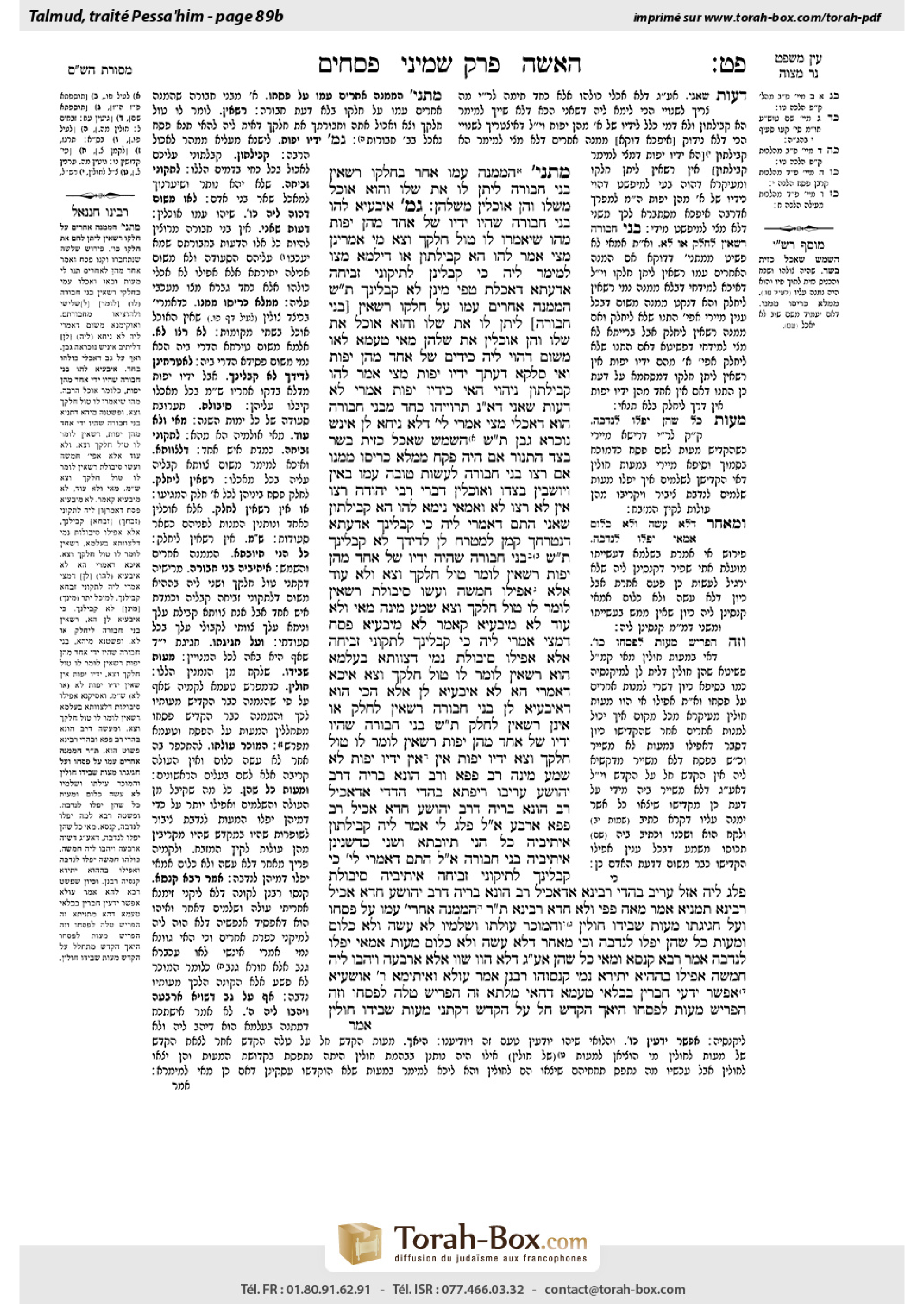
Pesachim 89b: Talmud study for Daf Yomi
Daf Yomi is the daily study of one Talmud folio. Explore 37 tractates with scans, Hebrew text, Sefaria English and AI-generated French translations where annotated.
Passage selection and English or AI-generated French translation are available where the scan has annotations. Daf Study is independent of Torah-Box and Sefaria.
Browse Pesachim · פסחים · All tractatesPesachim 89b text and translations
This page of Pesachim includes the Aramaic text, an English translation and an AI-generated French translation, alongside the scan above.
פסחים פ״ט ב · Aramaic and Hebrew text
מַתְנִי׳ הַמְמַנֶּה עִמּוֹ אַחֵר בְּחֶלְקוֹ — רַשָּׁאִין בְּנֵי חֲבוּרָה לִיתֵּן לוֹ אֶת שֶׁלּוֹ, וְהוּא אוֹכֵל מִשֶּׁלּוֹ, וְהֵן אוֹכְלִין מִשֶּׁלָּהֶן.
גְּמָ׳ אִיבַּעְיָא לְהוּ: בְּנֵי חֲבוּרָה שֶׁהָיוּ יָדָיו שֶׁל אֶחָד מֵהֶן יָפוֹת, מַהוּ שֶׁיֹּאמְרוּ לוֹ: טוֹל חֶלְקְךָ וָצֵא. מִי אָמְרִינַן, מָצֵי אֲמַר לְהוּ: הָא קַבֵּילְתּוּן. אוֹ דִילְמָא, מָצוּ לְמֵימַר לֵיהּ: כִּי קַבֵּלְינַן — לְתַיקּוֹנֵי זְבִיחָה, אַדַּעְתָּא דְּאָכְלַתְּ טְפֵי מִינַּן — לָא קַבֵּלְינָךְ.
תָּא שְׁמַע: הַמְמַנֶּה אֲחֵרִים עִמּוֹ עַל חֶלְקוֹ — רַשָּׁאִין [בְּנֵי חֲבוּרָה] לִיתֵּן לוֹ אֶת שֶׁלּוֹ, וְהוּא אוֹכֵל אֶת שֶׁלּוֹ, וְהֵן אוֹכְלִין אֶת שֶׁלָּהֶן. מַאי טַעְמָא? לָאו מִשּׁוּם דְּהָוֵי לֵיהּ כְּיָדַיִם שֶׁל אֶחָד מֵהֶן יָפוֹת. וְאִי סָלְקָא דַעְתָּךְ יָדָיו יָפוֹת מָצֵי אֲמַר לְהוּ קַבֵּילְתּוּן, נִיהְוֵי הַאי כְּיָדָיו יָפוֹת!
אָמְרִי: לָא, דֵּעוֹת שָׁאנֵי, דְּאִי נָמֵי תַּרְוַיְיהוּ כְּחַד מִבְּנֵי חֲבוּרָה הוּא דְּאָכְלִי, מָצֵי אָמְרִי לֵיהּ: דְּלָא נִיחָא לַן אִינָשׁ נוּכְרָא גַּבָּן.
תָּא שְׁמַע: הַשַּׁמָּשׁ שֶׁאָכַל כְּזַיִת בָּשָׂר בְּצַד הַתַּנּוּר, אִם הָיָה פִּקֵּחַ — מְמַלֵּא כְּרֵיסוֹ מִמֶּנּוּ. אִם רָצוּ בְּנֵי חֲבוּרָה לַעֲשׂוֹת טוֹבָה עִמּוֹ — בָּאִין וְיוֹשְׁבִין בְּצִדּוֹ וְאוֹכְלִין, דִּבְרֵי רַבִּי יְהוּדָה. רָצוּ — אִין, לֹא רָצוּ — לָא. וְאַמַּאי? נֵימָא לְהוּ: הָא קַבֵּילְתּוּן.
שָׁאנֵי הָתָם, דְּאָמְרִי לֵיהּ: כִּי קַבֵּלְינָךְ — אַדַּעְתָּא דְּנַטְרְחָךְ קַמַּן. לְמִטְרַח לַן לְדִידָךְ — לָא קַבֵּלְינָךְ.
תָּא שְׁמַע: בְּנֵי חֲבוּרָה שֶׁהָיָה יָדָיו שֶׁל אֶחָד מֵהֶן יָפוֹת, רַשָּׁאִין לוֹמַר: טוֹל חֶלְקְךָ וָצֵא. וְלֹא עוֹד, אֶלָּא אֲפִילּוּ חֲמִשָּׁה וְעָשׂוּ סִיבּוֹלֶת, רַשָּׁאִין לוֹמַר לוֹ: טוֹל חֶלְקְךָ וָצֵא. שְׁמַע מִינַּהּ.
מַאי ״וְלֹא עוֹד״? לָא מִיבַּעְיָא קָאָמַר. לָא מִיבַּעְיָא פֶּסַח, דְּמָצֵי אָמְרִי לֵיהּ: כִּי קַבֵּלְינָךְ לְתַקּוֹנֵי זְבִיחָה, אֶלָּא אֲפִילּוּ סִיבּוֹלֶת נָמֵי, דְּצַוְותָּא בְּעָלְמָא הוּא, רַשָּׁאִין לוֹמַר לוֹ: טוֹל חֶלְקְךָ וָצֵא.
אִיכָּא דְאָמְרִי: הָא לָא אִיבַּעְיָא לַן, אֶלָּא הָכִי הוּא דְּאִיבַּעְיָא לַן: בְּנֵי חֲבוּרָה רַשָּׁאִין לְחַלֵּק, אוֹ אֵינָן רַשָּׁאִין לְחַלֵּק?
תָּא שְׁמַע: בְּנֵי חֲבוּרָה שֶׁהָיוּ יָדָיו שֶׁל אֶחָד מֵהֶן יָפוֹת — רַשָּׁאִין לוֹמַר לוֹ: טוֹל חֶלְקְךָ וָצֵא. יָדָיו יָפוֹת — אִין, אֵין יָדָיו יָפוֹת — לָא. שְׁמַע מִינַּהּ.
רַב פָּפָּא וְרַב הוּנָא בְּרֵיהּ דְּרַב יְהוֹשֻׁעַ עָרִיבוּ רִיפְתָּא בַּהֲדֵי הֲדָדֵי. אַדְּאָכֵיל רַב הוּנָא בְּרֵיהּ דְּרַב יְהוֹשֻׁעַ חֲדָא, אָכֵיל רַב פָּפָּא אַרְבַּע. אֲמַר לֵיהּ: פְּלַג לִי. אֲמַר לֵיהּ: קַבֵּילְתּוּן.
אֵיתִיבֵיהּ כׇּל הָנֵי תְּיוּבָתָא, וְשַׁנִּי כִּדְשַׁנִּינַן. אֵיתִיבֵיהּ בְּנֵי חֲבוּרָה. אֲמַר לֵיהּ: הָתָם דְּאָמְרִי לֵיהּ כִּי קַבֵּלְינָךְ — לְתַיקּוֹנֵי זְבִיחָה. אֵיתִיבֵיהּ סִיבּוֹלֶת, פְּלַג לֵיהּ.
אֲזַל עָרֵיב בַּהֲדֵי רָבִינָא. אַדְּאָכֵיל רַב הוּנָא בְּרֵיהּ דְּרַב יְהוֹשֻׁעַ חֲדָא, אָכֵיל רָבִינָא תְּמָנְיָא. אֲמַר: מְאָה פָּפֵּי וְלָא חֲדָא רָבִינָא.
תָּנוּ רַבָּנַן: הַמְמַנֶּה אֲחֵרִים עִמּוֹ עַל פִּסְחוֹ וְעַל חֲגִיגָתוֹ — מָעוֹת שֶׁבְּיָדוֹ חוּלִּין. וְהַמּוֹכֵר עוֹלָתוֹ וּשְׁלָמָיו — לֹא עָשָׂה וְלֹא כְּלוּם, וּמָעוֹת כׇּל שֶׁהֵן יִפְּלוּ לִנְדָבָה.
וְכִי מֵאַחַר דְּלֹא עָשָׂה וְלֹא כְּלוּם, מָעוֹת אַמַּאי יִפְּלוּ לִנְדָבָה? אָמַר רָבָא: קְנָסָא. וּמַאי ״כׇּל שֶׁהֵן״ — אַף עַל גַּב דְּלָא הֲווֹ שָׁווּ אֶלָּא אַרְבְּעָה, וִיהַבוּ לֵיהּ חַמְשָׁה — אֲפִילּוּ בְּהָהִיא יַתִּירָא נָמֵי קַנְסוּהוּ רַבָּנַן.
אָמַר עוּלָּא, וְאִיתֵּימָא רַבִּי אוֹשַׁעְיָא: אֶפְשָׁר יָדְעִי חַבְרִין בַּבְלָאֵי טַעְמָא דְּהַאי מִלְּתָא. זֶה הִפְרִישׁ טָלֶה לְפִסְחוֹ, וְזֶה הִפְרִישׁ מָעוֹת לְפִסְחוֹ, הֵיאַךְ הֶקְדֵּשׁ חָל עַל הֶקְדֵּשׁ, דְּקָתָנֵי: מָעוֹת שֶׁבְּיָדוֹ חוּלִּין?
Pesachim 89b · English translation
MISHNA: If one who is registered for a Paschal lamb unilaterally registers another person with him in his portion of the Paschal lamb, the other members of his group are permitted to give him, i.e., the one who included the additional person, only his portion, which was originally allotted to him. And he, the additional person, eats from his portion, i.e., the portion of he who added him; and they, the other members of the group, eat from theirs. This is because they did not agree to the inclusion of the additional person.
GEMARA: A dilemma was raised before the Sages: If there is among the members of a group one of them who has fine hands, a euphemism for one who always hastens to take a large quantity of food, what is the halakha concerning whether they can say to him: Take your allotted portion to eat and leave; and don’t take any more from the other’s members portions? Do we say that he can say to them: You accepted me in the group without preconditions, and you therefore have no right to limit how much I can take now? Or perhaps they can say to him: When we accepted you, it was only for the preparation of the offering, to ensure that enough people would be registered to guarantee that the entire offering would be eaten with none left over. However, we did not accept you with the understanding that you would eat considerably more than us.
Come and hear a resolution to the dilemma from what we learned in the mishna: If one who registered for a Paschal lamb registers other people with him in his portion, the other members of the group are permitted to give him only his portion. And then he and the additional people eat from his portion, and they, the other members of the group, eat from theirs. What is the reason for this? Is it not because it is comparable to a case where one of them has fine hands, because in the case of one who adds a person, he and the additional person together eat more than one portion? And if it could enter your mind to say that one with fine hands can say to them: You accepted me without preconditions, then this person, who registered an additional person to join him, should be considered as though he had fine hands, and he should be able to take a double portion. Therefore, the mishna rules that the group can limit the quantity of food he takes. It is apparent that the claim of one with fine hands is not accepted.
The Gemara rejects this proof: They say: No, a comparison should not be drawn. Including additional people of individual minds is different. Even if both of them together would eat a quantity equivalent to a single member of the group, the other members of the group can nonetheless say to him: It is not pleasant for us to have a strange person among us. Therefore, no proof can be offered from the mishna.
Come and hear a resolution to the question from another mishna: In the case of an attendant who ate an olive-bulk of meat of the Paschal lamb next to the oven in which it is being roasted, if he were judicious, he should continue eating there to fill his stomach with it. By eating an olive-bulk, he has established his current location as his place for eating his Paschal lamb, and he may not eat any more in an additional location. If the members of the group wanted to do him a favor so that he may continue eating, they can come and sit at his side and eat there; this is the statement of Rabbi Yehuda. The Gemara makes the following inference: If they wanted to do him a favor, yes; but if they did not want to do so, no. But why should this be left to their discretion? Let him say to them: You accepted me unconditionally into the group, and therefore you have no right to prevent me from continuing to eat. The latter claim is not accepted, as is apparent by the mishna’s ruling that it is left to the group’s discretion
It is different there, in the case of an attendant, for they can say to him: When we accepted you, it was with the understanding that you would exert yourself before us and provide our needs by serving as our waiter; but for us to exert ourselves by moving to a place that is convenient for you, we did not accept you. Therefore, no proof can be derived from the mishna.
Come and hear an explicit resolution to this question from the Tosefta: Members of a group in which one of the group had fine hands are permitted to say to him: Take your allotted portion to eat and leave; don’t take any more from the other members’ portions. And not only is this true of a group sharing a Paschal lamb, but even five people who made a shared meal of friends [sibolet] throughout the year are permitted to say to one who has fine hands: Take your portion and leave. The Gemara concludes: Indeed, learn from this that that is the ruling.
The Gemara discusses the text of the Tosefta: What new ruling is introduced by the expression: And not only? The Tosefta is speaking employing the style of: There is no need. The Gemara explains: There is no need to state this rule in the case of a group sharing a Paschal lamb, since they have a strong claim, as they can say to him: When we accepted you, it was only for the preparation of the offering, to ensure that there would be enough people to guarantee that the entire offering would be eaten. It is therefore immediately understood that the group retains a right to limit the size of the portion he takes. Rather, the Tosefta emphasizes that even with regard to a shared friendly meal, which is for the sake of companionship only, they are permitted to say to him: Take your portion and leave.
There are those who say that this question concerning what a group may say to a member who has fine hands is not our dilemma. Rather, this is our dilemma: Are members of a group permitted to divide up into smaller separate groups, or are they not allowed to divide up if there is no special reason to do so?
Come and hear a resolution: Members of a group in which one of them had fine hands are permitted to say to him: Take your portion and leave, which is equivalent to instructing him to form his own group, albeit of only one person. This indicates that only if his hands are fine, yes, they may divide into separate groups, but if his hands are not fine, no, they may not. The Gemara concludes: Indeed, learn from this that they are not allowed to divide up into separate groups for no reason.
Incidental to this discussion, the Gemara recounts a related incident: Rav Pappa and Rav Huna, son of Rav Yehoshua, mixed their bread together in order to share it between them. By the time Rav Huna, son of Rav Yehoshua, ate one slice, Rav Pappa ate four slices. Rav Huna said to him: Let us stop sharing. Instead, divide the meal with me so that I can eat my portion. He said to him: You accepted my companionship, and it is improper to now retract.
Rav Huna raised all these objections mentioned previously, and Rav Pappa answered him as we answered that those cases dealt with exceptional circumstances. Rav Huna then raised an objection from the mishna with regard to the members of a group sharing a Paschal lamb. Rav Pappa said to him: There, they are permitted to limit his portion only because they can say to him: When we accepted you it was for the preparation of the sacrifice, but when friends share a meal it is with the understanding that each one will fully participate regardless of how much he eats. Rav Huna finally raised an objection from the ruling of the Tosefta concerning a shared meal. Rav Pappa accepted the proof and divided the meal with him.
On another occasion Rav Huna, son of Rav Yehoshua, went and mixed his bread together with Ravina. By the time Rav Huna, son of Rav Yehoshua, ate one slice, Ravina ate eight. Rav Huna said jokingly: It is better to eat together with one hundred Pappas and not with one Ravina, because Ravina eats significantly more.
The Sages taught in a baraita: One who registers others with him for his Paschal lamb or for his Festival peace-offering for the fourteenth of Nisan and takes money from them for their share, the money in his hand that he took for them is non-sacred. And one who sells his burnt-offering or peace-offerings to another person has not done anything; the sale is completely invalid, and any money he receives for the transaction should go to the Temple fund to be used for the purchase of public free-will offerings which will be sacrificed as burnt-offerings.
The Gemara asks: But since he has not done anything, the sale being completely invalid, why does the money fall to the fund used for free-will offerings? The money should remain non-sacred. Rava said: It is a fine that the Sages imposed to dissuade people from attempting to purchase others’ offerings. And what is the meaning of the phrase: And any money? It indicates that, although these offerings were worth only four zuz and they mistakenly gave him five zuz, even with regard to that extra zuz the Sages also fined him. They required it to be used for free-will offerings rather than considering the extra money a gift to the seller.
Ulla said, and some say it was Rabbi Oshaya: Is it possible that our Babylonian friends know the reason of this following matter: This person designated a lamb for his Paschal lamb, consecrating it as such; and this other person designated money to give to the owner of the lamb in order to register with his Paschal lamb, consecrating the money for that purpose. The sanctity endowed in the money can be removed from it only when transferred to the lamb upon purchasing a portion in it. Ulla questions the rationale for this: How does the sanctity of the money take effect upon and transfer to the Paschal lamb, which is itself already sacred, as implied by the baraita that teaches that the money in his hand is non-sacred, clearly indicating that the sanctity was indeed transferred from the money? Surely, if it is already sacred, no more sanctity can be transferred to it.
Pesachim 89b · Traduction française (IA)
MICHNA : Si une personne inscrite pour un agneau pascal inscrit de sa propre initiative une autre personne avec elle sur sa part de l’agneau pascal, les autres membres de son groupe ne peuvent lui donner, c’est-à-dire à celui qui a ajouté cette personne, que la part qui lui avait été attribuée à l’origine. Quant à la personne supplémentaire, elle mange de sa part, c’est-à-dire de la part de celui qui l’a inscrite ; et les autres membres du groupe mangent de la leur. En effet, ils n’avaient pas consenti à l’ajout de cette personne.
GUEMARA : Les Sages furent saisis du dilemme suivant : si, parmi les membres d’un groupe, l’un d’eux a la main lourde — expression euphémique désignant celui qui s’empresse toujours de prendre une grande quantité de nourriture — quelle est la halakha ? Peuvent-ils lui dire : « Prends la part qui t’est attribuée et mange-la, puis pars ; ne prends rien de plus sur les parts des autres membres » ? Dirons-nous qu’il peut leur répondre : « Vous m’avez accepté dans le groupe sans condition ; vous n’avez donc pas le droit de limiter la quantité que je peux prendre maintenant » ? Ou peut-être peuvent-ils lui dire : « En t’acceptant, nous l’avons fait uniquement pour la préparation du sacrifice, afin qu’il y ait assez de personnes inscrites pour garantir que le sacrifice entier serait consommé et qu’il n’en resterait rien. Mais nous ne t’avons pas accepté en sachant que tu mangerais beaucoup plus que nous. »
Venez et entendez une réponse au dilemme tirée de ce que nous avons appris dans la Michna : si une personne inscrite pour un agneau pascal inscrit d’autres personnes avec elle sur sa part, les autres membres du groupe ne peuvent lui donner que sa part. Lui et les personnes supplémentaires mangent alors de sa part, tandis que les autres membres du groupe mangent de la leur. Pourquoi cela ? N’est-ce pas parce que ce cas est comparable à celui où l’un d’eux a la main lourde, puisque celui qui ajoute une personne et celle-ci mangent ensemble davantage que la part d’un seul membre du groupe ? Et si l’on pouvait envisager qu’une personne qui a la main lourde leur dise : « Vous m’avez accepté sans condition », alors celui qui a inscrit une personne supplémentaire avec lui devrait être considéré comme ayant la main lourde et devrait pouvoir prendre une double part. La Michna enseigne donc que le groupe peut limiter la quantité de nourriture qu’il prend. Il apparaît que la revendication de celui qui a la main lourde n’est pas admise.
La Guemara rejette cette preuve : Ils répondent : Non, il ne faut pas établir de comparaison. Le cas où l’on ajoute des personnes ayant chacune leur propre personnalité est différent. Même si, tous les deux ensemble, ils mangeaient une quantité équivalente à celle d’un seul membre du groupe, les autres membres pourraient néanmoins lui dire : « Il ne nous est pas agréable d’avoir un étranger parmi nous. » On ne peut donc tirer aucune preuve de la Michna.
Venez et entendez une réponse à la question tirée d’une autre Michna : dans le cas d’un serviteur qui a mangé un volume d’olive de viande de l’agneau pascal près du four où celui-ci rôtit, s’il est avisé, il doit continuer à manger là pour s’en rassasier. En mangeant ce volume d’olive, il a établi l’endroit où il se trouve comme lieu où il mange son agneau pascal ; il ne peut donc plus manger ailleurs. Si les membres du groupe veulent lui faire plaisir afin qu’il puisse continuer à manger, ils peuvent venir s’asseoir à côté de lui et manger là ; telle est la déclaration de Rabbi Yehouda. La Guemara en déduit : s’ils veulent lui faire plaisir, oui ; mais s’ils ne le veulent pas, non. Mais pourquoi cela dépendrait-il de leur bon vouloir ? Qu’il leur dise : « Vous m’avez accepté dans le groupe sans condition ; vous n’avez donc pas le droit de m’empêcher de continuer à manger. » Cette revendication n’est pas admise, comme le montre la décision de la Michna, qui laisse cela à la discrétion du groupe.
Le cas du serviteur est différent, car ils peuvent lui dire : « En t’acceptant, nous nous attendions à ce que tu fasses des efforts pour nous et répondes à nos besoins en nous servant ; mais nous ne t’avons pas accepté pour que nous-mêmes fassions des efforts en nous déplaçant vers un endroit qui t’arrange. » On ne peut donc tirer aucune preuve de la Michna.
Venez et entendez une réponse explicite à cette question tirée de la Tosefta : les membres d’un groupe dont l’un des membres a la main lourde sont autorisés à lui dire : « Prends la part qui t’est attribuée et mange-la, puis pars ; ne prends rien de plus sur les parts des autres membres. » Et cela ne vaut pas seulement pour un groupe qui partage un agneau pascal : même cinq personnes qui, tout au long de l’année, prennent un repas en commun entre amis [sibolet] sont autorisées à dire à celui qui a la main lourde : « Prends ta part et pars. » La Guemara conclut : En effet, déduis de là que telle est la règle.
La Guemara examine le texte de la Tosefta : quelle nouvelle règle l’expression « et cela ne vaut pas seulement » introduit-elle ? La Tosefta s’exprime selon la formule « il n’est pas nécessaire de dire ». La Guemara explique : il n’est pas nécessaire d’énoncer cette règle dans le cas d’un groupe qui partage un agneau pascal, car ses membres ont un argument solide : ils peuvent lui dire : « En t’acceptant, nous l’avons fait uniquement pour la préparation du sacrifice, afin qu’il y ait assez de personnes inscrites pour garantir que le sacrifice entier serait consommé. » Il est donc évident que le groupe conserve le droit de limiter la quantité de nourriture qu’il prend. La Tosefta souligne plutôt que même dans le cas d’un repas partagé entre amis, qui n’a pour seul but que la camaraderie, ils sont autorisés à lui dire : « Prends ta part et pars. »
Certains disent que cette question concernant ce qu’un groupe peut dire à l’un de ses membres qui a la main lourde n’est pas le dilemme qui nous occupe. Notre dilemme est plutôt le suivant : les membres d’un groupe sont-ils autorisés à se séparer en groupes plus petits, ou ne peuvent-ils pas se diviser s’il n’y a pas de raison particulière de le faire ?
Venez et entendez une réponse : les membres d’un groupe dont l’un a la main lourde sont autorisés à lui dire : « Prends ta part et pars », ce qui revient à lui demander de former son propre groupe, même s’il ne compte qu’une seule personne. Cela indique que c’est seulement si sa main est lourde qu’ils peuvent se séparer en groupes distincts ; mais si sa main n’est pas lourde, ils ne le peuvent pas. La Guemara conclut : En effet, déduis de là qu’ils ne sont pas autorisés à se séparer en groupes distincts sans raison.
À l’occasion de cette discussion, la Guemara rapporte un incident connexe : Rav Pappa et Rav Houna, fils de Rav Yehoshoua, mélangèrent leurs pains afin de les partager entre eux. Au moment où Rav Houna, fils de Rav Yehoshoua, avait mangé une tranche, Rav Pappa en avait mangé quatre. Rav Houna lui dit : « Cessons de partager ainsi. Partage le repas avec moi de manière que je puisse manger ma part. » Rav Pappa lui répondit : « Tu as accepté ma compagnie ; il ne convient pas de revenir maintenant sur cet accord. »
Rav Houna souleva toutes les objections mentionnées précédemment, et Rav Pappa lui répondit comme nous l’avons répondu : ces cas concernaient des circonstances exceptionnelles. Rav Houna souleva ensuite une objection tirée de la Michna concernant les membres d’un groupe qui partage un agneau pascal. Rav Pappa lui dit : « Dans ce cas, ils ne sont autorisés à limiter sa part que parce qu’ils peuvent lui dire : “En t’acceptant, nous l’avons fait pour la préparation du sacrifice.” Mais lorsque des amis partagent un repas, ils le font en sachant que chacun y prendra pleinement part, quelle que soit la quantité qu’il mange. » Rav Houna souleva enfin une objection tirée de la décision de la Tosefta concernant un repas partagé. Rav Pappa admit que la preuve était valable et partagea le repas avec lui.
Une autre fois, Rav Houna, fils de Rav Yehoshoua, alla mélanger son pain avec celui de Ravina. Au moment où Rav Houna, fils de Rav Yehoshoua, avait mangé une tranche, Ravina en avait mangé huit. Rav Houna dit en plaisantant : « Mieux vaut manger avec cent Rav Pappa qu’avec un seul Ravina, car Ravina mange beaucoup plus. »
Les Sages enseignèrent dans une baraïta : celui qui inscrit d’autres personnes avec lui pour son agneau pascal ou pour son sacrifice de paix offert à l’occasion de la fête du 14 Nissan et leur prend de l’argent pour leur part détient de l’argent profane. Et celui qui vend son holocauste ou ses sacrifices de paix à une autre personne n’a rien fait : la vente est entièrement invalide, et tout argent qu’il reçoit pour cette transaction doit être versé au fonds du Temple, afin de servir à l’achat de sacrifices volontaires publics qui seront offerts en holocaustes.
La Guemara demande : mais puisqu’il n’a rien fait et que la vente est entièrement invalide, pourquoi l’argent est-il versé au fonds destiné aux sacrifices volontaires ? L’argent devrait rester profane. Rava dit : c’est une amende imposée par les Sages pour dissuader les gens d’essayer d’acheter les sacrifices d’autrui. Et que signifie l’expression « tout argent » ? Elle indique que, même si ces sacrifices ne valaient que quatre zouz et qu’on lui a donné cinq zouz par erreur, les Sages lui ont également imposé une amende pour le zouz supplémentaire. Ils ont exigé qu’il soit affecté aux sacrifices volontaires plutôt que de considérer cette somme supplémentaire comme un cadeau au vendeur.
Oulla dit — certains disent que c’était Rabbi Ochaya : « Nos amis babyloniens connaissent-ils la raison de ce qui suit ? Cet homme a désigné un agneau pour son sacrifice pascal, le consacrant à cette fin ; et cet autre homme a désigné de l’argent à donner au propriétaire de l’agneau afin de s’inscrire avec lui pour l’agneau pascal, consacrant cet argent à cette fin. La sainteté conférée à l’argent ne peut lui être retirée qu’au moment où elle est transférée à l’agneau, lors de l’achat d’une part de celui-ci. » Oulla s’interroge sur la logique de cela : comment la sainteté de l’argent peut-elle prendre effet sur l’agneau pascal et lui être transférée, alors que celui-ci est déjà consacré ? La baraïta enseigne que l’argent qu’il détient est profane, ce qui implique clairement que la sainteté a bien été transférée depuis l’argent. Or, si l’agneau est déjà consacré, aucune sainteté supplémentaire ne peut lui être transférée.
Traduction française générée par IA à partir de l’édition anglaise de Sefaria. Vérifie toujours un passage avec le texte source.
Text from Sefaria: William Davidson Edition - Vocalized Aramaic (CC BY NC); William Davidson Edition - English (CC BY NC).