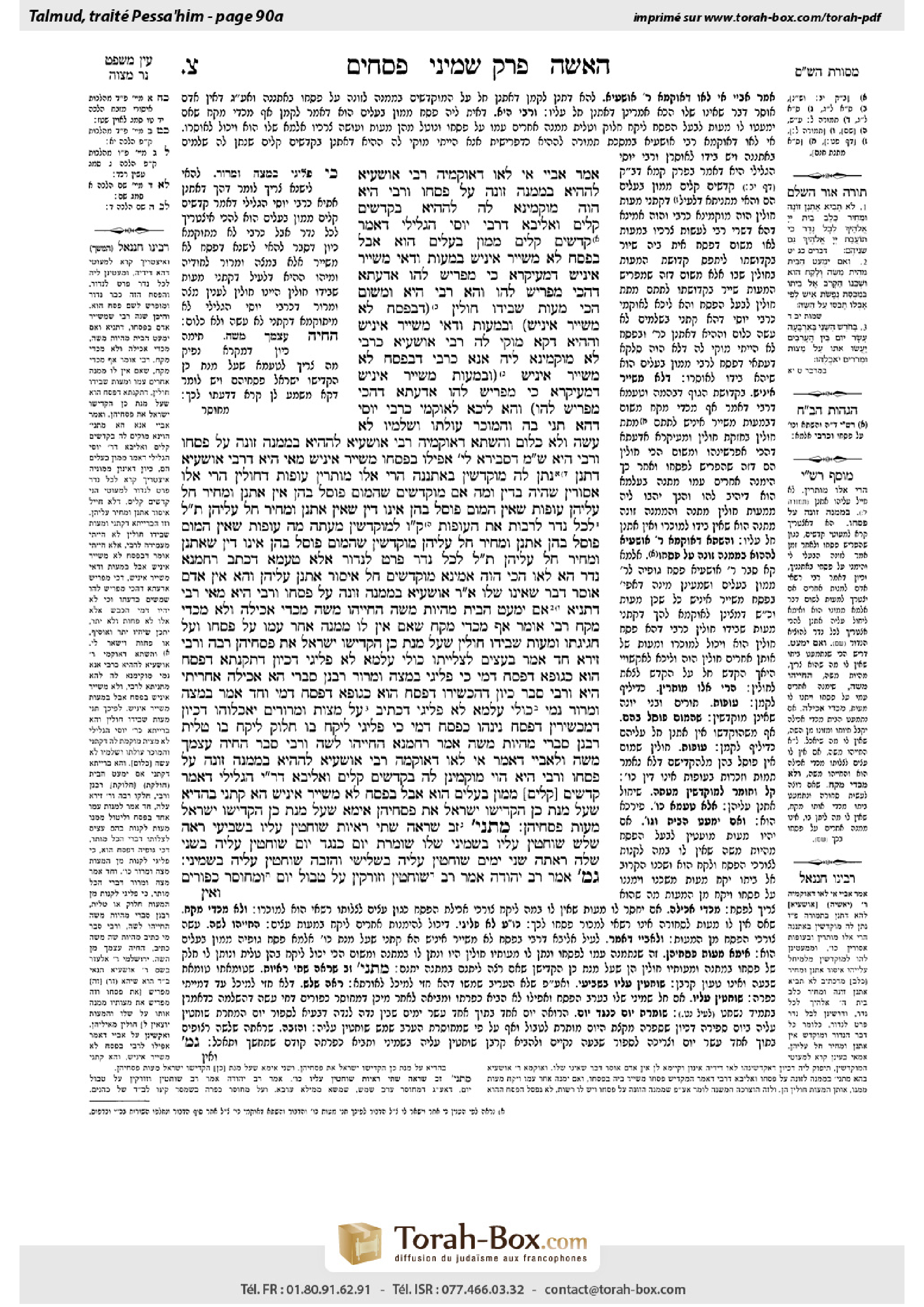
Pesachim 90a: Talmud study for Daf Yomi
Daf Yomi is the daily study of one Talmud folio. Explore 37 tractates with scans, Hebrew text, Sefaria English and AI-generated French translations where annotated.
Passage selection and English or AI-generated French translation are available where the scan has annotations. Daf Study is independent of Torah-Box and Sefaria.
Browse Pesachim · פסחים · All tractatesPesachim 90a text and translations
This page of Pesachim includes the Aramaic text, an English translation and an AI-generated French translation, alongside the scan above.
פסחים צ׳ א · Aramaic and Hebrew text
אָמַר אַבָּיֵי: אִי לָאו דְּאוֹקְמֵיהּ רַבִּי אוֹשַׁעְיָא לְהַהִיא בִּמְמַנֶּה זוֹנָה עַל פִּסְחוֹ וְרַבִּי הִיא, הֲוָה מוֹקֵמְינָא לָהּ לְהַהִיא בְּקָדָשִׁים קַלִּים וְאַלִּיבָּא דְּרַבִּי יוֹסֵי הַגְּלִילִי, דְּאָמַר: קָדָשִׁים קַלִּים מָמוֹן בְּעָלִים הוּא,
אֲבָל בְּפֶסַח לָא מְשַׁיַּיר אִינִישׁ, בְּמָעוֹת וַדַּאי מְשַׁיַּיר אִינִישׁ, דְּמֵעִיקָּרָא כִּי מַפְרֵישׁ לְהוּ — אַדַּעְתָּא דְּהָכִי מַפְרֵישׁ לְהוּ.
וְהָא רַבִּי הִיא, וּמִשּׁוּם הָכִי מָעוֹת שֶׁבְּיָדוֹ חוּלִּין, דְּבַפֶּסַח לָא מְשַׁיַּיר אִינִישׁ, וּבְמָעוֹת וַדַּאי מְשַׁיַּיר אִינִישׁ.
וְהָהִיא דְּקָא מוֹקֵי לַהּ רַבִּי אוֹשַׁעְיָא כְּרַבִּי — לָא מוֹקֵמְינָא לֵיהּ אֲנָא כְּרַבִּי, דִּבְפֶסַח לָא מְשַׁיַּיר אִינִישׁ — וּבְמָעוֹת מְשַׁיַּיר אִינִישׁ. דְּמֵעִיקָּרָא כִּי מַפְרֵישׁ לְהוּ — אַדַּעְתָּא דְּהָכִי מַפְרֵישׁ לְהוּ.
וְהָא לֵיכָּא לְאוֹקֹמֵי כְּרַבִּי יוֹסֵי, דְּהָא תָּנֵי בַּהּ: וְהַמּוֹכֵר עוֹלָתוֹ וּשְׁלָמָיו — לֹא עָשָׂה וְלֹא כְלוּם.
וְהַשְׁתָּא דְּאוֹקְמֵיהּ רַבִּי אוֹשַׁעְיָא לְהָהִיא בִּמְמַנֶּה זוֹנָה עַל פִּסְחוֹ, וְרַבִּי הִיא, שְׁמַע מִינַּהּ דִּסְבִירָא לֵיהּ אֲפִילּוּ בְּפִסְחוֹ מְשַׁיַּיר אִינִישׁ.
מַאי הִיא דְּרַבִּי אוֹשַׁעְיָא, דִּתְנַן: נָתַן לָהּ מוּקְדָּשִׁין בְּאֶתְנַנָּהּ — הֲרֵי אֵלּוּ מוּתָּרִין.
עוֹפוֹת דְּחוּלִּין — הֲרֵי אֵלּוּ אֲסוּרִין. שֶׁהָיָה בַּדִּין: וּמָה אִם מוּקְדָּשִׁים שֶׁהַמּוּם פּוֹסֵל בָּהֶן — אֵין אֶתְנַן וּמְחִיר חָל עֲלֵיהֶן, עוֹפוֹת שֶׁאֵין הַמּוּם פּוֹסֵל בָּהֶן — אֵינוֹ דִּין שֶׁאֵין אֶתְנַן וּמְחִיר חָל עֲלֵיהֶן? תַּלְמוּד לוֹמַר: ״לְכׇל נֶדֶר״ — לְרַבּוֹת אֶת הָעוֹפוֹת.
קַל וָחוֹמֶר לַמּוּקְדָּשִׁין מֵעַתָּה: מָה עוֹפוֹת שֶׁאֵין הַמּוּם פּוֹסֵל בָּהֶן — אֶתְנַן וּמְחִיר חָל עֲלֵיהֶן, מוּקְדָּשִׁין שֶׁהַמּוּם פּוֹסֵל בָּהֶן — אֵינוֹ דִּין שֶׁאֶתְנַן וּמְחִיר חָל עֲלֵיהֶן? תַּלְמוּד לוֹמַר: ״לְכׇל נֶדֶר״ — פְּרָט לִנְדּוֹר.
אֶלָּא טַעְמָא דִּכְתַב רַחֲמָנָא ״נֶדֶר״, הָא לָאו הָכִי, הֲוָה אָמֵינָא מוּקְדָּשִׁים חָל אִיסּוּר אֶתְנַן עֲלֵיהֶן, וְהָא אֵין אָדָם אוֹסֵר דָּבָר שֶׁאֵינוֹ שֶׁלּוֹ!
אָמַר רַבִּי אוֹשַׁעְיָא: בִּמְמַנֶּה זוֹנָה עַל פִּסְחוֹ, וְרַבִּי הִיא.
מַאי רַבִּי? דְּתַנְיָא: ״אִם יִמְעַט הַבַּיִת מִהְיוֹת מִשֶּׂה״, הַחֲיֵיהוּ מִשֶּׂה. מִכְּדֵי אֲכִילָה, וְלֹא מִכְּדֵי מִקָּח.
רַבִּי אוֹמֵר: אַף מִכְּדֵי מִקָּח, שֶׁאִם אֵין לוֹ — מְמַנֶּה אַחֵר עִמּוֹ עַל פִּסְחוֹ וְעַל חֲגִיגָתוֹ, וּמָעוֹת שֶׁבְּיָדוֹ חוּלִּין, שֶׁעַל מְנָת כֵּן הִקְדִּישׁוּ יִשְׂרָאֵל אֶת פִּסְחֵיהֶן.
רַבָּה וְרַבִּי זֵירָא, חַד אָמַר: בְּעֵצִים לִצְלִיָּיתוֹ כּוּלֵּי עָלְמָא לָא פְּלִיגִי, דְּכֵיוָן דְּתַקַּנְתָּא דְפֶסַח הוּא — כְּגוּפָא דְפֶסַח דָּמֵי. כִּי פְּלִיגִי בְּמַצָּה וּמָרוֹר.
רַבָּנַן סָבְרִי: הָא אֲכִילָה אַחֲרִיתִי הִיא. וְרַבִּי סָבַר: כֵּיוָן דְּהֶכְשֵׁירוֹ דְפֶסַח הוּא — כְּגוּפָא דְפֶסַח דָּמֵי.
וְחַד אָמַר: בְּמַצָּה וּמָרוֹר נָמֵי כּוּלֵּי עָלְמָא לָא פְּלִיגִי, דִּכְתִיב: ״עַל מַצּוֹת וּמְרֹרִים יֹאכְלֻהוּ״, דְּכֵיוָן דְּמַכְשִׁירִין דְפֶסַח נִינְהוּ — כְּפֶסַח דָּמֵי. כִּי פְּלִיגִי לִיקַּח בּוֹ חָלוּק, לִיקַּח בּוֹ טַלִּית. רַבָּנַן סָבְרִי: ״מִהְיוֹת מִשֶּׂה״ אָמַר רַחֲמָנָא, הַחֲיֵיהוּ לַשֶּׂה, וְרַבִּי סָבַר: הַחֲיֵה עַצְמְךָ מִשֶּׂה.
וּלְאַבָּיֵי דְּאָמַר: אִי לָאו דְּאוֹקְמַהּ רַבִּי אוֹשַׁעְיָא לְהַהִיא בִּמְמַנֶּה זוֹנָה עַל פִּסְחוֹ וְרַבִּי הִיא, הֲוֵי מוֹקְמִינַן לַהּ בְּקָדָשִׁים קַלִּים וְאַלִּיבָּא דְּרַבִּי יוֹסֵי הַגְּלִילִי, דְּאָמַר קָדָשִׁים [קַלִּים] מְמוֹן בְּעָלִים הוּא, אֲבָל בְּפֶסַח לָא מְשַׁיַּיר אִינִישׁ —
הָא קָתָנֵי בְּהֶדְיָא: ״שֶׁעַל מְנָת כֵּן הִקְדִּישׁוּ יִשְׂרָאֵל אֶת פִּסְחֵיהֶן״? אֵימָא: שֶׁעַל מְנָת כֵּן הִקְדִּישׁוּ יִשְׂרָאֵל מְעוֹת פִּסְחֵיהֶן.
מַתְנִי׳ זָב שֶׁרָאָה שְׁתֵּי רְאִיּוֹת — שׁוֹחֲטִין עָלָיו בַּשְּׁבִיעִי. רָאָה שָׁלֹשׁ — שׁוֹחֲטִין עָלָיו בַּשְּׁמִינִי שֶׁלּוֹ.
שׁוֹמֶרֶת יוֹם כְּנֶגֶד יוֹם — שׁוֹחֲטִין עָלֶיהָ בַּשֵּׁנִי שֶׁלָּהּ, רָאֲתָה שְׁנֵי יָמִים — שׁוֹחֲטִין עָלֶיהָ בַּשְּׁלִישִׁי.
וְהַזָּבָה — שׁוֹחֲטִין עָלֶיהָ בַּשְּׁמִינִי.
גְּמָ׳ אָמַר רַב יְהוּדָה אָמַר רַב: שׁוֹחֲטִין וְזוֹרְקִין עַל טְבוּל יוֹם וּמְחוּסַּר כִּפּוּרִים,
Pesachim 90a · English translation
A mishna and baraita that the Gemara cites later on in the discussion teach that, logically, were it not for a verse teaching otherwise, the prohibition against using as an offering an animal given as payment for a prostitute’s services should apply even in a case where the animal had already been consecrated as an offering before being given as payment. Abaye said: If not that Rabbi Oshaya established that that mishna is referring to a case of one who registers a prostitute for his Paschal lamb as her payment, and this position is in accordance with the opinion of Rabbi Yehuda HaNasi, whom Rabbi Oshaya apparently understood and who holds that a person retains monetary rights to his Paschal lamb even after consecration, which is why one is able to register the prostitute for it, I would have established that mishna as referring only to offerings of lesser sanctity and claimed it is in accordance with the opinion of Rabbi Yosei HaGelili, who said: Offerings of lesser sanctity are the monetary property of their owners, and therefore it is possible for the owner to use them as payment for a prostitute.
But I would have presumed that Rabbi Yehuda HaNasi holds that a Paschal lamb is unlike regular offerings of lesser sanctity, in that a person does not restrict its consecration in order to retain monetary rights to it, and it is therefore not considered to be his property at all. However, with regard to money consecrated for a Paschal lamb, a person certainly restricts its consecration. When one initially designates it, he designated it with this intent: If he should wish to purchase a portion in someone else’s Paschal lamb that was already consecrated, then the money should remain non-sacred in order to allow for that purchase to take hold.
I would have therefore been able to explain that this baraita is in accordance with the opinion of Rabbi Yehuda HaNasi. Due to this opinion of his, the money in the hand of the owner of the lamb, which he received for selling a share in his Paschal lamb, is non-sacred because, although with regard to the Paschal lamb a person does not restrict its consecration, with regard to money a person certainly restricts its consecration.
Abaye continues his line of thinking: And that mishna that Rabbi Oshaya established as being in accordance with the opinion of Rabbi Yehuda HaNasi, I would not establish it as being in accordance with the opinion of Rabbi Yehuda HaNasi. According to him, when designating a Paschal lamb, a person does not limit its consecration from fully taking effect, and therefore he retains monetary rights to the lamb; whereas with regard to money, a person does limit its consecration, for when one originally designates it, he designates it with this intent.
Abaye admits that there is a problem with explaining the baraita in this way: However, this, the baraita we are addressing, cannot be established in accordance with the opinion of Rabbi Yosei, for it also teaches in a different clause that one who sells his burnt-offering and peace-offerings has not done anything. Meanwhile, Rabbi Yosei maintains that a peace-offering is one’s personal property, and therefore if one sells it the sale is valid.
Nevertheless, now that Rabbi Oshaya has established that mishna as referring to one who registers a prostitute for his Paschal lamb, and he established that it is in accordance with the opinion of Rabbi Yehuda HaNasi, learn from it that Rabbi Yehuda HaNasi holds that even with regard to one’s Paschal lamb, a person restricts its consecration. Should someone wish to purchase a portion of it, he will be able to do so. In such a case, from the outset that portion was not considered consecrated. This will answer the question raised by Ulla as to how the sanctity of the money can be transferred to a Paschal lamb that was already consecrated. In such a case, according to Rabbi Yehuda HaNasi, one does not fully consecrate the animal from the outset. Therefore, the animal is considered non-sacred for this purpose, and the sanctity may be transferred from the money to the animal.
What is this teaching of Rabbi Oshaya that Abaye alluded to? Rabbi Oshaya’s teaching concerns the following mishna in Temura: As we learned in a mishna: If one gave animals consecrated as offerings for a prostitute’s payment, they are nevertheless permitted to be sacrificed. Although generally, animals given to a prostitute as payment are disqualified for use as offerings, this disqualification does not apply to an animal that was consecrated beforehand.
However, if one gave her birds that were non-sacred, they are prohibited for use as an offering. The ruling concerning birds needs to be stated as, by right, it should have been permitted based on the following a fortiori inference: What? If consecrated animals, for which a blemish disqualifies them for use, may nevertheless be used as an offering, since the status of a prostitute’s payment or the status of a dog’s price does not take effect upon them, then with regard to birds, for which a blemish does not disqualify them for use as an offering, is it not logically right that the status of a prostitute’s payment or a dog’s price should not take effect upon them? In repudiation of this argument, the verse states: “You shall not bring the payment of a prostitute, or the price of a dog, into the House of the Lord your God for any vow” (Deuteronomy 23:19). A derivation is made from the extraneous phrase “for any vow” to include birds, which may be brought as vows.
The Gemara cites a baraita that expands the argument made in the mishna and suggests that the opposite argument can also be made: From now, since it is known that birds used as a prostitute’s payment are disqualified, the following a fortiori inference can be made to disqualify an animal already consecrated: Just as with regard to birds, for which a blemish does not disqualify them, the status of a prostitute’s payment and a dog’s price takes effect upon them, so too, with regard to animals consecrated as offerings, for which a blemish does disqualify them, is it not logically right that the status of a prostitute’s payment and a dog’s price should take effect upon them? In repudiation of this argument, the verse states: “For any vow,” indicating that the disqualification applies to everything except for something that has already been vowed to be offered and consecrated for that purpose.
The Gemara analyzes the assumption of this baraita: But the only reason consecrated animals are disqualified is that the Torah writes the word vow; but if not for that I would have said that even with regard to consecrated animals, the prohibition of a prostitute’s payment takes effect upon them. The Gemara questions this assumption: But there is the following established principle: A person cannot make forbidden something that is not his. A consecrated animal is considered to be the property of the Temple and no longer of the individual who consecrated it. If so, how can one make it forbidden by giving it to a prostitute?
Rabbi Oshaya said: The mishna and baraita are referring to one who registers a prostitute for his Paschal lamb, giving her a portion in it as payment for her services, and the mishna and baraita are in accordance with the opinion of Rabbi Yehuda HaNasi, who holds that a Paschal lamb is considered a person’s personal property for the purposes of allowing additional people to register for it.
What is this teaching of Rabbi Yehuda HaNasi that Abaye alluded to? As it was taught in a baraita: The verse states: “And if the household be too little for a lamb, then shall he and his neighbor next to his house take one” (Exodus 12:4). The phrase “if the household be too little” is taken to mean the household cannot afford the basic necessities of the Festival. Continuing this interpretation, the phrase “for a lamb [miheyot miseh]” is then taken to mean: sustain him [haḥayeihu] from the lamb, i.e., he may use the Paschal lamb as a means of supporting himself. He takes money from his neighbor in return for registering his neighbor for a portion of his Paschal lamb and then uses that money to purchase his needs. However, this applies only if one lacks sufficient means to purchase food to eat, but not if he lacks only sufficient means to purchase other items.
Rabbi Yehuda HaNasi says: It applies even if one lacks sufficient means to purchase other necessary items, for if he does not have sufficient funds he may register another person with him for his Paschal lamb and for his Festival peace-offering. And the money in his hand that he receives for registering that person is non-sacred, for it is on this condition that the Jewish people consecrate their Paschal lambs.
Rabba and Rabbi Zeira disagreed with regard to the dispute between Rabbi Yehuda HaNasi and the Rabbis. One said: If one needs wood to roast the Paschal lamb, everyone agrees that since it is for the preparation of the Paschal lamb, it is comparable to something necessary for the Paschal lamb itself, and both Rabbi Yehuda HaNasi and the Rabbis agree that one may register additional people for the Paschal lamb and use the money received to procure wood. Where they disagree is in the case of one who doesn’t have sufficient means to purchase matza and bitter herbs.
The Rabbis hold that this is considered a different eating, not directly related to the Paschal lamb. Therefore, one may not use money for registering additional people for purchasing these items. And Rabbi Yehuda HaNasi holds that since it facilitates the consumption of the Paschal lamb, since the Paschal lamb must be eaten together with matza and bitter herbs, it is like the Paschal lamb itself and the money may therefore be used to purchase them.
And one said: Also with regard to matza and bitter herbs everyone agrees, as it is written: “They shall eat it with matza and bitter herbs” (Numbers 9:11), for since they are items that facilitate the consumption of the Paschal lamb, they are like the Paschal lamb itself. Where they disagree is when the money is to be used to purchase a shirt with it or to purchase a cloak with it. The Rabbis hold that the Torah stated “miheyot miseh,” which should be taken to mean sustain the lamb [haḥayeihu leseh], allowing the use of funds only for the direct needs of the Paschal lamb. And Rabbi Yehuda HaNasi holds that it should be interpreted to mean sustain yourself from the lamb [haḥayei atzmekha miseh], which includes taking care of all one’s needs.
The Gemara questions the plausibility of Abaye’s opinion: And according to Abaye, who said: If Rabbi Oshaya had not established that mishna as referring to one who registers a prostitute for his Paschal lamb and it is in accordance with the opinion of Rabbi Yehuda HaNasi, I would have established it as referring to sacrifices of lesser sanctity and according to the opinion of Rabbi Yosei HaGelili, who said: Sacrifices of lesser sanctity are the property of their owners, but in the case of the Paschal sacrifice one does not leave any of it unconsecrated. Rather, it is fully consecrated.
The Gemara asks: How could Abaye have ever claimed that Rabbi Yehuda HaNasi holds that a Paschal lamb is fully consecrated to the extent that it is no longer considered the property of its owners, but the baraita teaches explicitly that Rabbi Yehuda HaNasi said: It is on this condition, that the consecration should not be complete, that the Jewish people consecrate their Paschal lamb? The Gemara answers that the conclusion of the baraita should be emended to say: For it is on this condition that the Jewish people consecrated money for their Paschal lambs. This version leaves open the possibility of understanding Rabbi Yehuda HaNasi as Abaye suggested.
MISHNA: A zav, a man who experiences a gonorrheal discharge, who saw two sightings of discharge is ritually impure. To become ritually pure and able to partake of offerings, he must wait seven clean days during which he does not see any discharge. Then he immerses in a ritual bath. He will then be considered ritually pure upon nightfall. One slaughters the Paschal lamb on his behalf if Passover eve is on his seventh day, despite the fact he is still not ritually pure at the time of slaughter, since by the night of Passover he will be ritually pure and able to eat it. If he saw three sightings, in which case, in addition to the seven clean days he must bring an offering on the eighth day to be allowed to partake of offerings, one slaughters the Paschal lamb on his behalf if Passover eve is on his eighth day. It is presumed that by the evening his offering will have been brought and his purification complete.
A woman who keeps watch a day for a day is one who became ritually impure after experiencing a discharge of blood outside of her regular menstrual cycle on one day or two consecutive days. She must keep watch on the day following her last discharge to be certain she does not experience any additional discharges. To ritually purify herself, she should, on that day, immerse in a ritual bath, and on condition that she doesn’t experience any discharges throughout that day, she is considered ritually pure already from the time she immersed. If she saw a discharge on one day, one slaughters the Paschal lamb on her behalf after she has immersed on her second day, despite the possibility that she may see additional discharges later that day. If she saw a discharge on two days, one slaughters the Paschal lamb on her behalf on the third day.
And a zava is a woman who experienced discharges on three consecutive days. She must, like a zav, wait a full seven clean days with no discharges, immerse, and then bring a sacrifice on the eighth day. One slaughters a Paschal lamb on her behalf only on the eighth day.
GEMARA: Rav Yehuda said that Rav said: One slaughters the Paschal lamb and sprinkles its blood on behalf of one who has immersed himself during the day due to a type of ritual impurity from which he will become fully ritually pure upon nightfall. If he immerses on the fourteenth of Nisan, a Paschal lamb may be offered on his behalf. And a Paschal lamb may be offered on behalf of one who is ritually impure with a type of ritual impurity that requires that he also bring an atonement offering to fully complete his purification process, even if he still lacks the atonement offering, i.e., it has not yet been offered. Since he will be ritually pure and able to partake of the Paschal lamb by the evening, the Paschal lamb may be slaughtered on his behalf during the day, although at the time of slaughter he has not yet completed his purification process.
Pesachim 90a · Traduction française (IA)
Une Michna et une baraïta que la Guemara cite plus loin dans la discussion enseignent que, logiquement, sans un verset enseignant le contraire, l’interdiction d’utiliser comme offrande un animal donné en paiement des services d’une prostituée devrait s’appliquer même si l’animal avait déjà été consacré comme offrande avant d’être donné en paiement. Abayé dit : Si Rabbi Oshaya n’avait pas établi que cette Michna traite du cas où quelqu’un inscrit une prostituée parmi les participants à son agneau pascal, en paiement de ses services, et qu’elle suit l’opinion de Rabbi Yehouda HaNassi — que Rabbi Oshaya semble donc avoir comprise ainsi, et selon laquelle une personne conserve des droits patrimoniaux sur son agneau pascal même après sa consécration, ce qui lui permet d’y inscrire la prostituée —, j’aurais expliqué que cette Michna ne concerne que les offrandes de moindre sainteté et soutenu qu’elle suit l’opinion de Rabbi Yossi HaGelili, qui a dit : Les offrandes de moindre sainteté sont la propriété de leurs propriétaires et, par conséquent, leur propriétaire peut les utiliser en paiement des services d’une prostituée.
Mais j’aurais présumé que, selon Rabbi Yehouda HaNassi, un agneau pascal diffère des offrandes ordinaires de moindre sainteté : une personne ne limite pas sa consécration afin d’en conserver les droits patrimoniaux et, par conséquent, il n’est pas du tout considéré comme sa propriété. En revanche, s’agissant de l’argent consacré à l’achat d’un agneau pascal, une personne limite certainement sa consécration. Lorsqu’elle le désigne initialement, elle le fait avec cette intention : si elle souhaite acheter une part de l’agneau pascal déjà consacré d’une autre personne, l’argent restera profane, afin que cet achat puisse prendre effet.
J’aurais donc pu expliquer que cette baraïta suit l’opinion de Rabbi Yehouda HaNassi. Selon cette opinion, l’argent que détient le propriétaire de l’agneau, reçu en échange de la vente d’une part de son agneau pascal, est profane, car, même si une personne ne limite pas la consécration de l’agneau pascal, elle limite certainement celle de l’argent.
Abayé poursuit son raisonnement : Quant à cette Michna que Rabbi Oshaya a établie comme suivant l’opinion de Rabbi Yehouda HaNassi, je ne l’aurais pas interprétée ainsi. Selon lui, lorsqu’une personne désigne un agneau pascal, elle ne limite pas sa consécration, qui prend donc pleinement effet ; elle conserve ainsi des droits patrimoniaux sur l’agneau. En revanche, s’agissant de l’argent, une personne limite sa consécration, car, lorsqu’elle le désigne initialement, elle le fait avec cette intention.
Abayé reconnaît toutefois une difficulté dans cette interprétation de la baraïta : la baraïta dont nous parlons ne peut pas suivre l’opinion de Rabbi Yossi, car elle enseigne également, dans une autre clause, que celui qui vend son holocauste et ses sacrifices de paix n’a rien fait. Or Rabbi Yossi estime qu’un sacrifice de paix est la propriété personnelle de son propriétaire ; par conséquent, si celui-ci le vend, la vente est valide.
Néanmoins, maintenant que Rabbi Oshaya a établi que cette Michna traite du cas où quelqu’un inscrit une prostituée parmi les participants à son agneau pascal, et qu’il a établi qu’elle suit l’opinion de Rabbi Yehouda HaNassi, nous pouvons en déduire que, selon Rabbi Yehouda HaNassi, même pour son agneau pascal, une personne limite sa consécration. Si quelqu’un souhaite en acheter une part, il le peut. Dans ce cas, cette part n’était pas considérée comme consacrée dès le départ. Cela répondra à la question soulevée par Oulla : comment la sainteté de l’argent peut-elle être transférée à un agneau pascal déjà consacré ? Dans ce cas, selon Rabbi Yehouda HaNassi, l’animal n’est pas entièrement consacré dès le départ. Il est donc considéré comme profane à cette fin, et la sainteté peut être transférée de l’argent à l’animal.
À quel enseignement de Rabbi Oshaya Abayé faisait-il allusion ? L’enseignement de Rabbi Oshaya porte sur la Michna suivante de Temoura. En effet, nous avons appris dans une Michna : Si quelqu’un donne à une prostituée, en paiement de ses services, des animaux consacrés comme offrandes, ceux-ci restent néanmoins permis pour le sacrifice. Bien que, de façon générale, les animaux donnés à une prostituée en paiement soient disqualifiés comme offrandes, cette disqualification ne s’applique pas à un animal consacré au préalable.
Cependant, s’il lui donne des oiseaux profanes, ceux-ci sont interdits comme offrandes. Il faut énoncer la décision concernant les oiseaux, car, en toute logique, ils auraient dû être permis selon le raisonnement a fortiori suivant : Quoi donc ? Si les animaux consacrés, qu’une infirmité disqualifie pour le sacrifice, peuvent néanmoins être utilisés comme offrandes, puisque le statut de paiement d’une prostituée ou de prix d’un chien ne prend pas effet à leur égard, à plus forte raison le statut de paiement d’une prostituée ou de prix d’un chien ne devrait-il pas prendre effet à l’égard des oiseaux, qu’une infirmité ne disqualifie pas pour le sacrifice ? Pour réfuter cet argument, le verset dit : « Tu n’apporteras pas dans la maison de l’Éternel, ton Dieu, le salaire d’une prostituée ni le prix d’un chien, pour aucun vœu » (Deutéronome 23:19). On déduit de l’expression superflue « pour aucun vœu » que les oiseaux sont inclus, eux qui peuvent être apportés comme offrandes votives.
La Guemara cite une baraïta qui développe l’argument de la Michna et suggère qu’on peut également soutenir l’argument inverse : À présent, puisqu’il est établi que les oiseaux donnés en paiement à une prostituée sont disqualifiés, on peut formuler le raisonnement a fortiori suivant pour disqualifier un animal déjà consacré : de même que, pour les oiseaux, qu’une infirmité ne disqualifie pas, le statut de paiement d’une prostituée et de prix d’un chien prend effet à leur égard, de même, pour les animaux consacrés comme offrandes, qu’une infirmité disqualifie, ne devrait-il pas être d’autant plus logique que le statut de paiement d’une prostituée et de prix d’un chien prenne effet à leur égard ? Pour réfuter cet argument, le verset dit : « Pour aucun vœu », ce qui indique que la disqualification s’applique à tout, sauf à ce qui a déjà été voué à l’offrande et consacré à cette fin.
La Guemara examine la présupposition de cette baraïta : la seule raison pour laquelle les animaux consacrés sont disqualifiés est que la Torah écrit le mot « vœu » ; sans cela, j’aurais dit que l’interdiction relative au paiement d’une prostituée prend effet même à l’égard des animaux consacrés. La Guemara met cette présupposition en question : mais il existe le principe établi selon lequel une personne ne peut rendre interdit ce qui ne lui appartient pas. Un animal consacré est considéré comme la propriété du Temple, et non plus de l’individu qui l’a consacré. Comment, dès lors, peut-on le rendre interdit en le donnant à une prostituée ?
Rabbi Oshaya dit : La Michna et la baraïta traitent du cas où quelqu’un inscrit une prostituée parmi les participants à son agneau pascal, en lui accordant une part en paiement de ses services ; elles suivent l’opinion de Rabbi Yehouda HaNassi, selon laquelle un agneau pascal est considéré comme la propriété personnelle d’une personne aux fins d’y inscrire des participants supplémentaires.
À quel enseignement de Rabbi Yehouda HaNassi Abayé faisait-il allusion ? Comme il a été enseigné dans une baraïta : Le verset dit : « Si la maison est trop petite pour un agneau, il le prendra avec son voisin le plus proche de sa maison » (Exode 12:4). L’expression « si la maison est trop petite » signifie que la maison n’a pas les moyens de subvenir aux besoins essentiels de la fête. Dans la suite de cette interprétation, l’expression « pour un agneau [miheyot miseh] » est comprise comme signifiant : « fais-le vivre [haḥayeihu] grâce à l’agneau », c’est-à-dire qu’il peut utiliser l’agneau pascal comme moyen de subsistance. Il reçoit de l’argent de son voisin en échange de l’inscription de celui-ci pour une part de son agneau pascal, puis utilise cet argent pour acheter ce dont il a besoin. Cela ne s’applique toutefois que s’il n’a pas les moyens d’acheter de quoi manger, et non s’il lui manque seulement les moyens d’acheter d’autres choses.
Rabbi Yehouda HaNassi dit : Cela s’applique même s’il n’a pas les moyens d’acheter d’autres articles nécessaires, car, s’il manque de fonds, il peut inscrire une autre personne avec lui pour son agneau pascal et son sacrifice de paix de fête. L’argent qu’il reçoit et détient en inscrivant cette personne est profane, car c’est à cette condition que le peuple juif consacre ses agneaux pascals.
Rabba et Rabbi Zeïra sont en désaccord au sujet de la controverse entre Rabbi Yehouda HaNassi et les Rabbins. Selon l’un, si quelqu’un a besoin de bois pour faire rôtir l’agneau pascal, tous reconnaissent que, puisqu’il s’agit de préparer l’agneau pascal, le bois est comparable à un élément nécessaire à l’agneau pascal lui-même ; Rabbi Yehouda HaNassi et les Rabbins conviennent donc qu’on peut inscrire des participants supplémentaires pour l’agneau pascal et utiliser l’argent reçu pour se procurer du bois. Leur désaccord porte sur le cas de celui qui n’a pas les moyens d’acheter de la matsa et des herbes amères.
Les Rabbins estiment que cela constitue une autre forme de consommation, qui n’est pas directement liée à l’agneau pascal. On ne peut donc pas utiliser l’argent reçu en inscrivant des participants supplémentaires pour acheter ces aliments. Rabbi Yehouda HaNassi estime, lui, que, puisqu’ils facilitent la consommation de l’agneau pascal — lequel doit être mangé avec de la matsa et des herbes amères —, ils sont comme l’agneau pascal lui-même ; l’argent peut donc servir à les acheter.
Selon l’autre avis, tous reconnaissent qu’il en va de même pour la matsa et les herbes amères, comme il est écrit : « Ils le mangeront avec de la matsa et des herbes amères » (Nombres 9:11) ; puisqu’elles facilitent la consommation de l’agneau pascal, elles sont comme l’agneau pascal lui-même. Leur désaccord porte sur le cas où l’argent doit servir à acheter une chemise ou un manteau. Les Rabbins estiment que la Torah a écrit « miheyot miseh », expression qu’il faut comprendre comme « faire vivre l’agneau [haḥayeihu leseh] », ce qui n’autorise à utiliser les fonds que pour les besoins directs de l’agneau pascal. Rabbi Yehouda HaNassi estime qu’il faut comprendre l’expression comme « te faire vivre grâce à l’agneau [haḥayei atzmekha miseh] », ce qui inclut la satisfaction de tous ses besoins.
La Guemara met en question la plausibilité de l’opinion d’Abayé : selon Abayé, qui a dit : « Si Rabbi Oshaya n’avait pas établi que cette Michna traite du cas où quelqu’un inscrit une prostituée pour son agneau pascal et qu’elle suit l’opinion de Rabbi Yehouda HaNassi, je l’aurais expliquée en parlant d’offrandes de moindre sainteté et en suivant l’opinion de Rabbi Yossi HaGelili, qui a dit que les offrandes de moindre sainteté sont la propriété de leurs propriétaires », mais, dans le cas du sacrifice pascal, on ne laisse aucune partie non consacrée : il est entièrement consacré.
La Guemara demande : comment Abayé aurait-il pu prétendre que, selon Rabbi Yehouda HaNassi, un agneau pascal est entièrement consacré, au point de ne plus être considéré comme la propriété de son propriétaire, alors que la baraïta enseigne explicitement que Rabbi Yehouda HaNassi a dit : « C’est à cette condition, que la consécration ne soit pas complète, que le peuple juif consacre son agneau pascal » ? La Guemara répond qu’il faut corriger la conclusion de la baraïta ainsi : « Car c’est à cette condition que le peuple juif consacre l’argent destiné à ses agneaux pascals. » Cette version permet toujours de comprendre Rabbi Yehouda HaNassi comme Abayé l’avait suggéré.
MICHNA : Un zav, un homme qui présente un écoulement gonorrhéique, est rituellement impur s’il a eu deux écoulements. Pour devenir rituellement pur et pouvoir prendre part aux offrandes, il doit attendre sept jours purs, durant lesquels il ne présente aucun écoulement. Il s’immerge ensuite dans un bain rituel. Il sera considéré comme rituellement pur à la tombée de la nuit. On égorge l’agneau pascal pour lui si la veille de Pessa’h tombe le septième jour, bien qu’il ne soit pas encore rituellement pur au moment de l’abattage, puisqu’à la nuit de Pessa’h il sera rituellement pur et pourra le manger. S’il a eu trois écoulements, auquel cas, outre les sept jours purs, il doit apporter une offrande le huitième jour pour être autorisé à prendre part aux offrandes, on égorge l’agneau pascal pour lui si la veille de Pessa’h tombe le huitième jour. On présume que, le soir, son offrande aura été apportée et sa purification achevée.
Une femme qui observe un jour pour un jour est une femme devenue rituellement impure après avoir eu un écoulement sanguin en dehors de son cycle menstruel habituel pendant un ou deux jours consécutifs. Elle doit observer le jour suivant son dernier écoulement afin de s’assurer qu’elle n’en a pas d’autre. Pour se purifier rituellement, elle doit s’immerger dans un bain rituel ce jour-là ; à condition qu’elle n’ait aucun écoulement pendant toute cette journée, elle est considérée comme rituellement pure dès le moment de son immersion. Si elle a eu un écoulement un jour, on égorge l’agneau pascal pour elle après qu’elle s’est immergée le deuxième jour, malgré la possibilité qu’elle ait d’autres écoulements plus tard dans la journée. Si elle a eu un écoulement pendant deux jours, on égorge l’agneau pascal pour elle le troisième jour.
Une zava est une femme qui a eu des écoulements pendant trois jours consécutifs. Comme un zav, elle doit attendre sept jours entiers sans écoulement, s’immerger, puis apporter un sacrifice le huitième jour. On n’égorge l’agneau pascal pour elle que le huitième jour.
GUEMARA : Rav Yehouda a dit au nom de Rav : On égorge l’agneau pascal et on en asperge le sang en faveur de celui qui s’est immergé pendant la journée à la suite d’un type d’impureté rituelle dont il sera pleinement purifié à la tombée de la nuit. S’il s’immerge le quatorze nissan, on peut offrir un agneau pascal en sa faveur. On peut également offrir un agneau pascal en faveur de celui qui est rituellement impur d’un type d’impureté exigeant qu’il apporte aussi un sacrifice expiatoire pour achever sa purification, même si ce sacrifice lui manque encore, c’est-à-dire qu’il n’a pas encore été offert. Puisqu’il sera rituellement pur et pourra prendre part à l’agneau pascal le soir, on peut égorger l’agneau pascal en sa faveur pendant la journée, bien qu’au moment de l’abattage il n’ait pas encore achevé sa purification.
Traduction française générée par IA à partir de l’édition anglaise de Sefaria. Vérifie toujours un passage avec le texte source.
Text from Sefaria: William Davidson Edition - Vocalized Aramaic (CC BY NC); William Davidson Edition - English (CC BY NC).