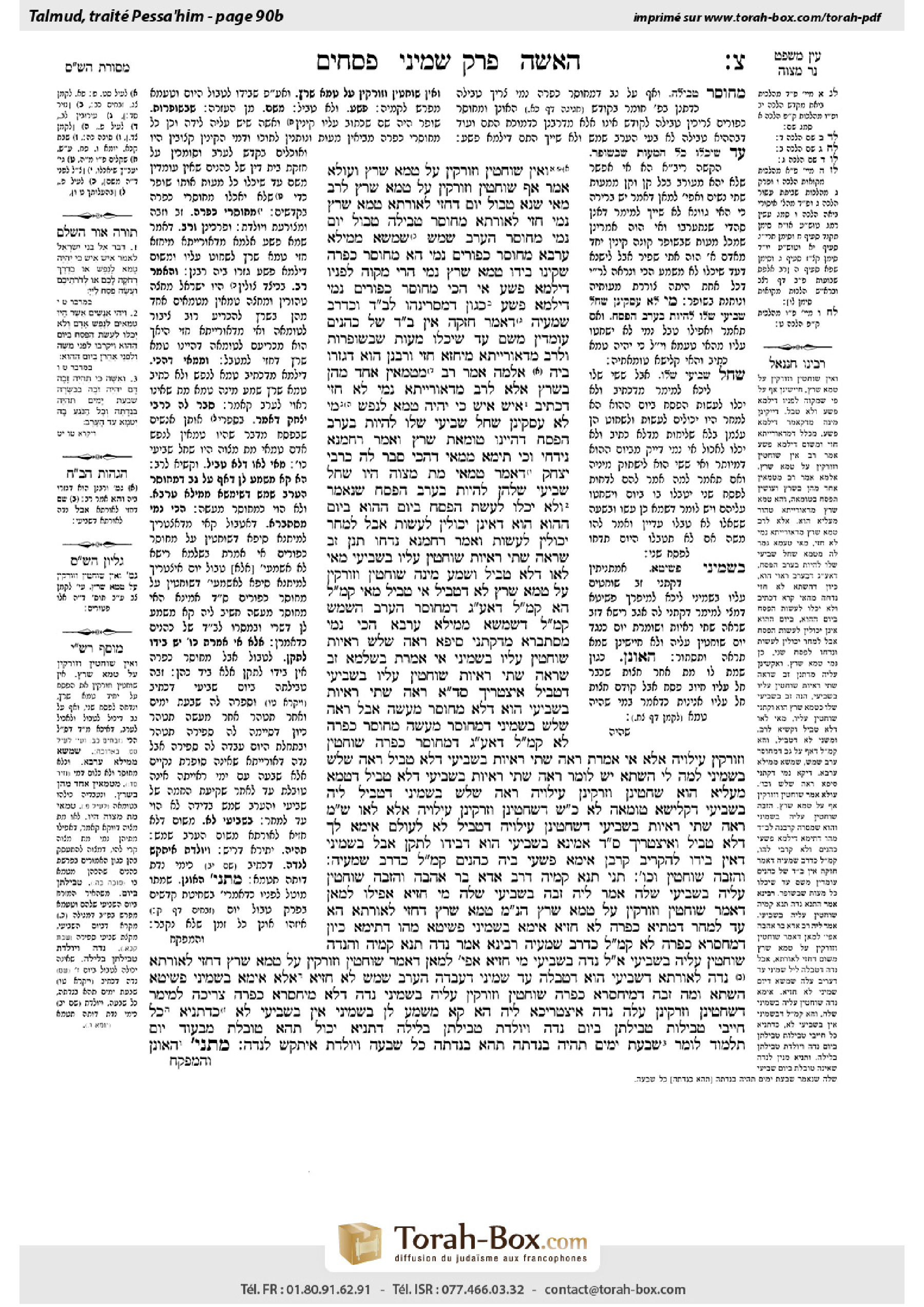
Pesachim 90b: Talmud study for Daf Yomi
Daf Yomi is the daily study of one Talmud folio. Explore 37 tractates with scans, Hebrew text, Sefaria English and AI-generated French translations where annotated.
Passage selection and English or AI-generated French translation are available where the scan has annotations. Daf Study is independent of Torah-Box and Sefaria.
Browse Pesachim · פסחים · All tractatesPesachim 90b text and translations
This page of Pesachim includes the Aramaic text, an English translation and an AI-generated French translation, alongside the scan above.
פסחים צ׳ ב · Aramaic and Hebrew text
וְאֵין שׁוֹחֲטִין וְזוֹרְקִין עַל טְמֵא שֶׁרֶץ. וְעוּלָּא אָמַר: אַף שׁוֹחֲטִין וְזוֹרְקִין עַל טְמֵא שֶׁרֶץ.
לְרַב, מַאי שְׁנָא טְבוּל יוֹם — דַּחֲזֵי לְאוּרְתָּא? טְמֵא שֶׁרֶץ נָמֵי חֲזֵי לְאוּרְתָּא! מְחוּסָּר טְבִילָה.
טְבוּל יוֹם נָמֵי — מְחוּסָּר הֶעֱרֵב שֶׁמֶשׁ! שִׁמְשָׁא מִמֵּילָא עָרְבָא.
מְחוּסַּר כִּפּוּרִים נָמֵי — הָא מְחוּסַּר כַּפָּרָה! שֶׁקִּינּוֹ בְּיָדוֹ.
טְמֵא שֶׁרֶץ נָמֵי — הֲרֵי מִקְוֶה לְפָנָיו! דִּילְמָא פָּשַׁע. אִי הָכִי, מְחוּסַּר כִּפּוּרִים נָמֵי דִּילְמָא פָּשַׁע! כְּגוֹן דְּמַסְרִינְהוּ לְבֵית דִּין,
וְכִדְרַב שְׁמַעְיָה, דְּאָמַר: חֲזָקָה אֵין בֵּית דִּין שֶׁל כֹּהֲנִים עוֹמְדִין מִשָּׁם עַד שֶׁיִּכְלוּ מָעוֹת שֶׁבַּשּׁוֹפָרוֹת.
וּלְרַב, מִדְּאוֹרָיְיתָא מִיחְזֵא חֲזֵי וְרַבָּנַן הוּא דִּגְזַרוּ בֵּיהּ, אַלְּמָה אָמַר רַב מְטַמְּאִין אֶחָד מֵהֶן בְּשֶׁרֶץ.
אֶלָּא, לְרַב מִדְּאוֹרָיְיתָא נָמֵי לָא חֲזֵי, דִּכְתִיב: ״אִישׁ אִישׁ כִּי יִהְיֶה טָמֵא לָנֶפֶשׁ״. מִי לָא עָסְקִינַן שֶׁחָל שְׁבִיעִי שֶׁלּוֹ לִהְיוֹת בְּעֶרֶב הַפֶּסַח, דְּהַיְינוּ טוּמְאַת שֶׁרֶץ, וְאָמַר רַחֲמָנָא: נִידְּחֵי!
וְכִי תֵּימָא מִמַּאי דְּהָכִי?
סָבַר לַהּ כְּרַבִּי יִצְחָק, דְּאָמַר: טְמֵאֵי מֵת מִצְוָה הָיוּ, שֶׁחָל שְׁבִיעִי שֶׁלָּהֶן לִהְיוֹת בְּעֶרֶב הַפֶּסַח, שֶׁנֶּאֱמַר: ״וְלֹא יָכְלוּ לַעֲשֹׂת הַפֶּסַח בַּיּוֹם הַהוּא״, בְּיוֹם הַהוּא הוּא דְּאֵינָן יְכוֹלִין לַעֲשׂוֹת, אֲבָל לְמָחָר יְכוֹלִין לַעֲשׂוֹת, וְאָמַר רַחֲמָנָא: נִדְּחוֹ.
תְּנַן: זָב שֶׁרָאָה שְׁתֵּי רְאִיּוֹת — שׁוֹחֲטִין עָלָיו בַּשְּׁבִיעִי. מַאי לָאו — דְּלָא טָבֵיל, וּשְׁמַע מִינַּהּ: שׁוֹחֲטִין וְזוֹרְקִין עַל טְמֵא שֶׁרֶץ!
לָא, דְּטָבֵיל. אִי טָבֵיל, מַאי קָא מַשְׁמַע לַן! הָא קָא מַשְׁמַע לַן, דְּאַף עַל גַּב דִּמְחוּסַּר הֶעֱרֵב הַשֶּׁמֶשׁ, קָא מַשְׁמַע לַן דְּשִׁמְשָׁא מִמֵּילָא עָרְבָא.
הָכִי נָמֵי מִסְתַּבְּרָא, מִדְּקָתָנֵי סֵיפָא: רָאָה שָׁלֹשׁ רְאִיּוֹת — שׁוֹחֲטִין עָלָיו בַּשְּׁמִינִי. אִי אָמְרַתְּ בִּשְׁלָמָא זָב שֶׁרָאָה שְׁתֵּי רְאִיּוֹת שׁוֹחֲטִין עָלָיו בַּשְּׁבִיעִי, דְּטָבֵיל — אִיצְטְרִיךְ.
סָלְקָא דַּעְתָּךְ אָמֵינָא, רָאָה שְׁתֵּי רְאִיּוֹת בִּשְׁבִיעִי הוּא דְּלָא מְחוּסַּר מַעֲשֶׂה, אֲבָל רָאָה שָׁלֹשׁ בַּשְּׁמִינִי, דִּמְחוּסַּר מַעֲשֶׂה — מְחוּסַּר כַּפָּרָה, לָא. קָא מַשְׁמַע לַן דְּאַף עַל גַּב דִּמְחוּסַּר כַּפָּרָה, שׁוֹחֲטִין וְזוֹרְקִין עִילָּוֵיהּ.
אֶלָּא אִי אָמְרַתְּ רָאָה שְׁתֵּי רְאִיּוֹת בִּשְׁבִיעִי, דְּלָא טָבֵיל — רָאָה שָׁלֹשׁ בַּשְּׁמִינִי לְמָה לִי?
הַשְׁתָּא יֵשׁ לוֹמַר רָאָה שְׁתֵּי רְאִיּוֹת בַּשְּׁבִיעִי, דְּלָא טָבֵיל, דְּטָמֵא מְעַלְּיָא הוּא — שָׁחֲטִינַן וְזָרְקִינַן עִילָּוֵיהּ. רָאָה שָׁלֹשׁ בַּשְּׁמִינִי, דְּטָבֵיל לֵיהּ בַּשְּׁבִיעִי, דִּקְלִישָׁא טוּמְאָה — לֹא כׇּל שֶׁכֵּן דְּשָׁחֲטִינַן וְזָרְקִינַן עִילָּוֵיהּ!
אֶלָּא לָאו, שְׁמַע מִינַּהּ: רָאָה שְׁתֵּי רְאִיּוֹת בַּשְּׁבִיעִי דְּשָׁחֲטִינַן עִילָּוֵיהּ, דְּטָבֵיל.
לָא, לְעוֹלָם אֵימָא לָךְ דְּלָא טָבֵיל, וְאִיצְטְרִיךְ. סָלְקָא דַּעְתָּךְ אָמֵינָא בַּשְּׁבִיעִי הוּא דִּבְיָדוֹ לְתַקֵּן,
אֲבָל בַּשְּׁמִינִי דְּאֵין בְּיָדוֹ לְהַקְרִיב קׇרְבָּן, אֵימָא פָּשְׁעִי בֵּיהּ כֹּהֲנִים, קָא מַשְׁמַע לַן כִּדְרַב שְׁמַעְיָה.
וְהַזָּבָה שׁוֹחֲטִין וְכוּ׳. תָּנֵי תַּנָּא קַמֵּיהּ דְּרַב אַדָּא בַּר אַהֲבָה: ״וְהַזָּבָה שׁוֹחֲטִין עָלֶיהָ בַּשְּׁבִיעִי שֶׁלָּהּ״. אֲמַר לֵיהּ: זָבָה בַּשְּׁבִיעִי שֶׁלָּהּ מִי חַזְיָא? אֲפִילּוּ לְמַאן דְּאָמַר שׁוֹחֲטִין וְזוֹרְקִין עַל טְמֵא שֶׁרֶץ, הָנֵי מִילֵּי טְמֵא שֶׁרֶץ — דַּחֲזֵי לְאוּרְתָּא, הָא — עַד לִמְחַר דְּמַתְיָא כַּפָּרָה לָא חַזְיָא! אֵימָא: ״בַּשְּׁמִינִי״.
פְּשִׁיטָא! מַהוּ דְּתֵימָא כֵּיוָן דִּמְחַסְּרָא כַּפָּרָה — לָא, קָא מַשְׁמַע לַן כִּדְרַב שְׁמַעְיָה.
רָבִינָא אָמַר — ״נִדָּה״ תְּנָא קַמֵּיהּ: ״וְהַנִּדָּה שׁוֹחֲטִין עָלֶיהָ בַּשְּׁבִיעִי״.
אֲמַר לֵיהּ: נִדָּה בַּשְּׁבִיעִי מִי חַזְיָא? אֲפִילּוּ לְמַאן דְּאָמַר שׁוֹחֲטִין וְזוֹרְקִין עַל טְמֵא שֶׁרֶץ, דַּחֲזֵי לְאוּרְתָּא, נִדָּה לְאוּרְתָּא דִשְׁבִיעִי הוּא דְּטָבְלָה, עַד שְׁמִינִי דְּעָבְדָה הֶעֱרֵב שֶׁמֶשׁ לָא חַזְיָא! אֶלָּא אֵימָא: ״בַּשְּׁמִינִי״.
פְּשִׁיטָא! הַשְׁתָּא וּמָה זָבָה דִּמְיחַסְּרָא כַּפָּרָה — שׁוֹחֲטִין וְזוֹרְקִין עָלֶיהָ בַּשְּׁמִינִי, נִדָּה דְּלָא מְיחַסְּרָא כַּפָּרָה — צְרִיכָה לְמֵימַר דְּשָׁחֲטִינַן וְזָרְקִינַן עֲלַהּ?!
נִדָּה אִיצְטְרִיכָא לֵיהּ, הָא קָא מַשְׁמַע לַן: בַּשְּׁמִינִי אִין, בַּשְּׁבִיעִי לָא, כִּדְתַנְיָא: כׇּל חַיָּיבֵי טְבִילוֹת טְבִילָתָן בַּיּוֹם, נִדָּה וְיוֹלֶדֶת טְבִילָתָן בַּלַּיְלָה.
דְּתַנְיָא: יָכוֹל תְּהֵא טוֹבֶלֶת מִבְּעוֹד יוֹם? תַּלְמוּד לוֹמַר: ״שִׁבְעַת יָמִים תִּהְיֶה בְּנִדָּתָהּ״ — תְּהֵא בְּנִדָּתָהּ כׇּל שִׁבְעָה. וְיוֹלֶדֶת אִיתַּקַּשׁ לְנִדָּה.
מַתְנִי׳ הָאוֹנֵן,
Pesachim 90b · English translation
And one does not slaughter the Paschal lamb and sprinkle its blood on behalf of one who is ritually impure due to contact with a creeping animal, although he could immerse that day and thereby ensure he will be ritually pure for the evening. And Ulla said: One slaughters the Paschal lamb and sprinkles its blood even for one who is ritually impure due to contact with a creeping animal.
The Gemara discusses the rationale behind Rav’s ruling: According to Rav, what is different about one who is ritually impure with a type of ritual impurity such that once he has immersed himself during the day he will become fully ritually pure upon nightfall that, despite presently being impure, one may offer the Paschal lamb on his behalf? It is due to the fact that he is fit to eat it by night. But why, then, is the Paschal lamb not offered on behalf of one who is ritually impure due to contact with a creeping animal? He can also be fit to eat it by night by immersing in a ritual bath. The Gemara answers: He lacks immersion in a ritual bath.
But one who immersed himself during the day and will become ritually pure upon nightfall also lacks the setting of the sun, i.e., nightfall. The Gemara explains the distinction: The sun sets by itself, and no action on the part of the one who is ritually impure is required to complete the purification process. A Paschal lamb may therefore be brought on his behalf.
But one who still lacks an atonement offering to complete his purification process also lacks an action, because he must still bring his atonement offering. Why may he nevertheless be registered for a Paschal lamb? The Gemara answers: His nest, i.e., the pair of doves he will offer as his atonement, is already in his possession, ready to be offered. It is therefore presumed he will immediately do so.
But one ritually impure due to contact with a creeping animal is also immediately able to become ritually pure, because the ritual bath is before him and he can immerse in it. Why does this not permit him to be registered for a Paschal lamb? The Gemara answers: The reason a Paschal lamb may not be brought on his behalf is due to concern that perhaps he will be neglectful and not immerse. Therefore, it cannot be assumed with certainty that by the evening he will be ritually pure. If so, in the case of one who still lacks an atonement offering, shouldn’t there also be concern that perhaps he will be neglectful and will not bring his offering? The baraita deals with a case such as one in which he has already handed over his pair of doves to the court of priests, in order that they offer them on his behalf. Therefore, it may be assumed with certainty that by the evening he will be ritually pure.
And this is in accordance with the teaching of Rav Shemaya, who said that there is a presumption that the court of priests will not stand up from there, i.e., their place of meeting in the Temple, until all the money in the collection boxes, which was placed there in order that the priests should use the money to bring offerings on the donors’ behalf, is used up. The priests ensure that any money they receive for offerings is used to purchase the offering and sacrifice it that same day. Certainly, if they were actually entrusted with an animal in order to sacrifice it, they would also do that on the very same day.
The Gemara asks: And according to Rav, it would appear that by Torah law one who is ritually impure due to contact with a creeping animal is fit to have the Paschal lamb slaughtered on his behalf, and it is the Sages who decreed that he is unfit, out of concern that he will be negligent. If so, why did Rav say with regard to a community that was half ritually pure and half impure: We contaminate one of them with a creeping animal so that the majority will be ritually impure, which will permit the entire community to offer the Paschal lamb in a state of ritual impurity? If, by Torah law, one who is ritually impure due to contact with a creeping animal is fit to have an offering brought on his behalf, how then can he tip the balance of the entire community such that the majority is considered ritually impure and unfit to bring the Paschal lamb in purity?
Rather, according to Rav, by Torah law he is also unfit to have an offering brought on his behalf, as it is written: “If any man of you or of your posterity shall be ritually impure due to a dead body... he shall still offer the Paschal lamb to the Lord. The fourteenth day of the second month…they shall offer it” (Numbers 9:10–11). Are we not dealing with all who are “ritually impure due to a dead body”? This includes one whose seventh day occurred on Passover eve. If they sprinkle on him that day he will immediately become ritually pure, which is the same situation as ritual impurity caused by a creeping animal, and nonetheless the Torah states that he shall be deferred, as he is considered unfit.
And if you say: From where do we know that this is so, that the verse is referring to those who are able to become ritually pure by that evening? Perhaps it is referring specifically to one who is ritually impure from a corpse before the completion of his seven-day purification process and will therefore not be ritually pure that evening.
He holds in accordance with the opinion of Rabbi Yitzḥak, who said: The ritually impure people in the desert asked Moses what they should do concerning their obligation to bring a Paschal lamb. It is about them that the verses pertaining to the second Pesaḥ were originally stated. They were ritually impure from a corpse that had no one to bury it [met mitzva], and their seventh day occurred on Passover eve, as it is stated: “They could not perform the Paschal lamb on that day” (Numbers 9:6). By inference, it was only on that day that they were unable to perform it, but the next day they would have been able to perform it by completing their purification process; and nonetheless the Torah said that they should be deferred.
The Gemara presents a challenge from the mishna to the opinion of Rav that a Paschal lamb may not be offered on behalf of someone who is ritually impure from a creeping animal: We learned in the mishna: In the case of a zav who saw two sightings of gonorrheal discharge, one slaughters the Paschal lamb on his behalf if Passover eve is on his seventh day. The Gemara suggests: What, is it not referring to a case in which he has not yet immersed in a ritual bath, and we may therefore learn from it that we also may slaughter and sprinkle on behalf of one who is ritually impure from a creeping animal, since his level of impurity is identical to a zav who saw two sightings?
No, the mishna is referring to a zav who already immersed. But if he already immersed, what is it teaching us? Since he will become ritually pure upon nightfall, surely it is obvious that a Paschal lamb may be offered on his behalf. It teaches us this: That even though he still lacks the setting of the sun, a Paschal lamb may nevertheless be brought on his behalf. It therefore teaches us that since the sun sets by itself, and no action of his own is required to complete his purification process, the fact that he currently has still not completed his purification process does not disqualify him.
So too, it is reasonable to establish the mishna as referring to a zav who had already immersed, from the fact that the last clause of the mishna taught: With regard to a zav who saw three sightings, one slaughters the Paschal lamb on his behalf on the eighth day. Granted, if you say that the first clause, which states: With regard to a zav who saw two sightings, one slaughters on his behalf on the seventh day, is referring to a case in which he had already immersed, then it is necessary to teach the last clause for the following reason:
It could enter your mind to say that it is true only with regard to a zav who saw two sightings and is now on his seventh day, for he, having already immersed, does not lack any action; but a zav who saw three sightings and is now on his eighth day, who lacks an action in that he still lacks his atonement offering, no, a Paschal lamb may not be offered on his behalf. The last clause therefore must teach us that although he still lacks his atonement offering, one slaughters and sprinkles on his behalf.
But if you say that the first clause, which states: With regard to a zav who saw two sightings, one slaughters on his behalf on the seventh day, is referring to a case in which he had not already immersed, then why do I need the last clause, which states: With regard to a zav who saw three sightings, one slaughters on his behalf on the eighth day? This clause could be logically deduced from the first one, as follows:
Now, it can be said: In the case of a zav who saw two sightings and is on his seventh day and has not yet immersed, and he is therefore still completely impure, one nevertheless slaughters and sprinkles the Paschal lamb on his behalf, since he can become pure by the evening. So too, with regard to a zav who saw three sightings and is now on his eighth day, and who has already immersed on the seventh day, and his impurity is therefore weakened in that he does not impart impurity to that which he touches, despite the fact that he is still prohibited to enter the Temple or partake of offerings until he brings his atonement offering, is it not all the more so true that one should slaughter and sprinkle on his behalf? Therefore, the last clause would be superfluous.
Rather, must one not conclude from the preceding analysis that the first clause, which states: With regard to a zav who saw two sightings, one slaughters on his behalf on the seventh day, is referring to a case in which he has already immersed?
No, one should not come to such a conclusion. Actually, I can say to you that the mishna is referring to a case in which one did not yet immerse, and it is necessary to teach the last clause concerning a zav who saw three sightings, because it could enter your mind to say that it is only for a zav who saw two sightings that the Paschal lamb may be offered on his behalf on the seventh, for it is within his ability to remedy the situation and purify himself by immersing in a ritual bath.
But then, on the eighth day of a zav who saw three sightings, when it is not within his ability to sacrifice the necessary offering, as he is dependent upon the priests to do it for him, say that perhaps the priests will be negligent with him. Perhaps his offering will not be brought, leaving him unfit for the Paschal lamb. Due to this concern, a Paschal lamb should not be offered on his behalf. The last clause therefore teaches us that there is no such concern, in accordance with the teaching of Rav Shemaya, who maintains that the court of the priests may be relied upon with certainty.
We learned in the mishna: And with regard to a zava; one slaughters a Paschal lamb on her behalf on the eighth day after her sightings. The tanna taught a baraita before Rav Adda bar Ahava: And with regard to a zava, one slaughters a Paschal lamb on her behalf on her seventh day. He said to him: Is a zava fit to have a Paschal lamb offered on her behalf on her seventh day? Even according to the one who says one slaughters and sprinkles on behalf of one who is impure from a creeping animal, this applies only to one who is ritually impure from a creeping animal, who will be fit to eat the Paschal lamb by the evening, but this zava will not be fit until the following day, when she brings her atonement offering. Rather, emend the baraita you quoted and say: Her eighth day instead of: Her seventh day.
The Gemara asks: It is obvious that a Paschal lamb may be offered on behalf of a zava on her eighth day. It is necessary to teach this halakha lest you say that since she lacks the offering of an atonement to complete her purification process, there is a concern that the priests will be negligent and she will not be ritually pure by the evening. This halakha therefore teaches us that there is no such concern, in accordance with the teaching of Rav Shemaya that the court of the priests may be relied upon with certainty.
Ravina said: The tanna didn’t teach the case of a zava; rather, he taught the case of a menstruating woman who is ritually impure due to her menstruation. She must count seven days from her first flow of blood, and then from the following night she can become ritually pure by immersing in a ritual bath. According to this, the baraita teaches: And with regard to a menstruating woman, one slaughters for her on the seventh day of her impurity.
He said to him: Is a menstruating woman fit on the seventh? Even according to the one who says one slaughters and sprinkles on behalf of one who is impure from a creeping animal, this is because he will be fit to eat the Paschal lamb by the evening. But a menstruating woman only immerses on the night following the seventh day, and until the eighth day, when she experiences the setting of the sun, she is not fully ritually pure and is not fit to partake of offerings. Rather, emend the baraita you quoted and say: Her eighth day, instead of: Her seventh day.
The Gemara asks: It is obvious that a Paschal lamb may be offered on behalf of a menstruating woman on her eighth day, as demonstrated by the following argument: Now, just as in the case of a zava who lacks the offering of an atonement to complete her purification process, one slaughters and sprinkles on her behalf on the eighth day, so too, with regard to a menstruating woman, who does not lack the offering of an atonement to complete her purification process, is it necessary to say that one slaughters and sprinkles on her behalf?
The Gemara explains that it was necessary for the baraita to teach the case of a menstruating woman because it teaches us that on the eighth day, yes, a Paschal lamb is offered on her behalf, but on the seventh day, no, as it was taught in a baraita: With regard to all those who are ritually impure and are obligated to immerse, their immersion is in the day, except for a menstruating woman and a woman after childbirth, whose immersion is at night.
As it was taught in a different baraita: I might have thought that a menstruating woman or a woman after childbirth should immerse while still day, like others who are obligated to immerse. Therefore, the verse states: “And if a woman should have an issue, and her issue in her flesh be blood, she shall be in her impurity seven days” (Leviticus 15:19), which indicates that she shall be in her state of impurity for a full seven days and doesn’t immerse until the night following the seventh day. And this is also true of a woman after childbirth, who is compared in the Torah to a menstruating woman in the verse “If a woman conceives and gives birth to a male, then she shall be unclean seven days, as in the days of her menstrual flow shall she be unclean” (Leviticus 12:2).
MISHNA: An acute mourner, i.e., a mourner on the day of the death of an immediate relative;
Pesachim 90b · Traduction française (IA)
On n’égorge pas non plus l’agneau pascal et on n’en asperge pas le sang pour celui qui est rituellement impur à la suite d’un contact avec un animal rampant, bien qu’il puisse s’immerger ce jour-là et être ainsi rituellement pur le soir. Et Oulla a dit : On égorge l’agneau pascal et on en asperge le sang même pour celui qui est rituellement impur à la suite d’un contact avec un animal rampant.
La Guemara examine le fondement de la décision de Rav : selon Rav, en quoi celui qui est atteint d’un type d’impureté rituelle tel qu’après s’être immergé dans la journée, il deviendra pleinement pur à la tombée de la nuit diffère-t-il, au point que, malgré son impureté actuelle, on puisse offrir l’agneau pascal pour lui ? C’est parce qu’il sera apte à le consommer le soir. Mais pourquoi, alors, ne pas offrir l’agneau pascal pour celui qui est rituellement impur à la suite d’un contact avec un animal rampant ? Lui aussi peut être apte à le consommer le soir en s’immergeant dans un bain rituel. La Guemara répond : Il lui manque l’immersion dans un bain rituel.
Mais celui qui s’est immergé dans la journée et deviendra rituellement pur à la tombée de la nuit doit lui aussi attendre le coucher du soleil. La Guemara explique la distinction : Le soleil se couche de lui-même, et aucune action de la part de celui qui est rituellement impur n’est nécessaire pour achever le processus de purification. On peut donc apporter un agneau pascal pour lui.
Mais celui à qui il manque encore un sacrifice expiatoire pour achever son processus de purification doit lui aussi accomplir une action, puisqu’il doit encore apporter son sacrifice expiatoire. Pourquoi peut-il néanmoins être inscrit pour un agneau pascal ? La Guemara répond : Son nid, c’est-à-dire le couple de colombes qu’il offrira comme sacrifice expiatoire, est déjà en sa possession, prêt à être offert. On présume donc qu’il le fera immédiatement.
Mais celui qui est rituellement impur à la suite d’un contact avec un animal rampant peut lui aussi devenir pur immédiatement, car le bain rituel est devant lui et il peut s’y immerger. Pourquoi cela ne lui permet-il pas d’être inscrit pour un agneau pascal ? La Guemara répond : On ne peut pas apporter d’agneau pascal pour lui, par crainte qu’il fasse preuve de négligence et ne s’immerge pas. On ne peut donc pas tenir pour certain qu’il sera rituellement pur le soir. Si tel est le cas, pour celui à qui il manque encore un sacrifice expiatoire, ne devrait-on pas également craindre qu’il fasse preuve de négligence et n’apporte pas son sacrifice ? La baraïta traite d’un cas où, par exemple, il a déjà remis son couple de colombes au tribunal des prêtres, afin qu’ils les offrent pour lui. On peut donc tenir pour certain qu’il sera rituellement pur le soir.
Cela concorde avec l’enseignement de Rav Shemaya, qui a dit qu’on présume que le tribunal des prêtres ne se lève pas de là, c’est-à-dire de son lieu de réunion dans le Temple, tant que tout l’argent des troncs de collecte — déposé afin que les prêtres l’utilisent pour apporter des sacrifices au nom des donateurs — n’a pas été dépensé. Les prêtres veillent à ce que tout argent reçu pour des sacrifices serve à acheter le sacrifice et à l’offrir le jour même. À plus forte raison, s’ils se sont vu confier un animal à sacrifier, ils le feront également le jour même.
La Guemara demande : Selon Rav, il semblerait que, d’après la Torah, celui qui est rituellement impur à la suite d’un contact avec un animal rampant soit apte à ce que l’agneau pascal soit égorgé pour lui, et que ce soient les Sages qui l’aient déclaré inapte, par crainte qu’il fasse preuve de négligence. Si tel est le cas, pourquoi Rav a-t-il dit au sujet d’une communauté dont la moitié est rituellement pure et l’autre moitié impure : « Nous rendons l’un d’eux impur au moyen d’un animal rampant, afin que la majorité soit rituellement impure », ce qui permettra à toute la communauté d’offrir l’agneau pascal en état d’impureté rituelle ? Si, d’après la Torah, celui qui est rituellement impur à la suite d’un contact avec un animal rampant est apte à ce qu’un sacrifice soit apporté pour lui, comment peut-il faire pencher la balance pour toute la communauté, de sorte que la majorité soit considérée comme rituellement impure et inapte à apporter l’agneau pascal en état de pureté ?
Au contraire, selon Rav, d’après la Torah, il est lui aussi inapte à ce qu’un sacrifice soit apporté pour lui, comme il est écrit : « Si quelqu’un parmi vous ou parmi vos descendants est rituellement impur à cause d’un mort… il offrira néanmoins l’agneau pascal au Seigneur. Le quatorzième jour du deuxième mois… ils l’offriront » (Nombres 9:10-11). Ne s’agit-il pas ici de tous ceux qui sont « rituellement impurs à cause d’un mort » ? Cela inclut celui dont le septième jour tombe la veille de Pessa’h. Si on l’asperge ce jour-là, il deviendra immédiatement rituellement pur ; sa situation est donc identique à celle d’une personne rendue impure par un animal rampant. Pourtant, la Torah dit qu’il doit être reporté, car il est considéré comme inapte.
Et si tu dis : D’où savons-nous qu’il en est ainsi, que le verset parle de ceux qui peuvent devenir rituellement purs ce soir-là ? Peut-être parle-t-il spécifiquement de celui qui est rituellement impur à cause d’un mort avant la fin de son processus de purification de sept jours et qui ne sera donc pas rituellement pur ce soir-là.
Il suit l’opinion de Rabbi Yitzḥak, qui a dit : Les personnes rituellement impures dans le désert demandèrent à Moïse ce qu’elles devaient faire au sujet de leur obligation d’apporter un agneau pascal. C’est à leur propos que furent initialement énoncés les versets concernant le second Pessa’h. Elles étaient rituellement impures à cause d’un mort dont personne ne pouvait assurer l’enterrement [met mitsva], et leur septième jour tombait la veille de Pessa’h, comme il est dit : « Elles ne purent accomplir le sacrifice pascal ce jour-là » (Nombres 9:6). On en déduit qu’elles ne purent l’accomplir que ce jour-là, mais que le lendemain elles auraient pu le faire en achevant leur processus de purification ; et pourtant la Torah dit qu’elles doivent être reportées.
La Guemara oppose à l’opinion de Rav, selon laquelle on ne peut pas offrir l’agneau pascal pour quelqu’un qui est rituellement impur à cause d’un animal rampant, une difficulté tirée de la Michna : Nous avons appris dans la Michna : Dans le cas d’un zav qui a eu deux écoulements de gonorrhée, on égorge l’agneau pascal pour lui si la veille de Pessa’h tombe son septième jour. La Guemara suggère : Ne s’agit-il pas d’un cas où il ne s’est pas encore immergé dans un bain rituel ? On pourrait donc en déduire qu’on peut également égorger et asperger le sang pour celui qui est rituellement impur à cause d’un animal rampant, puisque son degré d’impureté est identique à celui d’un zav ayant eu deux écoulements.
Non, la Michna parle d’un zav qui s’est déjà immergé. Mais s’il s’est déjà immergé, que nous enseigne-t-elle ? Puisqu’il deviendra rituellement pur à la tombée de la nuit, il est évident qu’on peut offrir un agneau pascal pour lui. Elle nous enseigne ceci : bien qu’il doive encore attendre le coucher du soleil, on peut néanmoins apporter un agneau pascal pour lui. Elle nous apprend donc que, puisque le soleil se couche de lui-même et qu’aucune action de sa part n’est nécessaire pour achever son processus de purification, le fait qu’il ne l’ait pas encore achevé ne le disqualifie pas.
De même, il est raisonnable d’établir que la Michna parle d’un zav qui s’était déjà immergé, comme le montre le fait que la dernière partie de la Michna enseigne : Dans le cas d’un zav qui a eu trois écoulements, on égorge l’agneau pascal pour lui le huitième jour. Certes, si tu dis que la première partie, qui dit : « Dans le cas d’un zav qui a eu deux écoulements, on égorge pour lui le septième jour », parle d’un cas où il s’était déjà immergé, alors il est nécessaire d’enseigner la dernière partie pour la raison suivante :
On pourrait penser que cela ne vaut que pour un zav qui a eu deux écoulements et en est maintenant à son septième jour : comme il s’est déjà immergé, aucune action ne lui manque. Mais pour un zav qui a eu trois écoulements et en est maintenant à son huitième jour, auquel il manque une action puisqu’il lui manque encore son sacrifice expiatoire, non, on ne peut pas offrir d’agneau pascal pour lui. La dernière partie doit donc nous enseigner que, bien qu’il lui manque encore son sacrifice expiatoire, on égorge l’agneau pascal et on en asperge le sang pour lui.
Mais si tu dis que la première partie, qui dit : « Dans le cas d’un zav qui a eu deux écoulements, on égorge pour lui le septième jour », parle d’un cas où il ne s’était pas encore immergé, pourquoi ai-je besoin de la dernière partie, qui dit : « Dans le cas d’un zav qui a eu trois écoulements, on égorge pour lui le huitième jour » ? Cette partie pourrait se déduire logiquement de la première, comme suit :
On peut alors dire ceci : Dans le cas d’un zav qui a eu deux écoulements, en est à son septième jour et ne s’est pas encore immergé — il est donc encore pleinement impur —, on égorge l’agneau pascal et on en asperge le sang pour lui, puisqu’il peut devenir pur le soir. À plus forte raison, dans le cas d’un zav qui a eu trois écoulements et en est maintenant à son huitième jour, qui s’est déjà immergé le septième jour et dont l’impureté est donc atténuée, puisqu’il ne transmet pas l’impureté à ce qu’il touche, bien qu’il lui soit encore interdit d’entrer dans le Temple ou de consommer des sacrifices avant d’avoir apporté son sacrifice expiatoire : ne devrait-on pas égorger l’agneau pascal et en asperger le sang pour lui ? La dernière partie serait donc superflue.
Ne faut-il pas plutôt conclure de l’analyse précédente que la première partie, qui dit : « Dans le cas d’un zav qui a eu deux écoulements, on égorge pour lui le septième jour », parle d’un cas où il s’est déjà immergé ?
Non, il ne faut pas tirer une telle conclusion. En réalité, je peux te dire que la Michna parle d’un cas où il ne s’est pas encore immergé, et qu’il est nécessaire d’enseigner la dernière partie concernant un zav qui a eu trois écoulements, car on pourrait penser que l’agneau pascal ne peut être offert pour un zav qui a eu deux écoulements que le septième jour, puisqu’il lui est possible de remédier à la situation et de se purifier en s’immergeant dans un bain rituel.
Mais, le huitième jour d’un zav qui a eu trois écoulements, lorsqu’il ne lui est pas possible d’apporter lui-même le sacrifice requis, puisqu’il dépend des prêtres pour qu’ils l’offrent à sa place, on pourrait dire que les prêtres feront peut-être preuve de négligence à son égard. Peut-être son sacrifice ne sera-t-il pas offert, ce qui le rendrait inapte à l’agneau pascal. Par crainte de cela, on ne devrait pas offrir d’agneau pascal pour lui. La dernière partie nous enseigne donc qu’il n’y a pas lieu de s’inquiéter ainsi, conformément à l’enseignement de Rav Shemaya, qui soutient qu’on peut se fier avec certitude au tribunal des prêtres.
Nous avons appris dans la Michna : « Et, dans le cas d’une zava, on égorge un agneau pascal pour elle le huitième jour après ses écoulements. » Le tanna enseigna une baraïta devant Rav Adda bar Ahava : « Et, dans le cas d’une zava, on égorge un agneau pascal pour elle le septième jour. » Il lui dit : Une zava est-elle apte à ce qu’on offre un agneau pascal pour elle le septième jour ? Même selon celui qui dit qu’on égorge l’agneau pascal et qu’on en asperge le sang pour une personne qui est rituellement impure à cause d’un animal rampant, cela ne vaut que pour une personne qui sera apte à consommer l’agneau pascal le soir ; mais cette zava ne sera apte que le lendemain, lorsqu’elle apportera son sacrifice expiatoire. Corrige plutôt la baraïta que tu as citée et dis : « Son huitième jour », au lieu de : « Son septième jour ».
La Guemara demande : Il est évident qu’on peut offrir un agneau pascal pour une zava le huitième jour. Il fallait enseigner cette halakha de peur que tu dises que, puisqu’il lui manque encore un sacrifice expiatoire pour achever son processus de purification, on craigne que les prêtres fassent preuve de négligence et qu’elle ne soit pas rituellement pure le soir. Cette halakha nous enseigne donc qu’il n’y a pas lieu de s’inquiéter ainsi, conformément à l’enseignement de Rav Shemaya, selon lequel on peut se fier avec certitude au tribunal des prêtres.
Ravina a dit : Le tanna n’a pas enseigné le cas d’une zava ; il a plutôt enseigné celui d’une femme menstruée, rituellement impure à cause de ses règles. Elle doit compter sept jours à partir de son premier écoulement de sang, puis, dès la nuit suivante, elle peut devenir rituellement pure en s’immergeant dans un bain rituel. Selon cela, la baraïta enseigne : « Dans le cas d’une femme menstruée, on égorge pour elle le septième jour de son impureté. »
Il lui dit : Une femme menstruée est-elle apte le septième jour ? Même selon celui qui dit qu’on égorge l’agneau pascal et qu’on en asperge le sang pour une personne qui est rituellement impure à cause d’un animal rampant, c’est parce qu’elle sera apte à consommer l’agneau pascal le soir. Mais une femme menstruée ne s’immerge que dans la nuit qui suit le septième jour ; jusqu’au huitième jour, au coucher du soleil, elle n’est pas pleinement pure rituellement et n’est pas apte à consommer des sacrifices. Corrige plutôt la baraïta que tu as citée et dis : « Son huitième jour », au lieu de : « Son septième jour ».
La Guemara demande : Il est évident qu’on peut offrir un agneau pascal pour une femme menstruée le huitième jour, comme le montre l’argument suivant : De même que, dans le cas d’une zava à laquelle il manque encore un sacrifice expiatoire pour achever son processus de purification, on égorge l’agneau pascal et on en asperge le sang pour elle le huitième jour, à plus forte raison, dans le cas d’une femme menstruée, à laquelle il ne manque pas de sacrifice expiatoire pour achever son processus de purification, faut-il égorger l’agneau pascal et en asperger le sang pour elle.
La Guemara explique qu’il était nécessaire que la baraïta enseigne le cas d’une femme menstruée, car elle nous apprend que le huitième jour, oui, on offre un agneau pascal pour elle, mais pas le septième jour. En effet, une baraïta enseigne : Pour toutes les personnes qui sont rituellement impures et tenues de s’immerger, l’immersion a lieu pendant la journée, à l’exception d’une femme menstruée et d’une femme après l’accouchement, qui s’immergent la nuit.
Comme l’enseigne une autre baraïta : J’aurais pu penser qu’une femme menstruée ou une femme après l’accouchement devait s’immerger pendant la journée, comme les autres personnes tenues de s’immerger. C’est pourquoi le verset dit : « Si une femme a un écoulement et que le sang de cet écoulement est dans sa chair, elle sera dans son impureté pendant sept jours » (Lévitique 15:19). Cela indique qu’elle doit rester dans son état d’impureté pendant sept jours complets et qu’elle ne s’immerge que dans la nuit qui suit le septième jour. Il en va de même pour une femme après l’accouchement, que la Torah compare à une femme menstruée dans le verset : « Si une femme conçoit et met au monde un garçon, elle sera impure pendant sept jours ; elle sera impure comme aux jours de ses règles » (Lévitique 12:2).
Michna : Un endeuillé anin, c’est-à-dire une personne en deuil le jour du décès d’un proche parent ;
Traduction française générée par IA à partir de l’édition anglaise de Sefaria. Vérifie toujours un passage avec le texte source.
Text from Sefaria: William Davidson Edition - Vocalized Aramaic (CC BY NC); William Davidson Edition - English (CC BY NC).