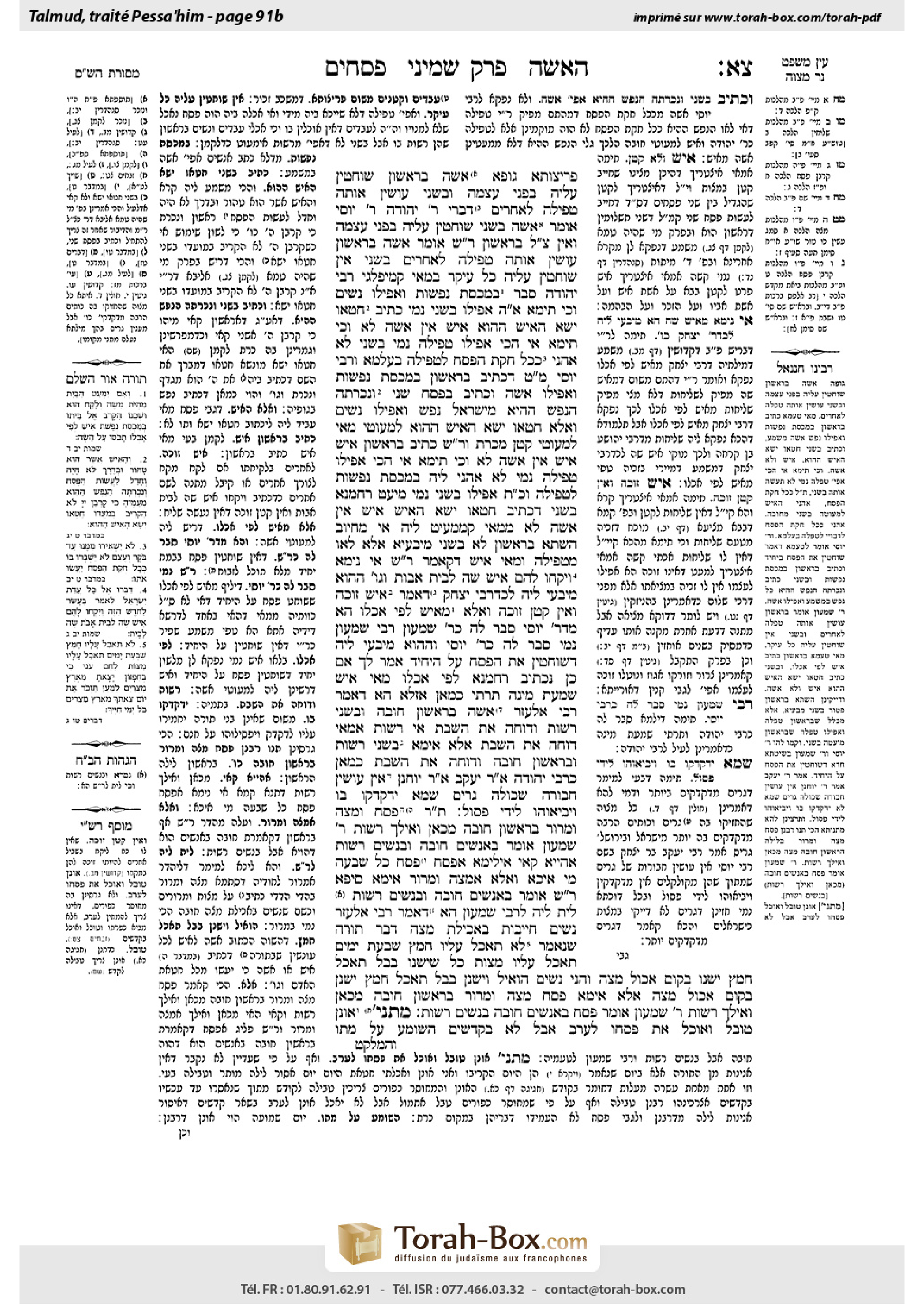
Pesachim 91b: Talmud study for Daf Yomi
Daf Yomi is the daily study of one Talmud folio. Explore 37 tractates with scans, Hebrew text, Sefaria English and AI-generated French translations where annotated.
Passage selection and English or AI-generated French translation are available where the scan has annotations. Daf Study is independent of Torah-Box and Sefaria.
Browse Pesachim · פסחים · All tractatesPesachim 91b text and translations
This page of Pesachim includes the Aramaic text, an English translation and an AI-generated French translation, alongside the scan above.
פסחים צ״א ב · Aramaic and Hebrew text
פְּרִיצוּתָא.
גּוּפָא: אִשָּׁה בָּרִאשׁוֹן — שׁוֹחֲטִין עָלֶיהָ בִּפְנֵי עַצְמָהּ, וּבַשֵּׁנִי עוֹשִׂין אוֹתָהּ טְפֵילָה לַאֲחֵרִים, דִּבְרֵי רַבִּי יְהוּדָה. רַבִּי יוֹסֵי אוֹמֵר: אִשָּׁה בַּשֵּׁנִי — שׁוֹחֲטִין עָלֶיהָ בִּפְנֵי עַצְמָהּ, וְאֵין צָרִיךְ לוֹמַר בָּרִאשׁוֹן. רַבִּי שִׁמְעוֹן אוֹמֵר: אִשָּׁה בָּרִאשׁוֹן — עוֹשִׂין אוֹתָהּ טְפֵילָה לַאֲחֵרִים, בַּשֵּׁנִי אֵין שׁוֹחֲטִין עָלֶיהָ כָּל עִיקָּר.
בְּמַאי קָמִיפַּלְגִי? רַבִּי יְהוּדָה סָבַר: ״בְּמִכְסַת נְפָשֹׁת״, וַאֲפִילּוּ נָשִׁים. וְכִי תֵּימָא, אִי הָכִי אֲפִילּוּ בַּשֵּׁנִי נָמֵי? כְּתִיב: ״חֶטְאוֹ יִשָּׂא הָאִישׁ הַהוּא״. אִישׁ — אִין, אִשָּׁה — לָא.
וְכִי תֵּימָא, אִי הָכִי אֲפִילּוּ טְפִילָה נָמֵי בַּשֵּׁנִי לָא? אַהֲנִי ״כְּכׇל חֻקַּת הַפֶּסַח״ לִטְפִילָה בְּעָלְמָא.
וְרַבִּי יוֹסֵי מַאי טַעְמָא? דִּכְתִיב בָּרִאשׁוֹן: ״בְּמִכְסַת נְפָשֹׁת״ — וַאֲפִילּוּ אִשָּׁה, וּכְתִיב בְּפֶסַח שֵׁנִי: ״וְנִכְרְתָה הַנֶּפֶשׁ הַהִוא מֵעַמֶּיהָ״, נֶפֶשׁ — וַאֲפִילּוּ נָשִׁים. וְאֶלָּא: ״חֶטְאוֹ יִשָּׂא הָאִישׁ הַהוּא״, לְמַעוֹטֵי מַאי? לְמַעוֹטֵי קָטָן מִכָּרֵת.
וְרַבִּי שִׁמְעוֹן: כְּתִיב בָּרִאשׁוֹן ״אִישׁ״, אִישׁ — אִין, אִשָּׁה — לָא. וְכִי תֵּימָא, אִי הָכִי אֲפִילּוּ טְפִילָה נָמֵי לָא? אַהֲנִי לֵיהּ ״בְּמִכְסַת נְפָשֹׁת״ לִטְפִילָה.
וְכִי תֵּימָא, אֲפִילּוּ בַּשֵּׁנִי נָמֵי. מִיעֵט רַחֲמָנָא בַּשֵּׁנִי, דִּכְתִיב: ״חֶטְאוֹ יִשָּׂא הָאִישׁ״, אִישׁ — אִין, אִשָּׁה — לָא. מִמַּאי קָמְמַעֵיט לֵיהּ? אִי מֵחִיּוּב — הַשְׁתָּא בָּרִאשׁוֹן לָא, בַּשֵּׁנִי מִיבַּעְיָא? אֶלָּא לָאו, מִטְּפִילָה.
וּמַאי ״אִישׁ״ דְּקָאָמַר רַבִּי שִׁמְעוֹן? אִי נֵימָא: ״וְיִקְחוּ לָהֶם אִישׁ שֶׂה לְבֵית אָבוֹת וְגוֹ׳״ — הַהוּא מִיבְּעֵי לֵיהּ לְכִדְרַבִּי יִצְחָק, דְּאָמַר: אִישׁ זוֹכֶה, וְאֵין קָטָן זוֹכֶה.
וְאֶלָּא ״מֵאִישׁ לְפִי אׇכְלוֹ״, הָא מִדְּרַבִּי יוֹסֵי סָבַר לַהּ כְּרַבִּי שִׁמְעוֹן, רַבִּי שִׁמְעוֹן נָמֵי סָבַר לַהּ כְּרַבִּי יוֹסֵי, וְהַהוּא מִיבְּעֵי לֵיהּ דְּשׁוֹחֲטִין אֶת הַפֶּסַח עַל הַיָּחִיד.
אָמַר לָךְ: אִם כֵּן נִכְתּוֹב רַחֲמָנָא ״לְפִי אׇכְלוֹ״. מַאי ״אִישׁ״ — שָׁמְעַתְּ מִינַּהּ תַּרְתֵּי.
כְּמַאן אָזְלָא הָא דְּאָמַר רַבִּי אֶלְעָזָר: אִשָּׁה בָּרִאשׁוֹן חוֹבָה וּבַשֵּׁנִי רְשׁוּת, וְדוֹחֶה אֶת הַשַּׁבָּת. אִי רְשׁוּת, אַמַּאי דּוֹחֶה אֶת הַשַּׁבָּת? אֶלָּא אֵימָא: בַּשֵּׁנִי רְשׁוּת וּבָרִאשׁוֹן חוֹבָה, וְדוֹחֶה אֶת הַשַּׁבָּת. כְּמַאן — כְּרַבִּי יְהוּדָה.
אָמַר רַבִּי יַעֲקֹב אָמַר רַבִּי יוֹחָנָן: אֵין עוֹשִׂין חֲבוּרָה שֶׁכּוּלָּהּ גֵּרִים, שֶׁמָּא יְדַקְדְּקוּ בּוֹ וִיבִיאוּהוּ לִידֵי פְּסוּל.
תָּנוּ רַבָּנַן: פֶּסַח וּמַצָּה וּמָרוֹר, בָּרִאשׁוֹן — חוֹבָה, מִכָּאן וְאֵילָךְ — רְשׁוּת, רַבִּי שִׁמְעוֹן אוֹמֵר: בָּאֲנָשִׁים חוֹבָה וּבַנָּשִׁים רְשׁוּת.
אַהֵיָיא קָאֵי? אִילֵּימָא אַפֶּסַח, פֶּסַח כׇּל שִׁבְעָה מִי אִיכָּא? וְאֶלָּא אַמַּצָּה וּמָרוֹר, אֵימָא סֵיפָא: רַבִּי שִׁמְעוֹן אוֹמֵר: בָּאֲנָשִׁים חוֹבָה וּבְנָשִׁים רְשׁוּת,
לֵית לֵיהּ לְרַבִּי שִׁמְעוֹן הָא דְּאָמַר רַבִּי אֶלְעָזָר: נָשִׁים חַיָּיבוֹת בַּאֲכִילַת מַצָּה דְּבַר תּוֹרָה, שֶׁנֶּאֱמַר: ״לֹא תֹאכַל עָלָיו חָמֵץ שִׁבְעַת יָמִים תֹּאכַל עָלָיו מַצּוֹת״ — כֹּל שֶׁיֶּשְׁנוֹ בְּבַל תֹּאכַל חָמֵץ, יֶשְׁנוֹ בְּקוּם אֱכוֹל מַצָּה. וְהָנֵי נָשִׁים, הוֹאִיל וְיֶשְׁנָן בְּבַל תֹּאכַל חָמֵץ, יֶשְׁנָן בְּקוּם אֱכוֹל מַצָּה!
אֶלָּא אֵימָא: פֶּסַח מַצָּה וּמָרוֹר, בָּרִאשׁוֹן — חוֹבָה, מִכָּאן וְאֵילָךְ — רְשׁוּת. רַבִּי שִׁמְעוֹן אוֹמֵר: פֶּסַח בָּאֲנָשִׁים חוֹבָה, בַּנָּשִׁים רְשׁוּת.
מַתְנִי׳ אוֹנֵן — טוֹבֵל וְאוֹכֵל אֶת פִּסְחוֹ לָעֶרֶב, אֲבָל לֹא בַּקֳּדָשִׁים. הַשּׁוֹמֵעַ עַל מֵתוֹ,
Pesachim 91b · English translation
promiscuity, i.e., homosexual behavior.
The Gemara returns to discuss the matter itself, i.e., the baraita partly cited previously, the full version of which states: A woman; on the first Pesaḥ, one slaughters the Paschal lamb on her behalf even if she is by herself. And on the second Pesaḥ, we make her ancillary to others, i.e., she may join others in a group registered for a Paschal lamb but we do not slaughter a lamb on her behalf if she is by herself; this is the statement of Rabbi Yehuda. Rabbi Yosei says: A woman; on the second Pesaḥ, one slaughters the Paschal lamb on her behalf even if she is by herself. And needless to say we also slaughter on her behalf even if she is by herself on the first Pesaḥ. Rabbi Shimon says: A woman; on the first Pesaḥ we make her ancillary to others, and on the second Pesaḥ we do not slaughter on her behalf at all.
With regard to what do they disagree? The Gemara explains that they disagree about how to interpret the various verses that refer to the first and second Pesaḥ: Rabbi Yehuda holds that the use of the word souls in the verse: “According to the number of the souls…you shall make your count for the lamb” (Exodus 12:4), includes everyone, and even women, in the first Pesaḥ. And if you say that if so, even on the second Pesaḥ, women should also be included, but it is written with regard to one who had not offered a Paschal lamb on the first Pesaḥ and then neglected to bring one on the second Pesaḥ: “That man shall bear his sin” (Numbers 9:13), which indicates that a man, yes, he is liable for not having brought a Paschal lamb on the second Pesaḥ, but a woman, no, she is not liable.
And if you say that if so, a woman should be totally excluded from participating in the second Pesaḥ, and even in a group in an ancillary manner on the second Pesaḥ she should have no part, this is not correct, because the verse states: “According to the entire statute of the Paschal lamb they shall offer it” (Numbers 9:12). The verse compares the first Pesaḥ to the second, and it is therefore effective to enable women to be included in a group in a merely ancillary manner.
And Rabbi Yosei, what is the reason for his opinion? As it is written with regard to the first Pesaḥ: “According to the number of the souls,” which includes even a woman. And it is written with regard to the second Pesaḥ: “The man who is ritually pure, and is not on a journey, and refrains from offering the Paschal lamb, that same soul shall be cut off from among his people” (Numbers 9:13). The word soul includes even women. But if so, the conclusion of that verse, which states: “That man shall bear his sin,” which appears to emphasize that specifically a man is liable for not participating in the second Pesaḥ, is there to exclude what case? It is there to exclude a minor who did not participate in the Paschal lamb from the punishment of karet.
And Rabbi Shimon, what is the reason for his opinion? It is written in a verse concerning the first Pesaḥ “man.” This teaches that a man, yes, a Paschal lamb may be brought on his behalf alone, but a woman, no. And if you say that if so, a woman should be totally excluded from participating even in a group in an ancillary manner, this is not correct, because the verse states: “According to the number of the souls,” which certainly includes women, and it is therefore effective to enable women to be included in a group in an ancillary manner.
And if you say that according to this, even on the second Pesaḥ women should be able to participate as part of a group, this is not correct, because the Torah excludes women from participating on the second Pesaḥ, as it is written: “That man shall bear his sin.” This indicates that a man, yes; a woman, no. From what precisely does the verse exclude women? If you say it is from the obligation to participate in the second Pesaḥ, this cannot be. Since now, on the first Pesaḥ, a woman has no obligation, on the second Pesaḥ is it necessary to say that a woman is not obligated? This is obvious, since the second Pesaḥ exists only as a second opportunity for those who neglected to participate in the first Pesaḥ. Rather, is it not clear that the verse excludes women from participating even in an ancillary fashion?
The Gemara clarifies the source for Rabbi Shimon’s opinion that women are excluded also from the first Pesaḥ. And what is the verse that employs the term “man” that Rabbi Shimon spoke of with regard to the first Pesaḥ? If we say that he is referring to the verse: “They shall take to them every man a lamb, according to their fathers’ houses, a lamb for a household” (Exodus 12:3), this is incorrect, because he needs that verse for the derivation of Rabbi Yitzḥak, who said: We learn from that verse that only a man, i.e., an adult, can acquire an object on behalf of others; but a minor cannot acquire on behalf of others.
Rather, perhaps Rabbi Shimon derived his halakha from the verse: “According to every man’s eating you shall make your count for the lamb” (Exodus 12:4). This is problematic. Since Rabbi Yosei holds in accordance with the opinion of Rabbi Shimon, that a Paschal lamb cannot be offered on an improvised altar, presumably Rabbi Shimon also holds in accordance with the opinion of Rabbi Yosei, that a Paschal lamb can be slaughtered for an individual. If so, Rabbi Shimon needs that verse, “according to every man’s eating,” in order to teach that we may slaughter the Paschal lamb for an individual, since that verse is the source of Rabbi Yosei’s halakha.
The Gemara justifies that Rabbi Shimon does indeed use the verse as the source of his opinion with regard to the first Pesaḥ: Rabbi Shimon could have said to you: If so, if it were true that the verse was only meant to teach Rabbi Yosei’s halakha concerning improvised altars, the Torah should have simply written: According to his eating, which is phrased in the singular and therefore indicates that the Paschal lamb may be slaughtered for an individual. What then is the significance of the additional term “man”? It must be that you learn from the verse two separate halakhot, that the Paschal lamb may be slaughtered for an individual and that it must be for a man and not a woman.
In accordance with whose opinion is that which Rabbi Elazar said: A woman’s participation in the first Pesaḥ is mandatory, and her participation in the second Pesaḥ is optional and overrides Shabbat? Before resolving this question, the Gemara questions whether Rabbi Elazar’s opinion is even reasonable: If offering the second Pesaḥ is optional for a woman, why does it override Shabbat? Rather, emend his statement and say: A woman’s participation in the second Pesaḥ is optional, and her participation in the first Pesaḥ is mandatory and overrides Shabbat. In accordance with whose opinion is this ruling? It is in accordance with the view of Rabbi Yehuda, as stated previously.
Rabbi Ya’akov said that Rabbi Yoḥanan said: We do not make a group for the Paschal lamb that is composed entirely of converts, because perhaps they will be overly meticulous with it and cause it to become unnecessarily disqualified. Converts can be especially zealous in their observance, and out of ignorance may cause an offering to be unnecessarily disqualified by adding extra details to the requirements of the offering.
The Sages taught in a baraita: Eating the Paschal lamb and matza and bitter herbs on the first night of Passover is mandatory. From here on, i.e., the remaining days, it is optional. Rabbi Shimon says: For men it is mandatory and for women it is optional.
The Gemara clarifies the precise intention of the last clause of the first tanna: To which part of the baraita does the halakha that eating after the first night is optional refer? If you say it is referring to the Paschal lamb, is there a Paschal lamb all seven days? Certainly not, and consequently it does not make sense to speak of whether eating it is mandatory or optional after the first night. Rather, if you say that it is referring to matza and bitter herbs, how will you say and explain accordingly the last part of the baraita, i.e., Rabbi Shimon says: For men it is mandatory and for women it is optional. If the second clause is referring only to matza and bitter herbs, then Rabbi Shimon would appear to be saying that women are exempt from eating them.
This is difficult: Does Rabbi Shimon not accept that which Rabbi Elazar said, that women are obligated in the command of eating matza by Torah law, despite the fact that it is a time-bound, positive mitzva, as it is stated: “You shall eat no leavened bread with it; seven days shall you eat matzot with it” (Deuteronomy 16:3), which teaches that all who are subject to the prohibition to not eat leavened bread are also subject to the positive mitzva to arise and eat matza? And those women, since they are subject to the prohibition to not eat leavened bread, since women are required to observe all the prohibitions of the Torah, they are subject also to the positive mitzva to arise and eat matza. Clearly, Rabbi Shimon was not referring to matza.
Rather, say instead that the baraita should be read as follows: Eating the Paschal lamb, matza, and bitter herbs on the first day of Passover is mandatory. From here on, i.e., the remaining days of Passover, it is optional to eat matza and bitter herbs. Rabbi Shimon says: The Paschal lamb is mandatory for men and optional for women, in accordance with his opinion stated previously.
MISHNA: An acute mourner, i.e., a mourner on the day of the death of an immediate relative, is prohibited from eating sacrificial food. By Torah law, the prohibition applies only to the day of death itself, but it is permitted to partake of sacrificial food on the following night. By rabbinic decree, the period of acute mourning is extended to include the night as well. Despite this, an acute mourner immerses and eats his Paschal lamb in the evening. But he may still not eat other sacrificial food. However, one who hears about the death of his dead, i.e., he discovers that one of his immediate relatives died more than thirty days after the death, his status of acute mourning applies on a rabbinic level.
Pesachim 91b · Traduction française (IA)
La promiscuité, c’est-à-dire les relations homosexuelles.
La Guemara revient sur le sujet lui-même, c’est-à-dire sur la baraïta citée en partie précédemment, dont la version complète dit : « Une femme : lors du premier Pessa’h, on immole l’agneau pascal pour elle, même si elle est seule. Lors du second Pessa’h, on l’associe à d’autres », c’est-à-dire qu’elle peut se joindre à un groupe inscrit pour un agneau pascal, mais on n’immole pas d’agneau pour elle si elle est seule. Telle est l’opinion de Rabbi Yehuda. Rabbi Yosei dit : « Une femme : lors du second Pessa’h, on immole l’agneau pascal pour elle, même si elle est seule. » À plus forte raison l’immole-t-on pour elle, même si elle est seule, lors du premier Pessa’h. Rabbi Shimon dit : « Une femme : lors du premier Pessa’h, on l’associe à d’autres, et lors du second Pessa’h, on n’immole pas du tout d’agneau pour elle. »
Sur quoi porte leur désaccord ? La Guemara explique qu’ils divergent sur l’interprétation des différents versets qui font référence au premier et au second Pessa’h. Rabbi Yehuda considère que l’emploi du mot « personnes » dans le verset : « Selon le nombre de personnes […] vous ferez le compte pour l’agneau » (Exode 12,4), inclut tout le monde, y compris les femmes, dans le premier Pessa’h. Et si tu dis que, dans ce cas, les femmes devraient également être incluses dans le second Pessa’h, il est pourtant écrit au sujet de celui qui n’a pas offert d’agneau pascal lors du premier Pessa’h et qui néglige ensuite d’en apporter un lors du second : « Cet homme portera son péché » (Nombres 9,13). Cela indique qu’un homme, oui, est passible pour n’avoir pas apporté d’agneau pascal lors du second Pessa’h, mais qu’une femme, non, ne l’est pas.
Et si tu dis que, dans ce cas, une femme devrait être totalement exclue de la participation au second Pessa’h et n’avoir aucune part dans un groupe, même à titre accessoire, ce n’est pas exact, car le verset dit : « Selon toute la règle du sacrifice pascal, ils l’offriront » (Nombres 9,12). Le verset établit une comparaison entre le premier et le second Pessa’h ; il permet donc aux femmes de prendre part à un groupe, mais seulement à titre accessoire.
Et quelle est la raison de l’opinion de Rabbi Yosei ? Il est écrit au sujet du premier Pessa’h : « Selon le nombre de personnes », ce qui inclut même une femme. Et il est écrit au sujet du second Pessa’h : « L’homme qui est rituellement pur, qui n’est pas en voyage et qui s’abstient d’offrir l’agneau pascal, cette personne sera retranchée du milieu de son peuple » (Nombres 9,13). Le mot « personne » inclut même les femmes. Mais dans ce cas, que vient exclure la conclusion de ce verset, qui dit : « Cet homme portera son péché » et semble souligner que seul un homme est passible pour ne pas avoir participé au second Pessa’h ? Elle vient exclure du châtiment du retranchement un mineur qui n’a pas participé au sacrifice pascal.
Et quelle est la raison de l’opinion de Rabbi Shimon ? Un verset relatif au premier Pessa’h emploie le mot « homme ». Cela enseigne qu’un homme, oui, peut avoir un agneau pascal offert pour lui seul, mais qu’une femme, non. Et si tu dis que, dans ce cas, une femme devrait être totalement exclue de la participation, même à titre accessoire dans un groupe, ce n’est pas exact, car le verset dit : « Selon le nombre de personnes », ce qui inclut certainement les femmes et permet donc qu’elles soient incluses dans un groupe à titre accessoire.
Et si tu dis qu’en conséquence les femmes devraient pouvoir participer à un groupe même lors du second Pessa’h, ce n’est pas exact, car la Torah exclut les femmes de la participation au second Pessa’h, comme il est écrit : « Cet homme portera son péché. » Cela indique qu’un homme, oui, mais une femme, non. De quoi précisément le verset exclut-il les femmes ? Si tu dis qu’il les exclut de l’obligation de participer au second Pessa’h, cela ne peut pas être. Puisqu’une femme n’a aucune obligation lors du premier Pessa’h, faut-il vraiment préciser qu’elle n’est pas tenue de participer au second ? C’est évident, puisque le second Pessa’h n’est qu’une seconde possibilité offerte à ceux qui ont négligé de participer au premier. N’est-il donc pas clair que le verset exclut les femmes de toute participation, même à titre accessoire ?
La Guemara précise la source de l’opinion de Rabbi Shimon, selon laquelle les femmes sont également exclues du premier Pessa’h. Quel est le verset contenant le terme « homme » auquel Rabbi Shimon faisait référence au sujet du premier Pessa’h ? Si l’on dit qu’il s’agit du verset : « Qu’ils prennent pour eux, chacun, un agneau, selon les maisons de leurs pères, un agneau par maisonnée » (Exode 12,3), ce n’est pas exact, car Rabbi Shimon a besoin de ce verset pour la déduction de Rabbi Yitzḥak, qui a dit : Nous apprenons de ce verset que seul un homme, c’est-à-dire un adulte, peut acquérir un objet au bénéfice d’autrui, mais qu’un mineur ne le peut pas.
Peut-être Rabbi Shimon a-t-il plutôt déduit sa halakha du verset : « Selon ce que chacun peut manger, vous ferez le compte pour l’agneau » (Exode 12,4). Cela pose problème. Puisque Rabbi Yosei partage l’opinion de Rabbi Shimon selon laquelle un agneau pascal ne peut pas être offert sur un autel improvisé, on peut supposer que Rabbi Shimon partage également l’opinion de Rabbi Yosei selon laquelle on peut immoler un agneau pascal pour une seule personne. Dans ce cas, Rabbi Shimon a besoin du verset « selon ce que chacun peut manger » pour enseigner qu’on peut immoler l’agneau pascal pour une seule personne, puisque ce verset est la source de la halakha de Rabbi Yosei.
La Guemara justifie que Rabbi Shimon utilise bien le verset comme source de son opinion au sujet du premier Pessa’h. Rabbi Shimon aurait pu te répondre : Dans ce cas, si le verset n’avait pour seul objet que d’enseigner la halakha de Rabbi Yosei concernant les autels improvisés, la Torah aurait simplement dû écrire : « Selon ce qu’il mange », au singulier, ce qui indiquerait que l’agneau pascal peut être immolé pour une seule personne. Quelle est donc la signification du terme supplémentaire « homme » ? Il faut en déduire deux halakhot distinctes : on peut immoler l’agneau pascal pour une seule personne, et cette personne doit être un homme, non une femme.
De l’opinion de qui relève ce que Rabbi Elazar a dit : « La participation d’une femme au premier Pessa’h est obligatoire, tandis que sa participation au second Pessa’h est facultative et l’emporte sur le Chabbat » ? Avant de résoudre cette question, la Guemara demande si l’opinion de Rabbi Elazar est même cohérente : si la participation au second Pessa’h est facultative pour une femme, pourquoi l’emporte-t-elle sur le Chabbat ? Il faut plutôt corriger sa déclaration et dire : « La participation d’une femme au second Pessa’h est facultative, tandis que sa participation au premier Pessa’h est obligatoire et l’emporte sur le Chabbat. » De l’opinion de qui relève cette décision ? De celle de Rabbi Yehuda, comme indiqué précédemment.
Rabbi Ya’akov a dit au nom de Rabbi Yoḥanan : On ne constitue pas de groupe pour l’agneau pascal composé uniquement de convertis, car ils pourraient se montrer trop scrupuleux à son sujet et entraîner sa disqualification sans nécessité. Les convertis peuvent faire preuve d’un zèle particulier dans l’observance et, par ignorance, disqualifier inutilement une offrande en ajoutant des exigences aux règles qui la régissent.
Les Sages ont enseigné dans une baraïta : Manger l’agneau pascal, la matsa et les herbes amères le premier soir de Pessa’h est obligatoire. À partir de là, c’est-à-dire pendant les jours restants, c’est facultatif. Rabbi Shimon dit : Pour les hommes, c’est obligatoire, et pour les femmes, c’est facultatif.
La Guemara précise le sens exact de la dernière clause du premier tanna : à quelle partie de la baraïta se rapporte la halakha selon laquelle manger après le premier soir est facultatif ? Si tu dis qu’elle se rapporte à l’agneau pascal, y a-t-il un agneau pascal pendant les sept jours ? Certainement pas ; il n’a donc aucun sens de parler de l’obligation ou du caractère facultatif de sa consommation après le premier soir. Si tu dis plutôt qu’elle se rapporte à la matsa et aux herbes amères, comment expliquer alors la dernière partie de la baraïta, à savoir la déclaration de Rabbi Shimon : « Pour les hommes, c’est obligatoire, et pour les femmes, c’est facultatif » ? Si cette seconde clause ne concerne que la matsa et les herbes amères, Rabbi Shimon semblerait dire que les femmes ne sont pas tenues d’en manger.
Cela pose problème : Rabbi Shimon ne reconnaît-il pas ce que Rabbi Elazar a dit, à savoir que les femmes sont tenues, par la Torah, d’accomplir la mitsva de manger de la matsa, bien qu’il s’agisse d’une mitsva positive liée au temps, comme il est dit : « Tu ne mangeras pas de pain levé avec elle ; pendant sept jours, tu mangeras des matsot avec elle » (Deutéronome 16,3) ? Cela enseigne que tous ceux qui sont soumis à l’interdiction de manger du pain levé sont également tenus d’accomplir la mitsva positive de manger de la matsa. Or, puisque les femmes sont soumises à l’interdiction de manger du pain levé — car elles doivent observer toutes les interdictions de la Torah —, elles sont également tenues d’accomplir la mitsva positive de manger de la matsa. Il est donc clair que Rabbi Shimon ne faisait pas référence à la matsa.
Il faut donc plutôt lire la baraïta ainsi : « Manger l’agneau pascal, la matsa et les herbes amères le premier jour de Pessa’h est obligatoire. À partir de là, c’est-à-dire pendant les jours restants de Pessa’h, manger de la matsa et des herbes amères est facultatif. » Rabbi Shimon dit : « L’agneau pascal est obligatoire pour les hommes et facultatif pour les femmes », conformément à l’opinion qu’il a exprimée précédemment.
MICHNA : Une personne en aninout, c’est-à-dire en deuil le jour du décès d’un proche parent, ne peut pas manger de nourriture consacrée. Selon la Torah, l’interdiction ne s’applique qu’au jour même du décès, mais il est permis de consommer de la nourriture consacrée la nuit suivante. Par décret rabbinique, la période d’aninout est également étendue à cette nuit. Malgré cela, une personne en aninout s’immerge et mange son agneau pascal le soir. Elle ne peut toutefois pas manger d’autres aliments consacrés. En revanche, celui qui apprend le décès de l’un de ses proches plus de trente jours après celui-ci — c’est-à-dire qui découvre qu’un proche parent est mort depuis plus de trente jours — a le statut de personne en aninout au niveau rabbinique.
Traduction française générée par IA à partir de l’édition anglaise de Sefaria. Vérifie toujours un passage avec le texte source.
Text from Sefaria: William Davidson Edition - Vocalized Aramaic (CC BY NC); William Davidson Edition - English (CC BY NC).