Pesachim 92a: Talmud study for Daf Yomi
Daf Yomi is the daily study of one Talmud folio. Explore 37 tractates with scans, Hebrew text, Sefaria English and AI-generated French translations where annotated.
Passage selection and English or AI-generated French translation are available where the scan has annotations. Daf Study is independent of Torah-Box and Sefaria.
Browse Pesachim · פסחים · All tractatesPesachim 92a text and translations
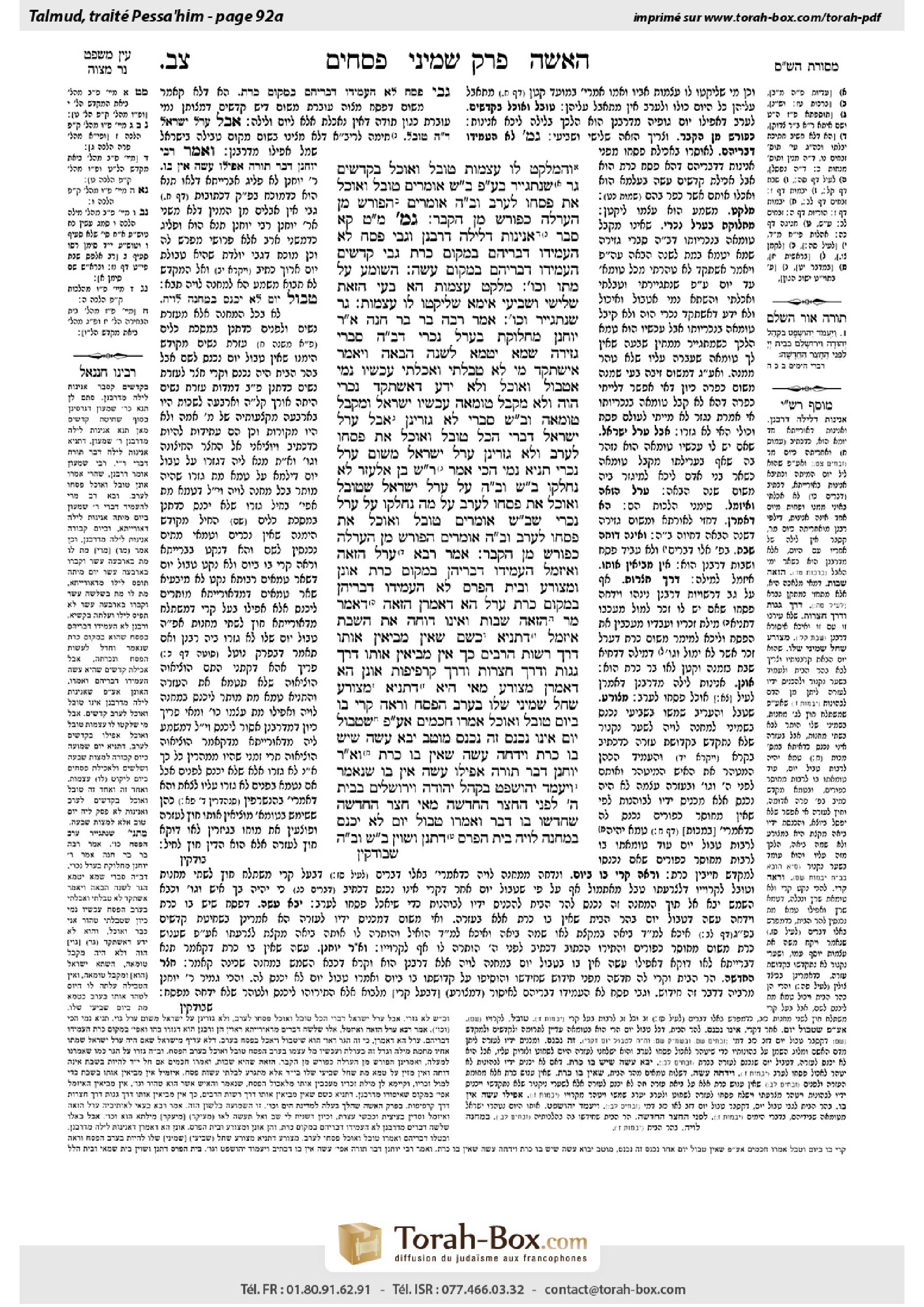
This page of Pesachim includes the Aramaic text, an English translation and an AI-generated French translation, alongside the scan above.
פסחים צ״ב א · Aramaic and Hebrew text
וְהַמְלַקֵּט לוֹ עֲצָמוֹת — טוֹבֵל וְאוֹכֵל בַּקֳּדָשִׁים.
גֵּר שֶׁנִּתְגַּיֵּיר בְּעֶרֶב פֶּסַח, בֵּית שַׁמַּאי אוֹמְרִים: טוֹבֵל וְאוֹכֵל אֶת פִּסְחוֹ לָעֶרֶב, וּבֵית הִלֵּל אוֹמְרִים: הַפּוֹרֵשׁ מִן הָעׇרְלָה כְּפוֹרֵשׁ מִן הַקֶּבֶר.
גְּמָ׳ מַאי טַעְמָא? קָא סָבַר אֲנִינוּת דְּלַיְלָה דְּרַבָּנַן, וְגַבֵּי פֶּסַח לֹא הֶעֱמִידוּ דִּבְרֵיהֶם בִּמְקוֹם כָּרֵת, גַּבֵּי קָדָשִׁים הַעֲמִידוּ דִּבְרֵיהֶם בִּמְקוֹם עֲשֵׂה.
הַשּׁוֹמֵעַ עַל מֵתוֹ וְכוּ׳. מְלַקֵּט עֲצָמוֹת? הָא בָּעֵי הַזָּאַת שְׁלִישִׁי וּשְׁבִיעִי! אֵימָא: שֶׁלִּיקְּטוּ לוֹ עֲצָמוֹת.
גֵּר שֶׁנִּתְגַּיֵּיר וְכוּ׳. אָמַר רַבָּה בַּר בַּר חָנָה אָמַר רַבִּי יוֹחָנָן: מַחֲלוֹקֶת בְּעָרֵל גּוֹי,
דְּבֵית הִלֵּל סָבְרִי: גְּזֵירָה שֶׁמָּא יִטָּמֵא לְשָׁנָה הַבָּאָה, וְיֹאמַר: אֶישְׁתָּקַד, מִי לֹא טָבַלְתִּי וְאָכַלְתִּי? עַכְשָׁיו נָמֵי אֶטְבּוֹל וְאוֹכַל. וְלָא יָדַע דְּאֶשְׁתָּקַד — גּוֹי הֲוָה וְלָא מְקַבֵּל טוּמְאָה, עַכְשָׁיו — יִשְׂרָאֵל וּמְקַבֵּל טוּמְאָה.
וּבֵית שַׁמַּאי סָבְרִי: לָא גָּזְרִינַן. אֲבָל עָרֵל יִשְׂרָאֵל — דִּבְרֵי הַכֹּל טוֹבֵל וְאוֹכֵל אֶת פִּסְחוֹ לָעֶרֶב, וְלָא גָּזְרִינַן עָרֵל יִשְׂרָאֵל מִשּׁוּם עָרֵל גּוֹי.
תַּנְיָא נָמֵי הָכִי, אָמַר רַבִּי שִׁמְעוֹן בֶּן אֶלְעָזָר: לֹא נֶחְלְקוּ בֵּית שַׁמַּאי וּבֵית הִלֵּל עַל עָרֵל יִשְׂרָאֵל שֶׁטּוֹבֵל וְאוֹכֵל אֶת פִּסְחוֹ לָעֶרֶב, עַל מָה נֶחְלְקוּ — עַל עָרֵל גּוֹי. שֶׁבֵּית שַׁמַּאי אוֹמְרִים: טוֹבֵל וְאוֹכֵל אֶת פִּסְחוֹ לָעֶרֶב, וּבֵית הִלֵּל אוֹמְרִים: הַפּוֹרֵשׁ מִן הָעׇרְלָה כְּפוֹרֵשׁ מִן הַקֶּבֶר.
אָמַר רָבָא: עָרֵל הַזָּאָה וְאִיזְמֵל — הֶעֱמִידוּ דִּבְרֵיהֶן בִּמְקוֹם כָּרֵת. אוֹנֵן וּמְצוֹרָע וּבֵית הַפְּרָס — לֹא הֶעֱמִידוּ דִּבְרֵיהֶן בִּמְקוֹם כָּרֵת.
עָרֵל — הָא דַּאֲמַרַן.
הַזָּאָה — דְּאָמַר מָר: הַזָּאָה שְׁבוּת וְאֵינוֹ דּוֹחֶה אֶת הַשַּׁבָּת.
אִיזְמֵל — דְּתַנְיָא: כְּשֵׁם שֶׁאֵין מְבִיאִין אוֹתוֹ דֶּרֶךְ רְשׁוּת הָרַבִּים, כָּךְ אֵין מְבִיאִין אוֹתוֹ דֶּרֶךְ גַּגּוֹת וְדֶרֶךְ חֲצֵרוֹת וְדֶרֶךְ קַרְפֵּיפוֹת.
אוֹנֵן — הָא דַּאֲמַרַן.
מְצוֹרָע — מַאי הִיא? דְּתַנְיָא: מְצוֹרָע שֶׁחָל שְׁמִינִי שֶׁלּוֹ בְּעֶרֶב הַפֶּסַח, וְרָאָה קֶרִי בּוֹ בַּיּוֹם — טוֹבֵל וְאוֹכֵל.
אָמְרוּ חֲכָמִים: אַף עַל פִּי שֶׁטְּבוּל יוֹם אֵינוֹ נִכְנָס, זֶה נִכְנָס. מוּטָב יָבֹא עֲשֵׂה שֶׁיֵּשׁ בּוֹ כָּרֵת, וְיִדְחֶה עֲשֵׂה שֶׁאֵין בּוֹ כָּרֵת.
וְאָמַר רַבִּי יוֹחָנָן: דְּבַר תּוֹרָה אֲפִילּוּ עֲשֵׂה אֵין בּוֹ, שֶׁנֶּאֱמַר: ״וַיַּעֲמֹד יְהוֹשָׁפָט בִּקְהַל יְהוּדָה וִירוּשָׁלִַים בְּבֵית ה׳ לִפְנֵי הֶחָצֵר הַחֲדָשָׁה״, מַאי חָצֵר הַחֲדָשָׁה? שֶׁחִדְּשׁוּ בּוֹ דָּבָר, וְאָמְרוּ: טְבוּל יוֹם לֹא יִכָּנֵס בְּמַחֲנֵה לְוִיָּה.
בֵּית הַפְּרָס, דִּתְנַן: וְשָׁוִין בֵּית שַׁמַּאי וּבֵית הִלֵּל
Pesachim 92a · English translation
And one who gathers the bones of his parents, who are buried in a temporary location for their flesh to decay and who is moving them to a permanent burial place must also observe a day of acute mourning by rabbinic decree. These mourners immerse and eat all types of sacrificial food at night. Since in these cases, even during the day, the mourning is by rabbinic decree, the Sages did not extend it into the evening.
With regard to a convert who converted on Passover eve, Beit Shammai say: He immerses and eats his Paschal lamb in the evening. And Beit Hillel say: One who separates from the foreskin by being circumcised is ritually impure, like one who separates from the grave after coming in contact with a corpse. Consequently, he must first observe the seven-day purification process necessary to remove ritual impurity imparted by a corpse. Only then, from the eighth day onward, may he partake of sacrificial meat.
GEMARA: What is the reason that an acute mourner may eat the Paschal lamb in the evening? The tanna of the mishna holds that the observance of acute mourning at night after the day of one’s relative’s death is a rabbinic prohibition. And with regard to the Paschal lamb, the Sages waived their prohibition because they did not uphold their statement prohibiting consumption of sacrificial food in a situation in which doing so would violate a prohibition that carries the punishment of karet, as is the case with one who neglects to offer the Paschal lamb. On the other hand, with regard to other sacrificial food, they maintained the prohibition, because they upheld their statement in a situation in which neglecting to eat the sacrificial food entails only the neglect of a positive mitzva.
We learned in the mishna: One who hears about the death of his dead relative more than thirty days after the death and one who gathers bones immerse and eat sacrificial food in the evening. The Gemara expresses surprise: Can this apply to one who gathers bones? But by doing so he came in contact with the bones of a corpse, and he needs sprinkling on the third and seventh days in order to become ritually pure. The Gemara answers: Emend the teaching of the mishna and instead say: One for whom they gathered bones, meaning that other people gathered the bones of his parents to transfer them to a new grave but he himself did not touch them, has a rabbinical requirement to observe a day of acute mourning, but he is not ritually impure.
We learned in the mishna: With regard to a convert who converted on Passover eve, there is a dispute between Beit Shammai and Beit Hillel as to whether he may immerse and eat the Paschal sacrifice in the evening. The Gemara discusses the scope of this dispute: Rabba bar bar Ḥana said that Rabbi Yoḥanan said that the dispute is about an uncircumcised gentile that was circumcised and converted on Passover eve.
Beit Hillel hold that there is a rabbinic decree due to a concern that perhaps he will become contaminated by a corpse in the following year and he will say: Last year, even though I had come in contact with a corpse previous to Passover, did I not immerse and eat the Paschal lamb without completing the purification process for impurity imparted by a corpse? Now also, I will immerse and eat. And he does not know and understand that last year, before his conversion on Passover eve, he was a gentile and therefore he was not susceptible to ritual impurity, because gentiles do not contract ritual impurity according to Torah law, but now he is a Jew and is susceptible to ritual impurity. Therefore, the Sages decreed that he should complete the seven-day purification process for impurity imparted by a corpse before he can partake of sacrificial food in order to avoid such a mistake.
And Beit Shammai hold that we do not make a decree due to this concern. But with regard to an uncircumcised Jew who for some reason had not been circumcised until Passover eve, all agree that he may immerse and eat his Paschal lamb in the evening. The concern that he will err the following year does not apply, and we do not decree in the case of an uncircumcised Jew who was circumcised on Passover eve, due to concern that the case will be confused with that of an uncircumcised gentile who was circumcised and converted on Passover eve.
That was also taught in a baraita: Rabbi Shimon ben Elazar said: Beit Shammai and Beit Hillel did not disagree about the fact that an uncircumcised Jew who was circumcised on Passover eve may immerse and eat his Paschal lamb in the evening. With regard to what did they disagree? With regard to an uncircumcised gentile who converted on Passover eve. Beit Shammai say that he may immerse and eat his Paschal lamb in the evening, and Beit Hillel say that one who separates from the foreskin is ritually impure like one who separates from the grave.
Rava said: With regard to an uncircumcised gentile who converted, sprinkling the purification waters to purify impurity imparted by a corpse, and a circumcision scalpel [izmel], the Sages upheld their statement even in a situation in which doing so would violate a prohibition that carries the punishment of karet. However, with regard to an acute mourner, a leper, and a beit haperas, an area in which a doubt exists concerning the location of a grave or a corpse, they did not uphold their statement in a situation in which doing so would violate a prohibition that carries the punishment of karet.
The Gemara details all the cases Rava referred to: The case of an uncircumcised gentile who converted is as we have said previously. Beit Hillel disqualify a convert from offering the Paschal lamb, despite the fact that neglecting to do so renders one liable to receive karet.
The case of sprinkling the purification waters to purify impurity imparted by a corpse is as the Master said in a mishna: Sprinkling is prohibited on Shabbat due to rabbinic decree, and it does not override Shabbat even on Passover eve, despite the fact that one who requires sprinkling will then be unable to offer the Paschal lamb.
The case of the circumcision scalpel is as it was taught in a baraita: If a circumcision scalpel was not brought to the location of the baby from before Shabbat, just as we may not bring it through a public domain in violation of Torah law, so too we may not bring it through roofs, through courtyards, and through enclosures, even though carrying in this manner is prohibited by rabbinic decree. One who has an uncircumcised member of his household may not bring a Paschal lamb and is liable for karet. The Sages maintained the prohibition of carrying the scalpel in all circumstances, even when doing so would mean the baby would remain uncircumcised on Passover eve, preventing his household from offering a Paschal lamb.
The Gemara lists the cases where the Sages waived their prohibition in the face of a prohibition carrying the punishment of karet: The case of an acute mourner is that which we said in the mishna.
The case of the leper, what is it? It is as it was taught in a baraita: A leper is ritually impure and must undergo an involved, eight-day purification process, which culminates on the eighth day with the bringing of various offerings in the Temple. If his eighth day occurs on Passover eve, such that it would be possible to bring his offerings and be fit to partake of the Paschal lamb that evening, and he saw an occurrence of semen on that day, and one who experiences such a discharge is ritually impure and prohibited from entering the Temple, he may immerse in order to purify himself from the discharge and then bring his offerings and eat the Paschal lamb at night.
The Sages said: Although normally, with regard to ritual impurity from seminal discharge, one who has immersed on that day may not enter the Temple until nightfall, this one may enter. The reason is that it is better for a positive mitzva that has a punishment of karet, i.e., the bringing of the Paschal lamb, to come and override a positive mitzva that does not have a punishment of karet, i.e., the mitzva of “They shall send out from the camp every leper and whoever has had issue, and whoever is unclean by the dead” (Numbers 5:2), which requires the removal from the Temple of one who has immersed that day and will become pure only upon nightfall.
And furthermore, Rabbi Yoḥanan said: By Torah law, there is not even a positive mitzva that restricts one who has immersed that day and will become pure only upon nightfall from entering the Temple, as it is stated: “And Jehoshaphat stood in the congregation of Judea and Jerusalem, in the House of the Lord, before the new courtyard” (II Chronicles 20:5). What is indicated by identifying the courtyards as the new courtyard? It indicates that they innovated something in it, and they said: One who has immersed on that day but will become pure only upon nightfall may not enter the Levite camp, which includes the entire Temple Mount. This suggests that the prohibition is of rabbinic origin and is not a positive mitzva.
The case of a beit haperas, in which the Sages did not uphold their decree, is as it was taught in a mishna: And Beit Shammai and Beit Hillel agree
Pesachim 92a · Traduction française (IA)
Celui qui recueille les ossements de ses parents, enterrés provisoirement en attendant que leur chair se décompose, afin de les transférer dans une sépulture définitive, doit lui aussi observer, par décret rabbinique, une journée de deuil intense. Ces endeuillés s’immergent et consomment toutes sortes d’aliments consacrés le soir. Puisque, dans ces cas, le deuil observé durant la journée est lui aussi d’origine rabbinique, les Sages ne l’ont pas prolongé jusqu’au soir.
Au sujet d’un converti qui s’est converti la veille de Pessa’h, Beit Chammaï dit : « Il s’immerge et consomme son sacrifice pascal le soir. » Beit Hillel dit : « Celui qui se sépare du prépuce par la circoncision est rituellement impur, comme celui qui s’éloigne d’une tombe après avoir été en contact avec un mort. » Il doit donc d’abord observer le processus de purification de sept jours nécessaire pour éliminer l’impureté transmise par un mort. Ce n’est qu’à partir du huitième jour qu’il peut consommer de la viande consacrée.
GUEMARA : Pour quelle raison un endeuillé en deuil intense peut-il consommer le sacrifice pascal le soir ? Le tanna de la Michna considère que l’observance du deuil intense durant la nuit qui suit le jour du décès de son proche est une interdiction rabbinique. Or, pour le sacrifice pascal, les Sages ont levé leur interdiction, car ils n’ont pas maintenu leur décision interdisant la consommation d’aliments consacrés dans une situation où cela entraînerait la transgression d’une interdiction passible de karet, comme c’est le cas pour celui qui néglige d’offrir le sacrifice pascal. En revanche, pour les autres aliments consacrés, ils ont maintenu l’interdiction, car ils ont maintenu leur décision dans une situation où négliger de consommer ces aliments consacrés n’entraîne que le manquement à une mitsva positive.
Nous avons appris dans la Michna : celui qui apprend le décès d’un proche plus de trente jours après celui-ci, et celui qui recueille des ossements, s’immergent et consomment des aliments consacrés le soir. La Guemara s’étonne : cela peut-il s’appliquer à celui qui recueille des ossements ? En agissant ainsi, il est entré en contact avec les ossements d’un mort, et il doit recevoir l’aspersion le troisième et le septième jour pour devenir rituellement pur. La Guemara répond : corrige l’enseignement de la Michna et dis plutôt : celui pour qui on a recueilli des ossements, c’est-à-dire que d’autres personnes ont recueilli les ossements de ses parents pour les transférer dans une nouvelle tombe, mais que lui-même ne les a pas touchés, est tenu, par prescription rabbinique, d’observer une journée de deuil intense, sans être rituellement impur.
Nous avons appris dans la Michna : au sujet d’un converti qui s’est converti la veille de Pessa’h, Beit Chammaï et Beit Hillel sont en désaccord sur le point de savoir s’il peut s’immerger et consommer le sacrifice pascal le soir. La Guemara précise la portée de ce désaccord : Rabba bar bar Ḥana a dit au nom de Rabbi Yoḥanan que le désaccord porte sur un non-Juif incirconcis qui a été circoncis et s’est converti la veille de Pessa’h.
Beit Hillel considère qu’il faut prendre un décret rabbinique, par crainte qu’il ne soit contaminé par un mort l’année suivante et ne se dise : « L’année dernière, bien que j’aie été en contact avec un mort avant Pessa’h, ne me suis-je pas immergé et n’ai-je pas consommé le sacrifice pascal sans achever le processus de purification de l’impureté transmise par un mort ? Je ferai de même maintenant et je m’immergerai pour le consommer. » Il ne sait pas et ne comprend pas que l’année dernière, avant sa conversion la veille de Pessa’h, il était non-Juif et n’était donc pas susceptible de contracter une impureté rituelle, car les non-Juifs ne contractent pas d’impureté rituelle selon la Torah. Mais à présent, il est juif et susceptible de contracter une impureté rituelle. C’est pourquoi les Sages ont décrété qu’il devait achever le processus de purification de sept jours de l’impureté transmise par un mort avant de pouvoir consommer des aliments consacrés, afin d’éviter une telle erreur.
Beit Chammaï considère qu’on ne prend pas de décret par crainte de cette éventualité. Mais pour un Juif incirconcis qui, pour une raison quelconque, n’a pas été circoncis avant la veille de Pessa’h, tous conviennent qu’il peut s’immerger et consommer son sacrifice pascal le soir. La crainte qu’il commette une erreur l’année suivante ne s’applique pas, et nous ne décrétons pas, dans le cas d’un Juif incirconcis circoncis la veille de Pessa’h, par crainte que son cas soit confondu avec celui d’un non-Juif incirconcis circoncis et converti la veille de Pessa’h.
Cela a également été enseigné dans une baraïta : Rabbi Shimon ben Elazar a dit : « Beit Chammaï et Beit Hillel n’étaient pas en désaccord sur le fait qu’un Juif incirconcis circoncis la veille de Pessa’h peut s’immerger et consommer son sacrifice pascal le soir. Sur quoi étaient-ils en désaccord ? Sur le cas d’un non-Juif incirconcis qui s’est converti la veille de Pessa’h. Beit Chammaï dit qu’il peut s’immerger et consommer son sacrifice pascal le soir, tandis que Beit Hillel dit que celui qui se sépare du prépuce est rituellement impur, comme celui qui s’éloigne d’une tombe. »
Rava a dit : dans les cas d’un non-Juif incirconcis qui s’est converti, de l’aspersion des eaux de purification pour éliminer l’impureté transmise par un mort, et du scalpel de circoncision [izmel], les Sages ont maintenu leur décision même dans une situation où cela entraînerait la transgression d’une interdiction passible de karet. En revanche, dans les cas d’un endeuillé en deuil intense, d’un lépreux et d’un beit haperas, zone où l’on doute de l’emplacement d’une tombe ou d’un mort, ils n’ont pas maintenu leur décision dans une situation où cela entraînerait la transgression d’une interdiction passible de karet.
La Guemara détaille tous les cas auxquels Rava a fait référence : le cas d’un non-Juif incirconcis qui s’est converti est celui que nous avons déjà exposé. Beit Hillel empêche un converti d’offrir le sacrifice pascal, bien que le fait de ne pas le faire le rende passible de karet.
Le cas de l’aspersion des eaux de purification pour éliminer l’impureté transmise par un mort est celui dont le Maître a parlé dans une Michna : l’aspersion est interdite le Chabbat par décret rabbinique, et elle ne repousse pas le Chabbat, même la veille de Pessa’h, bien que celui qui a besoin de cette aspersion ne puisse alors pas offrir le sacrifice pascal.
Le cas du scalpel de circoncision est celui qui a été enseigné dans une baraïta : si un scalpel de circoncision n’a pas été apporté à l’endroit où se trouve le nourrisson avant Chabbat, de même qu’on ne peut pas le transporter par le domaine public en transgressant une interdiction de la Torah, on ne peut pas non plus le transporter par les toits, les cours et les enclos, bien que le transport de cette manière soit interdit par décret rabbinique. Celui qui a un membre de son foyer incirconcis ne peut pas offrir de sacrifice pascal et est passible de karet. Les Sages ont maintenu l’interdiction de transporter le scalpel en toutes circonstances, même si cela devait laisser le nourrisson incirconcis la veille de Pessa’h et empêcher son foyer d’offrir le sacrifice pascal.
La Guemara énumère les cas où les Sages ont levé leur interdiction face à une interdiction passible de karet : le cas de l’endeuillé en deuil intense est celui que nous avons mentionné dans la Michna.
Quel est le cas du lépreux ? C’est celui qui a été enseigné dans une baraïta : un lépreux est rituellement impur et doit suivre un processus de purification complexe de huit jours, qui s’achève le huitième jour par l’apport de diverses offrandes au Temple. Si son huitième jour tombe la veille de Pessa’h, de sorte qu’il pourrait apporter ses offrandes et être apte à consommer le sacrifice pascal le soir, et qu’il a eu une émission séminale ce jour-là — or, celui qui a une telle émission est rituellement impur et ne peut pas entrer dans le Temple —, il peut s’immerger pour se purifier de cette émission, puis apporter ses offrandes et consommer le sacrifice pascal la nuit.
Les Sages ont dit : bien qu’en règle générale, en cas d’impureté due à une émission séminale, celui qui s’est immergé ce jour-là ne puisse pas entrer dans le Temple avant la tombée de la nuit, cet homme-ci peut y entrer. En effet, il vaut mieux qu’une mitsva positive passible de karet — c’est-à-dire l’offrande du sacrifice pascal — vienne repousser une mitsva positive qui n’est pas passible de karet, à savoir la mitsva : « Vous ferez sortir du camp tout lépreux, toute personne ayant une émission et quiconque est impur à cause d’un mort » (Nombres 5:2), qui exige que celui qui s’est immergé ce jour-là, mais ne deviendra pur qu’à la tombée de la nuit, soit expulsé du Temple.
Et de plus, Rabbi Yoḥanan a dit : selon la Torah, il n’existe même pas de mitsva positive interdisant d’entrer dans le Temple à celui qui s’est immergé ce jour-là, mais ne deviendra pur qu’à la tombée de la nuit, comme il est dit : « Josaphat se tint dans l’assemblée de Juda et de Jérusalem, dans la Maison de l’Éternel, devant la nouvelle cour » (II Chroniques 20:5). Qu’indique la mention de la cour comme étant nouvelle ? Elle indique qu’on y a instauré une nouvelle règle, en déclarant : celui qui s’est immergé ce jour-là, mais ne deviendra pur qu’à la tombée de la nuit, ne peut pas entrer dans le camp des Lévites, qui comprend toute l’esplanade du Temple. Cela suggère que l’interdiction est d’origine rabbinique et ne constitue pas une mitsva positive.
Le cas du beit haperas, dans lequel les Sages n’ont pas maintenu leur décret, est celui qui a été enseigné dans une Michna : Beit Chammaï et Beit Hillel sont d’accord
Traduction française générée par IA à partir de l’édition anglaise de Sefaria. Vérifie toujours un passage avec le texte source.
Text from Sefaria: William Davidson Edition - Vocalized Aramaic (CC BY NC); William Davidson Edition - English (CC BY NC).