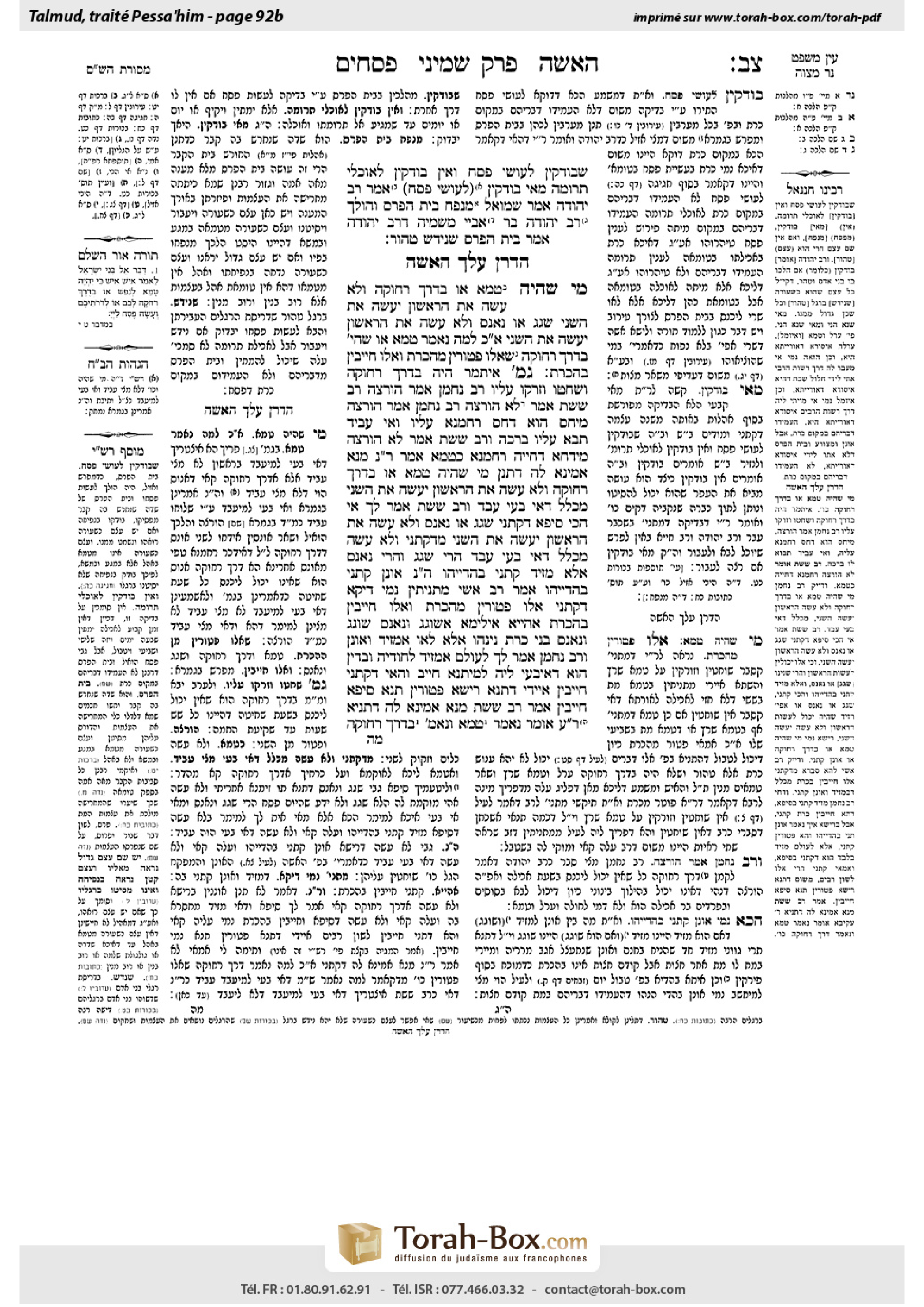
Pesachim 92b: Talmud study for Daf Yomi
Daf Yomi is the daily study of one Talmud folio. Explore 37 tractates with scans, Hebrew text, Sefaria English and AI-generated French translations where annotated.
Passage selection and English or AI-generated French translation are available where the scan has annotations. Daf Study is independent of Torah-Box and Sefaria.
Browse Pesachim · פסחים · All tractatesPesachim 92b text and translations
This page of Pesachim includes the Aramaic text, an English translation and an AI-generated French translation, alongside the scan above.
פסחים צ״ב ב · Aramaic and Hebrew text
שֶׁבּוֹדְקִין לְעוֹשֵׂי פֶסַח, וְאֵין בּוֹדְקִין לְאוֹכְלֵי תְרוּמָה.
מַאי בּוֹדְקִין (לְעוֹשֵׂי פֶּסַח)? אָמַר רַב יְהוּדָה אָמַר שְׁמוּאֵל: מְנַפֵּחַ בֵּית הַפְּרָס וְהוֹלֵךְ. רַב יְהוּדָה בַּר אַבָּיֵי מִשְּׁמֵיהּ דְּרַב יְהוּדָה אָמַר: בֵּית הַפְּרָס שֶׁנִּידַּשׁ טָהוֹר.
הֲדַרַן עֲלָךְ הָאִשָּׁה
מַתְנִי׳ מִי שֶׁהָיָה טָמֵא אוֹ בְּדֶרֶךְ רְחוֹקָה וְלֹא עָשָׂה אֶת הָרִאשׁוֹן — יַעֲשֶׂה אֶת הַשֵּׁנִי. שָׁגַג אוֹ נֶאֱנַס וְלֹא עָשָׂה אֶת הָרִאשׁוֹן — יַעֲשֶׂה אֶת הַשֵּׁנִי. אִם כֵּן, לָמָּה נֶאֱמַר טָמֵא אוֹ שֶׁהָיָה בְּדֶרֶךְ רְחוֹקָה? שֶׁאֵלּוּ פְּטוּרִין מֵהִכָּרֵת, וְאֵלּוּ חַיָּיבִין בְּהִכָּרֵת.
גְּמָ׳ אִיתְּמַר: הָיָה בְּדֶרֶךְ רְחוֹקָה וּשְׁחָטוֹ וְזָרְקוּ עָלָיו, רַב נַחְמָן אָמַר: הוּרְצָה. רַב שֵׁשֶׁת אָמַר: לֹא הוּרְצָה. רַב נַחְמָן אָמַר: הוּרְצָה, מֵיחָס הוּא דְּחַס רַחֲמָנָא עָלָיו. וְאִי עָבֵיד — תָּבֹא עָלָיו בְּרָכָה. וְרַב שֵׁשֶׁת אָמַר: לֹא הוּרְצָה, מִידְחֵא דַּחְיֵיהּ רַחֲמָנָא כְּטָמֵא.
אָמַר רַב נַחְמָן: מְנָא אָמֵינָא לַהּ, דִּתְנַן: מִי שֶׁהָיָה טָמֵא אוֹ בְּדֶרֶךְ רְחוֹקָה וְלֹא עָשָׂה אֶת הָרִאשׁוֹן — יַעֲשֶׂה אֶת הַשֵּׁנִי. מִכְּלָל דְּאִי בָּעֵי — עָבֵד.
וְרַב שֵׁשֶׁת אָמַר לָךְ: אִי הָכִי, סֵיפָא דְּקָתָנֵי: שָׁגַג אוֹ נֶאֱנַס וְלֹא עָשָׂה אֶת הָרִאשׁוֹן — יַעֲשֶׂה אֶת הַשֵּׁנִי. מִדְּקָתָנֵי ״וְלֹא עָשָׂה״, מִכְּלָל דְּאִי בָּעֵי — עָבֵד. הֲרֵי שָׁגַג, וַהֲרֵי נֶאֱנַס!
אֶלָּא, מֵזִיד קָתָנֵי בַּהֲדַיְיהוּ. הָכָא נָמֵי: אוֹנֵן קָתָנֵי בַּהֲדַיְיהוּ.
אָמַר רַב אָשֵׁי: מַתְנִיתִין נָמֵי דַּיְקָא, דְּקָתָנֵי: אֵלּוּ פְּטוּרִין מֵהִכָּרֵת וְאֵלּוּ חַיָּיבִין בְּהִכָּרֵת. אַהֵיָיא? אִילֵּימָא אַשּׁוֹגֵג וְנֶאֱנָס, שׁוֹגֵג וְנֶאֱנָס בְּנֵי כָרֵת נִינְהוּ?! אֶלָּא לָאו — אַמֵּזִיד וְאוֹנֵן.
וְרַב נַחְמָן אָמַר לָךְ: לְעוֹלָם אַמֵּזִיד לְחוֹדֵיהּ. וּבְדִין הוּא דְּאִיבְּעִי לֵיהּ לְמִיתְנֵא ״חַיָּיב״, וְהַאי דְּקָתָנֵי ״חַיָּיבִין״ — אַיְּידֵי דִּתְנָא רֵישָׁא ״פְּטוּרִין״, תְּנָא סֵיפָא ״חַיָּיבִין״.
אָמַר רַב שֵׁשֶׁת: מְנָא אָמֵינָא לַהּ? דְּתַנְיָא, רַבִּי עֲקִיבָא אוֹמֵר: נֶאֱמַר ״טָמֵא״, וְנֶאֱמַר ״בְּדֶרֶךְ רְחוֹקָה״,
Pesachim 92b · English translation
that we examine a beit haperas that lies in the path to Jerusalem for those offering the Paschal lamb to determine whether there is actually any ritual impurity present, in order to enable those who pass through it to know whether they are still ritually pure and able to offer the Paschal lamb. But we do not examine a beit haperas for the sake of those eating teruma in order that they should be able to eat teruma in purity. The Gemara asks:
What is meant when we say that we examine for those offering the Paschal lamb? Practically, how is it examined? Rav Yehuda said that Shmuel said: One must blow the dust on the path before taking each step in the beit haperas as he walks through it, in order to see if there is a hidden bone there. Rav Yehuda bar Abaye in the name of Rav Yehuda said: A beit haperas that has been trodden underfoot is considered ritually pure, since it is assumed that any bones that were there have been removed or broken. The impurity of a beit haperas is due to a rabbinic decree. The Sages waived this decree in a case where the necessary examination is made, in order to allow people to be able to offer their Paschal lambs. However, this leniency is limited to the case of the Paschal lamb, since its neglect carries the prohibition of karet. It is not extended to other cases, such as the prohibition to eat impure teruma.
MISHNA: One who was ritually impure or on a distant journey and did not observe the first Pesaḥ by participating in the offering of the Paschal lamb on the fourteenth of Nisan should observe the second Pesaḥ by participating in the offering on the fourteenth of Iyyar. If one unwittingly forgot or was prevented due to circumstances beyond his control and did not observe the first Pesaḥ, he too should observe the second Pesaḥ. If so, that the second Pesaḥ is observed even by someone who forgot or was prevented from observing the first Pesaḥ, why is it stated in the Torah that the second Pesaḥ is observed only by one who was ritually impure or on a distant journey? These cases were specified in order to teach that these two groups of people are exempt from karet if they do not observe the second Pesaḥ, but those who were not ritually impure or on a distant journey are liable to receive karet, as the Gemara will explain.
GEMARA: It was stated that the amora’im disagreed about the following issue: If one was on a distant journey and others slaughtered the Paschal lamb and sprinkled its blood on his behalf, and he arrived in time to eat the Paschal lamb, does he need to observe the second Pesaḥ since he was far away at the time that the sacrifice was offered? Rav Naḥman said: His offering was accepted, and he need not observe the second Pesaḥ. Rav Sheshet said: His offering was not accepted, and he must sacrifice the Paschal lamb on the second Pesaḥ. The Gemara explains their opinions. Rav Naḥman said: His offering was accepted because the Torah has mercy on one who was on a distant journey and allows him the option of observing the second Pesaḥ; but if he nonetheless did participate in the sacrifice of the Paschal lamb on the first Pesaḥ, may blessing come upon him. And Rav Sheshet said: His offering is not accepted because the Torah deferred his observance to the second Pesaḥ just as it does for one who is ritually impure. Just as one who is ritually impure may not voluntarily participate in the Paschal lamb, neither may one who is on a distant journey.
Rav Naḥman said: From where do I say my opinion? As we learned in the mishna: One who was ritually impure or on a distant journey and did not observe the first Pesaḥ should observe the second Pesaḥ. The expression: And did not observe, indicates by inference that regarding one who was on a distant journey, had he wished, he could have observed it and would thereby be exempt from participating in the sacrifice of the Paschal lamb on the second Pesaḥ.
And Rav Sheshet said in response: If so, consider the latter clause of the mishna, which teaches: If one unwittingly forgot or was prevented due to circumstances beyond his control and did not observe the first Pesaḥ, he should observe the second Pesaḥ. According to your reasoning, from the fact that it is taught: And did not observe, conclude by inference that had he wished, he could have observed it. However, this is not possible, as the mishna states explicitly that he unwittingly forgot or was prevented due to circumstances beyond his control and was unable to observe the first Pesaḥ.
Rather, the mishna must be explained differently, as follows: Even though it does not say so explicitly, the mishna is teaching with the phrase: And he did not observe, the case of one who intentionally refrained from observing the first Pesaḥ together with the other cases in the mishna. Here, too, in the first part of the mishna, the phrase: And he did not observe, must be understood as including another category of people: It is teaching the case of an acute mourner, i.e., one whose relative died that same day and has not yet been buried, together with the other cases. The first part of the mishna includes three cases: One who was ritually impure, one who was on distant journey, and one who was an acute mourner. Therefore, it cannot be inferred that had he wished to observe the first Pesaḥ, he could have done so.
Rav Ashi said: The mishna is also precisely formulated according to this interpretation, as it teaches: These are exempt from karet, but those are liable to receive karet. To which part of the mishna is this referring? If we say that this statement is referring to one who unwittingly forgot and one who was prevented due to circumstances beyond his control, are one who unwittingly forgot and one who was prevented due to circumstances beyond his control subject to the punishment of karet? One is liable to receive karet only for performing a transgression intentionally. Rather, is it not referring to the case of one who intentionally refrained from observing the Pesaḥ, which is included in the phrase in the latter clause: And he did not observe, and to the case of an acute mourner, which is included in the parallel phrase in the first clause? These two categories of people are liable to receive karet if they fail to sacrifice the Paschal lamb on the second Pesaḥ.
And Rav Naḥman could have said to you in response: Actually, the mishna refers only to the case of one who intentionally refrains from observing the first Pesaḥ and not to the case of an acute mourner; and by right it should have taught this ruling with the expression: He is liable, in the singular. And the reason that it teaches this ruling with the phrase: These are liable, in the plural, is that since the first clause of the mishna teaches its ruling with the expression: These are exempt, in the plural, the latter clause also teaches its ruling with the expression: Those are liable, in the plural. Therefore, the phrase in the first clause: And did not observe the first Pesaḥ, teaches that one on a journey has the option of observing the first Pesaḥ if he wishes. And the same phrase in the latter clause: And did not observe, comes to include the case of one who intentionally refrains from observing the first Pesaḥ.
Rav Sheshet said: From where do I say my opinion? As it was taught in a baraita that Rabbi Akiva says: It is stated that one who is ritually impure on the first Pesaḥ observes the second Pesaḥ, and it is stated that one who is on a distant journey observes the second Pesaḥ;
Pesachim 92b · Traduction française (IA)
Nous examinons donc un beit haperas situé sur le chemin de Jérusalem pour ceux qui apportent l’offrande pascale, afin de déterminer s’il s’y trouve effectivement une impureté rituelle et de permettre à ceux qui le traversent de savoir s’ils sont encore rituellement purs et aptes à offrir l’offrande pascale. En revanche, nous n’examinons pas un beit haperas pour ceux qui mangent de la terouma, afin de leur permettre de manger la terouma en état de pureté. La Guemara demande :
Que signifie l’affirmation selon laquelle on examine le chemin pour ceux qui apportent l’offrande pascale ? Concrètement, comment procède-t-on à cet examen ? Rav Yehouda a dit au nom de Shmuel : Avant chaque pas, il faut souffler sur la poussière du chemin en avançant dans le beit haperas, afin de voir s’il n’y a pas un os caché. Rav Yehouda bar Abaye a dit au nom de Rav Yehouda : Un beit haperas foulé aux pieds est considéré comme rituellement pur, car on présume que les os qui s’y trouvaient ont été retirés ou brisés. L’impureté d’un beit haperas relève d’un décret rabbinique. Les Sages ont levé ce décret lorsqu’on procède à l’examen requis, afin de permettre aux gens d’offrir leur offrande pascale. Cette indulgence est toutefois limitée au cas de l’offrande pascale, car ne pas l’offrir entraîne la sanction du retranchement. Elle ne s’étend pas à d’autres cas, comme l’interdiction de manger de la terouma impure.
MICHNA : Celui qui était rituellement impur ou en voyage lointain et n’a pas célébré le premier Pessa’h en prenant part à l’offrande de l’agneau pascal le quatorzième jour de Nissan doit célébrer le second Pessa’h en prenant part à l’offrande le quatorzième jour d’Iyar. Si quelqu’un a oublié par inadvertance ou a été empêché par des circonstances indépendantes de sa volonté de célébrer le premier Pessa’h, il doit lui aussi célébrer le second Pessa’h. Si tel est le cas, et que le second Pessa’h est célébré même par celui qui a oublié ou a été empêché de célébrer le premier, pourquoi la Torah précise-t-elle que le second Pessa’h est célébré uniquement par celui qui était rituellement impur ou en voyage lointain ? Ces cas ont été mentionnés pour enseigner que ces deux catégories de personnes sont exemptées du retranchement si elles ne célèbrent pas le second Pessa’h, tandis que ceux qui n’étaient ni rituellement impurs ni en voyage lointain sont passibles du retranchement, comme la Guemara l’expliquera.
GUEMARA : Il a été rapporté que les amoraïm sont en désaccord sur la question suivante : si quelqu’un était en voyage lointain et que d’autres ont égorgé l’agneau pascal et en ont aspergé le sang en son nom, puis qu’il est arrivé à temps pour manger l’agneau pascal, doit-il célébrer le second Pessa’h, puisqu’il était loin au moment où le sacrifice a été offert ? Rav Naḥman a dit : Son sacrifice a été accepté et il n’a pas besoin de célébrer le second Pessa’h. Rav Sheshet a dit : Son sacrifice n’a pas été accepté et il doit offrir l’agneau pascal lors du second Pessa’h. La Guemara explique leurs opinions. Rav Naḥman a dit : Son sacrifice a été accepté, car la Torah a pitié de celui qui était en voyage lointain et lui permet de célébrer le second Pessa’h ; mais s’il a néanmoins pris part au sacrifice de l’agneau pascal lors du premier Pessa’h, qu’une bénédiction soit sur lui. Rav Sheshet a dit : Son sacrifice n’est pas accepté, car la Torah a reporté sa célébration au second Pessa’h, comme elle le fait pour celui qui est rituellement impur. De même que celui qui est rituellement impur ne peut prendre part volontairement à l’offrande pascale, celui qui est en voyage lointain ne le peut pas non plus.
Rav Naḥman a dit : D’où est-ce que je tire mon opinion ? De ce que nous avons appris dans la Michna : Celui qui était rituellement impur ou en voyage lointain et n’a pas célébré le premier Pessa’h doit célébrer le second Pessa’h. L’expression « et n’a pas célébré » implique, par déduction, que celui qui était en voyage lointain aurait pu, s’il l’avait voulu, le célébrer et aurait ainsi été dispensé de prendre part au sacrifice de l’agneau pascal lors du second Pessa’h.
Rav Sheshet a répondu : Dans ce cas, considère la dernière partie de la Michna, qui enseigne : Si quelqu’un a oublié par inadvertance ou a été empêché par des circonstances indépendantes de sa volonté de célébrer le premier Pessa’h, il doit célébrer le second Pessa’h. Selon ton raisonnement, de l’expression « et n’a pas célébré », il faudrait déduire que, s’il l’avait voulu, il aurait pu le célébrer. Or cela est impossible, puisque la Michna dit explicitement qu’il a oublié par inadvertance ou a été empêché par des circonstances indépendantes de sa volonté et qu’il n’a pas pu célébrer le premier Pessa’h.
Il faut plutôt expliquer la Michna autrement, comme suit : bien que cela ne soit pas dit explicitement, par l’expression « et n’a pas célébré », la Michna enseigne le cas de celui qui s’est délibérément abstenu de célébrer le premier Pessa’h, parmi les autres cas qu’elle mentionne. Ici aussi, dans la première partie de la Michna, l’expression « et n’a pas célébré » doit être comprise comme incluant une autre catégorie de personnes : elle enseigne le cas de l’endeuillé avant l’inhumation, c’est-à-dire celui dont un proche est mort le jour même et qui n’a pas encore été enterré, parmi les autres cas. La première partie de la Michna comprend trois cas : celui qui était rituellement impur, celui qui était en voyage lointain et l’endeuillé avant l’inhumation. On ne peut donc pas déduire que, s’il avait voulu célébrer le premier Pessa’h, il aurait pu le faire.
Rav Ashi a dit : La Michna est également formulée avec précision selon cette interprétation, puisqu’elle enseigne : Ceux-ci sont exemptés du retranchement, tandis que ceux-là en sont passibles. À quelle partie de la Michna cela fait-il référence ? Si nous disons que cette affirmation concerne celui qui a oublié par inadvertance et celui qui a été empêché par des circonstances indépendantes de sa volonté, ceux qui ont oublié par inadvertance ou ont été ainsi empêchés sont-ils passibles du retranchement ? On n’est passible du retranchement que si l’on commet intentionnellement une transgression. Ne fait-elle pas plutôt référence au cas de celui qui s’est délibérément abstenu de célébrer le Pessa’h, inclus dans l’expression de la dernière partie « et n’a pas célébré », ainsi qu’au cas de l’endeuillé avant l’inhumation, inclus dans l’expression parallèle de la première partie ? Ces deux catégories de personnes sont passibles du retranchement si elles ne sacrifient pas l’agneau pascal lors du second Pessa’h.
Rav Naḥman aurait pu te répondre : En réalité, la Michna ne fait référence qu’au cas de celui qui s’abstient délibérément de célébrer le premier Pessa’h, et non à celui de l’endeuillé avant l’inhumation ; et, à juste titre, elle aurait dû énoncer cette règle au singulier : « il est passible ». Si elle énonce cette règle au pluriel, par l’expression « ceux-là sont passibles », c’est parce que la première partie de la Michna énonce sa règle au pluriel, par l’expression « ceux-ci sont exemptés » ; la dernière partie énonce donc elle aussi sa règle au pluriel, par l’expression « ceux-là sont passibles ». Par conséquent, l’expression de la première partie « et n’a pas célébré le premier Pessa’h » enseigne que celui qui était en voyage avait la possibilité de célébrer le premier Pessa’h s’il le souhaitait. La même expression, dans la dernière partie, « et n’a pas célébré », vient inclure le cas de celui qui s’abstient délibérément de célébrer le premier Pessa’h.
Rav Sheshet a dit : D’où est-ce que je tire mon opinion ? D’une baraïta où Rabbi Akiva enseigne : Il est dit que celui qui est rituellement impur lors du premier Pessa’h célèbre le second Pessa’h, et il est dit que celui qui est en voyage lointain célèbre le second Pessa’h ;
Traduction française générée par IA à partir de l’édition anglaise de Sefaria. Vérifie toujours un passage avec le texte source.
Text from Sefaria: William Davidson Edition - Vocalized Aramaic (CC BY NC); William Davidson Edition - English (CC BY NC).