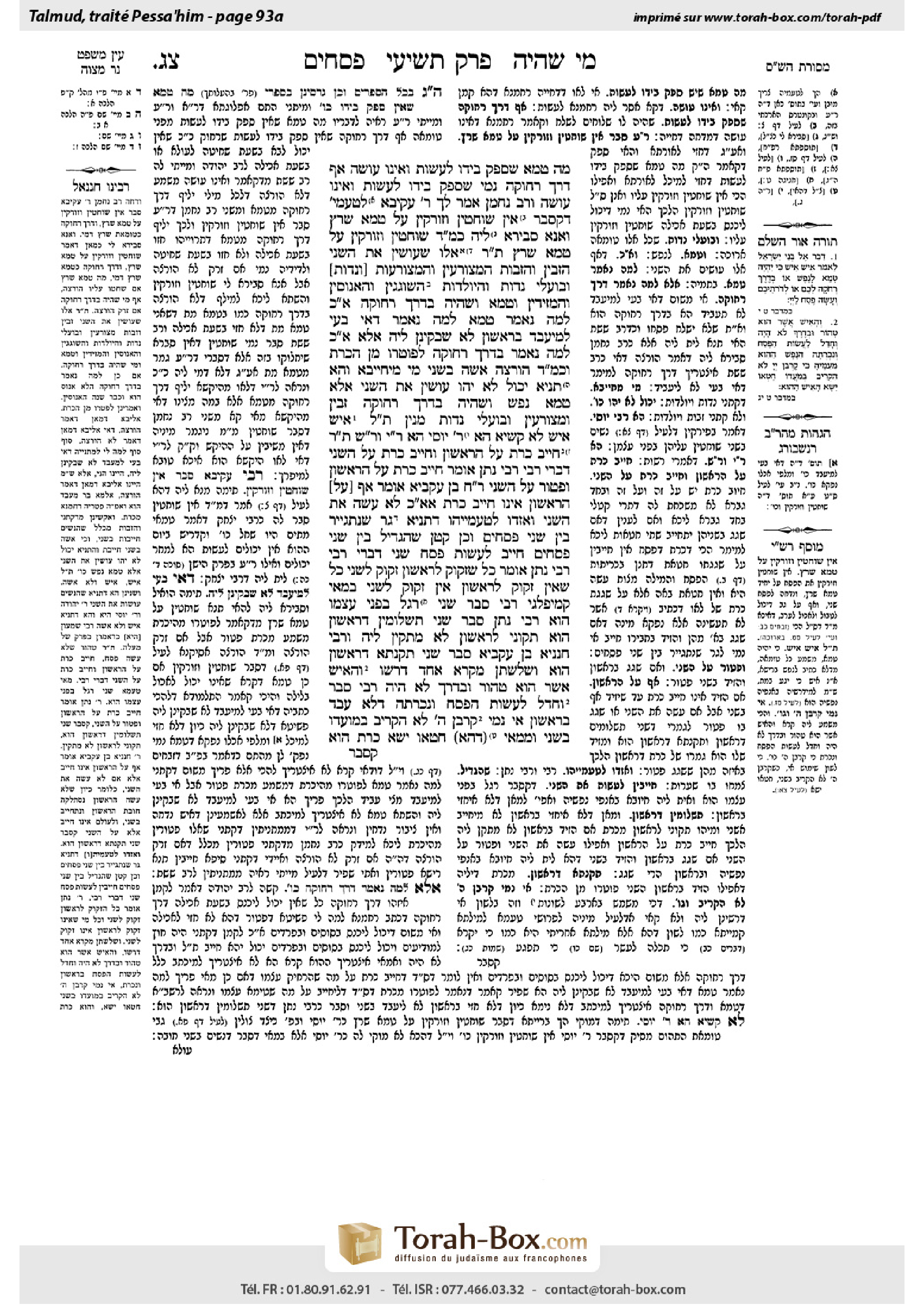
Pesachim 93a: Talmud study for Daf Yomi
Daf Yomi is the daily study of one Talmud folio. Explore 37 tractates with scans, Hebrew text, Sefaria English and AI-generated French translations where annotated.
Passage selection and English or AI-generated French translation are available where the scan has annotations. Daf Study is independent of Torah-Box and Sefaria.
Browse Pesachim · פסחים · All tractatesPesachim 93a text and translations
This page of Pesachim includes the Aramaic text, an English translation and an AI-generated French translation, alongside the scan above.
פסחים צ״ג א · Aramaic and Hebrew text
מָה טָמֵא, שֶׁסִּפֵּק בְּיָדוֹ לַעֲשׂוֹת וְאֵינוֹ עוֹשֶׂה. אַף דֶּרֶךְ רְחוֹקָה נָמֵי, שֶׁסִּפֵּק בְּיָדוֹ לַעֲשׂוֹת וְאֵינוֹ עוֹשֶׂה!
וְרַב נַחְמָן אָמַר לָךְ: רַבִּי עֲקִיבָא לְטַעְמֵיהּ, דְּקָסָבַר: אֵין שׁוֹחֲטִין וְזוֹרְקִין עַל טְמֵא שֶׁרֶץ. וַאֲנָא סְבִירָא לִי כְּמַאן דְּאָמַר: שׁוֹחֲטִין וְזוֹרְקִין עַל טְמֵא שֶׁרֶץ.
תָּנוּ רַבָּנַן, אֵלּוּ שֶׁעוֹשִׂין אֶת הַשֵּׁנִי: הַזָּבִין וְהַזָּבוֹת, הַמְצוֹרָעִין וְהַמְצוֹרָעוֹת, [וְנִדּוֹת] וּבוֹעֲלֵי נִדּוֹת וְהַיּוֹלְדוֹת, הַשּׁוֹגְגִין וְהָאֲנוּסִין וְהַמְּזִידִין, וְטָמֵא וְשֶׁהָיָה בְּדֶרֶךְ רְחוֹקָה.
אִם כֵּן לָמָּה נֶאֱמַר ״טָמֵא״? לָמָּה נֶאֱמַר?! דְּאִי בָּעֵי לְמִיעְבַּד בָּרִאשׁוֹן לָא שָׁבְקִינַן לֵיהּ! אֶלָּא: אִם כֵּן, לָמָּה נֶאֱמַר ״בְּדֶרֶךְ רְחוֹקָה״ — לְפוֹטְרוֹ מִן הִכָּרֵת. וּכְמַאן דְּאָמַר הוּרְצָה.
אִשָּׁה בַּשֵּׁנִי מִי מִיחַיְּיבָא? וְהָא תַּנְיָא: יָכוֹל לֹא יְהוּ עוֹשִׂין אֶת הַשֵּׁנִי אֶלָּא טְמֵא נֶפֶשׁ וְשֶׁהָיָה בְּדֶרֶךְ רְחוֹקָה. זָבִין וּמְצוֹרָעִין וּבוֹעֲלֵי נִדּוֹת מִנַּיִן? תַּלְמוּד לוֹמַר: ״אִישׁ אִישׁ״.
לָא קַשְׁיָא: הָא — רַבִּי יוֹסֵי, הָא — רַבִּי יְהוּדָה וְרַבִּי שִׁמְעוֹן.
תָּנוּ רַבָּנַן: חַיָּיב כָּרֵת עַל הָרִאשׁוֹן, וְחַיָּיב כָּרֵת עַל הַשֵּׁנִי, דִּבְרֵי רַבִּי. רַבִּי נָתָן אוֹמֵר: חַיָּיב כָּרֵת עַל הָרִאשׁוֹן, וּפָטוּר עַל הַשֵּׁנִי. רַבִּי חֲנַנְיָא בֶּן עֲקַבְיָא אוֹמֵר: אַף [עַל] הָרִאשׁוֹן אֵינוֹ חַיָּיב כָּרֵת אֶלָּא אִם כֵּן לֹא עָשָׂה אֶת הַשֵּׁנִי.
וְאָזְדוּ לְטַעְמַיְיהוּ. דְּתַנְיָא: גֵּר שֶׁנִּתְגַּיֵּיר בֵּין שְׁנֵי פְסָחִים, וְכֵן קָטָן שֶׁהִגְדִּיל בֵּין שְׁנֵי פְסָחִים — חַיָּיב לַעֲשׂוֹת פֶּסַח שֵׁנִי, דִּבְרֵי רַבִּי. רַבִּי נָתָן אוֹמֵר: כֹּל שֶׁזָּקוּק לָרִאשׁוֹן — זָקוּק לַשֵּׁנִי, כֹּל שֶׁאֵין זָקוּק לָרִאשׁוֹן — אֵין זָקוּק לַשֵּׁנִי.
בְּמַאי קָמִיפַּלְגִי? רַבִּי סָבַר: שֵׁנִי רֶגֶל בִּפְנֵי עַצְמוֹ הוּא.
רַבִּי נָתָן סָבַר: שֵׁנִי תַּשְׁלוּמִין דְּרִאשׁוֹן הוּא. תַּקּוֹנֵי לָרִאשׁוֹן, לָא מְתַקֵּין לֵיהּ.
וְרַבִּי חֲנַנְיָא בֶּן עֲקַבְיָא סָבַר: שֵׁנִי תַּקַּנְתָּא דְרִאשׁוֹן הוּא.
וּשְׁלׇשְׁתָּן מִקְרָא אֶחָד דָּרְשׁוּ: ״וְהָאִישׁ אֲשֶׁר הוּא טָהוֹר וּבְדֶרֶךְ לֹא הָיָה״. רַבִּי סָבַר: ״וְחָדַל לַעֲשׂוֹת הַפֶּסַח וְנִכְרְתָה״, דְּלָא עֲבַד בָּרִאשׁוֹן, אִי נָמֵי: ״קׇרְבַּן ה׳ לֹא הִקְרִיב בְּמוֹעֲדוֹ״, בַּשֵּׁנִי.
וּמִמַּאי (דְּהָא) ״חֶטְאוֹ יִשָּׂא״ כָּרֵת הוּא?
Pesachim 93a · English translation
just as the case of one who was ritually impure is referring to one who has the means to observe the first Pesaḥ via an agent but does not do so because the Torah prohibited him from doing so, so too, the case of one who was on a distant journey also refers to one who has the means to observe the first Pesaḥ via an agent and eat the offering at night, but does not do so because the Torah prohibited him from doing so.
And Rav Naḥman could have said to you: Rabbi Akiva conforms to his standard line of reasoning, as he holds that one may not slaughter a Paschal lamb and sprinkle its blood on behalf of one who is ritually impure due to contact with a dead creeping animal, even though he could immerse and become ritually pure in time to partake of the Paschal lamb in the evening. This indicates that according to Rabbi Akiva, one who is unfit when the blood is sprinkled is completely disqualified from participating in the offering. But I hold in accordance with the one who said: One may slaughter a Paschal lamb and sprinkle its blood on behalf of one who is ritually impure due to contact with a dead creeping animal, and therefore Rabbi Akiva’s ruling is not relevant to my opinion.
The Gemara cites a baraita in support of Rav Naḥman’s opinion. The Sages taught that these are the people who observe the second Pesaḥ: Zavim and zavot; male lepers and female lepers; and menstruating women and those men who had sexual relations with menstruating women; and women after childbirth; those who failed to observe the first Pesaḥ unwittingly, and those who were prevented due to circumstances beyond their control, and those who intentionally refrained from doing so; and one who was ritually impure; and one who was on a distant journey.
The baraita continues: If so, if one who missed the first Pesaḥ for any reason observes the second Pesaḥ, why is the case of one who was ritually impure stated explicitly in the Torah? The Gemara expresses surprise at this question: Why is it stated? It was necessary to mention this case to teach that if an impure person wishes to perform the sacrifice of the Paschal lamb on the first Pesaḥ we do not allow him to do so. Rather, the question should be: Why is the case of one who is on a distant journey stated in the Torah? It is stated to exempt him from karet even if he does not observe the second Pesaḥ. And this is in accordance with the opinion of the one who said that if the Paschal lamb was slaughtered on behalf of one who was on a distant journey it was accepted, which is the opinion of Rav Naḥman.
The baraita mentioned several types of ritually impure women who observe the second Pesaḥ rather than the first. The Gemara asks: Is a woman obligated to observe the second Pesaḥ? Wasn’t it taught in a baraita: I might have thought that only one who is impure due to ritual impurity imparted by a corpse or one who was on a distant journey observe the second Pesaḥ; with regard to zavim, male lepers, and those men who had sexual relations with menstruating women, from where is it derived that they may observe the second Pesaḥ? The verse states: “If any man [ish ish] of you or of your generations shall be ritually impure due to a dead body or is on a journey far away, he shall still offer the Paschal lamb to the Lord” (Numbers 9:10). The word ish is doubled in order to include these other cases. Women are not included by the repetition of the word ish.
The Gemara answers that this is not difficult: This first baraita, which includes women, is in accordance with the opinion of Rabbi Yosei that one may slaughter the Paschal lamb on the second Pesaḥ for women, and that second baraita, which includes only men, is in accordance with the opinion of Rabbi Yehuda and Rabbi Shimon, who hold that women do not have a full-fledged obligation to observe the second Pesaḥ.
The Sages taught in the Tosefta: One is liable to receive karet for intentionally refraining from observing the first Pesaḥ; similarly, one who could not observe the first Pesaḥ is liable to receive karet if he intentionally refrained from observing the second Pesaḥ. This is the statement of Rabbi Yehuda HaNasi. Rabbi Natan says: One is liable to receive karet for intentionally refraining from observing the first Pesaḥ; and one is exempt from karet for intentionally refraining from observing the second Pesaḥ even if he unwittingly failed to observe the first Pesaḥ, as the Torah does not specify a punishment of karet with regard to the second Pesaḥ. Rabbi Ḥananya ben Akavya says: Even for intentionally failing to observe the first Pesaḥ one is liable to receive karet only if he intentionally fails to observe the second Pesaḥ.
The Gemara adds that Rabbi Yehuda HaNasi and Rabbi Natan follow their line of reasoning as demonstrated by another dispute between them, which is related to the dispute quoted above. As it was taught in a baraita: A convert who converted during the month between the offering of the two Paschal lambs on the first and second Pesaḥ, and similarly, a minor who grew up and became obligated in mitzvot during the month between the offering of the two Paschal lambs, is obligated to observe the second Pesaḥ; this is the statement of Rabbi Yehuda HaNasi. Rabbi Natan says: Whoever needs to observe the first Pesaḥ needs to observe the second; whoever does not need to observe the first Pesaḥ, e.g., one who is a minor or is not yet Jewish, does not need to observe the second Pesaḥ either.
The Gemara explains: With regard to what do they disagree? Rabbi Yehuda HaNasi holds that the second Pesaḥ is its own Festival, and anyone who did not participate in the first Pesaḥ is obligated to participate in the second even if he was not fit to bring the Paschal lamb on the first Pesaḥ.
Conversely, Rabbi Natan holds that the second Pesaḥ is merely a redress for the first Pesaḥ, such that if one was obligated to bring the Paschal lamb on the first Pesaḥ and did not, he may do so on the second Pesaḥ; however, it does not repair the failure to bring the Paschal lamb on the first Pesaḥ. Therefore, one who intentionally refrained from bringing the Paschal lamb on the first Pesaḥ is liable to receive karet even if he brought the Paschal lamb on the second Pesaḥ. However, if one unwittingly failed to sacrifice the Paschal lamb on the first Pesaḥ, he is not liable to receive karet even if he intentionally refrained from observing the second Pesaḥ.
And Rabbi Ḥananya ben Akavya held: The second Pesaḥ repairs the failure to offer the Paschal lamb on the first Pesaḥ. In other words, the Paschal lamb brought on the second Pesaḥ is not an independent obligation; rather, it allows a second chance to avoid the liability to receive karet.
And all three of them expounded the same verse to derive their opinions: “But the man who is ritually pure, and is not on a journey, and refrains from offering the Paschal lamb, that soul shall be cut off from his people; because [ki] he did not bring the offering of the Lord in its appointed season, that man shall bear his sin” (Numbers 9:13). Rabbi Yehuda HaNasi holds that the verse should be understood as follows: The phrase: “And refrains from offering the Paschal lamb, that soul shall be cut off,” means that he did not participate in the offering on the first Pesaḥ. In the continuation of the verse, Rabbi Yehuda HaNasi understands the word ki to mean: If, as the word ki has various meanings, one of which is: If. Therefore, the verse can be interpreted in the following manner: If he also “did not bring the offering of the Lord in its appointed season,” with regard to the second Pesaḥ, “that man shall bear his sin.”
The Gemara asks: And from where do we know that this phrase: Shall bear his sin, refers to karet and not to some other punishment?
Pesachim 93a · Traduction française (IA)
De même que le cas de celui qui était rituellement impur désigne quelqu’un qui avait les moyens d’accomplir le premier Pessa’h par l’intermédiaire d’un mandataire, mais ne le faisait pas parce que la Torah le lui interdisait, de même, le cas de celui qui se trouvait en voyage lointain désigne également quelqu’un qui avait les moyens d’accomplir le premier Pessa’h par l’intermédiaire d’un mandataire et de manger le sacrifice le soir, mais ne le faisait pas parce que la Torah le lui interdisait.
Rav Naḥman aurait pu te répondre : Rabbi Akiva reste fidèle à son raisonnement habituel, car il estime qu’on ne peut ni égorger l’agneau pascal ni asperger son sang pour quelqu’un qui est rituellement impur à la suite d’un contact avec un reptile mort, même s’il pourrait s’immerger et devenir rituellement pur à temps pour consommer l’agneau pascal le soir. Cela indique que, selon Rabbi Akiva, celui qui est inapte au moment de l’aspersion du sang est entièrement disqualifié pour prendre part au sacrifice. Mais moi, je suis l’avis de celui qui dit qu’on peut égorger l’agneau pascal et asperger son sang pour quelqu’un qui est rituellement impur à la suite d’un contact avec un reptile mort ; l’enseignement de Rabbi Akiva n’est donc pas pertinent pour mon opinion.
La Guemara cite une baraïta à l’appui de l’avis de Rav Naḥman. Les Sages ont enseigné : Voici ceux qui accomplissent le second Pessa’h : les zavim et les zavot, les hommes lépreux et les femmes lépreuses, les femmes menstruées et les hommes qui ont eu des relations sexuelles avec des femmes menstruées, ainsi que les femmes ayant accouché ; ceux qui ont manqué le premier Pessa’h par inadvertance, ceux qui en ont été empêchés par des circonstances indépendantes de leur volonté et ceux qui s’en sont volontairement abstenus ; celui qui était rituellement impur et celui qui se trouvait en voyage lointain.
La baraïta poursuit : Si tel est le cas, si quiconque a manqué le premier Pessa’h pour quelque raison que ce soit accomplit le second Pessa’h, pourquoi le cas de celui qui était rituellement impur est-il explicitement mentionné dans la Torah ? La Guemara s’étonne de cette question : Pourquoi est-il mentionné ? Il fallait mentionner ce cas pour enseigner que, si une personne impure souhaite offrir le sacrifice de l’agneau pascal lors du premier Pessa’h, on ne le lui permet pas. La question devrait plutôt être : Pourquoi le cas de celui qui se trouve en voyage lointain est-il mentionné dans la Torah ? Il est mentionné pour l’exempter de karet même s’il n’accomplit pas le second Pessa’h. Cela correspond à l’avis de celui qui dit que, si l’agneau pascal a été égorgé pour quelqu’un qui se trouvait en voyage lointain, le sacrifice était accepté ; c’est l’avis de Rav Naḥman.
La baraïta a mentionné plusieurs catégories de femmes rituellement impures qui accomplissent le second Pessa’h plutôt que le premier. La Guemara demande : Une femme est-elle tenue d’accomplir le second Pessa’h ? N’a-t-on pas enseigné dans une baraïta : J’aurais pu penser que seuls accomplissent le second Pessa’h celui qui est impur en raison de l’impureté rituelle due à un cadavre ou celui qui se trouvait en voyage lointain. Quant aux zavim, aux hommes lépreux et aux hommes qui ont eu des relations sexuelles avec des femmes menstruées, d’où apprend-on qu’ils peuvent accomplir le second Pessa’h ? Le verset dit : « Si un homme [ish ish] parmi vous ou parmi vos générations est rituellement impur à cause d’un mort, ou se trouve en voyage lointain, il offrira néanmoins l’agneau pascal au Seigneur » (Nombres 9:10). Le mot ish est répété afin d’inclure ces autres cas. Les femmes ne sont pas incluses par la répétition du mot ish.
La Guemara répond que cela ne présente pas de difficulté : cette première baraïta, qui inclut les femmes, suit l’avis de Rabbi Yosei, selon lequel on peut égorger l’agneau pascal lors du second Pessa’h pour les femmes ; cette seconde baraïta, qui n’inclut que les hommes, suit l’avis de Rabbi Yehuda et de Rabbi Shimon, qui estiment que les femmes ne sont pas pleinement tenues d’accomplir le second Pessa’h.
Les Sages ont enseigné dans la Tossefta : On est passible de karet si l’on s’abstient volontairement d’accomplir le premier Pessa’h ; de même, celui qui n’a pas pu accomplir le premier Pessa’h est passible de karet s’il s’abstient volontairement d’accomplir le second Pessa’h. Telle est la déclaration de Rabbi Yehuda HaNassi. Rabbi Natan dit : On est passible de karet si l’on s’abstient volontairement d’accomplir le premier Pessa’h ; mais on est exempt de karet si l’on s’abstient volontairement d’accomplir le second Pessa’h, même si l’on a manqué le premier Pessa’h par inadvertance, car la Torah ne précise pas de peine de karet à propos du second Pessa’h. Rabbi Ḥananya ben Akavya dit : Même lorsqu’on a manqué volontairement le premier Pessa’h, on n’est passible de karet que si l’on manque volontairement le second Pessa’h.
La Guemara ajoute que Rabbi Yehuda HaNassi et Rabbi Natan restent fidèles à leur raisonnement, comme le montre une autre controverse entre eux, liée à celle qui vient d’être citée. En effet, une baraïta a enseigné : Un converti qui s’est converti pendant le mois séparant l’offrande des deux agneaux pascals, lors du premier et du second Pessa’h, et, de même, un mineur qui a grandi et est devenu astreint aux mitsvot pendant le mois séparant l’offrande des deux agneaux pascals, sont tenus d’accomplir le second Pessa’h ; telle est la déclaration de Rabbi Yehuda HaNassi. Rabbi Natan dit : Quiconque doit accomplir le premier Pessa’h doit accomplir le second ; quiconque n’a pas à accomplir le premier Pessa’h, par exemple un mineur ou quelqu’un qui n’est pas encore juif, n’a pas non plus à accomplir le second Pessa’h.
La Guemara explique : Sur quoi porte leur désaccord ? Rabbi Yehuda HaNassi estime que le second Pessa’h est une fête à part entière, et que toute personne qui n’a pas pris part au premier Pessa’h est tenue de prendre part au second, même si elle n’était pas apte à offrir l’agneau pascal lors du premier Pessa’h.
À l’inverse, Rabbi Natan estime que le second Pessa’h n’est qu’un rattrapage du premier : celui qui était tenu d’offrir l’agneau pascal lors du premier Pessa’h et ne l’a pas fait peut le faire lors du second Pessa’h ; toutefois, cela ne répare pas le manquement consistant à ne pas avoir offert l’agneau pascal lors du premier Pessa’h. Par conséquent, celui qui s’est volontairement abstenu d’offrir l’agneau pascal lors du premier Pessa’h est passible de karet même s’il a offert l’agneau pascal lors du second Pessa’h. En revanche, celui qui a omis par inadvertance d’offrir l’agneau pascal lors du premier Pessa’h n’est pas passible de karet, même s’il s’est volontairement abstenu d’accomplir le second Pessa’h.
Et Rabbi Ḥananya ben Akavya estimait que le second Pessa’h répare le manquement consistant à ne pas avoir offert l’agneau pascal lors du premier Pessa’h. Autrement dit, l’agneau pascal offert lors du second Pessa’h ne constitue pas une obligation indépendante ; il donne plutôt une seconde chance d’échapper à la peine de karet.
Et tous trois interprétaient le même verset pour établir leurs opinions : « Mais l’homme qui est rituellement pur, qui ne se trouve pas en voyage et qui s’abstient d’offrir l’agneau pascal, cette personne sera retranchée de son peuple ; car [ki] il n’a pas apporté l’offrande du Seigneur au temps fixé, cet homme portera sa faute » (Nombres 9:13). Rabbi Yehuda HaNassi estime que le verset doit se comprendre ainsi : la formule « et qui s’abstient d’offrir l’agneau pascal, cette personne sera retranchée » signifie qu’il n’a pas pris part à l’offrande lors du premier Pessa’h. Dans la suite du verset, Rabbi Yehuda HaNassi comprend le mot ki au sens de « si », car ce mot a plusieurs sens, dont celui de « si ». Le verset peut donc être interprété ainsi : si, de plus, il « n’a pas apporté l’offrande du Seigneur au temps fixé », à propos du second Pessa’h, « cet homme portera sa faute ».
La Guemara demande : Et d’où savons-nous que cette expression, « portera sa faute », désigne karet et non une autre peine ?
Traduction française générée par IA à partir de l’édition anglaise de Sefaria. Vérifie toujours un passage avec le texte source.
Text from Sefaria: William Davidson Edition - Vocalized Aramaic (CC BY NC); William Davidson Edition - English (CC BY NC).