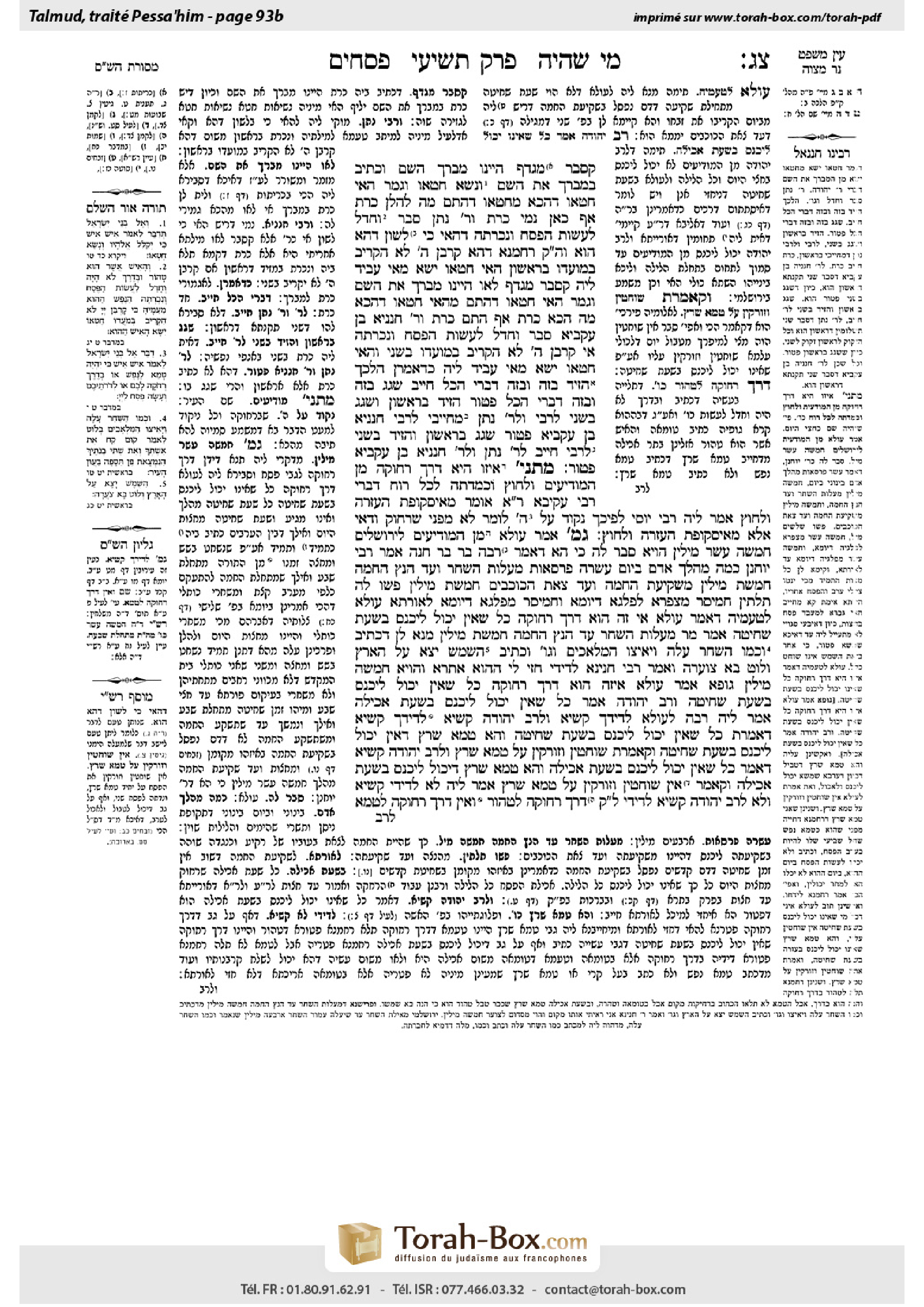
Pesachim 93b: Talmud study for Daf Yomi
Daf Yomi is the daily study of one Talmud folio. Explore 37 tractates with scans, Hebrew text, Sefaria English and AI-generated French translations where annotated.
Passage selection and English or AI-generated French translation are available where the scan has annotations. Daf Study is independent of Torah-Box and Sefaria.
Browse Pesachim · פסחים · All tractatesPesachim 93b text and translations
This page of Pesachim includes the Aramaic text, an English translation and an AI-generated French translation, alongside the scan above.
פסחים צ״ג ב · Aramaic and Hebrew text
קָסָבַר: מְגַדֵּף הַיְינוּ מְבָרֵךְ הַשֵּׁם, וּכְתִיב בִּמְבָרֵךְ אֶת הַשֵּׁם ״וְנָשָׂא חֶטְאוֹ״.
וְגָמַר הַאי ״חֶטְאוֹ״ דְּהָכָא, מֵ״חֶטְאוֹ״ דְּהָתָם: מָה לְהַלָּן כָּרֵת, אַף כָּאן נָמֵי כָּרֵת.
וְרַבִּי נָתָן סָבַר: ״וְחָדַל לַעֲשׂוֹת הַפֶּסַח וְנִכְרְתָה״, דְּהַאי ״כִּי״ — לְשׁוֹן דְּהָא הוּא, וְהָכִי קָאָמַר רַחֲמָנָא: דְּהָא ״קׇרְבַּן ה׳ לֹא הִקְרִיב בְּמוֹעֲדוֹ״ בָּרִאשׁוֹן.
הַאי ״חֶטְאוֹ יִשָּׂא״ מַאי עָבֵיד לֵיהּ? קָסָבַר: מְגַדֵּף לָאו הַיְינוּ מְבָרֵךְ אֶת הַשֵּׁם, וְגָמַר הַאי ״חֶטְאוֹ״ דְּהָתָם מֵהַאי ״חֶטְאוֹ״ דְּהָכָא. מָה הָכָא כָּרֵת — אַף הָתָם כָּרֵת.
וְרַבִּי חֲנַנְיָא בֶּן עֲקַבְיָא סָבַר: ״וְחָדַל לַעֲשׂוֹת הַפֶּסַח וְנִכְרְתָה״, אִי ״קׇרְבַּן ה׳ לֹא הִקְרִיב בְּמוֹעֲדוֹ״ — בַּשֵּׁנִי.
וְהַאי ״חֶטְאוֹ יִשָּׂא״ מַאי עָבֵיד לֵיהּ? כְּדַאֲמַרַן.
הִלְכָּךְ: הֵזִיד בָּזֶה וּבָזֶה — דִּבְרֵי הַכֹּל חַיָּיב, שָׁגַג בָּזֶה וּבָזֶה — דִּבְרֵי הַכֹּל פָּטוּר.
הֵזִיד בָּרִאשׁוֹן וְשָׁגַג בַּשֵּׁנִי, לְרַבִּי וּלְרַבִּי נָתָן — מִחַיְּיבִי, לְרַבִּי חֲנַנְיָא בֶּן עֲקַבְיָא — פָּטוּר.
שָׁגַג בָּרִאשׁוֹן וְהֵזִיד בַּשֵּׁנִי, לְרַבִּי — חַיָּיב. לְרַבִּי נָתָן וּלְרַבִּי חֲנַנְיָא בֶּן עֲקַבְיָא — פָּטוּר.
מַתְנִי׳ אֵיזוֹ הִיא דֶּרֶךְ רְחוֹקָה? מִן הַמּוֹדִיעִים וְלַחוּץ, וּכְמִדָּתָהּ לְכׇל רוּחַ, דִּבְרֵי רַבִּי עֲקִיבָא. רַבִּי אֱלִיעֶזֶר אוֹמֵר: מֵאִיסְקוּפַּת הָעֲזָרָה וְלַחוּץ. אֲמַר לֵיהּ רַבִּי יוֹסֵי: לְפִיכָךְ נָקוּד עַל ה׳, לוֹמַר: לָא מִפְּנֵי שֶׁרָחוֹק וַדַּאי, אֶלָּא מֵאִיסְקוּפַּת הָעֲזָרָה וְלַחוּץ.
גְּמָ׳ אָמַר עוּלָּא: מִן הַמּוֹדִיעִים לִירוּשָׁלַיִם חֲמִשָּׁה עָשָׂר מִילִין הָוְיָא. סָבַר לַהּ כִּי הָא דְּאָמַר רַבָּה בַּר בַּר חָנָה אָמַר רַבִּי יוֹחָנָן: כַּמָּה מַהֲלַךְ אָדָם בַּיּוֹם — עֲשָׂרָה פַּרְסָאוֹת: מֵעֲלוֹת הַשַּׁחַר וְעַד הָנֵץ הַחַמָּה חֲמֵשֶׁת מִילִין, מִשְּׁקִיעַת הַחַמָּה וְעַד צֵאת הַכּוֹכָבִים חֲמֵשֶׁת מִילִין. פָּשׁוּ לֵהּ תְּלָתִין: חֲמֵיסַר מִצַּפְרָא לְפַלְגָא דְיוֹמָא, וַחֲמֵיסַר מִפַּלְגָא דְיוֹמָא לְאוּרְתָּא.
עוּלָּא לְטַעְמֵיהּ, דְּאָמַר עוּלָּא: אֵי זֶה הוּא דֶּרֶךְ רְחוֹקָה? כֹּל שֶׁאֵין יָכוֹל לִיכָּנֵס בִּשְׁעַת שְׁחִיטָה.
אָמַר מָר: מֵעֲלוֹת הַשַּׁחַר עַד הָנֵץ הַחַמָּה חֲמֵשֶׁת מִילִין, מְנָא לַן? דִּכְתִיב: ״וּכְמוֹ הַשַּׁחַר עָלָה וַיָּאִיצוּ הַמַּלְאָכִים וְגוֹ׳״, וּכְתִיב: ״הַשֶּׁמֶשׁ יָצָא עַל הָאָרֶץ וְלוֹט בָּא צוֹעֲרָה״. וְאָמַר רַבִּי חֲנִינָא: לְדִידִי חֲזֵי לִי הָהוּא אַתְרָא וְהָוְיָא חֲמִשָּׁה מִילִין.
גּוּפָא, אָמַר עוּלָּא: אֵיזֶה הוּא דֶּרֶךְ רְחוֹקָה? כֹּל שֶׁאֵין יָכוֹל לִיכָּנֵס בִּשְׁעַת שְׁחִיטָה. וְרַב יְהוּדָה אָמַר: כֹּל שֶׁאֵין יָכוֹל לִיכָּנֵס בִּשְׁעַת אֲכִילָה.
אֲמַר לֵיהּ רַבָּה לְעוּלָּא: לְדִידָךְ קַשְׁיָא וּלְרַב יְהוּדָה קַשְׁיָא. לְדִידָךְ קַשְׁיָא, דְּאָמְרַתְּ: כֹּל שֶׁאֵין יָכוֹל לִיכָּנֵס בִּשְׁעַת שְׁחִיטָה, וְהָא טְמֵא שֶׁרֶץ — דְּאֵין יָכוֹל לִיכָּנֵס בִּשְׁעַת שְׁחִיטָה, וְקָאָמְרַתְּ: שׁוֹחֲטִין וְזוֹרְקִין עַל טְמֵא שֶׁרֶץ.
וּלְרַב יְהוּדָה קַשְׁיָא, דְּאָמַר: כֹּל שֶׁאֵין יָכוֹל לִיכָּנֵס בִּשְׁעַת אֲכִילָה, וְהָא טְמֵא שֶׁרֶץ — דְּיָכוֹל לִיכָּנֵס בִּשְׁעַת אֲכִילָה, וְקָאָמַר: אֵין שׁוֹחֲטִין וְזוֹרְקִין עַל טְמֵא שֶׁרֶץ!
אֲמַר לֵיהּ: לָא לְדִידִי קַשְׁיָא וְלָא לְרַב יְהוּדָה קַשְׁיָא. לְדִידִי לָא קַשְׁיָא: דֶּרֶךְ רְחוֹקָה לַטָּהוֹר, וְאֵין דֶּרֶךְ רְחוֹקָה לַטָּמֵא.
Pesachim 93b · English translation
He holds that with regard to the case of the blasphemer mentioned in the verse: “That person blasphemes the Lord and that soul shall be cut off [karet] from among his people” (Numbers 15:30), this is identical to the case of one who blesses the name of God, a euphemism for cursing God’s name. And it is written with regard to one who blesses the name of God: “Whoever curses his God shall bear his sin” (Leviticus 24:15). Therefore, the punishment of karet applies to a sin about which the Torah states: Shall bear his sin.
And Rabbi Yehuda HaNasi learned the meaning of this phrase: “And he shall bear his sin,” stated here, with regard to one who did not sacrifice the Paschal lamb, by way of a verbal analogy from the phrase: “Shall bear his sin” stated there, with regard to the blasphemer. Just as later, with regard to the blasphemer, it is referring to the punishment of karet, so too here, with regard to the Paschal lamb, it is referring to the punishment of karet. This concludes the Gemara’s explanation of the opinion of Rabbi Yehuda HaNasi.
And Rabbi Natan holds that the verse should be understood differently. In the verse: “And refrains from offering the Paschal lamb, that soul shall be cut off from his people; because [ki] he did not bring the offering of the Lord in its appointed season” (Numbers 9:13), this word ki has the meaning of: Because. And this is what the Torah is saying: “Because he did not bring the offering of the Lord in its appointed season,” referring to participating in the Paschal lamb on the first Pesaḥ, he is liable to receive karet.
The Gemara asks: If so, that part of the verse which says: He shall bear his sin, what does Rabbi Natan do with it? The Gemara answers: Rabbi Natan holds that the case of the blasphemer is not identical with the case of one who blesses the name of God; blasphemy refers instead to one who sings praises to false gods. Thus, the Torah does not specify the punishment of one who curses God. He learned the meaning of that phrase “his sin,” there, with regard to one who curses God, by way of a verbal analogy from this phrase “his sin” here, in the case of one who did not offer the Paschal lamb. Just as here, with regard to the Paschal lamb, the punishment is karet, so too there, with regard to one who curses God, the phrase: He shall bear his sin, is a reference to the punishment of karet.
And Rabbi Ḥananya ben Akavya holds that the word ki in the verse should be rendered: If, as Rabbi Yehuda HaNasi interpreted it, but the verse should be understood as follows: “And refrained from participating in the offering of the Paschal lamb, that soul shall be cut off from his people if he did not bring the offering of the Lord in its appointed season,” which is on the second Pesaḥ.
The Gemara asks: And with regard to that phrase: “He shall bear his sin,” what does Rabbi Ḥananya ben Akavya do with it? The Gemara answers: He uses it in the same way as Rabbi Natan, as we said above, to derive the punishment for one who curses God.
Therefore, if one intentionally refrained from offering the Paschal lamb on both the first and second Pesaḥ, all agree that he is liable to receive karet. If one unwittingly forgot on both the first and second Pesaḥ, all agree that he is exempt from karet.
If one intentionally refrained from offering the Paschal lamb on the first Pesaḥ and unwittingly forgot on the second, according to the opinions of Rabbi Yehuda HaNasi and Rabbi Natan he is liable to receive karet, because he intentionally refrained from offering the sacrifice on the first Pesaḥ and did not rectify his mistake on the second Pesaḥ; however, according to the opinion of Rabbi Ḥananya ben Akavya he is exempt, because he holds that one is liable only if he intentionally refrained both times from offering the Paschal lamb.
If one unwittingly forgot on the first Pesaḥ and intentionally refrained from bringing the offering on the second Pesaḥ, according to the opinion of Rabbi Yehuda HaNasi he is liable, because Rabbi Yehuda HaNasi considers the second Pesaḥ an independent Festival that is mandatory for all those who did not offer the Paschal lamb on the first Pesaḥ. According to the opinions of Rabbi Natan and Rabbi Ḥananya ben Akavya, who hold that the second Pesaḥ is a chance to redress the sin of the first Pesaḥ, since he did not intentionally fail to offer the Paschal lamb on the first Pesaḥ, he is exempt from the punishment of karet even if he intentionally failed to offer the Paschal lamb on the second Pesaḥ.
MISHNA: What is the definition of a distant journey that exempts one from observing the first Pesaḥ? Anywhere from the city of Modi’im and beyond, and from anywhere located an equal distance from Jerusalem and beyond in every direction; this is the statement of Rabbi Akiva. Rabbi Eliezer says: From the threshold of the Temple courtyard and beyond is considered a distant journey; therefore, anyone located outside the courtyard at the time that the Paschal lamb is slaughtered is exempt from observing the first Pesaḥ. Rabbi Yosei said to him: Therefore, the word is dotted over the letter heh in the word “distant [reḥoka]” to say that the meaning of the word should be qualified: It should be understood that it is not because he is really distant; rather, it includes anyone located from the threshold of the Temple courtyard and beyond.
GEMARA: Ulla said: The distance from the city of Modi’im to Jerusalem is fifteen mil. He held like this following opinion that Rabba bar bar Ḥana said that Rabbi Yoḥanan said: How far can an average person walk on an average day? One can walk ten parasangs [parsaot], which are forty mil. This is divided in the following way: From dawn until sunrise one can walk a distance of five mil, and from sunset until the emergence of the stars one can walk another five mil. There are thirty mil remaining that one can walk in a day: Fifteen from the morning until midday, and fifteen from midday until evening.
The Gemara explains that Ulla conforms to his standard line of reasoning below, as Ulla said: What is the definition of a distant journey? It is any distance from which one is unable to reach Jerusalem and enter the Temple by the earliest time of the slaughter of the Paschal lamb. The obligation to slaughter the Paschal lamb begins at noon; therefore, if one is a distance of fifteen mil from the Temple in the morning, he will not be able to arrive there before the time that the offering may be slaughtered.
The Gemara addresses the previously mentioned discussion: The Master said that from dawn until sunrise one can walk a distance of five mil. From where do we derive this? As it is written: “And when the morning arose, the angels hastened Lot, saying: Arise, take your wife and your two daughters that are here, lest you be swept away in the iniquity of the city” (Genesis 19:15), and it is written: “The sun was risen upon the earth when Lot came to Zoar” (Genesis 19:23). Therefore, the distance between Sodom and Zoar is the distance one can walk between dawn and sunrise, and Rabbi Ḥanina said: I myself saw that place, and it is a distance of five mil. This serves as a biblical proof that one can walk five mil between dawn and sunrise.
The Gemara discusses the matter of the above statement itself. Ulla said: What is the definition of a distant journey; any journey of a distance from which one is unable to reach Jerusalem and enter the Temple by the earliest time of the slaughter of the Paschal lamb. And Rav Yehuda said: Any journey of a distance from which one is unable to reach Jerusalem, where the Paschal lamb is eaten, and enter during the time of the eating, the following night.
Rabba said to Ulla: According to your opinion it is difficult, and according to Rav Yehuda’s opinion it is difficult. According to your opinion it is difficult, as you said that any journey of a distance from which one is unable to reach Jerusalem and enter the Temple courtyard by the time of the slaughter of the Paschal lamb is considered a distant journey. Yet with regard to one who is ritually impure due to contact with a dead creeping animal, who is unable to enter the Temple courtyard at the time of the slaughter due to his impurity, you said: One may slaughter the Paschal lamb and sprinkle its blood on behalf of one who is ritually impure due to contact with a dead creeping animal, even though he will only become pure after nightfall, when the Paschal lamb is eaten.
And according to Rav Yehuda’s opinion it is difficult, as he said that any journey of a distance from which one is unable to enter Jerusalem during the time of the eating is considered a distant journey; yet with regard to one who is ritually impure due to contact with a dead creeping animal, who is able to enter Jerusalem and participate in consuming the offering at the time of the eating, he said the opposite: One may not slaughter the Paschal lamb and sprinkle its blood on behalf of one who is ritually impure due to contact with a dead creeping animal, even though he will be able to immerse and become ritually pure by nightfall, when the offering is to be eaten.
Ulla said to him: According to my opinion it is not difficult, and according to Rav Yehuda’s opinion it is not difficult. According to my opinion it is not difficult because I hold that the concept of a distant journey applies only to one who is ritually pure, and the principle of a distant journey does not apply to one who is ritually impure. If one is ritually impure at the time of the slaughter, his obligation is immediately deferred to the second Pesaḥ regardless of the fact that he will become ritually pure in time to eat the offering at nightfall.
Pesachim 93b · Traduction française (IA)
Il soutient que le cas du blasphémateur mentionné dans le verset « Cet homme blasphème contre le Seigneur, et cette âme sera retranchée [karet] du milieu de son peuple » (Nombres 15,30) est identique à celui de l’homme qui bénit le Nom de Dieu, expression euphémique désignant celui qui maudit le Nom de Dieu. Or, il est écrit au sujet de celui qui bénit le Nom de Dieu : « Quiconque maudit son Dieu portera son péché » (Lévitique 24,15). La peine de karet s’applique donc à une faute au sujet de laquelle la Torah dit : « Portera son péché. »
Rabbi Yehouda HaNassi a appris le sens de l’expression « Il portera son péché », énoncée ici au sujet de celui qui n’a pas offert l’agneau pascal, par une analogie verbale avec l’expression « portera son péché », énoncée là au sujet du blasphémateur. De même que là, au sujet du blasphémateur, elle renvoie à la peine de karet, de même ici, au sujet de l’agneau pascal, elle renvoie à la peine de karet. La Guemara achève ainsi son explication de l’opinion de Rabbi Yehouda HaNassi.
Rabbi Natan, quant à lui, soutient que le verset doit être compris autrement. Dans le verset « S’abstient d’offrir l’agneau pascal, cette âme sera retranchée du milieu de son peuple, parce que [ki] elle n’a pas présenté l’offrande du Seigneur au temps fixé » (Nombres 9,13), le mot ki signifie « parce que ». Voici donc ce que dit la Torah : « Parce qu’il n’a pas présenté l’offrande du Seigneur au temps fixé », c’est-à-dire parce qu’il n’a pas pris part à l’offrande de l’agneau pascal lors du premier Pessaḥ, il est passible de karet.
La Guemara demande : Si tel est le cas, que fait Rabbi Natan de la partie du verset qui dit : « Il portera son péché » ? La Guemara répond : Rabbi Natan soutient que le cas du blasphémateur n’est pas identique à celui de l’homme qui bénit le Nom de Dieu ; le blasphème désigne plutôt le fait de chanter les louanges de faux dieux. Ainsi, la Torah ne précise pas la peine de celui qui maudit Dieu. Rabbi Natan apprend le sens de l’expression « son péché », là, au sujet de celui qui maudit Dieu, par une analogie verbale avec l’expression « son péché », ici, au sujet de celui qui n’a pas offert l’agneau pascal. De même qu’ici, au sujet de l’agneau pascal, la peine est le karet, de même là, au sujet de celui qui maudit Dieu, l’expression « il portera son péché » renvoie à la peine de karet.
Rabbi Ḥananya ben Akavya soutient que le mot ki dans le verset doit être compris comme signifiant « si », comme l’a interprété Rabbi Yehouda HaNassi, mais que le verset doit se comprendre ainsi : « S’est abstenu de participer à l’offrande de l’agneau pascal, cette âme sera retranchée du milieu de son peuple si elle n’a pas présenté l’offrande du Seigneur au temps fixé », c’est-à-dire lors du second Pessaḥ.
La Guemara demande : Et que fait Rabbi Ḥananya ben Akavya de l’expression « Il portera son péché » ? La Guemara répond : Il l’utilise comme Rabbi Natan, ainsi que nous l’avons dit plus haut, pour déduire la peine de celui qui maudit Dieu.
Par conséquent, si quelqu’un s’est intentionnellement abstenu d’offrir l’agneau pascal lors du premier et du second Pessaḥ, tous s’accordent à dire qu’il est passible de karet. Si quelqu’un a involontairement manqué l’offrande lors du premier et du second Pessaḥ, tous s’accordent à dire qu’il est exempté de karet.
Si quelqu’un s’est intentionnellement abstenu d’offrir l’agneau pascal lors du premier Pessaḥ et a involontairement manqué l’offrande lors du second, selon Rabbi Yehouda HaNassi et Rabbi Natan, il est passible de karet, car il s’est intentionnellement abstenu d’offrir le sacrifice lors du premier Pessaḥ et n’a pas réparé sa faute lors du second. En revanche, selon Rabbi Ḥananya ben Akavya, il est exempté, car celui-ci soutient qu’on n’est passible de karet que si l’on s’est intentionnellement abstenu d’offrir l’agneau pascal les deux fois.
Si quelqu’un a involontairement manqué l’offrande lors du premier Pessaḥ et s’est intentionnellement abstenu de l’apporter lors du second, selon Rabbi Yehouda HaNassi, il est passible de karet, car Rabbi Yehouda HaNassi considère le second Pessaḥ comme une fête indépendante, obligatoire pour tous ceux qui n’ont pas offert l’agneau pascal lors du premier Pessaḥ. Selon Rabbi Natan et Rabbi Ḥananya ben Akavya, qui soutiennent que le second Pessaḥ permet de réparer la faute commise lors du premier, puisqu’il ne s’est pas intentionnellement abstenu d’offrir l’agneau pascal lors du premier Pessaḥ, il est exempté de la peine de karet, même s’il s’est intentionnellement abstenu de l’offrir lors du second Pessaḥ.
Michna : Qu’appelle-t-on un voyage lointain, qui dispense d’observer le premier Pessaḥ ? Depuis la ville de Modi’in et au-delà, ainsi que depuis tout endroit situé à la même distance de Jérusalem ou plus loin, dans toutes les directions : telle est l’opinion de Rabbi Akiva. Rabbi Eliezer dit : À partir du seuil du parvis du Temple et au-delà, on considère qu’il s’agit d’un voyage lointain ; par conséquent, quiconque se trouve hors du parvis au moment où l’agneau pascal est abattu est dispensé d’observer le premier Pessaḥ. Rabbi Yosei lui dit : C’est pourquoi un point est placé au-dessus de la lettre hé du mot « lointain [reḥoka] », afin d’en préciser le sens : il faut comprendre que ce n’est pas parce qu’il est réellement loin ; le verset inclut plutôt quiconque se trouve à partir du seuil du parvis du Temple et au-delà.
Guemara : Oula dit : La distance entre la ville de Modi’in et Jérusalem est de quinze mil. Il suit en cela l’opinion rapportée par Rabba bar bar Ḥana au nom de Rabbi Yoḥanan : Jusqu’où une personne ordinaire peut-elle marcher au cours d’une journée ordinaire ? Elle peut parcourir dix parasanges [parsaot], soit quarante mil. Cette distance se répartit ainsi : de l’aube au lever du soleil, on peut parcourir cinq mil, et du coucher du soleil à l’apparition des étoiles, cinq mil supplémentaires. Il reste trente mil que l’on peut parcourir au cours de la journée : quinze du matin à midi, et quinze de midi au soir.
La Guemara explique qu’Oula suit la ligne de raisonnement qu’il adopte ailleurs, car Oula dit : Qu’appelle-t-on un voyage lointain ? Toute distance depuis laquelle on ne peut atteindre Jérusalem et entrer dans le Temple avant l’heure la plus précoce à laquelle l’agneau pascal peut être abattu. L’obligation d’abattre l’agneau pascal commence à midi ; par conséquent, si l’on se trouve le matin à quinze mil du Temple, on ne pourra pas y arriver avant l’heure où l’offrande peut être abattue.
La Guemara revient à la discussion précédente : Le Maître a dit que l’on peut parcourir cinq mil de l’aube au lever du soleil. D’où le déduit-on ? Car il est écrit : « Au lever du matin, les anges pressèrent Lot en disant : Lève-toi, prends ta femme et tes deux filles qui se trouvent ici, de peur que tu ne sois emporté par l’iniquité de la ville » (Genèse 19,15), et il est écrit : « Le soleil s’était levé sur la terre lorsque Lot arriva à Tsoar » (Genèse 19,23). La distance entre Sodome et Tsoar est donc celle que l’on peut parcourir entre l’aube et le lever du soleil. Rabbi Ḥanina dit : J’ai vu cet endroit moi-même, et la distance est de cinq mil. Cela constitue une preuve tirée de la Torah écrite qu’on peut parcourir cinq mil entre l’aube et le lever du soleil.
La Guemara examine en elle-même la question évoquée plus haut. Oula dit : Qu’appelle-t-on un voyage lointain ? Toute distance depuis laquelle on ne peut atteindre Jérusalem et entrer dans le Temple avant l’heure la plus précoce à laquelle l’agneau pascal peut être abattu. Rav Yehouda dit : Toute distance depuis laquelle on ne peut atteindre Jérusalem, où l’on mange l’agneau pascal, et y entrer pendant la période de consommation, la nuit suivante.
Rabba dit à Oula : Selon ton opinion, une difficulté se pose, et selon celle de Rav Yehouda également. Voici la difficulté selon ton opinion : tu as dit que toute distance depuis laquelle on ne peut atteindre Jérusalem et entrer dans le parvis du Temple au moment de l’abattage de l’agneau pascal est considérée comme un voyage lointain. Pourtant, au sujet de celui qui est rituellement impur à la suite d’un contact avec un animal rampant mort et qui ne peut entrer dans le parvis du Temple au moment de l’abattage en raison de son impureté, tu as dit : On peut abattre l’agneau pascal et en asperger le sang pour celui qui est rituellement impur à la suite d’un contact avec un animal rampant mort, bien qu’il ne devienne pur qu’après la tombée de la nuit, au moment où l’agneau pascal est consommé.
L’opinion de Rav Yehouda pose également une difficulté : il a dit que toute distance depuis laquelle on ne peut entrer dans Jérusalem pendant la période de consommation est considérée comme un voyage lointain. Pourtant, au sujet de celui qui est rituellement impur à la suite d’un contact avec un animal rampant mort et qui peut entrer dans Jérusalem et participer à la consommation de l’offrande au moment prévu, Rav Yehouda a dit le contraire : On ne peut pas abattre l’agneau pascal et en asperger le sang pour celui qui est rituellement impur à la suite d’un contact avec un animal rampant mort, même s’il pourra s’immerger et devenir rituellement pur à la tombée de la nuit, au moment où l’offrande doit être consommée.
Oula lui dit : Selon mon opinion, il n’y a pas de difficulté, et selon celle de Rav Yehouda non plus. Selon mon opinion, il n’y a pas de difficulté, car je soutiens que la notion de voyage lointain ne s’applique qu’à celui qui est rituellement pur, et non à celui qui est rituellement impur. Si quelqu’un est rituellement impur au moment de l’abattage, son obligation est immédiatement reportée au second Pessaḥ, même s’il deviendra rituellement pur à temps pour consommer l’offrande à la tombée de la nuit.
Traduction française générée par IA à partir de l’édition anglaise de Sefaria. Vérifie toujours un passage avec le texte source.
Text from Sefaria: William Davidson Edition - Vocalized Aramaic (CC BY NC); William Davidson Edition - English (CC BY NC).