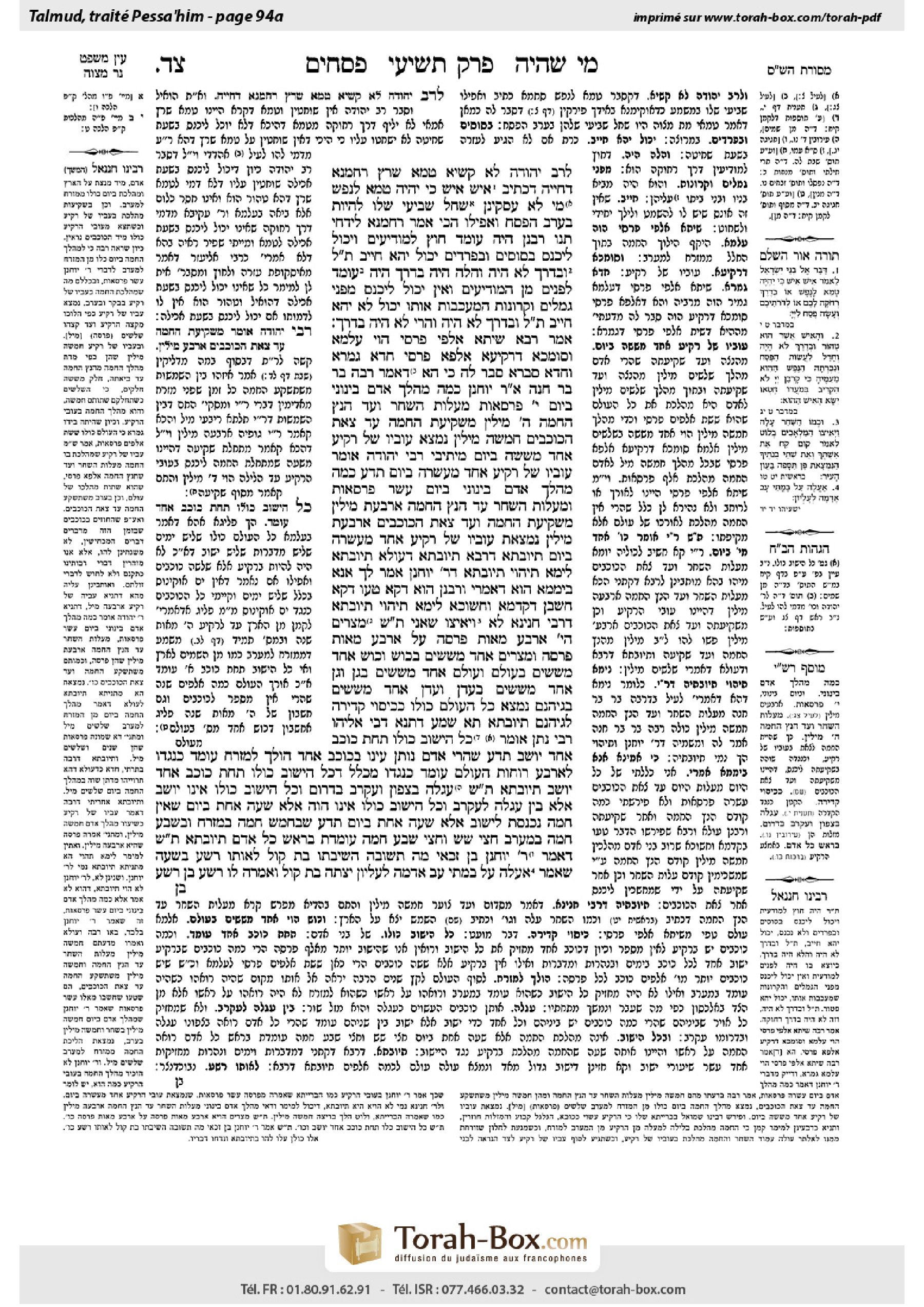
Pesachim 94a: Talmud study for Daf Yomi
Daf Yomi is the daily study of one Talmud folio. Explore 37 tractates with scans, Hebrew text, Sefaria English and AI-generated French translations where annotated.
Passage selection and English or AI-generated French translation are available where the scan has annotations. Daf Study is independent of Torah-Box and Sefaria.
Browse Pesachim · פסחים · All tractatesPesachim 94a text and translations
This page of Pesachim includes the Aramaic text, an English translation and an AI-generated French translation, alongside the scan above.
פסחים צ״ד א · Aramaic and Hebrew text
לְרַב יְהוּדָה לָא קַשְׁיָא: טְמֵא שֶׁרֶץ רַחֲמָנָא דַּחְיֵיהּ, דִּכְתִיב: ״אִישׁ אִישׁ כִּי יִהְיֶה טָמֵא לָנֶפֶשׁ״, מִי לָא עָסְקִינַן שֶׁחָל שְׁבִיעִי שֶׁלּוֹ לִהְיוֹת בְּעֶרֶב הַפֶּסַח, וַאֲפִילּוּ הָכִי אָמַר רַחֲמָנָא — לִידְּחֵי.
תָּנוּ רַבָּנַן: הָיָה עוֹמֵד חוּץ לַמּוֹדִיעִים, וְיָכוֹל לִיכָּנֵס בְּסוּסִים וּבִפְרָדִים, יָכוֹל יְהֵא חַיָּיב — תַּלְמוּד לוֹמַר: ״וּבְדֶרֶךְ לֹא הָיָה״, וְהַלָּה הָיָה בַּדֶּרֶךְ.
הָיָה עוֹמֵד לִפְנִים מִן הַמּוֹדִיעִים, וְאֵין יָכוֹל לִיכָּנֵס מִפְּנֵי גְּמַלִּים וּקְרוֹנוֹת הַמְעַכְּבוֹת אוֹתוֹ, יָכוֹל לֹא יְהֵא חַיָּיב — תַּלְמוּד לוֹמַר: ״וּבְדֶרֶךְ לֹא הָיָה״, וַהֲרֵי לֹא הָיָה בַּדֶּרֶךְ.
אָמַר רָבָא: שִׁיתָּא אַלְפֵי פַּרְסֵי הָוֵי עָלְמָא, וְסוּמְכָא דִרְקִיעָא אַלְפָּא פַּרְסֵי. חֲדָא גְּמָרָא, וַחֲדָא סְבָרָא.
סָבַר לַהּ כִּי הָא דְּאָמַר רַבָּה בַּר בַּר חָנָה אָמַר רַבִּי יוֹחָנָן: כַּמָּה מַהֲלַךְ אָדָם בֵּינוֹנִי בַּיּוֹם — עֶשֶׂר פַּרְסָאוֹת: מֵעֲלוֹת הַשַּׁחַר וְעַד הָנֵץ הַחַמָּה חֲמִשָּׁה מִילִין, מִשְּׁקִיעַת הַחַמָּה עַד צֵאת הַכּוֹכָבִים חֲמִשָּׁה מִילִין, נִמְצָא עוֹבְיוֹ שֶׁל רָקִיעַ אֶחָד מִשִּׁשָּׁה בַּיּוֹם.
מֵיתִיבִי, רַבִּי יְהוּדָה אוֹמֵר: עוֹבְיוֹ שֶׁל רָקִיעַ אֶחָד מֵעֲשָׂרָה בַּיּוֹם. תֵּדַע, כַּמָּה מַהֲלַךְ אָדָם בֵּינוֹנִי בַּיּוֹם — עֶשֶׂר פַּרְסָאוֹת, וּמֵעֲלוֹת הַשַּׁחַר עַד הָנֵץ הַחַמָּה אַרְבַּעַת מִילִין, מִשְּׁקִיעַת הַחַמָּה וְעַד צֵאת הַכּוֹכָבִים אַרְבַּעַת מִילִין, נִמְצֵאת עוֹבְיוֹ שֶׁל רָקִיעַ אֶחָד מֵעֲשָׂרָה בַּיּוֹם. תְּיוּבְתָּא דְרָבָא, תְּיוּבְתָּא דְעוּלָּא. תְּיוּבְתָּא.
לֵימָא תֶּיהְוֵי תְּיוּבְתָּא דְּרַבִּי יוֹחָנָן? אָמַר לָךְ: אֲנָא בִּימָמָא הוּא דַּאֲמַרִי, וְרַבָּנַן הוּא דְּקָא טָעוּ, דְּקָא חָשְׁבִן דְּקַדְמָא וַחֲשׁוֹכָא.
לֵימָא תֶּיהְוֵי תְּיוּבְתָּא דְּרַבִּי חֲנִינָא? לָא, ״וַיָּאִיצוּ״ שָׁאנֵי.
תָּא שְׁמַע: מִצְרַיִם הָיָה אַרְבַּע מֵאוֹת פַּרְסָה עַל אַרְבַּע מֵאוֹת פַּרְסָה, וּמִצְרַיִם אֶחָד מִשִּׁשִּׁים בְּכוּשׁ, וְכוּשׁ אֶחָד מִשִּׁשִּׁים בָּעוֹלָם, וְעוֹלָם אֶחָד מִשִּׁשִּׁים בַּגָּן, וְגַן אֶחָד מִשִּׁשִּׁים בְּעֵדֶן, וְעֵדֶן אֶחָד מִשִּׁשִּׁים בְּגֵיהִנָּם, נִמְצָא כׇּל הָעוֹלָם כּוּלּוֹ כְּכִיסּוּי קְדֵירָה לְגֵיהִנָּם. תְּיוּבְתָּא.
תָּא שְׁמַע, דְּתָנָא דְּבֵי אֵלִיָּהוּ, רַבִּי נָתָן אוֹמֵר: כׇּל הַיִּשּׁוּב כּוּלּוֹ תַּחַת כּוֹכָב אֶחָד יוֹשֵׁב. תֵּדַע, שֶׁהֲרֵי אָדָם נוֹתֵן עֵינוֹ בְּכוֹכָב אֶחָד, הוֹלֵךְ לַמִּזְרָח — עוֹמֵד כְּנֶגְדּוֹ, לְאַרְבַּע רוּחוֹת הָעוֹלָם — עוֹמֵד כְּנֶגְדּוֹ, מִכְּלָל דְּכׇל הַיִּשּׁוּב כּוּלּוֹ תַּחַת כּוֹכָב אֶחָד יוֹשֵׁב. תְּיוּבְתָּא.
תָּא שְׁמַע: עֲגָלָה בַּצָּפוֹן, וְעַקְרָב בַּדָּרוֹם, וְכׇל הַיִּשּׁוּב כּוּלּוֹ אֵינוֹ יוֹשֵׁב אֶלָּא בֵּין עֲגָלָה לְעַקְרָב. וְכׇל הַיִּשּׁוּב כּוּלּוֹ אֵינוֹ הֹוֶה אֶלָּא שָׁעָה אַחַת בַּיּוֹם, שֶׁאֵין חַמָּה נִכְנֶסֶת לַיִּשּׁוּב אֶלָּא שָׁעָה אַחַת בַּיּוֹם.
תֵּדַע, שֶׁבְּחָמֵשׁ חַמָּה בַּמִּזְרָח, וּבְשֶׁבַע חַמָּה בַּמַּעֲרָב, חֲצִי שֵׁשׁ וַחֲצִי שֶׁבַע חַמָּה עוֹמֶדֶת בְּרֹאשׁ כׇּל אָדָם. תְּיוּבְתָּא.
תָּא שְׁמַע, דְּאָמַר רַבָּן יוֹחָנָן בֶּן זַכַּאי: מָה תְּשׁוּבָה הֱשִׁיבַתּוּ בַּת קוֹל לְאוֹתוֹ רָשָׁע בְּשָׁעָה שֶׁאָמַר ״אֶעֱלֶה עַל בָּמֳתֵי עָב אֶדַּמֶּה לְעֶלְיוֹן״, יָצְתָה בַּת קוֹל וְאָמְרָה לוֹ: רָשָׁע בֶּן רָשָׁע,
Pesachim 94a · English translation
According to Rav Yehuda’s opinion it is also not difficult, because in his opinion the Torah itself deferred the obligation of one who is ritually impure through contact with a dead creeping animal to the second Pesaḥ, as it is written: “If any man of you or of your generations shall be ritually impure due to a dead body” (Numbers 9:10). Are we not dealing even with a situation in which his seventh day of purification occurs on Passover eve, such that he can be ritually pure by nightfall and therefore he has the same status on that seventh day as one who became impure due to contact with a dead creeping animal? And nonetheless the Torah stated that his obligation shall be deferred. This teaches that anyone who is ritually impure at the time of the slaughtering has his obligation deferred to the second Pesaḥ, even if he would be able to immerse and become pure in time to eat the offering on the first Pesaḥ with the rest of the Jewish people.
The Sages taught: If one was standing outside the city of Modi’im and was able to enter Jerusalem on horses or mules but not by walking, I might have thought he would be liable to receive karet for failing to come to Jerusalem and offer the Paschal lamb; therefore, the verse states: “And is not on a journey” (Numbers 9:13). This person was on a distant journey and is therefore exempt.
On the other hand, if one was standing closer to Jerusalem than Modi’im but was not able to enter due to the camels and carriages that are carrying his family and delaying him, I might have thought he would not be liable for failing to offer the Paschal lamb because he is trying to enter; therefore, the verse states: “And was not on a journey,” and this person was not on a distant journey and is therefore liable. This person could have dismounted and come to Jerusalem on foot, but he wanted to bring his family with him in a carriage and was consequently delayed. One’s liability is determined based on his distance from Jerusalem.
The discussion above pertaining to the distance that an average person can walk in a day is based on the assumption that he walks five mil between dawn and sunrise. The Gemara brings support for this assumption. Rava said: The size of the world is six thousand parasangs, and the thickness of the firmament is one thousand parasangs. One of these measurements with regard to the size of the world is a tradition, and one of the measurements is based upon Rava’s own reasoning.
The Gemara explains: Rava holds like that statement which Rabba bar bar Ḥana said that Rabbi Yoḥanan said: How far can an average person walk in a day? One can walk ten parasangs, which are forty mil. This is explained: From dawn until sunrise one can walk a distance of five mil; from sunset until the emergence of the stars one can walk another five mil. Therefore, it is found that the thickness of the firmament is one-sixth of the distance that the sun travels during the day. Between sunrise and sunset, the sun travels a distance of six thousand parasangs during the amount of time an average person can walk thirty mil. During the dawn and twilight periods in the morning and evening, when the sun passes through the thickness of the firmament, an average person can walk five mil, which is one-sixth of the distance he can walk between sunrise and sunset. Consequently, during dawn and twilight the sun must also travel one-sixth of the distance it travels between sunrise and sunset, i.e., one thousand parasangs, which is the thickness of the firmament.
The Gemara raises an objection from the following baraita: Rabbi Yehuda says: The thickness of the firmament is only one-tenth of the distance that the sun travels during the day. Know that this is true because how far can an average person walk in a day between dawn and the emergence of the stars? One can walk ten parasangs, which are forty mil, and from dawn until sunrise one can walk only four mil, which are one parasang. Therefore, it is found that the thickness of the firmament is only one-tenth of the distance that the sun travels during the day. This is a refutation of the opinion of Rava. Similarly, it is a refutation of the opinion of Ulla, who holds that an average person can walk fifteen mil in half a day, whereas Rabbi Yehuda holds that the average person can walk sixteen mil in half a day. The Gemara concludes: It is indeed a conclusive refutation.
The Gemara suggests: Let us say that this will be a conclusive refutation of the opinion of Rabba bar bar Ḥana, citing Rabbi Yoḥanan, with regard to how far an average person can walk in a day. The Gemara answers: Rabbi Yoḥanan could have said to you: I am speaking about the total distance that an average person can walk in an entire day, but I never specified the distance one can walk during different parts of the day. And it was the Sages Ulla and Rava who erred in interpreting my opinion by saying that one can walk five mil and not four during each intermediate period, because when they calculated five mil before sunrise and after sunset they included the distance walked by people who set out earlier in the morning, before dawn, and by those who continued walking after nightfall.
The Gemara suggests: Let us say it is a conclusive refutation of the opinion of Rabbi Ḥanina, who proved from biblical verses that the distance from Sodom to Zoar is five mil. The angels and Lot walked that distance between dawn and sunrise, which implies that it is only four mil. The Gemara responds: No, that verse states: “The angels hastened Lot,” which indicates that they traveled very quickly. Therefore, hastened is different; because they hurried, they traveled five mil in the time one would normally walk four mil.
Come and hear a challenge from a baraita to the previous opinion with regard to the size of the world: The size of Egypt was four hundred parasangs by four hundred parasangs, and Egypt is one-sixtieth of the size of Cush, and Cush is one-sixtieth of the world, and the world is one-sixtieth the size of the Garden of Eden, and the Garden of Eden is one-sixtieth of Eden, and Eden is one sixtieth of the size of Gehenna. Therefore, it is found that the entire world is like a pot cover, which is a small part of the total size of the pot, compared to Gehenna. In any event, based upon the sizes of Egypt and Cush, it is apparent that the entire world is larger than six thousand parasangs. This is indeed a conclusive refutation.
Come and hear another challenge: One of the Sages of the school of Eliyahu taught that Rabbi Natan says: The entire settlement, the area of the world that is inhabited, sits under one star. Know that this is correct because when a person focuses his eye on one star, he can travel east as far as he wishes within the settled part of the world and the star remains opposite him in the same place, and he can travel in the four directions of the world and the star remains in place opposite him. By inference, the entire settlement of the world rests under one star; and since so many stars are visible and each one covers an area of the world comparable in size to the entire settled portion of the world, it must be that the world is larger than six thousand parasangs. The Gemara comments that this is indeed a conclusive refutation of Rava’s opinion.
Come and hear another challenge from another baraita, which teaches that the constellation Ursa Major is in the north and the constellation Scorpio is in the south, and the entire settlement sits between Ursa Major and Scorpio, as the relative positions of these two constellations appear to be the same from any location in the settled areas of the world. The ratio of the entire settlement to the world as a whole is comparable to only one hour in a day, as the sun enters the sky above the settlement for only one hour a day while the rest of the day it is outside the settlement.
Know that this is correct because at five hours into the day the sun is still in the east, and at seven hours the sun is in the west. During the second half of the sixth hour and the first half of the seventh hour the sun is positioned on top of everyone, as it is in the middle of the sky in every inhabited area during this time. Apparently, the sun travels over the inhabited parts of the world in a single hour while the rest of the day it travels over the uninhabited parts. Therefore, the entire settled portion of the world is equal to one-twelfth of the world. It was established that the settled part of the world itself is several parasangs, so the entire world must be larger than six thousand parasangs. This also serves as a conclusive refutation of Rava’s opinion.
Come and hear another challenge, as Rabban Yoḥanan ben Zakkai said: What response did the Divine Voice answer to that wicked man, Nebuchadnezzar, when he said: “I will ascend above the heights of the clouds; I will be like the Most High” (Isaiah 14:14)? A Divine Voice emerged and said to him: Wicked man, son of a wicked man,
Pesachim 94a · Traduction française (IA)
Selon l’opinion de Rav Yehouda, il n’y a pas non plus de difficulté : à son avis, la Torah elle-même a reporté au second Pessaḥ l’obligation de celui qui est rituellement impur pour avoir touché un animal rampant mort, comme il est écrit : « Si quelqu’un parmi vous ou parmi vos générations est rituellement impur à cause d’un cadavre » (Nombres 9:10). Ne s’agit-il pas même d’un cas où le septième jour de sa purification tombe la veille de Pessaḥ, de sorte qu’il peut être rituellement pur à la tombée de la nuit et qu’il a donc, ce septième jour, le même statut que celui qui est devenu impur pour avoir touché un animal rampant mort ? Pourtant, la Torah a déclaré que son obligation serait reportée. Cela enseigne que quiconque est rituellement impur au moment de l’abattage voit son obligation reportée au second Pessaḥ, même s’il pourrait s’immerger et devenir pur à temps pour manger le sacrifice lors du premier Pessaḥ avec le reste du peuple juif.
Les Sages ont enseigné : Si quelqu’un se trouvait à l’extérieur de la ville de Modi’im et pouvait entrer à Jérusalem à cheval ou à dos de mulet, mais pas à pied, j’aurais pu penser qu’il serait passible de retranchement (karet) pour ne pas être venu à Jérusalem offrir l’agneau pascal ; c’est pourquoi le verset dit : « et n’est pas en voyage » (Nombres 9:13). Cet homme était en voyage lointain et est donc exempt.
À l’inverse, si quelqu’un se trouvait plus près de Jérusalem que Modi’im, mais ne pouvait y entrer à cause des chameaux et des charrettes qui transportaient sa famille et le retardaient, j’aurais pu penser qu’il ne serait pas passible pour ne pas avoir offert le sacrifice pascal, puisqu’il essayait d’entrer ; c’est pourquoi le verset dit : « et n’était pas en voyage ». Cet homme n’était pas en voyage lointain et est donc passible. Il aurait pu descendre de sa monture et venir à Jérusalem à pied, mais il voulait emmener sa famille avec lui dans une charrette et a donc été retardé. La responsabilité de chacun est déterminée en fonction de sa distance de Jérusalem.
La discussion précédente sur la distance qu’une personne moyenne peut parcourir en un jour repose sur l’hypothèse qu’elle parcourt cinq mil entre l’aube et le lever du soleil. La Guemara apporte un appui à cette hypothèse. Rava a dit : La taille du monde est de six mille parasanges et l’épaisseur du firmament, de mille parasanges. L’une de ces mesures de la taille du monde relève d’une tradition, et l’autre repose sur le raisonnement propre de Rava.
La Guemara explique : Rava suit l’enseignement que Rabba bar bar Ḥana a rapporté au nom de Rabbi Yoḥanan : Quelle distance une personne moyenne peut-elle parcourir en un jour ? Elle peut parcourir dix parasanges, soit quarante mil. Cela s’explique ainsi : de l’aube au lever du soleil, on peut parcourir cinq mil ; du coucher du soleil à l’apparition des étoiles, on peut parcourir encore cinq mil. Il s’ensuit donc que l’épaisseur du firmament représente un sixième de la distance parcourue par le soleil pendant la journée. Entre le lever et le coucher du soleil, celui-ci parcourt six mille parasanges durant le temps où une personne moyenne peut parcourir trente mil. Pendant les périodes de l’aube et du crépuscule, le matin et le soir, lorsque le soleil traverse l’épaisseur du firmament, une personne moyenne peut parcourir cinq mil, soit un sixième de la distance qu’elle peut parcourir entre le lever et le coucher du soleil. Par conséquent, à l’aube et au crépuscule, le soleil doit lui aussi parcourir un sixième de la distance parcourue entre le lever et le coucher du soleil, c’est-à-dire mille parasanges, ce qui correspond à l’épaisseur du firmament.
La Guemara soulève une objection à partir de la baraïta suivante : Rabbi Yehouda dit : L’épaisseur du firmament ne représente qu’un dixième de la distance parcourue par le soleil pendant la journée. La preuve en est la suivante : quelle distance une personne moyenne peut-elle parcourir en un jour, de l’aube à l’apparition des étoiles ? Elle peut parcourir dix parasanges, soit quarante mil ; or, de l’aube au lever du soleil, elle ne peut parcourir que quatre mil, soit une parasange. Il s’ensuit donc que l’épaisseur du firmament ne représente qu’un dixième de la distance parcourue par le soleil pendant la journée. Cela réfute l’opinion de Rava. De même, cela réfute l’opinion d’Ulla, selon laquelle une personne moyenne peut parcourir quinze mil en une demi-journée, tandis que Rabbi Yehouda estime qu’elle peut en parcourir seize. La Guemara conclut : c’est effectivement une réfutation décisive.
La Guemara suggère : Disons que cela constitue une réfutation décisive de l’opinion de Rabba bar bar Ḥana, rapportant les propos de Rabbi Yoḥanan, quant à la distance qu’une personne moyenne peut parcourir en un jour. La Guemara répond : Rabbi Yoḥanan aurait pu vous dire : « Je parlais de la distance totale qu’une personne moyenne peut parcourir pendant une journée entière, mais je n’ai jamais précisé la distance qu’elle peut parcourir à différents moments de la journée. » Ce sont les Sages Ulla et Rava qui se sont trompés en interprétant mon opinion, en affirmant qu’on peut parcourir cinq mil, et non quatre, pendant chacune des périodes intermédiaires. En calculant cinq mil avant le lever du soleil et après son coucher, ils ont en effet inclus la distance parcourue par ceux qui partent plus tôt le matin, avant l’aube, et par ceux qui continuent à marcher après la nuit tombée.
La Guemara suggère : Disons que cela constitue une réfutation décisive de l’opinion de Rabbi Ḥanina, qui a déduit de versets bibliques que la distance de Sodome à Zoar est de cinq mil. Les anges et Lot ont parcouru cette distance entre l’aube et le lever du soleil, ce qui implique qu’elle n’est que de quatre mil. La Guemara répond : Non, le verset dit : « Les anges pressèrent Lot », ce qui indique qu’ils voyagèrent très rapidement. Ce cas est donc différent : parce qu’ils se hâtèrent, ils parcoururent cinq mil pendant le temps qu’il faut normalement pour en parcourir quatre.
Viens et entends une objection tirée d’une baraïta contre l’opinion précédente concernant la taille du monde : L’Égypte avait une superficie de quatre cents parasanges sur quatre cents parasanges ; elle représentait un soixantième de la superficie de Koush, Koush un soixantième du monde, le monde un soixantième du Gan Eden, le Gan Eden un soixantième d’Eden, et Eden un soixantième de la Géhenne. Il s’ensuit donc que, comparé à la Géhenne, le monde entier est comme le couvercle d’une marmite, qui n’en représente qu’une petite partie. Quoi qu’il en soit, d’après les dimensions de l’Égypte et de Koush, il apparaît que le monde entier est plus grand que six mille parasanges. C’est effectivement une réfutation décisive.
Viens et entends une autre objection : Un des Sages de l’école d’Eliyahou a enseigné que Rabbi Natan dit : Toute la partie habitée du monde se trouve sous une seule étoile. La preuve en est la suivante : lorsqu’une personne fixe son regard sur une étoile, elle peut voyager vers l’est aussi loin qu’elle le souhaite dans la partie habitée du monde, et l’étoile reste en face d’elle au même endroit ; elle peut aussi voyager dans les quatre directions du monde, et l’étoile demeure à la même place, en face d’elle. On en déduit que toute la partie habitée du monde se trouve sous une seule étoile. Or, comme on voit tant d’étoiles et que chacune couvre une région du monde d’une superficie comparable à celle de toute la partie habitée, il faut que le monde soit plus grand que six mille parasanges. La Guemara fait remarquer qu’il s’agit effectivement d’une réfutation décisive de l’opinion de Rava.
Viens et entends une autre objection tirée d’une autre baraïta, qui enseigne que la constellation de la Grande Ourse se trouve au nord et celle du Scorpion au sud, et que toute la partie habitée s’étend entre la Grande Ourse et le Scorpion, car la position relative de ces deux constellations semble identique depuis tous les endroits des régions habitées du monde. Le rapport entre toute la partie habitée et le monde dans son ensemble équivaut à celui d’une heure sur une journée : le soleil ne passe dans le ciel au-dessus de la partie habitée que pendant une heure par jour ; le reste de la journée, il se trouve en dehors de la partie habitée.
La preuve en est la suivante : à la cinquième heure de la journée, le soleil est encore à l’est, et à la septième heure, il est à l’ouest. Pendant la seconde moitié de la sixième heure et la première moitié de la septième, le soleil se trouve au-dessus de tous, puisqu’il est au milieu du ciel dans toutes les régions habitées durant cette période. Il apparaît que le soleil passe au-dessus des régions habitées du monde en une seule heure, tandis que le reste de la journée, il passe au-dessus des régions inhabitées. Par conséquent, toute la partie habitée du monde équivaut à un douzième du monde. Il a été établi que la partie habitée du monde elle-même s’étend sur plusieurs parasanges ; le monde entier doit donc être plus grand que six mille parasanges. Cela constitue également une réfutation décisive de l’opinion de Rava.
Viens et entends une autre objection, comme l’a dit Rabban Yoḥanan ben Zakkaï : Quelle réponse la Voix divine a-t-elle adressée à ce méchant, Nabuchodonosor, lorsqu’il a dit : « Je monterai au-dessus des hauteurs des nuages ; je serai semblable au Très-Haut » (Isaïe 14:14) ? Une Voix divine lui répondit : « Méchant, fils d’un méchant, »
Traduction française générée par IA à partir de l’édition anglaise de Sefaria. Vérifie toujours un passage avec le texte source.
Text from Sefaria: William Davidson Edition - Vocalized Aramaic (CC BY NC); William Davidson Edition - English (CC BY NC).