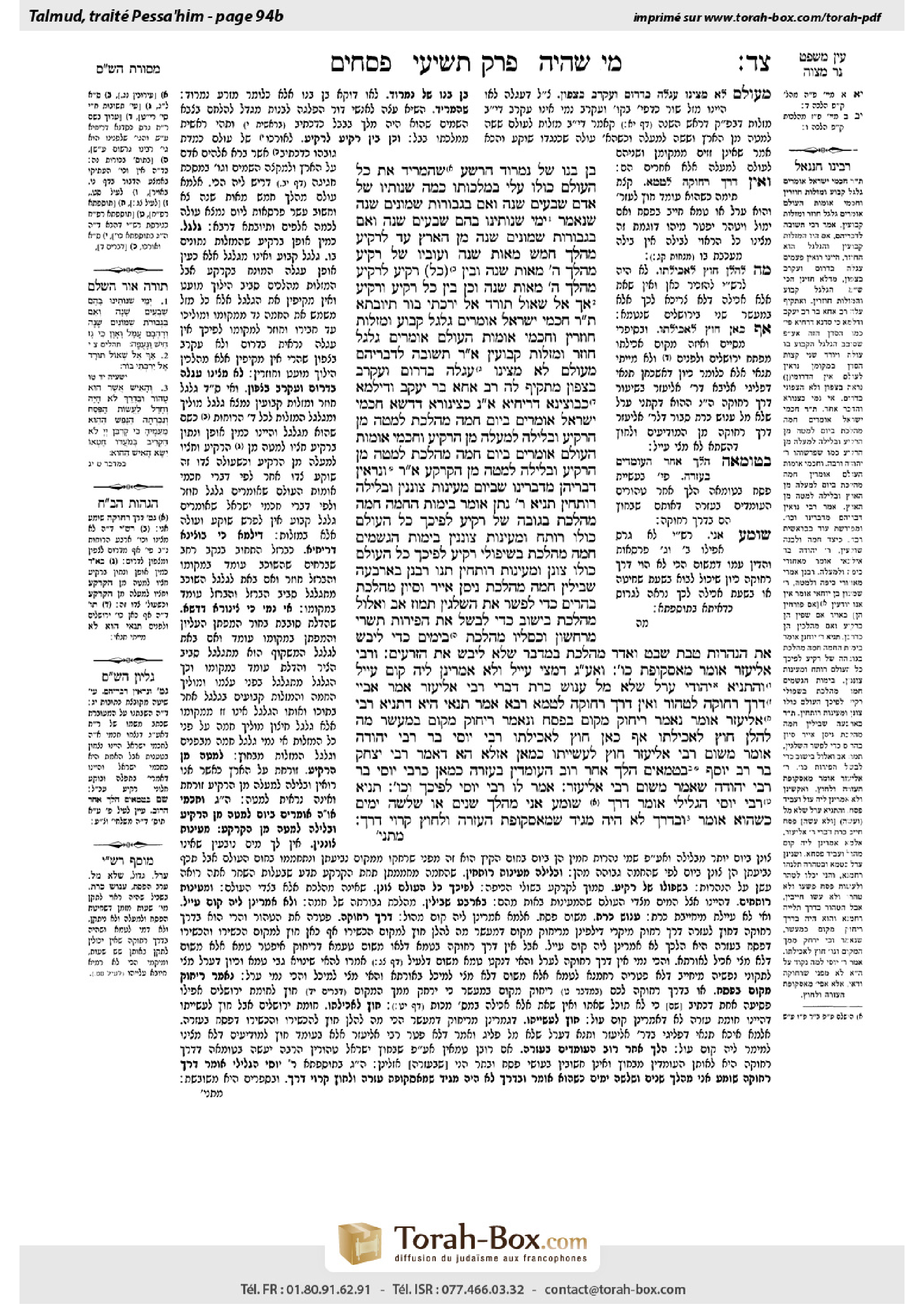
Pesachim 94b: Talmud study for Daf Yomi
Daf Yomi is the daily study of one Talmud folio. Explore 37 tractates with scans, Hebrew text, Sefaria English and AI-generated French translations where annotated.
Passage selection and English or AI-generated French translation are available where the scan has annotations. Daf Study is independent of Torah-Box and Sefaria.
Browse Pesachim · פסחים · All tractatesPesachim 94b text and translations
This page of Pesachim includes the Aramaic text, an English translation and an AI-generated French translation, alongside the scan above.
פסחים צ״ד ב · Aramaic and Hebrew text
בֶּן בְּנוֹ שֶׁל נִמְרוֹד הָרָשָׁע, שֶׁהִמְרִיד אֶת כָּל הָעוֹלָם כּוּלּוֹ עָלַי בְּמַלְכוּתוֹ. כַּמָּה שְׁנוֹתָיו שֶׁל אָדָם? שִׁבְעִים שָׁנָה, וְאִם בִּגְבוּרוֹת — שְׁמוֹנִים שָׁנָה, שֶׁנֶּאֱמַר: ״יְמֵי שְׁנוֹתֵינוּ בָהֶם שִׁבְעִים שָׁנָה וְאִם בִּגְבוּרוֹת שְׁמוֹנִים שָׁנָה״,
מִן הָאָרֶץ עַד לָרָקִיעַ מַהֲלַךְ חֲמֵשׁ מֵאוֹת שָׁנָה, וְעוֹבְיוֹ שֶׁל רָקִיעַ מַהֲלַךְ חֲמֵשׁ מֵאוֹת שָׁנָה, וּבֵין (כׇּל) רָקִיעַ לְרָקִיעַ מַהֲלַךְ חֲמֵשׁ מֵאוֹת שָׁנָה, וְכֵן בֵּין כׇּל רָקִיעַ וְרָקִיעַ, ״אַךְ אֶל שְׁאוֹל תּוּרָד אֶל יַרְכְּתֵי בוֹר״. תְּיוּבְתָּא.
תָּנוּ רַבָּנַן, חַכְמֵי יִשְׂרָאֵל אוֹמְרִים: גַּלְגַּל קָבוּעַ, וּמַזָּלוֹת חוֹזְרִין. וְחַכְמֵי אוּמּוֹת הָעוֹלָם אוֹמְרִים: גַּלְגַּל חוֹזֵר, וּמַזָּלוֹת קְבוּעִין. אָמַר רַבִּי: תְּשׁוּבָה לְדִבְרֵיהֶם — מֵעוֹלָם לֹא מָצִינוּ עֲגָלָה בַּדָּרוֹם וְעַקְרָב בַּצָּפוֹן.
מַתְקֵיף לַהּ רַב אַחָא בַּר יַעֲקֹב: וְדִילְמָא כְּבוּצִינָא דְרִיחְיָא. אִי נָמֵי כְּצִינּוֹרָא דְּדַשָּׁא.
חַכְמֵי יִשְׂרָאֵל אוֹמְרִים: בַּיּוֹם חַמָּה מְהַלֶּכֶת לְמַטָּה מִן הָרָקִיעַ, וּבַלַּיְלָה לְמַעְלָה מִן הָרָקִיעַ. וְחַכְמֵי אוּמּוֹת הָעוֹלָם אוֹמְרִים: בַּיּוֹם חַמָּה מְהַלֶּכֶת לְמַטָּה מִן הָרָקִיעַ, וּבַלַּיְלָה לְמַטָּה מִן הַקַּרְקַע. אָמַר רַבִּי: וְנִרְאִין דִּבְרֵיהֶן מִדְּבָרֵינוּ, שֶׁבַּיּוֹם מַעֲיָנוֹת צוֹנְנִין, וּבַלַּיְלָה רוֹתְחִין.
תַּנְיָא רַבִּי נָתָן אוֹמֵר: בִּימוֹת הַחַמָּה, חַמָּה מְהַלֶּכֶת בְּגוֹבַהּ שֶׁל רָקִיעַ, לְפִיכָךְ כָּל הָעוֹלָם כּוּלּוֹ רוֹתֵחַ וּמַעֲיָנוֹת צוֹנְנִין. בִּימוֹת הַגְּשָׁמִים, חַמָּה מְהַלֶּכֶת בְּשִׁיפּוּלֵי רָקִיעַ, לְפִיכָךְ כָּל הָעוֹלָם כּוּלּוֹ צוֹנֵן וּמַעֲיָנוֹת רוֹתְחִין.
תָּנוּ רַבָּנַן: בְּאַרְבָּעָה שְׁבִילִין חַמָּה מְהַלֶּכֶת. נִיסָן אִיָּיר וְסִיוָן — מְהַלֶּכֶת בֶּהָרִים, כְּדֵי לְפַשֵּׁר אֶת הַשְּׁלָגִין. תַּמּוּז אָב וֶאֱלוּל — מְהַלֶּכֶת בַּיִּשּׁוּב, כְּדֵי לְבַשֵּׁל אֶת הַפֵּירוֹת. תִּשְׁרֵי מְרַחְשְׁוָן וְכִסְלֵיו — מְהַלֶּכֶת בַּיַּמִּים, כְּדֵי לְיַבֵּשׁ אֶת הַנְּהָרוֹת. טֵבֵת שְׁבָט וַאֲדָר — מְהַלֶּכֶת בַּמִּדְבָּר, שֶׁלֹּא לְיַבֵּשׁ אֶת הַזְּרָעִים.
וְרַבִּי אֱלִיעֶזֶר אוֹמֵר מֵאִסְקוּפַּת כּוּ׳. וְאַף עַל גַּב דְּמָצֵי עָיֵיל, וְלָא אָמְרִינַן לֵיהּ קוּם עֱיֵיל?! וְהָתַנְיָא: יְהוּדִי עָרֵל שֶׁלֹּא מָל — עָנוּשׁ כָּרֵת, דִּבְרֵי רַבִּי אֱלִיעֶזֶר.
אָמַר אַבָּיֵי: דֶּרֶךְ רְחוֹקָה לַטָּהוֹר, וְאֵין דֶּרֶךְ רְחוֹקָה לַטָּמֵא.
רָבָא אָמַר, תַּנָּאֵי הִיא. דְּתַנְיָא, רַבִּי אֱלִיעֶזֶר אוֹמֵר: נֶאֱמַר רִיחוּק מָקוֹם בַּפֶּסַח, וְנֶאֱמַר רִיחוּק מָקוֹם בַּמַּעֲשֵׂר. מָה לְהַלָּן חוּץ לַאֲכִילָתוֹ, אַף כָּאן חוּץ לַאֲכִילָתוֹ.
רַבִּי יוֹסֵי בַּר רַבִּי יְהוּדָה אוֹמֵר מִשּׁוּם רַבִּי אֱלִיעֶזֶר: חוּץ לַעֲשִׂיָּיתוֹ.
כְּמַאן אָזְלָא הָא דְּאָמַר רַבִּי יִצְחָק בַּר רַב יוֹסֵף: בִּטְמֵאִים הַלֵּךְ אַחַר רוֹב הָעוֹמְדִין בָּעֲזָרָה. כְּמַאן — כְּרַבִּי יוֹסֵי בַּר רַבִּי יְהוּדָה שֶׁאָמַר מִשּׁוּם רַבִּי אֱלִיעֶזֶר.
אָמַר לוֹ רַבִּי יוֹסֵי: לְפִיכָךְ וְכוּ׳. תַּנְיָא, רַבִּי יוֹסֵי הַגְּלִילִי אוֹמֵר: ״דֶּרֶךְ״, שׁוֹמֵעַ אֲנִי מַהֲלַךְ שְׁנַיִם אוֹ שְׁלֹשָׁה יָמִים, כְּשֶׁהוּא אוֹמֵר ״וּבְדֶרֶךְ לֹא הָיָה״, מַגִּיד שֶׁמֵּאִסְקוּפַּת הָעֲזָרָה וְלַחוּץ קָרוּי דֶּרֶךְ.
Pesachim 94b · English translation
the disciple in corruption of Nimrod the wicked, who caused the entire world to rebel against Me during his reign by advising the generation of the dispersion to build a tower in order to fight the Hosts of Heaven, how many are the years of a person altogether? Seventy years, and if he is with strength, eighty years, as it is stated: “The days of our years are seventy years and with strength eighty years” (Psalms 90:10).
In contrast, from the earth to the first firmament of seven (see Ḥagiga 12b) is a walking distance of five hundred years, and the thickness of the firmament is a walking distance of five hundred years, which is equal to approximately 1.8 million parasangs, and between each firmament is another walking distance of five hundred years, and so too between each and every firmament. Therefore, how can you, Nebuchadnezzar, hope to reach the heavens in your lifetime, such that you say: “I will be like the Most High”? Rather, as the verse continues: “Yet you shall be brought down to the netherworld, to the uttermost parts of the pit” (Isaiah 14:15). In any event, this is a conclusive refutation of Rava’s opinion that the thickness of the firmament is only one thousand parasangs.
In a discussion related to the structure of the natural world, the Sages taught: The Jewish Sages say the celestial sphere of the zodiac is stationary, and the constellations revolve in their place within the sphere; and the sages of the nations of the world say the entire celestial sphere revolves, and the constellations are stationary within the sphere. Rabbi Yehuda HaNasi said: A refutation of their words that the entire sphere moves can be derived from the fact that we have never found the constellation of Ursa Major in the South or Scorpio in the North. This indicates that it is the stars themselves that revolve in place and not the celestial sphere as a whole, because otherwise it would be impossible for Ursa Major to remain in the North and Scorpio to remain in the South.
Rav Aḥa bar Ya’akov strongly objects to this proof: And perhaps the stars are stationary within the sphere like the steel socket of a mill, which remains stationary while the stones of the mill revolve around it. Alternatively, perhaps they are stationary like the pivot of a door, which remains stationary while the door makes wide turns around it; similarly, perhaps the constellations are stationary within a sphere, and there is an outer sphere within which the sun revolves around all the constellations. Therefore, Rabbi Yehuda HaNasi’s statement is not necessarily true.
The Gemara presents a similar dispute: The Jewish Sages say that during the day the sun travels beneath the firmament and is therefore visible, and at night it travels above the firmament. And the sages of the nations of the world say that during the day the sun travels beneath the firmament, and at night it travels beneath the earth and around to the other side of the world. Rabbi Yehuda HaNasi said: And the statement of the sages of the nations of the world appears to be more accurate than our statement. A proof to this is that during the day, springs that originate deep in the ground are cold, and during the night they are hot compared to the air temperature, which supports the theory that these springs are warmed by the sun as it travels beneath the earth.
It was taught in a baraita that Rabbi Natan says: During the summer the sun travels high in the sky, above the earth, and therefore the entire world is hot, and springs that originate deep in the ground are cold. On the other hand, during the winter the sun travels low in the sky, over the edges of the earth. Therefore, the entire world is cold, but springs are hot relative to the air temperature.
The Sages taught: The sun travels in four paths during the four seasons of the year, and each causes a unique weather pattern: During the months of Nisan, Iyyar, and Sivan, the sun travels over the mountains in order to melt the snows that collected during the winter. During Tammuz, Av, and Elul, it travels over the areas of the settlement in order to ripen the produce. During Tishrei, Marḥeshvan, and Kislev, it travels over the seas in order to dry the rivers, as the rivers flow more gently during that time of year and the water turns into rain clouds. During Tevet, Shevat, and Adar, it travels over the desert in order to not dry the seeds that were planted in the inhabited areas of settlement, which begin to sprout during this time.
It was taught in the mishna that Rabbi Eliezer says: Anyone located from the threshold of the Temple courtyard and beyond is considered to be on a distant journey. The Gemara objects: And even though he is able to enter the courtyard, we do not say to him: Get up and enter; rather, we rely on the fact that at the critical moment he is outside the courtyard. But wasn’t it taught in a baraita: An adult uncircumcised Jew who did not circumcise himself will be punished with karet for being unable to eat the Paschal lamb on Passover; this is the statement of Rabbi Eliezer. Apparently, Rabbi Eliezer himself requires one to take action and circumcise himself so that the obligation to bring the Paschal lamb will apply to him. If one does not do so, he is considered to have intentionally refrained from eating the Paschal lamb and will receive karet. This baraita in which Rabbi Eliezer requires a person to be proactive seems to contradict the mishna in which Rabbi Eliezer permits a person to remain passive.
Abaye said: The exemption from observing the first Pesaḥ granted to one on a distant journey was stated only for one who is ritually pure, and there is no exemption of a distant journey for one who is ritually impure or is unfit to offer the Paschal lamb for any other reason. One who is unfit to offer the sacrifice must take action to enable him to fulfill his obligation, and he is not included in the exemption of being on a distant journey. Conversely, the exemption does apply to people who are inherently fit to offer the sacrifice, and who are therefore not liable to karet if they do not enter the courtyard. There is no need to warn them to offer the Paschal lamb.
Rava said: It is a dispute between tanna’im as to Rabbi Eliezer’s true opinion, as it was taught in a baraita that Rabbi Eliezer says: The exemption of a distant journey is stated with regard to the Paschal lamb, and the exemption of a distant journey is stated with regard to the second tithe, as the verse states: “And if the way be too long for you, so that you are not able to carry it because the place is too far from you, which the Lord your God shall choose to set His name there” (Deuteronomy 14:24). Just as later in the Torah, with regard to the second tithe, the exemption applies only to someone located outside the area where it may be eaten, as the second tithe may be eaten only in Jerusalem, so too here, with regard to the Paschal lamb, the exemption of a distant journey applies only to one located outside the place in which it may be eaten, which is the entire city of Jerusalem. According to this opinion, anyone located in Jerusalem is included in the obligation to offer the Paschal lamb.
However, Rabbi Yosei bar Rabbi Yehuda says, citing Rabbi Eliezer: The exemption of a distant journey applies to anyone located outside the area where the offering of the Paschal lamb may be performed, which is the Temple courtyard.
The Gemara asks: In accordance with whose opinion is that which Rabbi Yitzḥak bar Rav Yosef said: In determining whether the majority of the community is ritually pure or ritually impure, follow the majority of those standing in the courtyard, and do not take into consideration people who are in Jerusalem but have not come to the courtyard. In accordance with whose opinion is it? It is in accordance with the opinion that Rabbi Yosei bar Rabbi Yehuda said, citing Rabbi Eliezer, which is as follows: Circumstances that can change the details of one’s obligation to offer the Paschal lamb, such as whether one is in a state of ritual impurity or whether he is on a distant journey, are determined based on whether or not one is within the Temple courtyard at the time of the slaughter.
It was taught in the mishna that Rabbi Yosei said to him: Therefore, there is a dot over the letter heh. It was taught in a baraita that Rabbi Yosei HaGelili says: If the verse had said simply: “A distant journey,” One would conclude from it that it means the distance of at least a two- or three-day walk. However, when it says later: “But the man who is ritually pure and is not on a journey” (Numbers 9:13) and does not specify a distant journey, it teaches that from the threshold of the courtyard and beyond is called a journey, and the exemption is not limited to one on a distant journey as the first verse seemed to imply.
Pesachim 94b · Traduction française (IA)
le disciple corrompu de Nimrod le méchant, qui, durant son règne, poussa le monde entier à se rebeller contre Moi en conseillant à la génération de la dispersion de construire une tour afin de combattre les armées du Ciel : combien d’années une personne vit-elle en tout ? Soixante-dix ans et, si elle est vigoureuse, quatre-vingts ans, comme il est dit : « Les jours de nos années sont de soixante-dix ans et, si nous sommes vigoureux, de quatre-vingts ans » (Psaumes 90, 10).
En revanche, la distance à parcourir à pied depuis la terre jusqu’au premier des sept firmaments (voir Ḥagiga 12b) est de cinq cents ans, et l’épaisseur du firmament représente une distance de cinq cents ans, soit environ 1,8 million de parasanges. Entre chaque firmament, il y a encore une distance de cinq cents ans, et il en va de même entre chacun des firmaments. Comment peux-tu donc, Nabuchodonosor, espérer atteindre les cieux au cours de ta vie, au point de dire : « Je serai semblable au Très-Haut » ? Au contraire, comme le poursuit le verset : « Pourtant, tu seras précipité dans le monde inférieur, au fond de la fosse » (Isaïe 14, 15). Quoi qu’il en soit, cela réfute définitivement l’opinion de Rava selon laquelle l’épaisseur du firmament n’est que de mille parasanges.
Dans une discussion portant sur la structure du monde naturel, les Sages enseignèrent : les Sages d’Israël disent que la sphère céleste du zodiaque est immobile et que les constellations tournent en son sein ; les sages des nations du monde disent que toute la sphère céleste tourne et que les constellations sont immobiles en son sein. Rabbi Yehouda HaNassi dit : On peut réfuter leur affirmation selon laquelle toute la sphère se déplace en constatant que nous n’avons jamais vu la constellation de la Grande Ourse au sud ni celle du Scorpion au nord. Cela indique que ce sont les étoiles elles-mêmes qui tournent sur place, et non la sphère céleste tout entière, car autrement il serait impossible que la Grande Ourse reste au nord et le Scorpion au sud.
Rav Aḥa bar Ya’akov s’oppose vivement à cette preuve : Et peut-être les étoiles sont-elles immobiles dans la sphère comme le moyeu en acier d’un moulin, qui reste immobile tandis que les meules tournent autour de lui. Ou bien sont-elles immobiles comme le gond d’une porte, qui reste immobile tandis que la porte pivote largement autour de lui ; de même, peut-être les constellations sont-elles immobiles dans une sphère, tandis qu’une sphère extérieure fait tourner le soleil autour de toutes les constellations. Par conséquent, l’affirmation de Rabbi Yehouda HaNassi n’est pas nécessairement exacte.
La Guemara présente une controverse similaire : les Sages d’Israël disent que, le jour, le soleil passe sous le firmament et est donc visible, tandis que, la nuit, il passe au-dessus du firmament. Les sages des nations du monde disent que, le jour, le soleil passe sous le firmament et que, la nuit, il passe sous la terre et contourne le monde pour en rejoindre l’autre côté. Rabbi Yehouda HaNassi dit : L’affirmation des sages des nations du monde semble plus exacte que la nôtre. La preuve en est que, le jour, les sources qui jaillissent au plus profond du sol sont froides, tandis que, la nuit, elles sont chaudes par rapport à la température de l’air ; cela étaye la théorie selon laquelle ces sources sont réchauffées par le soleil lorsqu’il passe sous la terre.
Il a été enseigné dans une baraïta que Rabbi Natan dit : En été, le soleil passe haut dans le ciel, au-dessus de la terre ; le monde entier est donc chaud, tandis que les sources qui jaillissent au plus profond du sol sont froides. En revanche, en hiver, le soleil passe bas dans le ciel, au-dessus des confins de la terre. Le monde entier est donc froid, mais les sources sont chaudes par rapport à la température de l’air.
Les Sages enseignèrent : Le soleil suit quatre trajectoires au cours des quatre saisons de l’année, chacune entraînant un régime météorologique particulier. Durant les mois de Nissan, Iyar et Sivan, le soleil passe au-dessus des montagnes afin de faire fondre les neiges accumulées pendant l’hiver. Durant Tammouz, Av et Eloul, il passe au-dessus des régions habitées afin de faire mûrir les récoltes. Durant Tishri, Marḥeshvan et Kislev, il passe au-dessus des mers afin d’assécher les fleuves, car ceux-ci coulent plus lentement à cette période de l’année et l’eau se transforme en nuages de pluie. Durant Tevet, Shevat et Adar, il passe au-dessus du désert afin de ne pas dessécher les graines semées dans les régions habitées, qui commencent à germer à cette période.
Il a été enseigné dans la Michna que Rabbi Eliezer dit : Toute personne qui se trouve à partir du seuil du parvis du Temple et au-delà est considérée comme étant en voyage lointain. La Guemara objecte : Même s’il est en mesure d’entrer dans le parvis, ne lui dit-on pas : « Lève-toi et entre » ? Au contraire, on se fonde sur le fait qu’au moment déterminant, il se trouve à l’extérieur du parvis. Mais n’a-t-on pas enseigné dans une baraïta : Un Juif adulte incirconcis qui ne s’est pas circoncis sera passible de retranchement, puisqu’il ne peut pas manger le sacrifice pascal à Pessaḥ ; telle est la déclaration de Rabbi Eliezer. Il semble donc que Rabbi Eliezer exige lui-même que l’on agisse et que l’on se circoncise afin que l’obligation d’offrir le sacrifice pascal s’applique à soi. Si l’on ne le fait pas, on est considéré comme s’étant volontairement abstenu de manger le sacrifice pascal et l’on sera passible de retranchement. Cette baraïta, dans laquelle Rabbi Eliezer exige qu’une personne prenne l’initiative d’agir, semble contredire la Michna, où Rabbi Eliezer permet à une personne de rester passive.
Abayé dit : L’exemption d’accomplir le premier Pessaḥ accordée à celui qui est en voyage lointain ne concerne que celui qui est en état de pureté rituelle ; celui qui est en état d’impureté rituelle, ou qui est inapte à offrir le sacrifice pascal pour toute autre raison, ne bénéficie pas de l’exemption pour voyage lointain. Celui qui est inapte à offrir le sacrifice doit agir pour pouvoir s’acquitter de son obligation ; il n’est pas inclus dans l’exemption accordée à celui qui est en voyage lointain. En revanche, cette exemption s’applique aux personnes qui sont, par nature, aptes à offrir le sacrifice et qui ne sont donc pas passibles de retranchement si elles n’entrent pas dans le parvis. Il n’est pas nécessaire de les exhorter à offrir le sacrifice pascal.
Rava dit : Il s’agit d’une controverse entre tannaïm quant à la véritable opinion de Rabbi Eliezer. En effet, il a été enseigné dans une baraïta que Rabbi Eliezer dit : L’exemption pour voyage lointain est énoncée au sujet du sacrifice pascal, et l’exemption pour voyage lointain est énoncée au sujet de la seconde dîme, comme le dit le verset : « Et si le chemin est trop long pour toi, de sorte que tu ne peux pas la porter, parce que le lieu que le Seigneur ton Dieu choisira pour y faire demeurer Son nom est trop éloigné de toi » (Deutéronome 14, 24). De même que, plus loin dans la Torah, à propos de la seconde dîme, l’exemption ne s’applique qu’à celui qui se trouve hors de la zone où elle peut être consommée — car la seconde dîme ne peut être consommée qu’à Jérusalem —, de même, ici, à propos du sacrifice pascal, l’exemption pour voyage lointain ne s’applique qu’à celui qui se trouve hors du lieu où il peut être consommé, c’est-à-dire hors de toute la ville de Jérusalem. Selon cette opinion, quiconque se trouve à Jérusalem est soumis à l’obligation d’offrir le sacrifice pascal.
Toutefois, Rabbi Yossi bar Rabbi Yehouda dit, au nom de Rabbi Eliezer : L’exemption pour voyage lointain s’applique à toute personne qui se trouve hors de la zone où le sacrifice pascal peut être offert, c’est-à-dire le parvis du Temple.
La Guemara demande : Selon l’opinion de qui faut-il comprendre ce que Rabbi Yitzḥak bar Rav Yossef a dit : Pour déterminer si la majorité de la communauté est en état de pureté rituelle ou d’impureté rituelle, il faut se fonder sur la majorité de ceux qui se tiennent dans le parvis, sans tenir compte des personnes qui sont à Jérusalem mais ne sont pas venues dans le parvis. Selon l’opinion de qui est-ce ? Selon l’opinion de Rabbi Yossi bar Rabbi Yehouda, qui l’a énoncée au nom de Rabbi Eliezer, à savoir que les circonstances susceptibles de modifier les détails de l’obligation d’offrir le sacrifice pascal, telles que l’état d’impureté rituelle ou le fait d’être en voyage lointain, sont déterminées selon que l’on se trouve ou non dans le parvis du Temple au moment de l’abattage.
Il a été enseigné dans la Michna que Rabbi Yossi lui dit : C’est pourquoi il y a un point au-dessus de la lettre hé. Il a été enseigné dans une baraïta que Rabbi Yossi HaGelili dit : Si le verset avait simplement dit « un voyage lointain », on en aurait déduit qu’il s’agit d’une distance d’au moins deux ou trois jours de marche. Cependant, lorsqu’il dit ensuite : « Mais l’homme qui est en état de pureté rituelle et qui n’est pas en voyage » (Nombres 9, 13), sans préciser qu’il s’agit d’un voyage lointain, il enseigne que l’on appelle « voyage » la distance à partir du seuil du parvis et au-delà ; l’exemption n’est donc pas limitée à celui qui est en voyage lointain, comme le semblait indiquer le premier verset.
Traduction française générée par IA à partir de l’édition anglaise de Sefaria. Vérifie toujours un passage avec le texte source.
Text from Sefaria: William Davidson Edition - Vocalized Aramaic (CC BY NC); William Davidson Edition - English (CC BY NC).