Pesachim 95a: Talmud study for Daf Yomi
Daf Yomi is the daily study of one Talmud folio. Explore 37 tractates with scans, Hebrew text, Sefaria English and AI-generated French translations where annotated.
Passage selection and English or AI-generated French translation are available where the scan has annotations. Daf Study is independent of Torah-Box and Sefaria.
Browse Pesachim · פסחים · All tractatesPesachim 95a text and translations
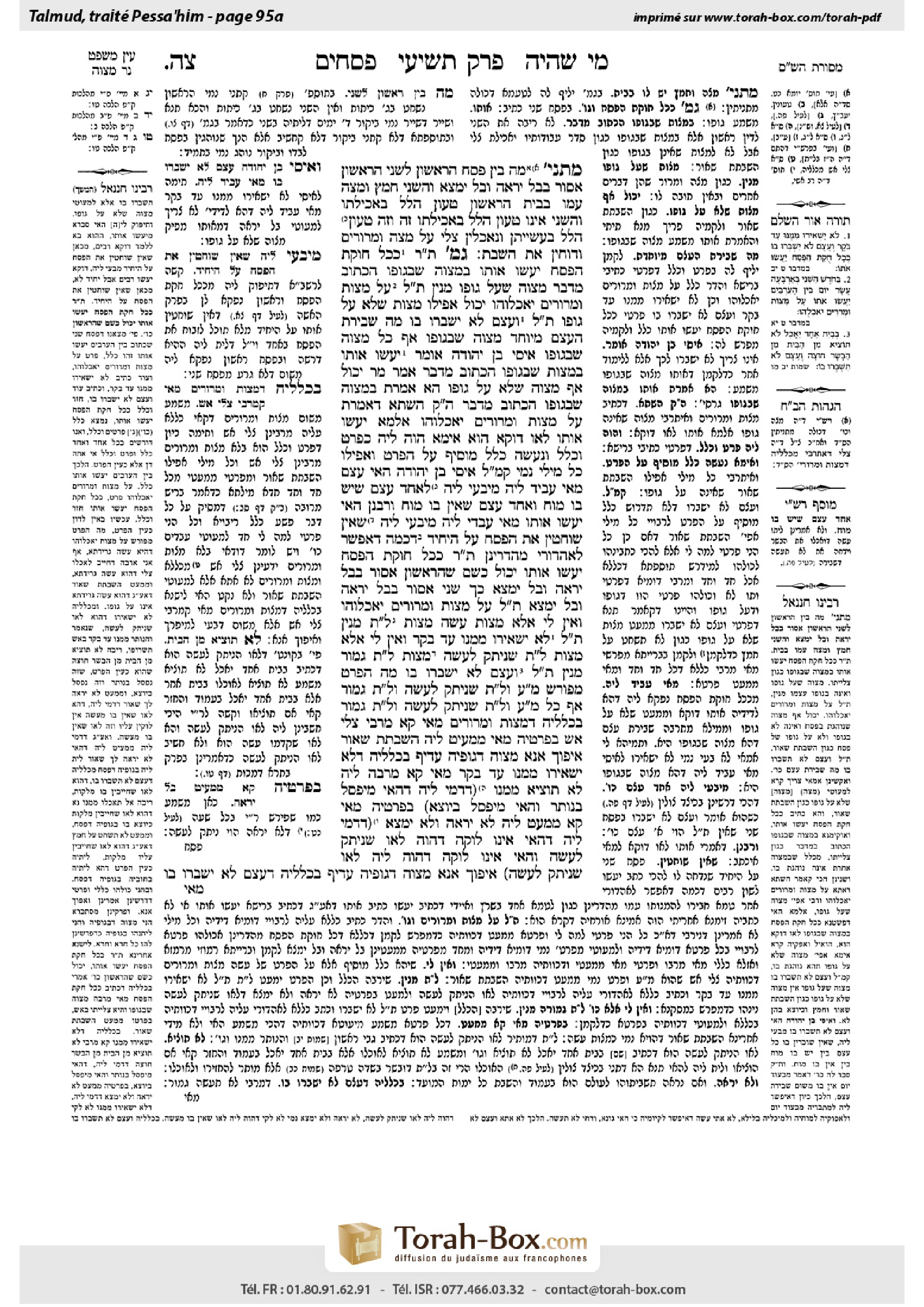
This page of Pesachim includes the Aramaic text, an English translation and an AI-generated French translation, alongside the scan above.
פסחים צ״ה א · Aramaic and Hebrew text
מַתְנִי׳ מָה בֵּין פֶּסַח הָרִאשׁוֹן לַשֵּׁנִי? הָרִאשׁוֹן אָסוּר בְּ״בַל יֵרָאֶה״ וּ״בַל יִמָּצֵא״, וְהַשֵּׁנִי — חָמֵץ וּמַצָּה עִמּוֹ בַּבַּיִת. הָרִאשׁוֹן טָעוּן הַלֵּל בַּאֲכִילָתוֹ, וְהַשֵּׁנִי אֵינוֹ טָעוּן הַלֵּל בַּאֲכִילָתוֹ. זֶה וָזֶה טָעוּן הַלֵּל בַּעֲשִׂיָּיתָן, וְנֶאֱכָלִין צָלִי עַל מַצָּה וּמְרוֹרִים, וְדוֹחִין אֶת הַשַּׁבָּת.
גְּמָ׳ תָּנוּ רַבָּנַן: ״כְּכׇל חוּקַּת הַפֶּסַח יַעֲשׂוּ אוֹתוֹ״ — בְּמִצְוָה שֶׁבְּגוּפוֹ הַכָּתוּב מְדַבֵּר.
מִצְוָה שֶׁעַל גּוּפוֹ, מִנַּיִן? תַּלְמוּד לוֹמַר: ״עַל מַצּוֹת וּמְרוֹרִים יֹאכְלוּהוּ״. יָכוֹל אֲפִילּוּ מִצְוֹת שֶׁלֹּא עַל גּוּפוֹ — תַּלְמוּד לוֹמַר: ״וְעֶצֶם לֹא יִשְׁבְּרוּ בוֹ״, מָה שְׁבִירַת הָעֶצֶם מְיוּחָד מִצְוָה שֶׁבְּגוּפוֹ — אַף כׇּל מִצְוָה שֶׁבְּגוּפוֹ.
אִיסִי בֶּן יְהוּדָה אוֹמֵר: ״יַעֲשׂוּ אוֹתוֹ״, בְּמִצְוֹת שֶׁבְּגוּפוֹ הַכָּתוּב מְדַבֵּר.
אָמַר מָר: יָכוֹל אַף מִצְוָה שֶׁלֹּא עַל גּוּפוֹ. הָא אָמְרַתְּ בְּמִצְוָה שֶׁבְּגוּפוֹ הַכָּתוּב מְדַבֵּר?
הָכִי קָאָמַר: הַשְׁתָּא דְּאָמְרַתְּ ״עַל מַצּוֹת וּמְרוֹרִים יֹאכְלוּהוּ״, אַלְמָא ״יַעֲשׂוּ אוֹתוֹ״ לָאו דַּוְקָא הוּא. אֵימָא הָוֵה לֵיהּ כִּפְרָט וּכְלָל, וְנַעֲשָׂה כְּלָל מוֹסִיף עַל הַפְּרָט, וַאֲפִילּוּ כֹּל מִילֵּי נָמֵי, קָא מַשְׁמַע לַן.
אִיסִי בֶּן יְהוּדָה, הַאי ״עֶצֶם״ מַאי עָבֵיד לֵיהּ? מִיבְּעֵי לֵיהּ לְאֶחָד עֶצֶם שֶׁיֵּשׁ בּוֹ מוֹחַ, וְאֶחָד עֶצֶם שֶׁאֵין בּוֹ מוֹחַ.
וְרַבָּנַן, הַאי ״יַעֲשׂוּ אֹתוֹ״ מַאי עָבְדִי לֵיהּ? מִיבְּעֵי לֵיהּ שֶׁאֵין שׁוֹחֲטִין אֶת הַפֶּסַח עַל הַיָּחִיד, דְּכַמָּה דְּאֶפְשָׁר לְאַהְדּוֹרֵי מַהְדְּרִינַן.
תָּנוּ רַבָּנַן: ״כְּכׇל חוּקַּת הַפֶּסַח יַעֲשׂוּ אוֹתוֹ״. יָכוֹל כְּשֵׁם שֶׁהָרִאשׁוֹן אָסוּר בְּ״בַל יֵרָאֶה״ וּ״בַל יִמָּצֵא״ כָּךְ שֵׁנִי אָסוּר בְּ״בַל יֵרָאֶה״ וּ״בַל יִמָּצֵא״ — תַּלְמוּד לוֹמַר: ״עַל מַצּוֹת וּמְרוֹרִים יֹאכְלוּהוּ״.
וְאֵין לִי אֶלָּא מִצְוַת עֲשֵׂה, מִצְוַת לֹא תַעֲשֶׂה מִנַּיִן? תַּלְמוּד לוֹמַר: ״לֹא יַשְׁאִירוּ מִמֶּנּוּ עַד בֹּקֶר״.
וְאֵין לִי אֶלָּא מִצְוַת לֹא תַעֲשֶׂה שֶׁנִּיתָּק לַעֲשֵׂה. מִצְוַת לֹא תַעֲשֶׂה גָּמוּר מִנַּיִן? תַּלְמוּד לוֹמַר: ״וְעֶצֶם לֹא יִשְׁבְּרוּ בוֹ״. מָה הַפְּרָט — מְפוֹרָשׁ: מִצְוַת עֲשֵׂה, וְלֹא תַעֲשֶׂה שֶׁנִּיתָּק לַעֲשֵׂה, וְלֹא תַעֲשֶׂה גָּמוּר — אַף כׇּל מִצְוַת עֲשֵׂה, וְלֹא תַעֲשֶׂה שֶׁנִּיתָּק לַעֲשֵׂה, וְלֹא תַעֲשֶׂה גָּמוּר.
בִּכְלָלֵיהּ דְּ״מַצּוֹת וּמְרוֹרִים״, מַאי קָא מְרַבֵּי? צְלִי אֵשׁ. בִּפְרָטֵיהּ מַאי מְמַעֵיט לֵיהּ? הַשְׁבָּתַת שְׂאוֹר. אֵיפוֹךְ אֲנָא! מִצְוָה דְגוּפֵיהּ עֲדִיף.
בִּכְלָלֵיהּ דְּ״לֹא יַשְׁאִירוּ מִמֶּנּוּ עַד בֹּקֶר״ מַאי קָא מְרַבֵּה לֵיהּ? ״לֹא תוֹצִיא מִמֶּנּוּ״ (דְּדָמֵי לֵיהּ. דְּהַאי מִיפְּסַל בְּנוֹתָר, וְהַאי מִיפְּסַל בְּיוֹצֵא).
בִּפְרָטֵיהּ מַאי קָא מְמַעֵט לֵיהּ? ״לֹא יֵרָאֶה וְלֹא יִמָּצֵא״ (דְּדָמֵי לֵיהּ, דְּהַאי אֵינוֹ לוֹקֶה דְּהָוֵה לָאו שֶׁנִּיתָּק לַעֲשֵׂה. וְהַאי אֵינוֹ לוֹקָה דְּהָוֵה לֵיהּ לָאו שֶׁנִּיתָּק לַעֲשֵׂה). אֵיפוֹךְ אֲנָא! מִצְוָה דְגוּפֵיהּ עֲדִיף.
בִּכְלָלֵיהּ דְּ״עֶצֶם לֹא יִשְׁבְּרוּ בוֹ״
Pesachim 95a · English translation
MISHNA: What is the difference between the Paschal lamb offered on the first Pesaḥ and the Paschal lamb offered on the second Pesaḥ? On the first Pesaḥ, at the time of slaughtering the Paschal lamb, it is prohibited to own leavened bread due to the prohibitions: It shall not be seen, and: It shall not be found. And on the second Pesaḥ it is permissible for one to have both leavened bread and matza with him in the house. Another difference is that the Paschal lamb offered on the first Pesaḥ requires the recitation of hallel as it is eaten and the second does not require the recitation of hallel as it is eaten. However, they are the same in that the Paschal lambs sacrificed on both the first and second Pesaḥ require the recitation of hallel as they are prepared, i.e., as they are slaughtered, and they are both eaten roasted with matza and bitter herbs, and they override Shabbat in that they may be slaughtered and their blood sprinkled even on Shabbat.
GEMARA: The Sages taught a halakhic midrash pertaining to the Paschal lamb offered on the second Pesaḥ. The verse states with regard to the second Pesaḥ: “They shall leave none of it to the morning, nor break a bone in it; according to all the entire statute of the Paschal lamb they shall offer it” (Numbers 9:12). The fact that the verse says “it” indicates that the verse is speaking of a mitzva applicable to the body of the Paschal lamb, meaning that halakhot pertaining to the actual Paschal lamb on the first Pesaḥ apply equally to the Paschal lamb on the second Pesaḥ.
The midrash continues: With regard to a mitzva related to the body of the Paschal lamb but not actually performed on the body of the offering, from where is it derived that it applies to the second Pesaḥ as well? The verse states: “They shall eat it with matzot and bitter herbs” (Numbers 9:11). One might have thought that one must fulfill all mitzvot related to the first Pesaḥ on the second Pesaḥ, even mitzvot not at all related to the body of the Paschal lamb, such as the requirement to destroy all one’s leaven. Therefore, the Torah states: “And they shall not break a bone in it” (Numbers 9:12), which teaches that just as the prohibition of breaking a bone is notable among the mitzvot related to the Paschal lamb in that it is a mitzva applicable to the Paschal lamb itself, so too, any mitzva applicable to the Paschal lamb itself must be fulfilled on the second Pesaḥ. However, other mitzvot pertaining to the first Pesaḥ need not be fulfilled on the second Pesaḥ.
Isi ben Yehuda says: It is unnecessary to derive that halakha from the end of the verse quoted, as the phrase in the first half of the verse: “They shall perform it,” indicates that the verse is speaking only of mitzvot applicable to the body of the Paschal lamb itself.
The Gemara clarifies the details of the baraita. The Master said: One might have thought that one must fulfill even a mitzva not at all related to the body of the Paschal lamb on the second Pesaḥ. The Gemara expresses surprise: But you said that the verse is speaking only of a mitzva applicable to the body of the Paschal lamb, so why would one think that unrelated mitzvot are also included?
The Gemara explains that this is what the baraita is saying: Now that you said the additional halakha that they shall eat it with unleavened bread and bitter herbs, apparently the phrase: “They shall perform it,” is not specific and does not limit the halakhot of the second Pesaḥ to those applicable to the Paschal lamb itself, say that this verse is expounded according to the principle of a detail and a generalization, as it first said: “They shall eat it with unleavened bread and bitter herbs” and “They shall leave none of it to the morning,” and then it stated a generalization: “According to all the statute of the Paschal lamb they shall perform it.” The principles of halakhic midrash state that in that case, the generalization adds to the detail and even includes everything, such that all the mitzvot of the first Pesaḥ would apply equally to the second, including the removal of leaven. Therefore, the verse “They shall not break a bone in it” teaches us that mitzvot unrelated to the Paschal lamb do not apply to the second Pesaḥ.
The Gemara asks: What does Isi ben Yehuda do with the end of the verse: “And they shall not break a bone in it”? The Gemara answers: He needs it to teach that the prohibition of breaking a bone applies both to a bone that has marrow and to a bone that does not have marrow.
The Gemara asks: And the Rabbis, who expound differently than Isi ben Yehuda, what do they do with this phrase: “They shall perform it”? The Gemara answers: They need it to teach that one does not slaughter the Paschal lamb on the second Pesaḥ on behalf of a single individual. Since the verse speaks of people performing the second Pesaḥ in the plural, it is derived that as much as it is possible to search for more people to join this individual in his Paschal lamb, we search for them, even if it means causing another individual to become ritually impure to prevent him from performing the first Pesaḥ.
The Sages taught in a different baraita: The verse states: “According to the entire statute of the Paschal lamb they shall offer it” (Numbers 9:12). One might have thought that just as at the time of the sacrifice of the Paschal lamb on the first Pesaḥ it is prohibited to own leaven due to the prohibitions of: It shall not be seen, and: It shall not be found, so too, at the time of the sacrifice of the Paschal lamb on the second Pesaḥ it is prohibited to own leaven due to the prohibitions of: It shall not be seen, and: It shall not be found. Therefore, the Torah states: “They shall eat it with matzot and bitter herbs” (Numbers 9:11), which indicates that the other mitzvot pertaining to the first Pesaḥ do not apply on the second.
The baraita continues: And from here I have derived only that positive mitzvot related to the first Pesaḥ apply on the second Pesaḥ; from where do I derive that the same is true of negative mitzvot? The verse states: “They shall leave none of it to the morning, nor break a bone in it” (Numbers 9:12).
The baraita continues: And from this verse I have derived only that a negative mitzva whose violation can be rectified by the fulfillment of a positive mitzva applies on the second Pesaḥ, e.g., the prohibition of leaving over meat from the Paschal lamb until morning, which can be rectified by the positive mitzva of burning the leftovers; from where is it derived that the same is true of a full-fledged negative mitzva? The verse states: “They shall not break a bone in it.” It may be concluded from these examples that just as the detail, i.e., the specific mitzvot mentioned in these verses, is explicit and includes a positive mitzva, a prohibition whose violation can be rectified by the fulfillment of a positive mitzva, and a full-fledged negative mitzva; so too, every positive mitzva, every prohibition whose violation can be rectified by the fulfillment of a positive mitzva, and every full-fledged negative mitzva is included.
Now that the generalization has been interpreted as referring to the specific examples mentioned earlier, what is included through the generalization of unleavened bread and bitter herbs? The Gemara answers: It comes to teach that the mitzva of roasting in fire applies to the Paschal lamb on the second Pesaḥ as well as to the first. Given that unleavened bread and bitter herbs is also a qualifying detail, what does it exclude through its detail? It teaches that the mitzva of removal of leaven does not apply on the second Pesaḥ. The Gemara asks: Perhaps I can reverse it and say that on the second Pesaḥ one is not obligated to roast the offering by fire, but one is obligated to remove all leaven? The Gemara answers: A mitzva relating to the Paschal lamb itself is preferable, as it is more reasonable to assume that the first and second Pesaḥ are comparable with regard to halakhot pertaining to the offering itself.
The Gemara asks further: What is included through the generalization of: They shall leave none of it to the morning? The Gemara answers that it includes the prohibition of: You shall not remove any of its meat from one group to another, which is similar to it, as through this prohibition mentioned in the verse it is disqualified as leftovers, and through this prohibition of removing the meat of the offering it is disqualified as sacrificial meat that has left its permitted boundary.
The Gemara asks further: What does it exclude through its detail? It excludes the prohibitions: It shall not be seen, and: It shall not be found, which are similar to it, as one who violates this prohibition of leaving over the meat of the offering until morning is not flogged because it is a prohibition whose violation can be rectified by fulfilling a positive mitzva by burning the leftovers; and one who violates this prohibition of owning leaven is not flogged because it is a prohibition whose violation can be rectified by fulfilling a positive mitzva of burning the leaven. The Gemara asks: Perhaps I can reverse it and say that the generalization is meant to include removal of leaven and the detail excludes the prohibition of leaving over the meat of the offering? The Gemara answers: In a comparison of the first Pesaḥ and the second, including a mitzva related to the Paschal lamb itself is preferable to including one that does not relate to the Paschal lamb.
The Gemara continues to ask: Through the generalization: They shall not break a bone in it,
Pesachim 95a · Traduction française (IA)
MICHNA : Quelle est la différence entre l’agneau pascal offert lors du premier Pessaḥ et celui offert lors du second Pessaḥ ? Lors du premier Pessaḥ, au moment de l’abattage de l’agneau pascal, il est interdit de posséder du levain en vertu des interdictions « Il ne sera pas vu » et « Il ne sera pas trouvé ». Lors du second Pessaḥ, en revanche, il est permis d’avoir chez soi aussi bien du levain que de la matsa. Autre différence : l’agneau pascal offert lors du premier Pessaḥ exige que l’on récite le Hallel pendant qu’on le mange, tandis que celui du second n’exige pas la récitation du Hallel pendant qu’on le mange. Toutefois, ils sont semblables en ceci que les agneaux pascals sacrifiés lors du premier comme du second Pessaḥ exigent la récitation du Hallel au moment où on les prépare, c’est-à-dire lorsqu’on les abat ; tous deux sont mangés rôtis, avec de la matsa et des herbes amères, et ils repoussent le Chabbat, en ce sens qu’ils peuvent être abattus et que leur sang peut être aspergé même le Chabbat.
GUEMARA : Les Sages ont enseigné un midrach halakhique concernant l’agneau pascal offert lors du second Pessaḥ. À propos du second Pessaḥ, le verset dit : « Ils n’en laisseront rien jusqu’au matin et n’en briseront aucun os ; selon toute la règle de l’agneau pascal, ils le célébreront » (Nombres 9,12). Le fait que le verset dise « le » indique qu’il parle d’une mitsva qui s’applique au corps de l’agneau pascal ; autrement dit, les halakhot concernant l’agneau pascal lui-même lors du premier Pessaḥ s’appliquent également à l’agneau pascal du second Pessaḥ.
Le midrach poursuit : Pour une mitsva qui concerne le corps de l’agneau pascal, mais qui ne s’accomplit pas directement sur le corps de l’offrande, d’où sait-on qu’elle s’applique également au second Pessaḥ ? Le verset dit : « Ils le mangeront avec des matsot et des herbes amères » (Nombres 9,11). On aurait pu penser qu’il faut observer, lors du second Pessaḥ, toutes les mitsvot liées au premier Pessaḥ, même celles qui ne concernent nullement le corps de l’agneau pascal, comme l’obligation de détruire tout son levain. La Torah dit donc : « Et ils n’en briseront aucun os » (Nombres 9,12), ce qui enseigne que, de même que l’interdiction de briser un os se distingue parmi les mitsvot liées à l’agneau pascal en ce qu’elle s’applique à l’agneau pascal lui-même, de même toute mitsva qui s’applique à l’agneau pascal lui-même doit être observée lors du second Pessaḥ. En revanche, les autres mitsvot relatives au premier Pessaḥ n’ont pas à être observées lors du second Pessaḥ.
Isi ben Yehouda dit : Il n’est pas nécessaire de déduire cette halakha de la fin du verset cité, car l’expression du début du verset, « Ils le célébreront », indique que le verset ne parle que des mitsvot qui s’appliquent au corps de l’agneau pascal lui-même.
La Guemara précise les détails de la baraïta. Le Maître a dit : On aurait pu penser qu’il faut observer, lors du second Pessaḥ, même une mitsva qui ne concerne nullement le corps de l’agneau pascal. La Guemara s’étonne : Mais tu as dit que le verset ne parle que d’une mitsva qui s’applique au corps de l’agneau pascal ; pourquoi penserait-on que les mitsvot sans rapport avec lui sont également incluses ?
La Guemara explique que voici ce que dit la baraïta : Puisque tu as maintenant dit qu’ils le mangeront avec des matsot et des herbes amères, il semble que l’expression « Ils le célébreront » ne soit pas spécifique et ne limite pas les halakhot du second Pessaḥ à celles qui s’appliquent à l’agneau pascal lui-même. Dis donc que ce verset s’interprète selon le principe du particulier et du général : il dit d’abord « Ils le mangeront avec des matsot et des herbes amères » et « Ils n’en laisseront rien jusqu’au matin », puis énonce un terme général : « Selon toute la règle de l’agneau pascal, ils le célébreront ». Les principes du midrach halakhique enseignent que, dans ce cas, le général ajoute au particulier et englobe même tout, de sorte que toutes les mitsvot du premier Pessaḥ s’appliqueraient également au second, y compris l’élimination du levain. Le verset « Ils n’en briseront aucun os » vient donc nous enseigner que les mitsvot sans rapport avec l’agneau pascal ne s’appliquent pas au second Pessaḥ.
La Guemara demande : Que fait Isi ben Yehouda de la fin du verset : « Et ils n’en briseront aucun os » ? La Guemara répond : Il en a besoin pour enseigner que l’interdiction de briser un os s’applique aussi bien à un os qui contient de la moelle qu’à un os qui n’en contient pas.
La Guemara demande : Et les Rabbins, qui interprètent différemment d’Isi ben Yehouda, que font-ils de l’expression « Ils le célébreront » ? La Guemara répond : Ils en ont besoin pour enseigner qu’on n’abat pas l’agneau pascal du second Pessaḥ pour un seul individu. Puisque le verset parle au pluriel des personnes qui célèbrent le second Pessaḥ, on en déduit que, dans toute la mesure du possible, on cherche d’autres personnes pour se joindre à cet individu pour son agneau pascal, même si cela implique de rendre un autre individu rituellement impur afin de l’empêcher de célébrer le premier Pessaḥ.
Les Sages ont enseigné dans une autre baraïta : Le verset dit : « Selon toute la règle de l’agneau pascal, ils le célébreront » (Nombres 9,12). On aurait pu penser que, de même qu’au moment du sacrifice de l’agneau pascal lors du premier Pessaḥ, il est interdit de posséder du levain en vertu des interdictions « Il ne sera pas vu » et « Il ne sera pas trouvé », de même, au moment du sacrifice de l’agneau pascal lors du second Pessaḥ, il est interdit de posséder du levain en vertu des interdictions « Il ne sera pas vu » et « Il ne sera pas trouvé ». La Torah dit donc : « Ils le mangeront avec des matsot et des herbes amères » (Nombres 9,11), ce qui indique que les autres mitsvot relatives au premier Pessaḥ ne s’appliquent pas au second.
La baraïta poursuit : Jusqu’ici, j’ai seulement déduit que les mitsvot positives liées au premier Pessaḥ s’appliquent au second Pessaḥ ; d’où déduis-je qu’il en va de même pour les mitsvot négatives ? Le verset dit : « Ils n’en laisseront rien jusqu’au matin et n’en briseront aucun os » (Nombres 9,12).
La baraïta poursuit : De ce verset, j’ai seulement déduit qu’une mitsva négative dont la transgression peut être réparée par l’accomplissement d’une mitsva positive s’applique au second Pessaḥ — par exemple, l’interdiction de laisser jusqu’au matin de la viande de l’agneau pascal, transgression qui peut être réparée par la mitsva positive consistant à brûler les restes. D’où déduit-on qu’il en va de même pour une véritable mitsva négative ? Le verset dit : « Ils n’en briseront aucun os. » On peut conclure de ces exemples que, de même que le particulier, c’est-à-dire les mitsvot spécifiques mentionnées dans ces versets, est explicite et comprend une mitsva positive, une interdiction dont la transgression peut être réparée par l’accomplissement d’une mitsva positive et une véritable mitsva négative, de même toute mitsva positive, toute interdiction dont la transgression peut être réparée par l’accomplissement d’une mitsva positive et toute véritable mitsva négative sont incluses.
Maintenant que le terme général a été interprété comme se rapportant aux exemples spécifiques mentionnés auparavant, qu’inclut le terme général associé au pain azyme et aux herbes amères ? La Guemara répond : Il vient enseigner que la mitsva de rôtir au feu s’applique à l’agneau pascal du second Pessaḥ comme à celui du premier. Puisque le pain azyme et les herbes amères constituent eux aussi un élément particulier, qu’exclut-on par ce particulier ? Il enseigne que la mitsva d’éliminer le levain ne s’applique pas au second Pessaḥ. La Guemara demande : Peut-être pourrais-je inverser les choses et dire que, lors du second Pessaḥ, on n’est pas tenu de rôtir l’offrande au feu, mais qu’on est tenu d’éliminer tout le levain ? La Guemara répond : Une mitsva qui concerne l’agneau pascal lui-même est préférable, car il est plus raisonnable de supposer que le premier et le second Pessaḥ sont comparables en ce qui concerne les halakhot relatives à l’offrande elle-même.
La Guemara demande encore : Qu’inclut le terme général « Ils n’en laisseront rien jusqu’au matin » ? La Guemara répond qu’il inclut l’interdiction de faire passer de sa viande d’un groupe à un autre, interdiction qui lui est similaire : par la transgression de l’interdiction mentionnée dans le verset, la viande est disqualifiée en tant que reste, et par la transgression de l’interdiction de déplacer la viande de l’offrande, elle est disqualifiée en tant que viande sacrificielle sortie de sa limite permise.
La Guemara demande encore : Qu’exclut-on par ce particulier ? Il exclut les interdictions « Il ne sera pas vu » et « Il ne sera pas trouvé », qui lui sont similaires, car celui qui transgresse l’interdiction de laisser jusqu’au matin la viande de l’offrande n’est pas flagellé, puisque sa transgression peut être réparée par l’accomplissement d’une mitsva positive, en brûlant les restes ; de même, celui qui transgresse l’interdiction de posséder du levain n’est pas flagellé, puisque sa transgression peut être réparée par l’accomplissement de la mitsva positive consistant à brûler le levain. La Guemara demande : Peut-être pourrais-je inverser les choses et dire que le terme général vise à inclure l’élimination du levain, tandis que le particulier exclut l’interdiction de laisser jusqu’au matin la viande de l’offrande ? La Guemara répond : Dans la comparaison entre le premier et le second Pessaḥ, il est préférable d’inclure une mitsva qui concerne l’agneau pascal lui-même plutôt qu’une mitsva qui ne le concerne pas.
La Guemara poursuit sa question : Par le terme général « Ils n’en briseront aucun os »,
Traduction française générée par IA à partir de l’édition anglaise de Sefaria. Vérifie toujours un passage avec le texte source.
Text from Sefaria: William Davidson Edition - Vocalized Aramaic (CC BY NC); William Davidson Edition - English (CC BY NC).