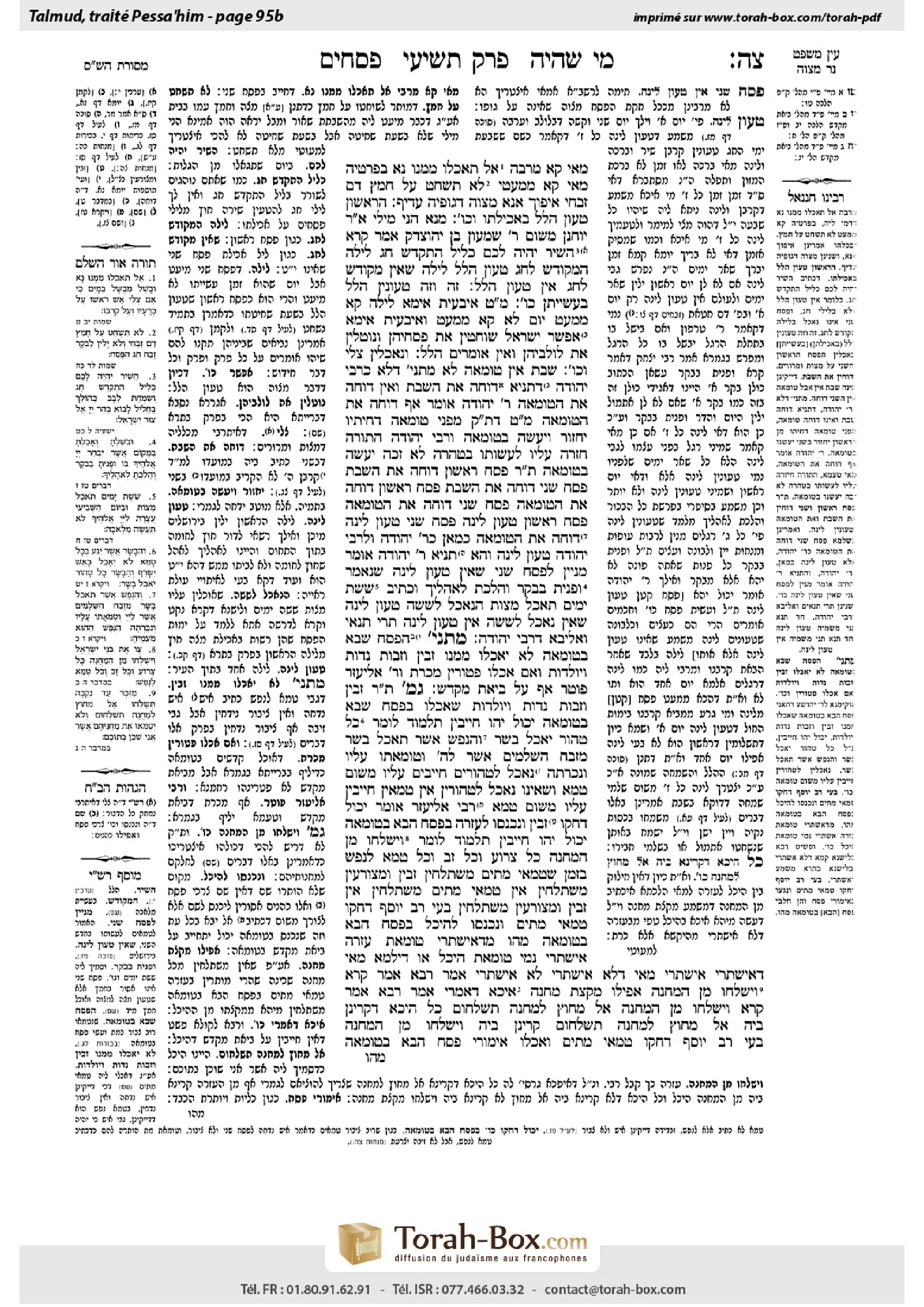
Pesachim 95b: Talmud study for Daf Yomi
Daf Yomi is the daily study of one Talmud folio. Explore 37 tractates with scans, Hebrew text, Sefaria English and AI-generated French translations where annotated.
Passage selection and English or AI-generated French translation are available where the scan has annotations. Daf Study is independent of Torah-Box and Sefaria.
Browse Pesachim · פסחים · All tractatesPesachim 95b text and translations
This page of Pesachim includes the Aramaic text, an English translation and an AI-generated French translation, alongside the scan above.
פסחים צ״ה ב · Aramaic and Hebrew text
מַאי קָא מְרַבֵּה? ״אַל תֹּאכְלוּ מִמֶּנּוּ נָא״. בִּפְרָטֵיהּ מַאי קָא מְמַעֲטִי? ״לֹא תִשְׁחַט עַל חָמֵץ דַּם זִבְחִי״. אֵיפוֹךְ אֲנָא! מִצְוָה דְגוּפֵיהּ עֲדִיף.
הָרִאשׁוֹן טָעוּן הַלֵּל בַּאֲכִילָתוֹ וְכוּ׳. מְנָא הָנֵי מִילֵּי? אָמַר רַבִּי יוֹחָנָן מִשּׁוּם רַבִּי שִׁמְעוֹן בֶּן יְהוֹצָדָק: אָמַר קְרָא ״הַשִּׁיר יִהְיֶה לָכֶם כְּלֵיל הִתְקַדֶּשׁ חָג״. לַיְלָה הַמְקוּדָּשׁ לֶחָג — טָעוּן הַלֵּל, לַיְלָה שֶׁאֵין מְקוּדָּשׁ לֶחָג — אֵין טָעוּן הַלֵּל.
זֶה וָזֶה טְעוּנִין הַלֵּל בַּעֲשִׂיָּיתָן כּוּ׳. מַאי טַעְמָא? אִיבָּעֵית אֵימָא: לַיְלָה קָא מְמַעֵט, יוֹם לָא קָא מְמַעֵט. וְאִיבָּעֵית אֵימָא: אֶפְשָׁר יִשְׂרָאֵל שׁוֹחֲטִין אֶת פִּסְחֵיהֶן וְנוֹטְלִין אֶת לוּלְבֵיהֶן, וְאֵין אוֹמְרִים הַלֵּל?!
וְנֶאֱכָלִין צָלִי וְכוּ׳. שַׁבָּת אִין, טוּמְאָה לָא. מַתְנִיתִין דְּלָא כְּרַבִּי יְהוּדָה. דְּתַנְיָא: דּוֹחֶה אֶת הַשַּׁבָּת, וְאֵין דּוֹחֶה אֶת הַטּוּמְאָה. רַבִּי יְהוּדָה אוֹמֵר: אַף דּוֹחֶה אֶת הַטּוּמְאָה.
מַאי טַעְמָא דְּתַנָּא קַמָּא: מִפְּנֵי טוּמְאָה דְּחִיתִיו יַחְזוֹר וְיֵעָשֶׂה בְּטוּמְאָה?! וְרַבִּי יְהוּדָה: הַתּוֹרָה חָזְרָה עָלָיו לַעֲשׂוֹתוֹ בְּטׇהֳרָה, לֹא זָכָה — יֵעָשֶׂה בְּטוּמְאָה.
תָּנוּ רַבָּנַן: פֶּסַח רִאשׁוֹן דּוֹחֶה אֶת הַשַּׁבָּת, פֶּסַח שֵׁנִי דּוֹחֶה אֶת הַשַּׁבָּת. פֶּסַח רִאשׁוֹן דּוֹחֶה אֶת הַטּוּמְאָה, פֶּסַח שֵׁנִי דּוֹחֶה אֶת הַטּוּמְאָה. פֶּסַח רִאשׁוֹן טָעוּן לִינָה, פֶּסַח שֵׁנִי טָעוּן לִינָה.
דּוֹחֶה אֶת הַטּוּמְאָה, כְּמַאן? כְּרַבִּי יְהוּדָה.
וּלְרַבִּי יְהוּדָה טָעוּן לִינָה? וְהָא תַּנְיָא, רַבִּי יְהוּדָה אוֹמֵר: מִנַּיִין לְפֶסַח שֵׁנִי שֶׁאֵין טָעוּן לִינָה, שֶׁנֶּאֱמַר: ״וּפָנִיתָ בַבֹּקֶר וְהָלַכְתָּ לְאֹהָלֶיךָ״, וּכְתִיב: ״שֵׁשֶׁת יָמִים תֹּאכַל מַצּוֹת״, הַנֶּאֱכָל לְשִׁשָּׁה טָעוּן לִינָה, שֶׁאֵין נֶאֱכָל לְשִׁשָּׁה — אֵין טָעוּן לִינָה!
תְּרֵי תַנָּאֵי וְאַלִּיבָּא דְּרַבִּי יְהוּדָה.
מַתְנִי׳ הַפֶּסַח שֶׁבָּא בְּטוּמְאָה, לֹא יֹאכְלוּ מִמֶּנּוּ זָבִין וְזָבוֹת נִדּוֹת וְיוֹלְדוֹת. וְאִם אָכְלוּ — פְּטוּרִין מִכָּרֵת.
וְרַבִּי אֱלִיעֶזֶר פּוֹטֵר אַף עַל בִּיאַת מִקְדָּשׁ.
גְּמָ׳ תָּנוּ רַבָּנַן: זָבִין וְזָבוֹת נִדּוֹת וְיוֹלְדוֹת שֶׁאָכְלוּ בְּפֶסַח שֶׁבָּא בְּטוּמְאָה, יָכוֹל יְהוּ חַיָּיבִין — תַּלְמוּד לוֹמַר: ״כׇּל טָהוֹר יֹאכַל בָּשָׂר. וְהַנֶּפֶשׁ אֲשֶׁר תֹּאכַל בָּשָׂר מִזֶּבַח הַשְּׁלָמִים אֲשֶׁר לַה׳ וְטוּמְאָתוֹ עָלָיו וְנִכְרְתָה״.
נֶאֱכַל לִטְהוֹרִים — חַיָּיבִים עָלָיו מִשּׁוּם טָמֵא, וְשֶׁאֵינוֹ נֶאֱכָל לִטְהוֹרִין — אֵין טְמֵאִין חַיָּיבִין עָלָיו מִשּׁוּם טָמֵא.
רַבִּי אֱלִיעֶזֶר אוֹמֵר: יָכוֹל דָּחֲקוּ זָבִין וְנִכְנְסוּ לָעֲזָרָה בְּפֶסַח הַבָּא בְּטוּמְאָה, יָכוֹל יְהוּ חַיָּיבִין — תַּלְמוּד לוֹמַר: ״וִישַׁלְּחוּ מִן הַמַּחֲנֶה כׇּל צָרוּעַ וְכׇל זָב וְכֹל טָמֵא לָנָפֶשׁ״, בִּזְמַן שֶׁטְּמֵאֵי מֵתִים מִשְׁתַּלְּחִין — זָבִין וּמְצוֹרָעִין מִשְׁתַּלְּחִין, אֵין טְמֵאֵי מֵתִים מִשְׁתַּלְּחִין — אֵין זָבִין וּמְצוֹרָעִין מִשְׁתַּלְּחִין.
בָּעֵי רַב יוֹסֵף: דָּחֲקוּ טְמֵאֵי מֵתִים וְנִכְנְסוּ לַהֵיכָל בְּפֶסַח הַבָּא בְּטוּמְאָה, מַהוּ? מִדְּאִישְׁתְּרַי טוּמְאַת עֲזָרָה אִישְׁתְּרַי נָמֵי טוּמְאַת הֵיכָל, אוֹ דִילְמָא מַאי דְּאִישְׁתְּרַי — אִישְׁתְּרַי, מַאי דְּלָא אִישְׁתְּרַי — לָא אִישְׁתְּרַי!
אָמַר רָבָא, אָמַר קְרָא: ״וִישַׁלְּחוּ מִן הַמַּחֲנֶה״, אֲפִילּוּ מִקְצָת מַחֲנֶה.
אִיכָּא דְּאָמְרִי: אָמַר רָבָא, אָמַר קְרָא: ״וִישַׁלְּחוּ מִן הַמַּחֲנֶה ... אֶל מִחוּץ לַמַּחֲנֶה תְּשַׁלְּחוּם״, כׇּל הֵיכָא דְּקָרֵינַן בֵּיהּ ״אֶל מִחוּץ לַמַּחֲנֶה תְּשַׁלְּחוּם״ — קָרֵינַן בֵּיהּ ״וִישַׁלְּחוּ מִן הַמַּחֲנֶה״.
בָּעֵי רַב יוֹסֵף: דָּחֲקוּ טְמֵאֵי מֵתִים וְאָכְלוּ אֵימוּרֵי פֶּסַח הַבָּא בְּטוּמְאָה,
Pesachim 95b · English translation
what is it including, beyond what is mentioned explicitly in the verse? The Gemara answers that it includes the mitzva: “Do not eat from it raw” (Exodus 12:9). The Gemara asks: What does it exclude through its detail? The Gemara answers that it excludes the mitzva: “You shall not offer the blood of My sacrifice with leavened bread” (Exodus 34:25). The Gemara asks: Perhaps I can reverse it and say the opposite, that the prohibition against eating the offering raw is excluded, and the prohibition against owning leaven is included. The Gemara answers: Including a mitzva related to the Paschal lamb itself is preferable to including one that does not relate as directly to the Paschal lamb. Therefore, the prohibition against eating the Paschal lamb raw is included, and the prohibition against slaughtering the Paschal lamb with leaven in one’s possession is excluded.
It was taught in the mishna that the Paschal lamb on the first Pesaḥ requires the recitation of hallel as it is eaten, whereas on the second Pesaḥ it does not. The Gemara asks: From where are these matters derived? Rabbi Yoḥanan said, citing Rabbi Shimon ben Yehotzadak, that the verse states: “You shall have a song as in the night when a Festival is sanctified” (Isaiah 30:29). From here it may be derived that a night sanctified as a Festival, on which labor is prohibited, such as the first night of Passover, requires the recitation of hallel; however, a night which is not sanctified as a Festival, such as the night when the Paschal lamb is eaten following the second Pesaḥ, does not require the recitation of hallel.
It was stated in the mishna that the Paschal lambs sacrificed on both the first and second Pesaḥ require the recitation of hallel as they are prepared. The Gemara asks: What is the reason that hallel must be recited while one prepares the Paschal lamb on the second Pesaḥ? The Gemara answers: If you wish, say that the verse quoted above: “As in the night when a festival is sanctified,” excludes laws that apply at night, but it does not exclude laws that apply by day; therefore, the recitation of hallel is required while slaughtering the Paschal lamb on the second Pesaḥ just as it is required while slaughtering the Paschal lamb on the first Pesaḥ. And if you wish, say that this halakha simply makes logical sense: Is it possible that the Jewish people are slaughtering their Paschal lambs or taking their lulavim on Sukkot and not reciting hallel? It is inconceivable that they would not be reciting hallel and there is no need for an explicit biblical source for this halakha.
It was also taught in the mishna that the Paschal lambs on both the first and second Pesaḥ are eaten roasted and override Shabbat. It may be inferred from this that with regard to Shabbat, yes, it is overridden by the Paschal lamb on the second Pesaḥ, but with regard to ritual impurity, no, it is not overridden for the sake of the Paschal lamb on the second Pesaḥ. The Gemara points out that this understanding of the mishna is not in accordance with the opinion of Rabbi Yehuda, as it was taught in a baraita: The Paschal lamb on the second Pesaḥ overrides Shabbat and does not override ritual impurity. Rabbi Yehuda says: It overrides even ritual impurity.
The Gemara explains: What is the reason for the opinion of the first tanna? He holds that once this person was deferred from the first Pesaḥ due to ritual impurity, shall he now return and perform the offering of the Paschal lamb on the second Pesaḥ in ritual impurity? And Rabbi Yehuda reasoned: The Torah sought to allow this person the opportunity to perform the offering of the Paschal lamb in ritual purity; if it ultimately becomes clear that he did not merit doing so, let him at least perform the offering of the second Pesaḥ in a state of ritual impurity.
The Sages taught in a different baraita: The offering of the Paschal lamb on the first Pesaḥ overrides Shabbat, and similarly, the offering of the Paschal lamb on the second Pesaḥ overrides Shabbat. The first Pesaḥ overrides ritual impurity, and similarly, the second Pesaḥ overrides ritual impurity. The first Pesaḥ requires remaining until morning, meaning that it is prohibited for people who have participated in the Paschal lamb to return that night to their homes outside Jerusalem, and similarly, the second Pesaḥ requires remaining until morning.
The Gemara clarifies: With regard to the statement that the second Pesaḥ overrides ritual impurity, in accordance with whose opinion is this? It is in accordance with the opinion of Rabbi Yehuda.
But according to Rabbi Yehuda, does the second Pesaḥ require remaining until morning? Wasn’t it taught explicitly in a baraita that Rabbi Yehuda says: From where is it derived that the second Pesaḥ does not require remaining until morning? As it is stated with regard to the Paschal lamb: “And you shall roast and eat it in the place which the Lord your God shall choose; and you shall turn in the morning and go to your tents” (Deuteronomy 16:7), and it is written immediately after: “Six days you shall eat matzot; and on the seventh day shall be a solemn assembly to the Lord your God; you shall do no work on it” (Deuteronomy 16:8). From this juxtaposition it may be concluded that the first Pesaḥ, which is followed by the mitzvah to eat matza for six days, requires remaining until morning, whereas the second Pesaḥ, which is not followed by the mitzva to eat matza for six days, does not require remaining until morning. This contradicts what was previously stated citing Rabbi Yehuda.
The Gemara answers: These statements were made by two tanna’im in accordance with the opinion of Rabbi Yehuda, but the two tanna’im disagreed about whether or not Rabbi Yehuda maintained that one is required to stay overnight on the second Pesaḥ.
MISHNA: When the Paschal lamb is sacrificed in a state of ritual impurity due to the fact that the majority of the Jewish people are ritually impure, zavim, and zavot, and menstruating women, and women after childbirth may not eat it, because the Paschal lamb overrides only ritual impurity imparted by a corpse, but it does not override other forms of ritual impurity. However, if they violated the halakha and ate from the offering, they are exempt from karet. One who eats sacrificial food in a state of ritual impurity is generally liable to receive karet; however, since in this case the offering is sacrificed in a state of ritual impurity, there is no punishment of karet even for ritually impure individuals who are not permitted to eat it.
And Rabbi Eliezer exempts these individuals from karet even for entering the Temple in a state of ritual impurity, despite their not being permitted to enter, because people who are impure due to ritual impurity imparted by a corpse are permitted to enter the Temple in this situation despite their impurity.
GEMARA: The Sages taught in a baraita: With regard to zavim, and zavot, and menstruating women, and women after childbirth who ate of the Paschal lamb that was sacrificed while the majority of the Jewish people were in a state of ritual impurity, one might have thought that they would be liable to receive karet; therefore, the verse states: “The meat that touches any impure thing shall not be eaten, it shall be burned in fire; and the meat, every one that is ritually pure may eat the meat. But the soul that eats of the meat of the sacrifice of peace-offerings, that belong to the Lord, having his impurity upon him, that soul shall be cut off [venikhreta] from his people” (Leviticus 7:19–20).
The baraita continues: The juxtaposition of these verses teaches that if the offering is eaten only by people who are ritually pure, ritually impure people are liable for eating it due to being ritually impure, but if it is not eaten only by people who are ritually pure, because it was offered when the majority of the Jewish people were impure, those who are ritually impure are not liable for eating it due to being impure.
Rabbi Eliezer says: One might have thought that if zavim or lepers pushed their way in and entered the courtyard, which they are prohibited from entering, in order to sacrifice the Paschal lamb that is brought when the majority of the Jewish people are in a state of ritual impurity, one might have thought that they would be liable to receive karet for entering the Temple while ritually impure; therefore, the verse states: “That they send out from the camp any leper and any zav and anyone defiled by the dead” (Numbers 5:2). This teaches that at a time when those who are impure due to ritual impurity imparted by a corpse are sent out from the Temple, zavim and lepers are also sent out; when those who are impure due to ritual impurity imparted by a corpse are not sent out but are permitted to sacrifice the offering in a state of ritual impurity, zavim and lepers are also not sent out.
Rav Yosef asked a question related to the halakhot discussed above: If those who are impure due to ritual impurity imparted by a corpse pushed their way in and entered the Sanctuary, which is an area in which no services are performed for the Paschal lamb and which only priests may enter ab initio, and this occurs in a case in which the Paschal lamb is brought when the majority of the Jewish people are in a state of ritual impurity, what is the halakha? Is the halakha that since ritual impurity was permitted in the courtyard for the sake of the Paschal lamb, ritual impurity in the Sanctuary was also permitted; or perhaps what was permitted was permitted and what was not permitted was not permitted, and consequently they are liable for entering the Sanctuary?
Rava said in answer to this question that the verse states: “They send out from the camp” (Numbers 5:2); the phrase “from the camp” indicates that the halakha applies even to a part of the camp. Therefore, when the majority of the Jewish people are ritually impure, even though people who are ritually impure are permitted to enter part of the Temple, as they must bring their offerings to the Temple courtyard, they are not permitted to enter everywhere inside the Temple, and the prohibition of entering the Sanctuary remains in place.
Some say that Rava said a different answer: The verse states: “That they send out from the camp any leper and any zav and anyone defiled by the dead…outside the camp you shall send them” (Numbers 5:2–3). This implies that anywhere that we apply the phrase: “Outside the camp you shall send them,” which is referring to a case in which the majority of the Jewish people are ritually pure and indicates that the impure people must be sent outside of the entire camp, we also apply the phrase: “They must send out from the camp,” meaning it is prohibited for people who are ritually impure to enter the Sanctuary. However, if the majority of the Jewish people are impure and the offering is sacrificed in a state of impurity, those who are impure are not liable if they enter the Sanctuary.
Rav Yosef asked a similar question: If people who are impure due to ritual impurity imparted by a corpse pushed their way in and ate portions that are supposed to be consumed on the altar, such as the fats, the kidneys, and the fat tail, from a Paschal lamb offered in ritual impurity,
Pesachim 95b · Traduction française (IA)
Qu’inclut-il, au-delà de ce qui est explicitement mentionné dans le verset ? La Guemara répond qu’il inclut la mitsva : « N’en mangez pas cru » (Exode 12:9). La Guemara demande : Qu’exclut-il par son détail ? La Guemara répond qu’il exclut la mitsva : « Tu n’offriras pas le sang de mon sacrifice avec du pain levé » (Exode 34:25). La Guemara demande : Peut-être puis-je inverser les choses et dire le contraire : l’interdiction de manger le sacrifice cru est exclue, et l’interdiction de posséder du pain levé est incluse. La Guemara répond : Il est préférable d’inclure une mitsva qui concerne le sacrifice de Pessa’h lui-même plutôt qu’une mitsva qui ne s’y rapporte pas aussi directement. Par conséquent, l’interdiction de manger cru le sacrifice de Pessa’h est incluse, et l’interdiction d’abattre le sacrifice de Pessa’h alors que l’on possède du pain levé est exclue.
La Michna enseignait que le sacrifice de Pessa’h du premier Pessa’h exige la récitation du Hallel pendant qu’on le mange, tandis que celui du second Pessa’h ne l’exige pas. La Guemara demande : D’où tire-t-on ces règles ? Rabbi Yoḥanan a dit au nom de Rabbi Shimon ben Yehotzadak que le verset déclare : « Vous chanterez comme la nuit où une fête est sanctifiée » (Isaïe 30:29). On en déduit qu’une nuit sanctifiée comme une fête, où le travail est interdit, comme la première nuit de Pessa’h, exige la récitation du Hallel ; en revanche, une nuit qui n’est pas sanctifiée comme une fête, comme la nuit où l’on mange le sacrifice de Pessa’h après le second Pessa’h, n’exige pas la récitation du Hallel.
La Michna indiquait que les sacrifices de Pessa’h offerts lors du premier comme du second Pessa’h exigent la récitation du Hallel pendant leur préparation. La Guemara demande : Pourquoi faut-il réciter le Hallel pendant la préparation du sacrifice de Pessa’h lors du second Pessa’h ? La Guemara répond : Si tu veux, dis que le verset cité plus haut — « comme la nuit où une fête est sanctifiée » — exclut les règles qui s’appliquent la nuit, mais n’exclut pas celles qui s’appliquent le jour ; par conséquent, il faut réciter le Hallel pendant l’abattage du sacrifice de Pessa’h lors du second Pessa’h, tout comme lors de l’abattage du sacrifice de Pessa’h du premier Pessa’h. Et si tu veux, dis que cette halakha relève simplement du bon sens : Est-il possible que le peuple juif abatte ses sacrifices de Pessa’h ou prenne ses loulavim à Souccot sans réciter le Hallel ? Il est inconcevable qu’il ne récite pas le Hallel ; aucun verset explicite n’est donc nécessaire pour établir cette halakha.
La Michna enseignait également que les sacrifices de Pessa’h du premier comme du second Pessa’h sont mangés rôtis et repoussent le Chabbat. On peut en déduire que, pour le Chabbat, oui, il est repoussé par le sacrifice de Pessa’h du second Pessa’h, mais que, pour l’impureté rituelle, non, elle n’est pas repoussée en faveur du sacrifice de Pessa’h du second Pessa’h. La Guemara fait remarquer que cette interprétation de la Michna ne concorde pas avec l’opinion de Rabbi Yehuda, car il a été enseigné dans une baraïta : Le sacrifice de Pessa’h du second Pessa’h repousse le Chabbat et ne repousse pas l’impureté rituelle. Rabbi Yehuda dit : Il repousse même l’impureté rituelle.
La Guemara explique : Quelle est la raison de l’opinion du premier tanna ? Il considère qu’après que cet homme a été écarté du premier Pessa’h en raison de l’impureté rituelle, va-t-il maintenant revenir et offrir le sacrifice de Pessa’h du second Pessa’h en état d’impureté rituelle ? Rabbi Yehuda, lui, raisonne ainsi : La Torah a voulu donner à cet homme la possibilité d’offrir le sacrifice de Pessa’h en état de pureté rituelle ; si, finalement, il s’avère qu’il n’a pas mérité de le faire, qu’il puisse au moins offrir le sacrifice du second Pessa’h en état d’impureté rituelle.
Les Sages ont enseigné dans une autre baraïta : L’offrande du sacrifice de Pessa’h du premier Pessa’h repousse le Chabbat, et de même, l’offrande du sacrifice de Pessa’h du second Pessa’h repousse le Chabbat. Le premier Pessa’h repousse l’impureté rituelle, et de même, le second Pessa’h repousse l’impureté rituelle. Le premier Pessa’h exige que l’on reste jusqu’au matin, c’est-à-dire qu’il est interdit à ceux qui ont participé au sacrifice de Pessa’h de rentrer cette nuit-là chez eux, hors de Jérusalem ; et de même, le second Pessa’h exige que l’on reste jusqu’au matin.
La Guemara précise : Quant à l’affirmation selon laquelle le second Pessa’h repousse l’impureté rituelle, de quelle opinion s’agit-il ? De celle de Rabbi Yehuda.
Mais, selon Rabbi Yehuda, le second Pessa’h exige-t-il que l’on reste jusqu’au matin ? N’a-t-il pas été explicitement enseigné dans une baraïta que Rabbi Yehuda dit : D’où sait-on que le second Pessa’h n’exige pas que l’on reste jusqu’au matin ? Car il est dit à propos du sacrifice de Pessa’h : « Tu le feras rôtir et le mangeras au lieu que l’Éternel, ton Dieu, choisira ; puis, le matin, tu retourneras à tes tentes » (Deutéronome 16:7), et il est écrit juste après : « Pendant six jours, tu mangeras des matsot ; et le septième jour, il y aura une assemblée solennelle pour l’Éternel, ton Dieu ; tu n’y feras aucun travail » (Deutéronome 16:8). De ce rapprochement, on peut conclure que le premier Pessa’h, auquel succède la mitsva de manger de la matsa pendant six jours, exige que l’on reste jusqu’au matin, tandis que le second Pessa’h, auquel ne succède pas la mitsva de manger de la matsa pendant six jours, n’exige pas que l’on reste jusqu’au matin. Cela contredit ce qui a été dit précédemment au nom de Rabbi Yehuda.
La Guemara répond : Ces propos ont été tenus par deux tannaïm selon l’opinion de Rabbi Yehuda, mais les deux tannaïm étaient en désaccord sur le fait de savoir si Rabbi Yehuda considérait ou non que l’on devait passer la nuit sur place après le second Pessa’h.
MICHNA : Lorsque le sacrifice de Pessa’h est offert en état d’impureté rituelle parce que la majorité du peuple juif est rituellement impure, les zavim, les zavot, les femmes menstruées et les femmes après l’accouchement ne peuvent pas le manger, car le sacrifice de Pessa’h ne repousse que l’impureté transmise par un cadavre et ne repousse pas les autres formes d’impureté rituelle. Cependant, s’ils ont enfreint la halakha et mangé de l’offrande, ils sont exemptés de karet. Celui qui mange de la viande consacrée en état d’impureté rituelle est généralement passible de karet ; toutefois, dans ce cas, l’offrande étant offerte en état d’impureté rituelle, même les personnes rituellement impures qui n’ont pas le droit de la manger ne sont pas passibles de karet.
Et Rabbi Eliezer exempte ces personnes de karet même si elles pénètrent dans le Temple en état d’impureté rituelle, bien qu’elles n’aient pas le droit d’y entrer, car, dans cette situation, les personnes impures en raison de l’impureté transmise par un cadavre sont autorisées à entrer dans le Temple malgré leur impureté.
GUEMARA : Les Sages ont enseigné dans une baraïta : À propos des zavim, des zavot, des femmes menstruées et des femmes après l’accouchement qui ont mangé du sacrifice de Pessa’h offert alors que la majorité du peuple juif était en état d’impureté rituelle, on aurait pu penser qu’elles seraient passibles de karet ; le verset déclare donc : « La chair qui touche quelque chose d’impur ne sera pas mangée ; elle sera brûlée au feu. Quant à la chair, quiconque est rituellement pur peut en manger. Mais la personne qui mange de la chair du sacrifice de paix appartenant à l’Éternel, alors qu’elle est en état d’impureté, cette personne sera retranchée [venikhreta] de son peuple » (Lévitique 7:19–20).
La baraïta poursuit : Le rapprochement de ces versets enseigne que si l’offrande est mangée uniquement par des personnes rituellement pures, les personnes rituellement impures sont passibles de sanction pour l’avoir mangée en état d’impureté ; mais si elle n’est pas mangée uniquement par des personnes rituellement pures, parce qu’elle a été offerte alors que la majorité du peuple juif était impure, celles qui sont rituellement impures ne sont pas passibles de sanction pour l’avoir mangée en état d’impureté.
Rabbi Eliezer dit : On aurait pu penser que si des zavim ou des lépreux se frayaient un passage et entraient dans le parvis, où il leur est interdit d’entrer, afin d’offrir le sacrifice de Pessa’h apporté lorsque la majorité du peuple juif est en état d’impureté rituelle, ils seraient passibles de karet pour être entrés dans le Temple en état d’impureté rituelle ; le verset déclare donc : « Qu’ils fassent sortir du camp tout lépreux, tout zav et toute personne souillée par un mort » (Nombres 5:2). Cela enseigne qu’au moment où les personnes impures en raison de l’impureté transmise par un cadavre sont expulsées du Temple, les zavim et les lépreux le sont également ; mais lorsque les personnes impures en raison de l’impureté transmise par un cadavre n’en sont pas expulsées et sont autorisées à offrir l’offrande en état d’impureté rituelle, les zavim et les lépreux ne le sont pas non plus.
Rav Yosef posa une question liée aux halakhot discutées plus haut : Si des personnes impures en raison de l’impureté transmise par un cadavre se frayaient un passage et entraient dans le Sanctuaire — un espace où aucun service relatif au sacrifice de Pessa’h n’est accompli et dans lequel seuls les prêtres peuvent entrer a priori —, et que cela se produisait dans un cas où le sacrifice de Pessa’h est offert alors que la majorité du peuple juif est en état d’impureté rituelle, quelle est la halakha ? La halakha est-elle que, puisque l’impureté rituelle a été autorisée dans le parvis pour les besoins du sacrifice de Pessa’h, elle a également été autorisée dans le Sanctuaire ? Ou bien ce qui a été autorisé l’a été, et ce qui n’a pas été autorisé ne l’a pas été, de sorte qu’ils sont passibles d’une sanction pour être entrés dans le Sanctuaire ?
Rava répondit à cette question que le verset déclare : « Qu’ils fassent sortir du camp » (Nombres 5:2). L’expression « du camp » indique que la règle s’applique aussi à une partie du camp. Par conséquent, lorsque la majorité du peuple juif est rituellement impure, même si les personnes rituellement impures sont autorisées à entrer dans une partie du Temple, puisqu’elles doivent y apporter leurs offrandes, dans le parvis, elles ne sont pas autorisées à entrer partout dans le Temple, et l’interdiction d’entrer dans le Sanctuaire reste en vigueur.
Certains disent que Rava a donné une autre réponse : Le verset déclare : « Qu’ils fassent sortir du camp tout lépreux, tout zav et toute personne souillée par un mort… Vous les ferez sortir hors du camp » (Nombres 5:2–3). Cela implique que partout où l’expression « Vous les ferez sortir hors du camp » s’applique — ce qui désigne un cas où la majorité du peuple juif est rituellement pure et indique que les personnes impures doivent être envoyées hors de tout le camp —, l’expression « Qu’ils fassent sortir du camp » s’applique également, c’est-à-dire qu’il est interdit aux personnes rituellement impures d’entrer dans le Sanctuaire. En revanche, si la majorité du peuple juif est impure et que l’offrande est offerte en état d’impureté, les personnes impures ne sont pas passibles d’une sanction si elles entrent dans le Sanctuaire.
Rav Yosef posa une question similaire : Si des personnes impures en raison de l’impureté transmise par un cadavre se frayaient un passage et mangeaient des parts qui doivent être consumées sur l’autel, comme les graisses, les rognons et la queue grasse, provenant d’un sacrifice de Pessa’h offert en état d’impureté rituelle,
Traduction française générée par IA à partir de l’édition anglaise de Sefaria. Vérifie toujours un passage avec le texte source.
Text from Sefaria: William Davidson Edition - Vocalized Aramaic (CC BY NC); William Davidson Edition - English (CC BY NC).