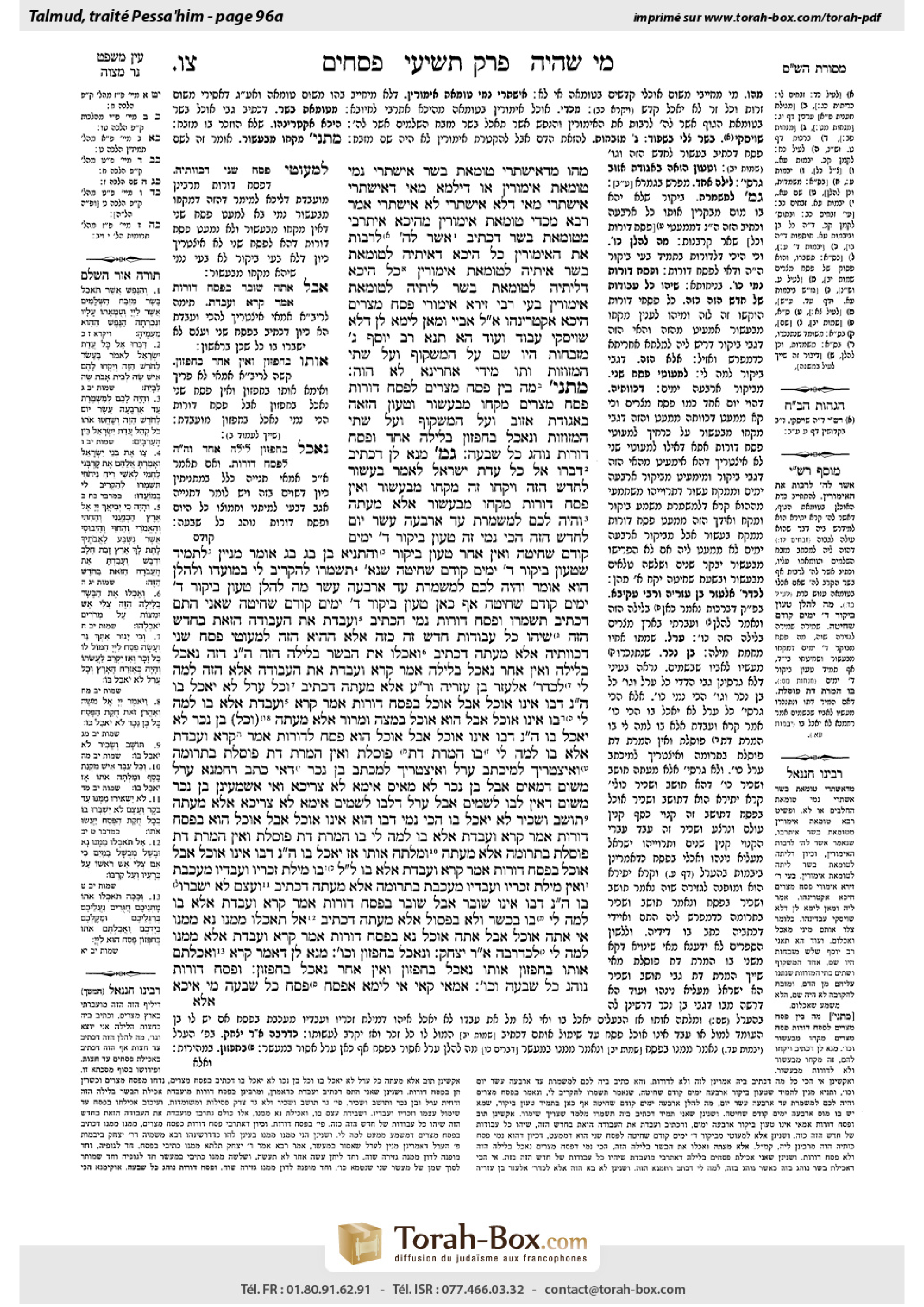
Pesachim 96a: Talmud study for Daf Yomi
Daf Yomi is the daily study of one Talmud folio. Explore 37 tractates with scans, Hebrew text, Sefaria English and AI-generated French translations where annotated.
Passage selection and English or AI-generated French translation are available where the scan has annotations. Daf Study is independent of Torah-Box and Sefaria.
Browse Pesachim · פסחים · All tractatesPesachim 96a text and translations
This page of Pesachim includes the Aramaic text, an English translation and an AI-generated French translation, alongside the scan above.
פסחים צ״ו א · Aramaic and Hebrew text
מַהוּ? מִדְּאִישְׁתְּרַי טוּמְאַת בָּשָׂר — אִישְׁתְּרַי נָמֵי טוּמְאַת אֵימוּרִין, אוֹ דִילְמָא: מַאי דְּאִישְׁתְּרַי — אִישְׁתְּרַי, מַאי דְּלָא אִישְׁתְּרַי — לָא אִישְׁתְּרַי.
אָמַר רָבָא: מִכְּדֵי טוּמְאַת אֵימוּרִין מֵהֵיכָא אִיתְרַבַּי — מִטּוּמְאַת בָּשָׂר, דִּכְתִיב: ״אֲשֶׁר לַה׳״, לְרַבּוֹת אֶת הָאֵימוּרִין.
כֹּל הֵיכָא דְּאִיתֵיהּ לְטוּמְאַת בָּשָׂר, אִיתֵיהּ לְטוּמְאַת אֵימוּרִין. כׇּל הֵיכָא דְּלֵיתֵיהּ לְטוּמְאַת בָּשָׂר, לֵיתֵיהּ לְטוּמְאַת אֵימוּרִין.
בָּעֵי רַבִּי זֵירָא: אֵימוּרֵי פֶּסַח מִצְרַיִם הֵיכָא אַקְטְרִינְהוּ? אֲמַר לֵיהּ אַבָּיֵי: וּמַאן לֵימָא לַן דְּלָא שְׁוִיסְקֵי עֲבוּד?
וְעוֹד, הָא תְּנָא רַב יוֹסֵף: שְׁלֹשָׁה מִזְבְּחוֹת הָיוּ שָׁם: עַל הַמַּשְׁקוֹף, וְעַל שְׁתֵּי הַמְּזוּזוֹת. וְתוּ מִידֵּי אַחֲרִינָא לָא הֲוָה.
מַתְנִי׳ מָה בֵּין פֶּסַח מִצְרַיִם לְפֶסַח דּוֹרוֹת? פֶּסַח מִצְרַיִם מִקָּחוֹ מִבֶּעָשׂוֹר, וְטָעוּן הַזָּאָה בַּאֲגוּדַּת אֵזוֹב, וְעַל הַמַּשְׁקוֹף וְעַל שְׁתֵּי הַמְּזוּזוֹת, וְנֶאֱכָל בְּחִפָּזוֹן, בַּלַּיְלָה אֶחָד. וּפֶסַח דּוֹרוֹת נוֹהֵג כׇּל שִׁבְעָה.
גְּמָ׳ מְנָא לַן? דִּכְתִיב: ״דַּבְּרוּ אֶל כׇּל עֲדַת יִשְׂרָאֵל לֵאמֹר בֶּעָשׂוֹר לַחֹדֶשׁ הַזֶּה וְיִקְחוּ״. זֶה מִקָּחוֹ מִבֶּעָשׂוֹר, וְאֵין פֶּסַח דּוֹרוֹת מִקָּחוֹ מִבֶּעָשׂוֹר.
אֶלָּא מֵעַתָּה: ״וְהָיָה לָכֶם לְמִשְׁמֶרֶת עַד אַרְבָּעָה עָשָׂר יוֹם לַחֹדֶשׁ הַזֶּה״, הָכִי נָמֵי — זֶה טָעוּן בִּיקּוּר אַרְבָּעָה יָמִים קוֹדֶם שְׁחִיטָה, וְאֵין אַחֵר טָעוּן בִּיקּוּר?
וְהָתַנְיָא, בֶּן בַּג בַּג אוֹמֵר: מִנַּיִין לְתָמִיד שֶׁטָּעוּן בִּיקּוּר אַרְבָּעָה יָמִים קוֹדֶם שְׁחִיטָה, שֶׁנֶּאֱמַר: ״תִּשְׁמְרוּ לְהַקְרִיב לִי בְּמוֹעֲדוֹ״, וּלְהַלָּן הוּא אוֹמֵר: ״וְהָיָה לָכֶם לְמִשְׁמֶרֶת עַד אַרְבָּעָה עָשָׂר״, מָה לְהַלָּן טָעוּן בִּיקּוּר אַרְבָּעָה יָמִים קוֹדֶם שְׁחִיטָה, אַף כָּאן טָעוּן בִּיקּוּר אַרְבָּעָה יָמִים קוֹדֶם שְׁחִיטָה!
שָׁאנֵי הָתָם, דִּכְתִיב: ״תִּשְׁמְרוּ״.
וּפֶסַח דּוֹרוֹת נָמֵי, הָכְתִיב: ״וְעָבַדְתָּ אֶת הָעֲבוֹדָה הַזֹּאת בַּחֹדֶשׁ הַזֶּה״, שֶׁיְּהוּ כׇּל עֲבוֹדוֹת חֹדֶשׁ זֶה — כָּזֶה.
אֶלָּא הָהוּא ״הַזֶּה״ — לְמַעוֹטֵי פֶּסַח שֵׁנִי דִּכְווֹתֵיהּ.
אֶלָּא מֵעַתָּה דִּכְתִיב: ״וְאָכְלוּ אֶת הַבָּשָׂר בַּלַּיְלָה הַזֶּה״, הָכִי נָמֵי דְּזֶה נֶאֱכָל בַּלַּיְלָה, וְאֵין אַחֵר נֶאֱכָל בַּלַּיְלָה?! אָמַר קְרָא: ״וְעָבַדְתָּ אֶת הָעֲבוֹדָה״.
אֶלָּא ״הַזֶּה״ לְמָה לִי? לְכִדְרַבִּי אֶלְעָזָר בֶּן עֲזַרְיָה וְרַבִּי עֲקִיבָא.
אֶלָּא מֵעַתָּה דִּכְתִיב: ״וְכׇל עָרֵל לֹא יֹאכַל בּוֹ״, הָכִי נָמֵי דְּ״בוֹ״ אֵינוֹ אוֹכֵל, אֲבָל אוֹכֵל בְּפֶסַח דּוֹרוֹת?! אָמַר קְרָא: ״וְעָבַדְתָּ״.
אֶלָּא, ״בּוֹ״ לְמָה לִי? דְּ״בוֹ״ אֵינוֹ אוֹכֵל, אֲבָל הוּא אוֹכֵל בְּמַצָּה וּמָרוֹר.
אֶלָּא מֵעַתָּה: ״(וְכׇל) בֶּן נֵכָר לֹא יֹאכַל בּוֹ״, הָכִי נָמֵי דְּ״בוֹ״ אֵינוֹ אוֹכֵל, אֲבָל אוֹכֵל הוּא פֶּסַח לְדוֹרוֹת?! אָמַר קְרָא: ״וְעָבַדְתָּ״.
אֶלָּא, ״בּוֹ״ לְמָה לִי? ״בּוֹ״ מְשׁוּמָּדוּת פּוֹסֶלֶת, וְאֵין מְשׁוּמָּדוּת פּוֹסֶלֶת בִּתְרוּמָה.
וְאִיצְטְרִיךְ לְמִיכְתַּב ״עָרֵל״, וְאִיצְטְרִיךְ לְמִכְתַּב ״בֶּן נֵכָר״. דְּאִי כְּתַב רַחֲמָנָא ״עָרֵל״, מִשּׁוּם דִּמְאִיס, אֲבָל בֶּן נֵכָר לָא מְאִיס — אֵימָא לָא, צְרִיכָא. וְאִי אַשְׁמְעִינַן ״בֶּן נֵכָר״, מִשּׁוּם דְּאֵין לִבּוֹ לַשָּׁמַיִם, אֲבָל עָרֵל דְּלִבּוֹ לַשָּׁמַיִם — אֵימָא לָא, צְרִיכָא.
אֶלָּא מֵעַתָּה: ״תּוֹשָׁב וְשָׂכִיר לֹא יֹאכַל בּוֹ״, הָכִי נָמֵי דְּ״בוֹ״ הוּא אֵינוֹ אוֹכֵל, אֲבָל אוֹכֵל הוּא בְּפֶסַח דּוֹרוֹת?! אָמַר קְרָא: ״וְעָבַדְתָּ״. אֶלָּא ״בּוֹ״ לְמָה לִי? ״בּוֹ״ מְשׁוּמָּדוּת פּוֹסֶלֶת, וְאֵין מְשׁוּמָּדוּת פּוֹסֶלֶת בִּתְרוּמָה.
אֶלָּא מֵעַתָּה: ״וּמַלְתָּה אֹתוֹ אָז יֹאכַל בּוֹ״, הָכִי נָמֵי דְּ״בוֹ״ אֵינוֹ אוֹכֵל, אֲבָל אוֹכֵל בְּפֶסַח דּוֹרוֹת?! אָמַר קְרָא: ״וְעָבַדְתָּ״. אֶלָּא ״בּוֹ״ לְמָה לִי? ״בּוֹ״ מִילַת זְכָרָיו וַעֲבָדָיו מְעַכֶּבֶת, וְאֵין מִילַת זְכָרָיו וַעֲבָדָיו מְעַכֶּבֶת בִּתְרוּמָה.
אֶלָּא מֵעַתָּה דִּכְתִיב: ״וְעֶצֶם לֹא יִשְׁבְּרוּ בּוֹ״, הָכִי נָמֵי דְּ״בוֹ״ אֵינוֹ שׁוֹבֵר, אֲבָל שׁוֹבֵר בְּפֶסַח דּוֹרוֹת?! אָמַר קְרָא: ״וְעָבַדְתָּ״. אֶלָּא ״בּוֹ״ לְמָה לִי? ״בּוֹ״ בְּכָשֵׁר, וְלֹא בְּפָסוּל.
אֶלָּא מֵעַתָּה דִּכְתִיב: ״אַל תֹּאכְלוּ מִמֶּנּוּ נָא״, ״מִמֶּנּוּ״ אִי אַתָּה אוֹכֵל, אֲבָל אַתָּה אוֹכֵל נָא בְּפֶסַח דּוֹרוֹת?! אָמַר קְרָא: ״וְעָבַדְתָּ״. אֶלָּא ״מִמֶּנּוּ״ לְמָה לִי? לְכִדְרַבָּה אָמַר רַבִּי יִצְחָק.
וְנֶאֱכָל בְּחִפָּזוֹן וְכוּ׳. מְנָא לַן? דְּאָמַר קְרָא: ״וַאֲכַלְתֶּם אוֹתוֹ בְּחִפָּזוֹן״. ״אוֹתוֹ״ נֶאֱכָל בְּחִפָּזוֹן, וְאֵין אַחֵר נֶאֱכָל בְּחִפָּזוֹן.
וּפֶסַח דּוֹרוֹת נוֹהֵג כׇּל שִׁבְעָה וְכוּ׳. אַמַּאי קָאֵי? אִי לֵימָא אַפֶּסַח, פֶּסַח כׇּל שִׁבְעָה מִי אִיכָּא!
Pesachim 96a · English translation
what is the halakha? Are they liable for eating sacrificial meat while they were ritually impure? Do we say that since ritual impurity of the meat that is eaten was permitted, ritual impurity of the sacrificial portions offered on the altar was also permitted; or perhaps we say that what was permitted was permitted, and what was not permitted was not permitted?
Rava said: After all, from where was the halakha pertaining to eating the sacrificial portions in a state of ritual impurity included? It is derived from the halakha with regard to eating the meat in a state of ritual impurity, as it is written: “But the soul that eats of the flesh of the sacrifice of peace-offerings that pertain to the Lord, having his ritual impurity upon him, that soul shall be cut off from his people” (Leviticus 7:20); the apparently superfluous phrase “that pertain to the Lord” is there to include the sacrificial portions and establish that one is liable to receive karet for eating these portions in a state of ritual impurity.
Since this is the source, there is a limitation to the halakha pertaining to sacrificial portions: Anywhere that there is liability for eating the meat in a state of ritual impurity, there is liability for eating the sacrificial portions in a state of ritual impurity; conversely, anywhere that there is no liability for eating the meat in a state of ritual impurity, such as in the case of a Paschal lamb offered in a state of ritual impurity, there is no liability for eating the sacrificial portions in a state of ritual impurity.
Rabbi Zeira asked: With regard to the sacrificial portions of the Paschal lamb that the Jewish people sacrificed in Egypt on the first Passover, just before they left Egypt, where did they burn them? The Torah does not say that they constructed an altar for this purpose. Abaye said to him: What place is there for such a question? Who will tell us that they did not make them roasted and eat them? The Jewish people had not yet been commanded with regard to the halakhot of sacrifices; therefore, they presumably did not distinguish between meat and forbidden fats, and they roasted and consumed the entire animal (Arukh).
And furthermore, Rav Yosef taught that there were three parts of the door upon which the blood was sprinkled that took the place of three altars there in Egypt. The blood was applied upon the lintel and upon the two doorposts; and there was nothing else. Presumably, the Jewish people did not fulfill any mitzva not explicitly mentioned in the Torah, and since no other altar is mentioned, one can conclude that they did not offer the fats and other sacrificial portions on an altar.
MISHNA: What are the differences between the Paschal lamb that the Jewish people offered in Egypt and the Paschal lamb offered in all later generations? The Paschal lamb the Jewish people offered in Egypt had to be taken from the tenth of the month of Nisan and required the people to sprinkle its blood with a bundle of hyssop, unlike the Paschal lamb in all later years, and its blood was also sprinkled upon the lintel and the two doorposts, and it was eaten with haste; in addition, the Paschal lamb in Egypt was only on one night, whereas the Paschal lamb throughout the generations is observed for seven days.
The Gemara discusses the meaning of this difficult phrase, as obviously, the Paschal lamb is slaughtered on the fourteenth and eaten on the evening of the fifteenth. GEMARA: The Gemara asks: From where do we conclude that the requirements of the Paschal lamb sacrificed in Egypt do not apply to later generations? As it is written: “Speak to all the congregation of Israel, saying: On the tenth day of this month they shall take to them every man a lamb, according to their fathers’ houses, a lamb for a household” (Exodus 12:3); and we derive from the superfluous word “this” that this Paschal lamb offered in Egypt had to be taken from the tenth of Nisan, and the Paschal lamb of later generations is not taken from the tenth of Nisan.
The Gemara expresses surprise: However, if that is so, when the verse states later in the same section: “And you shall keep it until the fourteenth day of this month” (Exodus 12:6), so too it should be inferred that this Paschal lamb in Egypt requires examination four days prior to its slaughter, and no other offering requires examination four days prior to its slaughter.
But wasn’t it taught in a baraita that ben Bag Bag says: From where do we know that the daily offering requires examination four days prior to its slaughter? It is stated with regard to the daily offering: “Command the children of Israel, and say to them: My food which is presented to Me for offerings made by fire, of a sweet flavor to Me, you shall safeguard it to sacrifice to Me in its due season” (Numbers 28:2), and it states there, with regard to the Paschal lamb: “And it shall be for you as a safeguard until the fourteenth day of this month” (Exodus 12:6). Just as in the verse there, the Paschal lamb requires examination four days prior to its slaughter, so too here, the daily offering requires examination four days prior to its slaughter. There is no inference from the phrase “this month” that the requirement of examining an offering four days before is limited to the Paschal lamb sacrificed in Egypt.
The Gemara answers: It is different there, with regard to the requirement to examine the daily offering four days prior to its slaughter, as it is written: “You shall safeguard it.” This halakha is derived from a verbal analogy based on the word “safeguard,” which is stated in the context of both offerings.
Similarly, the Paschal lamb sacrificed in later generations also requires examination four days prior to slaughter, as it is written: “And it shall be when the Lord shall bring you into the land of the Canaanite, and the Hittite, and the Amorite, and the Hivite, and the Jebusite, which He swore to your fathers to give you, a land flowing with milk and honey, that you shall perform this service in this month” (Exodus 13:5). From here it is derived that all the services of this month for all later generations shall be like this, including examination of the animal four days prior to sacrifice. Despite the fact that the verse connects the Paschal lamb in later years to the Paschal lamb in Egypt, the requirement to take the animal on the tenth of Nisan applied only on the first Passover.
Rather, what does that phrase: “this month,” stated with regard to the Paschal lamb sacrificed in Egypt, come to exclude? The Gemara answers that it comes to exclude the Paschal lamb of the second Pesaḥ, which is similar to it, as it is also limited to a one day celebration. The Paschal lamb of the second Pesaḥ does not require examination four days prior to its slaughter.
Once again the Gemara questions its assertion that the phrase “this month” stated in the context of the Paschal lamb sacrificed in Egypt indicates that its halakhot are not relevant to other offerings. However, if that is so, with regard to that which is written: “And they shall eat the meat on that night” (Exodus 12:8), so too, should it be inferred that this Paschal lamb offered in Egypt was eaten at night and no other Paschal lamb offered in later generations must be eaten at night? The Gemara answers that the verse states: “You shall perform this service in this month” (Exodus 13:5), in order to teach that the halakhot of the Paschal lamb sacrificed in Egypt apply to later generations as well.
The Gemara asks: Rather, if so, why do I need the word “this” stated with regard to the Paschal lamb sacrificed in Egypt if all the halakhot relevant to that offering apply to the Paschal lambs of later generations? The Gemara answers that the phrase is needed for the derivations cited by Rabbi Elazar ben Azarya and Rabbi Akiva (see Berakhot 9a) with regard to the length of time during which the Paschal lamb may be eaten.
The Gemara asks: However, if that is so, with regard to that which is written in the context of the Paschal lamb offered in Egypt: “And no uncircumcised person shall eat from it” (Exodus 12:48), so too, should it be inferred that the expression “from it” limits the application of the verse and teaches that “from it,” the Paschal lamb sacrificed in Egypt, he may not eat, but he may eat from the Paschal lamb sacrificed in later generations? The Gemara answers that the verse states: “You shall perform,” which teaches that the halakhot of the Paschal lamb sacrificed in Egypt apply to later generations as well.
The Gemara asks: But if so, why do I need the expression “from it” stated here? The Gemara answers that it teaches that from it, the Paschal lamb, he may not eat, but he eats from the matza and bitter herbs. An uncircumcised person is obligated to eat matza and bitter herbs on Passover, just like any other Jew.
The Gemara continues to question: However, if that is so, when the verse states: “No stranger shall eat from it” (Exodus 12:43), so too, should it be inferred that it is only from it, the Paschal lamb sacrificed in Egypt, that he may not eat, but he may eat from the Paschal lamb sacrificed in later generations? The Gemara answers that the verse states: “You shall perform,” which teaches that the halakhot of the Paschal lamb sacrificed in Egypt apply to future generations as well. Consequently, anyone who was prohibited from eating the Paschal lamb in Egypt may not eat it in subsequent years either.
The Gemara asks: But if so, why do I need the qualifying phrase: “From it”? The Gemara answers: It is from it, eating the Paschal lamb, that apostasy disqualifies, as the term “stranger” in this context is understood to refer to a Jew whose conduct makes him estranged from God; but apostasy does not disqualify one from eating teruma. Therefore, a priest who has become an apostate may still consume teruma.
The Gemara continues: And it is necessary for the Torah to write the prohibition of an uncircumcised person, and it is necessary for the Torah to write a separate prohibition with regard to a stranger, as, if the Torah had written only about an uncircumcised person, one might have thought that only he is prohibited to eat from the Paschal lamb because the foreskin is repulsive, but a stranger who is not repulsive, say that he may eat from the Paschal lamb. Therefore, it is necessary to teach the case of a stranger. And if it would have taught us only the prohibition with regard to a stranger, one might have concluded that only he is prohibited from eating the Paschal lamb because his heart is not directed toward Heaven due to his apostasy, but with regard to an uncircumcised person, whose heart is directed toward Heaven, say that there is no prohibition for him to eat the Paschal lamb. Therefore, it is necessary to teach also the case of an uncircumcised person.
The Gemara continues to question its initial derivation: However, if that is so, when the verse pertaining to the Paschal lamb sacrificed in Egypt states: “A sojourner and a hired servant shall not eat from it” (Exodus 12:45), so too, should it be derived that from it, the Paschal lamb sacrificed in Egypt, he may not eat, but he may eat from the Paschal lamb sacrificed in later generations? The Gemara answers that the verse states: “And you shall perform,” which teaches that the halakhot of the Paschal lamb in later generations are the same as the halakhot that applied in Egypt. The Gemara asks: But if so, why do I need the qualifying term “from it”? The Gemara answers that it teaches that from it, the Paschal lamb, apostasy disqualifies one from partaking, but apostasy does not disqualify one from eating teruma.
The Gemara continues its line of questioning: However, if that is so, when the verse said: “When you have circumcised him, then shall he eat from it” (Exodus 12:44), so too, should it be inferred that from it, the Paschal lamb sacrificed in Egypt, he may not eat unless he first circumcises his sons and slaves, but he may eat from the Paschal lamb sacrificed in later generations? The Gemara answers that the verse states: “You shall perform,” which teaches that this halakha applies to later generations as well. The Gemara asks: But if so, why do I need the qualifying term “from it”? The Gemara answers that this term teaches that from it, the Paschal lamb, the lack of circumcision of one’s male children and slaves prevents a father or master from eating until he ensures that all of the male members of his household have been circumcised, but the circumcision of one’s male children and slaves does not prevent him from eating teruma if he is himself eligible to eat it.
The Gemara asks further: However, if that is so, with regard to that which is written: “And they shall not break a bone in it” (Numbers 9:12), so too, should it be inferred that it is prohibited to break a bone only of it, the Paschal lamb sacrificed in Egypt, but one may break a bone of a Paschal lamb sacrificed in later generations? The Gemara answers that the verse states: You shall perform, which applies the halakhot stated with regard to the Paschal lamb sacrificed in Egypt to the Paschal lambs of later generations as well. The Gemara asks: But if so, why do I need the qualifying expression “in it”? The Gemara explains that this qualification teaches that only a bone in it, a fit Paschal lamb, may not be broken, but there is no prohibition to break the bone of an unfit Paschal lamb.
The Gemara asks further: However, if that is so, from that which is written: “Do not eat of it raw, nor boiled in water, but roasted in fire” (Exodus 12:9), should it be inferred that it is only of it, the Paschal lamb sacrificed in Egypt, that you may not eat raw, but you may eat raw meat from the Paschal lamb of later generations? The Gemara answers that the verse states: “You shall perform,” which teaches that the prohibition applies to later generations as well. The Gemara asks: But if so, why do I need the qualifying expression “in it”? The Gemara answers that it is necessary for that which Rabba said that Rabbi Yitzḥak said, that this verse serves as the basis of a verbal analogy which teaches that an uncircumcised man may not eat tithes.
The Gemara returns to discuss the mishna, which stated that the Paschal lamb sacrificed in Egypt was eaten with haste but that Paschal lambs sacrificed in later years were not. From where do we derive this halakha? The Gemara answers that it is as the verse states: “You shall eat it in haste; it is the Lord’s Paschal lamb” (Exodus 12:11). The word “it” indicates a detail and teaches that “it” is eaten with haste, and no other Paschal lamb is eaten with haste.
The mishna stated that the Paschal lamb of later generations applies all seven days. The Gemara asks: On what does this stand? If we say that it refers to the Paschal lamb itself, is there a Paschal lamb all seven days? It is offered only on the fourteenth of Nisan.
Pesachim 96a · Traduction française (IA)
Quelle est la halakha ? Sont-ils passibles pour avoir consommé de la viande sacrificielle alors qu’ils étaient en état d’impureté rituelle ? Doit-on dire que, puisque l’impureté rituelle de la viande consommée était permise, celle des portions sacrificielles offertes sur l’autel l’était également ? Ou bien doit-on dire que ce qui a été permis l’a été, et que ce qui n’a pas été permis ne l’a pas été ?
Rava dit : En définitive, d’où tire-t-on la halakha relative à la consommation des portions sacrificielles en état d’impureté rituelle ? Elle est déduite de la halakha relative à la consommation de la viande en état d’impureté rituelle, comme il est écrit : « Mais la personne qui mange de la chair du sacrifice de paix qui appartient au Seigneur, alors que son impureté rituelle est sur elle, cette personne sera retranchée de son peuple » (Lévitique 7:20). L’expression apparemment superflue « qui appartient au Seigneur » sert à inclure les portions sacrificielles et à établir que celui qui les consomme en état d’impureté rituelle est passible de karet.
Puisque telle est la source, la halakha relative aux portions sacrificielles est limitée : partout où l’on est passible pour avoir consommé la viande en état d’impureté rituelle, on est également passible pour avoir consommé les portions sacrificielles en état d’impureté rituelle ; inversement, partout où l’on n’est pas passible pour avoir consommé la viande en état d’impureté rituelle, comme dans le cas d’un agneau pascal offert en état d’impureté rituelle, on n’est pas passible pour avoir consommé les portions sacrificielles en état d’impureté rituelle.
Rabbi Zeira demanda : Quant aux portions sacrificielles de l’agneau pascal que le peuple juif offrit en Égypte lors du premier Pessaḥ, juste avant de quitter l’Égypte, où les brûlèrent-ils ? La Torah ne dit pas qu’ils construisirent un autel à cette fin. Abaye lui dit : Pourquoi poser une telle question ? Qui nous dit qu’ils ne les firent pas rôtir et ne les mangèrent pas ? Le peuple juif n’avait pas encore reçu les commandements relatifs aux halakhot des sacrifices ; il ne distinguait donc vraisemblablement pas la viande des graisses interdites, et il fit rôtir et consomma l’animal entier (Arukh).
De plus, Rav Yossef enseigna que les trois parties de la porte sur lesquelles le sang était appliqué tenaient lieu des trois autels, là-bas, en Égypte. Le sang était appliqué sur le linteau et sur les deux montants de la porte ; il n’y avait rien d’autre. Vraisemblablement, le peuple juif n’accomplissait aucune mitsva qui ne soit pas explicitement mentionnée dans la Torah ; comme aucun autre autel n’est mentionné, on peut en conclure qu’ils n’offrirent pas les graisses ni les autres portions sacrificielles sur un autel.
Michna : Quelles sont les différences entre l’agneau pascal que le peuple juif offrit en Égypte et celui offert dans toutes les générations suivantes ? L’agneau pascal que le peuple juif offrit en Égypte devait être pris le dixième jour du mois de Nissan, et le peuple devait en asperger le sang à l’aide d’un bouquet d’hysope, contrairement à l’agneau pascal des générations suivantes ; son sang était aussi aspergé sur le linteau et les deux montants de la porte, et il était consommé à la hâte. En outre, l’agneau pascal d’Égypte ne fut observé qu’une seule nuit, tandis que l’agneau pascal des générations suivantes est observé pendant sept jours.
La Guemara examine le sens de cette expression difficile, car il est évident que l’agneau pascal est abattu le quatorzième jour et consommé le soir du quinzième. Guemara : La Guemara demande : D’où concluons-nous que les exigences relatives à l’agneau pascal sacrifié en Égypte ne s’appliquent pas aux générations suivantes ? Car il est écrit : « Parle à toute l’assemblée d’Israël en ces termes : Le dixième jour de ce mois, que chacun prenne un agneau, selon les maisons de leurs pères, un agneau par maison » (Exode 12:3). Nous déduisons du mot apparemment superflu « ce » que cet agneau pascal offert en Égypte devait être pris le dixième jour de Nissan, tandis que l’agneau pascal des générations suivantes n’est pas pris le dixième jour de Nissan.
La Guemara s’étonne : Pourtant, si tel est le cas, lorsque le verset dit plus loin dans le même passage : « Vous le garderez jusqu’au quatorzième jour de ce mois » (Exode 12:6), ne faudrait-il pas également en déduire que cet agneau pascal d’Égypte doit être examiné quatre jours avant son abattage, et qu’aucun autre sacrifice ne doit être examiné quatre jours avant son abattage ?
Mais n’a-t-on pas enseigné dans une baraïta que ben Bag Bag dit : D’où savons-nous que l’offrande quotidienne doit être examinée quatre jours avant son abattage ? À propos de l’offrande quotidienne, il est dit : « Ordonne aux enfants d’Israël et dis-leur : Mon offrande, ma nourriture pour mes sacrifices consumés par le feu, d’agréable odeur pour Moi, vous la garderez afin de Me l’offrir en son temps fixé » (Nombres 28:2). Et il est dit à propos de l’agneau pascal : « Il sera pour vous gardé jusqu’au quatorzième jour de ce mois » (Exode 12:6). De même que, dans ce passage, l’agneau pascal doit être examiné quatre jours avant son abattage, de même ici, l’offrande quotidienne doit être examinée quatre jours avant son abattage. On ne peut donc déduire de l’expression « ce mois » que l’obligation d’examiner un sacrifice quatre jours à l’avance ne concerne que l’agneau pascal sacrifié en Égypte.
La Guemara répond : Le cas est différent pour l’obligation d’examiner l’offrande quotidienne quatre jours avant son abattage, car il est écrit : « Vous la garderez. » Cette halakha est déduite d’une analogie verbale fondée sur le mot « garderez », qui figure dans le contexte des deux sacrifices.
De même, l’agneau pascal sacrifié dans les générations suivantes doit aussi être examiné quatre jours avant son abattage, comme il est écrit : « Et lorsque le Seigneur te fera entrer dans le pays du Cananéen, du Hittite, de l’Amoréen, du Hivvite et du Jébuséen, qu’Il a juré à tes pères de te donner, pays où coulent le lait et le miel, tu accompliras ce service en ce mois » (Exode 13:5). On en déduit que, pour toutes les générations suivantes, tous les rites de ce mois doivent être comme ceux-ci, y compris l’examen de l’animal quatre jours avant le sacrifice. Bien que le verset établisse un lien entre l’agneau pascal des générations suivantes et celui d’Égypte, l’obligation de prendre l’animal le dixième jour de Nissan ne s’appliquait qu’au premier Pessaḥ.
Alors, qu’est-ce que l’expression « ce mois », mentionnée à propos de l’agneau pascal sacrifié en Égypte, vient exclure ? La Guemara répond qu’elle vient exclure l’agneau pascal du second Pessaḥ, qui lui ressemble en ce qu’il ne dure lui aussi qu’un seul jour. L’agneau pascal du second Pessaḥ n’a pas à être examiné quatre jours avant son abattage.
La Guemara conteste de nouveau l’affirmation selon laquelle l’expression « ce mois », mentionnée dans le contexte de l’agneau pascal sacrifié en Égypte, indique que ses halakhot ne concernent pas les autres sacrifices. Pourtant, si tel est le cas, à propos de ce qui est écrit : « Ils en mangeront la viande cette nuit-là » (Exode 12:8), faudrait-il également en déduire que cet agneau pascal offert en Égypte se mangeait la nuit, mais qu’aucun autre agneau pascal offert dans les générations suivantes ne doit être consommé la nuit ? La Guemara répond que le verset dit : « Tu accompliras ce service en ce mois » (Exode 13:5), afin d’enseigner que les halakhot de l’agneau pascal sacrifié en Égypte s’appliquent également aux générations suivantes.
La Guemara demande : Alors, si tel est le cas, pourquoi le mot « ce », mentionné à propos de l’agneau pascal sacrifié en Égypte, est-il nécessaire, si toutes les halakhot relatives à ce sacrifice s’appliquent aux agneaux pascals des générations suivantes ? La Guemara répond que cette expression est nécessaire pour les déductions citées par Rabbi Elazar ben Azarya et Rabbi Akiva (voir Berakhot 9a) concernant la durée pendant laquelle l’agneau pascal peut être consommé.
La Guemara demande : Pourtant, si tel est le cas, à propos de ce qui est écrit dans le contexte de l’agneau pascal offert en Égypte : « Aucun incirconcis n’en mangera » (Exode 12:48), faudrait-il également en déduire que l’expression « en » limite l’application du verset et enseigne qu’il ne peut pas manger de celui-ci, l’agneau pascal sacrifié en Égypte, mais qu’il peut manger de l’agneau pascal sacrifié dans les générations suivantes ? La Guemara répond que le verset dit : « Tu accompliras », ce qui enseigne que les halakhot de l’agneau pascal sacrifié en Égypte s’appliquent également aux générations suivantes.
La Guemara demande : Mais alors, pourquoi l’expression « en » est-elle nécessaire ici ? La Guemara répond qu’elle enseigne que l’incirconcis ne peut pas manger de l’agneau pascal, mais qu’il peut manger de la matsa et des herbes amères. Un incirconcis est tenu de manger de la matsa et des herbes amères à Pessaḥ, comme tout autre Juif.
La Guemara poursuit son objection : Pourtant, si tel est le cas, lorsque le verset dit : « Aucun étranger n’en mangera » (Exode 12:43), faudrait-il également en déduire qu’il ne peut manger que de celui-ci, l’agneau pascal sacrifié en Égypte, mais qu’il peut manger de l’agneau pascal sacrifié dans les générations suivantes ? La Guemara répond que le verset dit : « Tu accompliras », ce qui enseigne que les halakhot de l’agneau pascal sacrifié en Égypte s’appliquent aussi aux générations futures. Par conséquent, quiconque n’avait pas le droit de manger l’agneau pascal en Égypte ne peut pas non plus en manger les années suivantes.
La Guemara demande : Mais alors, pourquoi l’expression restrictive « en » est-elle nécessaire ? La Guemara répond : C’est la consommation de celui-ci, l’agneau pascal, que l’apostasie disqualifie, car le terme « étranger » dans ce contexte est compris comme désignant un Juif dont la conduite l’éloigne de Dieu ; mais l’apostasie ne disqualifie pas quelqu’un pour la consommation de terouma. Ainsi, un prêtre devenu apostat peut toujours consommer de la terouma.
La Guemara poursuit : Il est nécessaire que la Torah écrive l’interdiction concernant l’incirconcis, et il est également nécessaire qu’elle écrive une interdiction distincte concernant l’étranger. En effet, si la Torah n’avait parlé que de l’incirconcis, on aurait pu penser que lui seul n’a pas le droit de manger de l’agneau pascal, parce que son prépuce est répugnant ; mais l’étranger, qui n’est pas répugnant, pourrait, pense-t-on, en manger. Il est donc nécessaire d’enseigner le cas de l’étranger. Et si la Torah nous avait enseigné uniquement l’interdiction concernant l’étranger, on aurait pu conclure que lui seul n’a pas le droit de manger l’agneau pascal, parce que son cœur n’est pas tourné vers le Ciel en raison de son apostasie ; mais, pourrait-on penser, il n’est pas interdit à un incirconcis, dont le cœur est tourné vers le Ciel, de manger l’agneau pascal. Il est donc nécessaire d’enseigner aussi le cas de l’incirconcis.
La Guemara poursuit la contestation de sa déduction initiale : Pourtant, si tel est le cas, lorsque le verset relatif à l’agneau pascal sacrifié en Égypte dit : « Le résident et le salarié n’en mangeront pas » (Exode 12:45), faudrait-il également en déduire qu’il ne peut pas manger de celui-ci, l’agneau pascal sacrifié en Égypte, mais qu’il peut manger de l’agneau pascal sacrifié dans les générations suivantes ? La Guemara répond que le verset dit : « Et tu accompliras », ce qui enseigne que les halakhot de l’agneau pascal des générations suivantes sont les mêmes que celles qui s’appliquaient en Égypte. La Guemara demande : Mais alors, pourquoi le terme restrictif « en » est-il nécessaire ? La Guemara répond qu’il enseigne que c’est la consommation de celui-ci, l’agneau pascal, que l’apostasie disqualifie, mais que l’apostasie ne disqualifie pas pour la consommation de terouma.
La Guemara poursuit ses questions : Pourtant, si tel est le cas, lorsque le verset dit : « Après l’avoir circoncis, alors il en mangera » (Exode 12:44), faudrait-il également en déduire qu’il ne peut pas manger de celui-ci, l’agneau pascal sacrifié en Égypte, tant qu’il n’a pas d’abord circoncis ses fils et ses esclaves, mais qu’il peut manger de l’agneau pascal sacrifié dans les générations suivantes ? La Guemara répond que le verset dit : « Tu accompliras », ce qui enseigne que cette halakha s’applique aussi aux générations suivantes. La Guemara demande : Mais alors, pourquoi le terme restrictif « en » est-il nécessaire ? La Guemara répond que ce terme enseigne que, pour l’agneau pascal, le fait que ses enfants mâles et ses esclaves ne soient pas circoncis empêche un père ou un maître d’en manger jusqu’à ce qu’il ait veillé à la circoncision de tous les membres masculins de sa maisonnée ; en revanche, la circoncision de ses enfants mâles et de ses esclaves ne l’empêche pas de manger de la terouma s’il y a lui-même droit.
La Guemara demande encore : Pourtant, si tel est le cas, à propos de ce qui est écrit : « Ils ne briseront aucun os en lui » (Nombres 9:12), faudrait-il également en déduire qu’il est interdit de briser les os de celui-ci, l’agneau pascal sacrifié en Égypte, mais qu’on peut briser un os d’un agneau pascal sacrifié dans les générations suivantes ? La Guemara répond que le verset dit : « Tu accompliras », étendant également aux agneaux pascals des générations suivantes les halakhot énoncées à propos de l’agneau pascal sacrifié en Égypte. La Guemara demande : Mais alors, pourquoi l’expression restrictive « en lui » est-elle nécessaire ? La Guemara explique que cette restriction enseigne qu’on ne doit pas briser un os de celui-ci, un agneau pascal valide, mais qu’il n’est pas interdit de briser un os d’un agneau pascal invalide.
La Guemara demande encore : Pourtant, si tel est le cas, d’après ce qui est écrit : « N’en mangez pas cru, ni bouilli dans l’eau, mais rôti au feu » (Exode 12:9), faudrait-il en déduire que c’est seulement de celui-ci, l’agneau pascal sacrifié en Égypte, que vous ne pouvez pas manger cru, mais que vous pouvez manger crue la viande de l’agneau pascal des générations suivantes ? La Guemara répond que le verset dit : « Tu accompliras », ce qui enseigne que l’interdiction s’applique aussi aux générations suivantes. La Guemara demande : Mais alors, pourquoi l’expression restrictive « en lui » est-elle nécessaire ? La Guemara répond qu’elle est nécessaire pour ce que Rabba a dit au nom de Rabbi Yitzḥak : ce verset sert de fondement à une analogie verbale qui enseigne qu’un homme incirconcis ne peut pas manger les dîmes.
La Guemara revient à la discussion de la Michna, qui affirmait que l’agneau pascal sacrifié en Égypte était consommé à la hâte, contrairement aux agneaux pascals sacrifiés les années suivantes. D’où déduisons-nous cette halakha ? La Guemara répond que le verset dit : « Vous le mangerez à la hâte ; c’est le Pessaḥ du Seigneur » (Exode 12:11). Le mot « le » apporte une précision et enseigne que seul celui-ci est consommé à la hâte, et qu’aucun autre agneau pascal n’est consommé à la hâte.
La Michna disait que l’agneau pascal des générations suivantes s’applique pendant les sept jours. La Guemara demande : À quoi cela se rapporte-t-il ? Si l’on dit qu’il s’agit de l’agneau pascal lui-même, y a-t-il un agneau pascal pendant les sept jours ? Il n’est offert que le quatorzième jour de Nissan.
Traduction française générée par IA à partir de l’édition anglaise de Sefaria. Vérifie toujours un passage avec le texte source.
Text from Sefaria: William Davidson Edition - Vocalized Aramaic (CC BY NC); William Davidson Edition - English (CC BY NC).