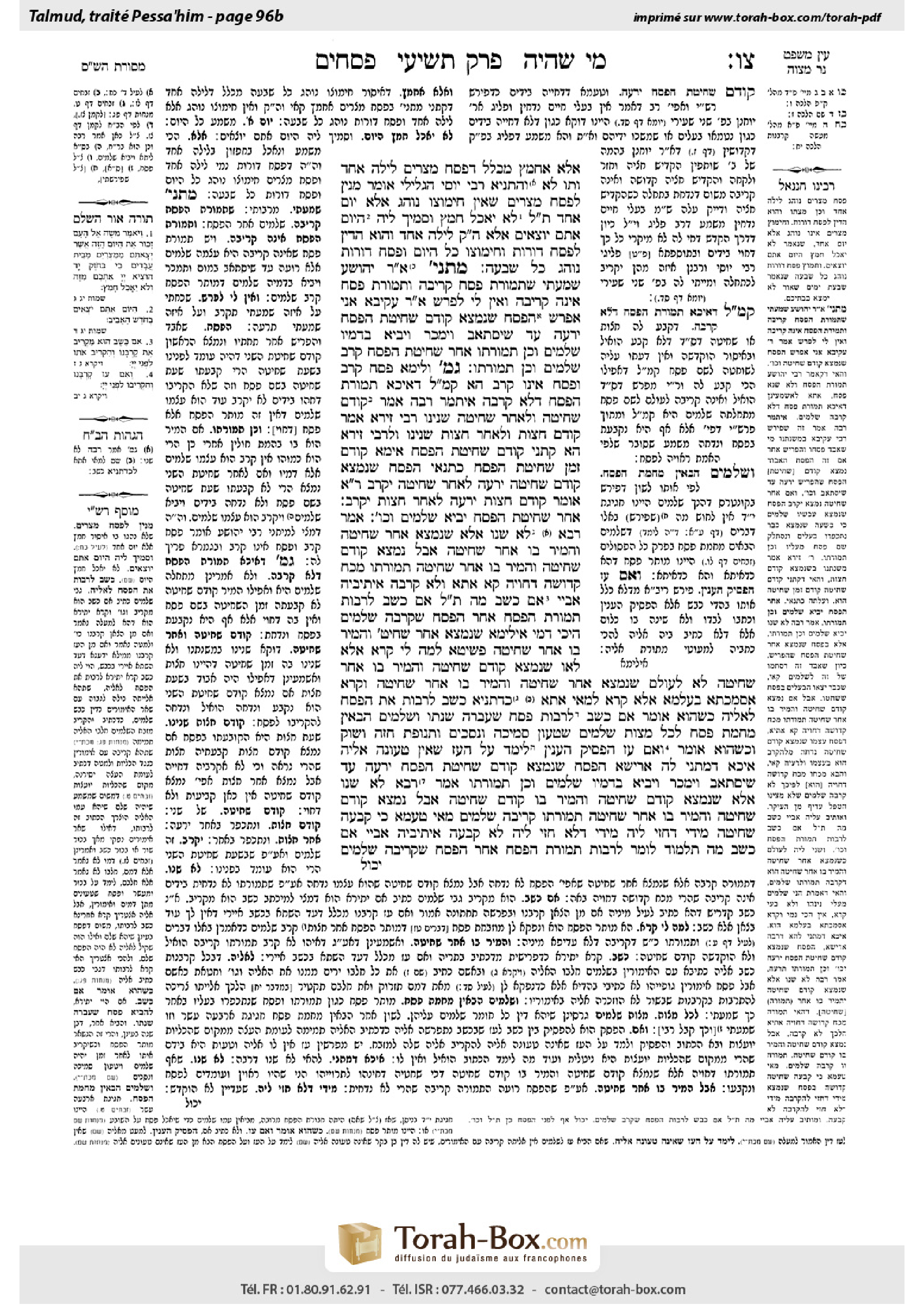
Pesachim 96b: Talmud study for Daf Yomi
Daf Yomi is the daily study of one Talmud folio. Explore 37 tractates with scans, Hebrew text, Sefaria English and AI-generated French translations where annotated.
Passage selection and English or AI-generated French translation are available where the scan has annotations. Daf Study is independent of Torah-Box and Sefaria.
Browse Pesachim · פסחים · All tractatesPesachim 96b text and translations
This page of Pesachim includes the Aramaic text, an English translation and an AI-generated French translation, alongside the scan above.
פסחים צ״ו ב · Aramaic and Hebrew text
אֶלָּא אַחָמֵץ. מִכְּלָל דְּפֶסַח מִצְרַיִם לַיְלָה אֶחָד וְתוּ לָא? וְהָתַנְיָא, רַבִּי יוֹסֵי הַגְּלִילִי אוֹמֵר: מִנַּיִן לְפֶסַח מִצְרַיִם שֶׁאֵין חִימּוּצוֹ נוֹהֵג אֶלָּא יוֹם אֶחָד — תַּלְמוּד לוֹמַר: ״לֹא יֵאָכֵל חָמֵץ״, וּסְמִיךְ לֵיהּ: ״הַיּוֹם אַתֶּם יוֹצְאִים״.
אֶלָּא הָכִי קָאָמַר: לַיְלָה אֶחָד, וְהוּא הַדִּין לְפֶסַח דּוֹרוֹת. וְחִימּוּצוֹ כׇּל הַיּוֹם, וּפֶסַח דּוֹרוֹת נוֹהֵג כׇּל שִׁבְעָה.
מַתְנִי׳ אָמַר רַבִּי יְהוֹשֻׁעַ: שָׁמַעְתִּי שֶׁתְּמוּרַת פֶּסַח קְרֵיבָה, וּתְמוּרַת פֶּסַח אֵינָהּ קְרֵיבָה, וְאֵין לִי לְפָרֵשׁ.
אָמַר רַבִּי עֲקִיבָא, אֲנִי אֲפָרֵשׁ: הַפֶּסַח שֶׁנִּמְצָא קוֹדֶם שְׁחִיטַת הַפֶּסַח — יִרְעֶה עַד שֶׁיִּסְתָּאֵב, וְיִמָּכֵר, וְיָבִיא בְּדָמָיו שְׁלָמִים. וְכֵן תְּמוּרָתוֹ.
אַחַר שְׁחִיטַת הַפֶּסַח — קָרֵב שְׁלָמִים. וְכֵן תְּמוּרָתוֹ.
גְּמָ׳ וְלֵימָא: פֶּסַח קָרֵב וּפֶסַח אֵינוֹ קָרֵב. הָא קָא מַשְׁמַע לַן דְּאִיכָּא תְּמוּרַת הַפֶּסַח דְּלָא קָרְבָה.
אִיתְּמַר, רַבָּה אָמַר: קוֹדֶם שְׁחִיטָה וּלְאַחַר שְׁחִיטָה שָׁנִינוּ. רַבִּי זֵירָא אָמַר: קוֹדֶם חֲצוֹת וּלְאַחַר חֲצוֹת שָׁנִינוּ.
וּלְרַבִּי זֵירָא, הָא קָתָנֵי קוֹדֶם שְׁחִיטַת הַפֶּסַח? אֵימָא: קוֹדֶם זְמַן שְׁחִיטַת הַפֶּסַח.
כְּתַנָּאֵי. הַפֶּסַח שֶׁנִּמְצָא קוֹדֶם שְׁחִיטָה — יִרְעֶה, לְאַחַר שְׁחִיטָה — יִקְרַב. רַבִּי אֱלִיעֶזֶר אוֹמֵר: קוֹדֶם חֲצוֹת — יִרְעֶה, לְאַחַר חֲצוֹת — יִקְרַב.
אַחַר שְׁחִיטַת הַפֶּסַח יָבִיא שְׁלָמִים וְכוּ׳. אָמַר רָבָא: לֹא שָׁנוּ אֶלָּא שֶׁנִּמְצָא אַחַר שְׁחִיטָה וְהֵמִיר בּוֹ אַחַר שְׁחִיטָה. אֲבָל נִמְצָא קוֹדֶם שְׁחִיטָה וְהֵמִיר בּוֹ אַחַר שְׁחִיטָה — תְּמוּרָתוֹ מִכֹּחַ קְדוּשָּׁה דְּחוּיָה קָא אָתָא, וְלָא קָרְבָה.
אֵיתִיבֵיהּ אַבָּיֵי: ״אִם כֶּשֶׂב״, מָה תַּלְמוּד לוֹמַר ״אִם כֶּשֶׂב״? לְרַבּוֹת תְּמוּרַת הַפֶּסַח אַחַר הַפֶּסַח שֶׁקְּרֵבָה שְׁלָמִים.
הֵיכִי דָּמֵי? אִילֵּימָא שֶׁנִּמְצָא אַחַר שְׁחִיטָה וְהֵמִיר בּוֹ אַחַר שְׁחִיטָה — פְּשִׁיטָא! לְמָה לִי קְרָא? אֶלָּא לָאו, שֶׁנִּמְצָא קוֹדֶם שְׁחִיטָה וְהֵמִיר בּוֹ אַחַר שְׁחִיטָה!
לָא, לְעוֹלָם שֶׁנִּמְצָא אַחַר שְׁחִיטָה וְהֵמִיר בּוֹ אַחַר שְׁחִיטָה, וּקְרָא אַסְמַכְתָּא בְּעָלְמָא.
אֶלָּא קְרָא לְמַאי אֲתָא? כִּדְתַנְיָא: ״כֶּשֶׂב״ לְרַבּוֹת אֶת הַפֶּסַח לְאַלְיָה.
כְּשֶׁהוּא אוֹמֵר ״אִם כֶּשֶׂב״, לְרַבּוֹת פֶּסַח שֶׁעָבְרָה שְׁנָתוֹ, וּשְׁלָמִים הַבָּאִין מֵחֲמַת פֶּסַח לְכׇל מִצְוַת שְׁלָמִים, שֶׁטָּעוּן סְמִיכָה וּנְסָכִים וּתְנוּפַת חָזֶה וָשׁוֹק.
וּכְשֶׁהוּא אוֹמֵר ״וְאִם עֵז״ — הִפְסִיק הָעִנְיָן, לִימֵּד עַל הָעֵז שֶׁאֵין טְעוּנָה אַלְיָה.
אִיכָּא דְּמַתְנֵי לַהּ אַרֵישָׁא: הַפֶּסַח שֶׁנִּמְצָא קוֹדֶם שְׁחִיטַת הַפֶּסַח — יִרְעֶה עַד שֶׁיִּסְתָּאֵב, וְיִמָּכֵר, וְיָבִיא בְּדָמָיו שְׁלָמִים. וְכֵן תְּמוּרָתוֹ.
אָמַר רָבָא: לֹא שָׁנוּ אֶלָּא שֶׁנִּמְצָא קוֹדֶם שְׁחִיטָה וְהֵמִיר בּוֹ קוֹדֶם שְׁחִיטָה, אֲבָל נִמְצָא קוֹדֶם שְׁחִיטָה וְהֵמִיר בּוֹ אַחַר שְׁחִיטָה — תְּמוּרָתוֹ קְרֵיבָה שְׁלָמִים. מַאי טַעְמָא — כִּי קָבְעָה שְׁחִיטָה מִידֵּי דַּחֲזֵי לֵיהּ. מִידֵּי דְּלָא חֲזֵי לֵיהּ — לָא קָבְעָה.
אֵיתִיבֵיהּ אַבָּיֵי: ״אִם כֶּשֶׂב״, מָה תַּלְמוּד לוֹמַר? לְרַבּוֹת תְּמוּרַת הַפֶּסַח אַחַר הַפֶּסַח שֶׁקְּרֵיבָה שְׁלָמִים.
Pesachim 96b · English translation
Rather, it refers to leavened bread, which is prohibited all seven days of Passover in the generations following the Exodus. The Gemara asks: Does this prove by inference that during the Passover of Egypt, leaven was prohibited for only one night and not more? But wasn’t it taught in a baraita that Rabbi Yosei HaGelili says: From where is it derived with regard to the Passover of Egypt that its prohibition of leavened bread applied for only one day? The verse states: “No leavened bread shall be eaten” (Exodus 13:3), and juxtaposed to it the verse states: “This day you go forth” (Exodus 13:4), to teach that the prohibition of leaven applied in Egypt for only one day. In any event, the prohibition applied for an entire night and day, and not just one night.
Rather, this question must be answered by saying that this is what it said in the mishna: The Paschal lamb was eaten in Egypt on one night, and the same is true of the Paschal lamb of later generations; and its prohibition against leavened bread applied the entire day, and on Passover in later generations it applies to all seven days of the Festival.
MISHNA: Rabbi Yehoshua said: I heard two rulings from my teachers: One ruling was that the substitute of a Paschal lamb is sacrificed as a peace-offering after Passover, and another ruling was that the substitute of a Paschal lamb is not sacrificed as a peace-offering after Passover; and I cannot explain these two rulings, as I do not remember the circumstances to which each ruling applies.
Rabbi Akiva said: I will explain: With regard to a lamb that is separated as a Paschal lamb and is then lost, leading the owner to separate another animal as its replacement, and is later found before the slaughter of the replacement Paschal lamb, it is left to graze until it becomes unfit [yista’ev] and disqualified for use as a sacrifice. It is then sold and becomes unconsecrated, and the owner must bring a peace-offering with its proceeds. And so too, the same is true with regard to its substitute: If one separates another lamb as a substitute for this replacement, the sanctity of the original lamb extends to the substitute as well. In the case outlined above, the substitute would graze, just like the replacement, until it developed a blemish and would then be sold. This is the circumstance in which the substitute of a Paschal lamb is not sacrificed.
On the other hand, if the lost lamb is found after the slaughter of the replacement Paschal lamb, it itself is sacrificed as a peace-offering, and so too, its substitute is sacrificed, which explains the ruling that the substitute of a Paschal lamb is sacrificed as a peace-offering.
GEMARA: The Gemara questions the explanation of Rabbi Akiva: If so, let the mishna say these halakhot more simply, as follows: The Paschal lamb itself is sacrificed and the Paschal lamb is not sacrificed. According to Rabbi Akiva’s explanation, the same rule applies to both the lamb and its substitute. What additional point is Rabbi Yehoshua making by speaking about the substitute? The Gemara answers: This comes to teach us through this formulation that there is a case of a substitute Paschal lamb that is not sacrificed. One might have thought that a substitute Paschal lamb is always treated as a peace-offering, even when it was substituted before the time of the slaughter; therefore, the mishna states that there is an instance in which it cannot be sacrificed because it is a substitute for a Paschal lamb that itself cannot be sacrificed.
It was stated that there was a dispute between amora’im about the proper text of the mishna. Rabba said: We learned the opinion of Rabbi Akiva in the mishna as referring to the distinction of whether the lamb is found before the slaughter of the replacement lamb or after the slaughter of the replacement lamb. Rabbi Zeira said: We learned that it depends upon whether it is found before midday or after midday. Midday is the time that determines the status of an animal as a Paschal lamb; therefore, if the lamb is found after midday, even if it is found before the slaughter of the replacement Paschal lamb, its identity as a Paschal lamb is not firmly established and it may be sacrificed as a peace-offering.
The Gemara asks: And according to Rabbi Zeira, isn’t the mishna teaching explicitly that it depends upon whether the lamb is found before the slaughter of the replacement Paschal lamb? How can he disagree with the mishna? The Gemara answers: Say that according to Rabbi Zeira, the mishna must be interpreted as referring not to the act of the slaughter itself but to a lamb that is found before the earliest time for the slaughter of the Paschal lamb, which is midday.
The Gemara notes that this dispute among the amora’im is like the following dispute between tanna’im in a mishna: The Paschal lamb that is found before the slaughter of its substitute shall be left to graze until it becomes unfit; it is then sold, and the proceeds are used to purchase an animal that will be sacrificed as a peace-offering. If it is found after the slaughter, it itself is to be sacrificed as a peace-offering. This is parallel to the explanation of Rabba. Rabbi Eliezer says that if it is found before midday it shall be left to graze, but if it is found after midday it is to be sacrificed as a peace-offering, which is parallel to the explanation of Rabbi Zeira.
It was stated in the mishna that if the original lamb is found after the slaughter of the replacement Paschal lamb, one should bring the original lamb as a peace-offering, and the same applies to its substitute. Rava said: They taught that the substitute may be sacrificed as a peace-offering only when the original lamb was found after the slaughter of the replacement lamb and one performed the substitution after the slaughter, when the original lamb itself was fit to be offered as a peace-offering. But if the original lamb was found before the slaughter, even if one performed the substitution after the slaughter of the replacement lamb, the substitute lamb may not be sacrificed as an offering. The reason for this is that the original lamb may no longer be sacrificed as an offering and must be left to graze until it develops a blemish. Therefore, the sanctity of its substitute comes on the strength of deferred sanctity, and the substitute may not be sacrificed.
Abaye raised an objection to Rava based on a baraita: With regard to the verse: “If he brings a lamb for his offering” (Leviticus 3:7), what is the meaning when the verse states: “If he brings a lamb”? What is added by the word “if”? It comes to include the substitute of a Paschal lamb after the slaughter of the replacement Paschal lamb and teaches that it is offered as a peace-offering.
Abaye clarifies the meaning of this baraita: What are the circumstances of the case under discussion? If we say it is a case in which the lamb was found after the slaughter and one performed the substitution after the slaughter, it is obvious, as any Paschal lamb found after the slaughter of its replacement becomes a peace-offering; in that case, why do I need a verse to teach this halakha? Rather, is it not addressing a case in which the original lamb was found before the slaughter of its replacement and one performed the substitution after the slaughter of the replacement, and nonetheless the substitute lamb may be offered as a peace-offering, in opposition to Rava’s ruling?
The Gemara responds: No; actually it can be explained as referring to a case in which the original lamb was found after the slaughter of the replacement, and one performed the substitution after the slaughter. It is indeed obvious and no verse is necessary to teach this halakha; the verse cited is not the source for this ruling but is a mere support.
The Gemara asks: But then for what purpose does this verse come? The Gemara answers: As it was taught in a baraita: The word “lamb” comes to include the Paschal lamb in the requirement that the fat tail be offered on the altar, as this halakha is not explicitly mentioned in the verses that relate to the Paschal lamb.
The baraita continues: When it says: “If he brings a lamb,” which alludes to additional types of offerings it comes to include a lamb consecrated as a Paschal lamb whose first year has passed and is therefore too old to be offered as a Paschal lamb, or peace-offerings that come due to a Paschal lamb, both those separated as a substitute for a Paschal lamb and those that were actually consecrated as a Paschal lamb but the owner fulfilled his obligation with a different Paschal lamb, in all the mitzvot of peace-offerings. These offerings are no longer considered Paschal lambs and are treated as peace-offerings in every way. Therefore, they require leaning and libations and the waving of the breast and thigh.
The baraita continues: And when it says: “And if his offering is a she-goat” (Leviticus 3:12), it interrupted the previous matter and taught that the offering of a she-goat does not require the fat tail to be burned on the altar.
The Gemara has concluded one version of the dispute between Rava and Abaye. However, some teach this dispute with regard to the first clause of the mishna, which states that a Paschal lamb which is first lost and then found before the slaughter of the replacement Paschal lamb must be left to graze until it becomes unfit, and it is then sold, and one must bring a peace-offering with its proceeds; and likewise, the same is the case with regard to its substitute.
With regard to this halakha, Rava said: They taught this halakha only in a case where the original lamb was found before the slaughter and one performed the substitution before the slaughter; but if the original lamb was found before the slaughter and one performed the substitution after the slaughter of the replacement lamb, its substitute is offered as a peace-offering. What is the reason for his opinion? The slaughter of the replacement establishes a halakhic reality only with regard to something which is fit for it; in other words, it is only with regard to a Paschal lamb itself that it matters whether it was found before or after the slaughter. However, with regard to something that was not fit for it, such as the substitute, which cannot be offered as a Paschal lamb in any event, the slaughter does not establish its status. Therefore, it can later be sacrificed as a peace-offering.
Abaye raised an objection to Rava based on the same baraita quoted previously: What is the meaning when the verse states: “If he brings a lamb”? It comes to include the substitute of a Paschal lamb after Passover, which is offered as a peace-offering.
Pesachim 96b · Traduction française (IA)
Il s’agit plutôt du pain levé, interdit pendant les sept jours de Pessa’h dans les générations qui ont suivi l’Exode. La Guemara demande : Faut-il en déduire que, lors du Pessa’h d’Égypte, le pain levé n’était interdit que pendant une nuit, et pas davantage ? Pourtant, une baraïta enseigne que Rabbi Yosei HaGelili dit : D’où déduit-on que, lors du Pessa’h d’Égypte, l’interdiction du pain levé ne s’appliquait que pendant un jour ? Le verset dit : « On ne mangera pas de pain levé » (Exode 13, 3), et le verset qui lui est juxtaposé dit : « Aujourd’hui, vous sortez » (Exode 13, 4), pour enseigner que l’interdiction du pain levé en Égypte ne s’appliquait que pendant un jour. Quoi qu’il en soit, l’interdiction s’appliquait pendant une nuit entière et un jour, et pas seulement pendant une nuit.
Il faut plutôt répondre que c’est ainsi que la Michna était formulée : l’agneau pascal était mangé en Égypte pendant une nuit, et il en allait de même de l’agneau pascal des générations ultérieures ; l’interdiction du pain levé s’appliquait pendant toute la journée, tandis que, lors de Pessa’h des générations ultérieures, elle s’applique pendant les sept jours de la fête.
MICHNA : Rabbi Yehoshua a dit : J’ai entendu de mes maîtres deux décisions : l’une disait que le substitut d’un agneau pascal est offert comme sacrifice de paix après Pessa’h, et l’autre disait que le substitut d’un agneau pascal n’est pas offert comme sacrifice de paix après Pessa’h. Je ne peux pas expliquer ces deux décisions, car je ne me souviens pas des circonstances auxquelles chacune s’applique.
Rabbi Akiva a dit : Je vais l’expliquer. Si un agneau est désigné comme agneau pascal, puis se perd, de sorte que son propriétaire désigne un autre animal à sa place, et que le premier est retrouvé avant l’abattage de l’agneau pascal de remplacement, on le laisse paître jusqu’à ce qu’il devienne impropre [yista’ev] et inapte à servir de sacrifice. On le vend alors ; il cesse d’être consacré, et son propriétaire doit apporter un sacrifice de paix avec le produit de la vente. Il en va de même de son substitut : si l’on désigne un autre agneau comme substitut de cet agneau de remplacement, la sainteté de l’agneau initial s’étend également au substitut. Dans le cas décrit ci-dessus, le substitut paîtrait, comme l’agneau de remplacement, jusqu’à ce qu’il présente un défaut, puis serait vendu. C’est dans cette circonstance que le substitut d’un agneau pascal n’est pas offert.
En revanche, si l’agneau perdu est retrouvé après l’abattage de l’agneau pascal de remplacement, il est lui-même offert comme sacrifice de paix ; de même, son substitut est offert, ce qui explique la décision selon laquelle le substitut d’un agneau pascal est offert comme sacrifice de paix.
GUEMARA : La Guemara remet en question l’explication de Rabbi Akiva : dans ce cas, que la Michna énonce plus simplement ces halakhot, comme suit : l’agneau pascal lui-même est offert, et l’agneau pascal lui-même n’est pas offert. Selon l’explication de Rabbi Akiva, la même règle s’applique à l’agneau et à son substitut. Quel élément supplémentaire Rabbi Yehoshua apporte-t-il en parlant du substitut ? La Guemara répond : Cette formulation vient nous enseigner qu’il existe un cas où le substitut d’un agneau pascal n’est pas offert. On aurait pu penser qu’un substitut d’agneau pascal est toujours traité comme un sacrifice de paix, même s’il a été désigné avant le moment de l’abattage ; la Michna enseigne donc qu’il existe un cas où il ne peut pas être offert, parce qu’il remplace un agneau pascal qui, lui-même, ne peut pas être offert.
Il a été rapporté que des amoraïm étaient en désaccord sur le texte exact de la Michna. Rabba a dit : Nous avons appris que, dans la Michna, l’opinion de Rabbi Akiva porte sur la distinction entre le cas où l’agneau est retrouvé avant l’abattage de l’agneau de remplacement et celui où il est retrouvé après cet abattage. Rabbi Zeira a dit : Nous avons appris que cela dépend du fait qu’il soit retrouvé avant ou après midi. Midi est le moment qui détermine le statut d’un animal en tant qu’agneau pascal ; par conséquent, si l’agneau est retrouvé après midi, même avant l’abattage de l’agneau pascal de remplacement, son statut d’agneau pascal n’est pas fermement établi et il peut être offert comme sacrifice de paix.
La Guemara demande : Mais, selon Rabbi Zeira, la Michna enseigne explicitement que cela dépend du fait que l’agneau soit retrouvé avant l’abattage de l’agneau pascal de remplacement. Comment peut-il être en désaccord avec la Michna ? La Guemara répond : Selon Rabbi Zeira, il faut comprendre que la Michna ne parle pas de l’acte même de l’abattage, mais d’un agneau retrouvé avant le premier moment auquel l’agneau pascal peut être abattu, à savoir midi.
La Guemara relève que ce désaccord entre amoraïm correspond au désaccord suivant entre des tannaïm dans une Michna : l’agneau pascal retrouvé avant l’abattage de son substitut doit être laissé à paître jusqu’à ce qu’il devienne impropre ; il est alors vendu, et le produit de la vente sert à acheter un animal qui sera offert comme sacrifice de paix. S’il est retrouvé après l’abattage, il est lui-même offert comme sacrifice de paix. Cela correspond à l’explication de Rabba. Rabbi Eliezer dit que, s’il est retrouvé avant midi, il doit être laissé à paître ; mais s’il est retrouvé après midi, il est offert comme sacrifice de paix, ce qui correspond à l’explication de Rabbi Zeira.
La Michna a enseigné que, si l’agneau initial est retrouvé après l’abattage de l’agneau pascal de remplacement, on apporte l’agneau initial comme sacrifice de paix, et la même règle s’applique à son substitut. Rava a dit : Ils ont enseigné que le substitut peut être offert comme sacrifice de paix uniquement lorsque l’agneau initial a été retrouvé après l’abattage de l’agneau de remplacement et que le substitut a été désigné après cet abattage, à un moment où l’agneau initial était lui-même apte à être offert comme sacrifice de paix. Mais si l’agneau initial a été retrouvé avant l’abattage, le substitut ne peut pas être offert comme sacrifice, même si on l’a désigné après l’abattage de l’agneau pascal de remplacement. En effet, l’agneau initial ne peut plus être offert comme sacrifice et doit être laissé à paître jusqu’à ce qu’il présente un défaut. Par conséquent, la sainteté de son substitut découle d’une sainteté différée, et le substitut ne peut pas être offert.
Abaye a objecté à Rava en s’appuyant sur une baraïta : concernant le verset « S’il apporte un agneau en offrande » (Lévitique 3, 7), que signifie le mot « s’il » dans « s’il apporte un agneau » ? Qu’ajoute ce mot ? Il vient inclure le substitut d’un agneau pascal après l’abattage de l’agneau pascal de remplacement et enseigne qu’il est offert comme sacrifice de paix.
Abaye précise le sens de cette baraïta : quelles sont les circonstances du cas dont il est question ? Si nous disons qu’il s’agit d’un cas où l’agneau a été retrouvé après l’abattage et où le substitut a été désigné après l’abattage, c’est évident : tout agneau pascal retrouvé après l’abattage de son remplaçant devient un sacrifice de paix. Dans ce cas, pourquoi ai-je besoin d’un verset pour enseigner cette halakha ? Ne vise-t-il pas plutôt un cas où l’agneau initial a été retrouvé avant l’abattage de son remplaçant et où le substitut a été désigné après l’abattage de l’agneau de remplacement, et où, malgré tout, le substitut peut être offert comme sacrifice de paix, contrairement à la décision de Rava ?
La Guemara répond : Non ; en réalité, on peut expliquer qu’il s’agit d’un cas où l’agneau initial a été retrouvé après l’abattage de l’agneau de remplacement et où le substitut a été désigné après l’abattage. C’est effectivement évident, et aucun verset n’est nécessaire pour enseigner cette halakha ; le verset cité n’est pas la source de cette décision, mais sert simplement d’appui.
La Guemara demande : Mais alors, dans quel but ce verset est-il énoncé ? La Guemara répond : Comme il a été enseigné dans une baraïta : le mot « agneau » vient inclure l’agneau pascal dans l’obligation d’offrir la queue grasse sur l’autel, car cette halakha n’est pas mentionnée explicitement dans les versets qui traitent de l’agneau pascal.
La baraïta poursuit : Lorsque le texte dit « s’il apporte un agneau », ce qui fait allusion à des types supplémentaires de sacrifices, cela vient inclure, dans toutes les mitsvot relatives aux sacrifices de paix, un agneau consacré comme agneau pascal dont la première année est passée et qui est donc trop vieux pour être offert comme agneau pascal, ainsi que les sacrifices de paix qui résultent d’un agneau pascal : ceux qui ont été désignés comme substituts d’un agneau pascal et ceux qui ont effectivement été consacrés comme agneaux pascals, mais dont le propriétaire a rempli son obligation avec un autre agneau pascal. Ces sacrifices ne sont plus considérés comme des agneaux pascals et sont traités en tout point comme des sacrifices de paix. Ils exigent donc l’imposition des mains, des libations et le balancement de la poitrine et de la cuisse.
La baraïta poursuit : Lorsque le texte dit « Et si son offrande est une chèvre » (Lévitique 3, 12), il interrompt le sujet précédent et enseigne que l’offrande d’une chèvre n’exige pas que la queue grasse soit brûlée sur l’autel.
La Guemara a achevé une version du désaccord entre Rava et Abaye. Toutefois, certains rapportent ce désaccord à propos de la première clause de la Michna, qui enseigne qu’un agneau pascal d’abord perdu puis retrouvé avant l’abattage de l’agneau pascal de remplacement doit être laissé à paître jusqu’à ce qu’il devienne impropre ; il est alors vendu, et son propriétaire doit apporter un sacrifice de paix avec le produit de la vente. Il en va de même de son substitut.
À propos de cette halakha, Rava a dit : Ils n’ont enseigné cette halakha que dans le cas où l’agneau initial a été retrouvé avant l’abattage et où le substitut a été désigné avant l’abattage ; mais si l’agneau initial a été retrouvé avant l’abattage et que le substitut a été désigné après l’abattage de l’agneau de remplacement, son substitut est offert comme sacrifice de paix. Quel est le motif de son opinion ? L’abattage de l’agneau de remplacement établit une réalité halakhique uniquement à l’égard de ce qui peut s’y prêter. Autrement dit, seul le cas de l’agneau pascal lui-même dépend du fait qu’il ait été retrouvé avant ou après l’abattage. En revanche, pour ce qui ne peut pas s’y prêter, comme le substitut, qui ne peut de toute façon pas être offert comme agneau pascal, l’abattage n’établit pas son statut. Il peut donc ensuite être offert comme sacrifice de paix.
Abaye a objecté à Rava en s’appuyant sur la même baraïta citée précédemment : que signifie le texte « S’il apporte un agneau » ? Cela vient inclure le substitut d’un agneau pascal après Pessa’h, qui est offert comme sacrifice de paix.
Traduction française générée par IA à partir de l’édition anglaise de Sefaria. Vérifie toujours un passage avec le texte source.
Text from Sefaria: William Davidson Edition - Vocalized Aramaic (CC BY NC); William Davidson Edition - English (CC BY NC).