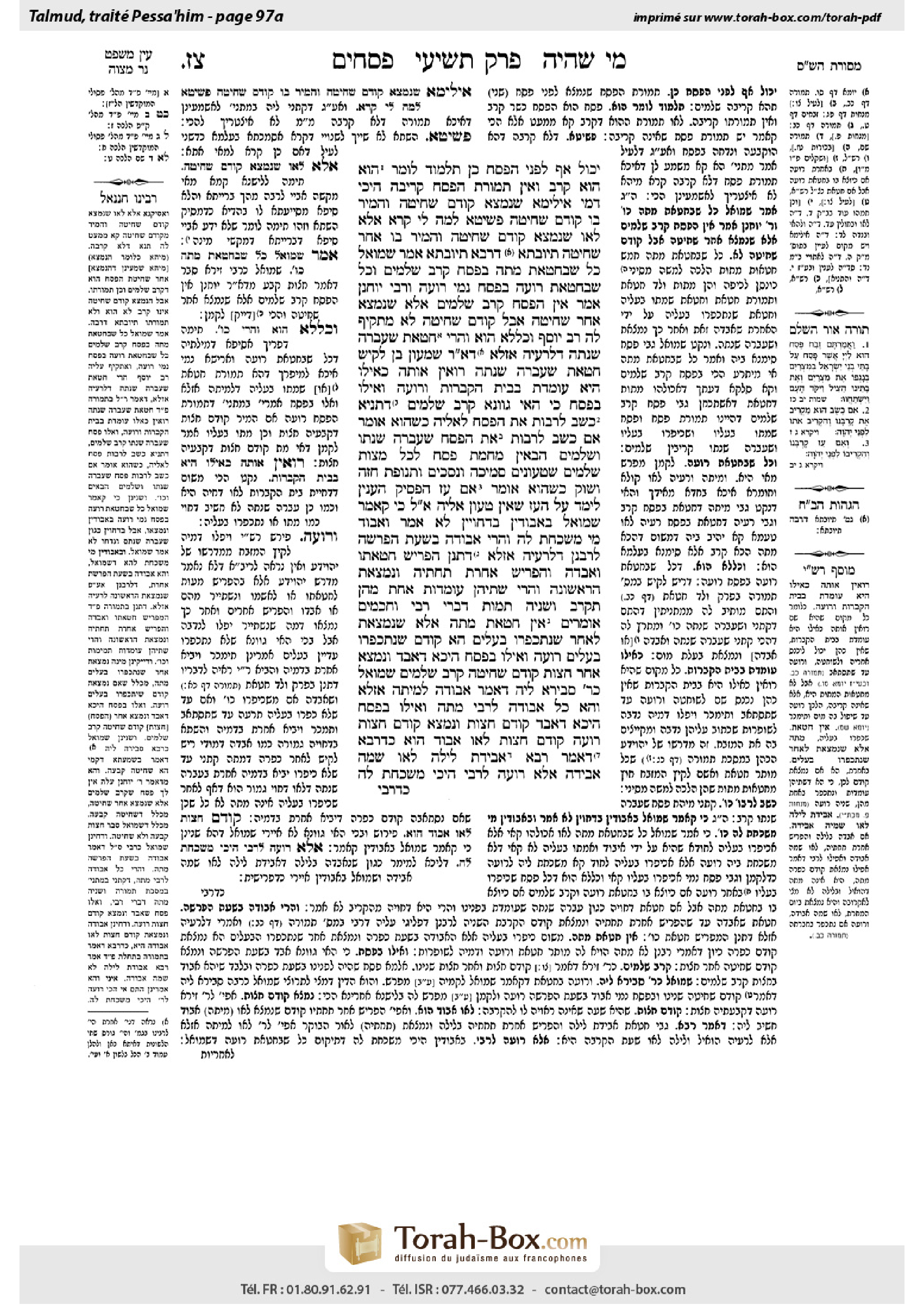
Pesachim 97a: Talmud study for Daf Yomi
Daf Yomi is the daily study of one Talmud folio. Explore 37 tractates with scans, Hebrew text, Sefaria English and AI-generated French translations where annotated.
Passage selection and English or AI-generated French translation are available where the scan has annotations. Daf Study is independent of Torah-Box and Sefaria.
Browse Pesachim · פסחים · All tractatesPesachim 97a text and translations
This page of Pesachim includes the Aramaic text, an English translation and an AI-generated French translation, alongside the scan above.
פסחים צ״ז א · Aramaic and Hebrew text
יָכוֹל אַף לִפְנֵי הַפֶּסַח כֵּן? תַּלְמוּד לוֹמַר: ״הוּא״ — הוּא קָרֵב, וְאֵין תְּמוּרַת הַפֶּסַח קְרֵיבָה.
הֵיכִי דָמֵי? אִילֵּימָא שֶׁנִּמְצָא קוֹדֶם שְׁחִיטָה וְהֵמִיר בּוֹ קוֹדֶם שְׁחִיטָה — פְּשִׁיטָא! לְמָה לִי קְרָא? אֶלָּא לָאו, שֶׁנִּמְצָא קוֹדֶם שְׁחִיטָה וְהֵמִיר בּוֹ אַחַר שְׁחִיטָה! תְּיוּבְתָּא דְרָבָא, תְּיוּבְתָּא.
אָמַר שְׁמוּאֵל: כֹּל שֶׁבַּחַטָּאת מֵתָה — בַּפֶּסַח קָרֵב שְׁלָמִים, וְכֹל שֶׁבַּחַטָּאת רוֹעֶה — בַּפֶּסַח נָמֵי רוֹעֶה. וְרַבִּי יוֹחָנָן אָמַר: אֵין הַפֶּסַח קָרֵב שְׁלָמִים אֶלָּא שֶׁנִּמְצָא אַחַר שְׁחִיטָה, אֲבָל קוֹדֶם שְׁחִיטָה — לֹא.
מַתְקֵיף לַהּ רַב יוֹסֵף: וּכְלָלָא הוּא? וַהֲרֵי חַטָּאת שֶׁעָבְרָה שְׁנָתָהּ, דְּלִרְעִיָּה אָזְלָא, דְּאָמַר רַבִּי שִׁמְעוֹן בֶּן לָקִישׁ: חַטָּאת שֶׁעָבְרָה שְׁנָתָהּ — רוֹאִין אוֹתָהּ כְּאִילּוּ הִיא עוֹמֶדֶת בְּבֵית הַקְּבָרוֹת, וְרוֹעֶה.
וְאִילּוּ בְּפֶסַח כִּי הַאי גַוְונָא קָרֵב שְׁלָמִים, דְּתַנְיָא: ״כֶּשֶׂב״, לְרַבּוֹת אֶת הַפֶּסַח לְאַלְיָה, כְּשֶׁהוּא אוֹמֵר: ״אִם כֶּשֶׂב״, לְרַבּוֹת אֶת הַפֶּסַח שֶׁעָבְרָה שְׁנָתוֹ וּשְׁלָמִים הַבָּאִין מֵחֲמַת פֶּסַח לְכׇל מִצְוַת שְׁלָמִים, שֶׁטְּעוּנִים סְמִיכָה וּנְסָכִים וּתְנוּפַת חָזֶה וָשׁוֹק. כְּשֶׁהוּא אוֹמֵר: ״אִם עֵז״ — הִפְסִיק הָעִנְיָן, לִימֵּד עַל הָעֵז שֶׁאֵין טָעוּן אַלְיָה.
אֲמַר לֵיהּ: כִּי קָאָמַר שְׁמוּאֵל, בַּאֲבוּדִין. בִּדְחוּיִין לָא אָמַר.
וְאָבוּד מִי מַשְׁכַּחַתְּ לַהּ? וַהֲרֵי אֲבוּדָה בִּשְׁעַת הַפְרָשָׁה, לְרַבָּנַן, דְּלִרְעִיָּה אָזְלָא. דִּתְנַן: הִפְרִישׁ חַטָּאתוֹ וְאָבְדָה, וְהִפְרִישׁ אַחֶרֶת תַּחְתֶּיהָ וְנִמְצֵאת הָרִאשׁוֹנָה, וַהֲרֵי שְׁתֵּיהֶן עוֹמְדוֹת — אַחַת מֵהֶן תִּקְרַב וּשְׁנִיָּה תָּמוּת, דִּבְרֵי רַבִּי. וַחֲכָמִים אוֹמְרִים: אֵין חַטָּאת מֵתָה אֶלָּא שֶׁנִּמְצֵאת לְאַחַר שֶׁנִּתְכַּפְּרוּ בְּעָלִים. הָא קוֹדֶם שֶׁנִּתְכַּפְּרוּ בְּעָלִים — רוֹעָה.
וְאִילּוּ בְּפֶסַח, הֵיכָא דְּאָבַד וְנִמְצָא אַחַר חֲצוֹת קוֹדֶם שְׁחִיטָה — קָרֵב שְׁלָמִים. שְׁמוּאֵל כְּרַבִּי סְבִירָא לֵיהּ, דְּאָמַר אֲבוּדָה לְמִיתָה אָזְלָא.
וְהָא כֹּל אֲבוּדָה לְרַבִּי מֵתָה, וְאִילּוּ בְּפֶסַח הֵיכָא דְּאָבַד קוֹדֶם חֲצוֹת וְנִמְצָא קוֹדֶם חֲצוֹת — רוֹעֶה! קוֹדֶם חֲצוֹת לָאו אָבוּד הוּא, כִּדְרָבָא, דְּאָמַר רָבָא: אֲבֵידַת לַיְלָה לָאו שְׁמָהּ אֲבֵידָה.
אֶלָּא, רוֹעָה לְרַבִּי הֵיכִי מַשְׁכַּחַתְּ לַהּ?
Pesachim 97a · English translation
One might have thought that even a substitute Paschal lamb that was found before the slaughter of the replacement Paschal lamb should have the same status, and it should be permitted to sacrifice such a lamb as a peace-offering. Therefore, the verse states: “It,” to emphasize that it, a valid Paschal lamb, is sacrificed, and the substitute of a Paschal lamb is not sacrificed.
What are the circumstances of the case under discussion? If we say it is a case in which the lamb is found before the slaughter and one performed the substitution before the slaughter of the replacement, it is obvious; why do I need a specific verse to teach this halakha? Rather, is it not addressing a case in which the original lamb was found before the slaughter and one performed the substitution after the slaughter of the replacement, and the baraita ruled that the substitute lamb may not be sacrificed as a peace-offering, in opposition to the ruling of Rava? The Gemara concludes that the refutation of the opinion of Rava is indeed a conclusive refutation, and his opinion is rejected according to this version.
Shmuel stated a principle pertaining to the halakhot of offerings: With regard to any animal that was consecrated as an offering and becomes unfit such that a sin-offering in its condition would be placed in isolation for it to die, meaning that it would be caused to die, if it is a Paschal lamb in that condition it is sacrificed as a peace-offering. And with regard to any animal that becomes unfit such that a sin-offering in its condition is left to graze until it develops a blemish, if it is a Paschal lamb it is also left to graze. And Rabbi Yoḥanan said: A Paschal lamb is sacrificed as a peace-offering only when the lost lamb was found after the slaughter of the replacement Paschal lamb, but if it was found before the slaughter, there is no instance in which it is brought as a peace-offering.
Rav Yosef strongly objects to Shmuel’s statement: Is that an established principle in every possible circumstance? Isn’t there the case of a sin-offering whose first year has passed and is therefore no longer fit to be offered as a sin-offering, which goes to graze until it develops a blemish? As Rabbi Shimon ben Lakish said: A sin-offering whose first year has passed, it is viewed as though it were standing in a cemetery where a priest may not enter in order to retrieve it; therefore, it grazes until it develops a blemish. The animal is then sold and its sanctity transferred to the proceeds of the sale, which are used to purchase an animal for a peace-offering.
However, a Paschal lamb in a case like this is sacrificed as a peace-offering, as it was taught in a baraita: The word “lamb” comes to include the Paschal lamb in the requirement that the fat tail be sacrificed on the altar. When it says: “If he brings a lamb,” it comes to include a lamb consecrated as a Paschal lamb whose first year has passed and peace-offerings that come due to a Paschal lamb. These are considered peace-offerings rather than Paschal lambs, and they are included in all the laws of peace-offerings in that they require leaning and libations and the waving of the breast and thigh. When it says later: “And if his offering is a she-goat” (Leviticus 3:12), it interrupted the previous matter of the halakhot of sheep brought as peace-offerings and began a new discussion in order to teach that the offering of a she-goat does not require the fat tail to be offered on the altar. This baraita teaches that an animal consecrated as a Paschal lamb whose first year has passed is offered as a peace-offering and is not left to graze until it develops a blemish.
He said to him: When Shmuel stated his principle, it was specifically with regard to Paschal lambs that were lost; he did not state his principle with regard to Paschal lambs that were deferred because they had become unfit for use.
The Gemara continues its line of questioning: With regard to lost sacrifices do you find Shmuel’s principle to be correct? But what about the case of a sin-offering that was already lost at the time of the separation of a replacement to take its place, and the original animal was found before the second was sacrificed? According to the Rabbis, this animal goes for grazing, as we learned in a mishna: If one separated his sin-offering and it was lost, and he separated another in its place and the first was found, and therefore both are available, then one of them, whichever he chooses, is sacrificed, as he may bring only one offering, and the second shall be caused to die; this is the statement of Rabbi Yehuda HaNasi. And the Rabbis say: A sin-offering is caused to die only when it is found after the owners gained atonement through another offering. Therefore, according to the Rabbis, if the animal was found before the owners gained atonement, it grazes.
And yet with regard to the Paschal lamb, in a situation where it is found after midday before the slaughter, it is sacrificed as a peace-offering. Consequently, Shmuel’s principle is not correct even with regard to offerings that were lost. The Gemara answers: Shmuel holds in accordance with the opinion of Rabbi Yehuda HaNasi, who said that a lost sin-offering is put into isolation and goes to its death.
The Gemara asks: But every lost sin-offering is placed in isolation and left to die according to Rabbi Yehuda HaNasi, whereas with regard to the Paschal lamb, when it was lost before midday and then found before midday but after a replacement animal had been separated, it grazes. The Gemara responds: A Paschal lamb lost before midday is not considered lost, in accordance with the opinion of Rava, as Rava said: A sin-offering lost at night and found by the morning is not called lost, and the halakhot of lost sin-offerings do not apply because a sin-offering cannot be sacrificed at night in any case. Similarly, if a Paschal lamb is lost before midday on the eve of Passover, since it could not be sacrificed at that time, it does not attain the status of a lost sacrifice even if one separates a replacement. In such a case, even Rabbi Yehuda HaNasi would concede that the original animal would be left to graze rather than being left to die.
The Gemara asks: But if so, according to the opinion of Rabbi Yehuda HaNasi, under what circumstances can the case of a sin-offering that is left to graze be found? Rabbi Yehuda HaNasi holds that every lost sin-offering is left to die and none is left to graze; therefore, there is no significance to Shmuel’s ruling with regard to any sin-offering that is left to graze.
Pesachim 97a · Traduction française (IA)
On aurait pu penser que même un agneau pascal de substitution retrouvé avant l’abattage de l’agneau pascal de remplacement aurait le même statut et qu’il serait permis de le sacrifier comme sacrifice de paix. Le verset dit donc : « Lui », pour souligner que c’est lui, l’agneau pascal valide, qui est sacrifié, tandis que le substitut d’un agneau pascal ne l’est pas.
Dans quelles circonstances se présente le cas dont il est question ? Si l’on dit qu’il s’agit d’un cas où l’agneau est retrouvé avant l’abattage et où la substitution a été effectuée avant l’abattage de l’agneau de remplacement, cela va de soi ; pourquoi faudrait-il un verset particulier pour enseigner cette halakha ? La baraïta ne traite-t-elle pas plutôt d’un cas où l’agneau initial a été retrouvé avant l’abattage, mais où la substitution a été effectuée après l’abattage de l’agneau de remplacement, et où elle enseigne que l’agneau substitué ne peut pas être sacrifié comme sacrifice de paix, contrairement à la décision de Rava ? La Guemara conclut que la réfutation de l’opinion de Rava est bien définitive et que son opinion est donc rejetée selon cette version.
Chmouel a énoncé un principe concernant les lois des sacrifices : tout animal consacré comme sacrifice qui devient impropre au point qu’un sacrifice expiatoire dans le même état serait mis à l’écart pour être mis à mort, si c’est un agneau pascal dans cet état, est sacrifié comme sacrifice de paix. Tout animal qui devient impropre au point qu’un sacrifice expiatoire dans le même état est laissé au pâturage jusqu’à ce qu’il développe un défaut, s’il s’agit d’un agneau pascal, est lui aussi laissé au pâturage. Rabbi Yoḥanan a dit : un agneau pascal n’est sacrifié comme sacrifice de paix que lorsque l’agneau perdu est retrouvé après l’abattage de l’agneau pascal de remplacement ; s’il est retrouvé avant l’abattage, il n’existe aucun cas où il est apporté comme sacrifice de paix.
Rav Yosef conteste vivement la déclaration de Chmouel : est-ce un principe établi dans toutes les circonstances possibles ? N’y a-t-il pas le cas d’un sacrifice expiatoire dont la première année est écoulée et qui n’est donc plus apte à être offert comme sacrifice expiatoire, et qui est laissé au pâturage jusqu’à ce qu’il développe un défaut ? Car Rabbi Shimon ben Lakish a dit : un sacrifice expiatoire dont la première année est écoulée est considéré comme s’il se trouvait dans un cimetière où un prêtre ne peut entrer pour le récupérer ; il est donc laissé au pâturage jusqu’à ce qu’il développe un défaut. L’animal est alors vendu, et sa sainteté est transférée au produit de la vente, qui sert à acheter un animal pour un sacrifice de paix.
Cependant, dans un cas comme celui-ci, un agneau pascal est sacrifié comme sacrifice de paix, comme l’enseigne une baraïta : le mot « agneau » inclut l’agneau pascal dans l’obligation d’offrir sa queue grasse sur l’autel. Lorsque le texte dit : « S’il apporte un agneau », cela inclut un agneau consacré comme agneau pascal dont la première année est écoulée, ainsi que les sacrifices de paix qui résultent d’un agneau pascal. Ceux-ci sont considérés comme des sacrifices de paix plutôt que comme des agneaux pascals et sont soumis à toutes les lois des sacrifices de paix : ils requièrent l’imposition des mains, des libations et le balancement de la poitrine et de la cuisse. Lorsque le texte dit ensuite : « Et si son offrande est une chèvre » (Lévitique 3:12), il interrompt le sujet précédent, qui portait sur les lois des ovins offerts comme sacrifices de paix, et entame une nouvelle discussion afin d’enseigner que l’offrande d’une chèvre ne requiert pas que la queue grasse soit offerte sur l’autel. Cette baraïta enseigne qu’un animal consacré comme agneau pascal dont la première année est écoulée est offert comme sacrifice de paix et n’est pas laissé au pâturage jusqu’à ce qu’il développe un défaut.
Il lui dit : lorsque Chmouel a énoncé son principe, il visait spécifiquement les agneaux pascals qui avaient été perdus ; il n’a pas énoncé ce principe au sujet des agneaux pascals écartés parce qu’ils étaient devenus impropres.
La Guemara poursuit son raisonnement : le principe de Chmouel est-il valable pour les sacrifices perdus ? Mais qu’en est-il du cas d’un sacrifice expiatoire qui était déjà perdu au moment où un autre animal a été désigné pour le remplacer, et où l’animal initial a été retrouvé avant que le second ne soit sacrifié ? Selon les Rabbins, cet animal est laissé au pâturage, comme nous l’avons appris dans une Michna : si quelqu’un a désigné son sacrifice expiatoire, que celui-ci a été perdu, qu’il en a désigné un autre à sa place et que le premier a été retrouvé, de sorte que les deux sont disponibles, l’un des deux, au choix, est sacrifié, puisqu’il ne peut offrir qu’un seul sacrifice, et le second est mis à mort ; telle est la déclaration de Rabbi Yehouda HaNassi. Les Rabbins disent : un sacrifice expiatoire n’est mis à mort que lorsqu’il est retrouvé après que ses propriétaires ont obtenu l’expiation grâce à un autre sacrifice. Par conséquent, selon les Rabbins, si l’animal est retrouvé avant que ses propriétaires n’aient obtenu l’expiation, il est laissé au pâturage.
Et pourtant, dans le cas de l’agneau pascal, s’il est retrouvé après midi, mais avant l’abattage, il est sacrifié comme sacrifice de paix. Par conséquent, le principe de Chmouel n’est pas valable même pour les sacrifices qui ont été perdus. La Guemara répond : Chmouel suit l’opinion de Rabbi Yehouda HaNassi, qui a dit qu’un sacrifice expiatoire perdu est mis à l’écart et laissé mourir.
La Guemara demande : mais, selon Rabbi Yehouda HaNassi, tout sacrifice expiatoire perdu est mis à l’écart et laissé mourir, tandis que, dans le cas de l’agneau pascal, s’il a été perdu avant midi puis retrouvé avant midi, après qu’un animal de remplacement a été désigné, il est laissé au pâturage. La Guemara répond : un agneau pascal perdu avant midi n’est pas considéré comme perdu, conformément à l’opinion de Rava. En effet, Rava a dit : un sacrifice expiatoire perdu pendant la nuit et retrouvé le matin n’est pas qualifié de perdu, et les lois relatives aux sacrifices expiatoires perdus ne s’appliquent pas, car un sacrifice expiatoire ne peut de toute façon pas être sacrifié pendant la nuit. De même, si un agneau pascal est perdu avant midi, la veille de Pessa’h, puisqu’il ne pouvait alors pas être sacrifié, il n’acquiert pas le statut de sacrifice perdu, même si l’on désigne un animal de remplacement. Dans un tel cas, même Rabbi Yehouda HaNassi reconnaîtrait que l’animal initial doit être laissé au pâturage plutôt que mis à mort.
La Guemara demande : mais alors, selon l’opinion de Rabbi Yehouda HaNassi, dans quelles circonstances trouve-t-on le cas d’un sacrifice expiatoire laissé au pâturage ? Rabbi Yehouda HaNassi considère que tout sacrifice expiatoire perdu est laissé mourir et qu’aucun n’est laissé au pâturage ; par conséquent, la décision de Chmouel concernant un sacrifice expiatoire laissé au pâturage n’a aucune portée.
Traduction française générée par IA à partir de l’édition anglaise de Sefaria. Vérifie toujours un passage avec le texte source.
Text from Sefaria: William Davidson Edition - Vocalized Aramaic (CC BY NC); William Davidson Edition - English (CC BY NC).