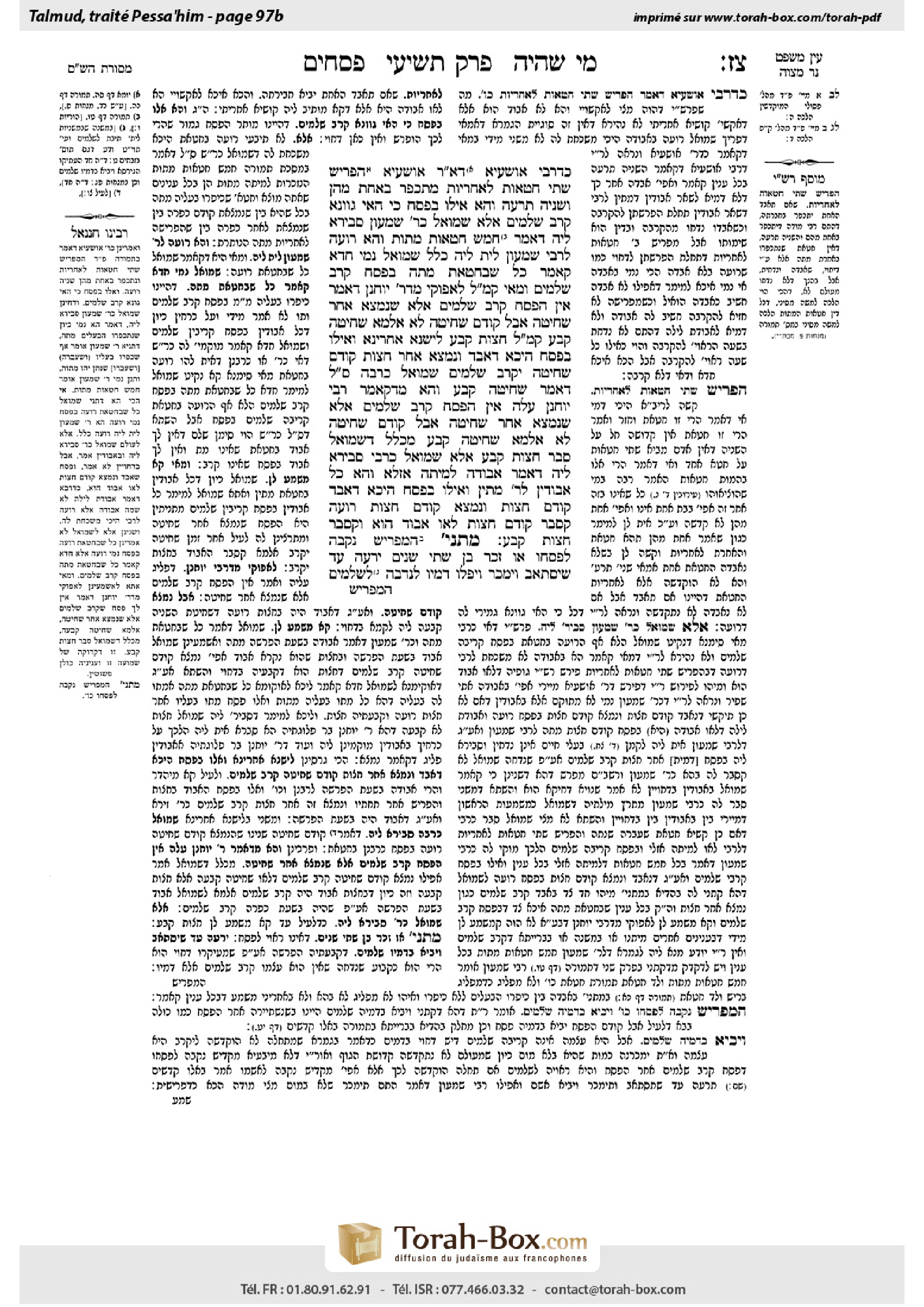
Pesachim 97b: Talmud study for Daf Yomi
Daf Yomi is the daily study of one Talmud folio. Explore 37 tractates with scans, Hebrew text, Sefaria English and AI-generated French translations where annotated.
Passage selection and English or AI-generated French translation are available where the scan has annotations. Daf Study is independent of Torah-Box and Sefaria.
Browse Pesachim · פסחים · All tractatesPesachim 97b text and translations
This page of Pesachim includes the Aramaic text, an English translation and an AI-generated French translation, alongside the scan above.
פסחים צ״ז ב · Aramaic and Hebrew text
כִּדְרַבִּי אוֹשַׁעְיָא. דְּאָמַר רַבִּי אוֹשַׁעְיָא: הִפְרִישׁ שְׁתֵּי חַטָּאוֹת לְאַחְרָיוּת — מִתְכַּפֵּר בְּאַחַת מֵהֶן, וּשְׁנִיָּה תִּרְעֶה.
וְהָא אִילּוּ בְּפֶסַח כִּי הַאי גַוְונָא קָרֵב שְׁלָמִים! אֶלָּא שְׁמוּאֵל כְּרַבִּי שִׁמְעוֹן סְבִירָא לֵיהּ, דְּאָמַר: חָמֵשׁ חַטָּאוֹת מֵתוֹת.
וְהָא רוֹעָה לְרַבִּי שִׁמְעוֹן לֵית לֵיהּ כְּלָל! שְׁמוּאֵל נָמֵי חֲדָא קָאָמַר: כֹּל שֶׁבַּחַטָּאת מֵתָה — בְּפֶסַח קָרֵב שְׁלָמִים.
וּמַאי קָא מַשְׁמַע לַן? לְאַפּוֹקֵי מִדְּרַבִּי יוֹחָנָן, דְּאָמַר: אֵין הַפֶּסַח קָרֵב שְׁלָמִים אֶלָּא שֶׁנִּמְצָא אַחַר שְׁחִיטָה, אֲבָל קוֹדֶם שְׁחִיטָה — לָא. אַלְמָא: שְׁחִיטָה קָבַע. קָא מַשְׁמַע לַן: חֲצוֹת קָבַע.
לִישָּׁנָא אַחֲרִינָא: וְאִילּוּ בְּפֶסַח הֵיכָא דְּאָבַד וְנִמְצָא אַחַר חֲצוֹת, קוֹדֶם שְׁחִיטָה יִקְרַב שְׁלָמִים! שְׁמוּאֵל כְּרַבָּה סְבִירָא לֵיהּ, דְּאָמַר: שְׁחִיטָה קָבַע.
וְהָא מִדְּקָאָמַר רַבִּי יוֹחָנָן עֲלַהּ: אֵין הַפֶּסַח קָרֵב שְׁלָמִים אֶלָּא שֶׁנִּמְצָא אַחַר שְׁחִיטָה, אֲבָל קוֹדֶם שְׁחִיטָה — לָא. אַלְמָא: שְׁחִיטָה קָבַע. מִכְּלָל דִּשְׁמוּאֵל סָבַר: חֲצוֹת קָבַע.
אֶלָּא: שְׁמוּאֵל כְּרַבִּי סְבִירָא לֵיהּ, דְּאָמַר: אֲבוּדָה לְמִיתָה אָזְלָא. וְהָא כֹּל אֲבוּדִין לְרַבִּי מֵתִין, וְאִילּוּ בְּפֶסַח, הֵיכָא דְּאָבַד קוֹדֶם חֲצוֹת וְנִמְצָא קוֹדֶם חֲצוֹת — רוֹעֶה! קָסָבַר: קוֹדֶם חֲצוֹת לָאו אָבוּד הוּא, וְקָסָבַר חֲצוֹת קָבַע.
מַתְנִי׳ הַמַּפְרִישׁ נְקֵבָה לְפִסְחוֹ, אוֹ זָכָר בֶּן שְׁתֵּי שָׁנִים — יִרְעֶה עַד שֶׁיִּסְתָּאֵב, וְיִמָּכֵר, וְיִפְּלוּ דָּמָיו לִנְדָבָה לִשְׁלָמִים.
Pesachim 97b · English translation
The Gemara answers: Even according to Rabbi Yehuda HaNasi there is a case in which a sin-offering is left to graze, in accordance with the opinion of Rabbi Oshaya, as Rabbi Oshaya said: If one separated two sin-offerings from the outset as a guarantee, so that if one is lost he may gain atonement with the other, he gains atonement with one of them and the second is left to graze.
The Gemara challenges this: But with regard to a Paschal lamb, in a case like this the second animal would be sacrificed as a peace-offering. This, too, does not follow Shmuel’s principle. Rather, it can be explained that Shmuel held in accordance with the opinion of Rabbi Shimon, who said there are five sin-offerings that are left in isolation to die, including all those which are lost or deferred.
The Gemara asks: But Rabbi Shimon does not concede in any case at all that a sin-offering is left to graze, as he holds that any sin-offering which is deferred for any reason is left to die, while Shmuel referred to sin-offerings left to graze. The Gemara answers: Shmuel also said only one case. He did not mention sin-offerings that are left to graze; he said only that with regard to any offering that became unfit such that a sin-offering in its condition would be left to die, if it is a Paschal lamb in that condition it is sacrificed as a peace-offering.
The Gemara asks: And what does he teach us with this statement beyond what was taught explicitly in the mishna? The Gemara answers that Shmuel’s statement was meant to exclude the opinion of Rabbi Yoḥanan, who said that a Paschal lamb is sacrificed as a peace-offering only when it is found after slaughter, but if it is found before the slaughter, no, it is not sacrificed as a peace-offering. Apparently, Rabbi Yoḥanan held that the slaughter determines when a sacrifice is deferred; therefore, Shmuel teaches us that in his opinion midday determines whether it is considered deferred, even if the other animal has not yet been slaughtered, because midday is the time when it may be slaughtered. Consequently, if the Paschal lamb is still lost at midday, it may be offered as a peace-offering when it is found.
The Gemara presents another version of the discussion, beginning from the proof that the halakhot of a sin-offering cannot be equated to those of a Paschal lamb because with regard to a Paschal lamb, in a situation where it is lost and then found after midday but before the slaughter of its replacement, it is offered as a peace-offering, which is not consistent with Shmuel’s principle. The Gemara answers: According to this version, Shmuel holds in accordance with the opinion of Rabba, who said that the slaughter of the replacement determines the status of a lost offering; therefore, if the original animal is found before the slaughter of the second animal, even after midday, it is not considered to have been lost.
The Gemara asks: But from the fact that Rabbi Yoḥanan said about this halakha that a Paschal lamb is sacrificed as a peace-offering only when it was found after the slaughter of the replacement, but if it was found before the slaughter, no, it is not, apparently he held that the slaughter determines whether the offering is considered lost. Since there is a dispute about this point, this proves by inference that Shmuel holds that midday determines this status, so that any animal lost at midday is considered lost and is sacrificed as a peace-offering, even if it is found before the slaughter. That does not accord with this second version of Shmuel’s opinion.
Rather, Shmuel’s statement must be explained differently: Shmuel holds in accordance with the opinion of Rabbi Yehuda HaNasi, who said that a lost sin-offering always goes to its death. The Gemara asks: But according to Rabbi Yehuda HaNasi all lost sin-offerings are left in isolation to die, whereas with regard to the Paschal lamb, in a situation where it is lost before midday and found before midday it is left to graze and is not sacrificed as a peace-offering. The Gemara answers: He held that a Paschal lamb that is lost before midday is not considered lost because the time for slaughtering the Paschal lamb has not yet arrived, and he held that midday determines the status of a lost Paschal lamb, not the time of the actual slaughter.
MISHNA: In the case of one who separates a female animal for his Paschal lamb although the Torah requires a male, or a male that is in its second year although a Paschal lamb must be an animal that is in its first year, the animal is left to graze until it develops a blemish and becomes unfit, and it is then sold and its money is used for free-will offerings or peace-offerings.
Pesachim 97b · Traduction française (IA)
La Guemara répond : Même selon Rabbi Yehuda HaNassi, il existe un cas où un sacrifice expiatoire est laissé à paître, conformément à l’opinion de Rabbi Ochaya. En effet, Rabbi Ochaya a dit : Si quelqu’un met d’emblée à part deux sacrifices expiatoires comme garantie, afin que, si l’un se perd, il puisse obtenir l’expiation grâce à l’autre, il obtient l’expiation par l’un d’eux, tandis que le second est laissé à paître.
La Guemara objecte : Mais, pour un agneau pascal, dans un cas semblable, le second animal serait offert comme sacrifice de paix. Cela non plus ne concorde pas avec le principe de Chmouel. Il faut plutôt expliquer que Chmouel suivait l’opinion de Rabbi Chimon, qui a dit qu’il existe cinq sacrifices expiatoires que l’on laisse à l’écart jusqu’à leur mort, parmi lesquels figurent tous ceux qui sont perdus ou écartés.
La Guemara demande : Mais Rabbi Chimon n’admet en aucun cas qu’un sacrifice expiatoire soit laissé à paître, car il considère que tout sacrifice expiatoire écarté pour quelque raison que ce soit est laissé à mourir, tandis que Chmouel a parlé de sacrifices expiatoires laissés à paître. La Guemara répond : Chmouel n’a lui aussi mentionné qu’un seul cas. Il n’a pas parlé de sacrifices expiatoires laissés à paître ; il a seulement dit que, pour tout sacrifice devenu impropre au point qu’un sacrifice expiatoire dans le même état serait laissé à mourir, si c’est un agneau pascal dans cet état, il est offert comme sacrifice de paix.
La Guemara demande : Et que nous enseigne-t-il par cette déclaration, au-delà de ce qui a été explicitement enseigné dans la Michna ? La Guemara répond que la déclaration de Chmouel visait à exclure l’opinion de Rabbi Yoḥanan, qui a dit qu’un agneau pascal n’est offert comme sacrifice de paix que lorsqu’on le retrouve après l’abattage ; mais que, si on le retrouve avant l’abattage, il n’est pas offert comme sacrifice de paix. Il ressort que Rabbi Yoḥanan considérait que l’abattage détermine le moment où un sacrifice est écarté. Chmouel nous enseigne donc qu’à son avis, c’est midi qui détermine s’il est considéré comme écarté, même si l’autre animal n’a pas encore été abattu, car midi est le moment où il peut être abattu. Par conséquent, si l’agneau pascal est toujours perdu à midi, il peut être offert comme sacrifice de paix lorsqu’on le retrouve.
La Guemara présente une autre version de la discussion, en partant de la preuve que les règles d’un sacrifice expiatoire ne peuvent être assimilées à celles d’un agneau pascal : pour un agneau pascal perdu puis retrouvé après midi, mais avant l’abattage de son remplaçant, il est offert comme sacrifice de paix, ce qui ne concorde pas avec le principe de Chmouel. La Guemara répond : Selon cette version, Chmouel suit l’opinion de Rabba, qui a dit que l’abattage du remplaçant détermine le statut d’un sacrifice perdu. Par conséquent, si l’animal initial est retrouvé avant l’abattage du second animal, même après midi, il n’est pas considéré comme perdu.
La Guemara demande : Mais du fait que Rabbi Yoḥanan a dit au sujet de cette halakha qu’un agneau pascal n’est offert comme sacrifice de paix que lorsqu’il a été retrouvé après l’abattage du remplaçant, mais que, s’il a été retrouvé avant l’abattage, il ne l’est pas, il semble qu’il considérait que l’abattage détermine si le sacrifice est considéré comme perdu. Puisqu’il existe une controverse sur ce point, on peut en déduire que Chmouel considère que midi détermine ce statut : tout animal perdu à midi est donc considéré comme perdu et est offert comme sacrifice de paix, même s’il est retrouvé avant l’abattage. Cela ne concorde pas avec cette seconde version de l’opinion de Chmouel.
Il faut plutôt expliquer autrement la déclaration de Chmouel : il suit l’opinion de Rabbi Yehuda HaNassi, qui a dit qu’un sacrifice expiatoire perdu est toujours laissé à mourir. La Guemara demande : Mais, selon Rabbi Yehuda HaNassi, tous les sacrifices expiatoires perdus sont laissés à l’écart jusqu’à leur mort, alors que, pour l’agneau pascal, s’il est perdu avant midi et retrouvé avant midi, il est laissé à paître et n’est pas offert comme sacrifice de paix. La Guemara répond : Il considérait qu’un agneau pascal perdu avant midi n’est pas réputé perdu, car le moment de l’abattage de l’agneau pascal n’est pas encore arrivé ; il considérait également que c’est midi qui détermine le statut d’un agneau pascal perdu, et non le moment de l’abattage effectif.
MICHNA : Celui qui met à part une femelle pour son agneau pascal, alors que la Torah exige un mâle, ou un mâle dans sa deuxième année, alors qu’un agneau pascal doit être un animal dans sa première année, laisse l’animal paître jusqu’à ce qu’il développe un défaut et devienne impropre. Il le vend alors et utilise l’argent pour des offrandes volontaires ou des sacrifices de paix.
Traduction française générée par IA à partir de l’édition anglaise de Sefaria. Vérifie toujours un passage avec le texte source.
Text from Sefaria: William Davidson Edition - Vocalized Aramaic (CC BY NC); William Davidson Edition - English (CC BY NC).