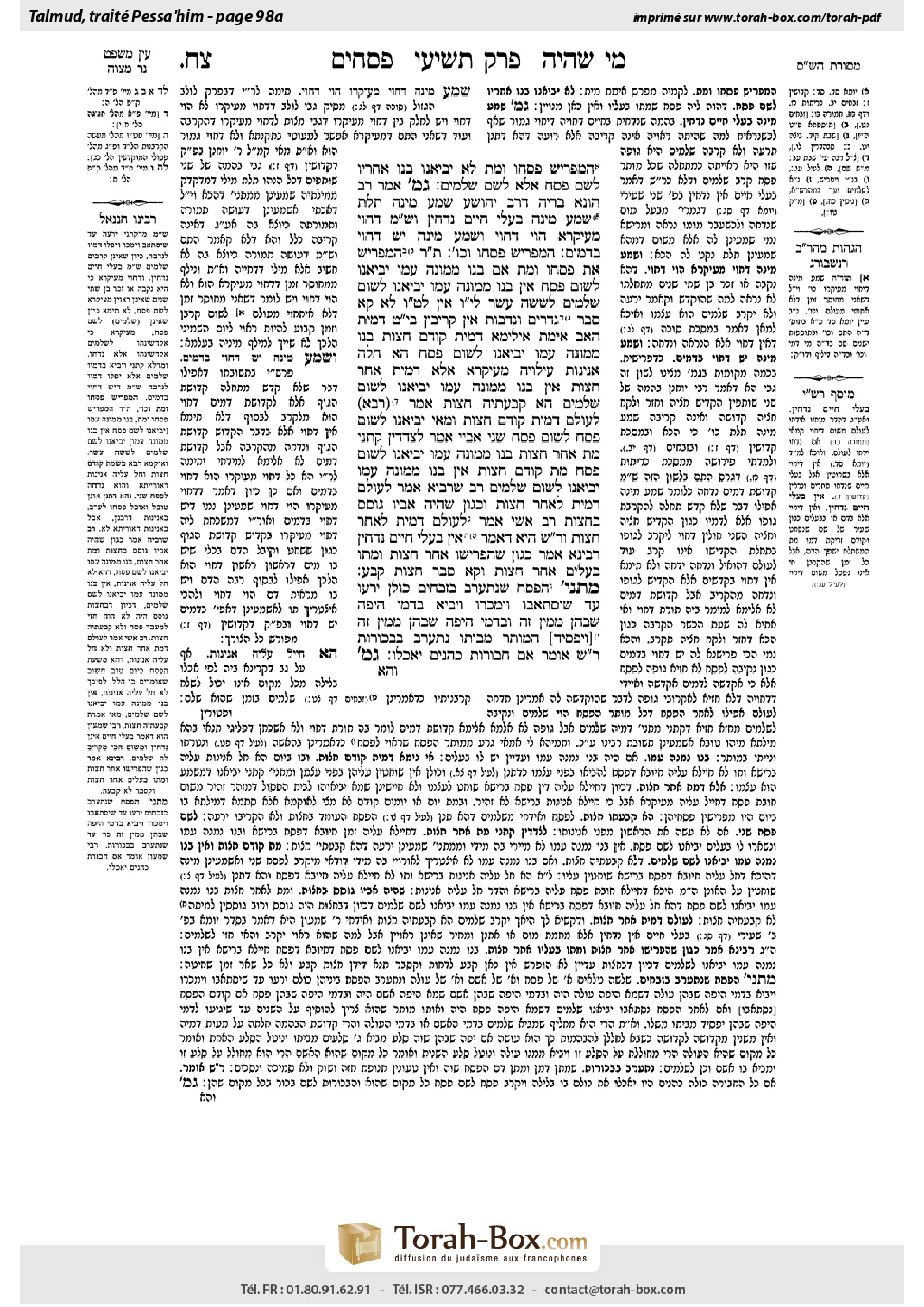
Pesachim 98a: Talmud study for Daf Yomi
Daf Yomi is the daily study of one Talmud folio. Explore 37 tractates with scans, Hebrew text, Sefaria English and AI-generated French translations where annotated.
Passage selection and English or AI-generated French translation are available where the scan has annotations. Daf Study is independent of Torah-Box and Sefaria.
Browse Pesachim · פסחים · All tractatesPesachim 98a text and translations
This page of Pesachim includes the Aramaic text, an English translation and an AI-generated French translation, alongside the scan above.
פסחים צ״ח א · Aramaic and Hebrew text
הַמַּפְרִישׁ פִּסְחוֹ וּמֵת, לֹא יְבִיאֶנּוּ בְּנוֹ אַחֲרָיו לְשֵׁם פֶּסַח אֶלָּא לְשֵׁם שְׁלָמִים.
גְּמָ׳ אָמַר רַב הוּנָא בְּרֵיהּ דְּרַב יְהוֹשֻׁעַ: שְׁמַע מִינַּהּ תְּלָת. שְׁמַע מִינַּהּ: בַּעֲלֵי חַיִּים נִדְחִין.
וּשְׁמַע מִינַּהּ: דָּחוּי מֵעִיקָּרָא הָוֵי דָּחוּי. וּשְׁמַע מִינַּהּ: יֵשׁ דִּחוּי בְּדָמִים.
הַמַּפְרִישׁ פִּסְחוֹ וְכוּ׳. תָּנוּ רַבָּנַן: הַמַּפְרִישׁ אֶת פִּסְחוֹ וּמֵת, אִם בְּנוֹ מְמוּנֶּה עִמּוֹ יְבִיאֶנּוּ לְשׁוּם פֶּסַח, אֵין בְּנוֹ מְמוּנֶּה עִמּוֹ — יְבִיאֶנּוּ לְשׁוּם שְׁלָמִים לְשִׁשָּׁה עָשָׂר. לְשִׁשָּׁה עָשָׂר אִין, לַחֲמִשָּׁה עָשָׂר — לָא. קָא סָבַר: נְדָרִים וּנְדָבוֹת אֵין קְרֵיבִין בְּיוֹם טוֹב.
דְּמִית הָאָב אֵימַת? אִילֵּימָא דְּמִית קוֹדֶם חֲצוֹת, בְּנוֹ מְמוּנֶּה עִמּוֹ יְבִיאֶנּוּ לְשׁוּם פֶּסַח? הָא חָלָה אֲנִינוּת עִילָּוֵיהּ מֵעִיקָּרָא!
אֶלָּא דְּמִית אַחַר חֲצוֹת. אֵין בְּנוֹ מְמוּנֶּה עִמּוֹ — יְבִיאֶנּוּ לְשׁוּם שְׁלָמִים? הָא קְבַעְתֵּיהּ חֲצוֹת!
אָמַר (רָבָא): לְעוֹלָם דְּמִית קוֹדֶם חֲצוֹת, וּמַאי יְבִיאֶנּוּ לְשׁוּם פֶּסַח — לְשׁוּם פֶּסַח שֵׁנִי.
אַבָּיֵי אָמַר, לִצְדָדִין קָתָנֵי: מֵת אַחַר חֲצוֹת — בְּנוֹ מְמוּנֶּה עִמּוֹ יְבִיאֶנּוּ לְשׁוּם פֶּסַח. מֵת קוֹדֶם חֲצוֹת — אֵין בְּנוֹ מְמוּנֶּה עִמּוֹ יְבִיאֶנּוּ לְשׁוּם שְׁלָמִים.
רַב שֵׁרֵבְיָא אָמַר: לְעוֹלָם דְּמִית לְאַחַר חֲצוֹת, וּכְגוֹן שֶׁהָיָה אָבִיו גּוֹסֵס בַּחֲצוֹת.
רַב אָשֵׁי אָמַר: לְעוֹלָם דְּמִית לְאַחַר חֲצוֹת, וְרַבִּי שִׁמְעוֹן הִיא, דְּאָמַר: אֵין בַּעֲלֵי חַיִּים נִדְחִין.
רָבִינָא אָמַר: כְּגוֹן שֶׁהִפְרִישׁוֹ אַחַר חֲצוֹת וּמֵתוּ בְּעָלִים אַחַר חֲצוֹת, וְקָא סָבַר חֲצוֹת קָבַע.
מַתְנִי׳ הַפֶּסַח שֶׁנִּתְעָרֵב בִּזְבָחִים — כּוּלָּן יִרְעוּ עַד שֶׁיִּסְתָּאֲבוּ, וְיִמָּכְרוּ, וְיָבִיא בִּדְמֵי הַיָּפֶה שֶׁבָּהֶן מִמִּין זֶה וּבִדְמֵי הַיָּפֶה שֶׁבָּהֶן מִמִּין זֶה, [וְיַפְסִיד] הַמּוֹתָר מִבֵּיתוֹ.
נִתְעָרֵב בִּבְכוֹרוֹת, רַבִּי שִׁמְעוֹן אוֹמֵר: אִם חֲבוּרַת כֹּהֲנִים — יֹאכֵלוּ.
Pesachim 98a · English translation
With regard to one who separates his Paschal lamb and then dies, his son may not bring it after him for the purpose of a Paschal lamb because it may no longer be used for that purpose after its owner has died. Rather, it is brought for the purpose of a peace-offering.
GEMARA: Rav Huna, son of Rav Yehoshua, said: Conclude three halakhot from this mishna, concerning one who separates an unfit sheep as a Paschal lamb: Conclude from it that living things can be permanently deferred; not only is a sacrifice that has already been slaughtered permanently deferred, but so is a living animal that has been separated as a sacrifice for which it is unfit. This is clear from the fact that a female animal separated as a Paschal lamb is not offered as a peace-offering, but rather redeemed for money, which is then used for free-will offerings. This mishna clearly supports one side of a dispute on this issue in tractate Yoma 63b.
And furthermore, conclude from this that deferral at the outset, when the lamb is first consecrated, is considered a permanent deferral; even though the female animal was never fit for use as a Paschal lamb and therefore one might have thought that it should be brought as a peace-offering, the fact that it may not be brought as a peace-offering indicates that it has been completely deferred. (See tractate Sukka 33b for an opposing view.) And conclude from this that there is deferral not only with regard to the offering itself, but also with regard to the money of that offering, as the proceeds from the sale of the offering are used for free-will offerings rather than peace-offerings (Rabbeinu Ḥananel).
The mishna states that if one who separates his Paschal lamb dies, his son may not sacrifice that animal as a Paschal lamb. Similarly, the Sages taught in the Tosefta: With regard to one who separates his Paschal lamb and dies, if his son is registered with him for that Paschal lamb, his son brings it for the purpose of a Paschal lamb, because if only one of the individuals registered for a Paschal lamb dies, the offering does not become entirely unfit. However, if his son is not registered with him, his son should bring it for the purpose of a peace-offering on the sixteenth of Nisan. The Gemara infers that on the sixteenth, yes, the son may sacrifice the offering, but on the fifteenth, which is the Festival day, no, he may not. This indicates that the tanna of this baraita holds that animals brought in order to fulfill vows and free-will offerings are not offered on a Festival; rather, only offerings that must be brought on the Festival are sacrificed on that day.
The Gemara seeks to clarify the intent of the Tosefta: When did the father die? If we say the father died before midday on the fourteenth, how is it possible to understand the continuation of the Tosefta, which states that if his son is registered with him, the son should bring it for the purpose of a Paschal lamb? Acute mourning applies to the son from the outset, before the Paschal lamb could be sacrificed, and an acute mourner may not sacrifice the Paschal lamb.
Rather, can one say that he died after midday? But the continuation of the Tosefta says that if his son is not registered with him, the son should bring it for the purpose of a peace-offering; but midday established it as a Paschal lamb, in which case it should have the status of a Paschal lamb that was fit and then deferred, since the father was the sole registered participant. Such an animal is left to graze until it develops a blemish; it is then sold, and its proceeds are used for free-will offerings. It may not be sacrificed as a peace-offering.
The Gemara presents several resolutions of this difficulty. Rava said: Actually, one can answer that the father died before midday, and what does it mean when it says that his son should bring the animal for the purpose of a Paschal lamb? It means that he should bring it for the purpose of a Paschal lamb on the second Pesaḥ, which is after the period of acute mourning.
Abaye said: It teaches it disjunctively, meaning that the two clauses in the Tosefta address two different cases: If the father died after midday and his son was registered with him, the son should bring the animal for the purpose of a Paschal lamb, because midday establishes the son’s obligation to sacrifice the Paschal lamb. This obligation overrides the rabbinic status of acute mourning, which applies the night after one’s relative has died. If the father died before midday and his son was not registered with him, the son should bring it for the purpose of a peace-offering because midday did not formally establish the animal’s identity as a Paschal lamb. The Tosefta does not address the other two possible cases, i.e., the father dying after midday and his son not being registered with him, or the father dying before midday and his son being registered with him.
Rav Sherevya said: Actually, the Tosefta is addressing a case in which the father died after midday, yet nonetheless the animal is not considered rejected and may be offered as a peace-offering; for example, this is the case if his father was on his death bed at midday. In that case, midday does not irreversibly classify the offering as a Paschal lamb, as it is known in advance that most people in such a condition die.
Rav Ashi said: Actually, the Tosefta is addressing a case in which the father died after midday, and it is in accordance with the opinion of Rabbi Shimon, as he said that living animals are not deferred. According to this opinion, midday does not irreversibly determine the status of the offering, as long as it has not yet been slaughtered.
Ravina said that the Tosefta is referring to a case where one separated this Paschal lamb after midday and the owners died after midday; and this tanna holds in accordance with the opinion of Rabbi Zeira stated earlier in the chapter that midday determines the status of the offering, and since it had not yet been separated by midday it cannot be rejected.
MISHNA: In the case of a Paschal lamb that was intermingled with other offerings, such as guilt-offerings and burnt-offerings, and it is not known which animal was separated for which offering, all of them are left to graze until they develop a blemish and become unfit; and they are then sold, and with the proceeds of the choicest of them he must bring this type of sacrifice, and with the proceeds of the choicest of them he must bring this other type of sacrifice, meaning that he must purchase one of each type of sacrifice that was intermingled at the value of the most expensive animal in the group. And he loses the difference from his own pocket. Not all the offerings were as expensive as the most valuable animal in the group, yet he must purchase an animal for each type of offering for the value of the most expensive animal in the group.
If a Paschal lamb was intermingled with firstborn animals, Rabbi Shimon says: If those whose offerings became mixed together were groups of priests, they may eat all of the animals on Passover night. This is because priests are permitted to eat the meat of a firstborn animal, and the slaughter and other services for a firstborn animal are the same as those for a Paschal lamb. The attending priests should state that they intend to sacrifice as a Paschal lamb whichever animal is the Paschal lamb and to sacrifice as a firstborn animal whichever animal is a firstborn.
Pesachim 98a · Traduction française (IA)
À propos de celui qui met à part son agneau pascal puis meurt, son fils ne peut pas le présenter comme agneau pascal, car il ne peut plus être utilisé à cette fin après la mort de son propriétaire. Il est plutôt présenté comme sacrifice de paix.
GUEMARA : Rav Houna, fils de Rav Yehoshoua, dit : Déduis de cette Michna trois halakhot au sujet de celui qui met à part une brebis impropre comme agneau pascal. Déduis-en que les animaux vivants peuvent être définitivement écartés : non seulement un sacrifice déjà abattu est définitivement écarté, mais aussi un animal vivant mis à part comme sacrifice alors qu’il est impropre à cet usage. Cela ressort clairement du fait qu’une femelle mise à part comme agneau pascal n’est pas présentée comme sacrifice de paix, mais est plutôt rachetée, et que l’argent obtenu sert ensuite à financer des offrandes volontaires. Cette Michna appuie clairement l’une des positions dans une controverse sur cette question, dans le traité Yoma 63b.
En outre, déduis-en qu’un rejet dès le départ, au moment où l’agneau est consacré pour la première fois, est considéré comme définitif. Bien que la femelle n’ait jamais été apte à servir d’agneau pascal et que l’on aurait donc pu penser qu’elle devait être présentée comme sacrifice de paix, le fait qu’elle ne puisse pas l’être indique qu’elle a été définitivement écartée. (Voir le traité Soukka 33b pour une opinion contraire.) Déduis-en aussi qu’il y a rejet non seulement pour l’offrande elle-même, mais aussi pour l’argent provenant de cette offrande, puisque le produit de sa vente sert à financer des offrandes volontaires plutôt que des sacrifices de paix (Rabbenou ‘Hananel).
La Michna enseigne que si celui qui met à part son agneau pascal meurt, son fils ne peut pas sacrifier cet animal comme agneau pascal. De même, les Sages ont enseigné dans la Tossefta : À propos de celui qui met à part son agneau pascal puis meurt, si son fils est inscrit avec lui pour cet agneau pascal, son fils le présente comme agneau pascal, car si un seul des individus inscrits pour un agneau pascal meurt, l’offrande ne devient pas entièrement impropre. En revanche, si son fils n’est pas inscrit avec lui, son fils doit le présenter comme sacrifice de paix le seize Nissan. La Guemara en déduit que le fils peut sacrifier l’offrande le seize, mais pas le quinze, jour de fête. Cela indique que le tanna de cette baraïta considère que les animaux apportés pour acquitter des vœux et des offrandes volontaires ne sont pas sacrifiés un jour de fête ; seules les offrandes qui doivent être apportées ce jour-là y sont sacrifiées.
La Guemara cherche à préciser le sens de la Tossefta : quand le père est-il mort ? Si l’on dit qu’il est mort avant midi le quatorze, comment comprendre la suite de la Tossefta, qui dit que si son fils est inscrit avec lui, celui-ci doit le présenter comme agneau pascal ? Le fils est alors en deuil aigu dès le départ, avant que l’agneau pascal puisse être sacrifié, et une personne en deuil aigu ne peut pas sacrifier l’agneau pascal.
Peut-on plutôt dire qu’il est mort après midi ? Mais la suite de la Tossefta dit que si son fils n’est pas inscrit avec lui, celui-ci doit le présenter comme sacrifice de paix. Or, à midi, il a été établi comme agneau pascal ; il devrait donc avoir le statut d’un agneau pascal qui était apte, puis a été écarté, puisque le père était le seul participant inscrit. Un tel animal est laissé au pâturage jusqu’à ce qu’il développe un défaut ; il est alors vendu, et le produit de sa vente sert à financer des offrandes volontaires. Il ne peut pas être sacrifié comme sacrifice de paix.
La Guemara propose plusieurs solutions à cette difficulté. Rava dit : En réalité, on peut répondre que le père est mort avant midi. Que signifie alors l’énoncé selon lequel son fils doit présenter l’animal comme agneau pascal ? Cela signifie qu’il doit le présenter comme agneau pascal lors du second Pessa’h, après la période de deuil aigu.
Abayé dit : L’enseignement distingue les deux cas, c’est-à-dire que les deux propositions de la Tossefta concernent des situations différentes. Si le père est mort après midi et que son fils était inscrit avec lui, celui-ci doit présenter l’animal comme agneau pascal, car midi établit l’obligation du fils de sacrifier l’agneau pascal. Cette obligation l’emporte sur le statut rabbinique de deuil aigu, qui s’applique durant la nuit suivant la mort d’un proche. Si le père est mort avant midi et que son fils n’était pas inscrit avec lui, celui-ci doit le présenter comme sacrifice de paix, car midi n’a pas formellement établi l’identité de l’animal comme agneau pascal. La Tossefta ne traite pas des deux autres cas possibles : le père meurt après midi alors que son fils n’était pas inscrit avec lui, ou le père meurt avant midi alors que son fils était inscrit avec lui.
Rav Cherevya dit : En réalité, la Tossefta traite d’un cas où le père est mort après midi et où, pourtant, l’animal n’est pas considéré comme rejeté et peut être présenté comme sacrifice de paix. C’est le cas, par exemple, si son père était à l’agonie à midi. Dans ce cas, midi ne classe pas irrévocablement l’offrande comme agneau pascal, puisqu’on sait à l’avance que la plupart des personnes dans un tel état meurent.
Rav Achi dit : En réalité, la Tossefta traite d’un cas où le père est mort après midi, conformément à l’opinion de Rabbi Chimon, qui affirme que les animaux vivants ne sont pas écartés. Selon cette opinion, midi ne détermine pas irrévocablement le statut de l’offrande tant qu’elle n’a pas encore été abattue.
Ravina dit que la Tossefta fait référence à un cas où l’on a mis à part cet agneau pascal après midi et où les propriétaires sont morts après midi. Ce tanna suit l’opinion de Rabbi Zeira, énoncée plus tôt dans le chapitre, selon laquelle midi détermine le statut de l’offrande ; comme celle-ci n’avait pas encore été mise à part à midi, elle ne peut pas être rejetée.
MICHNA : Dans le cas d’un agneau pascal mêlé à d’autres offrandes, telles que des sacrifices de culpabilité et des holocaustes, et où l’on ne sait pas quel animal avait été mis à part pour quelle offrande, on les laisse tous paître jusqu’à ce qu’ils développent un défaut et deviennent impropres. Ils sont alors vendus, et il doit, avec le produit de la vente des animaux les plus précieux, apporter chacun des types de sacrifices concernés : il doit acheter un sacrifice de chaque type parmi ceux qui ont été mêlés, d’une valeur égale à celle de l’animal le plus coûteux du groupe. Il supporte la différence de sa propre poche. Les offrandes n’avaient pas toutes une valeur égale à celle de l’animal le plus précieux du groupe ; pourtant, il doit acheter, pour chaque type d’offrande, un animal d’une valeur égale à celle de l’animal le plus coûteux du groupe.
Si un agneau pascal a été mêlé à des animaux premiers-nés, Rabbi Chimon dit : Si ceux dont les offrandes se sont mêlées formaient des groupes de prêtres, ils peuvent manger tous les animaux pendant la nuit de Pessa’h. En effet, les prêtres ont le droit de manger la viande d’un animal premier-né, et l’abattage ainsi que les autres rites concernant un premier-né sont les mêmes que pour un agneau pascal. Les prêtres officiants doivent déclarer qu’ils ont l’intention de sacrifier comme agneau pascal l’animal qui est l’agneau pascal, et comme premier-né celui qui est premier-né.
Traduction française générée par IA à partir de l’édition anglaise de Sefaria. Vérifie toujours un passage avec le texte source.
Text from Sefaria: William Davidson Edition - Vocalized Aramaic (CC BY NC); William Davidson Edition - English (CC BY NC).