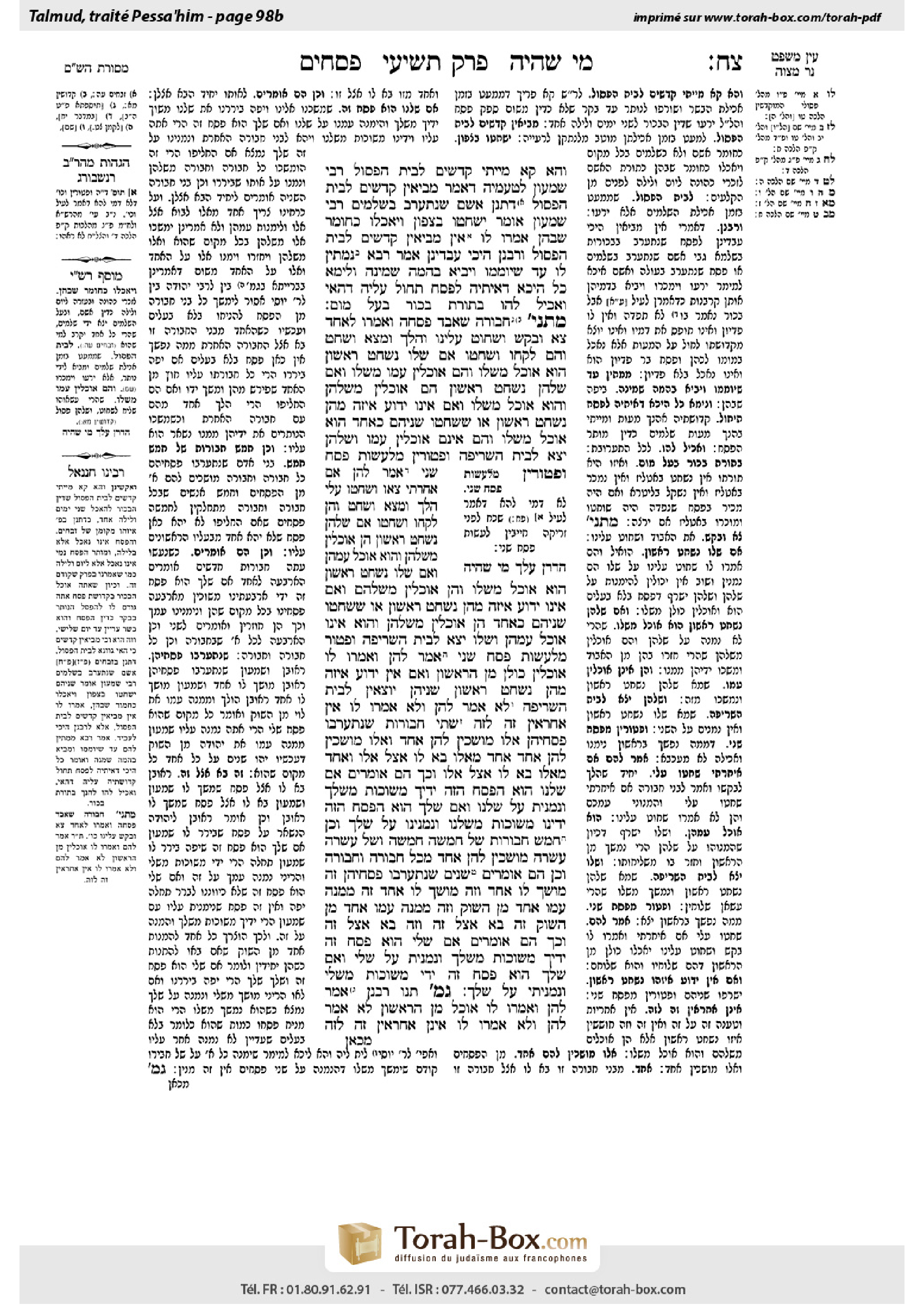
Pesachim 98b: Talmud study for Daf Yomi
Daf Yomi is the daily study of one Talmud folio. Explore 37 tractates with scans, Hebrew text, Sefaria English and AI-generated French translations where annotated.
Passage selection and English or AI-generated French translation are available where the scan has annotations. Daf Study is independent of Torah-Box and Sefaria.
Browse Pesachim · פסחים · All tractatesPesachim 98b text and translations
This page of Pesachim includes the Aramaic text, an English translation and an AI-generated French translation, alongside the scan above.
פסחים צ״ח ב · Aramaic and Hebrew text
גְּמָ׳ וְהָא קָא מַיְיתֵי קָדָשִׁים לְבֵית הַפְּסוּל?
רַבִּי שִׁמְעוֹן לְטַעְמֵיהּ, דְּאָמַר: מְבִיאִין קָדָשִׁים לְבֵית הַפְּסוּל. דִּתְנַן: אָשָׁם שֶׁנִּתְעָרֵב בִּשְׁלָמִים — רַבִּי שִׁמְעוֹן אוֹמֵר: יִשָּׁחֲטוּ בַּצָּפוֹן, וְיֵאָכְלוּ כַּחוֹמֶר שֶׁבָּהֶן.
אָמְרוּ לוֹ: אֵין מְבִיאִין קָדָשִׁים לְבֵית הַפְּסוּל.
וְרַבָּנַן, הֵיכִי עָבְדִינַן? אָמַר רָבָא: נַמְתִּין לוֹ עַד שֶׁיּוּמְמוּ, וְיָבִיא בְּהֵמָה שְׁמֵינָה, וְלֵימָא: כֹּל הֵיכָא דְּאִיתֵיהּ לְפֶסַח — תְּחוּל עֲלֵיהּ דְּהַאי, וְאָכֵיל לְהוּ בְּתוֹרַת בְּכוֹר בַּעַל מוּם.
מַתְנִי׳ חֲבוּרָה שֶׁאָבַד פִּסְחָהּ וְאָמְרוּ לְאֶחָד ״צֵא וּבַקֵּשׁ וּשְׁחוֹט עָלֵינוּ״, וְהָלַךְ וּמָצָא וְשָׁחַט, וְהֵם לָקְחוּ וְשָׁחֲטוּ, אִם שֶׁלּוֹ נִשְׁחַט רִאשׁוֹן — הוּא אוֹכֵל מִשֶּׁלּוֹ, וְהֵם אוֹכְלִין עִמּוֹ מִשֶּׁלּוֹ. וְאִם שֶׁלָּהֶן נִשְׁחַט רִאשׁוֹן — הֵם אוֹכְלִין מִשֶּׁלָּהֶן, וְהוּא אוֹכֵל מִשֶּׁלּוֹ.
וְאִם אֵינוֹ יָדוּעַ אֵיזֶה מֵהֶן נִשְׁחַט רִאשׁוֹן, אוֹ שֶׁשָּׁחֲטוּ שְׁנֵיהֶם כְּאֶחָד — הוּא אוֹכֵל מִשֶּׁלּוֹ, וְהֵם אֵינָם אוֹכְלִין עִמּוֹ, וְשֶׁלָּהֶן יֵצֵא לְבֵית הַשְּׂרֵיפָה. וּפְטוּרִין מִלַּעֲשׂוֹת פֶּסַח שֵׁנִי.
אָמַר לָהֶן: ״אִם אֵחַרְתִּי — צְאוּ וְשַׁחֲטוּ עָלַי״. הָלַךְ וּמָצָא וְשָׁחַט, וְהֵן לָקְחוּ וְשָׁחֲטוּ. אִם שֶׁלָּהֶן נִשְׁחַט רִאשׁוֹן — הֵן אוֹכְלִין מִשֶּׁלָּהֶן, וְהוּא אוֹכֵל עִמָּהֶן. וְאִם שֶׁלּוֹ נִשְׁחַט רִאשׁוֹן — הוּא אוֹכֵל מִשֶּׁלּוֹ, וְהֵן אוֹכְלִין מִשֶּׁלָּהֶם.
וְאִם אֵינוֹ יָדוּעַ אֵיזֶה מֵהֶן נִשְׁחַט רִאשׁוֹן, אוֹ שֶׁשָּׁחֲטוּ שְׁנֵיהֶם כְּאֶחָד — הֵן אוֹכְלִין מִשֶּׁלָּהֶן, וְהוּא אֵינוֹ אוֹכֵל עִמָּהֶן. וְשֶׁלּוֹ יֵצֵא לְבֵית הַשְּׂרֵיפָה, וּפָטוּר מִלַּעֲשׂוֹת פֶּסַח שֵׁנִי.
אָמַר לָהֶן וְאָמְרוּ לוֹ — אוֹכְלִין כּוּלָּן מִן הָרִאשׁוֹן. וְאִם אֵין יָדוּעַ אֵיזֶה מֵהֶן נִשְׁחַט רִאשׁוֹן — שְׁנֵיהֶן יוֹצְאִין לְבֵית הַשְּׂרֵיפָה.
לֹא אָמַר לָהֶן וְלֹא אָמְרוּ לוֹ — אֵין אַחֲרָאִין זֶה לָזֶה.
שְׁתֵּי חֲבוּרוֹת שֶׁנִּתְעָרְבוּ פִּסְחֵיהֶן, אֵלּוּ מוֹשְׁכִין לָהֶן אֶחָד וְאֵלּוּ מוֹשְׁכִין לָהֶן אֶחָד. אֶחָד מֵאֵלּוּ בָּא לוֹ אֵצֶל אֵלּוּ, וְאֶחָד מֵאֵלּוּ בָּא לוֹ אֵצֶל אֵלּוּ, וְכָךְ הֵם אוֹמְרִים: אִם שֶׁלָּנוּ הוּא הַפֶּסַח הַזֶּה — יָדֶיךָ מְשׁוּכוֹת מִשֶּׁלְּךָ וְנִמְנֵיתָ עַל שֶׁלָּנוּ. וְאִם שֶׁלְּךָ הוּא הַפֶּסַח הַזֶּה — יָדֵינוּ מְשׁוּכוֹת מִשֶּׁלָּנוּ וְנִמְנֵינוּ עַל שֶׁלָּךְ.
וְכֵן חָמֵשׁ חֲבוּרוֹת שֶׁל חֲמִשָּׁה חֲמִשָּׁה וְשֶׁל עֲשָׂרָה עֲשָׂרָה — מוֹשְׁכִין לָהֶן אֶחָד מִכׇּל חֲבוּרָה וַחֲבוּרָה וְכֵן הֵם אוֹמְרִים.
שְׁנַיִם שֶׁנִּתְעָרְבוּ פִּסְחֵיהֶן — זֶה מוֹשֵׁךְ לוֹ אֶחָד וְזֶה מוֹשֵׁךְ לוֹ אֶחָד, זֶה מְמַנֶּה עִמּוֹ אֶחָד מִן הַשּׁוּק וְזֶה מְמַנֶּה עִמּוֹ אֶחָד מִן הַשּׁוּק,
זֶה בָּא אֵצֶל זֶה, וְזֶה בָּא אֵצֶל זֶה, וְכָךְ הֵם אוֹמְרִים: אִם שֶׁלִּי הוּא פֶּסַח זֶה — יָדֶיךָ מְשׁוּכוֹת מִשֶּׁלְּךָ וְנִמְנֵיתָ עַל שֶׁלִּי, וְאִם שֶׁלְּךָ הוּא פֶּסַח זֶה — יָדַי מְשׁוּכוֹת מִשֶּׁלִּי וְנִמְנֵיתִי עַל שֶׁלָּךְ.
גְּמָ׳ תָּנוּ רַבָּנַן: אָמַר לָהֶן וְאָמְרוּ לוֹ — אוֹכֵל מִן הָרִאשׁוֹן. לֹא אָמַר לָהֶן וְלֹא אָמְרוּ לוֹ — אֵינָן אַחֲרָאִין זֶה לָזֶה.
Pesachim 98b · English translation
GEMARA: The Gemara challenges Rabbi Shimon’s statement permitting priests to eat a Paschal lamb that became intermingled with firstborn animals: How can all of the animals be eaten according to the strictures of the Paschal lamb? They will cause offerings to be considered disqualified unnecessarily. A firstborn animal may be eaten for two days and one night while a Paschal lamb must be eaten in one night; therefore, eating the firstborn animals according to the strictures of the Paschal lamb will cause them to be disqualified and burned once morning arrives, despite the fact that they are not actually disqualified yet.
The Gemara answers: Rabbi Shimon conforms to his standard line of reasoning, as he said that it is permitted to cause offerings to be considered disqualified, as we learned in a mishna: If a guilt-offering became intermingled with a peace-offering, what should be done? Rabbi Shimon says: One should slaughter all of them in the northern part of the Temple courtyard, like a guilt-offering, because it is permitted to slaughter a peace-offering there, even though it is not obligatory to do so. And they should be eaten as the stricter of them would be, according to the rules of a guilt-offering, which is a sacrifice of the most sacred order. Therefore, they must be eaten in the Temple courtyard over the course of one day and night, unlike sacrifices of minor sanctity, and may not be distributed to family members of the priests anywhere in Jerusalem.
The Rabbis said to him: One may not cause offerings to be considered disqualified, and since one of the animals is a peace-offering one may not treat it as a guilt-offering, which minimizes the time period in which it may be eaten and which may lead to it being burned unnecessarily. This indicates that Rabbi Shimon is not concerned with this possibility.
The Gemara asks: And according to the Rabbis, what should we do if a Paschal lamb is intermingled with firstborn animals? Firstborn animals are sanctified from birth, and their sanctity takes effect on them alone. Rava said: We wait for the owner until the animals are blemished, and at that point he will bring a fat, unsanctified animal and say: Anywhere that the Paschal lamb is, its sanctity should apply to this new animal. The new animal is then brought as a peace-offering. And with regard to the original group of animals, he eats them according to the laws of a blemished firstborn animal. Such an animal is considered unsanctified and is eaten by priests, albeit with certain limitations, such as the fact that the meat cannot be weighed or sold in a degrading manner.
MISHNA: With regard to a group whose Paschal lamb was lost, and they said to one member of the group: Go and search for our Paschal lamb, and when you find it, slaughter it on our behalf; and he went and found the missing offering and slaughtered it on behalf of the entire group, but in the meantime they took a different animal and slaughtered it as a Paschal lamb, the halakha is as follows: If his Paschal lamb was slaughtered first, he eats from his offering, as he is considered to be registered specifically for that offering, and they eat with him from his offering, because he included them in his offering and it belongs to the entire group. The second animal does not have any registrants and is therefore burned. And if theirs was slaughtered first, they eat from theirs because they withdrew from the original offering through the act of slaughtering a replacement, and he eats from his because he was not registered for the replacement offering sacrificed by the remainder of his group.
And if it is not known which of the offerings was slaughtered first, or if both the group and the individual slaughtered them together, he eats from his and they do not eat with him in case theirs was slaughtered first, and theirs must be taken out to the place designated for burning. The offering slaughtered by the group may not be eaten due to the concern that it was slaughtered second and the members of the group would therefore have been included in the first offering. However, they are exempt from performing the offering of the Paschal lamb on the second Pesaḥ, because they were included in the slaughter of whichever animal was slaughtered first. It is only due to external circumstances that they cannot complete the mitzva by eating the Paschal lamb, and this does not prevent them from fulfilling their obligation.
A somewhat different case of a lost Paschal lamb would occur if the group had sent one member as an agent to search for the lost animal, and the agent said to the other members of the group before he left: If I am late, go and slaughter a Paschal lamb for me. He then went and found the lost Paschal lamb and slaughtered it, and they took another animal and slaughtered it as a Paschal lamb. In that case, if theirs was slaughtered first, they eat from theirs and he eats with them, because he requested to be included in their offering and they registered him for their Paschal lamb. And if his was slaughtered first, he eats from his and they eat from theirs, because the fact that they slaughtered a different animal indicates that they have withdrawn from the original offering.
And if it is not known which of the animals was slaughtered first, or if both the group and the individual slaughtered them together, they eat from theirs because they definitely withdrew from the original offering by slaughtering a different one, and he does not eat with them because he also intended to be included in the animal he slaughtered and it is not clear which was slaughtered first. Therefore, his must be taken out to the place designated for burning; and he is exempt from performing the sacrifice of the Paschal lamb on the second Pesaḥ.
If he said to them that if he is delayed they should include him in their Paschal lamb, and they said to him that if he finds the original offering he should slaughter it on their behalf, all of them eat from the first sacrifice that was slaughtered. And if it is not known which of them was slaughtered first, both of them must be taken out to the place designated for burning, and the entire group is exempt from participating in the Paschal lamb on the second Pesaḥ.
If he did not say anything to them and they did not say anything to him, meaning that neither side granted the other authority to slaughter a Paschal lamb on its behalf, they are not responsible for each other, and the members of the group eat their Paschal lamb while the individual sent to find the lost animal eats from his own offering. The reason for this is that the individual is registered only for the original offering, while the other members of the group withdrew from that lost offering by sacrificing a different Paschal lamb.
Two groups whose Paschal lambs have become intermingled and they do not know which one belongs to which group should act in the following manner: These members of the first group draw one of the animals separated as a Paschal lamb for themselves, and those members of the second group draw one for themselves. One of these, a member of one group, comes to those, the members of the other group, and one of those members of the second group comes to these members of the first group. And this is what each group says to the member of the other group who has come to join them: If this Paschal lamb that is now in our possession is ours, you are withdrawn from the Paschal lamb that was yours, and you are registered for our Paschal lamb and you may eat from it. And if this Paschal lamb is yours, meaning that it actually belongs to the other group, including this individual, we are hereby withdrawn from ours and we are registered for your Paschal lamb, which you agree to share with us. The other group makes the same statement.
And similarly, if there were five groups of five people each or of ten people each, they draw one person from each and every group, and they say this statement mentioned in the case of two groups. The remaining member or members of each group will grant the representatives of the other groups that have come to join them a share in the Paschal lamb, and they will acquire a share in it for themselves in case the animal they have chosen belonged originally to one of the other groups.
In the case of two individuals whose Paschal lambs became intermingled and each person was the only one registered for his offering, what should they do? This person draws one of the Paschal lambs for himself and that person draws one for himself; this person registers someone from the marketplace with him on his Paschal lamb and that person registers someone from the marketplace with him on his Paschal lamb.
Once this has been done, this one comes to that person from the marketplace who has been added to the other person’s sacrifice, and that one comes to this person from the marketplace who has been added to the first person’s sacrifice, and this is what they say: If this Paschal lamb is mine, you are withdrawn from yours and you are registered for mine, and if this is your Paschal lamb, I am withdrawn from mine and I am hereby registered for yours, as described previously. The reason it is necessary for each individual to add an additional person to his Paschal lamb, is to ensure that when each person withdraws from his original Paschal lamb and registers for the other, no Paschal lamb will be left ownerless for any amount of time.
GEMARA: The Sages taught: If he, the agent, said to the other members of the group that if they slaughter their Paschal lamb first they should include him, and they said to him that if he slaughters his Paschal lamb first he should include them, all of them eat from the first Paschal lamb that was slaughtered, and the second one must be burned. If he did not say this to them and they did not say this to him, they are not responsible for each other, and each side eats its own Paschal lamb.
Pesachim 98b · Traduction française (IA)
GUEMARA : La Guemara objecte à la déclaration de Rabbi Shimon, qui autorise les prêtres à manger un agneau pascal mêlé à des premiers-nés : comment tous les animaux peuvent-ils être mangés selon les règles les plus strictes de l’agneau pascal ? Cela conduirait à considérer inutilement des offrandes comme disqualifiées. Un premier-né peut être mangé pendant deux jours et une nuit, tandis qu’un agneau pascal doit être mangé en une seule nuit. Manger les premiers-nés selon les règles les plus strictes de l’agneau pascal entraînerait donc leur disqualification et leur combustion dès le matin, alors qu’ils ne sont pas encore réellement disqualifiés.
La Guemara répond : Rabbi Shimon suit son raisonnement habituel, puisqu’il a dit qu’il est permis de faire considérer des offrandes comme disqualifiées, comme nous l’avons appris dans une Michna : si un sacrifice de culpabilité s’est mêlé à un sacrifice de paix, que faut-il faire ? Rabbi Shimon dit : on doit tous les abattre dans la partie nord du parvis du Temple, comme un sacrifice de culpabilité, car il est permis d’y abattre un sacrifice de paix, même si ce n’est pas obligatoire. On doit les manger selon les règles les plus strictes des deux, celles du sacrifice de culpabilité, qui est un sacrifice de sainteté supérieure. Ils doivent donc être mangés dans le parvis du Temple pendant un jour et une nuit, contrairement aux sacrifices de moindre sainteté, et ne peuvent être distribués aux membres de la famille des prêtres pour être mangés ailleurs dans Jérusalem.
Les Sages lui dirent : on ne peut pas faire considérer des offrandes comme disqualifiées ; puisque l’un des animaux est un sacrifice de paix, on ne peut pas le traiter comme un sacrifice de culpabilité, ce qui réduit la période pendant laquelle il peut être mangé et risque d’entraîner sa combustion inutile. Cela montre que Rabbi Shimon ne tient pas compte de cette éventualité.
La Guemara demande : et selon les Sages, que faut-il faire si un agneau pascal s’est mêlé à des premiers-nés ? Les premiers-nés sont consacrés dès la naissance, et leur sainteté ne s’applique qu’à eux-mêmes. Rava dit : on attend que les animaux présentent un défaut, puis leur propriétaire apporte un animal gras non consacré et dit : « Partout où se trouve l’agneau pascal, que sa sainteté s’applique à cet animal. » Le nouvel animal est alors apporté comme sacrifice de paix. Quant au groupe initial d’animaux, on les mange selon les règles applicables à un premier-né présentant un défaut. Un tel animal est considéré comme non consacré et est mangé par les prêtres, sous certaines restrictions toutefois, par exemple : sa viande ne peut être ni pesée ni vendue d’une manière dégradante.
MICHNA : Si un groupe dont l’agneau pascal s’est perdu dit à l’un de ses membres : « Va chercher notre agneau pascal et, quand tu l’auras trouvé, abats-le pour nous », puis que cet homme retrouve l’offrande égarée et l’abatte au nom de tout le groupe, tandis qu’entre-temps les autres prennent un autre animal et l’abattent comme agneau pascal, la halakha est la suivante : si son agneau pascal est abattu en premier, il mange de son offrande, car il est considéré comme inscrit spécifiquement pour celle-ci, et les autres mangent avec lui de son offrande, puisqu’il les y a inclus et qu’elle appartient à tout le groupe. Le second animal n’a aucun inscrit et doit donc être brûlé. Mais si le leur est abattu en premier, ils mangent du leur, car en abattant un animal de remplacement, ils se sont retirés de l’offrande initiale ; et lui mange du sien, car il n’était pas inscrit pour l’offrande de remplacement sacrifiée par le reste de son groupe.
Et si l’on ne sait pas laquelle des offrandes a été abattue en premier, ou si le groupe et l’individu les ont abattues en même temps, lui mange de la sienne et eux ne mangent pas avec lui, au cas où la leur aurait été abattue en premier ; la leur doit alors être emportée à l’endroit désigné pour la combustion. L’offrande abattue par le groupe ne peut pas être mangée, de crainte qu’elle ait été abattue en second et que les membres du groupe aient donc été inclus dans la première offrande. Toutefois, ils sont dispensés d’accomplir le sacrifice pascal lors du second Pessaḥ, car ils ont été inclus dans l’abattage de l’un ou l’autre des animaux, selon celui qui a été abattu en premier. Ce n’est qu’en raison de circonstances extérieures qu’ils ne peuvent pas achever la mitsva en mangeant l’agneau pascal, ce qui ne les empêche pas de s’acquitter de leur obligation.
Un cas quelque peu différent d’agneau pascal égaré se présente lorsque le groupe envoie l’un de ses membres comme mandataire à la recherche de l’animal perdu, et que celui-ci dit aux autres membres du groupe avant de partir : « Si je tarde, allez abattre un agneau pascal pour moi. » Il retrouve alors l’agneau pascal égaré et l’abat, tandis que les autres prennent un autre animal et l’abattent comme agneau pascal. Dans ce cas, si le leur est abattu en premier, ils mangent du leur et lui mange avec eux, car il a demandé à être inclus dans leur offrande et ils l’ont inscrit pour leur agneau pascal. Et si le sien est abattu en premier, il mange du sien et eux mangent du leur, car le fait qu’ils aient abattu un autre animal indique qu’ils se sont retirés de l’offrande initiale.
Et si l’on ne sait pas lequel des animaux a été abattu en premier, ou si le groupe et l’individu les ont abattus en même temps, ils mangent du leur, car ils se sont certainement retirés de l’offrande initiale en en abattant une autre ; lui ne mange pas avec eux, puisqu’il avait également l’intention d’être inclus dans l’animal qu’il a abattu et que l’on ne sait pas lequel a été abattu en premier. Le sien doit donc être emporté à l’endroit désigné pour la combustion, et il est dispensé d’accomplir le sacrifice pascal lors du second Pessaḥ.
S’il leur a dit que, s’il tardait, ils devaient l’inclure dans leur agneau pascal, et qu’ils lui ont dit que, s’il retrouvait l’offrande initiale, il devait l’abattre pour eux, tous mangent de la première offrande qui a été abattue. Et si l’on ne sait pas laquelle a été abattue en premier, les deux doivent être emportées à l’endroit désigné pour la combustion, et tout le groupe est dispensé de participer au sacrifice pascal lors du second Pessaḥ.
S’il ne leur a rien dit et qu’ils ne lui ont rien dit non plus, c’est-à-dire qu’aucune des deux parties n’a autorisé l’autre à abattre un agneau pascal en son nom, elles ne sont pas responsables l’une de l’autre. Les membres du groupe mangent leur agneau pascal, tandis que l’individu envoyé chercher l’animal égaré mange de sa propre offrande. En effet, l’individu est inscrit uniquement pour l’offrande initiale, tandis que les autres membres du groupe se sont retirés de cette offrande égarée en sacrifiant un autre agneau pascal.
Deux groupes dont les agneaux pascals se sont mêlés, sans qu’ils sachent lequel appartient à quel groupe, doivent procéder ainsi : les membres du premier groupe choisissent pour eux-mêmes l’un des animaux mis à part comme agneau pascal, et les membres du second groupe en choisissent un pour eux-mêmes. Un membre de l’un des groupes rejoint les membres de l’autre groupe, et un membre de ce dernier rejoint les membres du premier. Chaque groupe dit alors au membre de l’autre groupe qui l’a rejoint : « Si l’agneau pascal qui est maintenant en notre possession est le nôtre, tu te retires de l’agneau pascal qui était le tien, tu es inscrit pour le nôtre et tu peux en manger. Et si cet agneau pascal est le tien, c’est-à-dire s’il appartient en réalité à l’autre groupe, dont tu fais partie, nous nous retirons du nôtre et nous sommes inscrits pour le vôtre, que vous acceptez de partager avec nous. » L’autre groupe fait la même déclaration.
De même, s’il y avait cinq groupes de cinq personnes chacun, ou de dix personnes chacun, ils choisissent une personne dans chacun des groupes et prononcent la déclaration mentionnée dans le cas de deux groupes. Le ou les membres qui restent dans chaque groupe accordent aux représentants des autres groupes venus les rejoindre une part de l’agneau pascal, et acquièrent eux-mêmes une part de celui-ci, au cas où l’animal qu’ils ont choisi appartenait à l’origine à l’un des autres groupes.
Dans le cas de deux individus dont les agneaux pascals se sont mêlés, chacun étant le seul inscrit pour son offrande, que doivent-ils faire ? Celui-ci choisit l’un des agneaux pascals pour lui-même, et celui-là en choisit un pour lui-même ; chacun inscrit avec lui, pour son agneau pascal, une personne prise sur la place du marché.
Cela fait, celui-ci rejoint la personne prise sur la place du marché qui a été ajoutée au sacrifice de l’autre, et celui-là rejoint la personne prise sur la place du marché qui a été ajoutée au sacrifice du premier. Ils déclarent alors : « Si cet agneau pascal est le mien, tu te retires du tien et tu es inscrit pour le mien ; et si celui-ci est ton agneau pascal, je me retire du mien et je suis désormais inscrit pour le tien », comme cela a été expliqué précédemment. Chacun doit ajouter une personne à son agneau pascal afin que, lorsque chacun se retire de son agneau pascal initial et s’inscrit pour l’autre, aucun agneau pascal ne reste sans propriétaire, même un instant.
GUEMARA : Les Sages ont enseigné : si le mandataire a dit aux autres membres du groupe que, s’ils abattaient leur agneau pascal en premier, ils devaient l’inclure, et qu’ils lui ont dit que, s’il abattait son agneau pascal en premier, il devait les inclure, tous mangent du premier agneau pascal qui a été abattu, et le second doit être brûlé. S’il ne leur a rien dit et qu’ils ne lui ont rien dit non plus, ils ne sont pas responsables les uns des autres, et chaque partie mange son propre agneau pascal.
Traduction française générée par IA à partir de l’édition anglaise de Sefaria. Vérifie toujours un passage avec le texte source.
Text from Sefaria: William Davidson Edition - Vocalized Aramaic (CC BY NC); William Davidson Edition - English (CC BY NC).