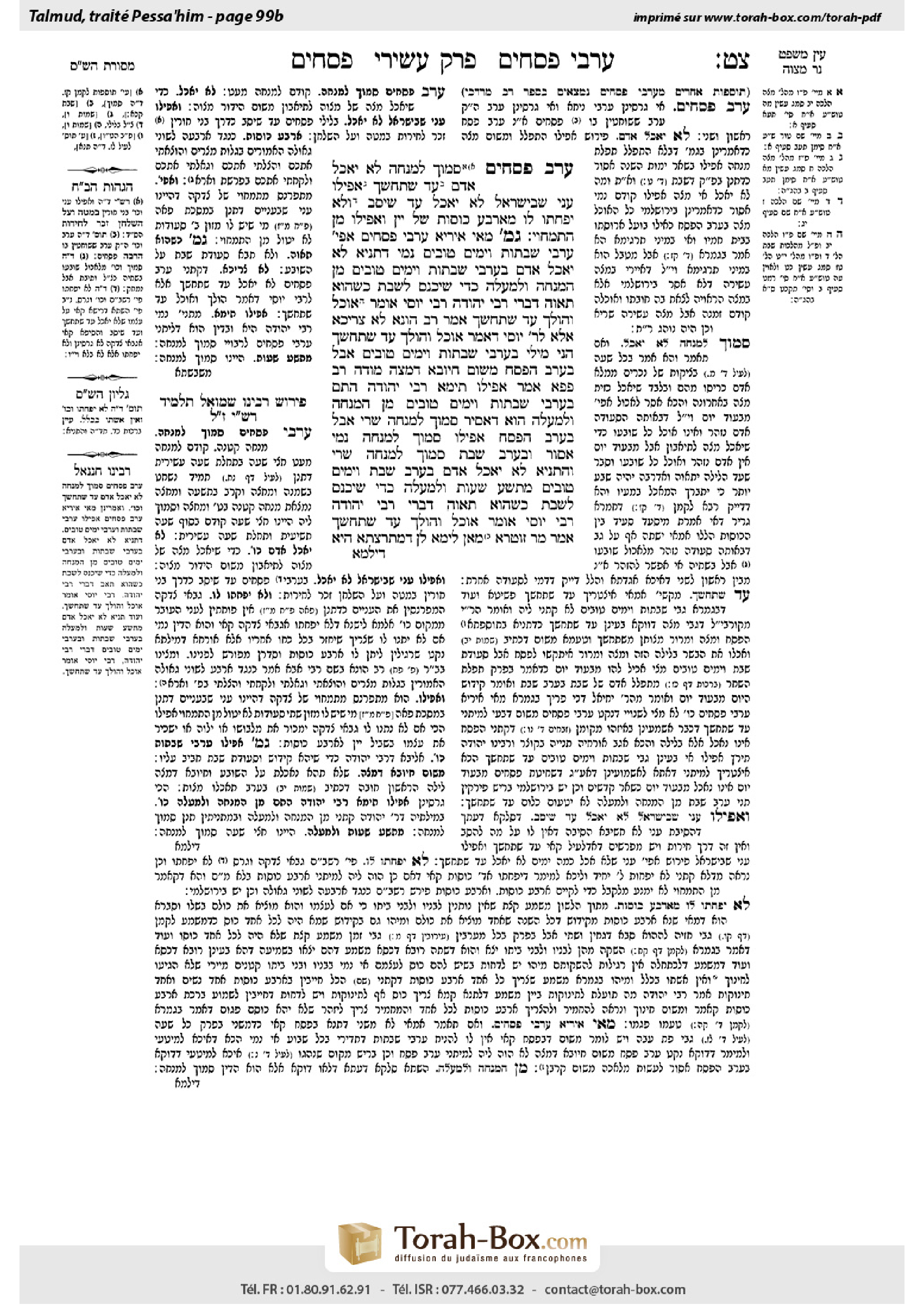
Pesachim 99b: Talmud study for Daf Yomi
Daf Yomi is the daily study of one Talmud folio. Explore 37 tractates with scans, Hebrew text, Sefaria English and AI-generated French translations where annotated.
Passage selection and English or AI-generated French translation are available where the scan has annotations. Daf Study is independent of Torah-Box and Sefaria.
Browse Pesachim · פסחים · All tractatesPesachim 99b text and translations
This page of Pesachim includes the Aramaic text, an English translation and an AI-generated French translation, alongside the scan above.
פסחים צ״ט ב · Aramaic and Hebrew text
מַתְנִי׳ עֶרֶב פְּסָחִים סָמוּךְ לַמִּנְחָה לֹא יֹאכַל אָדָם עַד שֶׁתֶּחְשַׁךְ. אֲפִילּוּ עָנִי שֶׁבְּיִשְׂרָאֵל לֹא יֹאכַל עַד שֶׁיָּסֵב, וְלֹא יִפְחֲתוּ לוֹ מֵאַרְבַּע כּוֹסוֹת שֶׁל יַיִן וַאֲפִילּוּ מִן הַתַּמְחוּי.
גְּמָ׳ מַאי אִירְיָא עַרְבֵי פְסָחִים? אֲפִילּוּ עַרְבֵי שַׁבָּתוֹת וְיָמִים טוֹבִים נָמֵי. דְּתַנְיָא: לֹא יֹאכַל אָדָם בְּעַרְבֵי שַׁבָּתוֹת וְיָמִים טוֹבִים מִן הַמִּנְחָה וּלְמַעְלָה כְּדֵי שֶׁיִּכָּנֵס לַשַּׁבָּת כְּשֶׁהוּא תַּאֲוָה, דִּבְרֵי רַבִּי יְהוּדָה. רַבִּי יוֹסֵי אוֹמֵר: אוֹכֵל וְהוֹלֵךְ עַד שֶׁתֶּחְשַׁךְ.
אָמַר רַב הוּנָא: לָא צְרִיכָא אֶלָּא לְרַבִּי יוֹסֵי, דְּאָמַר: אוֹכֵל וְהוֹלֵךְ עַד שֶׁתֶּחְשַׁךְ — הָנֵי מִילֵּי בְּעַרְבֵי שַׁבָּתוֹת וְיָמִים טוֹבִים, אֲבָל בְּעֶרֶב הַפֶּסַח, מִשּׁוּם חִיּוּבָא דְמַצָּה מוֹדֶה.
רַב פָּפָּא אָמַר: אֲפִילּוּ תֵּימָא רַבִּי יְהוּדָה, הָתָם בְּעַרְבֵי שַׁבָּתוֹת וְיָמִים טוֹבִים מִן הַמִּנְחָה וּלְמַעְלָה הוּא דַּאֲסִיר, סָמוּךְ לַמִּנְחָה שְׁרֵי. אֲבָל בְּעֶרֶב הַפֶּסַח, אֲפִילּוּ סָמוּךְ לַמִּנְחָה נָמֵי אָסוּר.
וּבָעֶרֶב שַׁבָּת סָמוּךְ לַמִּנְחָה שְׁרֵי? וְהָתַנְיָא: לֹא יֹאכַל אָדָם בְּעֶרֶב שַׁבָּת וְיָמִים טוֹבִים מִתֵּשַׁע שָׁעוֹת וּלְמַעְלָה, כְּדֵי שֶׁיִּכָּנֵס לַשַּׁבָּת כְּשֶׁהוּא תַּאֲוָה, דִּבְרֵי רַבִּי יְהוּדָה. רַבִּי יוֹסֵי אוֹמֵר: אוֹכֵל וְהוֹלֵךְ עַד שֶׁתֶּחְשַׁךְ.
אָמַר מָר זוּטְרָא: מַאן לֵימָא לַן דִּמְתָרַצְתָּא הִיא?
Pesachim 99b · English translation
MISHNA: On the eve of Passover, adjacent to minḥa time, a person may not eat until dark, so that he will be able to eat matza that night with a hearty appetite. Even the poorest of Jews should not eat the meal on Passover night until he reclines on his left side, as free and wealthy people recline when they eat. And the distributors of charity should not give a poor person less than four cups of wine for the Festival meal of Passover night. And this halakha applies even if the poor person is one of the poorest members of society and receives his food from the charity plate.
GEMARA: The Gemara expresses surprise at the mishna’s statement that one may not eat on Passover eve from the time that is adjacent to minḥa. Why discuss this halakha particularly with regard to the eves of Passover? Even on the eves of Shabbat and other Festivals it is also prohibited to eat in the late afternoon, as it was taught in a baraita: A person should not eat on the eves of Shabbat and Festivals from minḥa time onward, so that he will enter Shabbat when he has a desire to eat and he will enjoy the Shabbat meal; this is the statement of Rabbi Yehuda. Rabbi Yosei says: One may continue eating until dark.
Rav Huna said: The mishna was necessary only according to the opinion of Rabbi Yosei, who said that one may continue eating until dark. According to his opinion, the mishna is necessary to emphasize that this applies only on the eves of Shabbat and Festivals. But on the eve of Passover, due to the obligation to eat matza, Rabbi Yosei concedes that one must refrain from eating in the afternoon, so that he will eat matza with a good appetite.
Rav Pappa said: Even if you say that the mishna is in accordance with the opinion of Rabbi Yehuda, there is still a difference between the eves of Shabbat and other Festivals, as compared with the eve of Passover. There, on the eves of Shabbat and other Festivals, it is only from minḥa time onward that it is prohibited to eat, but adjacent to minḥa time it is permitted. However, on the eve of Passover, even adjacent to minḥa time, it is also prohibited to eat. For this reason, the mishna is referring specifically to the eve of Passover.
The Gemara asks: And on the eve of Shabbat adjacent to minḥa time, is it permitted to eat? But wasn’t the following taught in a baraita? A person may not eat on the eve of Shabbat and Festivals from nine hours onward, so that he will enter Shabbat when he is filled with the desire to eat; this is the statement of Rabbi Yehuda. Rabbi Yosei says: One may continue eating until dark. According to the opinion of Rabbi Yehuda, even on Shabbat eve one may not eat from before the time of the lesser minḥa, which is at nine and a half hours of the day.
Mar Zutra said: Who will say to us that this version of the baraita is accurate?
Pesachim 99b · Traduction française (IA)
MICHNA : La veille de Pessa’h, à l’approche de l’heure de min’ha, il est interdit de manger jusqu’à la nuit, afin de pouvoir manger la matsa ce soir-là avec bon appétit. Même le plus pauvre des Juifs ne doit pas prendre le repas de Pessa’h sans s’accouder sur le côté gauche, comme le font les hommes libres et les riches lorsqu’ils mangent. Les distributeurs de tsedaka ne doivent pas donner à un pauvre moins de quatre coupes de vin pour le repas de fête du soir de Pessa’h. Cette halakha s’applique même si le pauvre compte parmi les plus démunis de la société et reçoit sa nourriture de la caisse de la tsedaka.
GUEMARA : La Guemara s’étonne de la déclaration de la Michna selon laquelle il est interdit de manger la veille de Pessa’h à partir de l’heure proche de min’ha. Pourquoi énoncer cette halakha spécifiquement au sujet des veilles de Pessa’h ? Il est également interdit de manger en fin d’après-midi les veilles de Chabbat et des autres fêtes, comme l’enseigne une baraïta : « On ne doit pas manger les veilles de Chabbat et des fêtes à partir de l’heure de min’ha, afin d’entrer dans Chabbat avec l’envie de manger et de profiter du repas de Chabbat. » Telle est l’opinion de Rabbi Yehouda. Rabbi Yossi dit : « On peut continuer à manger jusqu’à la nuit. »
Rav Houna dit : La Michna était nécessaire uniquement selon l’opinion de Rabbi Yossi, qui dit qu’on peut continuer à manger jusqu’à la nuit. Selon son opinion, il fallait préciser que cette règle ne vaut que pour les veilles de Chabbat et des fêtes. Mais la veille de Pessa’h, en raison de l’obligation de manger de la matsa, Rabbi Yossi reconnaît qu’il faut s’abstenir de manger l’après-midi, afin de manger la matsa avec bon appétit.
Rav Pappa dit : Même si tu soutiens que la Michna suit l’opinion de Rabbi Yehouda, il existe néanmoins une différence entre les veilles de Chabbat et des autres fêtes, d’une part, et la veille de Pessa’h, d’autre part. Dans le premier cas, il n’est interdit de manger qu’à partir de l’heure de min’ha, mais à l’approche de cette heure, cela est permis. En revanche, la veille de Pessa’h, il est également interdit de manger à l’approche de l’heure de min’ha. C’est pourquoi la Michna traite spécifiquement de la veille de Pessa’h.
La Guemara demande : La veille de Chabbat, à l’approche de l’heure de min’ha, est-il donc permis de manger ? Pourtant, n’a-t-on pas enseigné dans une baraïta : « On ne doit pas manger la veille de Chabbat et des fêtes à partir de la neuvième heure, afin d’entrer dans Chabbat avec l’envie de manger. » Telle est l’opinion de Rabbi Yehouda. Rabbi Yossi dit : « On peut continuer à manger jusqu’à la nuit. » Selon l’opinion de Rabbi Yehouda, même la veille de Chabbat, il est interdit de manger avant l’heure de min’ha ketana, qui tombe à neuf heures et demie du jour.
Mar Zoutra dit : Qui nous garantit que cette version de la baraïta est exacte ?
Traduction française générée par IA à partir de l’édition anglaise de Sefaria. Vérifie toujours un passage avec le texte source.
Text from Sefaria: William Davidson Edition - Vocalized Aramaic (CC BY NC); William Davidson Edition - English (CC BY NC).