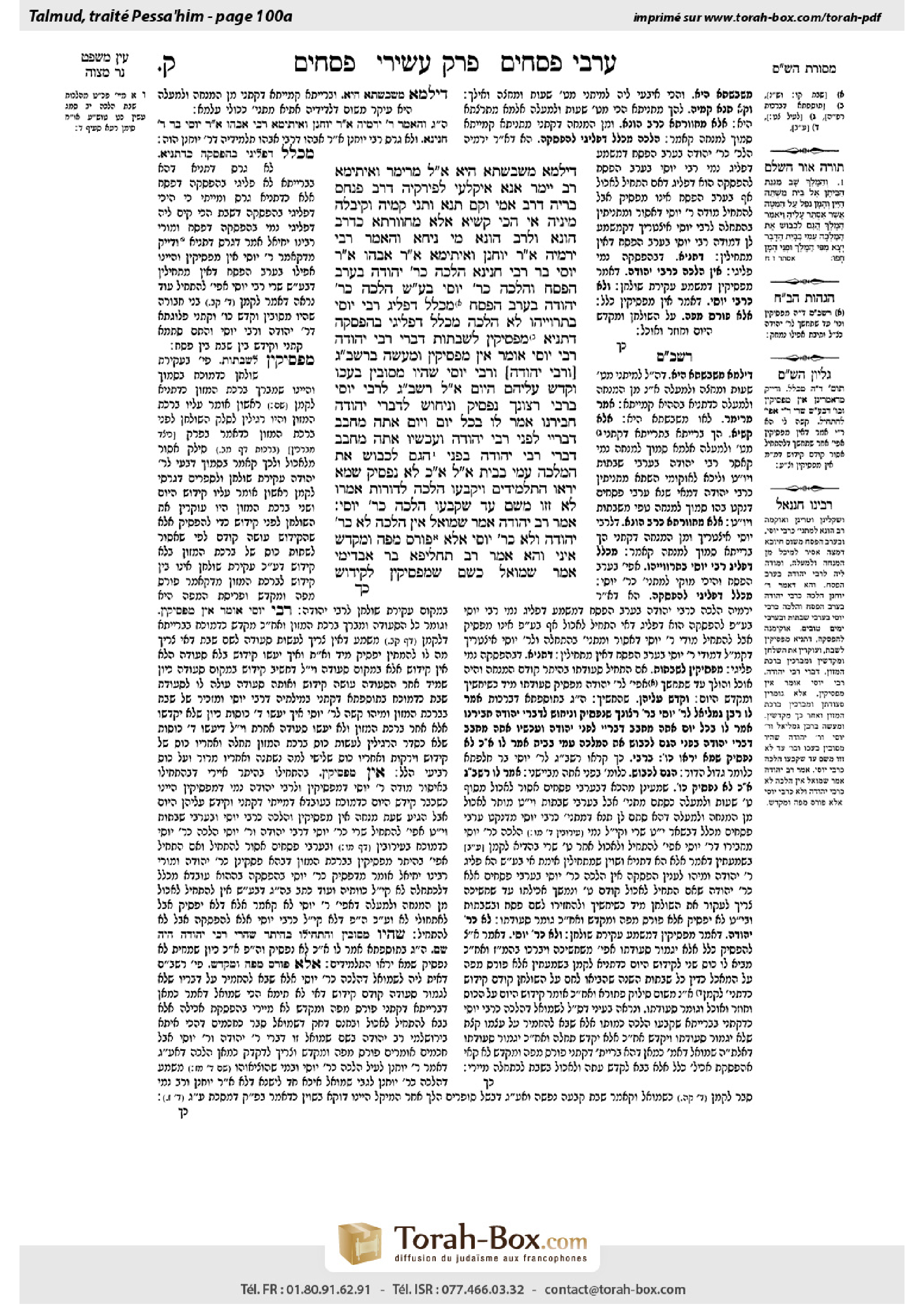
Pesachim 100a: Talmud study for Daf Yomi
Daf Yomi is the daily study of one Talmud folio. Explore 37 tractates with scans, Hebrew text, Sefaria English and AI-generated French translations where annotated.
Passage selection and English or AI-generated French translation are available where the scan has annotations. Daf Study is independent of Torah-Box and Sefaria.
Browse Pesachim · פסחים · All tractatesPesachim 100a text and translations
This page of Pesachim includes the Aramaic text, an English translation and an AI-generated French translation, alongside the scan above.
פסחים ק׳ א · Aramaic and Hebrew text
דִּילְמָא מְשַׁבַּשְׁתָּא הִיא.
אֲמַר לֵיהּ מָרִימָר, וְאִיתֵּימָא רַב יֵימַר: אֲנָא אִיקְּלַעִי לְפִירְקֵיהּ דְּרַב פִּנְחָס בְּרֵיהּ דְּרַב אַמֵּי, וְקָם תַּנָּא וְתָנֵי קַמֵּיהּ וְקַיבְּלַהּ מִינֵּיהּ. אִי הָכִי קַשְׁיָא! אֶלָּא מְחַוַּורְתָּא כִּדְרַב הוּנָא.
וּלְרַב הוּנָא מִי נִיחָא? וְהָאָמַר רַבִּי יִרְמְיָה אָמַר רַבִּי יוֹחָנָן, וְאִיתֵּימָא אָמַר רַבִּי אֲבָהוּ אָמַר רַבִּי יוֹסֵי בַּר רַבִּי חֲנִינָא: הֲלָכָה כְּרַבִּי יְהוּדָה בְּעֶרֶב הַפֶּסַח, וַהֲלָכָה כְּרַבִּי יוֹסֵי בְּעֶרֶב שַׁבָּת.
הֲלָכָה כְּרַבִּי יְהוּדָה בְּעֶרֶב הַפֶּסַח, מִכְּלָל דִּפְלִיג רַבִּי יוֹסֵי בְּתַרְוַיְיהוּ!
לָא: הֲלָכָה, מִכְּלָל דִּפְלִיגִי בְּהַפְסָקָה.
דְּתַנְיָא: מַפְסִיקִין לְשַׁבָּתוֹת, דִּבְרֵי רַבִּי יְהוּדָה. רַבִּי יוֹסֵי אוֹמֵר: אֵין מַפְסִיקִין.
וּמַעֲשֶׂה בְּרַבָּן שִׁמְעוֹן בֶּן גַּמְלִיאֵל [וְרַבִּי יְהוּדָה] וְרַבִּי יוֹסֵי שֶׁהָיוּ מְסוּבִּין בְּעַכּוֹ וְקִדֵּשׁ עֲלֵיהֶם הַיּוֹם, אֲמַר לֵיהּ רַבָּן שִׁמְעוֹן בֶּן גַּמְלִיאֵל לְרַבִּי יוֹסֵי: בְּרַבִּי, רְצוֹנְךָ נַפְסִיק וְנֵיחוּשׁ לְדִבְרֵי יְהוּדָה חֲבֵירֵנוּ?
אָמַר לוֹ: בְּכׇל יוֹם וְיוֹם אַתָּה מְחַבֵּב דְּבָרַיי לִפְנֵי רַבִּי יְהוּדָה, וְעַכְשָׁיו אַתָּה מְחַבֵּב דִּבְרֵי רַבִּי יְהוּדָה בְּפָנַי? ״הֲגַם לִכְבּוֹשׁ אֶת הַמַּלְכָּה עִמִּי בַּבָּיִת״.
אֲמַר לֵיהּ: אִם כֵּן לֹא נַפְסִיק, שֶׁמָּא יִרְאוּ הַתַּלְמִידִים וְיִקְבְּעוּ הֲלָכָה לְדוֹרוֹת. אָמְרוּ: לֹא זָזוּ מִשָּׁם עַד שֶׁקָּבְעוּ הֲלָכָה כְּרַבִּי יוֹסֵי.
אָמַר רַב יְהוּדָה אָמַר שְׁמוּאֵל: אֵין הֲלָכָה לֹא כְּרַבִּי יְהוּדָה וְלֹא כְּרַבִּי יוֹסֵי, אֶלָּא פּוֹרֵס מַפָּה וּמְקַדֵּשׁ. אִינִי?! וְהָא אָמַר רַב תַּחְלִיפָא בַּר אַבְדִּימִי אָמַר שְׁמוּאֵל: כְּשֵׁם שֶׁמַּפְסִיקִין לְקִידּוּשׁ
Pesachim 100a · English translation
Perhaps this baraita is corrupted, and therefore it cannot serve as the basis of an objection.
Mareimar said to him, and some say it was Rav Yeimar: I happened to come to the Festival lecture of Rav Pineḥas, son of Rav Ami, and the tanna who recited mishnayot stood up and taught this baraita before him, and he accepted it. This incident proves that the above version of the baraita is accepted and considered accurate. If so, the aforementioned objection to Rav Pappa’s opinion on the basis of the baraita remains difficult. Rather, Rav Pappa’s answer is insufficient, and it is clear that the mishna must be understood in accordance with the explanation of Rav Huna. In other words, the mishna is in accordance with the opinion of Rabbi Yosei, who maintains that although one may eat until dark on the eves of Shabbat and other Festivals, it is prohibited to eat on Passover eve from shortly before the lesser minḥa until nightfall.
The Gemara asks: And according to the explanation of Rav Huna, does it work out well? But didn’t Rabbi Yirmeya say that Rabbi Yoḥanan said, and some say that Rabbi Abbahu said that Rabbi Yosei bar Rabbi Ḥanina said: The halakha is in accordance with the opinion of Rabbi Yehuda with regard to the eve of Passover, and the halakha is in accordance with the opinion of Rabbi Yosei with regard to the eve of Shabbat?
The Gemara infers from the above statement: From the fact that it was necessary to say that the halakha is in accordance with the opinion of Rabbi Yehuda with regard to the eve of Passover, this proves by inference that Rabbi Yosei disagrees with regard to both cases, both the eves of Shabbat and other Festivals, as well as Passover eve. Consequently, it is impossible to ascribe to the opinion of Rabbi Yosei the mishna’s prohibition against eating on the eve of Passover, as he evidently permits one to eat until dark even on Passover eve.
The Gemara answers: No; the statement should be understood as follows: When it was said that the halakha is in accordance with the opinion of Rabbi Yehuda, this proves by inference that they disagree with regard to interruption. Even Rabbi Yosei agrees that one may not start eating on Passover eve from minḥa time onward, but he maintains that one who started to eat is not obligated to interrupt his meal even when the Festival begins.
As it was taught in a baraita that Rabbi Yehuda and Rabbi Yosei disagree about interrupting a meal: If people were eating on the eve of Shabbat, they must interrupt for Shabbatot, meaning that once Shabbat begins, they must interrupt their meal, clear away the table, and recite the evening prayers and kiddush before continuing their meal; this is the statement of Rabbi Yehuda. Rabbi Yosei says: These diners need not interrupt their meal.
The baraita continues by relating a story: And there was an incident involving Rabban Shimon ben Gamliel, and Rabbi Yehuda, and Rabbi Yosei, who were reclining and eating together in Akko on Friday afternoon, and the day of Shabbat was sanctified, i.e., Shabbat began. Rabban Shimon ben Gamliel said to Rabbi Yosei: Berabbi, a title for an important man of distinguished lineage, is it your will that we should interrupt and be concerned for the statements of our colleague Yehuda, who maintains that one is obligated to interrupt his meal?
He said to him: Each and every day you cherish my statements before those of Rabbi Yehuda, and rule in accordance with my opinion, and now you cherish the statement of Rabbi Yehuda before me? Rabbi Yosei continued by applying a verse to this situation: “Will he even force the queen before me in the house?” (Esther 7:8).
Rabban Shimon said to him: If so, if displaying concern for Rabbi Yehuda’s opinion will be viewed as a halakhic ruling, we will not interrupt, as perhaps the students will see that we have broken off our meal and will establish the halakha for generations in accordance with the opinion of Rabbi Yehuda. The Sages later said: They did not move from there until they established the halakha in accordance with the opinion of Rabbi Yosei, that one need not interrupt one’s meal on the eve of Shabbat and Festivals.
Rav Yehuda said that Shmuel said: The halakha is not in accordance with the opinion of Rabbi Yehuda, who said that one must interrupt one’s meal by removing the table entirely, nor is it in accordance with the opinion of Rabbi Yosei, who ruled that one need not interrupt one’s meal at all. Rather, one must spread a cloth over one’s table and recite kiddush, after which he may continue his meal. The Gemara asks: Is that so? But didn’t Rav Taḥalifa bar Avdimi say that Shmuel said: Just as one interrupts for kiddush,
Pesachim 100a · Traduction française (IA)
Peut-être cette baraïta est-elle corrompue et ne peut-elle donc servir de fondement à une objection.
Mareimar lui dit — et certains disent que c’était Rav Yeimar : « Il m’est arrivé d’assister au cours donné à l’occasion de la fête par Rav Pineḥas, fils de Rav Ami. Le tanna qui récitait les michnayot se leva et lui enseigna cette baraïta, et il l’accepta. » Cet épisode prouve que la version susmentionnée de la baraïta est acceptée et considérée comme exacte. Dès lors, l’objection précitée à l’opinion de Rav Pappa, fondée sur la baraïta, demeure difficile. La réponse de Rav Pappa est donc insuffisante, et il est clair que la Michna doit être comprise selon l’explication de Rav Huna. Autrement dit, la Michna suit l’opinion de Rabbi Yosei, qui soutient que, bien qu’on puisse manger jusqu’à la tombée de la nuit la veille de Chabbat et des autres fêtes, il est interdit de manger la veille de Pessaḥ à partir de peu avant la petite minḥa jusqu’à la tombée de la nuit.
La Guemara demande : Mais l’explication de Rav Huna convient-elle ? Rabbi Yirmeya n’a-t-il pas dit au nom de Rabbi Yoḥanan — et certains disent que Rabbi Abbahu a dit au nom de Rabbi Yosei bar Rabbi Ḥanina — : « La halakha suit l’opinion de Rabbi Yehuda concernant la veille de Pessaḥ, et celle de Rabbi Yosei concernant la veille de Chabbat » ?
La Guemara déduit de cette déclaration : Le fait qu’il ait fallu dire que la halakha suit l’opinion de Rabbi Yehuda concernant la veille de Pessaḥ prouve, par déduction, que Rabbi Yosei est en désaccord dans les deux cas : la veille de Chabbat et des autres fêtes, ainsi que la veille de Pessaḥ. Par conséquent, il est impossible d’attribuer à Rabbi Yosei l’interdiction de manger la veille de Pessaḥ énoncée dans la Michna, puisqu’il permet manifestement de manger jusqu’à la tombée de la nuit même la veille de Pessaḥ.
La Guemara répond : Non ; il faut comprendre la déclaration ainsi : lorsqu’il a été dit que la halakha suit l’opinion de Rabbi Yehuda, cela prouve, par déduction, qu’ils sont en désaccord au sujet de l’interruption du repas. Rabbi Yosei lui-même convient qu’on ne peut pas commencer à manger la veille de Pessaḥ à partir de l’heure de la minḥa, mais il soutient que celui qui a commencé à manger n’est pas tenu d’interrompre son repas, même lorsque la fête commence.
Comme on l’a enseigné dans une baraïta, Rabbi Yehuda et Rabbi Yosei sont en désaccord au sujet de l’interruption d’un repas : si des gens mangeaient la veille de Chabbat, ils doivent interrompre leur repas à l’arrivée du Chabbat ; c’est-à-dire que, dès le début du Chabbat, ils doivent interrompre leur repas, débarrasser la table et réciter les prières du soir ainsi que le kiddouch avant de poursuivre leur repas. Telle est l’opinion de Rabbi Yehuda. Rabbi Yosei dit : « Ces convives n’ont pas besoin d’interrompre leur repas. »
La baraïta poursuit en rapportant un épisode : Rabban Shimon ben Gamliel, Rabbi Yehuda et Rabbi Yosei étaient accoudés et mangeaient ensemble à Akko, le vendredi après-midi, lorsque le jour du Chabbat fut sanctifié, c’est-à-dire que le Chabbat commença. Rabban Shimon ben Gamliel dit à Rabbi Yosei : « Berabbi — titre honorifique désignant un homme important de lignage distingué —, souhaites-tu que nous interrompions notre repas et tenions compte des propos de notre collègue Yehuda, qui soutient qu’il faut interrompre son repas ? »
Il lui répondit : « Chaque jour, tu préfères mes propos à ceux de Rabbi Yehuda et tranches selon mon opinion ; et maintenant, tu préfères les propos de Rabbi Yehuda aux miens ? » Rabbi Yosei poursuivit en appliquant à cette situation un verset : « Va-t-il même faire violence à la reine en ma présence, dans la maison ? » (Esther 7, 8).
Rabban Shimon lui dit : « Dans ce cas, si le fait de tenir compte de l’opinion de Rabbi Yehuda est considéré comme une décision halakhique, nous n’interromprons pas notre repas, car les élèves pourraient nous voir l’interrompre et établir pour les générations à venir la halakha selon l’opinion de Rabbi Yehuda. » Les Sages dirent plus tard : « Ils ne quittèrent pas les lieux avant d’avoir établi la halakha selon l’opinion de Rabbi Yosei : il n’est pas nécessaire d’interrompre son repas la veille de Chabbat et des fêtes. »
Rav Yehuda dit au nom de Shmuel : « La halakha ne suit ni l’opinion de Rabbi Yehuda, selon laquelle il faut interrompre son repas en retirant entièrement la table, ni celle de Rabbi Yosei, qui tranche qu’il n’est pas du tout nécessaire d’interrompre son repas. Il faut plutôt étendre une nappe sur sa table et réciter le kiddouch, après quoi on peut poursuivre le repas. » La Guemara demande : « Est-ce bien le cas ? Rav Taḥalifa bar Avdimi n’a-t-il pas dit au nom de Shmuel : “De même qu’on interrompt pour le kiddouch,”
Traduction française générée par IA à partir de l’édition anglaise de Sefaria. Vérifie toujours un passage avec le texte source.
Text from Sefaria: William Davidson Edition - Vocalized Aramaic (CC BY NC); William Davidson Edition - English (CC BY NC).