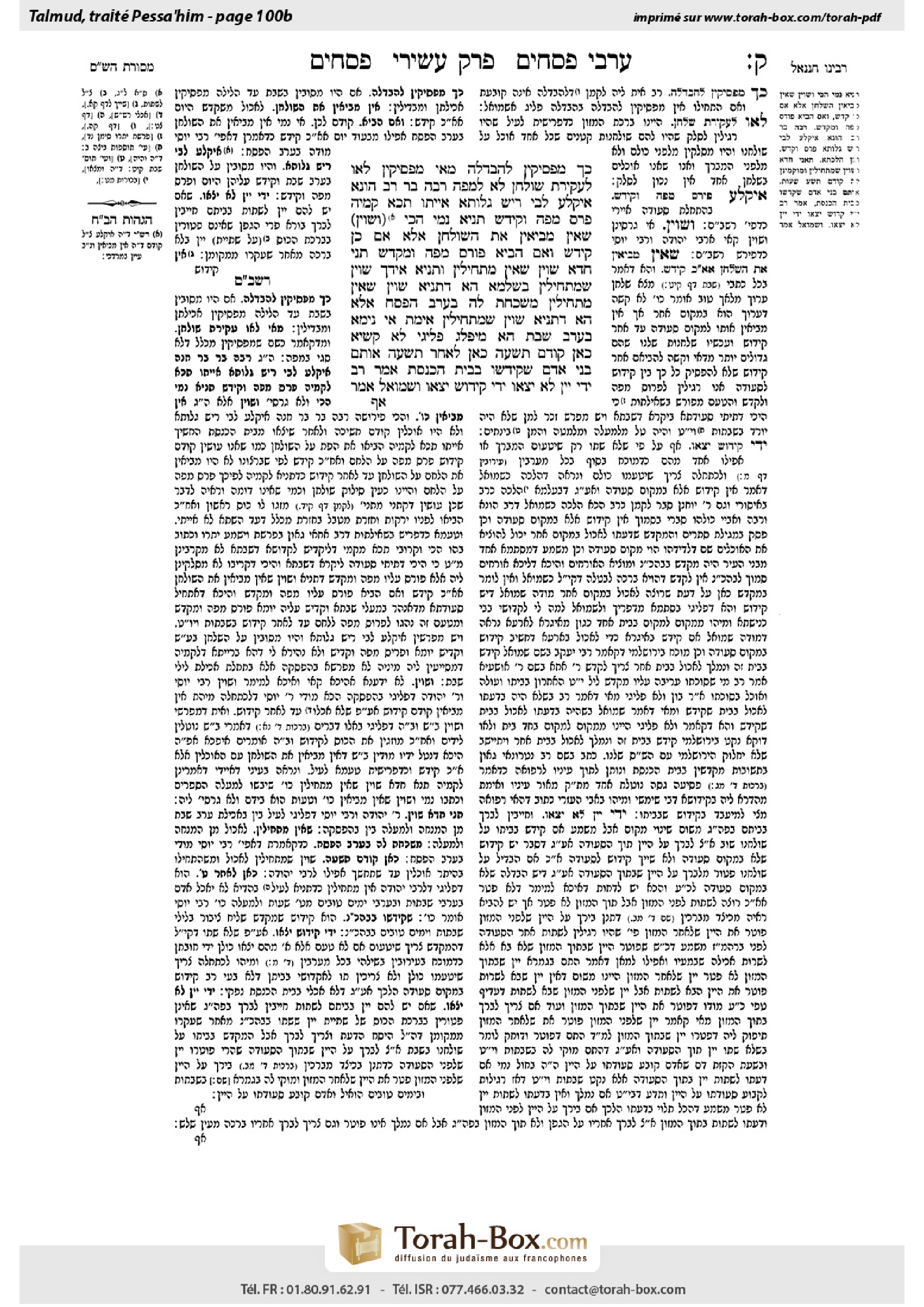
Pesachim 100b: Talmud study for Daf Yomi
Daf Yomi is the daily study of one Talmud folio. Explore 37 tractates with scans, Hebrew text, Sefaria English and AI-generated French translations where annotated.
Passage selection and English or AI-generated French translation are available where the scan has annotations. Daf Study is independent of Torah-Box and Sefaria.
Browse Pesachim · פסחים · All tractatesPesachim 100b text and translations
This page of Pesachim includes the Aramaic text, an English translation and an AI-generated French translation, alongside the scan above.
פסחים ק׳ ב · Aramaic and Hebrew text
כָּךְ מַפְסִיקִין לַהַבְדָּלָה. מַאי מַפְסִיקִין — לָאו לַעֲקִירַת שׁוּלְחַן? לָא, לְמַפָּה.
רַבָּה בַּר רַב הוּנָא אִיקְּלַע לְבֵי רֵישׁ גָּלוּתָא, אַיְיתוֹ תַּכָּא קַמֵּיהּ, פְּרַס מַפָּה וְקַידֵּשׁ. תַּנְיָא נָמֵי הָכִי: (וְשָׁוִין) שֶׁאֵין מְבִיאִין אֶת הַשּׁוּלְחָן אֶלָּא אִם כֵּן קִידֵּשׁ, וְאִם הֵבִיא — פּוֹרֵס מַפָּה וּמְקַדֵּשׁ.
תָּנֵי חֲדָא: שָׁוִין שֶׁאֵין מַתְחִילִין, וְתַנְיָא אִידַּךְ: שָׁוִין שֶׁמַּתְחִילִין. בִּשְׁלָמָא הָא דְּתַנְיָא שָׁוִין שֶׁאֵין מַתְחִילִין — מַשְׁכַּחַתְּ לַהּ בְּעֶרֶב הַפֶּסַח,
אֶלָּא הָא דְּתַנְיָא שָׁוִין שֶׁמַּתְחִילִין — אֵימַת? אִי נֵימָא בְּעֶרֶב שַׁבָּת — הָא מִיפְלָג פְּלִיגִי! לָא קַשְׁיָא: כָּאן — קוֹדֶם תִּשְׁעָה, כָּאן — לְאַחַר תִּשְׁעָה.
אוֹתָם בְּנֵי אָדָם שֶׁקִּידְּשׁוּ בְּבֵית הַכְּנֶסֶת, אָמַר רַב: יְדֵי יַיִן לֹא יָצְאוּ, יְדֵי קִידּוּשׁ יָצְאוּ. וּשְׁמוּאֵל אָמַר:
Pesachim 100b · English translation
so one interrupts for havdala? People eating a meal on Shabbat until after nightfall must interrupt their meal to recite havdala. The Gemara inquires: What is the meaning of the phrase: One interrupts? Is it not referring to removing the table? The Gemara answers: No, it is referring to spreading a cloth, which is sufficient for havdala as well.
The Gemara relates: Rabba bar Rav Huna happened to come to the house of the Exilarch. His hosts were reclining for a meal, and the attendants brought a table before him so he could eat as well. Since Shabbat had already started, he spread a cloth over the food and recited kiddush. That was also taught in a baraita: And the Sages agree that one may bring the table only if he has already recited kiddush; and if one brought out the table before kiddush, he should spread a cloth over the food and recite kiddush.
It was taught in one baraita: Rabbi Yehuda and Rabbi Yosei, who disagree over whether it is permitted to eat from minḥa time on Shabbat eve and whether one must interrupt his meal, agree that one may not begin a meal from this time. And it was taught in the other baraita that they agree that one may begin a meal. The Gemara explains: Granted, that which was taught in the first baraita, that Rabbi Yehuda and Rabbi Yosei agree that one may not begin a meal, you will find that this is correct with regard to the eve of Passover, as even Rabbi Yosei concedes that one may not start a meal on Passover eve ab initio.
However, with regard to the other baraita, which taught that Rabbi Yehuda and Rabbi Yosei agree that one may begin, when does this halakha apply? If we say it is referring to the eve of Shabbat, this cannot be the case, as it was taught that Rabbi Yehuda and Rabbi Yosei indeed disagree over whether one may start a meal at that time. The Gemara answers: It is not difficult: Here, the baraita in which Rabbi Yehuda and Rabbi Yosei agree that it is permitted to start a new meal, is referring to before nine hours of the day have passed, as everyone agrees that it is permitted to commence a meal at this time. Conversely, there, the baraita in which they disagree over whether it is permitted to start a new meal, is referring to later in the day, after nine hours.
The Gemara continues to discuss the halakhot of kiddush: With regard to those people who recited kiddush in the synagogue, as was customarily done at the conclusion of the prayer service on Shabbat night, Rav said: They have not fulfilled their obligation to recite a blessing over wine. That is, the blessing over the wine in the synagogue does not enable them to drink wine at home without an additional blessing. However, they have fulfilled their obligation of reciting kiddush. And Shmuel said:
Pesachim 100b · Traduction française (IA)
Faut-il donc interrompre le repas pour la havdala ? Ceux qui prennent un repas pendant Chabbat jusqu’après la tombée de la nuit doivent l’interrompre pour réciter la havdala. La Guemara demande : Que signifie l’expression « on interrompt » ? Ne désigne-t-elle pas le fait de retirer la table ? La Guemara répond : Non, elle désigne le fait d’étendre une nappe, ce qui suffit également pour la havdala.
La Guemara rapporte : Rabba bar Rav Huna se rendit chez l’Exilarque. Ses hôtes étaient accoudés pour le repas, et les serviteurs apportèrent une table devant lui afin qu’il puisse manger lui aussi. Comme Chabbat avait déjà commencé, il étendit une nappe sur les aliments et récita le kiddouch. Cela fut également enseigné dans une baraïta : Les Sages conviennent qu’on ne peut apporter la table que si l’on a déjà récité le kiddouch ; si l’on a apporté la table avant le kiddouch, on doit étendre une nappe sur les aliments et réciter le kiddouch.
Il fut enseigné dans une baraïta : Rabbi Yehuda et Rabbi Yosei, qui sont en désaccord sur la question de savoir s’il est permis de manger à partir de l’heure de min’ha la veille de Chabbat et s’il faut interrompre le repas, conviennent qu’on ne peut pas commencer un repas à partir de ce moment. Une autre baraïta enseigne qu’ils conviennent qu’on peut commencer un repas. La Guemara explique : Il est compréhensible que l’enseignement de la première baraïta, selon lequel Rabbi Yehuda et Rabbi Yosei conviennent qu’on ne peut pas commencer un repas, s’applique à la veille de Pessa’h, car même Rabbi Yosei admet qu’on ne peut pas commencer un repas la veille de Pessa’h a priori.
Cependant, pour ce qui est de l’autre baraïta, qui enseigne que Rabbi Yehuda et Rabbi Yosei conviennent qu’on peut commencer un repas, à quel cas cette halakha s’applique-t-elle ? Si l’on dit qu’elle concerne la veille de Chabbat, cela ne peut pas être le cas, puisqu’il a été enseigné que Rabbi Yehuda et Rabbi Yosei sont effectivement en désaccord sur la question de savoir si l’on peut commencer un repas à ce moment-là. La Guemara répond : Il n’y a pas de difficulté : ici, la baraïta dans laquelle Rabbi Yehuda et Rabbi Yosei conviennent qu’il est permis de commencer un nouveau repas concerne la période précédant la neuvième heure du jour, car tous conviennent qu’il est permis de commencer un repas à ce moment-là. En revanche, là, la baraïta dans laquelle ils sont en désaccord sur la question de savoir s’il est permis de commencer un nouveau repas concerne une période plus tardive de la journée, après la neuvième heure.
La Guemara poursuit son examen des halakhot du kiddouch : Au sujet de ceux qui ont récité le kiddouch à la synagogue, comme c’était l’usage à la fin de l’office du vendredi soir, Rav dit : Ils ne se sont pas acquittés de leur obligation de réciter une bénédiction sur le vin. Autrement dit, la bénédiction sur le vin prononcée à la synagogue ne leur permet pas de boire du vin chez eux sans réciter une bénédiction supplémentaire. Cependant, ils se sont acquittés de leur obligation de réciter le kiddouch. Et Shmuel dit :
Traduction française générée par IA à partir de l’édition anglaise de Sefaria. Vérifie toujours un passage avec le texte source.
Text from Sefaria: William Davidson Edition - Vocalized Aramaic (CC BY NC); William Davidson Edition - English (CC BY NC).