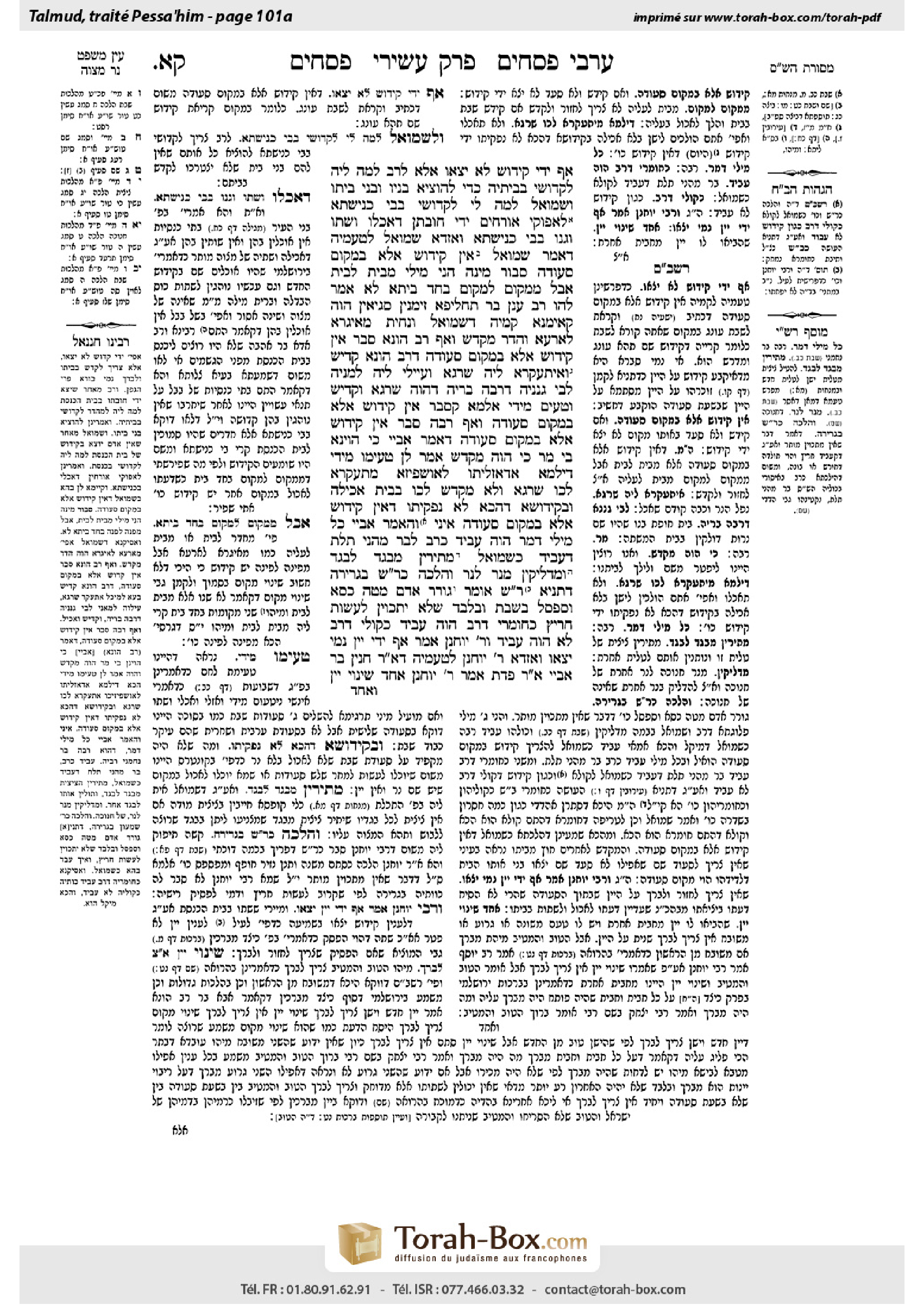
Pesachim 101a: Talmud study for Daf Yomi
Daf Yomi is the daily study of one Talmud folio. Explore 37 tractates with scans, Hebrew text, Sefaria English and AI-generated French translations where annotated.
Passage selection and English or AI-generated French translation are available where the scan has annotations. Daf Study is independent of Torah-Box and Sefaria.
Browse Pesachim · פסחים · All tractatesPesachim 101a text and translations
This page of Pesachim includes the Aramaic text, an English translation and an AI-generated French translation, alongside the scan above.
פסחים ק״א א · Aramaic and Hebrew text
אַף יְדֵי קִידּוּשׁ לֹא יָצְאוּ. אֶלָּא לְרַב, לְמָה לֵיהּ לְקַדּוֹשֵׁי בְּבֵיתֵיהּ? כְּדֵי לְהוֹצִיא בָּנָיו וּבְנֵי בֵיתוֹ.
וּשְׁמוּאֵל, לְמָה לִי לְקַדּוֹשֵׁי בְּבֵי כְנִישְׁתָּא? לְאַפּוֹקֵי אוֹרְחִים יְדֵי חוֹבָתָן, דְּאָכְלוּ וְשָׁתוּ וְגָנוּ בְּבֵי כְנִישְׁתָּא.
וְאַזְדָּא שְׁמוּאֵל לְטַעְמֵיהּ, דְּאָמַר שְׁמוּאֵל: אֵין קִידּוּשׁ אֶלָּא בִּמְקוֹם סְעוּדָה. סְבוּר מִינַּהּ: הָנֵי מִילֵּי מִבַּיִת לְבַיִת, אֲבָל מִמָּקוֹם לְמָקוֹם בְּחַד בֵּיתָא — לָא.
אֲמַר לְהוּ רַב עָנָן בַּר תַּחְלִיפָא: זִימְנִין סַגִּיאִין הֲוָה קָאֵימְנָא קַמֵּיהּ דִּשְׁמוּאֵל, וְנָחֵית מֵאִיגָּרָא לְאַרְעָא וַהֲדַר מְקַדֵּשׁ.
וְאַף רַב הוּנָא סָבַר אֵין קִידּוּשׁ אֶלָּא בִּמְקוֹם סְעוּדָה. דְּרַב הוּנָא קַדֵּישׁ, וְאִיתְעֲקַרָא לֵיהּ שְׁרָגָא, וְעַיַּילִי לֵיהּ לְמָנֵיהּ לְבֵי גְנָנֵיהּ דְּרַבָּה בְּרֵיהּ דַּהֲוָה שְׁרָגָא וְקַדֵּישׁ וּטְעֵים מִידֵּי, אַלְמָא קָסָבַר: אֵין קִידּוּשׁ אֶלָּא בִּמְקוֹם סְעוּדָה.
וְאַף רַבָּה סָבַר אֵין קִידּוּשׁ אֶלָּא בִּמְקוֹם סְעוּדָה. דַּאֲמַר אַבָּיֵי: כִּי הֲוֵינָא בֵּי מָר, כִּי הֲוָה מְקַדֵּשׁ אֲמַר לַן: טְעִימוּ מִידֵּי, דִּילְמָא אַדְּאָזְלִיתוּ לְאוּשְׁפִּיזָא מִתְעַקְרָא לְכוּ שְׁרָגָא וְלָא מְקַדֵּשׁ לְכוּ בְּבֵית אֲכִילָה, וּבְקִידּוּשָׁא דְהָכָא לָא נָפְקִיתוּ, דְּאֵין קִידּוּשׁ אֶלָּא בִּמְקוֹם סְעוּדָה.
אִינִי?! וְהָאָמַר אַבָּיֵי: כֹּל מִילֵּי דְּמָר הֲוָה עָבֵיד כְּרַב, לְבַר מֵהָנֵי תְּלָת דְּעָבֵיד כִּשְׁמוּאֵל: מַתִּירִין מִבֶּגֶד לְבֶגֶד. וּמַדְלִיקִין מִנֵּר לְנֵר. וַהֲלָכָה כְּרַבִּי שִׁמְעוֹן בִּגְרִירָה.
דְּתַנְיָא, רַבִּי שִׁמְעוֹן אוֹמֵר: גּוֹרֵר אָדָם מִטָּה כִּסֵּא וְסַפְסָל בַּשַּׁבָּת, וּבִלְבַד שֶׁלֹּא יִתְכַּוֵּין לַעֲשׂוֹת חָרִיץ.
כְּחוּמְרֵי דְרַב הֲוָה עָבֵיד, כְּקוּלֵּי דְרַב לָא הֲוָה עֲבִיד.
וְרַבִּי יוֹחָנָן אָמַר: אַף יְדֵי יַיִן נָמֵי יָצְאוּ. וְאַזְדָּא רַבִּי יוֹחָנָן לְטַעְמֵיהּ, דְּאָמַר רַבִּי חָנִין בַּר אַבָּיֵי אָמַר רַבִּי פְּדָת אָמַר רַבִּי יוֹחָנָן: אֶחָד שִׁינּוּי יַיִן,
Pesachim 101a · English translation
Even the obligation of kiddush they have not fulfilled, and they must recite kiddush again at home. The Gemara asks: But according to the opinion of Rav, why should one have to recite kiddush a second time at home if he has already fulfilled his obligation in the synagogue? The Gemara answers: He must repeat kiddush to fulfill the obligations of his children and the members of his household, who did not come to the synagogue.
The Gemara asks: But according to the opinion of Shmuel, why do I need to recite kiddush in the synagogue at all, if one does not fulfill his obligation with that kiddush? The Gemara answers: The purpose of kiddush in the synagogue is to fulfill the obligations of the guests who eat and drink and sleep in the synagogue. Since these visitors are staying in the synagogue for Shabbat, they must hear kiddush there.
And Shmuel follows his line of reasoning, as Shmuel said: There is no valid kiddush except in the place of one’s Shabbat meal. If one does not eat a meal in the location in which he recites kiddush, he has not fulfilled the mitzva of kiddush. The students understood from this statement that this halakha applies only when one goes from house to house and eats the Shabbat meal in a different house from the one in which he recited kiddush. But if one went from the place where he recited kiddush to another place in one house, no, there is no problem, and he has fulfilled the mitzva of kiddush.
However, Rav Anan bar Taḥalifa said to the students: Many times I stood before Shmuel, and he descended from the roof to the ground floor and recited kiddush again. This indicates that Shmuel maintains that even if one recites kiddush and eats the Shabbat meal in a different part of the same house, he must recite kiddush a second time.
With regard to this halakha, the Gemara notes: And Rav Huna also maintains that there is no kiddush except in the place of one’s Shabbat meal. The proof of this is that Rav Huna once recited kiddush and his lamp was extinguished. And as it was difficult to eat in the dark, he brought his belongings to the wedding home of his son Rabba, where there was a lamp, and he recited kiddush there and tasted some food. Apparently, Rav Huna maintains that there is no kiddush except in the place of one’s Shabbat meal.
The Gemara further comments: And Rabba also maintains that there is no kiddush except in the place of one’s Shabbat meal, as Abaye said: When I was in the house of my Master, Rabba, when he would recite kiddush he would say to us: Taste some food here, lest by the time you get to your place of lodging your lamp be extinguished, and you will not be able to recite kiddush in the place where you will eat. And with the kiddush you heard here you do not fulfill the mitzva, as there is no kiddush except in the place of one’s Shabbat meal.
The Gemara expresses surprise at this statement: Is that so? But didn’t Abaye say: With regard to all the customs of my Master, Rabba, he would act in accordance with the opinion of Rav, except for these three instances, in which he acted in accordance with the opinion of Shmuel: Rabba maintained that one may untie ritual fringes [tzitzit] from one garment and tie them to another garment, contrary to Rav’s opinion that this constitutes a disgrace of the mitzva. He also maintained that on Hanukkah one may light from one lamp to another lamp, despite Rav’s opinion that this is prohibited as a mundane usage of the lamp of the mitzva. In addition, Rabba maintained that the halakha is in accordance with the opinion of Rabbi Shimon in the case of dragging.
As it was taught in a baraita that Rabbi Shimon says: A person may drag a bed, chair, or stool on Shabbat if it is difficult for him to lift them, provided that he does not intend to dig a furrow in the ground. In the event that he does create a furrow, he has not violated a prohibition, as an unintentional act does not constitute a prohibited act of labor on Shabbat. In light of Abaye’s statement that with the exception of those three rulings Rabba always acted in accordance with Rav, why didn’t Rabba follow the opinion of Rav with regard to kiddush, as Rav maintains that one fulfills the mitzva of kiddush even if he does not eat his Shabbat meal in the same location?
The Gemara answers: He would act in accordance with Rav’s stringencies, but he would not act in accordance with Rav’s leniencies. In the three cases listed above, Rabba was lenient despite Rav’s stringent ruling. However, with regard to kiddush, Rabba did not follow Rav’s lenient opinion.
And Rabbi Yoḥanan said: Not only do those who recite kiddush in the synagogue fulfill the mitzva of kiddush, they fulfill even their obligation to recite a blessing over the wine they will drink during their meal at home. Since they intend to eat the Shabbat meal and drink wine at home, they do not divert their attention from the blessing and need not recite another one. And Rabbi Yoḥanan follows his regular line of reasoning, as Rabbi Ḥanin bar Abaye said that Rabbi Pedat said that Rabbi Yoḥanan said: Both in a case of a change of wine during a meal to a new type,
Pesachim 101a · Traduction française (IA)
Ils ne se sont même pas acquittés de l’obligation de réciter le kiddouch et doivent le réciter de nouveau chez eux. La Guemara demande : Mais, selon Rav, pourquoi faudrait-il réciter une seconde fois le kiddouch chez soi, s’il s’est déjà acquitté de son obligation à la synagogue ? La Guemara répond : Il doit répéter le kiddouch afin d’acquitter ses enfants et les membres de son foyer, qui ne sont pas venus à la synagogue.
La Guemara demande : Mais, selon Chmouel, pourquoi faut-il réciter le kiddouch à la synagogue, si l’on ne s’acquitte pas de son obligation par ce kiddouch ? La Guemara répond : Le kiddouch récité à la synagogue sert à acquitter les hôtes qui y mangent, boivent et dorment. Puisque ces visiteurs séjournent à la synagogue pendant Chabbat, ils doivent y entendre le kiddouch.
Et Chmouel suit sa ligne de raisonnement, car il a dit : Le kiddouch n’est valable que là où l’on prend son repas de Chabbat. Si l’on ne prend pas de repas à l’endroit où l’on récite le kiddouch, on ne s’est pas acquitté de la mitsva du kiddouch. Les élèves comprirent de cette déclaration que cette halakha ne s’applique que lorsqu’on va d’une maison à l’autre et que l’on prend le repas de Chabbat dans une maison différente de celle où l’on a récité le kiddouch. En revanche, si l’on quitte l’endroit où l’on a récité le kiddouch pour se rendre dans un autre endroit de la même maison, il n’y a pas de problème : on s’est acquitté de la mitsva du kiddouch.
Cependant, Rav Anan bar Taḥalifa dit aux élèves : À maintes reprises, je me suis tenu devant Chmouel, et il descendait du toit au rez-de-chaussée et récitait de nouveau le kiddouch. Cela indique que, selon Chmouel, même si l’on récite le kiddouch et prend le repas de Chabbat dans deux endroits différents d’une même maison, il faut réciter le kiddouch une seconde fois.
À propos de cette halakha, la Guemara relève que Rav Houna aussi considère qu’il n’y a pas de kiddouch si l’on ne le récite pas à l’endroit où l’on prend son repas de Chabbat. La preuve en est que Rav Houna récita un jour le kiddouch et que sa lampe s’éteignit. Comme il était difficile de manger dans l’obscurité, il transporta ses affaires dans la maison où avait lieu le mariage de son fils Rabba, où il y avait une lampe, puis il y récita le kiddouch et goûta quelque chose. Il apparaît donc que, selon Rav Houna, il n’y a pas de kiddouch si l’on ne le récite pas à l’endroit où l’on prend son repas de Chabbat.
La Guemara ajoute que Rabba aussi considère qu’il n’y a pas de kiddouch si l’on ne le récite pas à l’endroit où l’on prend son repas de Chabbat, comme l’a dit Abayé : Lorsque j’étais chez mon maître, Rabba, celui-ci nous disait, lorsqu’il récitait le kiddouch : « Goûtez quelque chose ici, de peur qu’à votre arrivée à votre lieu de séjour, votre lampe ne s’éteigne et que vous ne puissiez pas réciter le kiddouch à l’endroit où vous mangerez. Le kiddouch que vous avez entendu ici ne vous acquitte pas de la mitsva, car il n’y a pas de kiddouch si on ne le récite pas à l’endroit où l’on prend son repas de Chabbat. »
La Guemara s’étonne de cette déclaration : Vraiment ? Abayé n’a-t-il pas dit : Pour toutes les pratiques de mon maître, Rabba agissait selon l’opinion de Rav, à l’exception de ces trois cas, où il agissait selon l’opinion de Chmouel ? Rabba considérait qu’on pouvait détacher les franges rituelles [tzitzit] d’un vêtement et les attacher à un autre, contrairement à l’opinion de Rav, selon laquelle cela constitue une atteinte à la mitsva. Il considérait aussi qu’à Hanoucca, on pouvait allumer une lampe à partir d’une autre, malgré l’opinion de Rav, selon laquelle cela est interdit, car c’est faire un usage profane de la lampe de la mitsva. De plus, Rabba considérait que la halakha suit l’opinion de Rabbi Chimon dans le cas où l’on traîne un objet.
Car il a été enseigné dans une baraïta que Rabbi Chimon dit : On peut traîner un lit, une chaise ou un tabouret pendant Chabbat si l’on a du mal à les soulever, à condition de ne pas avoir l’intention de creuser un sillon dans le sol. Si l’on creuse effectivement un sillon, on n’a enfreint aucune interdiction, car un acte involontaire ne constitue pas un travail interdit pendant Chabbat. À la lumière de la déclaration d’Abayé selon laquelle, à l’exception de ces trois décisions, Rabba agissait toujours selon Rav, pourquoi Rabba n’a-t-il pas suivi l’opinion de Rav à propos du kiddouch, puisque Rav considère que l’on s’acquitte de la mitsva du kiddouch même si l’on ne prend pas son repas de Chabbat au même endroit ?
La Guemara répond : Il suivait les positions rigoureuses de Rav, mais pas ses positions indulgentes. Dans les trois cas mentionnés ci-dessus, Rabba se montrait indulgent malgré la décision rigoureuse de Rav. Cependant, pour le kiddouch, Rabba ne suivait pas l’opinion indulgente de Rav.
Et Rabbi Yoḥanan a dit : Non seulement ceux qui récitent le kiddouch à la synagogue s’acquittent de la mitsva du kiddouch, mais ils s’acquittent aussi de leur obligation de réciter une bénédiction sur le vin qu’ils boiront pendant leur repas chez eux. Puisqu’ils ont l’intention de prendre le repas de Chabbat et de boire du vin chez eux, ils ne détournent pas leur attention de la bénédiction et n’ont pas besoin d’en réciter une autre. Et Rabbi Yoḥanan suit sa ligne de raisonnement habituelle, car Rabbi Ḥanin bar Abaye a dit que Rabbi Pedat a dit que Rabbi Yoḥanan a dit : aussi bien dans le cas où, pendant un repas, on passe à un nouveau type de vin,
Traduction française générée par IA à partir de l’édition anglaise de Sefaria. Vérifie toujours un passage avec le texte source.
Text from Sefaria: William Davidson Edition - Vocalized Aramaic (CC BY NC); William Davidson Edition - English (CC BY NC).