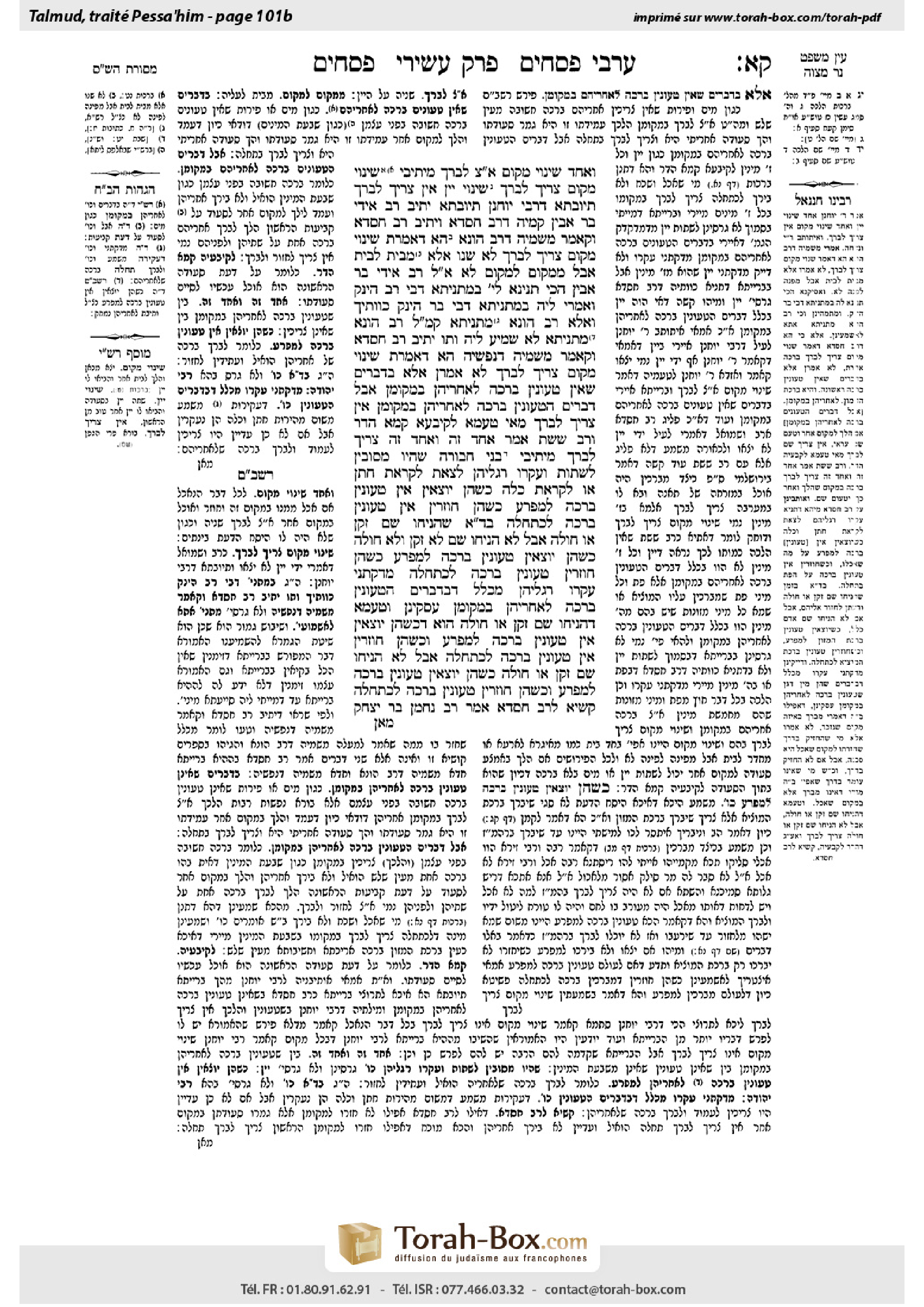
Pesachim 101b: Talmud study for Daf Yomi
Daf Yomi is the daily study of one Talmud folio. Explore 37 tractates with scans, Hebrew text, Sefaria English and AI-generated French translations where annotated.
Passage selection and English or AI-generated French translation are available where the scan has annotations. Daf Study is independent of Torah-Box and Sefaria.
Browse Pesachim · פסחים · All tractatesPesachim 101b text and translations
This page of Pesachim includes the Aramaic text, an English translation and an AI-generated French translation, alongside the scan above.
פסחים ק״א ב · Aramaic and Hebrew text
וְאֶחָד שִׁינּוּי מָקוֹם — אֵין צָרִיךְ לְבָרֵךְ. מֵיתִיבִי: שִׁינּוּי מָקוֹם צָרִיךְ לְבָרֵךְ, שִׁינּוּי יַיִן אֵין צָרִיךְ לְבָרֵךְ, תְּיוּבְתָּא דְּרַבִּי יוֹחָנָן תְּיוּבְתָּא.
יָתֵיב רַב אִידִי בַּר אָבִין קַמֵּיהּ דְּרַב חִסְדָּא, וְיָתֵיב רַב חִסְדָּא וְקָאָמַר מִשְּׁמֵיהּ דְּרַב הוּנָא: הָא דְּאָמְרַתְּ שִׁינּוּי מָקוֹם צָרִיךְ לְבָרֵךְ, לֹא שָׁנוּ אֶלָּא מִבַּיִת לְבַיִת, אֲבָל מִמָּקוֹם לְמָקוֹם — לָא.
אֲמַר לֵיהּ רַב אִידִי בַּר אָבִין: הָכִי תְּנֵינָא לֵיהּ בְּמַתְנִיתָא דְּבֵי רַב הֵינַק, וְאָמְרִי לֵיהּ בְּמַתְנִיתָא דְּבֵי בַּר הֵינַק כְּווֹתָיךְ. וְאֶלָּא רַב הוּנָא מַתְנִיתָא קָא מַשְׁמַע לַן? רַב הוּנָא מַתְנִיתָא לָא שְׁמִיעַ לֵיהּ.
וְתוּ, יָתֵיב רַב חִסְדָּא וְקָאָמַר מִשְּׁמֵיהּ דְּנַפְשֵׁיהּ: הָא דְּאָמְרַתְּ שִׁינּוּי מָקוֹם צָרִיךְ לְבָרֵךְ, לָא אֲמַרַן אֶלָּא בִּדְבָרִים שֶׁאֵין טְעוּנִין בְּרָכָה לְאַחֲרֵיהֶן בִּמְקוֹמָן,
אֲבָל דְּבָרִים הַטְּעוּנִין בְּרָכָה לְאַחֲרֵיהֶן בִּמְקוֹמָן — אֵין צָרִיךְ לְבָרֵךְ. מַאי טַעְמָא, לְקִיבְעָא קַמָּא הָדַר. וְרַב שֵׁשֶׁת אָמַר: אֶחָד זֶה וְאֶחָד זֶה צָרִיךְ לְבָרֵךְ.
מֵיתִיבִי: בְּנֵי חֲבוּרָה שֶׁהָיוּ מְסוּבִּין לִשְׁתּוֹת, וְעָקְרוּ רַגְלֵיהֶן לָצֵאת לִקְרַאת חָתָן אוֹ לִקְרַאת כַּלָּה, כְּשֶׁהֵן יוֹצְאִין — אֵין טְעוּנִין בְּרָכָה לְמַפְרֵעַ, כְּשֶׁהֵן חוֹזְרִין — אֵין טְעוּנִין בְּרָכָה לְכַתְּחִלָּה.
בַּמֶּה דְּבָרִים אֲמוּרִים שֶׁהִנִּיחוּ שָׁם זָקֵן אוֹ חוֹלֶה, אֲבָל לֹא הִנִּיחוּ שָׁם לֹא זָקֵן וְלֹא חוֹלֶה, כְּשֶׁהֵן יוֹצְאִין — טְעוּנִין בְּרָכָה לְמַפְרֵעַ, כְּשֶׁהֵן חוֹזְרִין — טְעוּנִין בְּרָכָה לְכַתְּחִלָּה.
מִדְּקָתָנֵי עָקְרוּ רַגְלֵיהֶן, מִכְּלָל דְּבִדְבָרִים הַטְּעוּנִין בְּרָכָה לְאַחֲרֵיהֶן בִּמְקוֹמָן עָסְקִינַן, וְטַעְמָא דְּהִנִּיחוּ שָׁם זָקֵן אוֹ חוֹלֶה הוּא דִּכְשֶׁהֵן יוֹצְאִין אֵין טְעוּנִין בְּרָכָה לְמַפְרֵעַ וּכְשֶׁהֵן חוֹזְרִין אֵין טְעוּנִין בְּרָכָה לְכַתְּחִלָּה,
אֲבָל לֹא הִנִּיחוּ שָׁם זָקֵן אוֹ חוֹלֶה, כְּשֶׁהֵן יוֹצְאִין — טְעוּנִין בְּרָכָה לְמַפְרֵעַ, וּכְשֶׁהֵן חוֹזְרִין — טְעוּנִין בְּרָכָה לְכַתְּחִלָּה, קַשְׁיָא לְרַב חִסְדָּא!
אָמַר רַב נַחְמָן בַּר יִצְחָק:
Pesachim 101b · English translation
and a change of place, i.e., one moves to a different location in the middle of his meal, he need not recite a new blessing. The Gemara raises an objection from a baraita: In the case of a change of place one must recite a new blessing; however, in a case of a change of wine one need not recite another blessing. The Gemara concludes: The refutation of the opinion of Rabbi Yoḥanan is indeed a conclusive refutation.
The Gemara relates: Rav Idi bar Avin sat before Rav Ḥisda, and Rav Ḥisda sat and said in the name of Rav Huna: That which you said, that after a change of place following kiddush one must recite a new blessing, they only taught this halakha with regard to one who moves from house to house; however, with regard to one who moves from place to place within one house, no, he is not obligated to recite a new blessing.
Rav Idi bar Avin said to him: This is indeed what we learned in the baraita of the school of Rav Hinak, and some say in the baraita of the school of bar Hinak, in accordance with your ruling. The Gemara asks: But if there is a baraita that states the same halakha, does Rav Huna merely come to teach us a baraita? The Gemara answers: Rav Huna taught the halakha quoted in the baraita because he had not heard the baraita. Rav Huna independently issued the same ruling as that of the baraita.
And furthermore, Rav Ḥisda sat and said in his own name, not in the name of his teachers: That which you said, that after a change of place one must recite a new blessing, we only said so with regard to one who eats items of food that do not require a blessing after them in their original place, e.g., water or fruit. In a case of this kind, exiting one’s location indicates that he has concluded his meal, and when he begins to eat again, this is considered a new meal that requires a new blessing.
However, this is the ruling if one is eating items of food that require a blessing of significance, i.e., Grace after Meals and its abridged version, after them, e.g., one of the seven species: As this blessing must be recited in their original place, i.e., where one ate these foods, he has not completed his meal by exiting that location. Therefore, if he changes location and continues to eat, he need not recite a new blessing. What is the reason for this halakha? He returns to the originally established meal when he continues eating, as he certainly intended to continue that meal. And Rav Sheshet said: Both in this case and that case, whether or not one is eating food that requires a blessing afterward in the place where he ate, if he changes location and continues eating he must recite a new blessing.
The Gemara raises an objection to Rav Ḥisda’s opinion from a baraita: With regard to members of a group who were reclining to drink, and they uprooted themselves from their place to go and greet a groom or greet a bride, when they exit, these foods do not require a blessing to be recited afterward, and when they return these foods do not require an introductory blessing.
The baraita continues: In what case is this statement said? When they left there an elderly or a sick person who cannot go with them, and he remains in the place of the meal. In this case, the original meal is considered ongoing. However, if they did not leave there an elderly or sick person, when they exit, the foods that they have already eaten require a blessing; when they return, the foods that they will eat require an introductory blessing.
The Gemara infers from the baraita: From the fact that it is taught in the baraita: Uprooted themselves, this proves by inference that we are dealing with items of food that require a blessing after them in their original place. The word uprooted indicates that in the normal course of events, a blessing would have been required for this meal in its place, and for some reason the people left the meal early. And the reason is that they left there an elderly or sick person. That is why when they exit, these foods do not require a blessing to be recited afterward, and when they return, these foods do not require an introductory blessing.
However, if they did not leave there an elderly or sick person, when they exit, the foods they have already eaten require a blessing to be recited afterward, and when they return, these foods require an introductory blessing before resuming eating. This is difficult according to the opinion of Rav Ḥisda, who maintains that even if one did not return to his original location at all but resumed eating elsewhere, he need not recite a new blessing.
Rav Naḥman bar Yitzḥak said:
Pesachim 101b · Traduction française (IA)
et un changement de lieu, c’est-à-dire que l’on se déplace vers un autre endroit au milieu du repas : il n’est pas nécessaire de réciter une nouvelle bénédiction. La Guemara soulève une objection à partir d’une baraïta : en cas de changement de lieu, il faut réciter une nouvelle bénédiction ; en revanche, en cas de changement de vin, il n’est pas nécessaire d’en réciter une autre. La Guemara conclut : la réfutation de l’opinion de Rabbi Yoḥanan est effectivement définitive.
La Guemara rapporte : Rav Idi bar Avin était assis devant Rav Ḥisda, qui dit au nom de Rav Huna : « Ce que tu as dit, à savoir qu’après un changement de lieu consécutif au kiddouch, il faut réciter une nouvelle bénédiction, ne s’applique qu’à celui qui passe d’une maison à une autre ; en revanche, celui qui se déplace d’un endroit à un autre au sein d’une même maison n’est pas tenu de réciter une nouvelle bénédiction. »
Rav Idi bar Avin lui dit : « C’est précisément ce que nous avons appris dans la baraïta de l’école de Rav Hinak — certains disent : dans la baraïta de l’école de bar Hinak —, conformément à ta décision. » La Guemara demande : « Mais si une baraïta énonce déjà la même halakha, Rav Huna ne vient-il que nous enseigner cette baraïta ? » La Guemara répond : Rav Huna enseigna la halakha citée dans la baraïta parce qu’il ne l’avait pas entendue. Rav Huna avait formulé indépendamment la même décision que celle de la baraïta.
En outre, Rav Ḥisda dit en son propre nom, et non au nom de ses maîtres : « Ce que tu as dit, à savoir qu’après un changement de lieu il faut réciter une nouvelle bénédiction, nous ne l’avons dit qu’à propos de celui qui consomme des aliments qui ne nécessitent pas de bénédiction après leur consommation à l’endroit où il les a mangés, par exemple de l’eau ou des fruits. Dans un tel cas, le fait de quitter son emplacement indique qu’il a terminé son repas ; lorsqu’il recommence à manger, cela est considéré comme un nouveau repas qui nécessite une nouvelle bénédiction. »
En revanche, si l’on consomme des aliments qui exigent après leur consommation une bénédiction importante, à savoir le Birkat Hamazon ou sa version abrégée, par exemple l’une des sept espèces, la règle est différente. Puisque cette bénédiction doit être récitée à l’endroit où l’on a mangé ces aliments, le fait de quitter cet endroit ne signifie pas que le repas est terminé. Par conséquent, si l’on change de lieu et que l’on continue à manger, il n’est pas nécessaire de réciter une nouvelle bénédiction. Quelle est la raison de cette halakha ? En continuant à manger, on reprend le repas initialement commencé, car on avait certainement l’intention de le poursuivre. Rav Sheshet dit : dans les deux cas, que l’on consomme ou non des aliments exigeant une bénédiction après leur consommation à l’endroit où on les a mangés, si l’on change de lieu et que l’on continue à manger, il faut réciter une nouvelle bénédiction.
La Guemara soulève une objection à l’opinion de Rav Ḥisda à partir d’une baraïta : « Des membres d’un groupe étaient accoudés pour boire et quittèrent leur place afin d’aller saluer un marié ou une mariée. Lorsqu’ils partent, il n’est pas nécessaire de réciter après coup une bénédiction pour ces aliments ; à leur retour, il n’est pas nécessaire de réciter de bénédiction introductive pour ces aliments. »
La baraïta poursuit : « Dans quel cas cette règle a-t-elle été énoncée ? Lorsqu’ils ont laissé sur place une personne âgée ou malade, incapable de les accompagner, qui demeure à l’endroit où se déroule le repas. Dans ce cas, le repas initial est considéré comme se poursuivant. Toutefois, s’ils n’ont laissé sur place aucune personne âgée ou malade, lorsqu’ils partent, les aliments qu’ils ont déjà consommés exigent une bénédiction après coup ; à leur retour, les aliments qu’ils vont consommer exigent une bénédiction introductive. »
La Guemara tire une déduction de la baraïta : puisqu’il y est enseigné qu’ils « quittèrent leur place », cela prouve qu’il s’agit d’aliments qui nécessitent une bénédiction après leur consommation à l’endroit où ils ont été mangés. Le terme « quittèrent leur place » indique que, dans le cours normal des choses, une bénédiction aurait dû être récitée à cet endroit pour ce repas, et que, pour une raison quelconque, les convives l’ont interrompu prématurément. La raison est qu’ils ont laissé sur place une personne âgée ou malade. C’est pourquoi, lorsqu’ils partent, il n’est pas nécessaire de réciter après coup une bénédiction pour ces aliments et, à leur retour, il n’est pas nécessaire de réciter de bénédiction introductive pour ces aliments.
En revanche, s’ils n’ont laissé sur place aucune personne âgée ou malade, lorsqu’ils partent, les aliments qu’ils ont déjà consommés exigent une bénédiction après coup ; à leur retour, les aliments qu’ils vont consommer exigent une bénédiction introductive avant qu’ils ne reprennent leur repas. Cela pose une difficulté au regard de l’opinion de Rav Ḥisda, qui soutient que même si l’on ne retourne pas du tout à son emplacement initial, mais que l’on reprend son repas ailleurs, il n’est pas nécessaire de réciter une nouvelle bénédiction.
Rav Naḥman bar Yitzḥak dit :
Traduction française générée par IA à partir de l’édition anglaise de Sefaria. Vérifie toujours un passage avec le texte source.
Text from Sefaria: William Davidson Edition - Vocalized Aramaic (CC BY NC); William Davidson Edition - English (CC BY NC).