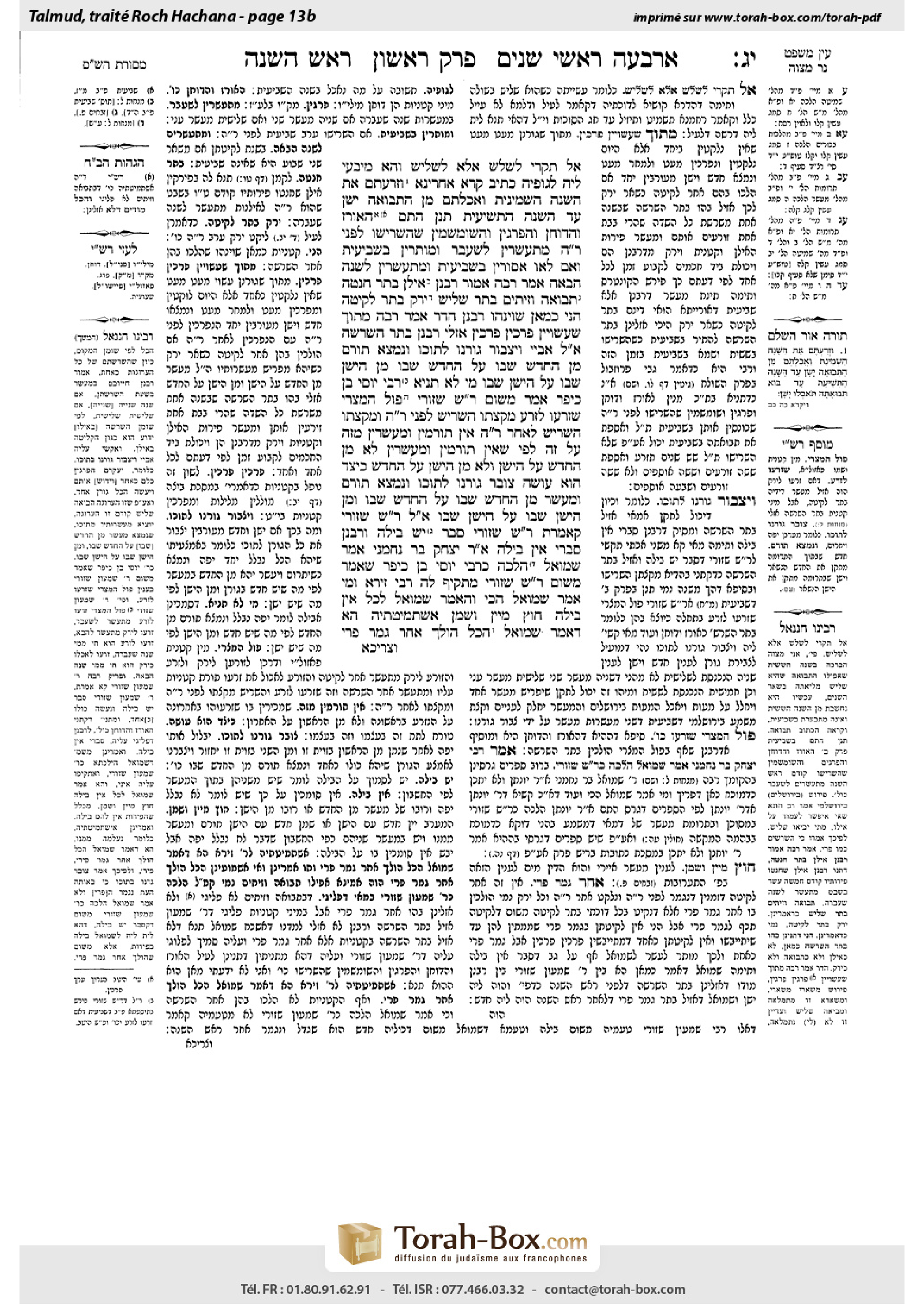
Rosh Hashanah 13b: Talmud study for Daf Yomi
Daf Yomi is the daily study of one Talmud folio. Explore 37 tractates with scans, Hebrew text, Sefaria English and AI-generated French translations where annotated.
Passage selection and English or AI-generated French translation are available where the scan has annotations. Daf Study is independent of Torah-Box and Sefaria.
Browse Rosh Hashanah · ראש השנה · All tractatesRosh Hashanah 13b text and translations
This page of Rosh Hashanah includes the Aramaic text, an English translation and an AI-generated French translation, alongside the scan above.
ראש השנה י״ג ב · Aramaic and Hebrew text
אַל תִּקְרֵי ״לִשְׁלֹשׁ״, אֶלָּא ״לִשְׁלִישׁ״.
וְהָא מִיבְּעֵי לֵיהּ לְגוּפֵיהּ! כְּתִיב קְרָא אַחֲרִינָא: ״וּזְרַעְתֶּם אֵת הַשָּׁנָה הַשְּׁמִינִית וַאֲכַלְתֶּם מִן הַתְּבוּאָה יָשָׁן עַד הַשָּׁנָה הַתְּשִׁיעִית״.
תְּנַן הָתָם: הָאוֹרֶז וְהַדּוֹחַן וְהַפְּרָגִין וְהַשּׁוּמְשְׁמִין שֶׁהִשְׁרִישׁוּ לִפְנֵי רֹאשׁ הַשָּׁנָה מִתְעַשְּׂרִין לְשֶׁעָבַר, וּמוּתָּרִין בַּשְּׁבִיעִית. וְאִם לָאו — אֲסוּרִין בַּשְּׁבִיעִית, וּמִתְעַשְּׂרִין לְשָׁנָה הַבָּאָה.
אָמַר רַבָּה, אֲמוּר רַבָּנַן: אִילָן בָּתַר חֲנָטָה, תְּבוּאָה וְזֵיתִים בָּתַר שְׁלִישׁ, יָרָק בָּתַר לְקִיטָה. הָנֵי כְּמַאן שַׁוִּינְהוּ רַבָּנַן?
הֲדַר אָמַר רַבָּה: מִתּוֹךְ שֶׁעֲשׂוּיִין פְּרָכִין פְּרָכִין, אָזְלִי רַבָּנַן בָּתַר הַשְׁרָשָׁה.
אֲמַר לֵיהּ אַבָּיֵי: וְיִצְבּוֹר גּוֹרְנוֹ לְתוֹכוֹ, וְנִמְצָא תּוֹרֵם מִן הֶחָדָשׁ שֶׁבּוֹ עַל הֶחָדָשׁ שֶׁבּוֹ, מִן הַיָּשָׁן שֶׁבּוֹ עַל הַיָּשָׁן שֶׁבּוֹ!
מִי לָא תַּנְיָא, רַבִּי יוֹסֵי בֶּן כִּיפָּר אָמַר מִשּׁוּם רַבִּי שִׁמְעוֹן שֵׁזוּרִי: פּוֹל הַמִּצְרִי שֶׁזְּרָעוֹ לְזֶרַע, מִקְצָתוֹ הִשְׁרִישׁ לִפְנֵי רֹאשׁ הַשָּׁנָה, וּמִקְצָתוֹ הִשְׁרִישׁ לְאַחַר רֹאשׁ הַשָּׁנָה — אֵין תּוֹרְמִין וּמְעַשְּׂרִין מִזֶּה עַל זֶה, לְפִי שֶׁאֵין תּוֹרְמִין וּמְעַשְּׂרִין לֹא מִן הֶחָדָשׁ עַל הַיָּשָׁן וְלֹא מִן הַיָּשָׁן עַל הֶחָדָשׁ.
כֵּיצַד הוּא עוֹשֶׂה — צוֹבֵר גּוֹרְנוֹ לְתוֹכוֹ, וְנִמְצָא תּוֹרֵם וּמְעַשֵּׂר מִן הֶחָדָשׁ שֶׁבּוֹ עַל הֶחָדָשׁ שֶׁבּוֹ, וּמִן הַיָּשָׁן שֶׁבּוֹ עַל הַיָּשָׁן שֶׁבּוֹ.
אֲמַר לֵיהּ: רַבִּי שִׁמְעוֹן שֵׁזוּרִי קָאָמְרַתְּ? רַבִּי שִׁמְעוֹן שֵׁזוּרִי סָבַר יֵשׁ בִּילָּה.
וְרַבָּנַן סָבְרִי אֵין בִּילָּה.
אָמַר רַבִּי יִצְחָק בַּר נַחְמָנִי אָמַר שְׁמוּאֵל: הֲלָכָה כְּרַבִּי יוֹסֵי בֶּן כִּיפָּר שֶׁאָמַר מִשּׁוּם רַבִּי שִׁמְעוֹן שֵׁזוּרִי. מַתְקֵיף לַהּ רַבִּי זֵירָא: וּמִי אָמַר שְׁמוּאֵל הָכִי? וְהָאָמַר שְׁמוּאֵל: לַכֹּל אֵין בִּילָּה, חוּץ מִיַּיִן וָשֶׁמֶן!
אִשְׁתְּמִיטְתֵּיהּ הָא דְּאָמַר שְׁמוּאֵל: הַכֹּל הוֹלֵךְ אַחַר גְּמַר פֶּרִי.
Rosh Hashanah 13b · English translation
do not read it as “for three [lishelosh]” but as: For one-third [lishelish]. And learn from here that the year for tithes is determined by the date on which the produce reaches one-third of its growth.
The Gemara raises a difficulty: But the phrase is necessary for the meaning of the verse itself, to teach that the sixth year will be blessed so that it yields three years’ worth of produce. The Gemara answers: It is written in another verse: “And you shall sow the eighth year, and eat yet of old produce until the ninth year” (Leviticus 25:22), so that the latter verse teaches about the three years’ worth of produce, and the first verse is available to derive the halakha with regard to one-third growth.
§ We learned in a mishna there: Rice, millet, poppy, and sesame that took root before Rosh HaShana are tithed in accordance with the outgoing year, meaning that second tithe is set aside in the first, second, fourth, and fifth years of the Sabbatical cycle, and poor man’s tithe is set aside in the third and sixth years, and they are permitted even if the following year is a Sabbatical Year. If they did not take root before Rosh HaShana, they are prohibited if it is the Sabbatical Year, and in ordinary years they are tithed in accordance with the incoming year.
Rabba said: Say that the Sages said that the tithe year of a tree follows the time of the formation of its fruit, that of grain and olives follows the time that they reach one-third of their growth, and that of vegetables follows the time of their picking. The question may therefore be raised: With regard to these crops, i.e., rice, millet, poppy, and sesame, to what did the Sages equate them? Their tithe year is determined neither by their formation, nor by the time when they reach one-third of their growth, nor by their picking.
Rabba then said: The reason for their uniqueness with regard to tithing is that since these crops do not ripen all at once, but rather, they ripen and are gathered little by little over an extended period of time, if their year were to follow the time of their picking, people might set aside tithes from that which was picked before Rosh HaShana for that which was picked after Rosh HaShana. Therefore, the Sages decreed that their tithe year follows the time of their taking root, which is the same for the entire field.
Abaye said to him: Why should they have made such a decree? There is a better alternative: Let one pile the entire stock onto his threshing floor, into the middle of it, mix the stock together well, and then set aside teruma and tithes, and consequently it will turn out that he has set aside teruma and tithes from the new crop in the mixture for the new crop in it, and from the old crop in the mixture for the old crop in it.
Abaye continued: Isn’t it taught in a baraita: Rabbi Yosei ben Keifar said in the name of Rabbi Shimon Shezuri: If the cowpea plant was planted for seed, not to be eaten as a vegetable but for the seeds, the beans themselves, either for eating or planting, and some took root already before Rosh HaShana, while some took root only after Rosh HaShana, one may not set aside teruma or tithes from this for that, as one may not set aside teruma or tithes from the new crop for the old or from the old crop for the new.
How, then, should one act so that he not err and set aside teruma and tithes incorrectly? He should pile the entire stock onto his threshing floor, into the middle of it, mix the stock together well, and then set aside teruma and tithes, and consequently it will turn out that he has set aside teruma and tithes from the new crop in the mixture for the new crop in it, and from the old crop in the mixture for the old crop in it. Why not do the same for rice, millet, poppy, and sesame?
Rabba said to Abaye: You are speaking of the opinion of Rabbi Shimon Shezuri? You cannot raise an objection from what he says, as Rabbi Shimon Shezuri holds that there is mixing. He assumes that the old and new were thoroughly mixed, so that the teruma and tithes set aside from the mixture have the same proportions of old and new crops as did the original crops.
But the Sages hold that there is no mixing; they do not assume that the old and new became thoroughly and evenly mixed. Therefore, piling the entire stock, mixing it together, and then setting aside teruma and tithes will not ensure that they are set aside correctly.
Rabbi Yitzḥak bar Naḥmani said that Shmuel said: The halakha is in accordance with the statement of Rabbi Yosei ben Keifar that he said in the name of Rabbi Shimon Shezuri. Rabbi Zeira strongly objects to this: And did Shmuel actually say this? But didn’t Shmuel say: There is no mixing for anything except for wine, oil, and other liquids? In the case of liquids he holds that everything is entirely mixed together, but not in the case of solids. How, then, could he have ruled in accordance with the opinion of Rabbi Shimon Shezuri?
The Gemara answers: Rabbi Zeira forgot that which Shmuel said: In all cases, the tithe year follows the time of the full ripening of the produce. Therefore, all of the cowpea seeds may be tithed together, whether the plants from which they grew took root before or after Rosh HaShana. This is not due to Rabbi Shimon Shezuri’s rationale that there is mixing, but because all of the beans reach full ripening at the same time, and consequently, they are all considered produce of the incoming year.
Rosh Hashanah 13b · Traduction française (IA)
Ne lis pas « pour trois [lishelosh] », mais « pour un tiers [lishelish] ». On apprend donc de là que l’année de référence pour les dîmes est déterminée par la date à laquelle les produits atteignent un tiers de leur croissance.
La Guemara soulève une difficulté : mais cette expression est nécessaire au sens même du verset, pour enseigner que la sixième année sera bénie de sorte qu’elle produira de quoi couvrir trois années. La Guemara répond : un autre verset dit : « Vous sèmerez la huitième année et vous mangerez encore de l’ancienne récolte jusqu’à la neuvième année » (Lévitique 25,22). Ce dernier verset enseigne donc qu’il y aura de quoi couvrir trois années, et le premier verset peut dès lors servir à déduire la halakha concernant le tiers de la croissance.
§ Nous avons appris dans une Michna, là-bas : le riz, le millet, le pavot et le sésame qui ont pris racine avant Roch Hachana sont soumis aux dîmes selon l’année écoulée ; autrement dit, on prélève la seconde dîme les première, deuxième, quatrième et cinquième années du cycle sabbatique, et la dîme du pauvre les troisième et sixième années. Ils sont permis même si l’année suivante est une année sabbatique. S’ils n’ont pas pris racine avant Roch Hachana, ils sont interdits si c’est une année sabbatique ; les années ordinaires, ils sont soumis aux dîmes selon l’année qui commence.
Rabba dit : On peut dire que les Sages ont établi que, pour les arbres, l’année de référence pour la dîme suit le moment où leurs fruits se forment ; pour les céréales et les olives, elle suit le moment où elles atteignent un tiers de leur croissance ; et pour les légumes, elle suit le moment de leur cueillette. On peut donc poser la question au sujet de ces cultures, c’est-à-dire le riz, le millet, le pavot et le sésame : à quelle catégorie les Sages les ont-ils assimilées ? Leur année de référence pour la dîme n’est déterminée ni par la formation de leurs fruits, ni par le moment où ils atteignent un tiers de leur croissance, ni par leur cueillette.
Rabba dit ensuite : la raison de leur particularité en matière de dîme est que ces cultures ne mûrissent pas toutes en même temps ; elles mûrissent et sont récoltées peu à peu, sur une période prolongée. Si leur année de référence suivait le moment de leur cueillette, on pourrait prélever les dîmes sur ce qui a été récolté avant Roch Hachana pour ce qui l’a été après Roch Hachana. Les Sages ont donc décrété que leur année de référence pour la dîme suit le moment où elles prennent racine, qui est le même pour tout le champ.
Abayé lui dit : pourquoi auraient-ils pris une telle décision ? Il existe une meilleure solution : que l’on rassemble toute la récolte sur l’aire de battage, au milieu de celle-ci, qu’on la mélange soigneusement, puis qu’on prélève la terouma et les dîmes. Ainsi, on aura prélevé, dans le mélange, la terouma et les dîmes de la nouvelle récolte pour la part de nouvelle récolte qu’il contient, et celles de l’ancienne récolte pour la part d’ancienne récolte qu’il contient.
Abayé poursuit : N’est-il pas enseigné dans une baraïta : Rabbi Yossé ben Keifar a dit au nom de Rabbi Shimon Shezouri : si le niébé a été semé pour ses graines — non pour être consommé comme un légume, mais pour ses graines, les haricots eux-mêmes, destinés à être mangés ou plantés — et que certaines plantes ont pris racine avant Roch Hachana tandis que d’autres n’ont pris racine qu’après Roch Hachana, on ne peut pas prélever la terouma ni les dîmes de l’un pour l’autre, car on ne peut pas prélever la terouma ni les dîmes de la nouvelle récolte pour l’ancienne, ni de l’ancienne pour la nouvelle.
Comment faut-il donc procéder pour ne pas se tromper et prélever incorrectement la terouma et les dîmes ? Il faut rassembler toute la récolte sur l’aire de battage, au milieu de celle-ci, la mélanger soigneusement, puis prélever la terouma et les dîmes. Ainsi, on aura prélevé, dans le mélange, la terouma et les dîmes de la nouvelle récolte pour la part de nouvelle récolte qu’il contient, et celles de l’ancienne récolte pour la part d’ancienne récolte qu’il contient. Pourquoi ne pas faire de même pour le riz, le millet, le pavot et le sésame ?
Rabba dit à Abayé : tu parles de l’opinion de Rabbi Shimon Shezouri ? On ne peut pas soulever d’objection à partir de ce qu’il dit, car Rabbi Shimon Shezouri considère qu’il y a mélange. Il suppose que les récoltes ancienne et nouvelle ont été parfaitement mélangées, de sorte que la terouma et les dîmes prélevées sur le mélange contiennent les mêmes proportions de récolte ancienne et nouvelle que les récoltes d’origine.
Mais les Sages considèrent qu’il n’y a pas de mélange ; ils ne supposent pas que les récoltes ancienne et nouvelle se sont parfaitement et uniformément mélangées. Par conséquent, rassembler toute la récolte, la mélanger, puis prélever la terouma et les dîmes ne garantit pas que les prélèvements seront faits correctement.
Rabbi Yitsḥak bar Naḥmani dit au nom de Shmouel : la halakha suit l’avis de Rabbi Yossé ben Keifar, qu’il a énoncé au nom de Rabbi Shimon Shezouri. Rabbi Zeïra soulève une vive objection : Shmouel a-t-il réellement dit cela ? N’a-t-il pas dit : il n’y a de mélange que pour le vin, l’huile et les autres liquides ? Pour les liquides, il considère que tout se mélange complètement, mais pas pour les solides. Comment aurait-il donc pu trancher conformément à l’opinion de Rabbi Shimon Shezouri ?
La Guemara répond : Rabbi Zeïra avait oublié ce que Shmouel avait dit : dans tous les cas, l’année de référence pour la dîme suit le moment où les produits atteignent leur pleine maturité. On peut donc prélever les dîmes sur toutes les graines de niébé ensemble, que les plantes dont elles proviennent aient pris racine avant ou après Roch Hachana. Ce n’est pas en vertu du raisonnement de Rabbi Shimon Shezouri, selon lequel il y a mélange, mais parce que tous les haricots atteignent leur pleine maturité au même moment et sont donc tous considérés comme des produits de l’année qui commence.
Traduction française générée par IA à partir de l’édition anglaise de Sefaria. Vérifie toujours un passage avec le texte source.
Text from Sefaria: William Davidson Edition - Vocalized Aramaic (CC BY NC); William Davidson Edition - English (CC BY NC).