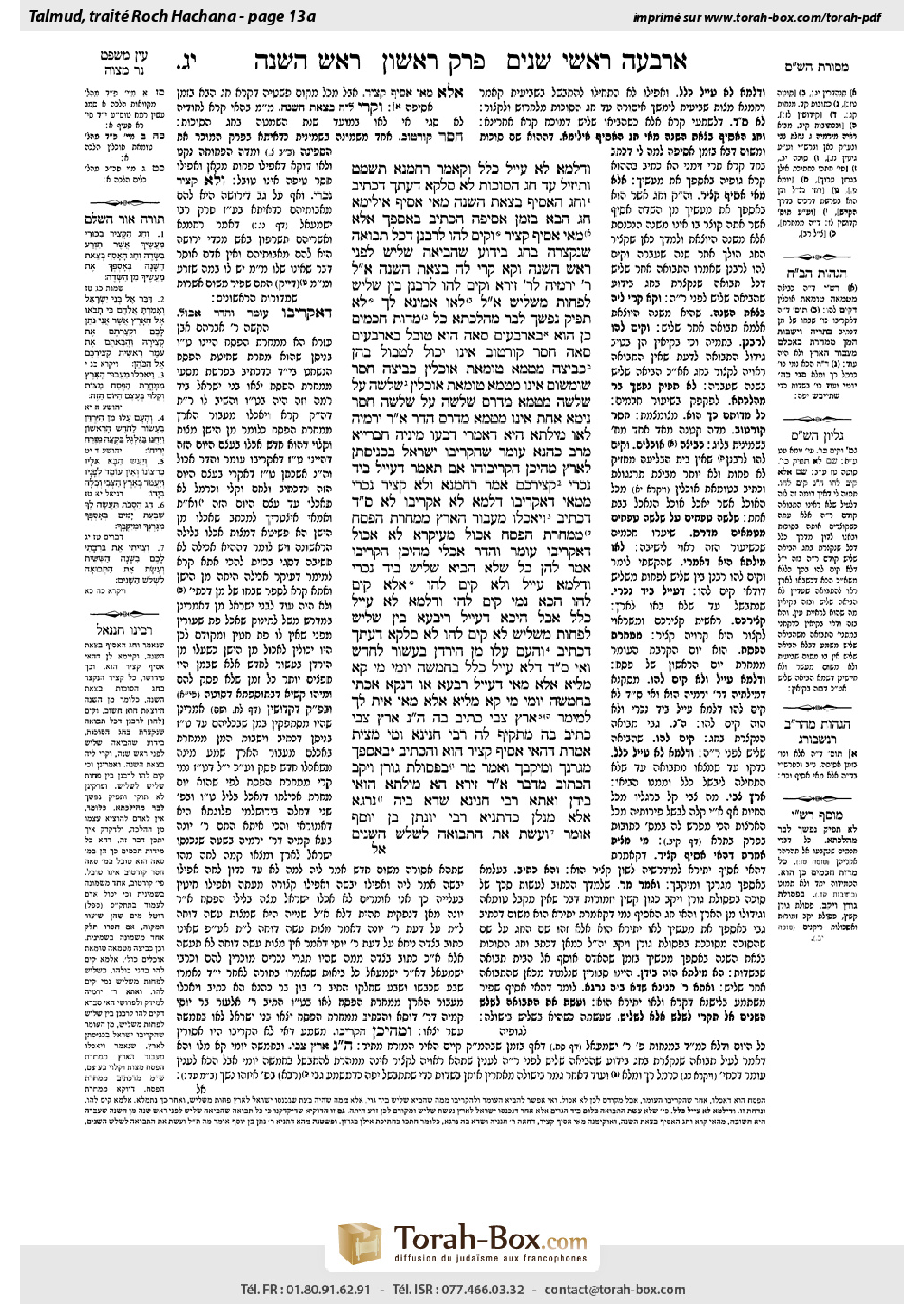
Rosh Hashanah 13a: Talmud study for Daf Yomi
Daf Yomi is the daily study of one Talmud folio. Explore 37 tractates with scans, Hebrew text, Sefaria English and AI-generated French translations where annotated.
Passage selection and English or AI-generated French translation are available where the scan has annotations. Daf Study is independent of Torah-Box and Sefaria.
Browse Rosh Hashanah · ראש השנה · All tractatesRosh Hashanah 13a text and translations
This page of Rosh Hashanah includes the Aramaic text, an English translation and an AI-generated French translation, alongside the scan above.
ראש השנה י״ג א · Aramaic and Hebrew text
וְדִלְמָא לָא עָיֵיל כְּלָל, וְקָאָמַר רַחֲמָנָא תְּשַׁמֵּט וְתֵיזִיל עַד חַג הַסּוּכּוֹת!
לָא סָלְקָא דַּעְתָּךְ, דִּכְתִיב: ״וְחַג הָאָסִיף בְּצֵאת הַשָּׁנָה״, מַאי ״אָסִיף״? אִילֵּימָא: חַג הַבָּא בִּזְמַן אֲסִיפָה — הָכְתִיב: ״בְּאׇסְפְּךָ״.
אֶלָּא מַאי ״אָסִיף״ — קָצִיר. וְקִים לְהוּ לְרַבָּנַן דְּכׇל תְּבוּאָה שֶׁנִּקְצְרָה בֶּחָג, בְּיָדוּעַ שֶׁהֵבִיאָה שְׁלִישׁ לִפְנֵי רֹאשׁ הַשָּׁנָה, וְקָא קָרֵי לַהּ ״בְּצֵאת הַשָּׁנָה״.
אֲמַר לֵיהּ רַבִּי יִרְמְיָה לְרַבִּי זֵירָא: וְקִים לְהוּ לְרַבָּנַן בֵּין שְׁלִישׁ לְפָחוֹת מִשְּׁלִישׁ? אֲמַר לֵיהּ: לָאו אָמֵינָא לָךְ לָא תַּפֵּיק נַפְשָׁךְ לְבַר מֵהִלְכְתָא? כׇּל מִדּוֹת חֲכָמִים — כֵּן הוּא.
אַרְבָּעִים סְאָה הוּא טוֹבֵל, בְּאַרְבָּעִים סְאָה חָסֵר קוּרְטוֹב — אֵינוֹ יָכוֹל לִטְבּוֹל בָּהֶן. כְּבֵיצָה מְטַמֵּא טוּמְאַת אוֹכָלִין, כְּבֵיצָה חָסֵר שׁוּמְשׁוּם — אֵינוֹ מְטַמֵּא טוּמְאַת אוֹכָלִין.
שְׁלֹשָׁה עַל שְׁלֹשָׁה — מִטַּמֵּא מִדְרָס, שְׁלֹשָׁה עַל שְׁלֹשָׁה חָסֵר נִימָא אַחַת — אֵינוֹ מִטַּמֵּא מִדְרָס.
הֲדַר אָמַר רַבִּי יִרְמְיָה: לָאו מִילְּתָא הִיא דַּאֲמַרִי. דִּבְעוֹ מִינֵּיהּ חַבְרַיָּיא מֵרַב כָּהֲנָא: עוֹמֶר שֶׁהִקְרִיבוּ יִשְׂרָאֵל בִּכְנִיסָתָן לָאָרֶץ, מֵהֵיכָן הִקְרִיבוּהוּ? אִם תֹּאמַר דְּעָיֵיל בְּיַד גּוֹי, ״קְצִירְכֶם״ אָמַר רַחֲמָנָא — וְלֹא קְצִיר גּוֹי.
מִמַּאי דְּאַקְרִיבוּ, דִּלְמָא לָא אַקְרִיבוּ! לָא סָלְקָא דַּעְתָּךְ, דִּכְתִיב: ״וַיֹּאכְלוּ מֵעֲבוּר הָאָרֶץ מִמׇּחֳרַת הַפֶּסַח״. מִמָּחֳרַת הַפֶּסַח — אֲכוּל, מֵעִיקָּרָא — לָא אֲכוּל. דְּאַקְרִיבוּ עוֹמֶר וַהֲדַר אָכְלִי. מֵהֵיכָן הִקְרִיבוּ?
אָמַר לָהֶן: כׇּל שֶׁלֹּא הֵבִיא שְׁלִישׁ בְּיַד גּוֹי.
וְדִלְמָא עָיֵיל וְלָא קִים לְהוּ? אֶלָּא קִים לְהוּ — הָכָא נָמֵי קִים לְהוּ.
וְדִלְמָא לָא עָיֵיל כְּלָל, אֲבָל הֵיכָא דְּעָיֵיל רִיבְעָא — בֵּין שְׁלִישׁ לְפָחוֹת מִשְּׁלִישׁ לָא קִים לְהוּ!
לָא סָלְקָא דַּעְתָּךְ, דִּכְתִיב: ״וְהָעָם עָלוּ מִן הַיַּרְדֵּן בֶּעָשׂוֹר לַחֹדֶשׁ״, וְאִי סָלְקָא דַעְתָּךְ דְּלָא עָיֵיל כְּלָל — בְּחַמְשָׁה יוֹמֵי מִי קָא מָלְיָא?
אֶלָּא מַאי, דְּעָיֵיל רִבְעָא אוֹ דַנְקָא? אַכַּתִּי בְּחַמְשָׁה יוֹמֵי מִי קָא מָלְיָא! אֶלָּא מַאי אִית לָךְ לְמֵימַר: ״אֶרֶץ צְבִי״ כְּתִיב בַּהּ — הָכָא נָמֵי: ״אֶרֶץ צְבִי״ כְּתִיב בַּהּ.
מַתְקֵיף לַהּ רַבִּי חֲנִינָא: וּמִי מָצֵית אָמְרַתְּ דְּהַאי ״אָסִיף״ קָצִיר הוּא? וְהָכְתִיב: ״בְּאׇסְפְּךָ מִגׇּרְנְךָ וּמִיִּקְבֶךָ״, וְאָמַר מָר: בִּפְסוֹלֶת גּוֹרֶן וְיֶקֶב הַכָּתוּב מְדַבֵּר!
אָמַר רַבִּי זֵירָא: הָא מִילְּתָא הֲוַאי בִּידַן, וַאֲתָא רַבִּי חֲנִינָא שְׁדָא בַּיהּ נַרְגָּא.
אֶלָּא מְנָלַן? כִּדְתַנְיָא, רַבִּי יוֹנָתָן בֶּן יוֹסֵף אוֹמֵר: ״וְעָשָׂת אֶת הַתְּבוּאָה לִשְׁלֹשׁ הַשָּׁנִים״,
Rosh Hashanah 13a · English translation
But perhaps the verse is referring to produce that did not grow at all during the seventh year, and nevertheless, the Merciful One states in the Torah that all the halakhot of the Sabbatical Year continue to apply until the festival of Sukkot of the eighth year.
The Gemara answers: It should not enter your mind to say this, as it is written: “And the festival of gathering, which is at the end of the year, when you have gathered in your labors out of the field” (Exodus 23:16). What is the meaning of “gathering”? If we say that it means: A Festival that comes at the time of gathering the crops, isn’t it already written: “When you have gathered in your labors”? There is no need to repeat this a second time.
Rather, what is meant here by “gathering”? It means harvesting. And the Sages have an accepted tradition that any grain that reaches full growth so that it is harvested on the festival of Sukkot is known to have reached one-third of its growth before Rosh HaShana, and the Torah calls that period of the year until Sukkot “at the end of the year,” thereby indicating that it is still subject to the halakhot governing the previous year.
§ Rabbi Yirmeya said to Rabbi Zeira: And are the Sages able to discern precisely between produce that reached one-third of its growth and produce that reached less than one-third of its growth? Rabbi Zeira said to him: Do I not always tell you that you must not take yourself out of the bounds of the halakha? All the measures of the Sages are like this; they are precise and exact.
For example, one who immerses himself in a ritual bath containing forty se’a of water is rendered pure, but in forty se’a less the tiny amount of a kortov, he cannot immerse and become pure in them. Similarly, an egg-bulk of impure food can render other food ritually impure, but an egg-bulk less even the tiny amount of a sesame seed does not render food ritually impure.
So too, a piece of cloth three by three handbreadths in size is susceptible to ritual impurity imparted by treading, but a piece of cloth three by three handbreadths less one hair [nima] is not susceptible to ritual impurity imparted by treading.
Rabbi Yirmeya then said: What I said is nothing, and my question had no basis, as it can be demonstrated that the Sages know how to determine that produce has reached one-third of its growth. As Rav Kahana was once asked by the other colleagues of the academy as follows: With regard to the omer offering that the Jewish people brought when they first entered Eretz Yisrael in the days of Joshua, from where did they bring it? If you say that this omer offering was brought from grain that grew in the possession of a gentile, there is a difficulty, as the Merciful One states in the Torah: “You shall bring an omer of the first fruits of your harvest to the priest” (Leviticus 23:10), from which it can be derived that it must be your harvest, grown in the possession of a Jew, and not the harvest of a gentile.
The Gemara first questions the assumption of Rav Kahana’s colleagues: From where is it known that the Jewish people actually brought an omer offering that year? Perhaps they did not offer it at all. The Gemara rejects this argument: It should not enter your mind to say this, as it is written: “And they did eat of the produce of the land on the next day after Passover” (Joshua 5:11), which teaches: Only on the next day after Passover did they eat from the new grain, but initially they did not eat from it. Why? It is because they first brought the omer offering on the sixteenth of Nisan as is required, and only afterward did they eat from the new grain. Therefore the question remains: From where did they bring the omer offering?
Rav Kahana said to them: Anything that came into the possession of a Jew and did not reach one-third of its growth in the possession of a gentile is fit to be harvested for the sake of the omer offering.
Rabbi Yirmeya concludes his proof: But there, too, one might ask: Perhaps the grain had in fact already reached one-third of its growth, but they could not discern with certainty between grain that had reached one-third of its growth and grain that had not. Rather, you must say that they were able to discern with certainty. Here, too, you can say that the Sages can discern with certainty between produce that has reached one-third of its growth before Rosh HaShana and produce that has not.
The Gemara asks: This is not absolute proof, as perhaps the Jewish people brought the omer offering from grain that did not grow at all before they conquered the land, and the distinction was evident to all. But where produce reached one quarter of its growth, the Sages cannot discern with certainty the difference between one-third and less than one-third.
The Gemara answers: It should not enter your mind to say this, as it is written: “And the people came up from the Jordan on the tenth day of the first month” (Joshua 4:19). And if it enters your mind to say that the grain had not grown at all before the Jewish people entered the land, could it have reached full growth in just five days?
The Gemara rejects this argument: Rather, what can one say? That the grain had reached one quarter or one-sixth [danka] of its growth before the Jewish people conquered the land? This too is difficult, as one can still ask: Could the grain have reached full growth in just five days? Rather, what have you to say? One could say that with regard to Eretz Yisrael it is written: “The land of the deer” (Daniel 11:41), implying that the grain of Eretz Yisrael ripens with the swiftness of a deer. Here, too, one can say that “the land of the deer” is written with regard to Eretz Yisrael and applies to the ripening of the grain, so that it can ripen in just a few days.
§ Rabbi Ḥanina strongly objects to the proof brought from the verse in Exodus cited above, which refers to Sukkot as the festival of gathering: How can you say that this “gathering” means harvesting? But isn’t it written: “You shall observe the festival of Sukkot seven days, after you have gathered in from your threshing floor and from your winepress” (Deuteronomy 16:13), and the Master said about this: The verse speaks here of the waste of the threshing floor and the winepress, which is used to make the roof of the sukka. If so, the gathering mentioned with regard to the festival of Sukkot is referring not to harvesting but to gathering straw from the threshing floor.
Rabbi Zeira said about this: This matter was in our hands, i.e., I thought that we had solid proof that the years for produce follow the first third of its growth, but Rabbi Ḥanina came and cast an axe upon it, cutting it down, as Rabbi Ḥanina’s objection has totally nullified the proof.
The Gemara asks: Rather, from where do we derive that the years for produce follow the first third of its growth? The Gemara answers: As it is taught in a baraita that Rabbi Yonatan ben Yosef says: The verse states: “And it shall bring forth fruit for the three years” (Leviticus 25:21);
Rosh Hashanah 13a · Traduction française (IA)
Mais peut-être le verset parle-t-il de produits qui n’ont pas du tout poussé pendant la septième année ; pourtant, le Miséricordieux déclare dans la Torah que toutes les halakhot de l’année sabbatique continuent de s’appliquer jusqu’à la fête de Soukkot de la huitième année.
La Guemara répond : Il ne faut pas penser cela, car il est écrit : « Et la fête de la récolte, à la fin de l’année, lorsque tu auras recueilli le fruit de tes travaux des champs » (Exode 23,16). Que signifie ici « récolte » ? Si l’on dit qu’il s’agit d’une fête qui a lieu au moment de la récolte, n’est-il pas déjà écrit : « lorsque tu auras recueilli le fruit de tes travaux » ? Il n’était pas nécessaire de le répéter.
Mais que signifie ici « récolte » ? Cela signifie la moisson. Or, les Sages ont reçu une tradition selon laquelle tout grain qui atteint sa pleine croissance au point d’être moissonné à la fête de Soukkot est réputé avoir atteint le tiers de sa croissance avant Roch Hachana. La Torah appelle la période de l’année qui va jusqu’à Soukkot « la fin de l’année », indiquant ainsi qu’elle reste soumise aux halakhot de l’année précédente.
§ Rabbi Yirmeya dit à Rabbi Zeira : Les Sages sont-ils capables de distinguer précisément les produits qui ont atteint le tiers de leur croissance de ceux qui en ont atteint moins du tiers ? Rabbi Zeira lui dit : Ne te dis-je pas toujours que tu ne dois pas sortir des limites de la halakha ? Toutes les mesures fixées par les Sages sont ainsi : précises et exactes.
Par exemple, celui qui s’immerge dans un bain rituel contenant quarante séa d’eau devient pur ; mais avec quarante séa moins une quantité infime, un kortov, il ne peut pas s’y immerger et devenir pur. De même, un volume d’aliment impur équivalant à un œuf peut rendre d’autres aliments rituellement impurs, mais un volume équivalant à un œuf moins même la quantité infime d’une graine de sésame ne rend pas les aliments rituellement impurs.
De même, un morceau de tissu de trois sur trois palmes est susceptible de contracter l’impureté rituelle transmise par piétinement, mais un morceau de tissu de trois sur trois palmes moins un cheveu [nima] n’est pas susceptible de contracter cette impureté rituelle.
Rabbi Yirmeya dit alors : Ce que j’ai dit n’a pas lieu d’être, et ma question n’était pas fondée, car on peut démontrer que les Sages savent déterminer qu’un produit a atteint le tiers de sa croissance. En effet, Rav Kahana fut un jour interrogé par ses autres collègues de l’académie en ces termes : Concernant l’offrande de l’omer que les Juifs apportèrent lorsqu’ils entrèrent pour la première fois en Eretz Israël, à l’époque de Josué, d’où l’apportèrent-ils ? Si tu dis que cette offrande de l’omer fut apportée à partir de grain qui avait poussé sur une terre appartenant à un non-Juif, cela pose une difficulté : le Miséricordieux dit dans la Torah : « Vous apporterez au prêtre un omer des prémices de votre moisson » (Lévitique 23,10). On peut en déduire qu’il doit s’agir de votre moisson, cultivée en possession d’un Juif, et non de la moisson d’un non-Juif.
La Guemara met d’abord en question la prémisse des collègues de Rav Kahana : D’où sait-on que les Juifs apportèrent effectivement une offrande de l’omer cette année-là ? Peut-être ne l’offrirent-ils pas du tout. La Guemara rejette cet argument : Il ne faut pas penser cela, car il est écrit : « Ils mangèrent des produits du pays le lendemain de Pessa’h » (Josué 5,11), ce qui enseigne que ce n’est que le lendemain de Pessa’h qu’ils mangèrent du grain nouveau, mais qu’auparavant ils n’en mangèrent pas. Pourquoi ? Parce qu’ils apportèrent d’abord l’offrande de l’omer le seize Nissan, comme il se doit, et ne mangèrent du grain nouveau qu’ensuite. La question demeure donc : d’où apportèrent-ils l’offrande de l’omer ?
Rav Kahana leur dit : Tout produit qui est entré en possession d’un Juif et qui n’avait pas atteint le tiers de sa croissance lorsqu’il était en possession d’un non-Juif peut être moissonné pour l’offrande de l’omer.
Rabbi Yirmeya conclut sa démonstration : Mais là aussi, on pourrait demander : Peut-être le grain avait-il déjà atteint le tiers de sa croissance, mais ils ne pouvaient pas distinguer avec certitude le grain qui avait atteint le tiers de sa croissance de celui qui ne l’avait pas atteint. Il faut plutôt dire qu’ils étaient capables de le distinguer avec certitude. Ici aussi, on peut dire que les Sages sont capables de distinguer avec certitude les produits qui ont atteint le tiers de leur croissance avant Roch Hachana de ceux qui ne l’ont pas atteint.
La Guemara demande : Ce n’est pas une preuve absolue, car peut-être les Juifs apportèrent-ils l’offrande de l’omer à partir de grain qui n’avait pas du tout poussé avant la conquête du pays, et la différence était alors évidente pour tous. Mais lorsque les produits avaient atteint un quart de leur croissance, les Sages ne pouvaient peut-être pas distinguer avec certitude ceux qui avaient atteint le tiers de ceux qui en avaient atteint moins.
La Guemara répond : Il ne faut pas penser cela, car il est écrit : « Le peuple monta du Jourdain le dixième jour du premier mois » (Josué 4,19). Et si l’on pense que le grain n’avait pas du tout poussé avant l’entrée des Juifs dans le pays, aurait-il pu atteindre sa pleine croissance en seulement cinq jours ?
La Guemara rejette cet argument : Que peut-on dire alors ? Que le grain avait atteint un quart ou un sixième [danka] de sa croissance avant que les Juifs ne conquièrent le pays ? Cela aussi pose une difficulté, car on peut encore demander : le grain aurait-il pu atteindre sa pleine croissance en seulement cinq jours ? Mais que peut-on répondre ? On pourrait dire qu’il est écrit à propos d’Eretz Israël : « le pays du cerf » (Daniel 11,41), ce qui implique que le grain d’Eretz Israël mûrit à la vitesse d’un cerf. Ici aussi, on peut dire que l’expression « le pays du cerf » est écrite à propos d’Eretz Israël et s’applique à la maturation du grain, de sorte qu’il peut mûrir en quelques jours seulement.
§ Rabbi Ḥanina soulève une objection catégorique contre la preuve tirée du verset de l’Exode cité plus haut, qui désigne Soukkot comme la fête de la récolte : Comment peux-tu dire que cette « récolte » signifie la moisson ? N’est-il pas écrit : « Tu célébreras la fête de Soukkot pendant sept jours, après avoir recueilli les produits de ton aire de battage et de ton pressoir » (Deutéronome 16,13), et le Maître a dit à ce sujet : Le verset parle ici des déchets de l’aire de battage et du pressoir, qui servent à faire le toit de la soukka. Si tel est le cas, la récolte mentionnée à propos de la fête de Soukkot désigne non pas la moisson, mais le ramassage de la paille sur l’aire de battage.
Rabbi Zeira dit à ce sujet : Cette question était entre nos mains, c’est-à-dire que je pensais que nous avions une preuve solide que l’année à laquelle les produits sont rattachés dépend du premier tiers de leur croissance ; mais Rabbi Ḥanina est venu l’abattre d’un coup de hache, car son objection a complètement invalidé la preuve.
La Guemara demande : D’où déduisons-nous donc que l’année à laquelle les produits sont rattachés dépend du premier tiers de leur croissance ? La Guemara répond : Comme il est enseigné dans une baraïta que Rabbi Yonatan ben Yosef dit : Le verset déclare : « Elle produira des fruits pendant les trois années » (Lévitique 25,21) ;
Traduction française générée par IA à partir de l’édition anglaise de Sefaria. Vérifie toujours un passage avec le texte source.
Text from Sefaria: William Davidson Edition - Vocalized Aramaic (CC BY NC); William Davidson Edition - English (CC BY NC).