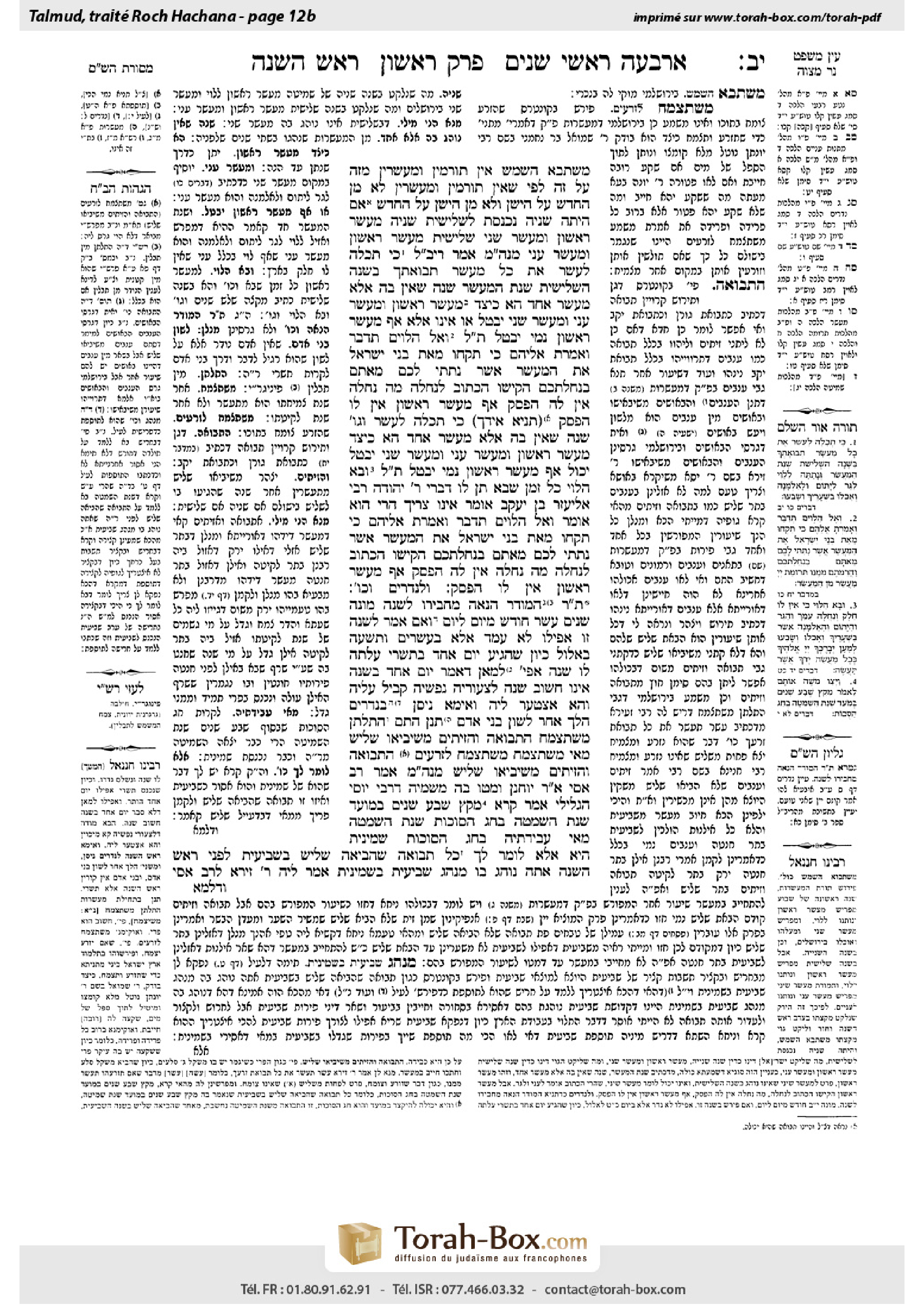
Rosh Hashanah 12b: Talmud study for Daf Yomi
Daf Yomi is the daily study of one Talmud folio. Explore 37 tractates with scans, Hebrew text, Sefaria English and AI-generated French translations where annotated.
Passage selection and English or AI-generated French translation are available where the scan has annotations. Daf Study is independent of Torah-Box and Sefaria.
Browse Rosh Hashanah · ראש השנה · All tractatesRosh Hashanah 12b text and translations
This page of Rosh Hashanah includes the Aramaic text, an English translation and an AI-generated French translation, alongside the scan above.
ראש השנה י״ב ב · Aramaic and Hebrew text
מִשֶּׁתָּבֹא הַשֶּׁמֶשׁ — אֵין תּוֹרְמִין וּמְעַשְּׂרִין מִזֶּה עַל זֶה, לְפִי שֶׁאֵין תּוֹרְמִין וּמְעַשְּׂרִין, לֹא מִן הֶחָדָשׁ עַל הַיָּשָׁן, וְלֹא מִן הַיָּשָׁן עַל הֶחָדָשׁ. אִם הָיְתָה שְׁנִיָּה נִכְנֶסֶת לִשְׁלִישִׁית — שְׁנִיָּה מַעֲשֵׂר רִאשׁוֹן וּמַעֲשֵׂר שֵׁנִי, שְׁלִישִׁית — מַעֲשֵׂר רִאשׁוֹן וּמַעְשַׂר עָנִי.
מְנָא הָנֵי מִילֵּי? אָמַר רַבִּי יְהוֹשֻׁעַ בֶּן לֵוִי: ״כִּי תְכַלֶּה לַעְשֵׂר אֶת כׇּל מַעְשַׂר תְּבוּאָתְךָ בַּשָּׁנָה הַשְּׁלִישִׁית שְׁנַת הַמַּעֲשֵׂר״, שָׁנָה שֶׁאֵין בָּהּ אֶלָּא מַעֲשֵׂר אֶחָד. הָא כֵּיצַד? מַעֲשֵׂר רִאשׁוֹן וּמַעְשַׂר עָנִי, וּמַעֲשֵׂר שֵׁנִי יִבְטַל.
אוֹ אֵינוֹ אֶלָּא אַף מַעֲשֵׂר רִאשׁוֹן נָמֵי יִבְטַל — תַּלְמוּד לוֹמַר: ״וְאֶל הַלְוִיִּם תְּדַבֵּר וְאָמַרְתָּ אֲלֵיהֶם כִּי תִקְחוּ מֵאֶת בְּנֵי יִשְׂרָאֵל אֶת הַמַּעֲשֵׂר אֲשֶׁר נָתַתִּי לָכֶם מֵאִתָּם בְּנַחֲלַתְכֶם״, הִקִּישׁוֹ הַכָּתוּב לְנַחֲלָה: מָה נַחֲלָה אֵין לָהּ הֶפְסֵק — אַף מַעֲשֵׂר רִאשׁוֹן אֵין לוֹ הֶפְסֵק.
תַּנְיָא אִידַּךְ: ״כִּי תְכַלֶּה לַעְשֵׂר וְגוֹ׳״, שָׁנָה שֶׁאֵין בָּהּ אֶלָּא מַעֲשֵׂר אֶחָד. הָא כֵּיצַד? מַעֲשֵׂר רִאשׁוֹן וּמַעְשַׂר עָנִי, וּמַעֲשֵׂר שֵׁנִי יִבְטַל. יָכוֹל אַף מַעֲשֵׂר רִאשׁוֹן נָמֵי יִבְטַל? תַּלְמוּד לוֹמַר: ״וּבָא הַלֵּוִי״, כׇּל זְמַן שֶׁבָּא — תֵּן לוֹ. דִּבְרֵי רַבִּי יְהוּדָה.
רַבִּי אֱלִיעֶזֶר בֶּן יַעֲקֹב אוֹמֵר: אֵינוֹ צָרִיךְ, הֲרֵי הוּא אוֹמֵר: ״וְאֶל הַלְוִיִּם תְּדַבֵּר וְאָמַרְתָּ אֲלֵיהֶם כִּי תִקְחוּ מֵאֶת בְּנֵי יִשְׂרָאֵל אֶת הַמַּעֲשֵׂר אֲשֶׁר נָתַתִּי לָכֶם מֵאִתָּם בְּנַחֲלַתְכֶם״, הִקִּישׁוֹ הַכָּתוּב לְנַחֲלָה: מָה נַחֲלָה אֵין לָהּ הֶפְסֵק — אַף מַעֲשֵׂר רִאשׁוֹן אֵין לוֹ הֶפְסֵק.
וְלַנְּדָרִים וְכוּ׳. תָּנוּ רַבָּנַן: הַמּוּדָּר הֲנָאָה מֵחֲבֵירוֹ לְשָׁנָה — מוֹנֶה שְׁנֵים עָשָׂר חוֹדֶשׁ מִיּוֹם לְיוֹם. וְאִם אָמַר לְשָׁנָה זוֹ, אֲפִילּוּ לֹא עָמַד אֶלָּא בְּעֶשְׂרִים וְתִשְׁעָה בֶּאֱלוּל, כֵּיוָן שֶׁהִגִּיעַ יוֹם אֶחָד בְּתִשְׁרִי — עָלְתָה לוֹ שָׁנָה.
אֲפִילּוּ לְמַאן דְּאָמַר יוֹם אֶחָד בַּשָּׁנָה אֵינוֹ חָשׁוּב שָׁנָה, לְצַעוֹרֵיהּ נַפְשֵׁיהּ קַבֵּיל עֲלֵיהּ — וְהָא אִצְטַעַר לֵיהּ.
וְאֵימָא נִיסָן? בִּנְדָרִים הַלֵּךְ אַחַר לְשׁוֹן בְּנֵי אָדָם.
תְּנַן הָתָם: הַתִּלְתָּן — מִשֶּׁתִּצְמַח, הַתְּבוּאָה וְהַזֵּיתִים — מִשֶּׁיָּבִיאוּ שְׁלִישׁ.
מַאי מִשֶּׁתִּצְמַח — מִשֶּׁתִּצְמַח לִזְרָעִים.
הַתְּבוּאָה וְהַזֵּיתִים מִשֶּׁיָּבִיאוּ שְׁלִישׁ. מְנָא הָנֵי מִילֵּי? אָמַר רַב אַסִּי אָמַר רַבִּי יוֹחָנָן, וּמָטוּ בָּהּ מִשְּׁמֵיהּ דְּרַבִּי יוֹסֵי הַגְּלִילִי, אָמַר קְרָא: ״מִקֵּץ שֶׁבַע שָׁנִים בְּמוֹעֵד שְׁנַת הַשְּׁמִטָּה בְּחַג הַסּוּכּוֹת״, שְׁנַת הַשְּׁמִטָּה מַאי עֲבִידְתֵּיהּ בְּחַג הַסּוּכּוֹת? שְׁמִינִית הִיא!
אֶלָּא, לוֹמַר לָךְ: כׇּל תְּבוּאָה שֶׁהֵבִיאָה שְׁלִישׁ בַּשְּׁבִיעִית לִפְנֵי רֹאשׁ הַשָּׁנָה — אַתָּה נוֹהֵג בּוֹ מִנְהַג שְׁבִיעִית בַּשְּׁמִינִית.
אֲמַר לֵיהּ רַבִּי זֵירָא לְרַב אַסִּי:
Rosh Hashanah 12b · English translation
after sunset, so that they belong to the new year, one may not set aside teruma and tithe from the one to the other, as one may not set aside teruma and tithe from the new crop for the old nor from the old crop for the new. If it was the second year of the Sabbatical cycle going into the third year, the halakha is: From what he picked in the second year he must set aside first tithe, which he gives to a Levite, and second tithe, which he eats in Jerusalem; from what he picked in the third year, he must set aside first tithe and poor man’s tithe, which he gives to one who is needy.
From where are these matters derived that during the third year one must set aside poor man’s tithe and not second tithe? Rabbi Yehoshua ben Levi said: The verse states: “When you have made an end of tithing all the tithes of your produce in the third year, which is the year of the tithe” (Deuteronomy 26:12). This is referring to a year when there is only one of the two tithes that had been given in the previous years. How so? One sets aside first tithe and poor man’s tithe, which is explicitly mentioned in that section, and second tithe is nullified that year.
Or perhaps it is not like this, but in fact even first tithe is nullified during the third year and only one tithe is set aside, i.e., the poor man’s tithe. Therefore, the verse states: “Thus speak to the Levites, and say to them: When you take of the children of Israel the tithes which I have given you from them for your inheritance” (Numbers 18:26). The verse juxtaposes the first tithe that is given to the Levites to an inheritance of land: Just as with regard to an inheritance there is no interruption, as by Torah law a landed inheritance cannot be sold in perpetuity, but rather it passes from one generation to the next without interruption, so too, with regard to the first tithe that is given to the Levites there is no interruption, but rather it is taken every year.
The same halakha is taught in another baraita: The verse states: “When you have made an end of tithing all the tithes of your produce in the third year, which is the year of the tithe.” This is referring to the year when there is only one of the two tithes that had been given in the previous years. How so? One sets aside first tithe and poor man’s tithe, and second tithe is canceled. One might have thought that even first tithe is canceled during the third year. Therefore, the verse states: “And the Levite, because he has no part or inheritance with you, and the stranger, and the fatherless, and the widow, who are within your gates, shall come, and shall eat and be satisfied” (Deuteronomy 14:29). Whenever the Levite comes, give him; every year you must give the Levite his tithe. This is the statement of Rabbi Yehuda.
Rabbi Eliezer ben Ya’akov says: One need not learn this from here but from another source, as it says: “Thus speak to the Levites, and say to them: When you take of the children of Israel the tithes which I have given you from them for your inheritance.” The verse juxtaposes the first tithe to an inheritance of land: Just as with regard to a landed inheritance there is no interruption, so too, with regard to first tithe there is no interruption.
§ It was taught in the baraita cited above: And the first of Tishrei is the new year for vows. The Sages taught in a baraita: One who is prohibited by a vow from deriving benefit from another for a year counts twelve months from day to day, from the day that the vow was taken. This applies whether one took a vow not to derive any benefit from another for a year, or he was the subject of someone else’s vow prohibiting him from deriving any benefit from that individual’s property for a year. But if, when he took the vow, he said: For this year, then even if he took the vow only on the twenty-ninth of Elul, once the first day of Tishrei, the following month, has arrived, it is counted as a year, and he is permitted to derive benefit from the other.
The Gemara comments: This is true even according to the one who said that one day in a year is not considered a year, since in the case of a vow the person accepted upon himself to suffer affliction, and he has already achieved his goal and suffered affliction, and so he has fulfilled his vow.
The Gemara asks: But say that a year with regard to vows ends in Nisan. The Gemara answers: The halakha is that with regard to vows, follow the ordinary language of people. The meaning of a vow is understood in accordance with the way that the words are used in common speech, and when people speak of a year, they ordinarily count it from the beginning of Tishrei.
We learned in a mishna there (Ma’asrot 1:3): From when is produce obligated in tithes? Fenugreek is obligated from the time when it sprouts. Grain and olives are obligated from the time when they have reached one-third of their growth.
The Gemara asks: What is the meaning of the phrase: From the time when it sprouts? Fenugreek begins to sprout almost immediately after it is planted. The Gemara answers: It means from the time when it sprouts for seed, i.e., from the time that its seeds are sufficiently developed to sprout into another crop.
It was taught in the mishna: Grain and olives are obligated in tithes from the time when they have reached one-third of their growth. The Gemara asks: From where are these matters derived, that the years of produce follow the first third of their growth? Rav Asi said that Rabbi Yoḥanan said, and some determined that this statement was said in the name of Rabbi Yosei HaGelili: The verse states: “At the end of every seven years, in the time of the year of release, in the festival of Sukkot” (Deuteronomy 31:10). What is the purpose of the Sabbatical Year being mentioned with the festival of Sukkot? The festival of Sukkot is already the eighth year.
Rather, it comes to tell you that the halakhot of the Sabbatical Year continue to apply on Sukkot of the following year, as you must treat all produce that reached one-third of its growth in the Sabbatical Year before Rosh HaShana with the sanctity of the Sabbatical Year, even if it fully grows and is able to be used only in the eighth year.
Rabbi Zeira said to Rav Asi:
Rosh Hashanah 12b · Traduction française (IA)
après le coucher du soleil, de sorte qu’ils appartiennent à la nouvelle année, on ne peut prélever la terouma et les dîmes de l’un sur l’autre, car on ne peut prélever la terouma et les dîmes de la nouvelle récolte pour l’ancienne, ni de l’ancienne pour la nouvelle. Si l’on passe de la deuxième à la troisième année du cycle sabbatique, la halakha est la suivante : sur ce qu’il a récolté la deuxième année, il doit prélever la première dîme, qu’il donne à un Lévite, et la seconde dîme, qu’il consomme à Jérusalem ; sur ce qu’il a récolté la troisième année, il doit prélever la première dîme et la dîme du pauvre, qu’il donne à une personne dans le besoin.
D’où déduit-on que, la troisième année, il faut prélever la dîme du pauvre et non la seconde dîme ? Rabbi Yehoshua ben Levi dit : Le verset énonce : « Quand tu auras achevé de prélever toutes les dîmes de tes produits, la troisième année, qui est l’année de la dîme » (Deutéronome 26:12). Cela désigne une année où l’on ne prélève qu’une seule des deux dîmes qui étaient prélevées les années précédentes. Comment cela ? On prélève la première dîme et la dîme du pauvre, explicitement mentionnée dans ce passage, et la seconde dîme est supprimée cette année-là.
Ou peut-être n’en est-il pas ainsi, et la première dîme aussi est-elle supprimée la troisième année, de sorte qu’on ne prélève qu’une seule dîme, à savoir la dîme du pauvre ? C’est pourquoi le verset énonce : « Parle ainsi aux Lévites et dis-leur : Quand vous recevrez des enfants d’Israël les dîmes que Je vous ai données de leur part en héritage » (Nombres 18:26). Le verset assimile la première dîme, donnée aux Lévites, à un héritage foncier : de même qu’un héritage foncier ne connaît aucune interruption, puisqu’en vertu de la Torah écrite un héritage foncier ne peut être vendu à perpétuité, mais passe sans interruption d’une génération à l’autre, de même, la première dîme donnée aux Lévites ne connaît aucune interruption : elle est prélevée chaque année.
La même halakha est enseignée dans une autre baraïta : Le verset énonce : « Quand tu auras achevé de prélever toutes les dîmes de tes produits, la troisième année, qui est l’année de la dîme. » Cela désigne l’année où l’on ne prélève qu’une seule des deux dîmes qui étaient prélevées les années précédentes. Comment cela ? On prélève la première dîme et la dîme du pauvre, tandis que la seconde dîme est supprimée. On aurait pu penser que la première dîme aussi est supprimée la troisième année. C’est pourquoi le verset énonce : « Et le Lévite, puisqu’il n’a avec toi ni part ni héritage, ainsi que l’étranger, l’orphelin et la veuve qui sont dans tes portes, viendront, mangeront et seront rassasiés » (Deutéronome 14:29). Chaque fois que le Lévite vient, donne-lui ; tu dois lui donner sa dîme chaque année. Telle est la déclaration de Rabbi Yehuda.
Rabbi Eliezer ben Ya’akov dit : Il n’est pas nécessaire de déduire cela de ce passage, mais d’une autre source, car il est dit : « Parle ainsi aux Lévites et dis-leur : Quand vous recevrez des enfants d’Israël les dîmes que Je vous ai données de leur part en héritage. » Le verset assimile la première dîme à un héritage foncier : de même qu’un héritage foncier ne connaît aucune interruption, de même, la première dîme ne connaît aucune interruption.
§ Il a été enseigné dans la baraïta citée plus haut : le premier Tichri est le nouvel an des vœux. Les Sages ont enseigné dans une baraïta : Celui qui s’interdit par un vœu de tirer profit d’autrui pendant un an compte douze mois, de jour à jour, à partir du jour où le vœu a été prononcé. Cela s’applique qu’il ait fait le vœu de ne tirer aucun profit d’autrui pendant un an, ou qu’une autre personne lui ait interdit, par un vœu, de tirer profit des biens de celle-ci pendant un an. Mais s’il a dit, en prononçant le vœu : « Pour cette année », alors, même s’il n’a fait le vœu que le vingt-neuvième jour d’Eloul, dès l’arrivée du premier Tichri, le mois suivant, cela compte comme une année et il lui est permis de tirer profit de l’autre personne.
La Guemara fait remarquer : Cela est vrai même selon celui qui dit qu’un jour dans une année ne compte pas comme une année, puisque, dans le cas d’un vœu, la personne s’est imposé une souffrance et a déjà atteint son objectif en souffrant ; elle a donc accompli son vœu.
La Guemara demande : Mais ne pourrait-on pas dire que, pour les vœux, une année s’achève en Nissan ? La Guemara répond : Pour les vœux, la halakha suit le langage courant. Le sens d’un vœu se comprend d’après l’usage ordinaire des mots ; or, lorsqu’on parle d’une année, on la compte habituellement à partir du début de Tichri.
Nous avons appris dans une Michna, là-bas (Ma’asrot 1:3) : À partir de quand les produits sont-ils assujettis aux dîmes ? Le fenugrec y est assujetti dès qu’il germe. Les céréales et les olives y sont assujetties lorsqu’elles ont atteint le tiers de leur croissance.
La Guemara demande : Que signifie l’expression « dès qu’il germe » ? Le fenugrec commence à germer presque aussitôt après avoir été semé. La Guemara répond : Cela signifie dès qu’il germe pour produire des graines, c’est-à-dire à partir du moment où ses graines sont suffisamment développées pour germer et donner une nouvelle récolte.
Il a été enseigné dans la Michna : Les céréales et les olives sont assujetties aux dîmes lorsqu’elles ont atteint le tiers de leur croissance. La Guemara demande : D’où déduit-on que l’année à laquelle sont rattachés les produits est déterminée par le premier tiers de leur croissance ? Rav Asi dit au nom de Rabbi Yoḥanan — et certains attribuent cette déclaration à Rabbi Yosei HaGelili — : Le verset énonce : « Au terme de chaque période de sept ans, à l’époque de l’année de la remise, lors de la fête de Souccot » (Deutéronome 31:10). Pourquoi mentionner l’année sabbatique avec la fête de Souccot ? La fête de Souccot a déjà lieu la huitième année.
Au contraire, cela vient t’enseigner que les halakhot de l’année sabbatique continuent de s’appliquer à Souccot de l’année suivante : tu dois considérer comme ayant la sainteté de l’année sabbatique tous les produits qui avaient atteint le tiers de leur croissance pendant l’année sabbatique avant Roch Hachana, même s’ils ne parviennent à maturité et ne peuvent être utilisés qu’à la huitième année.
Rabbi Zeira dit à Rav Asi :
Traduction française générée par IA à partir de l’édition anglaise de Sefaria. Vérifie toujours un passage avec le texte source.
Text from Sefaria: William Davidson Edition - Vocalized Aramaic (CC BY NC); William Davidson Edition - English (CC BY NC).