Rosh Hashanah 12a: Talmud study for Daf Yomi
Daf Yomi is the daily study of one Talmud folio. Explore 37 tractates with scans, Hebrew text, Sefaria English and AI-generated French translations where annotated.
Passage selection and English or AI-generated French translation are available where the scan has annotations. Daf Study is independent of Torah-Box and Sefaria.
Browse Rosh Hashanah · ראש השנה · All tractatesRosh Hashanah 12a text and translations
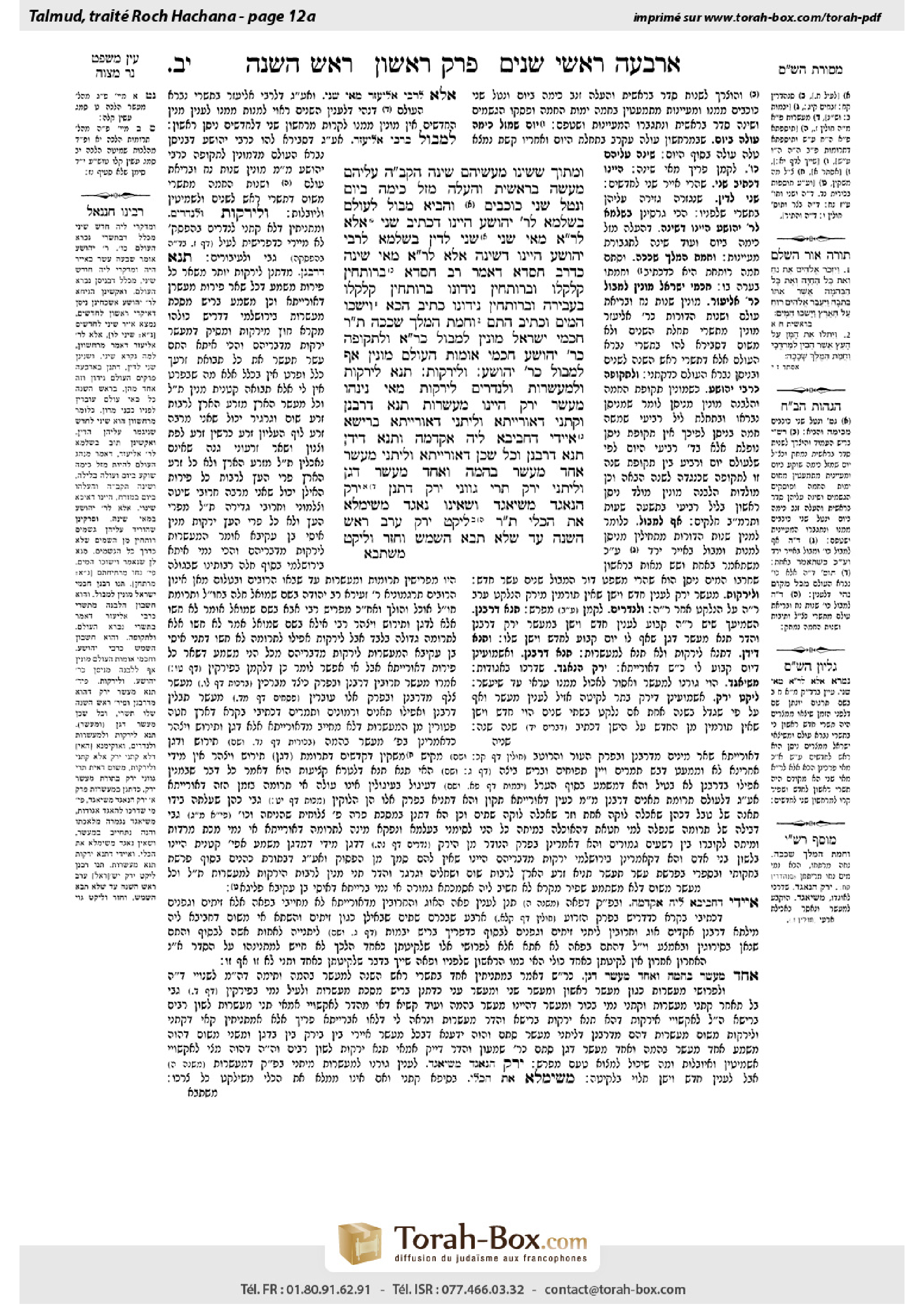
This page of Rosh Hashanah includes the Aramaic text, an English translation and an AI-generated French translation, alongside the scan above.
ראש השנה י״ב א · Aramaic and Hebrew text
וּמִתּוֹךְ שֶׁשִּׁינּוּ מַעֲשֵׂיהֶם, שִׁינָּה הַקָּדוֹשׁ בָּרוּךְ הוּא עֲלֵיהֶם מַעֲשֵׂה בְרֵאשִׁית, וְהֶעֱלָה מַזַּל כִּימָה בַּיּוֹם, וְנָטַל שְׁנֵי כּוֹכָבִים וְהֵבִיא מַבּוּל לָעוֹלָם.
בִּשְׁלָמָא לְרַבִּי יְהוֹשֻׁעַ, הַיְינוּ דִּכְתִיב: ״שֵׁנִי״. אֶלָּא לְרַבִּי אֱלִיעֶזֶר, מַאי ״שֵׁנִי״? שֵׁנִי לְדִין.
בִּשְׁלָמָא לְרַבִּי יְהוֹשֻׁעַ, הַיְינוּ דְּשִׁינָּה. אֶלָּא לְרַבִּי אֱלִיעֶזֶר, מַאי שִׁינָּה?
כִּדְרַב חִסְדָּא. דְּאָמַר רַב חִסְדָּא: בְּרוֹתְחִין קִלְקְלוּ וּבְרוֹתְחִין נִידּוֹנוּ. בְּרוֹתְחִין קִלְקְלוּ — בַּעֲבֵירָה, וּבְרוֹתְחִין נִידּוֹנוּ — כְּתִיב הָכָא: ״וַיָּשֹׁכּוּ הַמָּיִם״, וּכְתִיב הָתָם: ״וַחֲמַת הַמֶּלֶךְ שָׁכָכָה״.
תָּנוּ רַבָּנַן: חַכְמֵי יִשְׂרָאֵל מוֹנִין לַמַּבּוּל כְּרַבִּי אֱלִיעֶזֶר, וְלַתְּקוּפָה כְּרַבִּי יְהוֹשֻׁעַ. חַכְמֵי אוּמּוֹת הָעוֹלָם מוֹנִין אַף לַמַּבּוּל כְּרַבִּי יְהוֹשֻׁעַ.
וְלַיְּרָקוֹת. תָּנָא: לַיְּרָקוֹת וְלַמַּעַשְׂרוֹת וְלַנְּדָרִים. לַיְּרָקוֹת מַאי נִינְהוּ? מַעֲשֵׂר יָרָק.
הַיְינוּ מַעַשְׂרוֹת? תְּנָא דְּרַבָּנַן וְקָתָנֵי דְּאוֹרָיְיתָא.
וְלִיתְנֵי דְּאוֹרָיְיתָא בְּרֵישָׁא! אַיְּידֵי דַּחֲבִיבָא לֵיהּ — אַקְדְּמַהּ. וְתַנָּא דִּידַן? תְּנָא דְּרַבָּנַן, וְכׇל שֶׁכֵּן דְּאוֹרָיְיתָא.
וְלִיתְנֵי ״מַעֲשֵׂר״! אֶחָד מַעְשַׂר בְּהֵמָה וְאֶחָד מַעְשַׂר דָּגָן. וְלִיתְנֵי ״יָרָק״! תְּרֵי גַּוְונֵי יָרָק, דִּתְנַן: יָרָק הַנֶּאֱגָד — מִשֶּׁיֵּאָגֵד, וְשֶׁאֵינוֹ נֶאֱגָד — מִשֶּׁיְּמַלֵּא אֶת הַכְּלִי.
תָּנוּ רַבָּנַן: לִיקֵּט יָרָק עֶרֶב רֹאשׁ הַשָּׁנָה עַד שֶׁלֹּא תָּבֹא הַשֶּׁמֶשׁ, וְחָזַר וְלִיקֵּט
Rosh Hashanah 12a · English translation
But because the people changed their actions for the worse, the Holy One, Blessed be He, changed for them the acts of Creation and He caused the constellation of Kima to rise during the day, and He removed two stars from it and He brought a flood to the world.
The Gemara asks: Granted, according to Rabbi Yehoshua, who holds that the flood began in the month of Iyyar, this is as it is written: “In the second month,” which is referring to the month of Iyyar, the second month from Nisan. But according to Rabbi Eliezer, who holds that the flood began in the month of Marḥeshvan, what is the meaning of “the second month”? The Gemara answers: It means second to the month that includes the day of judgment, which is the month of Tishrei.
The Gemara asks further: Granted, according to Rabbi Yehoshua, who holds that the flood began in the month of Iyyar, this is what it means that He changed the acts of Creation with a flood, as rain does not usually fall in Iyyar. But according to Rabbi Eliezer, who holds that the flood began in Marḥeshvan, what did He change?
The Gemara answers: Even according to Rabbi Eliezer a change was made, in accordance with the statement of Rav Ḥisda, as Rav Ḥisda said: They sinned with boiling heat, and they were punished with boiling heat; they sinned with the boiling heat of the sin of forbidden sexual relations, and they were punished with the boiling heat of scalding waters. This is derived from a verbal analogy. It is written here, with regard to the flood: “And the waters abated” (Genesis 8:1), and it is written elsewhere, with regard to King Ahasuerus: “And the heated anger of the king abated” (Esther 7:10), which implies that the word “abated” means cooled. This indicates that at first the waters of the flood had been scalding hot.
The Sages taught in a baraita: The Jewish Sages count the years from Creation and the flood in accordance with the opinion of Rabbi Eliezer, from Tishrei, and they calculate the cycles of the sun and the moon in accordance with the opinion of Rabbi Yehoshua, from Nisan. The sages of the gentile nations of the world, on the other hand, count both the years from Creation and the flood in accordance with the opinion of Rabbi Yehoshua, from Nisan.
§ The mishna taught: And the first of Tishrei is the new year for vegetables. It is taught in a baraita: The first of Tishrei is the new year for vegetables, and for tithes, and for vows. The Gemara asks: What is meant by the term: For vegetables? It means for the vegetable tithe, i.e., one may not take teruma or tithes from vegetables picked before Rosh HaShana in order to fulfill the obligation for vegetables picked after Rosh HaShana.
The Gemara asks: If so, this is the same as the meaning of the term for tithes, and yet the baraita distinguishes between them. The Gemara answers: The baraita taught first about a tithe that is by rabbinic law, i.e., the vegetable tithe, that its new year is the first of Tishrei, and then it teaches about a tithe that is by Torah law, i.e., the tithe of grain, wine, and oil, that its new year is also the first of Tishrei.
The Gemara asks: If so, let the tanna of the baraita teach that which is by Torah law in the first clause. The Gemara explains: Since the halakha with regard to vegetable tithes was dear to him, he mentioned it first. He taught first about the tithe that is by rabbinic decree, as it involves a greater novelty, and afterward he taught about the tithe that is by Torah law. The Gemara asks further: And with regard to the tanna of our mishna, who mentioned only vegetables but not tithes, what is his reasoning? The Gemara explains: He taught vegetable tithes, which are by rabbinic decree, and from which one may infer all the more so that the first of Tishrei is the new year for the tithe of grain, wine, and oil, which is by Torah law.
The Gemara raises a question about the baraita: But let the tanna of the baraita teach: Tithe, in the singular. Why teach tithes in the plural? The Gemara answers: He uses this formulation to include both the animal tithe and the grain tithe. The Gemara asks further: But let him teach: Vegetable, in the singular. Why teach: Vegetables, in the plural? The Gemara answers: He means to include two categories of vegetables, as we learned in a mishna: With regard to a type of vegetable that is usually made into bundles before being sold, the time of tithing is from when it is bundled; and with regard to a type of vegetable that is not usually made into such bundles, the time of tithing is from when one fills a vessel with it.
§ The Sages taught in a baraita: If one picked vegetables on the eve of Rosh HaShana before the sun had set, so that they belong to the previous year, and then he returned and he picked more vegetables
Rosh Hashanah 12a · Traduction française (IA)
Mais parce que les gens avaient changé leur conduite en mal, le Saint, béni soit-Il, modifia pour eux les actes de la Création : Il fit se lever la constellation de Kima pendant le jour, lui retira deux étoiles et fit venir le Déluge sur le monde.
La Guemara demande : Certes, selon Rabbi Yehoshua, qui soutient que le Déluge commença au mois d’Iyyar, cela correspond à ce qui est écrit : « Au deuxième mois », c’est-à-dire au mois d’Iyyar, le deuxième mois à compter de Nisan. Mais selon Rabbi Eliezer, qui soutient que le Déluge commença au mois de Marḥeshvan, que signifie « au deuxième mois » ? La Guemara répond : Cela signifie le deuxième mois après celui qui comprend le jour du jugement, c’est-à-dire le mois de Tishrei.
La Guemara demande encore : Certes, selon Rabbi Yehoshua, qui soutient que le Déluge commença au mois d’Iyyar, on comprend qu’Il modifia les actes de la Création en faisant venir un Déluge, car il ne pleut généralement pas en Iyyar. Mais selon Rabbi Eliezer, qui soutient que le Déluge commença en Marḥeshvan, qu’a-t-Il modifié ?
La Guemara répond : Même selon Rabbi Eliezer, une modification eut lieu, conformément à l’enseignement de Rav Ḥisda. Car Rav Ḥisda a dit : Ils péchèrent par une chaleur ardente et furent punis par une chaleur ardente ; ils péchèrent par la chaleur ardente du péché des relations sexuelles interdites et furent punis par la chaleur ardente des eaux brûlantes. Cela se déduit d’une analogie verbale. Il est écrit ici, à propos du Déluge : « Et les eaux s’apaisèrent » (Genèse 8,1), et il est écrit ailleurs, à propos du roi Assuérus : « Et la colère ardente du roi s’apaisa » (Esther 7,10), ce qui implique que le mot « s’apaisa » signifie « se refroidit ». Cela indique qu’au début, les eaux du Déluge étaient brûlantes.
Les Sages ont enseigné dans une baraïta : Les Sages juifs comptent les années depuis la Création et celles du Déluge conformément à l’opinion de Rabbi Eliezer, à partir de Tishrei, et calculent les cycles du soleil et de la lune conformément à l’opinion de Rabbi Yehoshua, à partir de Nisan. En revanche, les sages des nations du monde comptent aussi bien les années depuis la Création que celles du Déluge conformément à l’opinion de Rabbi Yehoshua, à partir de Nisan.
§ La Michna enseignait : Le premier Tishrei est le nouvel an des légumes. Une baraïta enseigne : Le premier Tishrei est le nouvel an des légumes, des dîmes et des vœux. La Guemara demande : Que signifie l’expression « des légumes » ? Elle désigne la dîme des légumes, c’est-à-dire qu’on ne peut pas prélever la terouma ou des dîmes sur des légumes cueillis avant Roch Hachana pour s’acquitter de l’obligation concernant des légumes cueillis après Roch Hachana.
La Guemara demande : Dans ce cas, cela a le même sens que l’expression « des dîmes », et pourtant la baraïta les distingue. La Guemara répond : La baraïta a d’abord enseigné qu’une dîme relevant de la loi rabbinique, à savoir la dîme des légumes, a pour nouvel an le premier Tishrei ; puis elle enseigne qu’une dîme relevant de la Torah écrite, à savoir la dîme des céréales, du vin et de l’huile, a également pour nouvel an le premier Tishrei.
La Guemara demande : Dans ce cas, que le tanna de la baraïta enseigne d’abord ce qui relève de la Torah écrite. La Guemara explique : Comme la halakha concernant les dîmes des légumes lui tenait à cœur, il l’a mentionnée en premier. Il a d’abord enseigné la dîme instituée par décret rabbinique, car elle présente une nouveauté plus grande, puis il a enseigné la dîme relevant de la Torah écrite. La Guemara demande encore : Et quant au tanna de notre Michna, qui n’a mentionné que les légumes, mais pas les dîmes, quelle est sa raison ? La Guemara explique : Il a enseigné les dîmes des légumes, qui relèvent d’un décret rabbinique ; on peut en déduire a fortiori que le premier Tishrei est le nouvel an de la dîme des céréales, du vin et de l’huile, qui relève de la Torah écrite.
La Guemara soulève une question à propos de la baraïta : Que le tanna de la baraïta enseigne « dîme », au singulier. Pourquoi enseigner « dîmes », au pluriel ? La Guemara répond : Cette formulation inclut à la fois la dîme animale et la dîme des céréales. La Guemara demande encore : Qu’il enseigne « légume », au singulier. Pourquoi enseigner « légumes », au pluriel ? La Guemara répond : Il veut inclure deux catégories de légumes, comme nous l’avons appris dans une Michna : pour une sorte de légume que l’on met habituellement en bottes avant de le vendre, le moment du prélèvement de la dîme est celui où on le met en bottes ; et pour une sorte de légume que l’on ne met pas habituellement en bottes de cette manière, le moment du prélèvement de la dîme est celui où l’on en remplit un récipient.
§ Les Sages ont enseigné dans une baraïta : Si quelqu’un a cueilli des légumes la veille de Roch Hachana, avant le coucher du soleil, de sorte qu’ils appartiennent à l’année précédente, puis qu’il est revenu et a cueilli d’autres légumes
Traduction française générée par IA à partir de l’édition anglaise de Sefaria. Vérifie toujours un passage avec le texte source.
Text from Sefaria: William Davidson Edition - Vocalized Aramaic (CC BY NC); William Davidson Edition - English (CC BY NC).