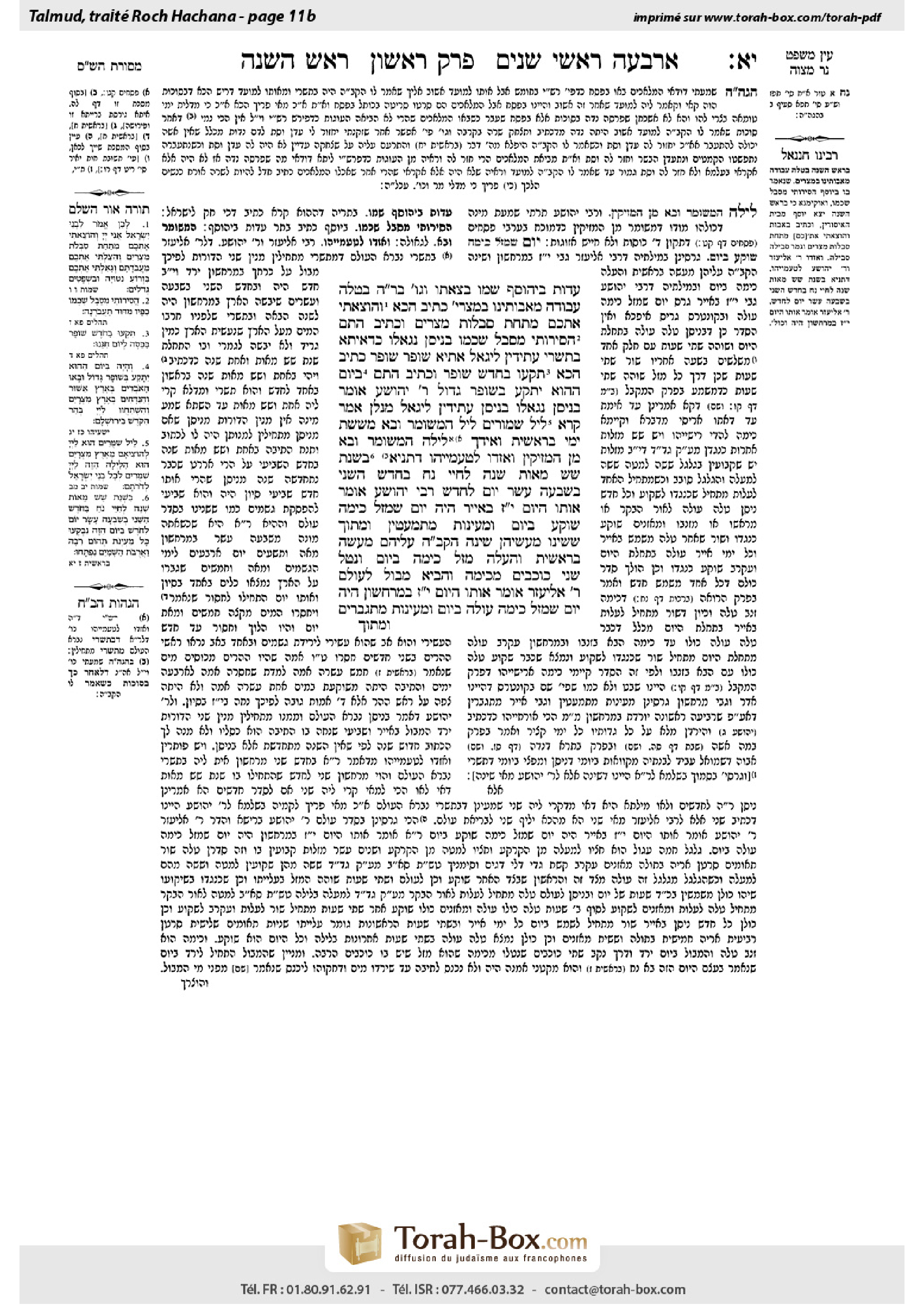
Rosh Hashanah 11b: Talmud study for Daf Yomi
Daf Yomi is the daily study of one Talmud folio. Explore 37 tractates with scans, Hebrew text, Sefaria English and AI-generated French translations where annotated.
Passage selection and English or AI-generated French translation are available where the scan has annotations. Daf Study is independent of Torah-Box and Sefaria.
Browse Rosh Hashanah · ראש השנה · All tractatesRosh Hashanah 11b text and translations
This page of Rosh Hashanah includes the Aramaic text, an English translation and an AI-generated French translation, alongside the scan above.
ראש השנה י״א ב · Aramaic and Hebrew text
עֵדוּת בִּיהוֹסֵף שָׂמוֹ בְּצֵאתוֹ וְגוֹ׳״.
בְּרֹאשׁ הַשָּׁנָה בָּטְלָה עֲבוֹדָה מֵאֲבוֹתֵינוּ בְּמִצְרַיִם — כְּתִיב הָכָא: ״וְהוֹצֵאתִי אֶתְכֶם מִתַּחַת סִבְלוֹת מִצְרַיִם״, וּכְתִיב הָתָם: ״הֲסִירוֹתִי מִסֵּבֶל שִׁכְמוֹ״.
בְּנִיסָן נִגְאֲלוּ — כִּדְאִיתָא. בְּתִשְׁרִי עֲתִידִין לִיגָּאֵל — אָתְיָא ״שׁוֹפָר״ ״שׁוֹפָר״. כְּתִיב הָכָא: ״תִּקְעוּ בַחֹדֶשׁ שׁוֹפָר״, וּכְתִיב הָתָם: ״בְּיוֹם הַהוּא יִתָּקַע בְּשׁוֹפָר גָּדוֹל״.
רַבִּי יְהוֹשֻׁעַ אוֹמֵר: בְּנִיסָן נִגְאֲלוּ, בְּנִיסָן עֲתִידִין לִיגָּאֵל — מְנָלַן? אָמַר קְרָא: ״לֵיל שִׁמּוּרִים״ — לַיִל הַמְשׁוּמָּר וּבָא מִשֵּׁשֶׁת יְמֵי בְּרֵאשִׁית.
וְאִידַּךְ: לַיְלָה הַמְּשׁוּמָּר וּבָא מִן הַמַּזִּיקִין.
וְאָזְדוּ לְטַעְמַיְיהוּ, דְּתַנְיָא: ״בִּשְׁנַת שֵׁשׁ מֵאוֹת שָׁנָה לְחַיֵּי נֹחַ בַּחֹדֶשׁ הַשֵּׁנִי בְּשִׁבְעָה עָשָׂר יוֹם לַחֹדֶשׁ״, רַבִּי יְהוֹשֻׁעַ אוֹמֵר: אוֹתוֹ הַיּוֹם שִׁבְעָה עָשָׂר בְּאִיָּיר הָיָה, יוֹם שֶׁמַּזַּל כִּימָה שׁוֹקֵעַ בַּיּוֹם וּמַעְיָנוֹת מִתְמַעֲטִין. וּמִתּוֹךְ שֶׁשִּׁינּוּ מַעֲשֵׂיהֶן, שִׁינָּה הַקָּדוֹשׁ בָּרוּךְ הוּא עֲלֵיהֶם מַעֲשֵׂה בְרֵאשִׁית, וְהֶעֱלָה מַזַּל כִּימָה בַּיּוֹם, וְנָטַל שְׁנֵי כּוֹכָבִים מִכִּימָה וְהֵבִיא מַבּוּל לָעוֹלָם.
רַבִּי אֱלִיעֶזֶר אוֹמֵר: אוֹתוֹ הַיּוֹם שִׁבְעָה עָשָׂר בְּמַרְחֶשְׁוָן הָיָה, יוֹם שֶׁמַּזַּל כִּימָה עוֹלֶה בַּיּוֹם וּמַעְיָנוֹת מִתְגַּבְּרִים.
Rosh Hashanah 11b · English translation
And immediately afterward it is written: “This He ordained in Joseph for testimony, when he went out over the land of Egypt” (Psalms 81:6), implying that Joseph’s release from prison took place on Rosh HaShana.
It was also taught in the baraita: On Rosh HaShana our forefathers’ slavery in Egypt ceased. From where is this known? It is written here: “And I will bring you out from under the burdens of Egypt” (Exodus 6:6); and it is written there, with regard to Joseph: “I removed his shoulder from the burden” (Psalms 81:7). From here it is derived by verbal analogy between the two instances of the word “burden” that just as Joseph was released from prison in Tishrei, so too, the slavery of our forefathers in Egypt ended in Tishrei.
It was taught in the baraita: In Nisan our forefathers were redeemed from Egypt, as it is explicitly stated in the Torah. The baraita continues: In Tishrei in the future the Jewish people will be redeemed in the final redemption. This is derived by means of a verbal analogy between one instance of the word shofar and another instance of the word shofar. It is written here, with regard to Rosh HaShana: “Sound a shofar at the New Moon” (Psalms 81:4), and it is written there, with regard to the final redemption: “And it shall come to pass on that day, that a great shofar shall be blown” (Isaiah 27:13).
It was also taught in the baraita: Rabbi Yehoshua says: In Nisan our forefathers were redeemed from Egypt; and in Nisan in the future the Jewish people will be redeemed in the final redemption. The Gemara asks: From where do we derive that the final redemption will be in Nisan? The verse states: “It is a night of watching for the Lord for bringing them out from the land of Egypt; this is the Lord’s night of watching, for all the children of Israel throughout their generations” (Exodus 12:42). This teaches that the night of Passover is a night that has been continuously watched, i.e., set aside for the purpose of redemption, from the six days of Creation, and it will continue to be so until the final redemption.
The Gemara asks: And how does the other tanna, Rabbi Eliezer, understand this verse? He derives from it that this is a night that is continuously watched and protected from demons, meaning that demons have no power on the first night of Passover.
And Rabbi Eliezer and Rabbi Yehoshua follow their lines of reasoning, as they disagreed about this same issue in another context as well. As it is taught in a baraita: “In the six hundredth year of Noah’s life, in the second month, on the seventeenth day of the month, on that day were all the fountains of the great deep broken open, and the windows of heaven were opened” (Genesis 7:11). Rabbi Yehoshua says: That day was the seventeenth of Iyyar, the second month of the year counting from Nisan, which is the day that the constellation of Kima sets during the day and the season that the springs diminish with the increased heat. But because the people of the generation of the flood changed their actions for the worse, the Holy One, Blessed be He, changed for them the acts of Creation, and instead of Kima setting, He caused the constellation of Kima to rise during the day and He removed two stars from Kima, and in this way He brought a flood to the world.
Rabbi Eliezer disagrees and says: That day was the seventeenth of Marḥeshvan, the second month counting from Tishrei, which is the day that the constellation of Kima rises during the day and the season that the springs increase.
Rosh Hashanah 11b · Traduction française (IA)
Et immédiatement après, il est écrit : « Il en fit une loi pour Joseph, comme témoignage, lorsqu’il partit contre le pays d’Égypte » (Psaumes 81,6), ce qui implique que Joseph fut libéré de prison à Roch Hachana.
Il a également été enseigné dans une baraïta : À Roch Hachana, l’esclavage de nos ancêtres en Égypte prit fin. D’où le sait-on ? Il est écrit ici : « Je vous ferai sortir de dessous les corvées de l’Égypte » (Exode 6,6), et il est écrit là, au sujet de Joseph : « J’ai retiré son épaule de la charge » (Psaumes 81,7). On déduit de là, par analogie verbale entre les deux occurrences du mot « charge », que, de même que Joseph fut libéré de prison en tichri, l’esclavage de nos ancêtres en Égypte prit lui aussi fin en tichri.
Il a été enseigné dans une baraïta : En nissan, nos ancêtres furent délivrés d’Égypte, comme la Torah l’affirme explicitement. La baraïta poursuit : En tichri, à l’avenir, le peuple juif sera délivré lors de la rédemption finale. On le déduit par analogie verbale entre deux occurrences du mot « chofar ». Il est écrit ici, à propos de Roch Hachana : « Faites retentir le chofar à la nouvelle lune » (Psaumes 81,4), et il est écrit là, à propos de la rédemption finale : « En ce jour-là, un grand chofar retentira » (Isaïe 27,13).
Il a également été enseigné dans une baraïta : Rabbi Yehoshua dit : En nissan, nos ancêtres furent délivrés d’Égypte, et en nissan, à l’avenir, le peuple juif sera délivré lors de la rédemption finale. La Guemara demande : D’où déduisons-nous que la rédemption finale aura lieu en nissan ? Le verset dit : « C’est une nuit de veille pour le Seigneur, pour les faire sortir du pays d’Égypte ; cette nuit est une veille pour le Seigneur, pour tous les enfants d’Israël, de génération en génération » (Exode 12,42). Cela enseigne que la nuit de Pessa’h est une nuit qui a été continuellement réservée, c’est-à-dire mise à part en vue de la rédemption, depuis les six jours de la Création, et qu’elle le restera jusqu’à la rédemption finale.
La Guemara demande : Et comment l’autre tanna, Rabbi Eliezer, comprend-il ce verset ? Il en déduit qu’il s’agit d’une nuit continuellement surveillée et protégée contre les démons, c’est-à-dire que les démons n’ont aucun pouvoir durant la première nuit de Pessa’h.
Rabbi Eliezer et Rabbi Yehoshua restent cohérents avec leurs raisonnements respectifs, car ils ont également divergé sur cette même question dans un autre contexte. En effet, il est enseigné dans une baraïta : « La six centième année de la vie de Noé, le deuxième mois, le dix-septième jour du mois, ce jour-là, toutes les sources du grand abîme se fendirent et les fenêtres des cieux s’ouvrirent » (Genèse 7,11). Rabbi Yehoshua dit : Ce jour était le dix-septième d’iyyar, le deuxième mois de l’année comptée à partir de nissan. C’est le jour où la constellation de Kima se couche pendant la journée et la saison où les sources diminuent sous l’effet de la chaleur croissante. Mais parce que les gens de la génération du Déluge avaient aggravé leur conduite, le Saint, béni soit-Il, modifia pour eux les actes de la Création : au lieu que Kima se couche, Il fit se lever la constellation de Kima pendant la journée et lui retira deux étoiles. C’est ainsi qu’Il fit venir un déluge sur le monde.
Rabbi Eliezer n’est pas d’accord et dit : Ce jour était le dix-septième de mar’hechvan, le deuxième mois compté à partir de tichri. C’est le jour où la constellation de Kima se lève pendant la journée et la saison où les sources abondent.
Traduction française générée par IA à partir de l’édition anglaise de Sefaria. Vérifie toujours un passage avec le texte source.
Text from Sefaria: William Davidson Edition - Vocalized Aramaic (CC BY NC); William Davidson Edition - English (CC BY NC).