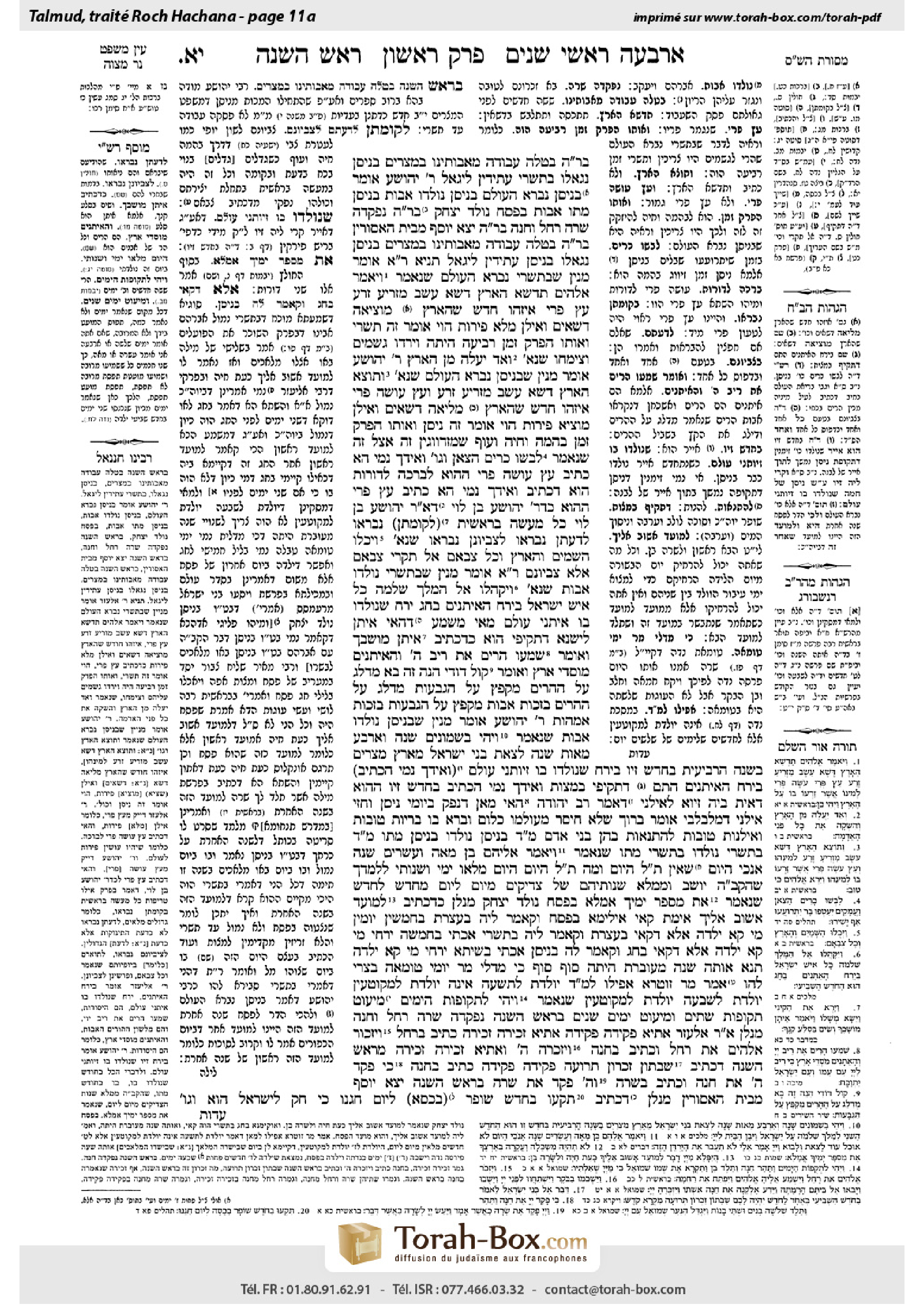
Rosh Hashanah 11a: Talmud study for Daf Yomi
Daf Yomi is the daily study of one Talmud folio. Explore 37 tractates with scans, Hebrew text, Sefaria English and AI-generated French translations where annotated.
Passage selection and English or AI-generated French translation are available where the scan has annotations. Daf Study is independent of Torah-Box and Sefaria.
Browse Rosh Hashanah · ראש השנה · All tractatesRosh Hashanah 11a text and translations
This page of Rosh Hashanah includes the Aramaic text, an English translation and an AI-generated French translation, alongside the scan above.
ראש השנה י״א א · Aramaic and Hebrew text
בְּרֹאשׁ הַשָּׁנָה בָּטְלָה עֲבוֹדָה מֵאֲבוֹתֵינוּ בְּמִצְרַיִם, בְּנִיסָן נִגְאֲלוּ, בְּתִשְׁרִי עֲתִידִין לִיגָּאֵל.
רַבִּי יְהוֹשֻׁעַ אוֹמֵר: בְּנִיסָן נִבְרָא הָעוֹלָם, בְּנִיסָן נוֹלְדוּ אָבוֹת, בְּנִיסָן מֵתוּ אָבוֹת, בְּפֶסַח נוֹלַד יִצְחָק, בְּרֹאשׁ הַשָּׁנָה נִפְקְדָה שָׂרָה רָחֵל וְחַנָּה, בְּרֹאשׁ הַשָּׁנָה יָצָא יוֹסֵף מִבֵּית הָאֲסוּרִין, בְּרֹאשׁ הַשָּׁנָה בָּטְלָה עֲבוֹדָה מֵאֲבוֹתֵינוּ בְּמִצְרַיִם, בְּנִיסָן נִגְאֲלוּ בְּנִיסָן עֲתִידִין לִיגָּאֵל.
תַּנְיָא, רַבִּי אֱלִיעֶזֶר אוֹמֵר: מִנַּיִן שֶׁבְּתִשְׁרִי נִבְרָא הָעוֹלָם — שֶׁנֶּאֱמַר: ״וַיֹּאמֶר אֱלֹהִים תַּדְשֵׁא הָאָרֶץ דֶּשֶׁא עֵשֶׂב מַזְרִיעַ זֶרַע עֵץ פְּרִי״. אֵיזֶהוּ חֹדֶשׁ שֶׁהָאָרֶץ מוֹצִיאָה דְּשָׁאִים וְאִילָן מָלֵא פֵּירוֹת — הֱוֵי אוֹמֵר זֶה תִּשְׁרִי. וְאוֹתוֹ הַפֶּרֶק זְמַן רְבִיעָה הָיְתָה, וְיָרְדוּ גְּשָׁמִים וְצִימֵּחוּ, שֶׁנֶּאֱמַר: ״וְאֵד יַעֲלֶה מִן הָאָרֶץ״.
רַבִּי יְהוֹשֻׁעַ אוֹמֵר: מִנַּיִן שֶׁבְּנִיסָן נִבְרָא הָעוֹלָם — שֶׁנֶּאֱמַר: ״וַתּוֹצֵא הָאָרֶץ דֶּשֶׁא עֵשֶׂב מַזְרִיעַ זֶרַע וְעֵץ עוֹשֶׂה פְּרִי״. אֵיזֶהוּ חֹדֶשׁ שֶׁהָאָרֶץ מְלֵיאָה דְּשָׁאִים וְאִילָן מוֹצִיא פֵּירוֹת — הֱוֵי אוֹמֵר, זֶה נִיסָן. וְאוֹתוֹ הַפֶּרֶק, זְמַן בְּהֵמָה וְחַיָּה וָעוֹף שֶׁמִּזְדַּוְּוגִין זֶה אֵצֶל זֶה, שֶׁנֶּאֱמַר: ״לָבְשׁוּ כָרִים הַצֹּאן וְגוֹ׳״.
וְאִידַּךְ נָמֵי, הָא כְּתִיב: ״עֵץ עוֹשֶׂה פְּרִי״! הָהוּא לִבְרָכָה לְדוֹרוֹת הוּא דִּכְתִיב.
וְאִידַּךְ נָמֵי, הָא כְּתִיב: ״עֵץ פְּרִי״? הָהוּא כִּדְרַבִּי יְהוֹשֻׁעַ בֶּן לֵוִי. דְּאָמַר רַבִּי יְהוֹשֻׁעַ בֶּן לֵוִי: כׇּל מַעֲשֵׂה בְרֵאשִׁית לְקוֹמָתָן נִבְרְאוּ, לְדַעְתָּן נִבְרְאוּ, לְצִבְיוֹנָן נִבְרְאוּ, שֶׁנֶּאֱמַר: ״וַיְכֻלּוּ הַשָּׁמַיִם וְהָאָרֶץ וְכׇל צְבָאָם״, אַל תִּקְרֵי ״צְבָאָם״, אֶלָּא ״צִבְיוֹנָם״.
רַבִּי אֱלִיעֶזֶר אוֹמֵר: מִנַּיִן שֶׁבְּתִשְׁרִי נוֹלְדוּ אָבוֹת — שֶׁנֶּאֱמַר: ״וַיִּקָּהֲלוּ אֶל הַמֶּלֶךְ שְׁלֹמֹה כׇּל אִישׁ יִשְׂרָאֵל בְּיֶרַח הָאֵיתָנִים בֶּחָג״, יֶרַח שֶׁנּוֹלְדוּ בּוֹ אֵיתָנֵי עוֹלָם.
מַאי מַשְׁמַע דְּהַאי ״אֵיתָן״ לִישָּׁנָא דְּתַקִּיפֵי הוּא — כְּדִכְתִיב: ״אֵיתָן מוֹשָׁבֶךָ״, וְאוֹמֵר: ״שִׁמְעוּ הָרִים אֶת רִיב ה׳ וְהָאֵיתָנִים מוֹסְדֵי אָרֶץ״, וְאוֹמֵר: ״קוֹל דּוֹדִי הִנֵּה זֶה בָּא מְדַלֵּג עַל הֶהָרִים מְקַפֵּץ עַל הַגְּבָעוֹת״. ״מְדַלֵּג עַל הֶהָרִים״ — בִּזְכוּת אָבוֹת. ״מְקַפֵּץ עַל הַגְּבָעוֹת״ — בִּזְכוּת אִמָּהוֹת.
רַבִּי יְהוֹשֻׁעַ אוֹמֵר: מִנַּיִן שֶׁבְּנִיסָן נוֹלְדוּ אָבוֹת — שֶׁנֶּאֱמַר: ״וַיְהִי בִשְׁמוֹנִים שָׁנָה וְאַרְבַּע מֵאוֹת שָׁנָה לְצֵאת בְּנֵי יִשְׂרָאֵל מֵאֶרֶץ מִצְרַיִם בַּשָּׁנָה הָרְבִיעִית בְּחֹדֶשׁ זִיו״ — בְּיֶרַח שֶׁנּוֹלְדוּ בּוֹ זִיוְתָנֵי עוֹלָם.
וְאִידַּךְ נָמֵי, הָכְתִיב: ״בְּיֶרַח הָאֵיתָנִים״! הָתָם, דְּתַקִּיפֵי בְּמִצְוֹת.
וְאִידַּךְ נָמֵי, הָכְתִיב: ״בְּחֹדֶשׁ זִיו״? הַהוּא, דְּאִית בֵּיהּ זִיוָא לְאִילָנֵי. דְּאָמַר רַב יְהוּדָה: הַאי מַאן דִּנְפַק בְּיוֹמֵי נִיסָן וְחָזֵי אִילָנֵי דִּמְלַבְלְבִי, אוֹמֵר: בָּרוּךְ שֶׁלֹּא חִיסֵּר מֵעוֹלָמוֹ כְּלוּם, וּבָרָא בּוֹ בְּרִיּוֹת טוֹבוֹת וְאִילָנוֹת טוֹבוֹת לְהִתְנָאוֹת בָּהֶן בְּנֵי אָדָם.
מַאן דְּאָמַר בְּנִיסָן נוֹלְדוּ — בְּנִיסָן מֵתוּ. מַאן דְּאָמַר בְּתִשְׁרִי נוֹלְדוּ — בְּתִשְׁרִי מֵתוּ, שֶׁנֶּאֱמַר: ״וַיֹּאמֶר אֲלֵיהֶם בֶּן מֵאָה וְעֶשְׂרִים שָׁנָה אָנֹכִי הַיּוֹם״, שֶׁאֵין תַּלְמוּד לוֹמַר ״הַיּוֹם״, וּמָה תַּלְמוּד לוֹמַר ״הַיּוֹם״ — הַיּוֹם מָלְאוּ יָמַי וּשְׁנוֹתַי. לְלַמֶּדְךָ שֶׁהַקָּדוֹשׁ בָּרוּךְ הוּא יוֹשֵׁב וּמְמַלֵּא שְׁנוֹתֵיהֶם שֶׁל צַדִּיקִים מִיּוֹם לְיוֹם מֵחֹדֶשׁ לְחֹדֶשׁ, שֶׁנֶּאֱמַר: ״אֶת מִסְפַּר יָמֶיךָ אֲמַלֵּא״.
בְּפֶסַח נוֹלַד יִצְחָק, מְנָלַן — כְּדִכְתִיב: ״לַמּוֹעֵד אָשׁוּב אֵלֶיךָ״. אֵימַת קָאֵי? אִילֵּימָא בְּפֶסַח וְקָאָמַר לֵיהּ בַּעֲצֶרֶת — בְּחַמְשִׁין יוֹמִין מִי קָא יָלְדָה? אֶלָּא דְּקָאֵי בַּעֲצֶרֶת וְקָאָמַר לֵיהּ בְּתִשְׁרִי — אַכַּתִּי בְּחַמְשָׁה יַרְחֵי מִי קָא יָלְדָה? אֶלָּא דְּקָאֵי בְּחַג וְקָאָמַר לַהּ בְּנִיסָן.
אַכַּתִּי, בְּשִׁיתָּא יַרְחֵי מִי קָא יָלְדָה? תָּנָא: אוֹתָהּ שָׁנָה מְעוּבֶּרֶת הָיְתָה. סוֹף סוֹף, כִּי מַדְלֵי מָר יוֹמֵי טוּמְאָה — בָּצְרִי לְהוּ!
אָמַר מָר זוּטְרָא: אֲפִילּוּ לְמַאן דְּאָמַר יוֹלֶדֶת לְתִשְׁעָה — אֵינָהּ יוֹלֶדֶת לִמְקוּטָּעִין, יוֹלֶדֶת לְשִׁבְעָה — יוֹלֶדֶת לִמְקוּטָּעִין, שֶׁנֶּאֱמַר: ״וַיְהִי לִתְקוּפוֹת הַיָּמִים״, מִיעוּט תְּקוּפוֹת — שְׁתַּיִם, וּמִיעוּט יָמִים — שְׁנַיִם.
בְּרֹאשׁ הַשָּׁנָה נִפְקְדָה שָׂרָה רָחֵל וְחַנָּה. מְנָלַן? אָמַר רַבִּי אֶלְעָזָר: אָתְיָא ״פְּקִידָה״ ״פְּקִידָה״, אָתְיָא ״זְכִירָה״ ״זְכִירָה״. כְּתִיב בְּרָחֵל: ״וַיִּזְכּוֹר אֱלֹהִים אֶת רָחֵל״, וּכְתִיב בְּחַנָּה: ״וַיִּזְכְּרֶהָ ה׳״, וְאָתְיָא ״זְכִירָה״ ״זְכִירָה״ מֵרֹאשׁ הַשָּׁנָה, דִּכְתִיב: ״שַׁבָּתוֹן זִכְרוֹן תְּרוּעָה״.
״פְּקִידָה״ ״פְּקִידָה״, כְּתִיב בְּחַנָּה: ״כִּי פָקַד ה׳ אֶת חַנָּה״, וּכְתִיב בְּשָׂרָה: ״וַה׳ פָּקַד אֶת שָׂרָה״.
בְּרֹאשׁ הַשָּׁנָה יָצָא יוֹסֵף מִבֵּית הָאֲסוּרִין, מְנָלַן — דִּכְתִיב: ״תִּקְעוּ בַחֹדֶשׁ שׁוֹפָר בַּכֵּסֶא לְיוֹם חַגֵּנוּ. כִּי חֹק לְיִשְׂרָאֵל הוּא וְגוֹ׳.
Rosh Hashanah 11a · English translation
on Rosh HaShana our forefathers’ slavery in Egypt ceased; in Nisan the Jewish people were redeemed from Egypt; and in Tishrei in the future the Jewish people will be redeemed in the final redemption with the coming of the Messiah.
Rabbi Yehoshua disagrees and says: In Nisan the world was created; in Nisan the Patriarchs were born; in Nisan the Patriarchs died; on Passover Isaac was born; on Rosh HaShana Sarah, Rachel, and Hannah were remembered by God and conceived sons; on Rosh HaShana Joseph came out from prison; on Rosh HaShana our forefathers’ slavery in Egypt ceased; in Nisan the Jewish people were redeemed from Egypt; and in Nisan in the future the Jewish people will be redeemed in the final redemption.
The Gemara explains these matters in detail: It is taught in a baraita that Rabbi Eliezer says: From where is it derived that the world was created in the month of Tishrei? As it is stated: “And God said: Let the earth bring forth grass, herb yielding seed, and fruit tree yielding fruit after its kind” (Genesis 1:11). Which is the month in which the earth brings forth grass and the trees are full of ripe fruit? You must say that this is Tishrei. And a further proof that the world was created in Tishrei is that when the world was first created, it needed rain so that the plants would grow, and the period beginning with Tishrei is a time of rain, and rain fell and the plants grew, as it is stated: “But there went up a mist from the earth, and watered the whole face of the ground” (Genesis 2:6).
Rabbi Yehoshua says: From where is it derived that the world was created in the month of Nisan? As it is stated: “And the earth brought forth grass, herb yielding seed after its kind, and tree yielding fruit” (Genesis 1:12). Which is the month in which the earth is full of grass and the trees begin to bring forth fruit? You must say that this is Nisan. And further proof that the world was created in Nisan is that when the world was first created, the animals had to breed in order to fill the world, and the period beginning with Nisan is a time when cattle, and beasts, and birds mate with one another, as it is stated: “The flocks are clothed in the meadows, and the valleys are wrapped in grain; they shout for joy, they also sing” (Psalms 65:14).
The Gemara asks: And according to the opinion of the other tanna, Rabbi Eliezer, isn’t it written: “And tree yielding fruit,” indicating that the world was created at a time when the trees were just beginning to form their fruit? The Gemara answers: That verse is written as a blessing for future generations, that then too they will form their fruit.
The Gemara continues to ask: And according to the opinion of the other tanna, Rabbi Yehoshua, isn’t it written: “Fruit tree,” indicating that the world was created in a season when the trees were already filled with their fruit? The Gemara answers: That verse may be understood in accordance with the statement of Rabbi Yehoshua ben Levi, as Rabbi Yehoshua ben Levi said: All the acts of Creation were created with their full stature, immediately fit to bear fruit; they were created with their full mental capacities; they were created with their full form. As it is stated: “And the heavens and the earth were finished, and all their host” (Genesis 2:1). Do not read it as “their host [tzeva’am]”; rather, read it as their form [tzivyonam], which implies that the trees were created filled with ripe fruit.
The baraita continues: Rabbi Eliezer says: From where is it derived that in Tishrei the Patriarchs were born? As it is stated: “And all the men of Israel assembled themselves before King Solomon at the feast in the month of the mighty [eitanim], which is the seventh month” (I Kings 8:2), i.e., Tishrei. What is the meaning of the phrase: The month of the mighty? It is the month in which the mighty ones of the world, i.e., the Patriarchs, were born.
The Gemara asks: From where may it be inferred that the term eitan denotes mighty? As it is written: “Strong [eitan] is Your dwelling place, and You put Your nest in a rock” (Numbers 24:21). And it says: “Hear, O mountains, the Lord’s controversy, and you strong [eitanim] foundations of the earth” (Micah 6:2), which is a call to the Patriarchs. And it says: “The voice of my beloved; behold, he comes leaping upon the mountains, skipping upon the hills” (Song of Songs 2:8): “Leaping upon the mountains” means that the redemption will arrive early in the merit of the Patriarchs, who are called mountains, and “skipping upon the hills” means that it will come in the merit of the Matriarchs.
Rabbi Yehoshua says: From where is it derived that in Nisan the Patriarchs were born? As it is stated: “And it came to pass in the four hundred and eightieth year after the children of Israel were come out of the land of Egypt, in the fourth year, in the month of Ziv” (I Kings 6:1). This means in the month in which the radiant ones [zivtanei] of the world, the Patriarchs, were born.
The Gemara asks: And according to the other tanna, Rabbi Yehoshua, isn’t it written: “In the month of the mighty,” which indicates that the Patriarchs were born in Tishrei? The Gemara answers: There, it means that the month is mighty in mitzvot, due to the many Festivals that occur in Tishrei.
The Gemara asks further: And according to the other tanna, Rabbi Eliezer, isn’t it written: “In the month of Ziv”? The Gemara answers: Ziv is not an allusion to the Patriarchs. Rather, it means that Nisan is the month in which there is radiance [ziv] for the trees. As Rav Yehuda said: One who goes out during the days of Nisan and sees trees that are blossoming recites: Blessed…Who has withheld nothing from His world and has created in it beautiful creatures and beautiful trees for human beings to enjoy.
The Gemara continues: The one who said that in Nisan the Patriarchs were born also holds that in Nisan they died. The one who says that in Tishrei they were born also holds that in Tishrei they died, as it is stated about Moses on the day of his death: “And he said to them: I am one hundred and twenty years old today” (Deuteronomy 31:2). As there is no need for the verse to state “today,” since it is clear that Moses was speaking on that day, what is the meaning when the verse states “today”? It is to teach that Moses was speaking precisely, as if to say: Today my days and years are exactly filled and completed. This comes to teach you that the Holy One, Blessed be He, sits and fills the years of the righteous from day to day and from month to month, as it is stated: “The number of your days I will fulfill” (Exodus 23:26). Similarly, the Patriarchs merited that their years be fulfilled to the day, and so they died on the same date they were born.
It was taught in the baraita: On Passover Isaac was born. The Gemara asks: From where do we derive this? As it is written that the angel who informed Sarah that she would bear a son told Abraham: “At the appointed time [mo’ed] I will return to you, at this season, and Sarah shall have a son” (Genesis 18:14). This is understood to mean: At the time of the next Festival [mo’ed]. When did the angel say this? If we say that it was on Passover and he said to him that Sarah would have a son on Shavuot, can a woman give birth after only fifty days? Rather, say that it was Shavuot and he said that she would give birth on the Festival that occurs in the month of Tishrei, i.e., Sukkot. But still, can she give birth after only five months? Rather, you must say that it was Sukkot, and he spoke about the Festival that occurs in the month of Nisan, i.e., Passover.
The Gemara asks further: But still, can a woman give birth after only six months? The Gemara answers: A Sage taught in a baraita: That year was a leap year, in which an additional month of Adar was added before Nisan, and a woman can indeed give birth after seven months. The Gemara raises another question: Ultimately, if one deducts Sarah’s days of ritual impurity, as when the angel spoke Sarah had not yet conceived, and there is a tradition that on that day she began menstruating, as is alluded to in the verse: “After I am grown old, shall I have pleasure” (Genesis 18:12), there are less than seven months.
Mar Zutra said: Even according to the one who said that if a woman gives birth to a viable baby in her ninth month, she cannot give birth prematurely, and if she does not complete nine full months’ gestation the baby will not survive, nevertheless, if a woman gives birth in her seventh month, she may give birth early, before the seventh month is complete. As it is stated about the birth of Samuel: “And it came to pass after cycles of days that Hannah conceived and bore a son” (I Samuel 1:20), which is understood as follows: The minimum of “cycles,” seasons of three months, is two, and the minimum of “days” is two. Consequently, it is possible for a woman to give birth after a pregnancy of six months and two days.
It was taught in the baraita: On Rosh HaShana, Sarah, Rachel, and Hannah were revisited by God and conceived children. The Gemara asks: From where do we derive this? Rabbi Elazar said: This is derived by means of a verbal analogy between one instance of the term revisiting [pekida] and another instance of the term revisiting, and by means of a verbal analogy between one instance of the term remembering [zekhira] and another instance of the word remembering. It is written about Rachel: “And God remembered Rachel” (Genesis 30:22), and it is written about Hannah: “And the Lord remembered her” (I Samuel 1:19). And the meaning of these instances of the term remembering is derived from another instance of the term remembering, with regard to Rosh HaShana, as it is written: “A solemn rest, memorial proclaimed with the blast of a shofar” (Leviticus 23:24). From here it is derived that Rachel and Hannah were remembered by God on Rosh HaShana.
And the meaning of one instance of the term revisiting is derived from another instance of the term revisiting. It is written about Hannah: “And the Lord revisited Hannah” (I Samuel 2:21), and it is written about Sarah: “And the Lord revisited Sarah” (Genesis 21:1). From here it is derived that just as Hannah was revisited on Rosh HaShana, so too, Sarah was revisited on Rosh HaShana.
It was further taught in the baraita: On Rosh HaShana Joseph came out of prison. The Gemara asks: From where do we derive this? As it is written: “Sound a shofar at the New Moon, at the covered time of our Festival day. For this is a statute for Israel, a judgment of the God of Jacob” (Psalms 81:4–5). This is a reference to Rosh HaShana, the only Festival that occurs at the time of the New Moon, when the moon is covered and cannot be seen.
Rosh Hashanah 11a · Traduction française (IA)
À Roch Hachana, l’esclavage de nos ancêtres en Égypte prit fin ; en nissan, le peuple juif fut délivré d’Égypte ; et, à l’avenir, en tichri, le peuple juif sera délivré lors de la rédemption finale, avec la venue du Messie.
Rabbi Yehoshua n’est pas d’accord et dit : En nissan, le monde fut créé ; en nissan, les Patriarches naquirent ; en nissan, les Patriarches moururent ; Isaac naquit à Pessa’h ; à Roch Hachana, Sarah, Rachel et Hannah furent exaucées par Dieu et conçurent des fils ; à Roch Hachana, Joseph sortit de prison ; à Roch Hachana, l’esclavage de nos ancêtres en Égypte prit fin ; en nissan, le peuple juif fut délivré d’Égypte ; et, à l’avenir, en nissan, le peuple juif sera délivré lors de la rédemption finale.
La Guemara explique ces sujets en détail : une baraïta enseigne que Rabbi Eliezer dit : D’où déduit-on que le monde fut créé au mois de tichri ? Comme il est dit : « Dieu dit : Que la terre fasse pousser de l’herbe, des plantes portant semence et des arbres fruitiers donnant des fruits selon leur espèce » (Genèse 1,11). Quel est le mois où la terre fait pousser de l’herbe et où les arbres sont chargés de fruits mûrs ? Il faut dire que c’est tichri. Une autre preuve que le monde fut créé en tichri est que, lorsque le monde venait d’être créé, il avait besoin de pluie pour que les plantes poussent. Or, la période qui commence en tichri est une période de pluies ; la pluie tomba et les plantes poussèrent, comme il est dit : « Mais une vapeur montait de la terre et arrosait toute la surface du sol » (Genèse 2,6).
Rabbi Yehoshua dit : D’où déduit-on que le monde fut créé au mois de nissan ? Comme il est dit : « La terre fit pousser de l’herbe, des plantes portant semence selon leur espèce, et des arbres donnant des fruits » (Genèse 1,12). Quel est le mois où la terre est couverte d’herbe et où les arbres commencent à donner des fruits ? Il faut dire que c’est nissan. Une autre preuve que le monde fut créé en nissan est que, lorsque le monde venait d’être créé, les animaux devaient se reproduire afin de le peupler. Or, la période qui commence en nissan est celle où le bétail, les bêtes sauvages et les oiseaux s’accouplent, comme il est dit : « Les pâturages se couvrent de troupeaux, les vallées se revêtent de blé ; ils poussent des cris de joie, ils chantent aussi » (Psaumes 65,14).
La Guemara demande : Et selon l’opinion de l’autre tanna, Rabbi Eliezer, n’est-il pas écrit : « Des arbres donnant des fruits », ce qui indique que le monde fut créé à une époque où les arbres commençaient tout juste à former leurs fruits ? La Guemara répond : Ce verset est formulé comme une bénédiction pour les générations futures : à cette époque aussi, les arbres formeront leurs fruits.
La Guemara poursuit : Et selon l’opinion de l’autre tanna, Rabbi Yehoshua, n’est-il pas écrit : « Arbre fruitier », ce qui indique que le monde fut créé à une saison où les arbres étaient déjà chargés de fruits ? La Guemara répond : On peut comprendre ce verset conformément à l’enseignement de Rabbi Yehoshua ben Levi. En effet, Rabbi Yehoshua ben Levi a dit : Toutes les œuvres de la Création furent créées dans leur stature complète, immédiatement aptes à porter des fruits ; elles furent créées avec toutes leurs facultés intellectuelles ; elles furent créées dans leur forme complète. Comme il est dit : « Ainsi furent achevés les cieux, la terre et toute leur armée » (Genèse 2,1). Ne lis pas « leur armée [tzeva’am] », mais plutôt « leur forme [tzivyonam] », ce qui implique que les arbres furent créés chargés de fruits mûrs.
La baraïta poursuit : Rabbi Eliezer dit : D’où déduit-on que les Patriarches naquirent en tichri ? Comme il est dit : « Tous les hommes d’Israël se réunirent auprès du roi Salomon, lors de la fête, au mois des puissants [eitanim], qui est le septième mois » (I Rois 8,2), c’est-à-dire tichri. Quel est le sens de l’expression « le mois des puissants » ? C’est le mois où naquirent les puissants du monde, c’est-à-dire les Patriarches.
La Guemara demande : D’où peut-on déduire que le terme eitan désigne la puissance ? Comme il est écrit : « Fort [eitan] est ton séjour, et tu as placé ton nid dans le rocher » (Nombres 24,21). Et il est dit : « Écoutez, montagnes, la controverse de l’Éternel, et vous, solides [eitanim] fondements de la terre » (Michée 6,2), ce qui est un appel aux Patriarches. Et il est dit : « La voix de mon bien-aimé ! Le voici, il vient, bondissant sur les montagnes, sautant sur les collines » (Cantique des Cantiques 2,8) : « Bondissant sur les montagnes » signifie que la rédemption arrivera tôt grâce au mérite des Patriarches, qui sont appelés montagnes, et « sautant sur les collines » signifie qu’elle viendra grâce au mérite des Matriarches.
Rabbi Yehoshua dit : D’où déduit-on que les Patriarches naquirent en nissan ? Comme il est dit : « La quatre cent quatre-vingtième année après la sortie des enfants d’Israël du pays d’Égypte, la quatrième année, au mois de Ziv » (I Rois 6,1). Cela signifie : au mois où naquirent les êtres lumineux [zivtanei] du monde, les Patriarches.
La Guemara demande : Et selon l’opinion de l’autre tanna, Rabbi Yehoshua, n’est-il pas écrit « au mois des puissants », ce qui indique que les Patriarches naquirent en tichri ? La Guemara répond : Ici, cela signifie que ce mois est puissant en mitsvot, en raison des nombreuses fêtes qui ont lieu en tichri.
La Guemara demande encore : Et selon l’opinion de l’autre tanna, Rabbi Eliezer, n’est-il pas écrit « au mois de Ziv » ? La Guemara répond : Ziv ne fait pas allusion aux Patriarches. Cela signifie plutôt que nissan est le mois où les arbres rayonnent [ziv]. Car Rav Yehuda a dit : Celui qui sort pendant les jours de nissan et voit des arbres en fleurs récite : « Béni… qui n’a rien laissé manquer dans Son monde et y a créé de belles créatures et de beaux arbres, pour que les êtres humains en jouissent. »
La Guemara poursuit : Celui qui dit que les Patriarches naquirent en nissan soutient également qu’ils moururent en nissan. Celui qui dit qu’ils naquirent en tichri soutient également qu’ils moururent en tichri, comme il est dit au sujet de Moïse, le jour de sa mort : « Il leur dit : J’ai cent vingt ans aujourd’hui » (Deutéronome 31,2). Le verset n’a pas besoin de préciser « aujourd’hui », puisqu’il est évident que Moïse parlait ce jour-là. Quel est donc le sens du mot « aujourd’hui » ? Cela enseigne que Moïse s’exprimait avec précision, comme pour dire : « Aujourd’hui, mes jours et mes années sont exactement arrivés à leur terme et sont accomplis. » Cela vient t’enseigner que le Saint, béni soit-Il, fait en sorte que les années des justes s’accomplissent du jour au jour et du mois au mois, comme il est dit : « J’accomplirai le nombre de tes jours » (Exode 23,26). De même, les Patriarches eurent le mérite que leurs années s’accomplissent jusqu’au jour près et moururent donc à la même date que celle de leur naissance.
La baraïta enseigne : Isaac naquit à Pessa’h. La Guemara demande : D’où déduisons-nous cela ? Il est écrit que l’ange qui annonça à Sarah qu’elle aurait un fils dit à Abraham : « À l’époque fixée [mo’ed], je reviendrai vers toi, à cette même saison, et Sarah aura un fils » (Genèse 18,14). Cela se comprend ainsi : à l’époque de la prochaine fête [mo’ed]. Quand l’ange a-t-il dit cela ? Si nous disons que c’était à Pessa’h et qu’il lui annonça que Sarah aurait un fils à Chavouot, une femme peut-elle accoucher après seulement cinquante jours ? Il faut plutôt dire que c’était à Chavouot et qu’il lui annonça qu’elle accoucherait à la fête qui a lieu au mois de tichri, c’est-à-dire Souccot. Mais peut-elle tout de même accoucher après seulement cinq mois ? Il faut plutôt dire que c’était à Souccot et qu’il parlait de la fête qui a lieu au mois de nissan, c’est-à-dire Pessa’h.
La Guemara demande encore : Mais une femme peut-elle tout de même accoucher après seulement six mois ? La Guemara répond : Un Sage a enseigné dans une baraïta : Cette année-là était une année embolismique, au cours de laquelle un mois supplémentaire d’Adar fut ajouté avant nissan ; une femme peut effectivement accoucher après sept mois. La Guemara soulève une autre question : En définitive, si l’on déduit les jours d’impureté rituelle de Sarah — car, au moment où l’ange parla, Sarah n’avait pas encore conçu, et la tradition enseigne que ce jour-là elle commença à avoir ses règles, comme le suggère le verset : « Après que je suis devenue vieille, aurais-je encore du plaisir ? » (Genèse 18,12) — il reste moins de sept mois.
Mar Zutra a dit : Même selon celui qui affirme que, si une femme accouche d’un enfant viable au neuvième mois, elle ne peut pas accoucher prématurément et que, si la grossesse n’arrive pas au terme de neuf mois complets, l’enfant ne survivra pas, néanmoins, si une femme accouche au septième mois, elle peut accoucher avant que celui-ci soit complet. Comme il est dit au sujet de la naissance de Samuel : « Et il arriva, au bout des cycles des jours, que Hannah conçut et enfanta un fils » (I Samuel 1,20), ce qui s’interprète ainsi : le minimum de « cycles », c’est-à-dire de saisons de trois mois, est de deux ; et le minimum de « jours » est de deux. Par conséquent, une femme peut accoucher après une grossesse de six mois et deux jours.
La baraïta enseigne : À Roch Hachana, Sarah, Rachel et Hannah furent exaucées par Dieu et conçurent des enfants. La Guemara demande : D’où déduisons-nous cela ? Rabbi Elazar a dit : On le déduit au moyen d’une analogie verbale entre une occurrence du terme « exaucer » [pekida] et une autre occurrence de ce terme, ainsi qu’au moyen d’une analogie verbale entre une occurrence du terme « souvenir » [zekhira] et une autre occurrence de ce terme. Il est écrit au sujet de Rachel : « Dieu se souvint de Rachel » (Genèse 30,22), et au sujet de Hannah : « L’Éternel se souvint d’elle » (I Samuel 1,19). Le sens de ces occurrences du terme « souvenir » se déduit d’une autre occurrence de ce terme, à propos de Roch Hachana, comme il est écrit : « Un repos solennel, un souvenir proclamé au son du chofar » (Lévitique 23,24). On déduit de là que Rachel et Hannah furent exaucées par Dieu à Roch Hachana.
Le sens d’une occurrence du terme « exaucer » se déduit d’une autre occurrence de ce terme. Il est écrit au sujet de Hannah : « L’Éternel exauça Hannah » (I Samuel 2,21), et au sujet de Sarah : « L’Éternel exauça Sarah » (Genèse 21,1). On déduit de là que, de même que Hannah fut exaucée à Roch Hachana, Sarah le fut également à Roch Hachana.
La baraïta enseigne également : À Roch Hachana, Joseph sortit de prison. La Guemara demande : D’où déduisons-nous cela ? Comme il est écrit : « Sonnez du chofar à la nouvelle lune, au moment fixé, le jour de notre fête. Car c’est une loi pour Israël, un jugement du Dieu de Jacob » (Psaumes 81,4-5). Cela fait référence à Roch Hachana, la seule fête qui tombe au moment de la nouvelle lune, lorsque la lune est cachée et invisible.
Traduction française générée par IA à partir de l’édition anglaise de Sefaria. Vérifie toujours un passage avec le texte source.
Text from Sefaria: William Davidson Edition - Vocalized Aramaic (CC BY NC); William Davidson Edition - English (CC BY NC).