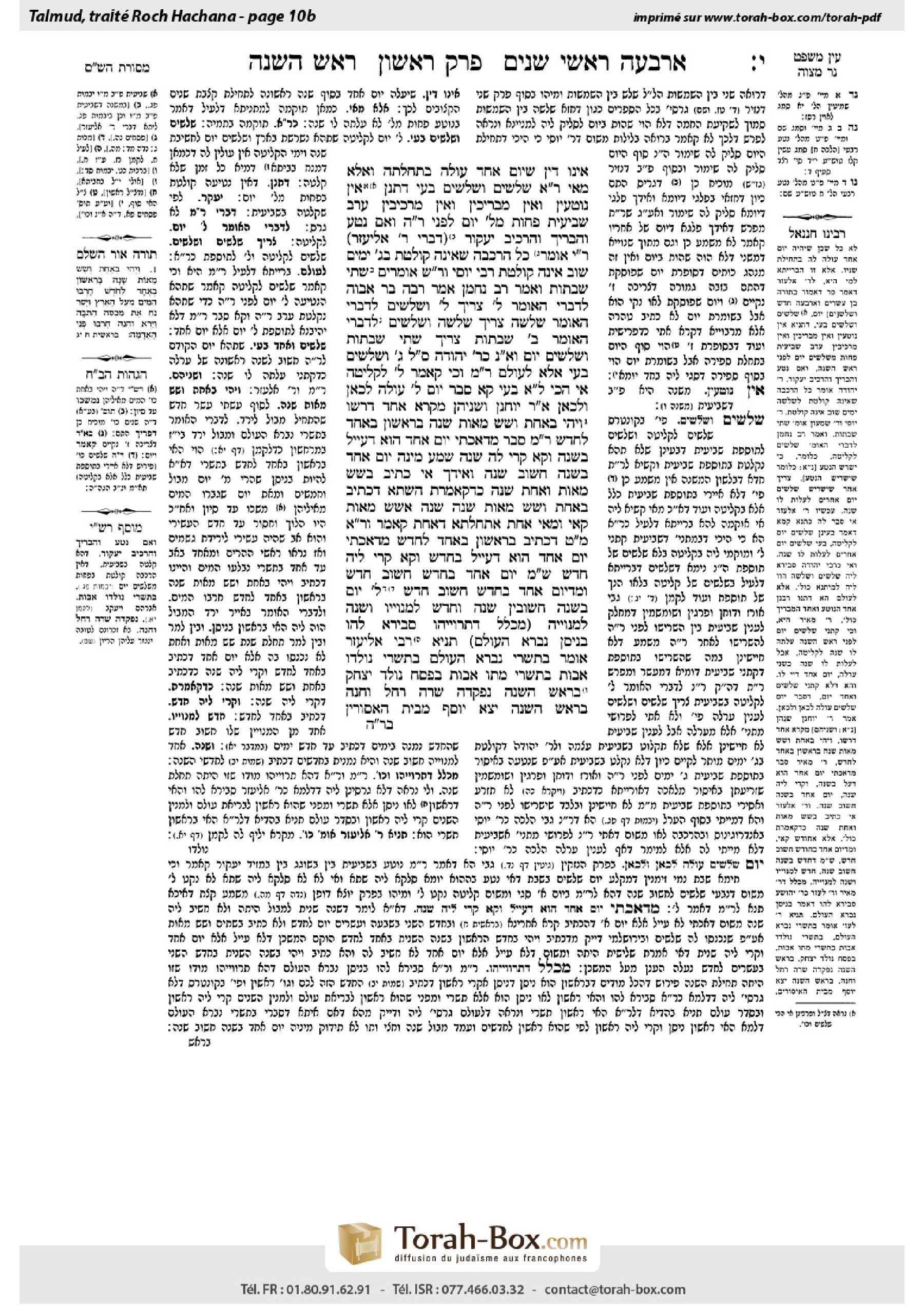
Rosh Hashanah 10b: Talmud study for Daf Yomi
Daf Yomi is the daily study of one Talmud folio. Explore 37 tractates with scans, Hebrew text, Sefaria English and AI-generated French translations where annotated.
Passage selection and English or AI-generated French translation are available where the scan has annotations. Daf Study is independent of Torah-Box and Sefaria.
Browse Rosh Hashanah · ראש השנה · All tractatesRosh Hashanah 10b text and translations
This page of Rosh Hashanah includes the Aramaic text, an English translation and an AI-generated French translation, alongside the scan above.
ראש השנה י׳ ב · Aramaic and Hebrew text
אֵינוֹ דִּין שֶׁיּוֹם אֶחָד עוֹלֶה בִּתְחִלָּתָהּ?
וְאֶלָּא מַאי — רַבִּי אֶלְעָזָר? שְׁלֹשִׁים וּשְׁלֹשִׁים בָּעֵי! דִּתְנַן: אֵין נוֹטְעִין וְאֵין מַבְרִיכִין וְאֵין מַרְכִּיבִין עֶרֶב שְׁבִיעִית פָּחוֹת מִשְּׁלֹשִׁים יוֹם לִפְנֵי רֹאשׁ הַשָּׁנָה, וְאִם נָטַע וְהִבְרִיךְ וְהִרְכִּיב — יַעֲקוֹר, דִּבְרֵי רַבִּי אֶלְעָזָר. רַבִּי יְהוּדָה אוֹמֵר: כׇּל הַרְכָּבָה שֶׁאֵינָהּ קוֹלֶטֶת בִּשְׁלֹשָׁה יָמִים — שׁוּב אֵינָהּ קוֹלֶטֶת. רַבִּי יוֹסֵי וְרַבִּי שִׁמְעוֹן אוֹמְרִים: שְׁתֵּי שַׁבָּתוֹת.
וְאָמַר רַב נַחְמָן אָמַר רַבָּה בַּר אֲבוּהּ: לְדִבְרֵי הָאוֹמֵר שְׁלֹשִׁים — צָרִיךְ שְׁלֹשִׁים וּשְׁלֹשִׁים, לְדִבְרֵי הָאוֹמֵר שְׁלֹשָׁה — צָרִיךְ שְׁלֹשָׁה וּשְׁלֹשִׁים, לְדִבְרֵי הָאוֹמֵר שְׁתֵּי שַׁבָּתוֹת — צָרִיךְ שְׁתֵּי שַׁבָּתוֹת וּשְׁלֹשִׁים יוֹם. וְאִי נָמֵי, כְּרַבִּי יְהוּדָה סְבִירָא לֵיהּ — שְׁלֹשָׁה וּשְׁלֹשִׁים בָּעֵי!
אֶלָּא לְעוֹלָם רַבִּי מֵאִיר, וְכִי קָאָמַר שְׁלֹשִׁים — לִקְלִיטָה.
אִי הָכִי, שְׁלֹשִׁים וְאֶחָד בָּעֵי! קָא סָבַר: יוֹם שְׁלֹשִׁים עוֹלֶה לְכָאן וּלְכָאן.
אָמַר רַבִּי יוֹחָנָן, וּשְׁנֵיהֶן מִקְרָא אֶחָד דָּרְשׁוּ: ״וַיְהִי בְּאַחַת וְשֵׁשׁ מֵאוֹת שָׁנָה בָּרִאשׁוֹן בְּאֶחָד לְחֹדֶשׁ״, רַבִּי מֵאִיר סָבַר: מִדְּאַכַּתִּי יוֹם אֶחָד הוּא דְּעָיֵיל בַּשָּׁנָה וְקָא קָרֵי לַהּ שָׁנָה, שְׁמַע מִינַּהּ: יוֹם אֶחָד בַּשָּׁנָה חָשׁוּב שָׁנָה.
וְאִידַּךְ: אִי כְּתִיב בְּ״שֵׁשׁ מֵאוֹת וְאַחַת שָׁנָה״ — כִּדְקָאָמְרַתְּ. הַשְׁתָּא דִּכְתִיב ״בְּאַחַת וְשֵׁשׁ מֵאוֹת שָׁנָה״, ״שָׁנָה״ אַ״שֵּׁשׁ מֵאוֹת״ קָאֵי. וּמַאי ״אַחַת״ — אַתְחַלְתָּא דְּאַחַת קָאָמַר.
וְרַבִּי אֶלְעָזָר מַאי טַעְמָא? דִּכְתִיב: ״בָּרִאשׁוֹן בְּאֶחָד לַחֹדֶשׁ״, מִדְּאַכַּתִּי יוֹם אֶחָד הוּא דְּעָיֵיל בַּחֹדֶשׁ וְקָא קָרֵי לֵיהּ חֹדֶשׁ — שְׁמַע מִינַּהּ: יוֹם אֶחָד בַּחֹדֶשׁ חָשׁוּב חֹדֶשׁ, וּמִדְּיוֹם אֶחָד בַּחֹדֶשׁ חָשׁוּב חֹדֶשׁ — שְׁלֹשִׁים יוֹם בַּשָּׁנָה חֲשׁוּבִין שָׁנָה. וְחֹדֶשׁ לִמְנוּיָיו, וְשָׁנָה לִמְנוּיֶיהָ.
מִכְּלַל דְּתַרְוַיְיהוּ סְבִירָא לְהוּ בְּנִיסָן נִבְרָא הָעוֹלָם.
תַּנְיָא, רַבִּי אֱלִיעֶזֶר אוֹמֵר: בְּתִשְׁרִי נִבְרָא הָעוֹלָם, בְּתִשְׁרִי נוֹלְדוּ אָבוֹת, בְּתִשְׁרִי מֵתוּ אָבוֹת, בַּפֶּסַח נוֹלַד יִצְחָק, בְּרֹאשׁ הַשָּׁנָה נִפְקְדָה שָׂרָה רָחֵל וְחַנָּה, בְּרֹאשׁ הַשָּׁנָה יָצָא יוֹסֵף מִבֵּית הָאֲסוּרִין.
Rosh Hashanah 10b · English translation
is it not right that one day should count as a full year at the beginning of the year?
Rather, what opinion does it follow? If the baraita was not taught in accordance with the opinion of Rabbi Meir, does it follow the opinion of Rabbi Elazar, who holds that only thirty days are considered like a year? If so, then thirty days and another thirty days are required: Thirty days for the planting to take root, and another thirty days to count as a year. As we learned in a mishna: One may not plant, layer, or graft trees on the eve of the Sabbatical Year less than thirty days before Rosh HaShana, and if one planted, layered, or grafted, he must uproot it, as the planting will take root only in the seventh year; this is the statement of Rabbi Elazar. Rabbi Yehuda says: Any grafting that does not take root within three days will never take root. Rabbi Yosei and Rabbi Shimon say: Two weeks are needed for the planting to take root.
And on this topic Rav Naḥman said that Rabba bar Avuh said: According to the statement of the one who says thirty days, this means that it requires thirty days for the planting to take root and another thirty days to count as a year. And according to the statement of the one who says three days, this means that it requires thirty-three days. And according to the statement of the one who says two weeks, this means that it requires two weeks for the planting to take root and another thirty days to count as a year. And if the tanna of the mishna holds in accordance with the opinion of Rabbi Yehuda that only three days are needed for the planting to take root, it still requires three days for the planting to take root and thirty days to count as a year. If so, the baraita cannot be understood even in accordance with the opinion of Rabbi Elazar.
Rather, it must be understood as follows: The baraita was actually taught in accordance with the opinion of Rabbi Meir, and when it says thirty days, it is referring to the time needed for the planting to take root.
The Gemara raises a difficulty: If so, it requires thirty-one days; thirty days for the planting to take root and one more day to count as a year. The Gemara answers: This is theoretically correct, but he holds that the thirtieth day is counted for here and for there, i.e., it counts as both the thirtieth day for taking root and as a day that is counted as a year.
Rabbi Yoḥanan said: And both of them, Rabbi Meir and Rabbi Elazar, who disagree about how much time must pass to count as a year, expounded the same verse. As the verse states: “And it came to pass in the one and six hundredth year, in the first month on the first day of the month, that the waters were dried up from off the earth” (Genesis 8:13). Rabbi Meir holds: From the fact that it was only one day into the year, as it was still the first day of the first month, and yet it is called the six hundred and first year, learn from here that one day in a year is already considered a year.
And the other tanna, Rabbi Elazar, expounds the verse as follows. If it had written: In the six hundred and first year, it would be as you said. However, now that it is written: “In the one and six hundredth year," I can say that the word “year” relates to “six hundredth,” thereby teaching that it is still considered the six hundredth year. And what is meant by “one”? That it is the beginning of one year, but not that the first day counts as a year.
The Gemara asks: And with regard to Rabbi Elazar, what is the rationale for his opinion? From where does he learn that thirty days are counted as a year? As it is written: “In the first month on the first day of the month.” Since it was only one day into the month, and yet it is called a month, learn from here that one day in a month is already considered a month. And since one day in a month is already considered a month, likewise thirty days in a year are already considered a year, as a month is calculated according to its unit, and a year is calculated according to its unit. If one unit by which a month is calculated, i.e., a day, counts as a full month, so too, one unit by which a year is calculated, i.e., a month, counts as a full year.
§ The Gemara comments: By inference, both of them, Rabbi Meir and Rabbi Elazar, hold that the world was created in Nisan and that the years are counted from that month, as, if the world were created in Tishrei and the count started then, the first day of the first month of the six hundred and first year would already have been six months into the year for the purpose of counting years.
It is taught in a baraita that the tanna’im disagreed about this point: Rabbi Eliezer says: In Tishrei the world was created; in Tishrei the Patriarchs were born; in Tishrei the Patriarchs died; on Passover Isaac was born; on Rosh HaShana Sarah, Rachel, and Hannah were remembered by God and conceived; on Rosh HaShana Joseph came out from prison;
Rosh Hashanah 10b · Traduction française (IA)
N’est-il pas juste qu’un seul jour au début de l’année soit considéré comme une année entière ?
Mais alors, quelle opinion suit-elle ? Si la baraïta n’a pas été enseignée conformément à l’opinion de Rabbi Meïr, suit-elle celle de Rabbi Elazar, qui considère que seuls trente jours sont assimilés à une année ? Dans ce cas, il faut trente jours, puis trente autres jours : trente jours pour que la plantation prenne racine, et trente autres jours pour compter comme une année. Comme nous l’avons appris dans une Michna : On ne peut pas planter, marcotter ou greffer des arbres à la veille de l’année sabbatique, moins de trente jours avant Roch Hachana ; si l’on a planté, marcotté ou greffé, il faut arracher l’arbre, car la plantation ne prendra racine que pendant la septième année. Telle est la déclaration de Rabbi Elazar. Rabbi Yehouda dit : Toute greffe qui ne prend pas racine en trois jours ne prendra jamais racine. Rabbi Yossi et Rabbi Chimon disent : Il faut deux semaines pour que la plantation prenne racine.
À ce sujet, Rav Naḥman a dit au nom de Rabba bar Avouha : Selon celui qui dit trente jours, il faut trente jours pour que la plantation prenne racine, puis trente autres jours pour compter comme une année. Selon celui qui dit trois jours, il faut trente-trois jours. Et selon celui qui dit deux semaines, il faut deux semaines pour que la plantation prenne racine, puis trente autres jours pour compter comme une année. Et si le tanna de la Michna suit l’opinion de Rabbi Yehouda, selon laquelle trois jours suffisent pour que la plantation prenne racine, il faut malgré tout trois jours pour qu’elle prenne racine, puis trente jours pour compter comme une année. Dès lors, on ne peut même pas comprendre la baraïta conformément à l’opinion de Rabbi Elazar.
Il faut plutôt comprendre ainsi : la baraïta a bien été enseignée conformément à l’opinion de Rabbi Meïr, et les trente jours qu’elle mentionne correspondent au temps nécessaire pour que la plantation prenne racine.
La Guemara soulève une difficulté : dans ce cas, il faut trente et un jours : trente jours pour que la plantation prenne racine, puis un jour supplémentaire pour compter comme une année. La Guemara répond : En théorie, c’est exact, mais il considère que le trentième jour compte à la fois ici et là, c’est-à-dire qu’il compte à la fois comme le trentième jour nécessaire à la prise de racine et comme un jour comptant pour une année.
Rabbi Yoḥanan a dit : Rabbi Meïr et Rabbi Elazar, qui sont en désaccord sur le temps qui doit s’écouler pour compter comme une année, ont tous deux interprété le même verset. Car il est dit : « Et il arriva, en l’an six cent un, au premier mois, le premier jour du mois, que les eaux avaient séché sur la terre » (Genèse 8,13). Rabbi Meïr considère : Puisqu’un seul jour de l’année s’était écoulé — car on était encore le premier jour du premier mois — et que pourtant cette année est appelée la six cent unième année, apprends de là qu’un seul jour dans une année est déjà considéré comme une année.
L’autre tanna, Rabbi Elazar, interprète le verset ainsi : S’il était écrit « la six cent unième année », ce serait comme tu l’as dit. Mais puisqu’il est écrit « en l’an six cent un », je peux dire que le mot « année » se rapporte à « six cent », ce qui enseigne que cette année est encore considérée comme la six centième. Et que signifie le mot « un » ? Qu’il s’agit du début d’une année, mais non que le premier jour compte comme une année.
La Guemara demande : Et pour Rabbi Elazar, quel est le fondement de son opinion ? D’où apprend-il que trente jours comptent comme une année ? Car il est écrit : « Au premier mois, le premier jour du mois. » Puisqu’un seul jour du mois s’était écoulé et que pourtant il est appelé un mois, apprends de là qu’un seul jour dans un mois est déjà considéré comme un mois. Et puisqu’un seul jour dans un mois est déjà considéré comme un mois, de même, trente jours dans une année sont déjà considérés comme une année, car un mois se compte selon son unité et une année selon la sienne. Si une unité selon laquelle un mois est compté, c’est-à-dire un jour, compte comme un mois entier, de même, une unité selon laquelle une année est comptée, c’est-à-dire un mois, compte comme une année entière.
§ La Guemara fait remarquer : Il s’ensuit que Rabbi Meïr et Rabbi Elazar considèrent tous deux que le monde a été créé en Nissan et que les années sont comptées à partir de ce mois. En effet, si le monde avait été créé en Tichri et que le décompte avait commencé alors, le premier jour du premier mois de la six cent unième année serait déjà survenu six mois après le début de l’année, pour le calcul des années.
Une baraïta enseigne que les tannaïm sont en désaccord sur ce point : Rabbi Eliezer dit : Le monde a été créé en Tichri ; les Patriarches sont nés en Tichri ; les Patriarches sont morts en Tichri ; Isaac est né à Pessaḥ ; à Roch Hachana, Sarah, Rachel et Hannah ont été évoquées par Dieu et ont conçu ; à Roch Hachana, Joseph est sorti de prison ;
Traduction française générée par IA à partir de l’édition anglaise de Sefaria. Vérifie toujours un passage avec le texte source.
Text from Sefaria: William Davidson Edition - Vocalized Aramaic (CC BY NC); William Davidson Edition - English (CC BY NC).